Radioimmuno Assay
Presented by : Azad Rawat
Radioimmunoassay
• Radioimmunoassay (RIA) is a very
sensitive in vitro assay technique used to
measure concentrations of antigens (for
example, hormone levels in the blood) by
use of antibodies.
• RIA technique is extremely sensitive and
extremely specific, requiring specialized
equipment, it remains the least expensive
method to perform such tests
• The technique was introduced in 1960 by
berson and yalow as an assay for the
concentration of insulin in plasma.
• It represented the first time that hormone
levels in the blood could be detected by an
in vitro assay.
• The technique of radioimmunoassay has
revolutionized research and clinical practice
in many areas, e.G.,
• Blood banking
• Diagnosis of allergies
• Endocrinology
Method
• To perform a radioimmunoassay, a known
quantity of an antigen is made radioactive,
frequently by labeling it with gamma-
radioactive isotopes of iodine attached to
tyrosine (hot).
• This radiolabeled antigen is then mixed with
a known amount of antibody for that
antigen, and as a result, the two specifically
bind to one another
• Then, a sample of serum from a patient
containing an unknown quantity of that
same antigen is added.
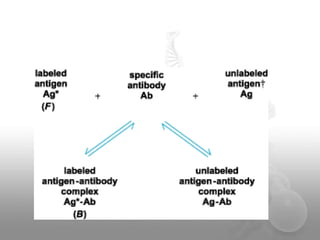
• This causes the unlabeled (or "cold")
antigen from the serum to compete with the
radiolabeled antigen ("hot") for antibody
binding sites.
•Principle :
• The technique is based on the ability of an
unlabelled form of the substance to inhibit
competitively the binding of a radioactively
labelled substance by specific antibodies.
The principle of RIA
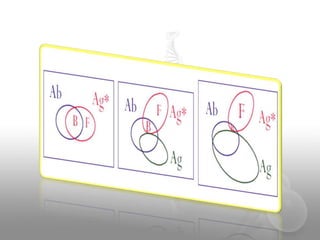
• The amount of Ab per tube is kept
constant, the amount of antigen added
(known or unknown) is the variable
parameter.
• The added antigen will be distributed
between a bound (B) and a free (F)
fraction. This distribution is governed by the
association constant (KA) of the Ab:
Ab + Ag 􀁺 AgAb and K = [AbAg]
/[Ab][Ag]
• Conclusion: If total Ab input is kept
constant, the value of B/F is a measure
for the total Ag input
Requirements for the development
of an RIA
1. Pure antigen : for - standards (μg),
- Tracer production (tens of μg)
- Ab production (hundreds of μg)
2. Tracer : self-made or commercial.
3. Specific, high-affinity antibody : self-
made or commercial.
4. A method to separate bound and free
antigen.
5. (Optional) : A system to extract the
antigen from the sample.
USES
Radioimmunoassay is widely-used because
of its great sensitivity.
The greater the specificity of the antiserum,
the greater the specificity of the assay.
Advantages & Disadvantages of RIA
• Advantages
• Highly specific: Immune reactions are specific
• High sensitivity : Immune reactions are sensitive
• Possible to detect picograms of Ag
• Sepharose beads used in RIA are reuseable
Disadvantages
• Radiation hazards: Uses radio labelled reagents
• Requires specially trained persons
• Labs require special license to handle radioactive
material
• Requires special arrangements for
• Requisition
• storage of radioactive material
• radioactive waste disposal.
Applications of RIA
 Analysis of hormones, vitamins,metabolites,
diagnostic markers
◦ Eg. ACTH, FSH, T3, T4, Glucagon, Insulin,
Testosterone, vitamin B12, prostaglandins,
glucocorticoids,
Therapeutic drug monitoring:
◦ Barbiturates, morphine, digoxin,
 Diagnostic procedures for detecting infection
◦ HIV, Hepatitis A, B etc
azad ria

azad ria

  • 1.
  • 2.
    Radioimmunoassay • Radioimmunoassay (RIA)is a very sensitive in vitro assay technique used to measure concentrations of antigens (for example, hormone levels in the blood) by use of antibodies.
  • 3.
    • RIA techniqueis extremely sensitive and extremely specific, requiring specialized equipment, it remains the least expensive method to perform such tests
  • 4.
    • The techniquewas introduced in 1960 by berson and yalow as an assay for the concentration of insulin in plasma. • It represented the first time that hormone levels in the blood could be detected by an in vitro assay.
  • 5.
    • The techniqueof radioimmunoassay has revolutionized research and clinical practice in many areas, e.G., • Blood banking • Diagnosis of allergies • Endocrinology
  • 6.
    Method • To performa radioimmunoassay, a known quantity of an antigen is made radioactive, frequently by labeling it with gamma- radioactive isotopes of iodine attached to tyrosine (hot). • This radiolabeled antigen is then mixed with a known amount of antibody for that antigen, and as a result, the two specifically bind to one another
  • 7.
    • Then, asample of serum from a patient containing an unknown quantity of that same antigen is added. • This causes the unlabeled (or "cold") antigen from the serum to compete with the radiolabeled antigen ("hot") for antibody binding sites.
  • 8.
    •Principle : • Thetechnique is based on the ability of an unlabelled form of the substance to inhibit competitively the binding of a radioactively labelled substance by specific antibodies.
  • 9.
    The principle ofRIA • The amount of Ab per tube is kept constant, the amount of antigen added (known or unknown) is the variable parameter. • The added antigen will be distributed between a bound (B) and a free (F) fraction. This distribution is governed by the association constant (KA) of the Ab: Ab + Ag 􀁺 AgAb and K = [AbAg] /[Ab][Ag]
  • 10.
    • Conclusion: Iftotal Ab input is kept constant, the value of B/F is a measure for the total Ag input
  • 13.
    Requirements for thedevelopment of an RIA 1. Pure antigen : for - standards (μg), - Tracer production (tens of μg) - Ab production (hundreds of μg)
  • 14.
    2. Tracer :self-made or commercial. 3. Specific, high-affinity antibody : self- made or commercial. 4. A method to separate bound and free antigen. 5. (Optional) : A system to extract the antigen from the sample.
  • 15.
    USES Radioimmunoassay is widely-usedbecause of its great sensitivity. The greater the specificity of the antiserum, the greater the specificity of the assay.
  • 16.
    Advantages & Disadvantagesof RIA • Advantages • Highly specific: Immune reactions are specific • High sensitivity : Immune reactions are sensitive • Possible to detect picograms of Ag • Sepharose beads used in RIA are reuseable
  • 17.
    Disadvantages • Radiation hazards:Uses radio labelled reagents • Requires specially trained persons • Labs require special license to handle radioactive material • Requires special arrangements for • Requisition • storage of radioactive material • radioactive waste disposal.
  • 18.
    Applications of RIA Analysis of hormones, vitamins,metabolites, diagnostic markers ◦ Eg. ACTH, FSH, T3, T4, Glucagon, Insulin, Testosterone, vitamin B12, prostaglandins, glucocorticoids, Therapeutic drug monitoring: ◦ Barbiturates, morphine, digoxin,  Diagnostic procedures for detecting infection ◦ HIV, Hepatitis A, B etc