Dr Taj Khan
Dept. of Pharmaceutical Chemistry, OCP, Sanpada.
Radiopharmaceuticals (nuclear
medicine)
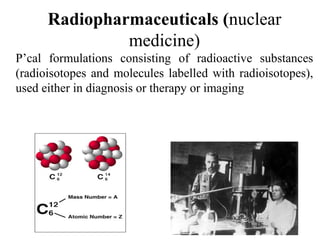
P’cal formulations consisting of radioactive substances
(radioisotopes and molecules labelled with radioisotopes),
used either in diagnosis or therapy or imaging
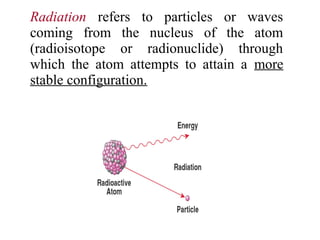
Radiation refers to particles or waves
coming from the nucleus of the atom
(radioisotope or radionuclide) through
which the atom attempts to attain a more
stable configuration.
Isotopes of an element are nuclides with the same atomic number ‘Z’ but
different mass numbers ‘A’
Radionuclide: Nuclides containing an unstable arrangement of protons
Radioactivity: The phenomenon of emission of radiation owing to the
spontaneous transformation or disintegration of the radionuclide and
neutrons
Units of Radioactivity: In the International System (SI), the unit of
radioactivity is one nuclear transmutation per second and is expressed in
Becquerel (Bq), named after the scientist Henri Bequerel.
The old unit of radioactivity was Curie (Ci), named after the scientists
Madame Marie Curie and Pierre Curie, the pioneers who studied the
phenomenon of radioactivity.
One Ci is the number of disintegrations emanating from 1 g of Ra226
, and is
equal to 3.7 x 10¹⁰
Bq.
Difft no of neutron
• Half-Life Period: The time in which a given
quantity of a radionuclide decays to half its initial
value (T1/2).
• Radionuclide generator: Any system or device
incorporating a fixed parent radionuclide from
which is produced a daughter radionuclide is
extracted by elution or by any other method. e.g.,
the most widely used radionuclide generator in
radiopharmacy is 99Mo-99mTc generator.
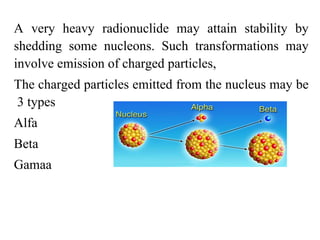
A very heavy radionuclide may attain stability by
shedding some nucleons. Such transformations may
involve emission of charged particles,
The charged particles emitted from the nucleus may be
3 types
Alfa
Beta
Gamaa
α particles
(He nucleus of mass number 4)
Radioactive nuclei having too many nucleons (n
and p) often undergo α decay, in order to
achieve nuclear stability. α particle has a mass of
4 units and a charge of +2 units, and is therefore,
equivalent to helium +2
ion. α particles are
relatively slow and heavy and have a low
penetrating power.
Have a large charge, so α particles ionize other
atoms strongly.
Beta (β) particles: Negatrons
-vely charged
Nuclei having neutrons in excess than what is needed for a
stable configuration mostly undergo β- decay, in order to
achieve nuclear stability.
β particles have a charge of -1. (Same as e)
Atomic mass is unchanged the atomic number or by 1.
They are fast, and light. medium penetrating power.
Can ionize atoms but wkr than α
Gamma (γ) rays:
Energetic photons of electromagnetic radiation and no charge or
mass. electromagnetic rays coming out of nucleus as a result of
the difference in nuclear energy levels of the excited and the
ground states of the daughter nuclide when a nuclear
transmutation takes place.
Energy greater than those of X-rays.
waves, not particles.
Gamma rays have a high penetrating power
Gamma rays do not directly ionize other atoms, although they
may cause atoms to emit other particles which will then cause
ionization.
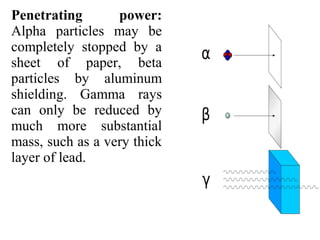
Penetrating power:
Alpha particles may be
completely stopped by a
sheet of paper, beta
particles by aluminum
shielding. Gamma rays
can only be reduced by
much more substantial
mass, such as a very thick
layer of lead.
Radioactive decay
At an exponential rate with a particular decay constant which is a
characteristic of each radionuclide.
The exponential decay (decay curve) is described by the equation:
At = Ao e-λt
At = the radioactivity at time t,
Ao = the radioactivity at time t = 0,
λ = the decay constant characteristic of each radionuclide,
e = the base of Napierian logarithms.
The half-life (T1/2) is related to the decay constant (λ) by the equation:
T1/2 = 0.693/ λ
The radionuclide is generally identified by its half-life or by the nature and
energy of radiation or radiations emitted as prescribed in the monograph.
The T1/2 is measured with a suitable detection apparatus detector such as
ionisation chamber, Geiger-Müller counter, scintillation counter (solid crystal
or liquid) or a semiconductor detector.
1) Treatment of disease:
They are radiolabeled molecules designed to deliver
therapeutic doses of ionizing radiation to specific
diseased sites. e.g. cancer
2) As an aid in the diagnosis of disease:
The radiopharmaceutical accumulated in an organ of interest
emit gamma radiation which are used for imaging of the
organs with the help of an external imaging device called
gamma camera
Chromium 51 (51
Cr)
Radioactive isotope of chromium having a T1/2 27.7 &
decaying by electron capture,
emitting gamma rays. It is used to label RBCs for measur
ement of red cell mass or volume, survival time, &sequest
ration studies, and for the diagnosis of GIT bleeding, & is
used to label platelets to study their survival.
RBC tagging agent for the determination of red cell
survival
To quantify gastro- intestinal protein loss.
Iodine - 125
• Chemical Symbol: 125
I
• Half-life:   59.4 days
• Diagnostic use: Indicated for use in the determination of:
                  • Total blood
                  • Plasma volume
                    evaluation of glomerular filtration
                 • Total blood and plasma volumes
                  • Cardiac output
                  • Cardiac and pulmonary blood volumes and circulation times
                  • Protein turnover studies
                  • Heart and great vessel delineation
                  • Localization of the placenta
                  • Localization of cerebral neoplasm
• Performance of the radioactive iodide 
(RAI) uptake test to evaluate thyroid 
function
   • Localizing thyroid malignancies
      Therapeutic:
    • Treatment of hyperthyroidism
     • Treatment of carcinoma of the    
             thyroid
CO-60 and C0-57
Cobalt-60 (10.5 mth): used for external beam radiotherapy.
Cobalt-57 (272 d): Used as a marker to estimate organ size and 
for in-vitro diagnostic kits.
CO-60
 Abs & meta of Vit B12 1 Micro curie oral or im 
route
GFR of kidney functioning
Matallic wire/ seeds implanted into body cavities 
– Treatment of advance cancer of  cervix, mouth 
vagina, uterus & bladder
Iron-59
Iron-59 (46 d): Irradiation of Fe 58 Beta & Gamma
Used in studies of iron metabolism in the spleen.
Ferric citrate Fe-59 inection –diagnosis of 
haematological disorders related to Fe metabolism & 
RBC formation dose 5-50 micro curie
Gold 198
Gold-198 is currently one of the limited treatments for 
cancer.  This  isotope  can  cure  prostate, cervix, and 
bladder cancer. 
Rheumatoid arthritis. "disodium aurothiomalate" which 
is an injection used to treat the disease. The isotope has 
also other medical uses as imaging and scanning body 
parts  for  diagnostic  use. 
SE: radiation sickness. 
Technetium-99m
• Diagnostic use:
• Diagnosis of acute cholecystitis 
• As a hepatobiliary imaging agent
• As an adjunct in the detection of altered regional cerebral perfusion 
in stroke.
• Leukocyte labeled scintigraphy as an adjunct in the localization of 
intra abdominal infection and inflammatory bowel disease.
An adjunct in the evaluation of pulmonary perfusion (adult and 
pediatric)
Technetium-99m
• As a bone imaging agent to delineate areas of altered osteogenesis.
• In patients > 30 days of age as a renal imaging agent for use in the
diagnosis of:
• Congenital and acquired abnormalities
• Renal failure
• Urinary tract obstruction and calculi
• Diagnostic aid in providing:
• Renal function
• Renal angiograms
• Renogram curves for whole kidney and renal cortex
• As a bone imaging agent to delineate areas of altered osteogenesis
(adult and pediatric use)
Technetium-99m
• • Brain imaging
• Kidney imaging:
- To assess renal perfusion
- To estimate glomerular filtration rate
• As a bone imaging agent to delineate areas of altered osteogenesis
• As a cardiac imaging agent used as an adjunct in the diagnosis of
acute
myocardial infarction
• As a blood pool imaging agent useful for:
- Gated blood pool imaging
- Detection of sites of gastrointestinal bleeding
Technetium-99m
®
•Diagnostic use: Myocardial perfusion agent that is indicated for:
•Detecting coronary artery disease by localizing myocardial ischemia
(reversible defects) and infarction (non-reversible defects)
•Evaluating myocardial function
•Developing information for use in patient management decisions
•Planar breast imaging as a second line diagnostic drug after
mammography to assist in the evaluation of breast lesions in patients
with an abnormal mammogram or a palpable breast mass
Technetium-99m
• Diagnostic use: • Brain Imaging (including cerebral radionuclide
angiography)*
• Thyroid Imaging*
• Salivary Gland Imaging
• Placenta Localization
• Blood Pool Imaging (including radionuclide angiography)*
• Urinary Bladder Imaging (direct isotopic cystography) for the
detection of vesico-ureteral reflux*
• Nasolacrimal Drainage System Imaging (*adult and pediatric use)
Technetium-99m
• Diagnostic use: Indicated for lymphatic mapping with a hand-held
gamma counter to assist in the localization of lymph nodes draining
a primary tumor site in patients with breast cancer or melanoma.
• Myocardial perfusion agent that is indicated for:
• Detecting coronary artery disease by localizing myocardial ischemia
(reversible defects) and infarction (non-reversible defects)
• The assessment of left ventricular function (left ventricular ejection
fraction and wall motion)
• Imaging areas of functioning retriculoendothelial cells in the liver,
spleen and bone marrow*
• It is used orally for:
- Esophageal transit studies*
- Gastroesophageal reflux scintigraphy*
- Detection of pulmonary aspiration of gastric contents*
The effect of radioactive radiations on biological tissue
depends on:
1) Penetration ability
2)Energy of radiation
3)Nature of tissue
4) Surface area exposed
Destructive ability is directly related to its interaction with
molecules present in the tissue to form abnormal amt of
ions & or free radicals. these chem species can alter the
local pH or serve to initiate free radical chain rxns, this
results in production of peroxide & other toxic compounds.
This leads to hostile environment for tissue which leads to
necrosis & then tissue /organ destruction Since H2O is
most abundant in body radiation reacts with it give free
radical of H and OH which produce H2 and H2O2
• Radiation can cause immediate effects (radiation sickness), but also
long term effects which may occur many years (cancer) or several
generations later (genetic effects).
• Biological effects of radiation result from both direct and indirect
action of radiation
• Direct action is based on direct interaction between radiation
particles and complex body cell molecules, (for example direct
break-up of DNA molecules)
• Indirect action is more complex and depends heavily on the energy
loss effects of radiation in the body tissue and the subsequent
chemistry.
• Resulting biological damage depends on the kind of alteration and
can cause cancer or long-term genetic alterations.
• OH radical attacks DNA-molecule.

Radiopharmaceuticals

  • 1.
    Dr Taj Khan Dept.of Pharmaceutical Chemistry, OCP, Sanpada.
  • 2.
    Radiopharmaceuticals (nuclear medicine) P’cal formulationsconsisting of radioactive substances (radioisotopes and molecules labelled with radioisotopes), used either in diagnosis or therapy or imaging
  • 3.
    Radiation refers toparticles or waves coming from the nucleus of the atom (radioisotope or radionuclide) through which the atom attempts to attain a more stable configuration.
  • 4.
    Isotopes of anelement are nuclides with the same atomic number ‘Z’ but different mass numbers ‘A’ Radionuclide: Nuclides containing an unstable arrangement of protons Radioactivity: The phenomenon of emission of radiation owing to the spontaneous transformation or disintegration of the radionuclide and neutrons Units of Radioactivity: In the International System (SI), the unit of radioactivity is one nuclear transmutation per second and is expressed in Becquerel (Bq), named after the scientist Henri Bequerel. The old unit of radioactivity was Curie (Ci), named after the scientists Madame Marie Curie and Pierre Curie, the pioneers who studied the phenomenon of radioactivity. One Ci is the number of disintegrations emanating from 1 g of Ra226 , and is equal to 3.7 x 10¹⁰ Bq. Difft no of neutron
  • 5.
    • Half-Life Period:The time in which a given quantity of a radionuclide decays to half its initial value (T1/2). • Radionuclide generator: Any system or device incorporating a fixed parent radionuclide from which is produced a daughter radionuclide is extracted by elution or by any other method. e.g., the most widely used radionuclide generator in radiopharmacy is 99Mo-99mTc generator.
  • 6.
    A very heavyradionuclide may attain stability by shedding some nucleons. Such transformations may involve emission of charged particles, The charged particles emitted from the nucleus may be 3 types Alfa Beta Gamaa
  • 7.
    α particles (He nucleusof mass number 4) Radioactive nuclei having too many nucleons (n and p) often undergo α decay, in order to achieve nuclear stability. α particle has a mass of 4 units and a charge of +2 units, and is therefore, equivalent to helium +2 ion. α particles are relatively slow and heavy and have a low penetrating power. Have a large charge, so α particles ionize other atoms strongly.
  • 8.
    Beta (β) particles:Negatrons -vely charged Nuclei having neutrons in excess than what is needed for a stable configuration mostly undergo β- decay, in order to achieve nuclear stability. β particles have a charge of -1. (Same as e) Atomic mass is unchanged the atomic number or by 1. They are fast, and light. medium penetrating power. Can ionize atoms but wkr than α
  • 9.
    Gamma (γ) rays: Energeticphotons of electromagnetic radiation and no charge or mass. electromagnetic rays coming out of nucleus as a result of the difference in nuclear energy levels of the excited and the ground states of the daughter nuclide when a nuclear transmutation takes place. Energy greater than those of X-rays. waves, not particles. Gamma rays have a high penetrating power Gamma rays do not directly ionize other atoms, although they may cause atoms to emit other particles which will then cause ionization.
  • 11.
    Penetrating power: Alpha particlesmay be completely stopped by a sheet of paper, beta particles by aluminum shielding. Gamma rays can only be reduced by much more substantial mass, such as a very thick layer of lead.
  • 12.
    Radioactive decay At anexponential rate with a particular decay constant which is a characteristic of each radionuclide. The exponential decay (decay curve) is described by the equation: At = Ao e-λt At = the radioactivity at time t, Ao = the radioactivity at time t = 0, λ = the decay constant characteristic of each radionuclide, e = the base of Napierian logarithms. The half-life (T1/2) is related to the decay constant (λ) by the equation: T1/2 = 0.693/ λ The radionuclide is generally identified by its half-life or by the nature and energy of radiation or radiations emitted as prescribed in the monograph. The T1/2 is measured with a suitable detection apparatus detector such as ionisation chamber, Geiger-Müller counter, scintillation counter (solid crystal or liquid) or a semiconductor detector.
  • 13.
    1) Treatment ofdisease: They are radiolabeled molecules designed to deliver therapeutic doses of ionizing radiation to specific diseased sites. e.g. cancer 2) As an aid in the diagnosis of disease: The radiopharmaceutical accumulated in an organ of interest emit gamma radiation which are used for imaging of the organs with the help of an external imaging device called gamma camera
  • 14.
    Chromium 51 (51 Cr) Radioactive isotope ofchromium having a T1/2 27.7 & decaying by electron capture, emitting gamma rays. It is used to label RBCs for measur ement of red cell mass or volume, survival time, &sequest ration studies, and for the diagnosis of GIT bleeding, & is used to label platelets to study their survival. RBC tagging agent for the determination of red cell survival To quantify gastro- intestinal protein loss.
  • 15.
    Iodine - 125 •Chemical Symbol: 125 I • Half-life:   59.4 days • Diagnostic use: Indicated for use in the determination of:                   • Total blood                   • Plasma volume                     evaluation of glomerular filtration                  • Total blood and plasma volumes                   • Cardiac output                   • Cardiac and pulmonary blood volumes and circulation times                   • Protein turnover studies                   • Heart and great vessel delineation                   • Localization of the placenta                   • Localization of cerebral neoplasm
  • 16.
  • 17.
  • 18.
  • 19.
  • 20.
    Gold 198 Gold-198 is currently one of the limited treatments for  cancer.  This isotope  can  cure  prostate, cervix, and  bladder cancer.  Rheumatoid arthritis. "disodium aurothiomalate" which  is an injection used to treat the disease. The isotope has  also other medical uses as imaging and scanning body  parts  for  diagnostic  use.  SE: radiation sickness. 
  • 21.
    Technetium-99m • Diagnostic use: •Diagnosis of acute cholecystitis  • As a hepatobiliary imaging agent • As an adjunct in the detection of altered regional cerebral perfusion  in stroke. • Leukocyte labeled scintigraphy as an adjunct in the localization of  intra abdominal infection and inflammatory bowel disease. An adjunct in the evaluation of pulmonary perfusion (adult and  pediatric)
  • 22.
    Technetium-99m • As abone imaging agent to delineate areas of altered osteogenesis. • In patients > 30 days of age as a renal imaging agent for use in the diagnosis of: • Congenital and acquired abnormalities • Renal failure • Urinary tract obstruction and calculi • Diagnostic aid in providing: • Renal function • Renal angiograms • Renogram curves for whole kidney and renal cortex • As a bone imaging agent to delineate areas of altered osteogenesis (adult and pediatric use)
  • 23.
    Technetium-99m • • Brainimaging • Kidney imaging: - To assess renal perfusion - To estimate glomerular filtration rate • As a bone imaging agent to delineate areas of altered osteogenesis • As a cardiac imaging agent used as an adjunct in the diagnosis of acute myocardial infarction • As a blood pool imaging agent useful for: - Gated blood pool imaging - Detection of sites of gastrointestinal bleeding
  • 24.
    Technetium-99m ® •Diagnostic use: Myocardialperfusion agent that is indicated for: •Detecting coronary artery disease by localizing myocardial ischemia (reversible defects) and infarction (non-reversible defects) •Evaluating myocardial function •Developing information for use in patient management decisions •Planar breast imaging as a second line diagnostic drug after mammography to assist in the evaluation of breast lesions in patients with an abnormal mammogram or a palpable breast mass
  • 25.
    Technetium-99m • Diagnostic use:• Brain Imaging (including cerebral radionuclide angiography)* • Thyroid Imaging* • Salivary Gland Imaging • Placenta Localization • Blood Pool Imaging (including radionuclide angiography)* • Urinary Bladder Imaging (direct isotopic cystography) for the detection of vesico-ureteral reflux* • Nasolacrimal Drainage System Imaging (*adult and pediatric use)
  • 26.
    Technetium-99m • Diagnostic use:Indicated for lymphatic mapping with a hand-held gamma counter to assist in the localization of lymph nodes draining a primary tumor site in patients with breast cancer or melanoma. • Myocardial perfusion agent that is indicated for: • Detecting coronary artery disease by localizing myocardial ischemia (reversible defects) and infarction (non-reversible defects) • The assessment of left ventricular function (left ventricular ejection fraction and wall motion) • Imaging areas of functioning retriculoendothelial cells in the liver, spleen and bone marrow* • It is used orally for: - Esophageal transit studies* - Gastroesophageal reflux scintigraphy* - Detection of pulmonary aspiration of gastric contents*
  • 27.
    The effect ofradioactive radiations on biological tissue depends on: 1) Penetration ability 2)Energy of radiation 3)Nature of tissue 4) Surface area exposed Destructive ability is directly related to its interaction with molecules present in the tissue to form abnormal amt of ions & or free radicals. these chem species can alter the local pH or serve to initiate free radical chain rxns, this results in production of peroxide & other toxic compounds. This leads to hostile environment for tissue which leads to necrosis & then tissue /organ destruction Since H2O is most abundant in body radiation reacts with it give free radical of H and OH which produce H2 and H2O2
  • 28.
    • Radiation cancause immediate effects (radiation sickness), but also long term effects which may occur many years (cancer) or several generations later (genetic effects). • Biological effects of radiation result from both direct and indirect action of radiation • Direct action is based on direct interaction between radiation particles and complex body cell molecules, (for example direct break-up of DNA molecules) • Indirect action is more complex and depends heavily on the energy loss effects of radiation in the body tissue and the subsequent chemistry. • Resulting biological damage depends on the kind of alteration and can cause cancer or long-term genetic alterations. • OH radical attacks DNA-molecule.