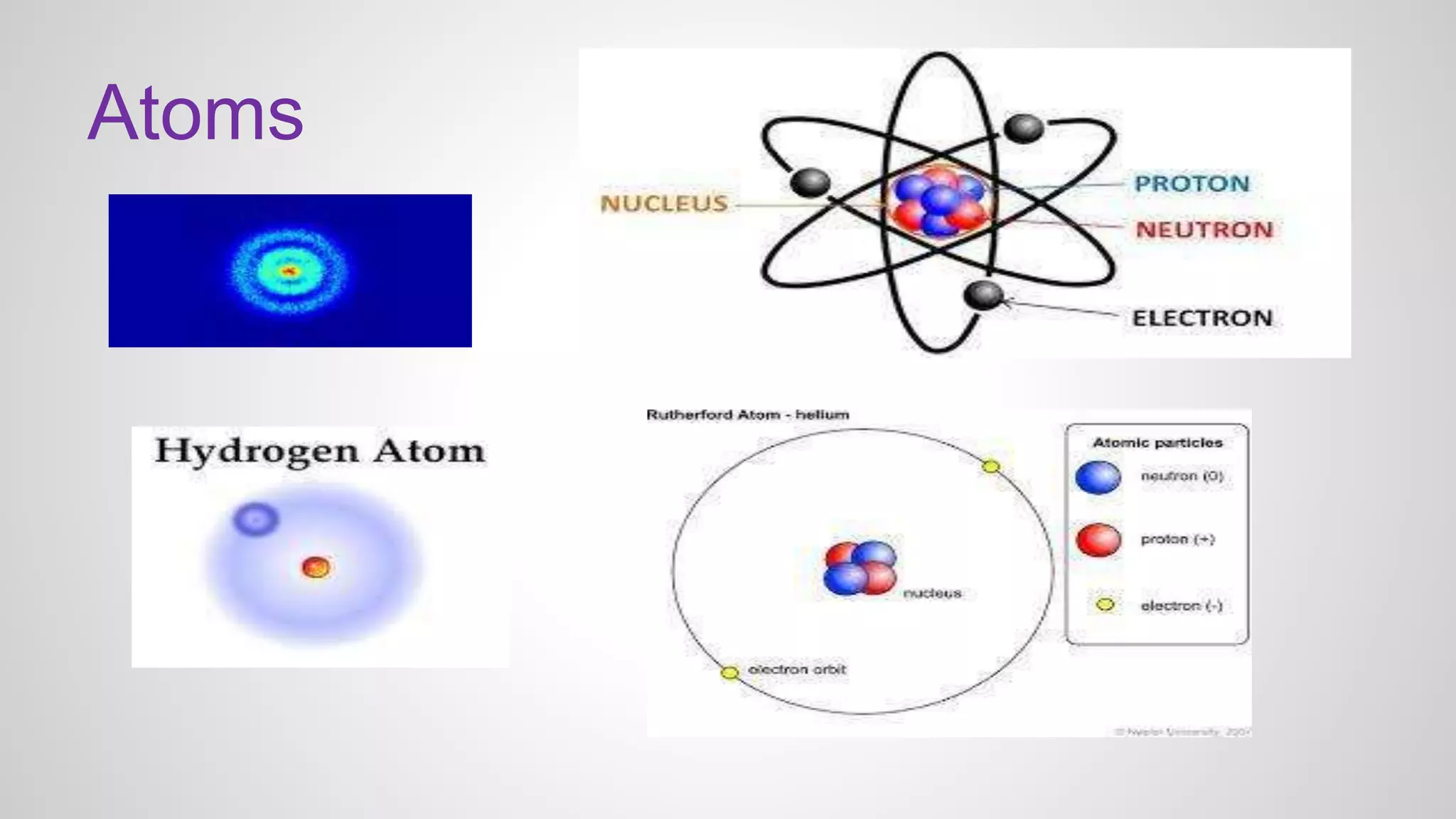
Atoms
Vocabulary 
● Ion 
● Valence Electrons 
● Electron Orbitals 
● Neutral Atom 
● Chemical Bond 
● Ionic Bond 
● Covalent Bond 
● Polar Covalent Bond 
● Nonpolar Covalent Bond 
● Polyatomic Ion 
● Electronegativity 
● Molecule 
● Double Bond 
● Triple Bond
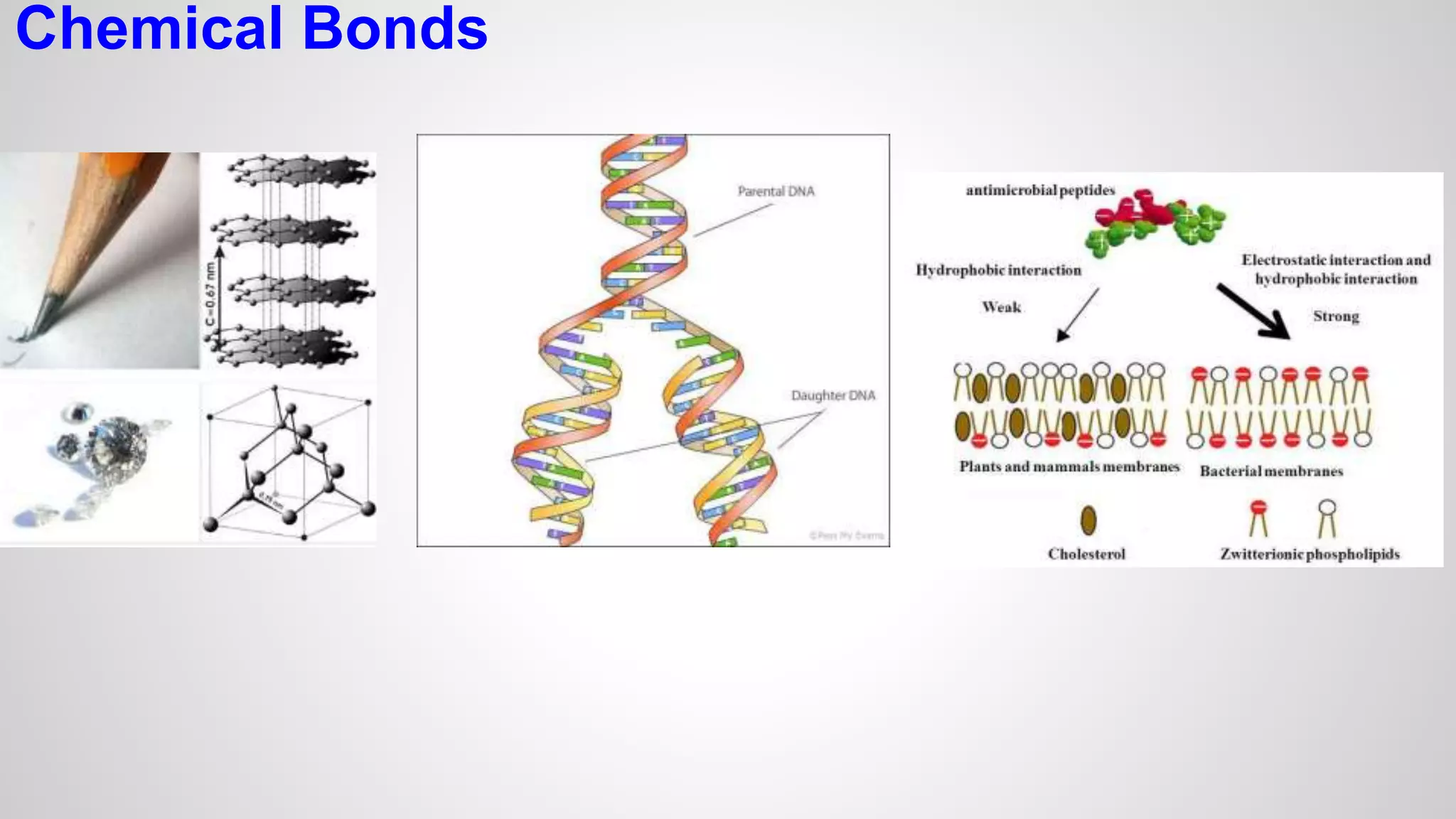
Chemical Bonds
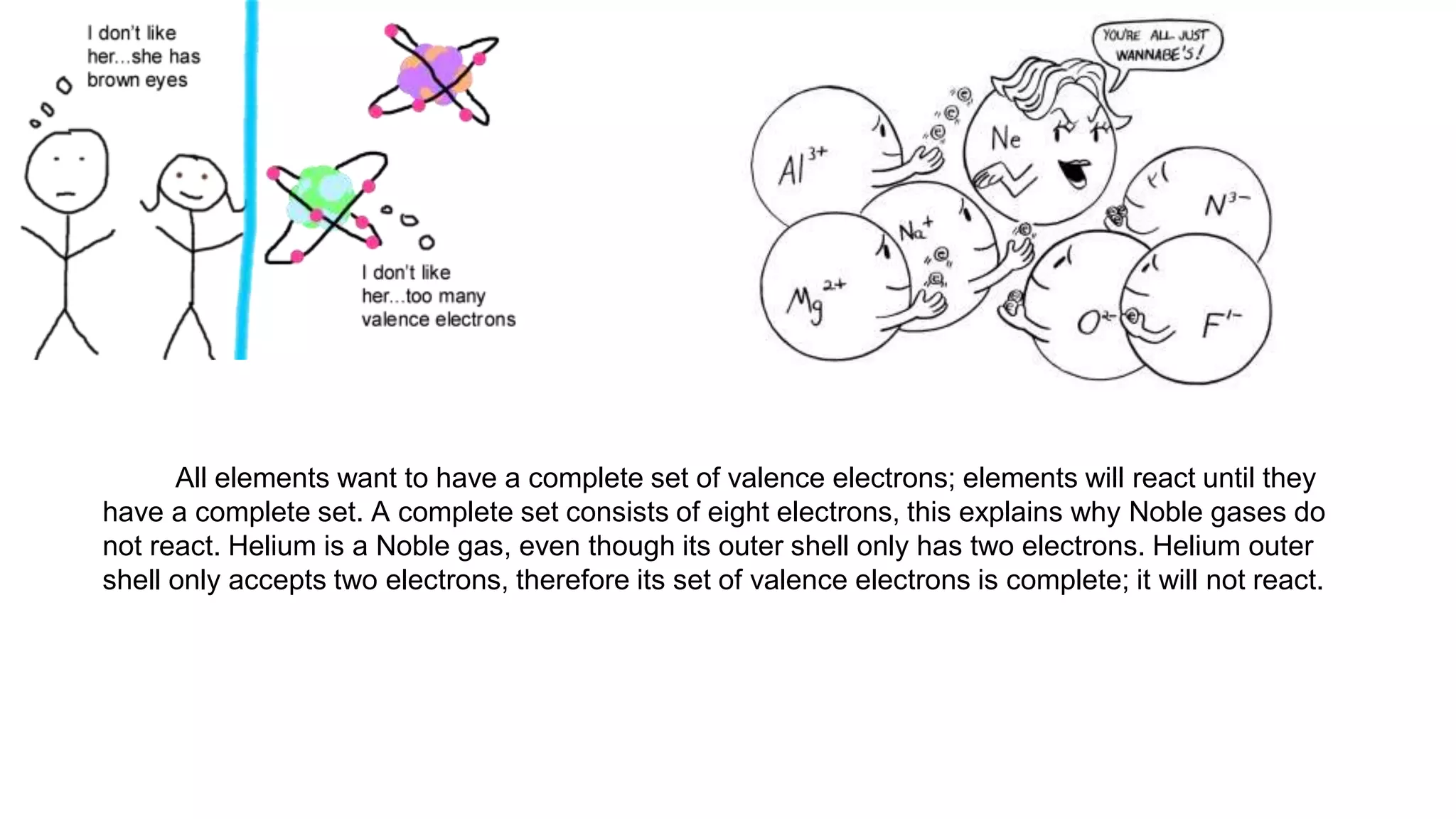
All elements want to have a complete set of valence electrons; elements will react until they 
have a complete set. A complete set consists of eight electrons, this explains why Noble gases do 
not react. Helium is a Noble gas, even though its outer shell only has two electrons. Helium outer 
shell only accepts two electrons, therefore its set of valence electrons is complete; it will not react.
***Pg 58 & 59
Ions 
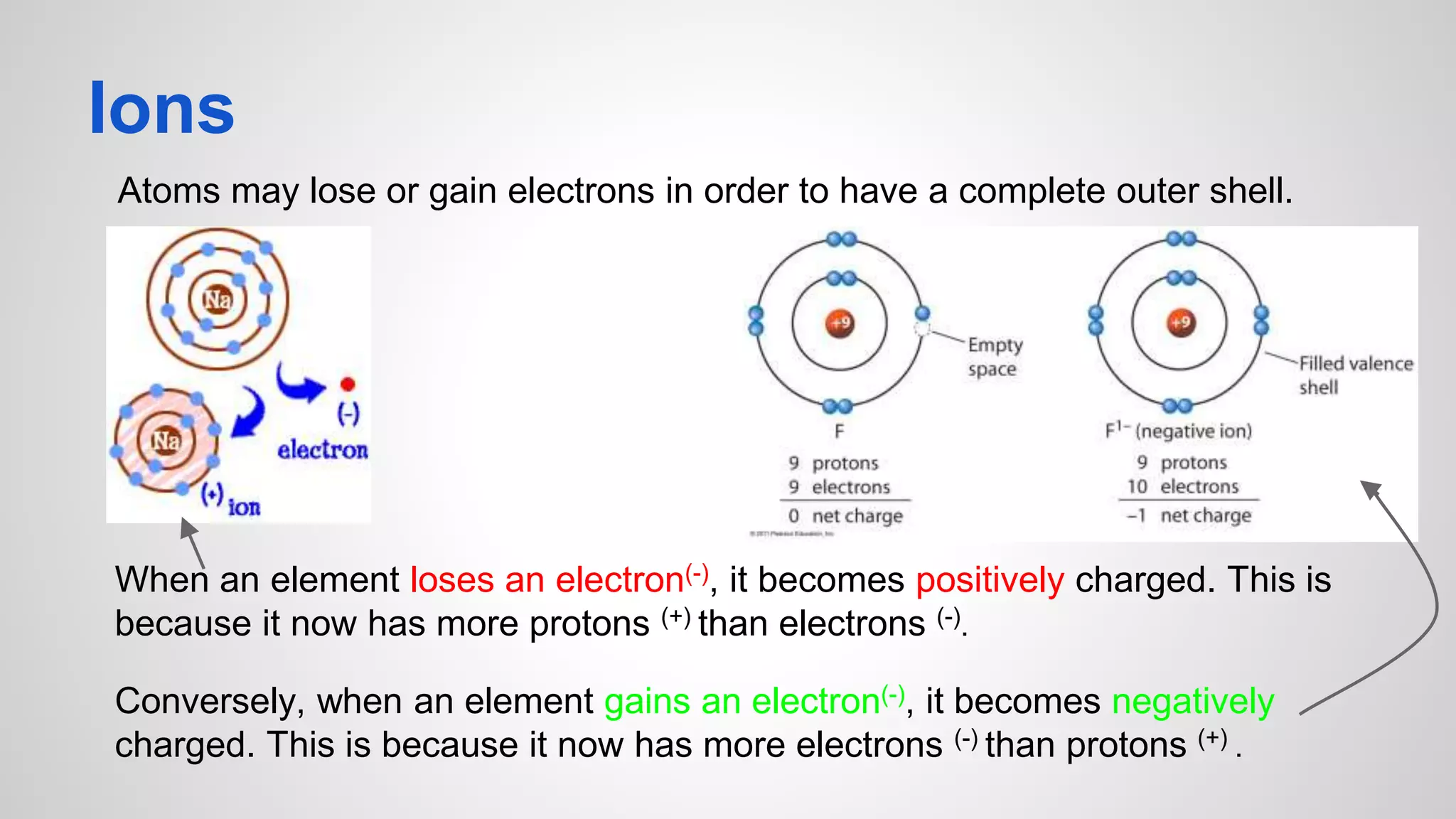
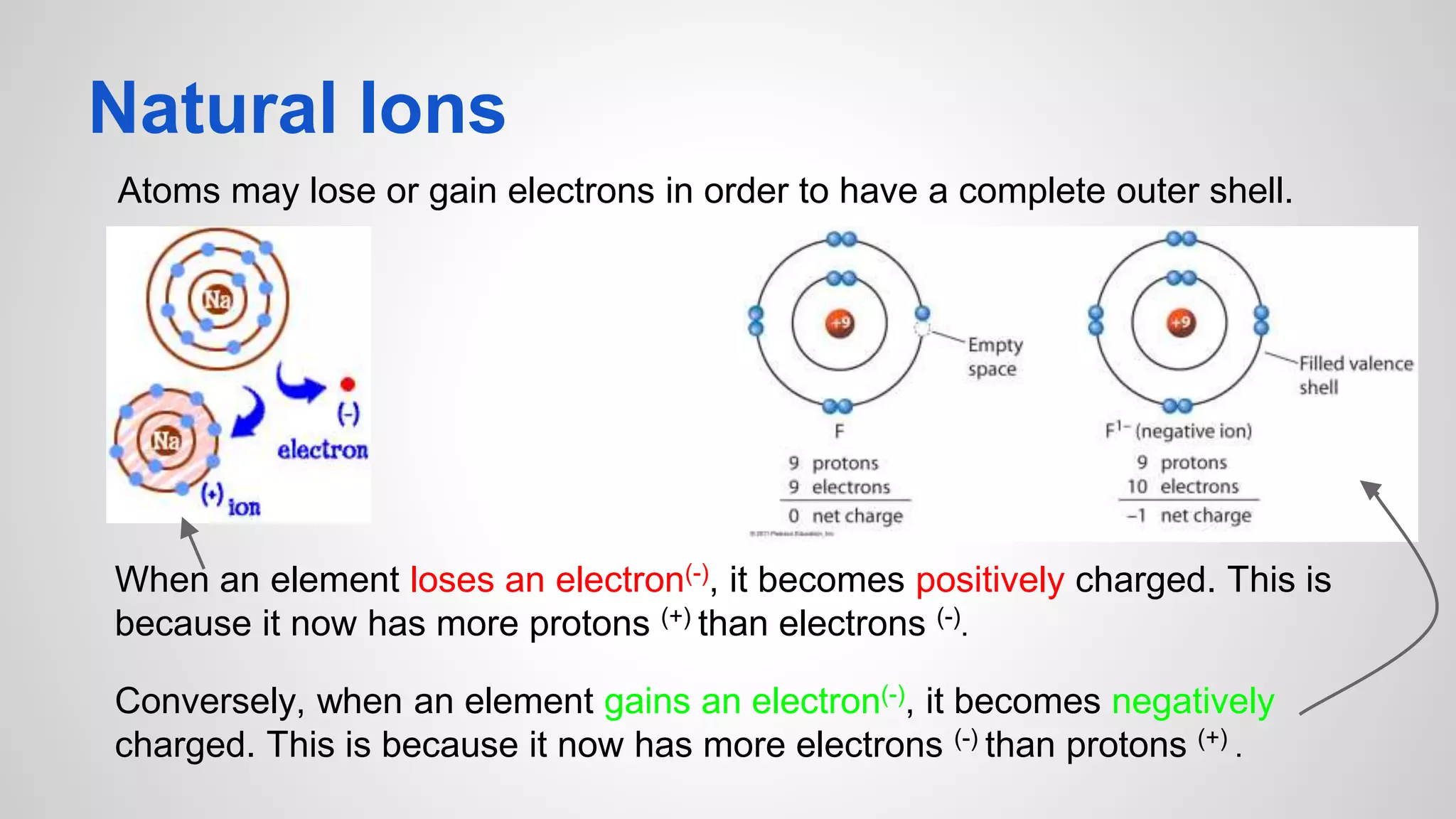
Atoms may lose or gain electrons in order to have a complete outer shell. 
When an element loses an electron(-), it becomes positively charged. This is 
because it now has more protons (+) than electrons (-). 
Conversely, when an element gains an electron(-), it becomes negatively 
charged. This is because it now has more electrons (-) than protons (+) .
Valence Electrons & Ions 
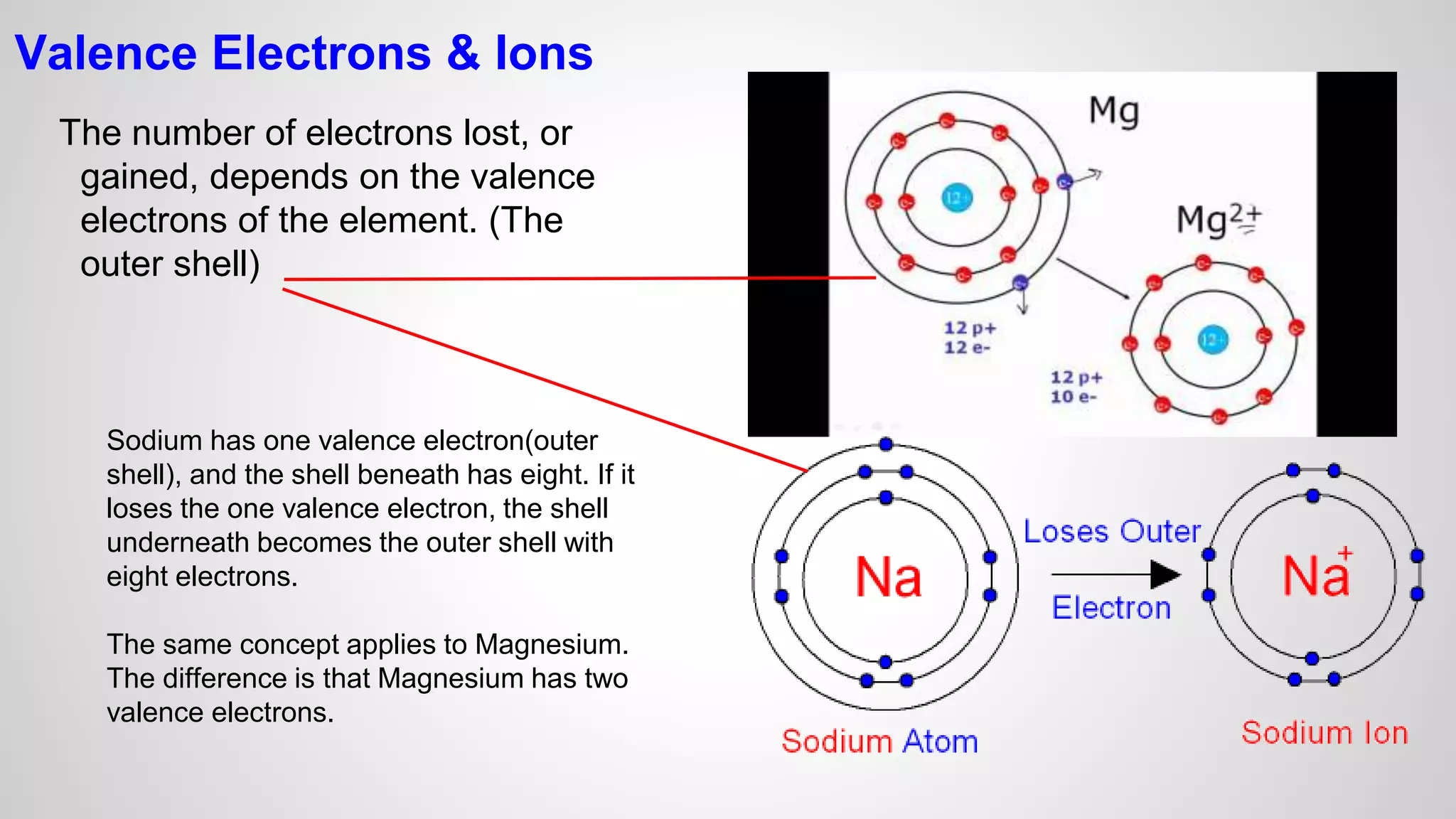
The number of electrons lost, or 
gained, depends on the valence 
electrons of the element. (The 
outer shell) 
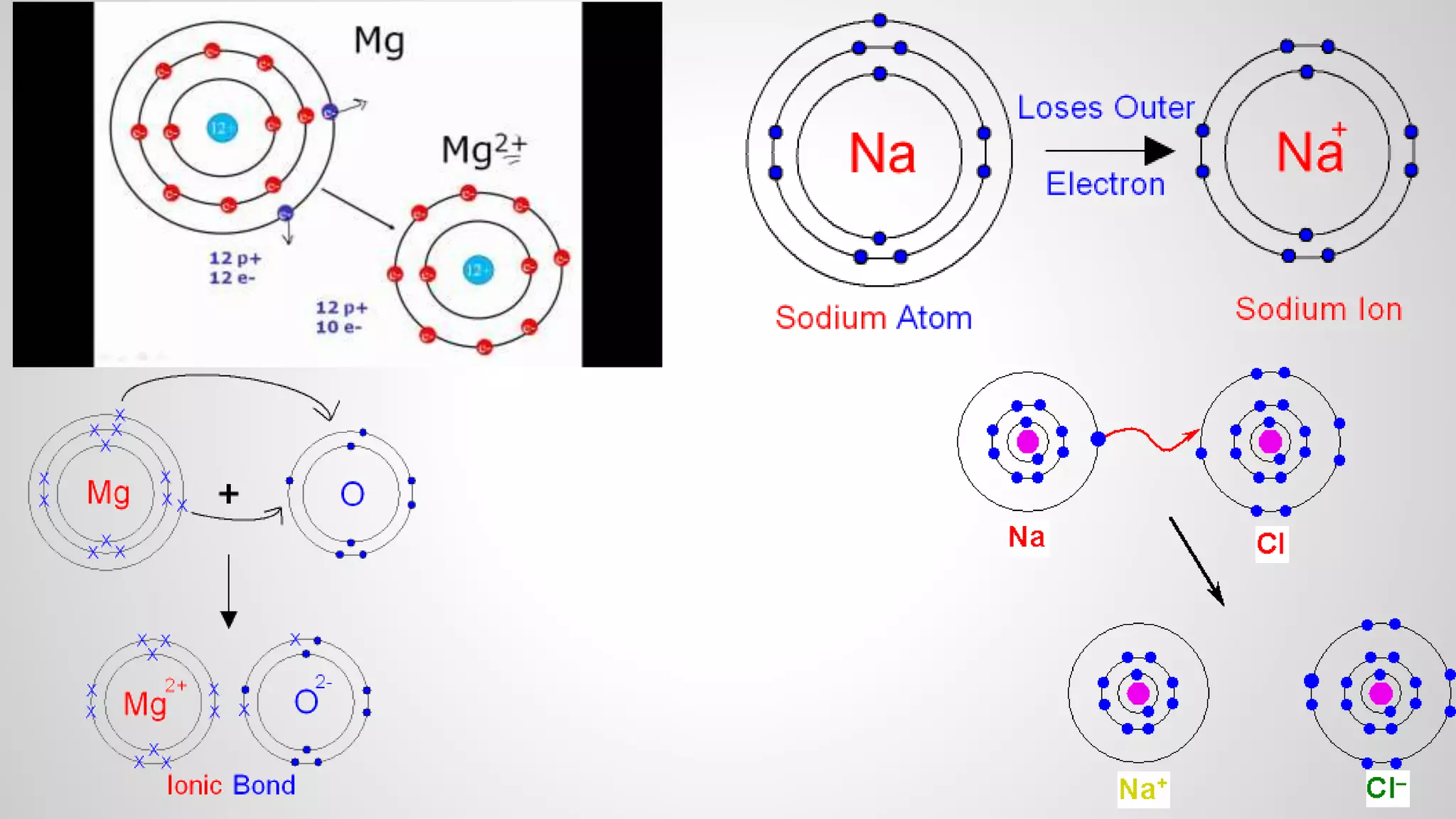
Sodium has one valence electron(outer 
shell), and the shell beneath has eight. If it 
loses the one valence electron, the shell 
underneath becomes the outer shell with 
eight electrons. 
The same concept applies to Magnesium. 
The difference is that Magnesium has two 
valence electrons.
Valence Electrons & Ions 
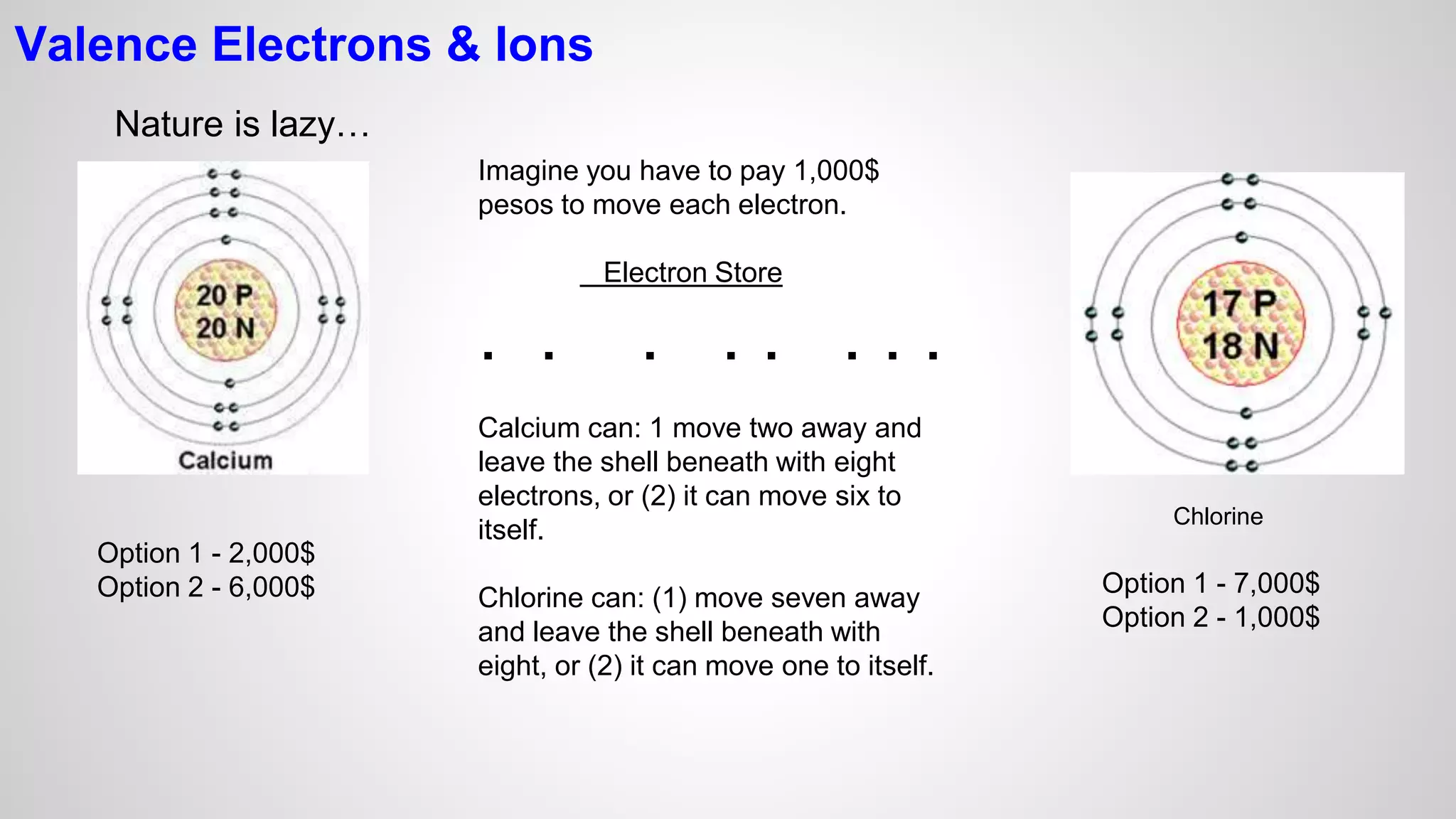
Nature is lazy… 
Chlorine 
Imagine you have to pay 1,000$ 
pesos to move each electron. 
Electron Store 
. . . . . . . . 
Calcium can: 1 move two away and 
leave the shell beneath with eight 
electrons, or (2) it can move six to 
itself. 
Option 1 - 2,000$ 
Option 2 - 6,000$ Option 1 - 7,000$ 
Chlorine can: (1) move seven away 
and leave the shell beneath with 
eight, or (2) it can move one to itself. 
Option 2 - 1,000$
Valence Electrons & Natural Ions 
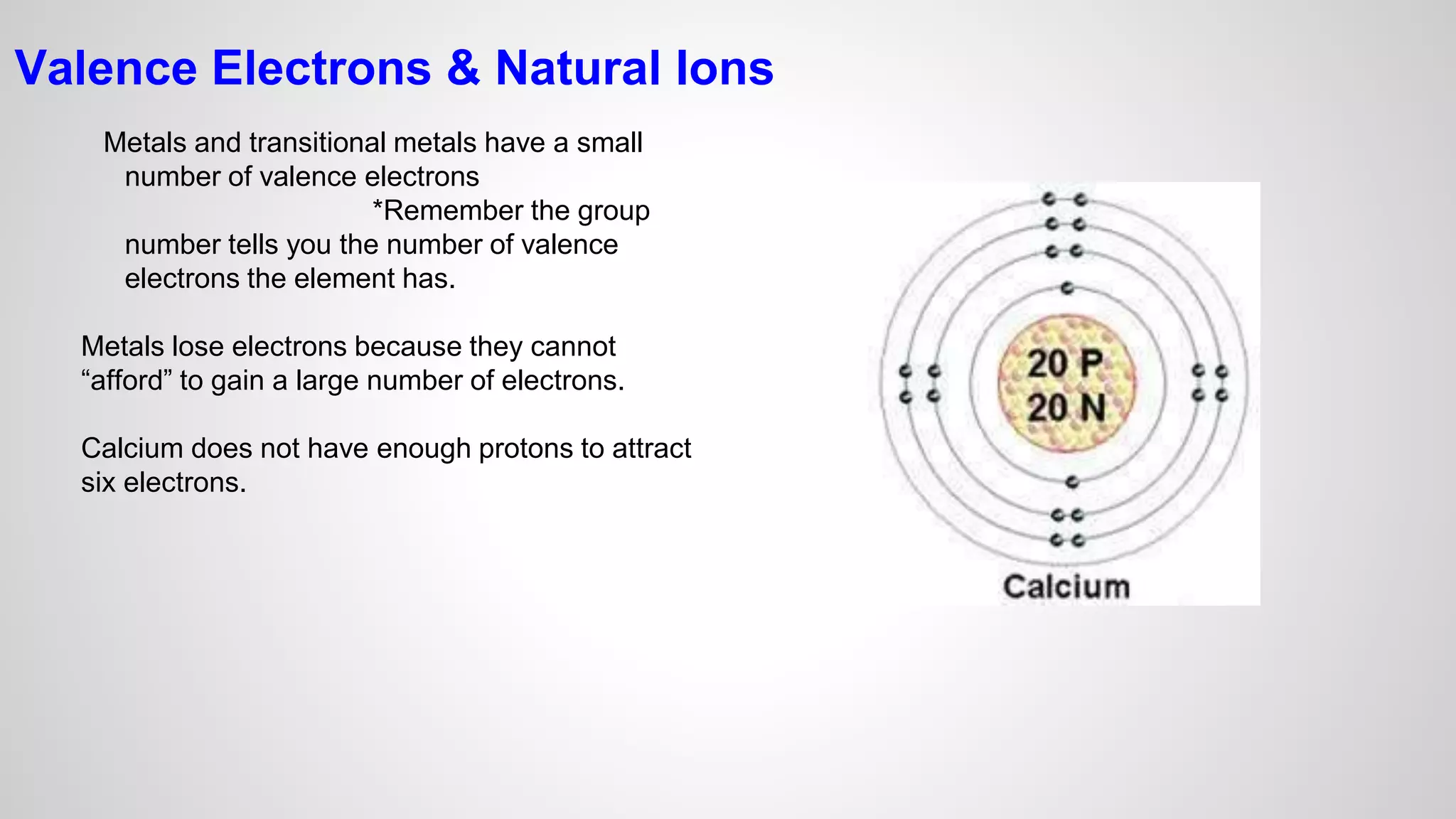
Metals and transitional metals have a small 
number of valence electrons 
*Remember the group 
number tells you the number of valence 
electrons the element has. 
Metals lose electrons because they cannot 
“afford” to gain a large number of electrons. 
Calcium does not have enough protons to attract 
six electrons.
Valence Electrons & Natural Ions 
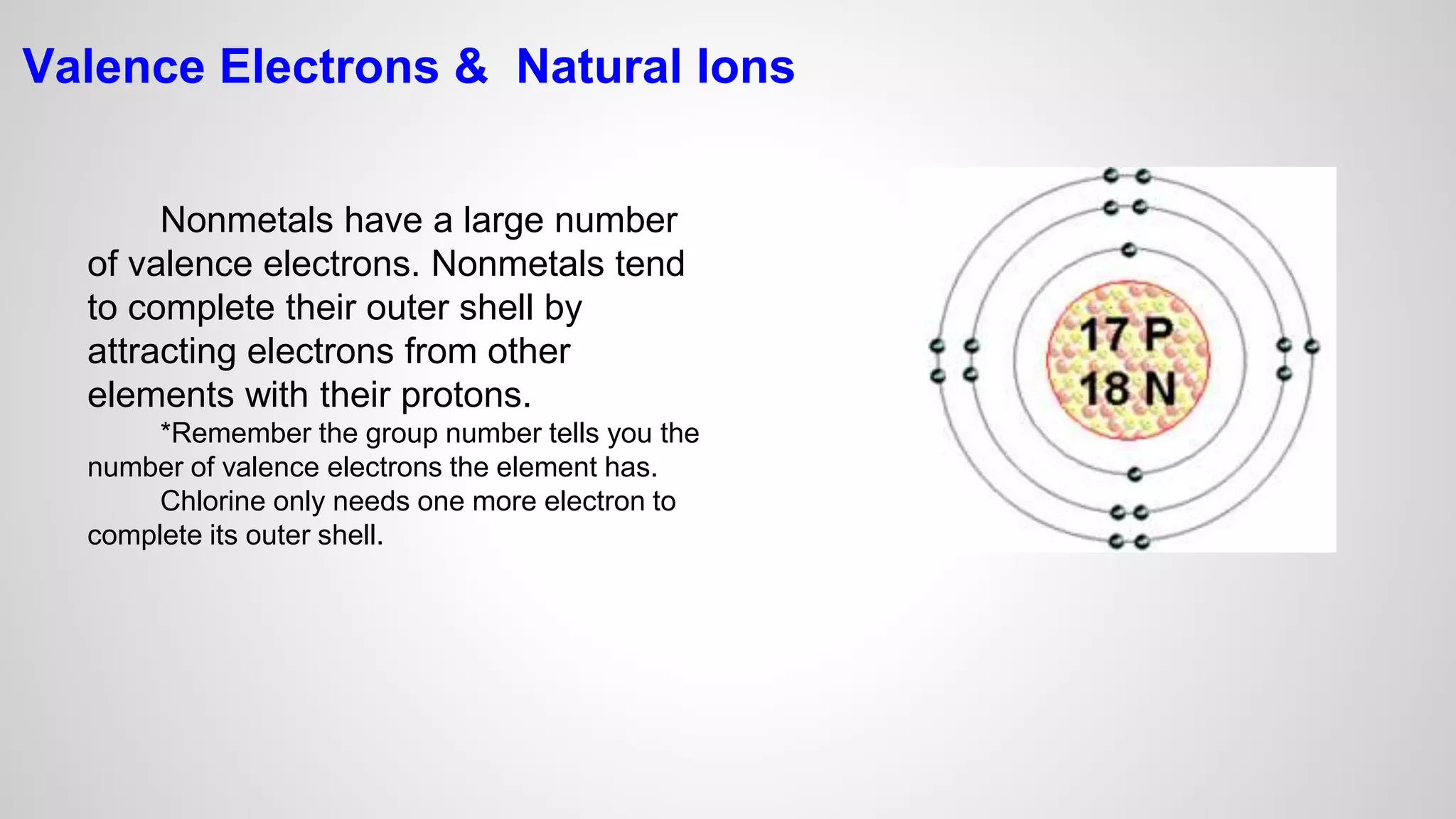
Nonmetals have a large number 
of valence electrons. Nonmetals tend 
to complete their outer shell by 
attracting electrons from other 
elements with their protons. 
*Remember the group number tells you the 
number of valence electrons the element has. 
Chlorine only needs one more electron to 
complete its outer shell.
Natural Ions 
Atoms may lose or gain electrons in order to have a complete outer shell. 
When an element loses an electron(-), it becomes positively charged. This is 
because it now has more protons (+) than electrons (-). 
Conversely, when an element gains an electron(-), it becomes negatively 
charged. This is because it now has more electrons (-) than protons (+) .
Valence Electrons & Natural Ions 
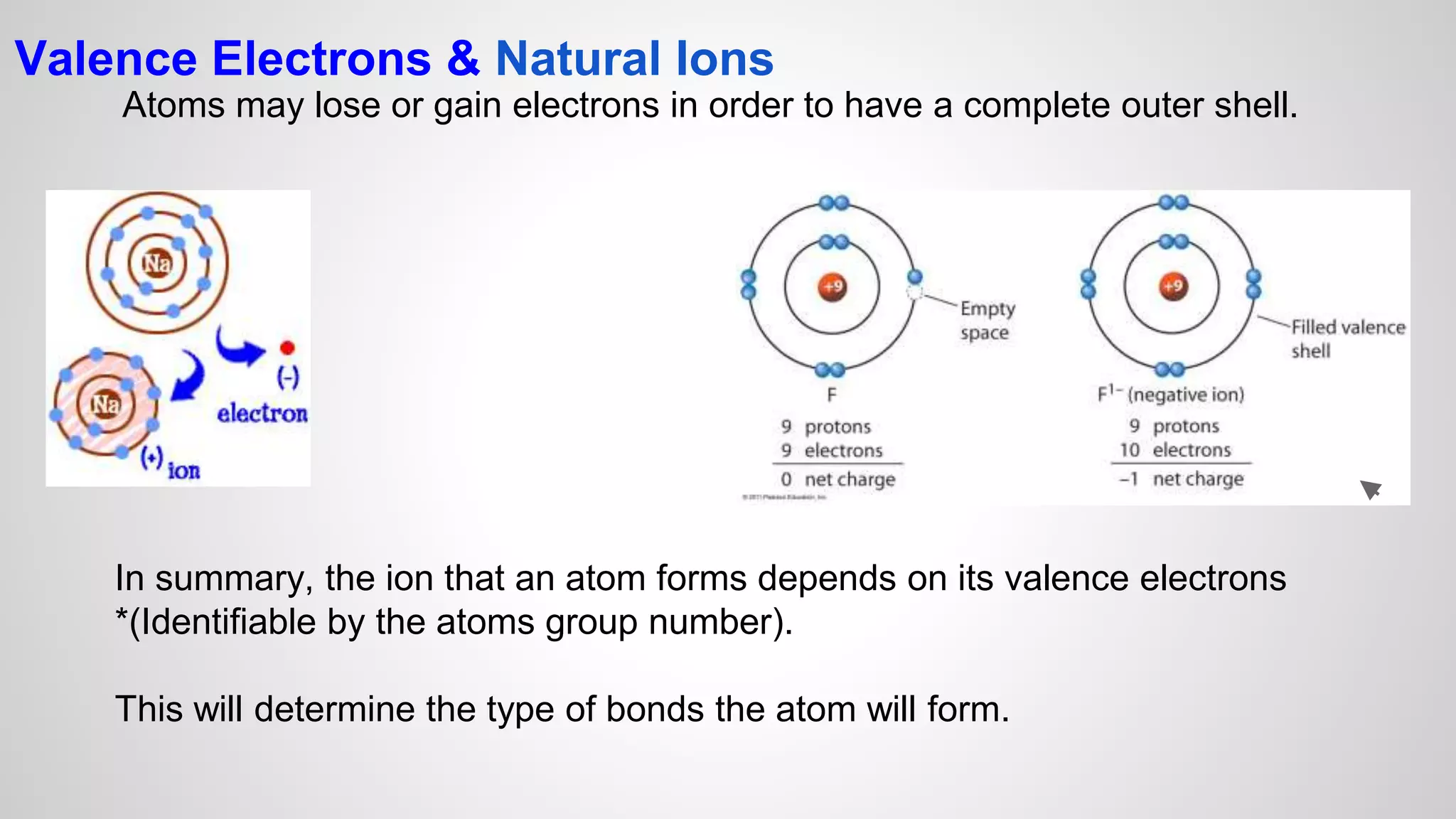
Atoms may lose or gain electrons in order to have a complete outer shell. 
In summary, the ion that an atom forms depends on its valence electrons 
*(Identifiable by the atoms group number). 
This will determine the type of bonds the atom will form.
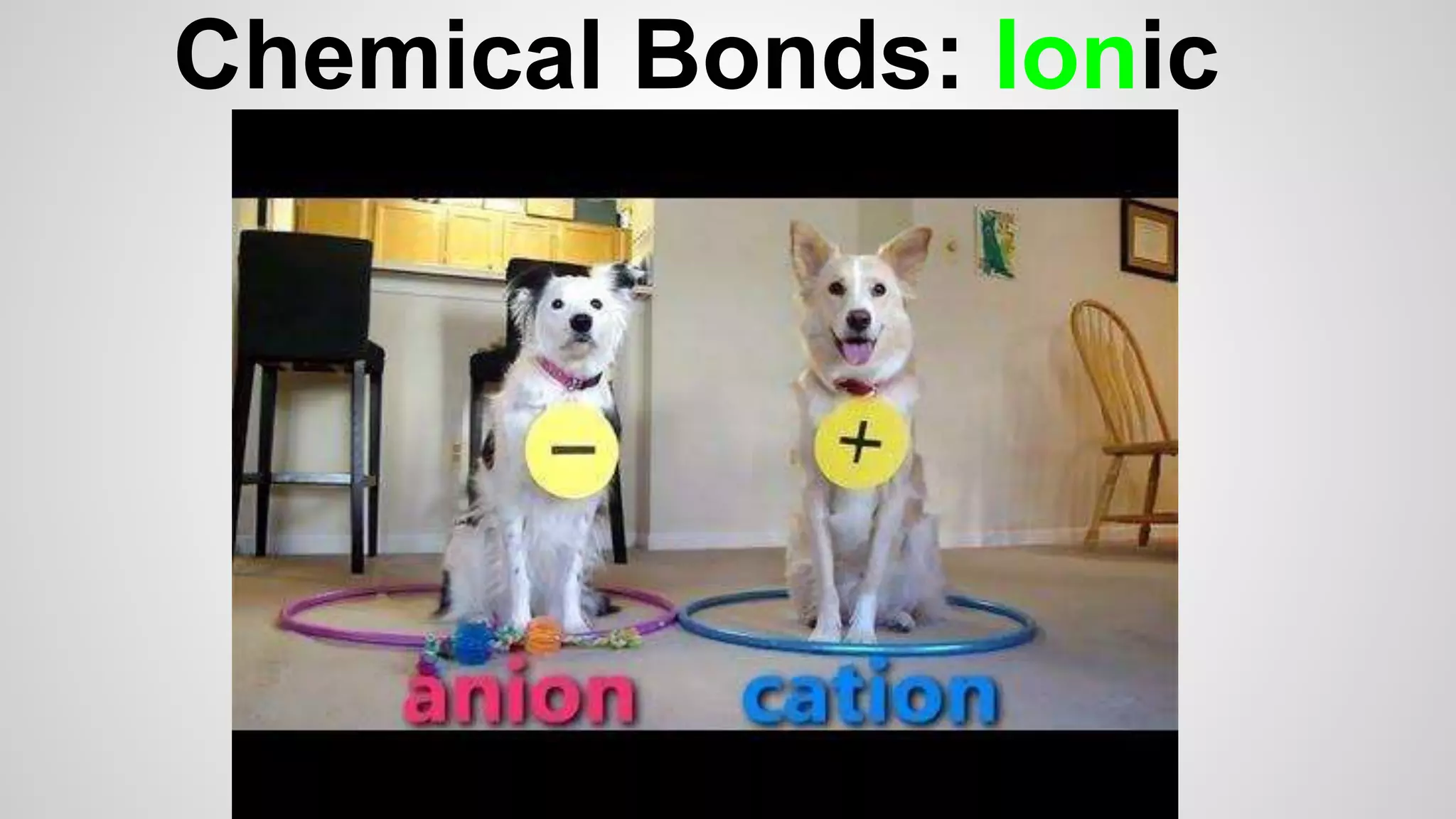
Chemical Bonds: Ionic
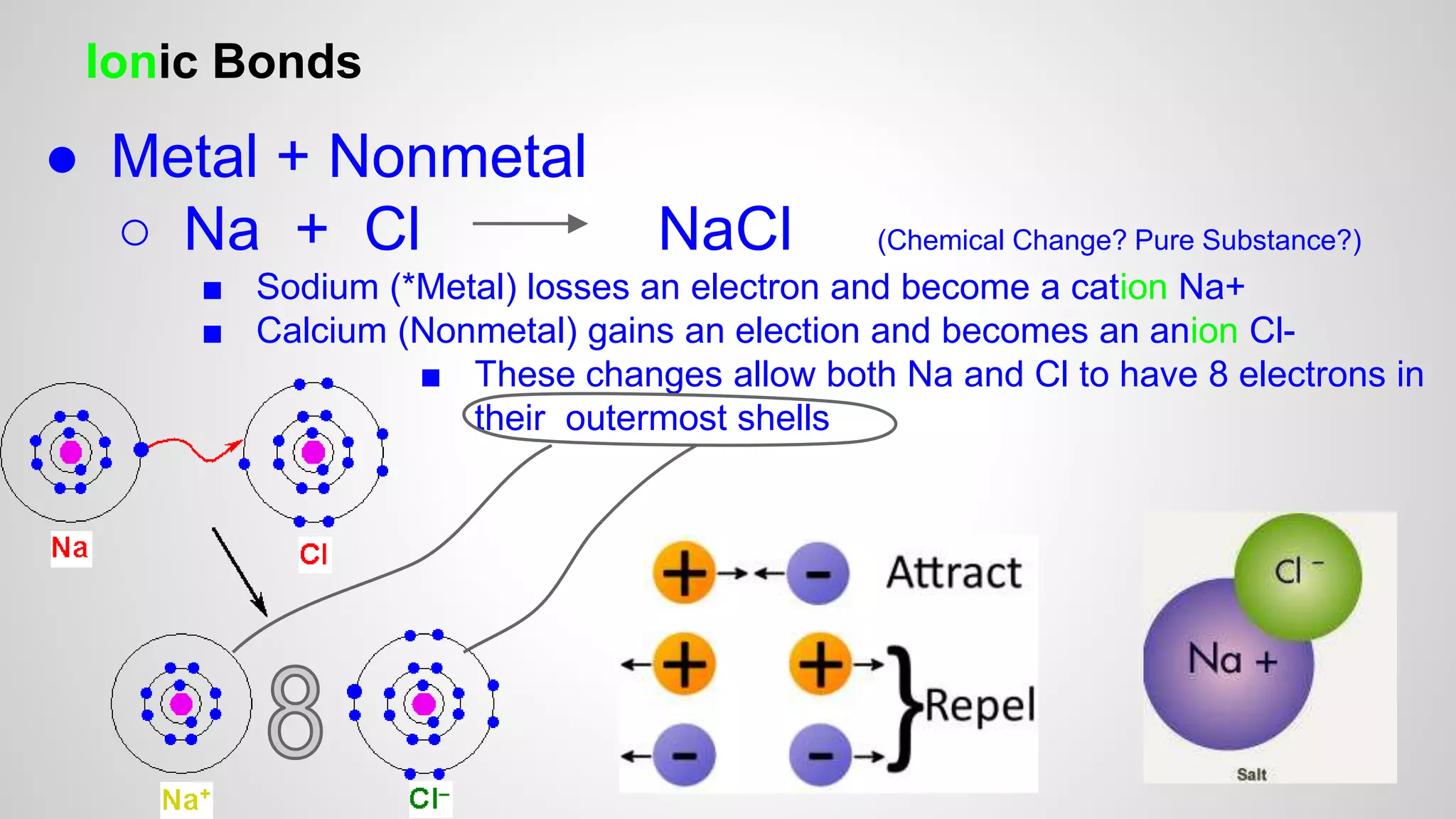
● Metal + Nonmetal 
○ Na + Cl NaCl (Chemical Change? Pure Substance?) 
■ Sodium (*Metal) losses an electron and become a cation Na+ 
■ Calcium (Nonmetal) gains an election and becomes an anion Cl- 
■ These changes allow both Na and Cl to have 8 electrons in 
their outermost shells 
Ionic Bonds
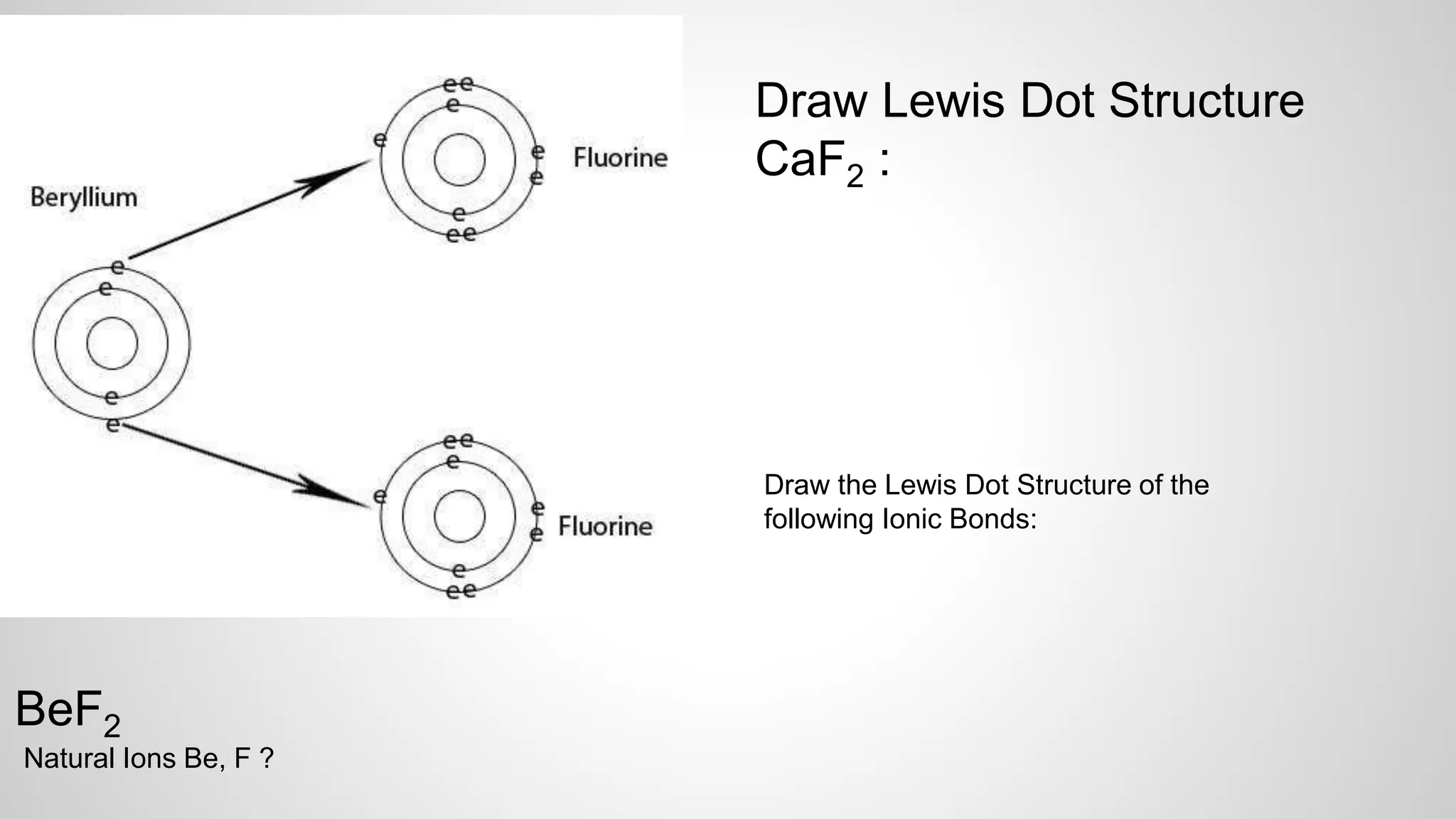
Draw Lewis Dot Structure 
CaF2 : 
BeF2 
Natural Ions Be, F ? 
Draw the Lewis Dot Structure of the 
following Ionic Bonds:
Subscripts 
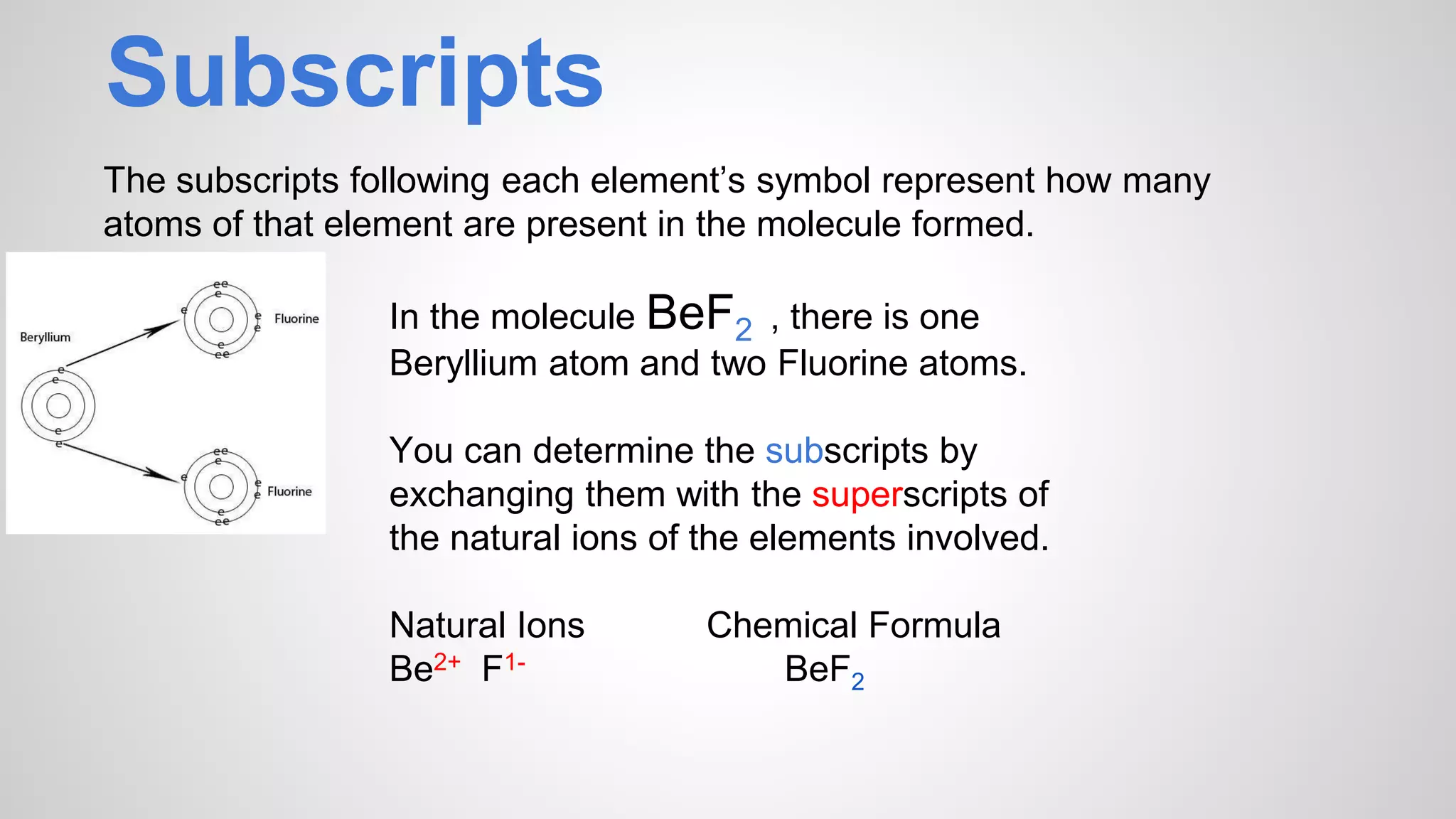
The subscripts following each element’s symbol represent how many 
atoms of that element are present in the molecule formed. 
In the molecule BeF2 , there is one 
Beryllium atom and two Fluorine atoms. 
You can determine the subscripts by 
exchanging them with the superscripts of 
the natural ions of the elements involved. 
Natural Ions Chemical Formula 
Be2+ F1- BeF2
Covalent Bonds 
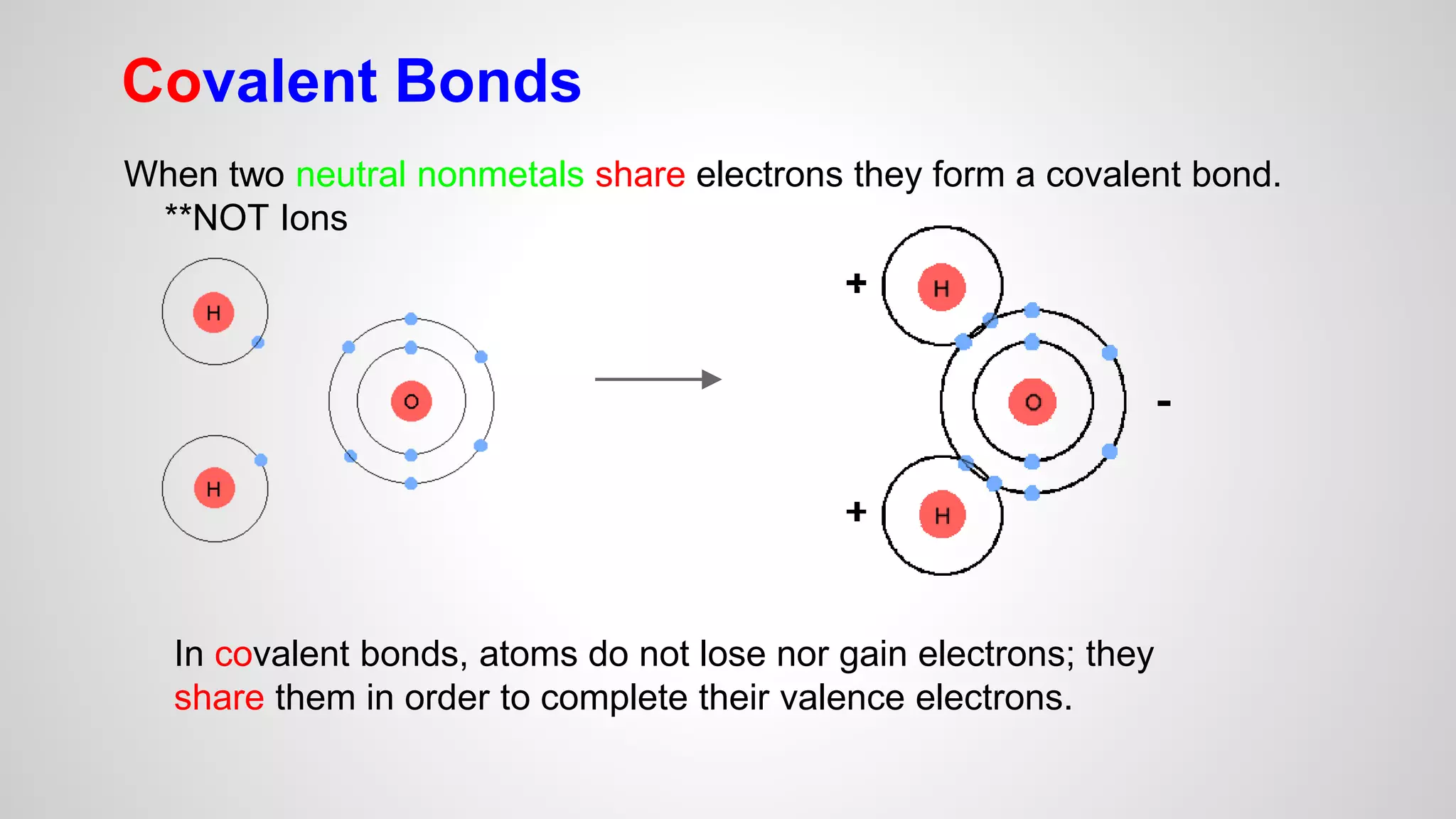
When two neutral nonmetals share electrons they form a covalent bond. 
**NOT Ions 
In covalent bonds, atoms do not lose nor gain electrons; they 
share them in order to complete their valence electrons.
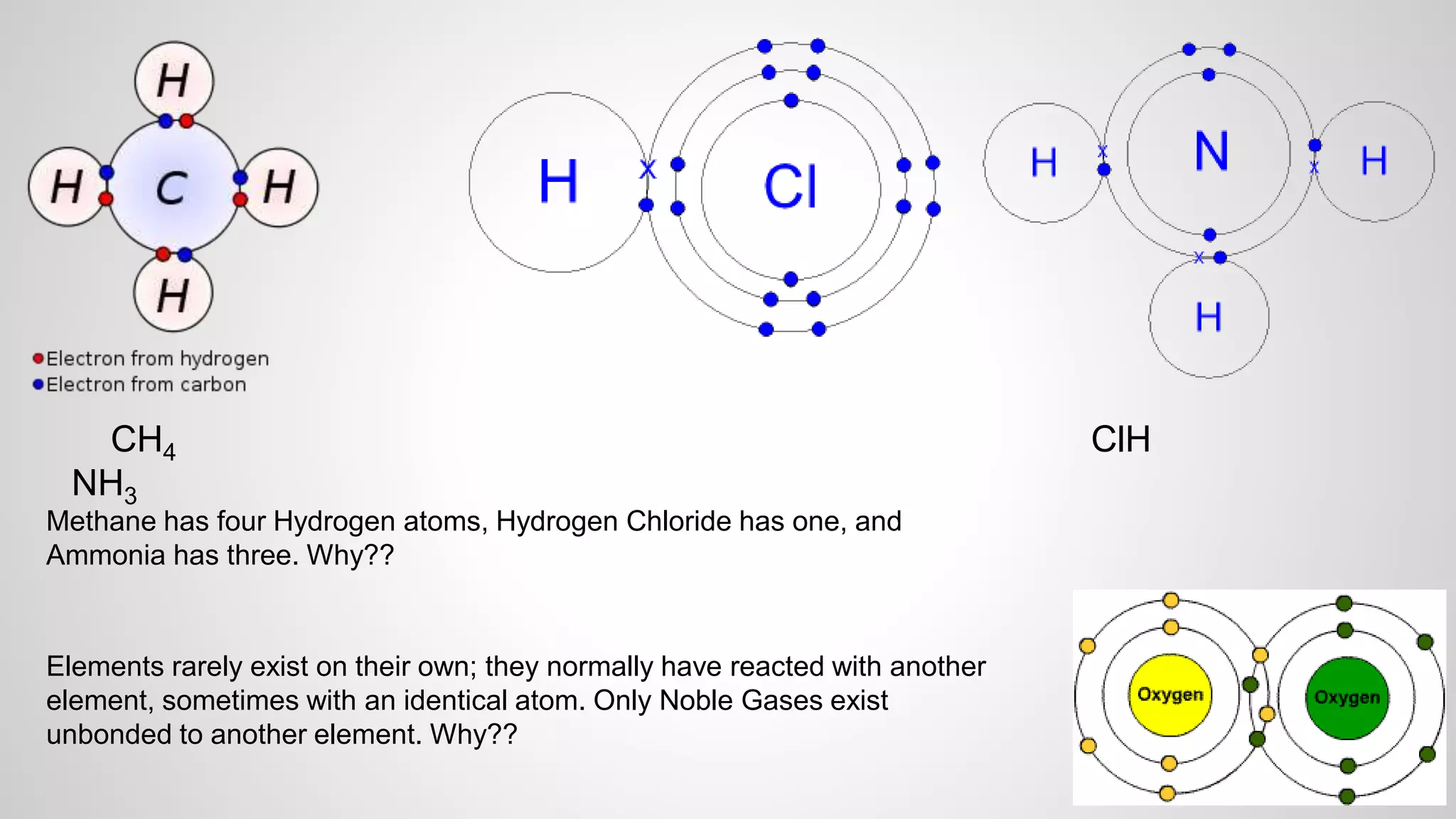
CH4 ClH 
NH3 
Methane has four Hydrogen atoms, Hydrogen Chloride has one, and 
Ammonia has three. Why?? 
Elements rarely exist on their own; they normally have reacted with another 
element, sometimes with an identical atom. Only Noble Gases exist 
unbonded to another element. Why??
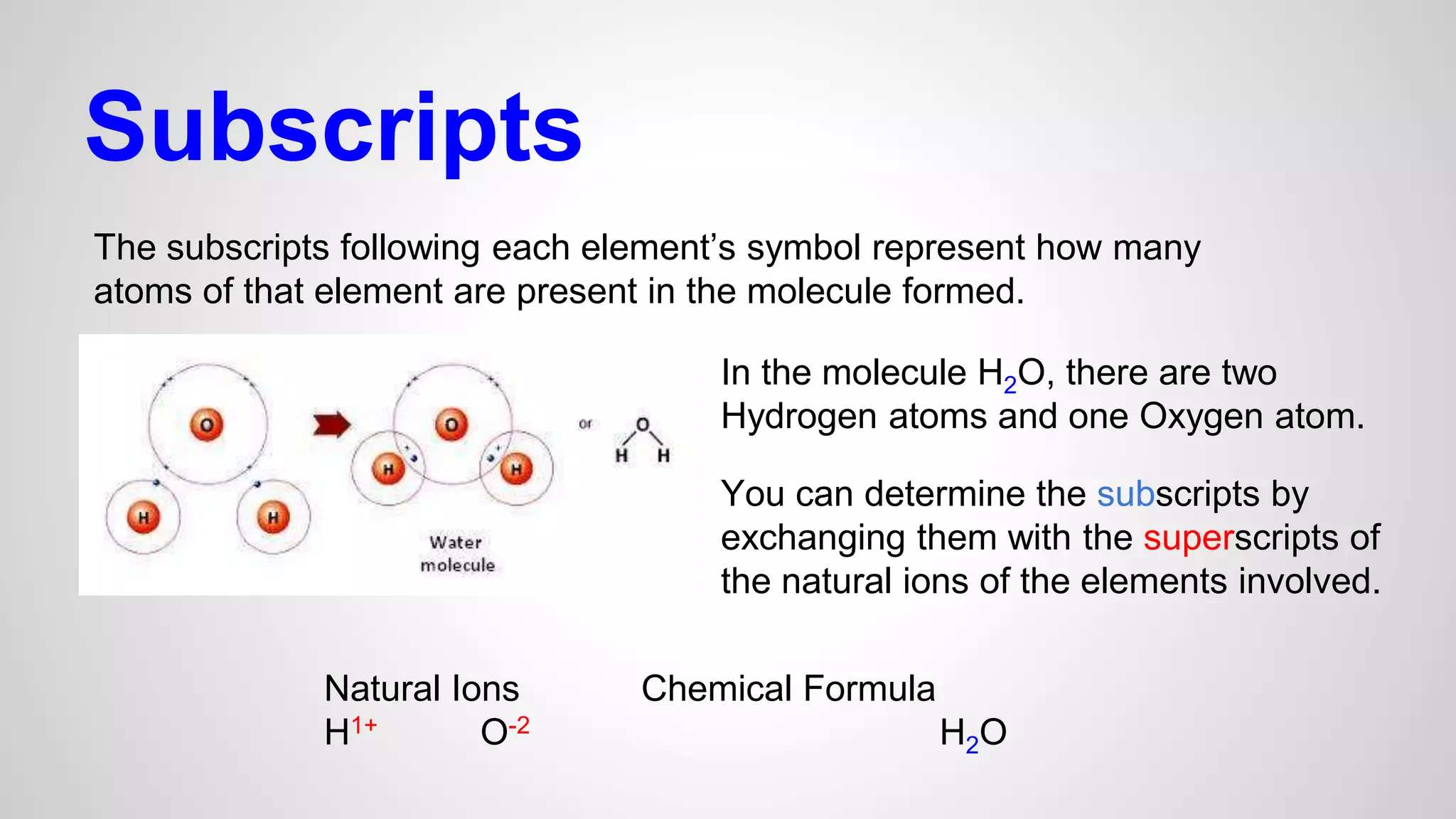
Subscripts 
The subscripts following each element’s symbol represent how many 
atoms of that element are present in the molecule formed. 
In the molecule H2O, there are two 
Hydrogen atoms and one Oxygen atom. 
You can determine the subscripts by 
exchanging them with the superscripts of 
the natural ions of the elements involved. 
Natural Ions Chemical Formula 
H1+ O-2 H2O
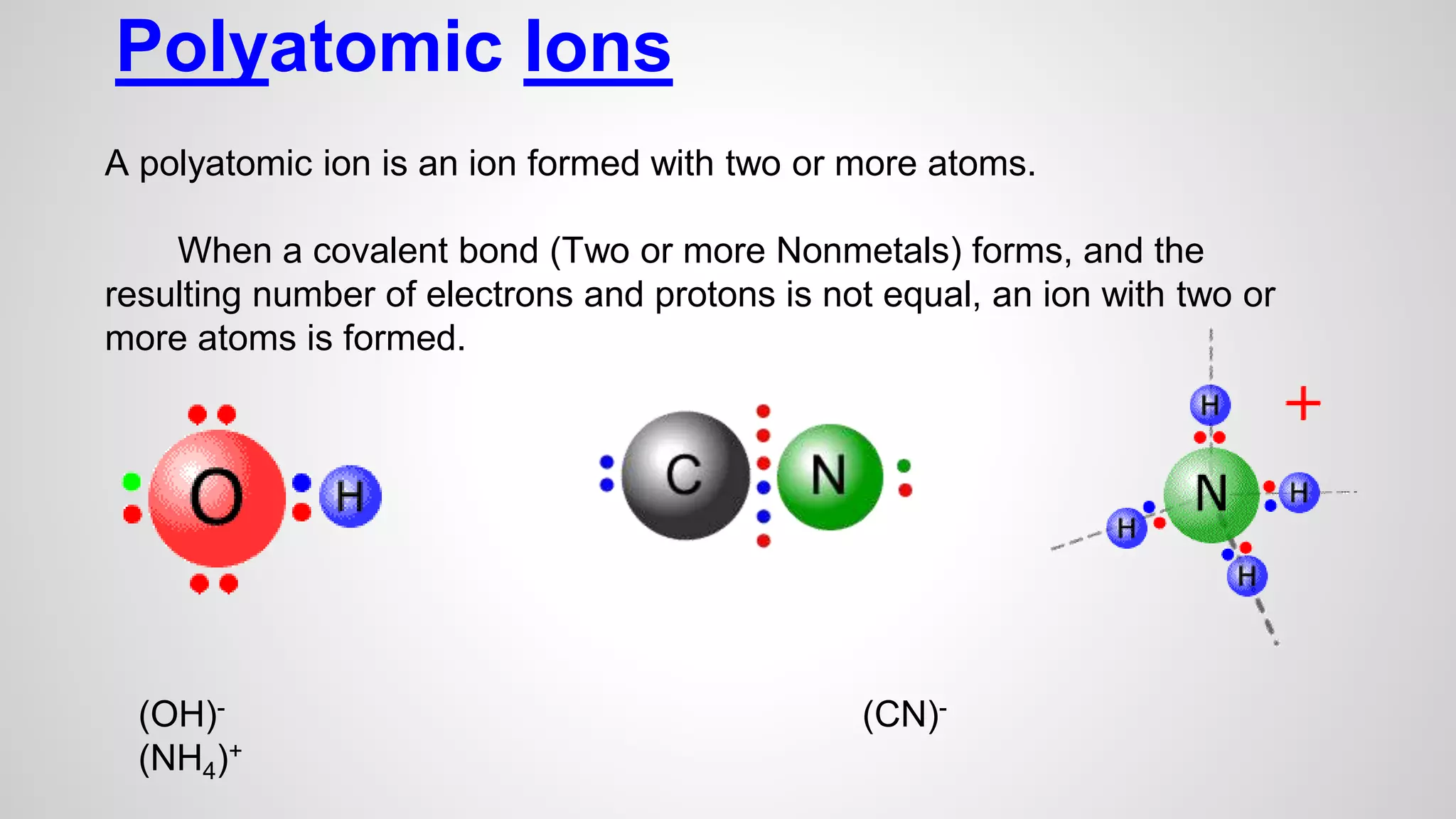
Polyatomic Ions 
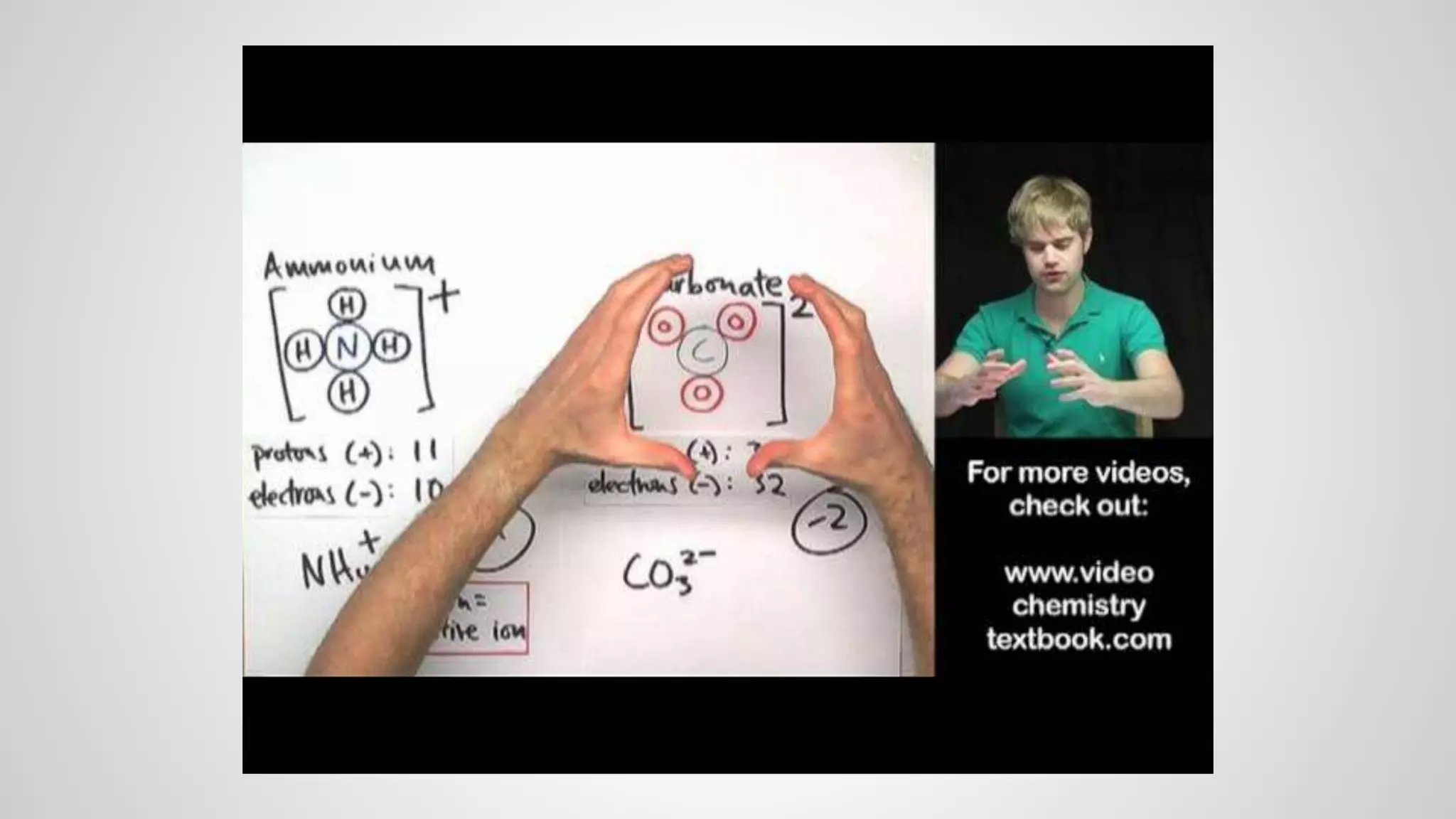
A polyatomic ion is an ion formed with two or more atoms. 
When a covalent bond (Two or more Nonmetals) forms, and the 
resulting number of electrons and protons is not equal, an ion with two or 
more atoms is formed. 
(OH)- (CN)- 
(NH4)+
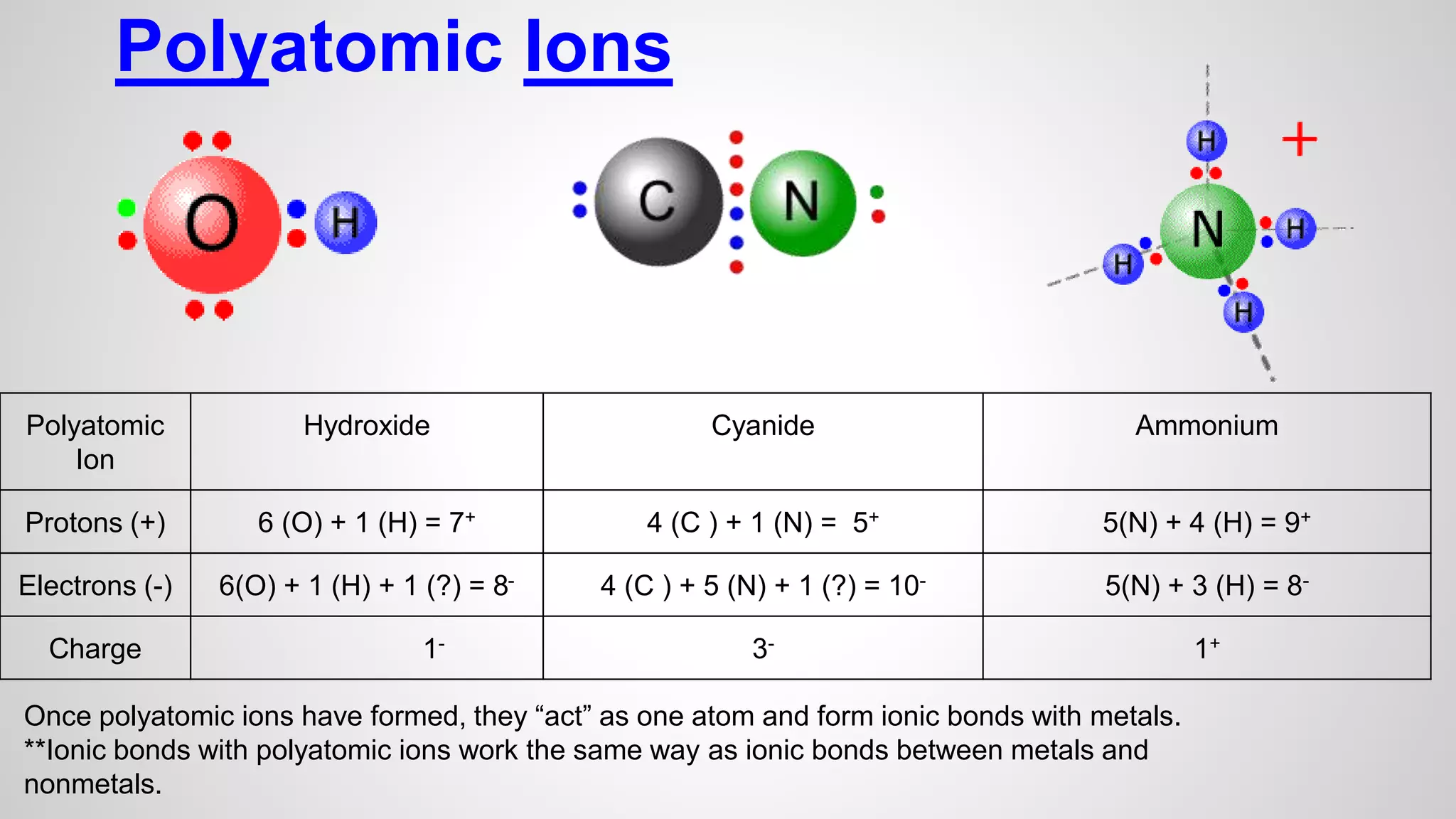
Polyatomic Ions 
Polyatomic 
Ion 
Hydroxide Cyanide Ammonium 
Protons (+) 6 (O) + 1 (H) = 7+ 4 (C ) + 1 (N) = 5+ 5(N) + 4 (H) = 9+ 
Electrons (-) 6(O) + 1 (H) + 1 (?) = 8- 4 (C ) + 5 (N) + 1 (?) = 10- 5(N) + 3 (H) = 8- 
Charge 1- 3- 1+ 
Once polyatomic ions have formed, they “act” as one atom and form ionic bonds with metals. 
**Ionic bonds with polyatomic ions work the same way as ionic bonds between metals and 
nonmetals.
Ionic Bonds with Polyatomic Ions 
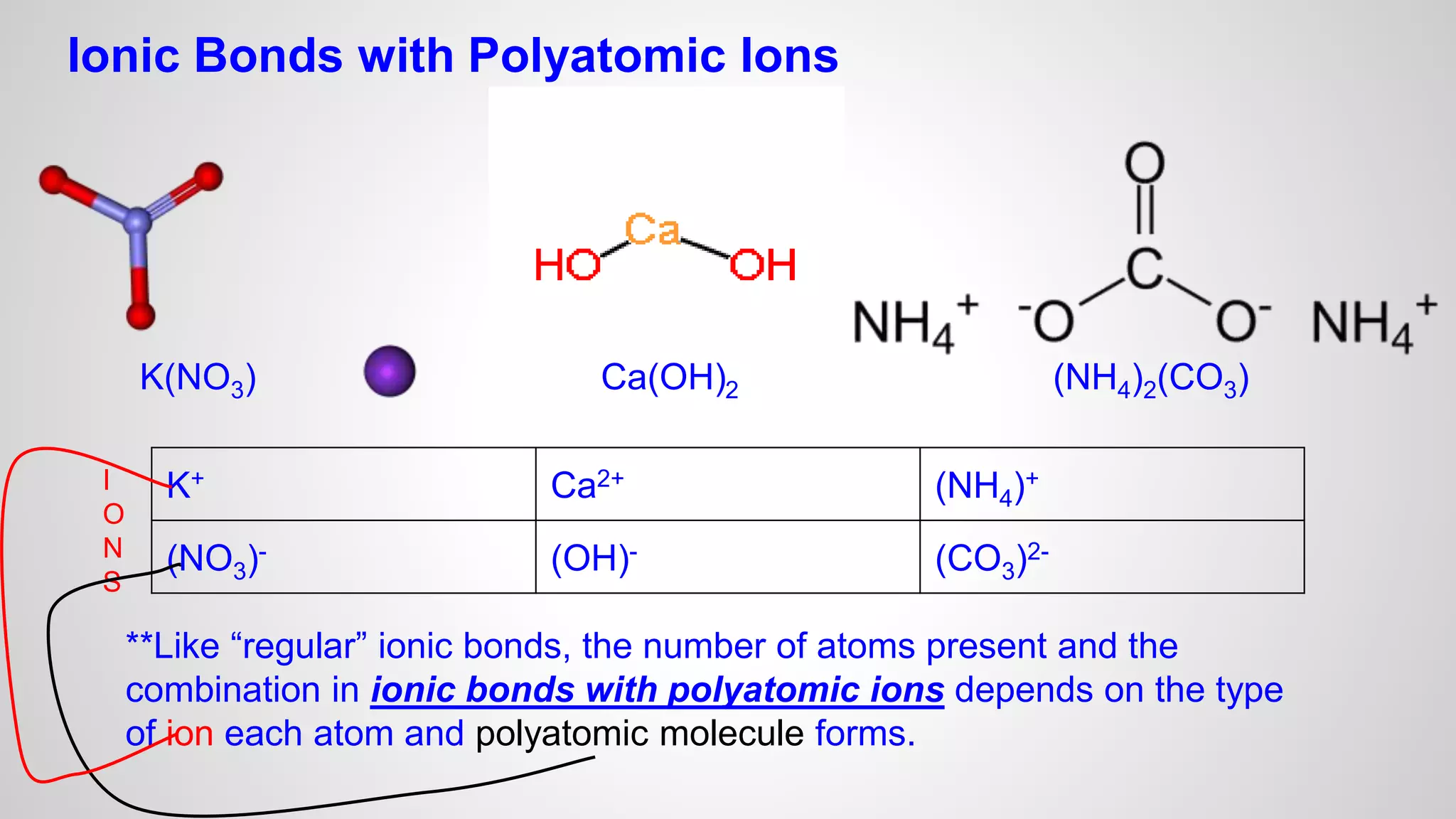
K(NO3) Ca(OH)2 (NH4)2(CO3) 
I 
K+ Ca2+ (NH)+ 
4O 
N 
(NO)- (OH)- (CO)2- 
S 
33**Like “regular” ionic bonds, the number of atoms present and the 
combination in ionic bonds with polyatomic ions depends on the type 
of ion each atom and polyatomic molecule forms.
Ionic Bonds with Polyatomic Ions 
**Like “regular” ionic bonds, the number of atoms present and the 
combination in ionic bonds with polyatomic ions depends on the type of 
ion each atom and polyatomic molecule forms. 
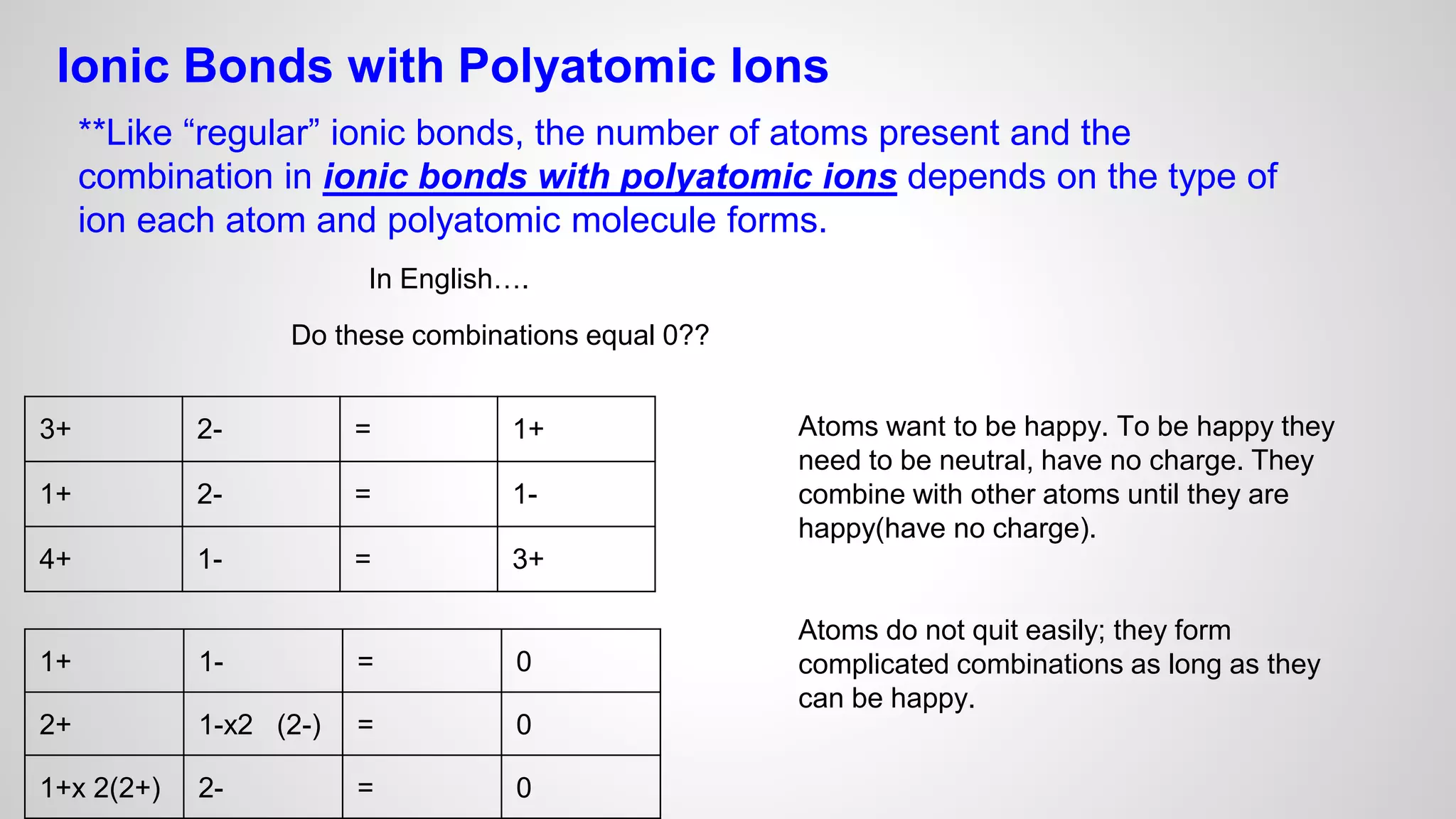
In English…. 
Do these combinations equal 0?? 
3+ 2- = 1+ 
1+ 2- = 1- 
4+ 1- = 3+ 
1+ 1- = 0 
2+ 1-x2 (2-) = 0 
1+x 2(2+) 2- = 0 
Atoms want to be happy. To be happy they 
need to be neutral, have no charge. They 
combine with other atoms until they are 
happy(have no charge). 
Atoms do not quit easily; they form 
complicated combinations as long as they 
can be happy.
Ionic Bonds with Polyatomic 
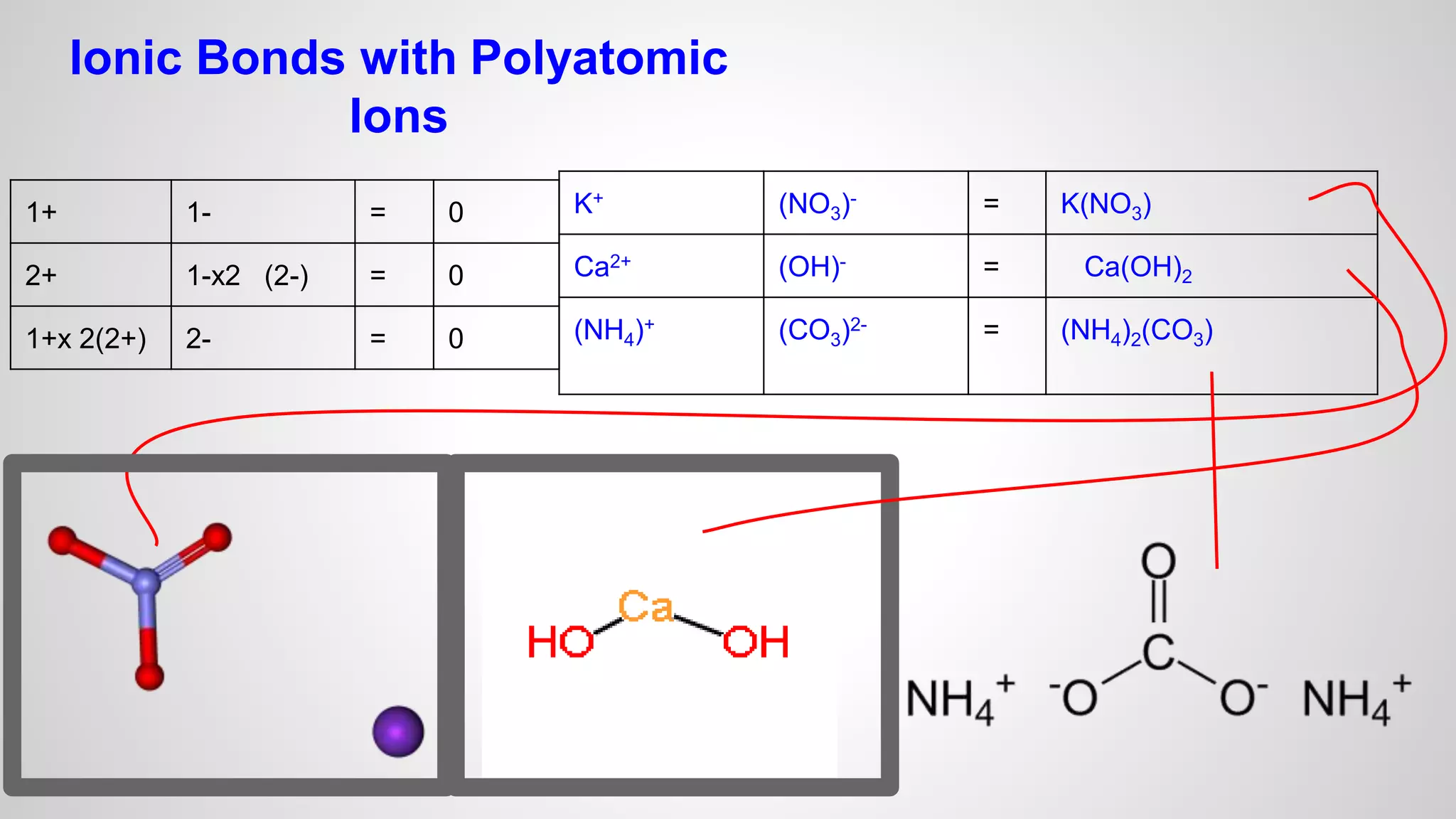
1+ 1- = 0 
2+ 1-x2 (2-) = 0 
1+x 2(2+) 2- = 0 
K+ (NO3)- = K(NO3) 
Ca2+ (OH)- = Ca(OH)2 
(NH4)+ (CO3)2- = (NH4)2(CO3) 
Ions
Subscripts (Ionic Bonds with Polyatomic Ions) 
The subscripts following each element’s symbol represent how many 
atoms of that element are present in the molecule formed. 
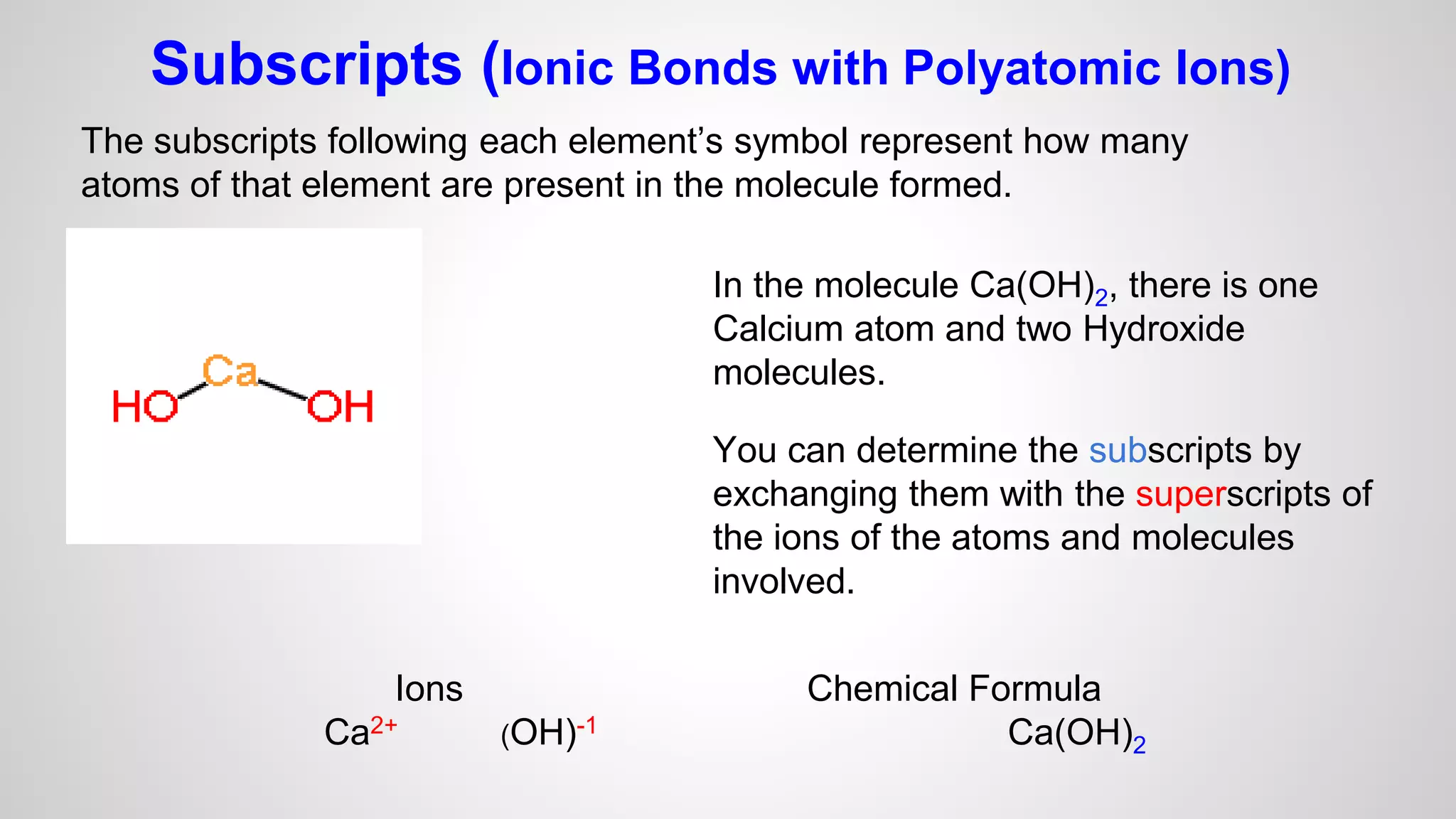
In the molecule Ca(OH)2, there is one 
Calcium atom and two Hydroxide 
molecules. 
You can determine the subscripts by 
exchanging them with the superscripts of 
the ions of the atoms and molecules 
involved. 
Ions Chemical Formula 
Ca2+ (OH)-1 Ca(OH)2

Chapter2

  • 1.
  • 2.
    Vocabulary ● Ion ● Valence Electrons ● Electron Orbitals ● Neutral Atom ● Chemical Bond ● Ionic Bond ● Covalent Bond ● Polar Covalent Bond ● Nonpolar Covalent Bond ● Polyatomic Ion ● Electronegativity ● Molecule ● Double Bond ● Triple Bond
  • 3.
  • 6.
    All elements wantto have a complete set of valence electrons; elements will react until they have a complete set. A complete set consists of eight electrons, this explains why Noble gases do not react. Helium is a Noble gas, even though its outer shell only has two electrons. Helium outer shell only accepts two electrons, therefore its set of valence electrons is complete; it will not react.
  • 7.
  • 8.
    Ions Atoms maylose or gain electrons in order to have a complete outer shell. When an element loses an electron(-), it becomes positively charged. This is because it now has more protons (+) than electrons (-). Conversely, when an element gains an electron(-), it becomes negatively charged. This is because it now has more electrons (-) than protons (+) .
  • 9.
    Valence Electrons &Ions The number of electrons lost, or gained, depends on the valence electrons of the element. (The outer shell) Sodium has one valence electron(outer shell), and the shell beneath has eight. If it loses the one valence electron, the shell underneath becomes the outer shell with eight electrons. The same concept applies to Magnesium. The difference is that Magnesium has two valence electrons.
  • 10.
    Valence Electrons &Ions Nature is lazy… Chlorine Imagine you have to pay 1,000$ pesos to move each electron. Electron Store . . . . . . . . Calcium can: 1 move two away and leave the shell beneath with eight electrons, or (2) it can move six to itself. Option 1 - 2,000$ Option 2 - 6,000$ Option 1 - 7,000$ Chlorine can: (1) move seven away and leave the shell beneath with eight, or (2) it can move one to itself. Option 2 - 1,000$
  • 11.
    Valence Electrons &Natural Ions Metals and transitional metals have a small number of valence electrons *Remember the group number tells you the number of valence electrons the element has. Metals lose electrons because they cannot “afford” to gain a large number of electrons. Calcium does not have enough protons to attract six electrons.
  • 12.
    Valence Electrons &Natural Ions Nonmetals have a large number of valence electrons. Nonmetals tend to complete their outer shell by attracting electrons from other elements with their protons. *Remember the group number tells you the number of valence electrons the element has. Chlorine only needs one more electron to complete its outer shell.
  • 13.
    Natural Ions Atomsmay lose or gain electrons in order to have a complete outer shell. When an element loses an electron(-), it becomes positively charged. This is because it now has more protons (+) than electrons (-). Conversely, when an element gains an electron(-), it becomes negatively charged. This is because it now has more electrons (-) than protons (+) .
  • 14.
    Valence Electrons &Natural Ions Atoms may lose or gain electrons in order to have a complete outer shell. In summary, the ion that an atom forms depends on its valence electrons *(Identifiable by the atoms group number). This will determine the type of bonds the atom will form.
  • 15.
  • 16.
    ● Metal +Nonmetal ○ Na + Cl NaCl (Chemical Change? Pure Substance?) ■ Sodium (*Metal) losses an electron and become a cation Na+ ■ Calcium (Nonmetal) gains an election and becomes an anion Cl- ■ These changes allow both Na and Cl to have 8 electrons in their outermost shells Ionic Bonds
  • 18.
    Draw Lewis DotStructure CaF2 : BeF2 Natural Ions Be, F ? Draw the Lewis Dot Structure of the following Ionic Bonds:
  • 19.
    Subscripts The subscriptsfollowing each element’s symbol represent how many atoms of that element are present in the molecule formed. In the molecule BeF2 , there is one Beryllium atom and two Fluorine atoms. You can determine the subscripts by exchanging them with the superscripts of the natural ions of the elements involved. Natural Ions Chemical Formula Be2+ F1- BeF2
  • 20.
    Covalent Bonds Whentwo neutral nonmetals share electrons they form a covalent bond. **NOT Ions In covalent bonds, atoms do not lose nor gain electrons; they share them in order to complete their valence electrons.
  • 21.
    CH4 ClH NH3 Methane has four Hydrogen atoms, Hydrogen Chloride has one, and Ammonia has three. Why?? Elements rarely exist on their own; they normally have reacted with another element, sometimes with an identical atom. Only Noble Gases exist unbonded to another element. Why??
  • 22.
    Subscripts The subscriptsfollowing each element’s symbol represent how many atoms of that element are present in the molecule formed. In the molecule H2O, there are two Hydrogen atoms and one Oxygen atom. You can determine the subscripts by exchanging them with the superscripts of the natural ions of the elements involved. Natural Ions Chemical Formula H1+ O-2 H2O
  • 23.
    Polyatomic Ions Apolyatomic ion is an ion formed with two or more atoms. When a covalent bond (Two or more Nonmetals) forms, and the resulting number of electrons and protons is not equal, an ion with two or more atoms is formed. (OH)- (CN)- (NH4)+
  • 24.
    Polyatomic Ions Polyatomic Ion Hydroxide Cyanide Ammonium Protons (+) 6 (O) + 1 (H) = 7+ 4 (C ) + 1 (N) = 5+ 5(N) + 4 (H) = 9+ Electrons (-) 6(O) + 1 (H) + 1 (?) = 8- 4 (C ) + 5 (N) + 1 (?) = 10- 5(N) + 3 (H) = 8- Charge 1- 3- 1+ Once polyatomic ions have formed, they “act” as one atom and form ionic bonds with metals. **Ionic bonds with polyatomic ions work the same way as ionic bonds between metals and nonmetals.
  • 26.
    Ionic Bonds withPolyatomic Ions K(NO3) Ca(OH)2 (NH4)2(CO3) I K+ Ca2+ (NH)+ 4O N (NO)- (OH)- (CO)2- S 33**Like “regular” ionic bonds, the number of atoms present and the combination in ionic bonds with polyatomic ions depends on the type of ion each atom and polyatomic molecule forms.
  • 27.
    Ionic Bonds withPolyatomic Ions **Like “regular” ionic bonds, the number of atoms present and the combination in ionic bonds with polyatomic ions depends on the type of ion each atom and polyatomic molecule forms. In English…. Do these combinations equal 0?? 3+ 2- = 1+ 1+ 2- = 1- 4+ 1- = 3+ 1+ 1- = 0 2+ 1-x2 (2-) = 0 1+x 2(2+) 2- = 0 Atoms want to be happy. To be happy they need to be neutral, have no charge. They combine with other atoms until they are happy(have no charge). Atoms do not quit easily; they form complicated combinations as long as they can be happy.
  • 28.
    Ionic Bonds withPolyatomic 1+ 1- = 0 2+ 1-x2 (2-) = 0 1+x 2(2+) 2- = 0 K+ (NO3)- = K(NO3) Ca2+ (OH)- = Ca(OH)2 (NH4)+ (CO3)2- = (NH4)2(CO3) Ions
  • 29.
    Subscripts (Ionic Bondswith Polyatomic Ions) The subscripts following each element’s symbol represent how many atoms of that element are present in the molecule formed. In the molecule Ca(OH)2, there is one Calcium atom and two Hydroxide molecules. You can determine the subscripts by exchanging them with the superscripts of the ions of the atoms and molecules involved. Ions Chemical Formula Ca2+ (OH)-1 Ca(OH)2