CHAPTER 5 :
CHEMICAL BOND
FORM 4
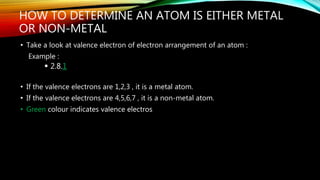
HOW TO DETERMINE AN ATOM IS EITHER METAL
OR NON-METAL
• Take a look at valence electron of electron arrangement of an atom :
Example :
 2.8.1
• If the valence electrons are 1,2,3 , it is a metal atom.
• If the valence electrons are 4,5,6,7 , it is a non-metal atom.
• Green colour indicates valence electros
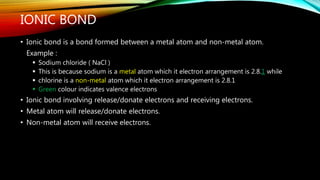
IONIC BOND
• Ionic bond is a bond formed between a metal atom and non-metal atom.
Example :
 Sodium chloride ( NaCl )
 This is because sodium is a metal atom which it electron arrangement is 2.8.1 while
 chlorine is a non-metal atom which it electron arrangement is 2.8.1
 Green colour indicates valence electrons
• Ionic bond involving release/donate electrons and receiving electrons.
• Metal atom will release/donate electrons.
• Non-metal atom will receive electrons.
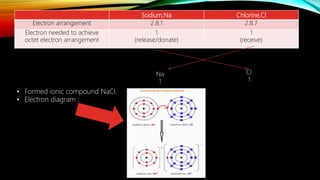
Sodium,Na Chlorine,Cl
Electron arrangement 2.8.1 2.8.7
Electron needed to achieve
octet electron arrangement
1
(release/donate)
1
(receive)
Na
1
Cl
1
• Formed ionic compound NaCl.
• Electron diagram :
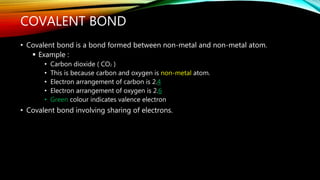
COVALENT BOND
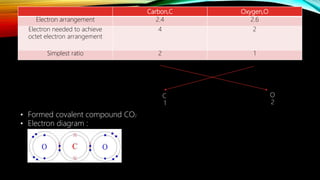
• Covalent bond is a bond formed between non-metal and non-metal atom.
 Example :
• Carbon dioxide ( CO2 )
• This is because carbon and oxygen is non-metal atom.
• Electron arrangement of carbon is 2.4
• Electron arrangement of oxygen is 2.6
• Green colour indicates valence electron
• Covalent bond involving sharing of electrons.
Carbon,C Oxygen,O
Electron arrangement 2.4 2.6
Electron needed to achieve
octet electron arrangement
4 2
Simplest ratio 2 1
O
2
C
1
• Formed covalent compound CO2
• Electron diagram :
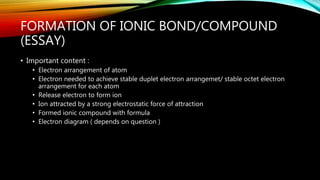
FORMATION OF IONIC BOND/COMPOUND
(ESSAY)
• Important content :
• Electron arrangement of atom
• Electron needed to achieve stable duplet electron arrangemet/ stable octet electron
arrangement for each atom
• Release electron to form ion
• Ion attracted by a strong electrostatic force of attraction
• Formed ionic compound with formula
• Electron diagram ( depends on question )
EXAMPLE
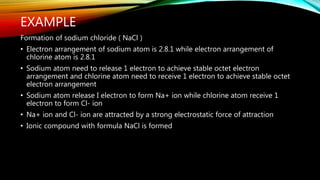
Formation of sodium chloride ( NaCl )
• Electron arrangement of sodium atom is 2.8.1 while electron arrangement of
chlorine atom is 2.8.1
• Sodium atom need to release 1 electron to achieve stable octet electron
arrangement and chlorine atom need to receive 1 electron to achieve stable octet
electron arrangement
• Sodium atom release I electron to form Na+ ion while chlorine atom receive 1
electron to form Cl- ion
• Na+ ion and Cl- ion are attracted by a strong electrostatic force of attraction
• Ionic compound with formula NaCl is formed
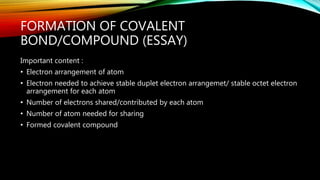
FORMATION OF COVALENT
BOND/COMPOUND (ESSAY)
Important content :
• Electron arrangement of atom
• Electron needed to achieve stable duplet electron arrangemet/ stable octet electron
arrangement for each atom
• Number of electrons shared/contributed by each atom
• Number of atom needed for sharing
• Formed covalent compound
EXAMPLE
Formation of tetrachloromethane ( CCl4 )
• The electron arrangement of carbon atom is 2.4 while electron arrangement of
chlorine atom is 2.8.7
• Carbon atom need 4 electrons to achieve stable octet electron arrangement while
chlorine atom need 1 electron to achieve stable octet electron arrangement.
• 1 carbon atom share/contribute 4 electrons for sharing and 1 chlorine atom
share/contribute 1 electron for sharing.
• 1 carbon atom share/contribute 4 electron for sharing and 4 chlorine atom
share/contribute 4 electrons for sharing.
• Covalent compound CCl4 is formed

Chapter 5 chemical bond

  • 1.
  • 2.
    HOW TO DETERMINEAN ATOM IS EITHER METAL OR NON-METAL • Take a look at valence electron of electron arrangement of an atom : Example :  2.8.1 • If the valence electrons are 1,2,3 , it is a metal atom. • If the valence electrons are 4,5,6,7 , it is a non-metal atom. • Green colour indicates valence electros
  • 3.
    IONIC BOND • Ionicbond is a bond formed between a metal atom and non-metal atom. Example :  Sodium chloride ( NaCl )  This is because sodium is a metal atom which it electron arrangement is 2.8.1 while  chlorine is a non-metal atom which it electron arrangement is 2.8.1  Green colour indicates valence electrons • Ionic bond involving release/donate electrons and receiving electrons. • Metal atom will release/donate electrons. • Non-metal atom will receive electrons.
  • 4.
    Sodium,Na Chlorine,Cl Electron arrangement2.8.1 2.8.7 Electron needed to achieve octet electron arrangement 1 (release/donate) 1 (receive) Na 1 Cl 1 • Formed ionic compound NaCl. • Electron diagram :
  • 5.
    COVALENT BOND • Covalentbond is a bond formed between non-metal and non-metal atom.  Example : • Carbon dioxide ( CO2 ) • This is because carbon and oxygen is non-metal atom. • Electron arrangement of carbon is 2.4 • Electron arrangement of oxygen is 2.6 • Green colour indicates valence electron • Covalent bond involving sharing of electrons.
  • 6.
    Carbon,C Oxygen,O Electron arrangement2.4 2.6 Electron needed to achieve octet electron arrangement 4 2 Simplest ratio 2 1 O 2 C 1 • Formed covalent compound CO2 • Electron diagram :
  • 7.
    FORMATION OF IONICBOND/COMPOUND (ESSAY) • Important content : • Electron arrangement of atom • Electron needed to achieve stable duplet electron arrangemet/ stable octet electron arrangement for each atom • Release electron to form ion • Ion attracted by a strong electrostatic force of attraction • Formed ionic compound with formula • Electron diagram ( depends on question )
  • 8.
    EXAMPLE Formation of sodiumchloride ( NaCl ) • Electron arrangement of sodium atom is 2.8.1 while electron arrangement of chlorine atom is 2.8.1 • Sodium atom need to release 1 electron to achieve stable octet electron arrangement and chlorine atom need to receive 1 electron to achieve stable octet electron arrangement • Sodium atom release I electron to form Na+ ion while chlorine atom receive 1 electron to form Cl- ion • Na+ ion and Cl- ion are attracted by a strong electrostatic force of attraction • Ionic compound with formula NaCl is formed
  • 9.
    FORMATION OF COVALENT BOND/COMPOUND(ESSAY) Important content : • Electron arrangement of atom • Electron needed to achieve stable duplet electron arrangemet/ stable octet electron arrangement for each atom • Number of electrons shared/contributed by each atom • Number of atom needed for sharing • Formed covalent compound
  • 10.
    EXAMPLE Formation of tetrachloromethane( CCl4 ) • The electron arrangement of carbon atom is 2.4 while electron arrangement of chlorine atom is 2.8.7 • Carbon atom need 4 electrons to achieve stable octet electron arrangement while chlorine atom need 1 electron to achieve stable octet electron arrangement. • 1 carbon atom share/contribute 4 electrons for sharing and 1 chlorine atom share/contribute 1 electron for sharing. • 1 carbon atom share/contribute 4 electron for sharing and 4 chlorine atom share/contribute 4 electrons for sharing. • Covalent compound CCl4 is formed