Types of Chemical Bonding
Ionic Bonds
Covalent Bonds
Hydrogen Bonds
Ionic Bonds
An Ionic bond is when an electron leaves
one atom and exothermically enters into
orbit around another. These to oppositely
charged ions now attract each other.
Ionic bonds are generally formed between
metals and nonmetals
© iTutor. 2000-2013. All Rights Reserved
Example of Ionic Bond
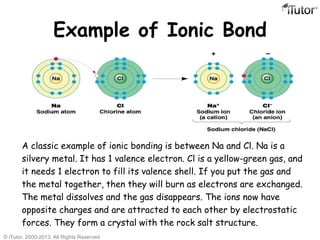
A classic example of ionic bonding is between Na and Cl. Na is a
silvery metal. It has 1 valence electron. Cl is a yellow-green gas, and
it needs 1 electron to fill its valence shell. If you put the gas and
the metal together, then they will burn as electrons are exchanged.
The metal dissolves and the gas disappears. The ions now have
opposite charges and are attracted to each other by electrostatic
forces. They form a crystal with the rock salt structure.
© iTutor. 2000-2013. All Rights Reserved
Covalent Bonds
A type of chemical bond in which there is
mutual sharing of electrons between two
atoms is called covalent bond. It is
further classified into single, double, and
triple covalent bond with respect to
mutual sharing of one, two, and three
bonds respectively.
© iTutor. 2000-2013. All Rights Reserved
Example of Covalent Bond
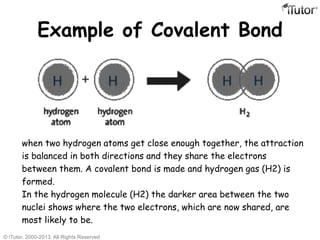
when two hydrogen atoms get close enough together, the attraction
is balanced in both directions and they share the electrons
between them. A covalent bond is made and hydrogen gas (H2) is
formed.
In the hydrogen molecule (H2) the darker area between the two
nuclei shows where the two electrons, which are now shared, are
most likely to be.
© iTutor. 2000-2013. All Rights Reserved
Hydrogen Bonds
A hydrogen bond is the attractive force
between the hydrogen attached to an
electronegative atom of one molecule and
an electronegative atom of a different
molecule.
Usually the electronegative atom is
oxygen, nitrogen, or fluorine, which has a
partial negative charge.
© iTutor. 2000-2013. All Rights Reserved
Example of Hydrogen Bond
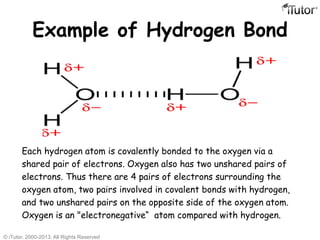
Each hydrogen atom is covalently bonded to the oxygen via a
shared pair of electrons. Oxygen also has two unshared pairs of
electrons. Thus there are 4 pairs of electrons surrounding the
oxygen atom, two pairs involved in covalent bonds with hydrogen,
and two unshared pairs on the opposite side of the oxygen atom.
Oxygen is an "electronegative“ atom compared with hydrogen.
© iTutor. 2000-2013. All Rights Reserved

Chemicalbonding

  • 1.
    Types of ChemicalBonding Ionic Bonds Covalent Bonds Hydrogen Bonds
  • 2.
    Ionic Bonds An Ionicbond is when an electron leaves one atom and exothermically enters into orbit around another. These to oppositely charged ions now attract each other. Ionic bonds are generally formed between metals and nonmetals © iTutor. 2000-2013. All Rights Reserved
  • 3.
    Example of IonicBond A classic example of ionic bonding is between Na and Cl. Na is a silvery metal. It has 1 valence electron. Cl is a yellow-green gas, and it needs 1 electron to fill its valence shell. If you put the gas and the metal together, then they will burn as electrons are exchanged. The metal dissolves and the gas disappears. The ions now have opposite charges and are attracted to each other by electrostatic forces. They form a crystal with the rock salt structure. © iTutor. 2000-2013. All Rights Reserved
  • 4.
    Covalent Bonds A typeof chemical bond in which there is mutual sharing of electrons between two atoms is called covalent bond. It is further classified into single, double, and triple covalent bond with respect to mutual sharing of one, two, and three bonds respectively. © iTutor. 2000-2013. All Rights Reserved
  • 5.
    Example of CovalentBond when two hydrogen atoms get close enough together, the attraction is balanced in both directions and they share the electrons between them. A covalent bond is made and hydrogen gas (H2) is formed. In the hydrogen molecule (H2) the darker area between the two nuclei shows where the two electrons, which are now shared, are most likely to be. © iTutor. 2000-2013. All Rights Reserved
  • 6.
    Hydrogen Bonds A hydrogenbond is the attractive force between the hydrogen attached to an electronegative atom of one molecule and an electronegative atom of a different molecule. Usually the electronegative atom is oxygen, nitrogen, or fluorine, which has a partial negative charge. © iTutor. 2000-2013. All Rights Reserved
  • 7.
    Example of HydrogenBond Each hydrogen atom is covalently bonded to the oxygen via a shared pair of electrons. Oxygen also has two unshared pairs of electrons. Thus there are 4 pairs of electrons surrounding the oxygen atom, two pairs involved in covalent bonds with hydrogen, and two unshared pairs on the opposite side of the oxygen atom. Oxygen is an "electronegative“ atom compared with hydrogen. © iTutor. 2000-2013. All Rights Reserved