Understanding Chemical Reactions Lesson Covalent bonding
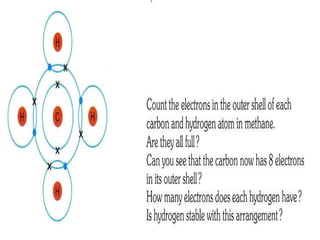
Covalent bonding REMEMBER! Two non-metals can both  gain electrons by sharing ! If their outer shells overlap, they share some of each other’s electrons. This ‘satisfies’ both atoms.
Covalent bonding Shared electrons form  covalent bonds  between non-metal atoms.
 
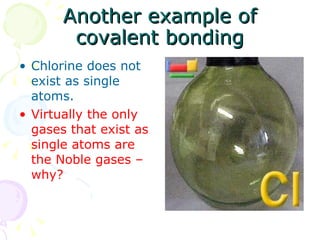
Another example of covalent bonding Chlorine does not exist as single atoms. Virtually the only gases that exist as single atoms are the Noble gases – why?
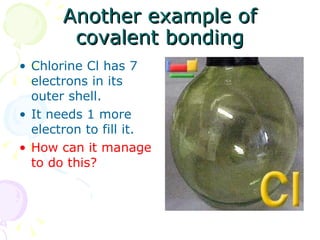
Another example of covalent bonding Chlorine Cl has 7 electrons in its outer shell. It needs 1 more electron to fill it. How can it manage to do this?
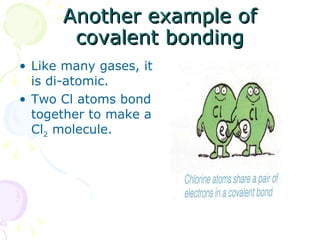
Another example of covalent bonding Like many gases, it is di-atomic. Two Cl atoms bond together to make a Cl 2  molecule.
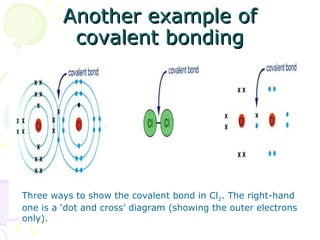
Another example of covalent bonding Three ways to show the covalent bond in Cl 2 . The right-hand one is a ‘dot and cross’ diagram (showing the outer electrons only).
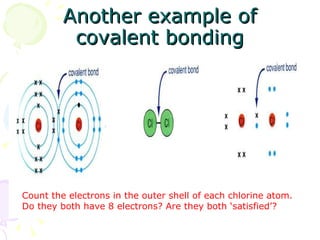
Another example of covalent bonding Count the electrons in the outer shell of each chlorine atom. Do they both have 8 electrons? Are they both ‘satisfied’?
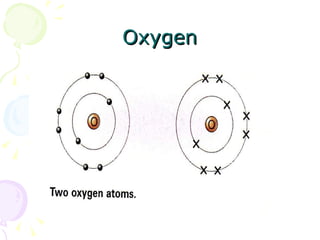
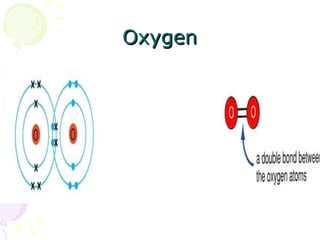
Oxygen Oxygen, like hydrogen and chlorine exists as a di-atomic molecule. Each oxygen atom has six electrons in the outer shell – two electrons short of the stable electron arrangement of a Noble gas.
Oxygen
Oxygen Each oxygen atom gives  two  electrons to be shared, so this makes two covalent bonds (called a  double bond ).
Oxygen
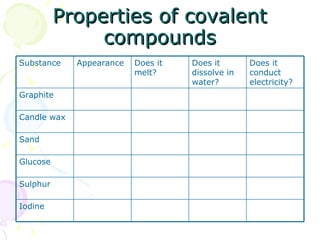
Properties of covalent compounds Iodine Sulphur Glucose Sand Candle wax Graphite Does it conduct electricity? Does it dissolve in water? Does it melt? Appearance Substance
Properties of covalent compounds involving 2, 3, 4 or 5 non-metal atoms bonded together to form a molecule. They are usually gases  (think methane, ammonia) Their melting points are low They are poor conductors of electricity They do not dissolve easily in water  (except HCl) They dissolve well in organic solvents
Properties of covalent compounds involving 2, 3, 4 or 5 non-metal atoms bonded together to form a molecule. The bonds within the covalent molecules are  very strong . But the particles have no electric charge There are only  very weak  forces between the molecules. This explains their low melting and boiling points.
Properties of covalent compounds involving 2, 3, 4 or 5 non-metal atoms bonded together to form a molecule. Small molecules form gases at room temperature. Larger molecules may be liquids or soft solids.
Properties of covalent compounds involving 2, 3, 4 or 5 non-metal atoms bonded together to form a molecule. Sulphur reacts with oxygen to form sulphur dioxide (SO 2 ) molecules. Is this likely to be a solid, liquid or gas?
Giant covalent structures Use the CHEMISTRY text book Read page 120 – 121 (up to but not including the section on ‘Plastics’). Answer the following questions in your own words…..
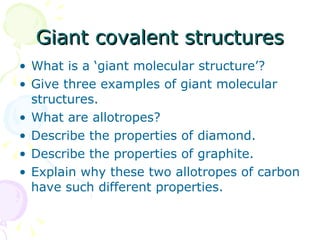
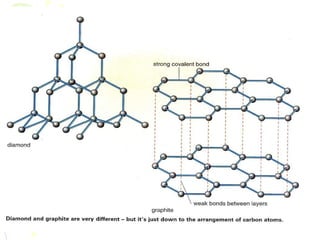
Giant covalent structures What is a ‘giant molecular structure’? Give three examples of giant molecular structures. What are allotropes? Describe the properties of diamond. Describe the properties of graphite. Explain why these two allotropes of carbon have such different properties.


Covalent Bond

  • 1.
    Understanding Chemical ReactionsLesson Covalent bonding
  • 2.
    Covalent bonding REMEMBER!Two non-metals can both gain electrons by sharing ! If their outer shells overlap, they share some of each other’s electrons. This ‘satisfies’ both atoms.
  • 3.
    Covalent bonding Sharedelectrons form covalent bonds between non-metal atoms.
  • 4.
  • 5.
    Another example ofcovalent bonding Chlorine does not exist as single atoms. Virtually the only gases that exist as single atoms are the Noble gases – why?
  • 6.
    Another example ofcovalent bonding Chlorine Cl has 7 electrons in its outer shell. It needs 1 more electron to fill it. How can it manage to do this?
  • 7.
    Another example ofcovalent bonding Like many gases, it is di-atomic. Two Cl atoms bond together to make a Cl 2 molecule.
  • 8.
    Another example ofcovalent bonding Three ways to show the covalent bond in Cl 2 . The right-hand one is a ‘dot and cross’ diagram (showing the outer electrons only).
  • 9.
    Another example ofcovalent bonding Count the electrons in the outer shell of each chlorine atom. Do they both have 8 electrons? Are they both ‘satisfied’?
  • 10.
    Oxygen Oxygen, likehydrogen and chlorine exists as a di-atomic molecule. Each oxygen atom has six electrons in the outer shell – two electrons short of the stable electron arrangement of a Noble gas.
  • 11.
  • 12.
    Oxygen Each oxygenatom gives two electrons to be shared, so this makes two covalent bonds (called a double bond ).
  • 13.
  • 14.
    Properties of covalentcompounds Iodine Sulphur Glucose Sand Candle wax Graphite Does it conduct electricity? Does it dissolve in water? Does it melt? Appearance Substance
  • 15.
    Properties of covalentcompounds involving 2, 3, 4 or 5 non-metal atoms bonded together to form a molecule. They are usually gases (think methane, ammonia) Their melting points are low They are poor conductors of electricity They do not dissolve easily in water (except HCl) They dissolve well in organic solvents
  • 16.
    Properties of covalentcompounds involving 2, 3, 4 or 5 non-metal atoms bonded together to form a molecule. The bonds within the covalent molecules are very strong . But the particles have no electric charge There are only very weak forces between the molecules. This explains their low melting and boiling points.
  • 17.
    Properties of covalentcompounds involving 2, 3, 4 or 5 non-metal atoms bonded together to form a molecule. Small molecules form gases at room temperature. Larger molecules may be liquids or soft solids.
  • 18.
    Properties of covalentcompounds involving 2, 3, 4 or 5 non-metal atoms bonded together to form a molecule. Sulphur reacts with oxygen to form sulphur dioxide (SO 2 ) molecules. Is this likely to be a solid, liquid or gas?
  • 19.
    Giant covalent structuresUse the CHEMISTRY text book Read page 120 – 121 (up to but not including the section on ‘Plastics’). Answer the following questions in your own words…..
  • 20.
    Giant covalent structuresWhat is a ‘giant molecular structure’? Give three examples of giant molecular structures. What are allotropes? Describe the properties of diamond. Describe the properties of graphite. Explain why these two allotropes of carbon have such different properties.
  • 21.
  • 22.