
Transformation through new
e-pedagogies – the future of learning
     Gráinne Conole, University of Leicester
                 MOOC 2012
                   6th – 9th
                     2012
Outline
•   The evolving landscape of e-learning
•   Affordances of new technologies
•   From Gutenberg to Zuckerberg
•   Learner experience
•   New pedagogies and implications
•   Open practices
•   Teacher practice and paradoxes
•   Strategies for change
    – Intervention framework: linking
      research to policy and practice
    – The LMS as a Trojan horse
    – New approaches to design
Research questions
• What:
  – Is the learner experience and teacher practice?
  – Are the emergent technologies and their affordances?
  – Resources, OER and Pedagogical Patterns are there and
    how are they been used?
  – E-Pedagogies are there and how do they facilitate
    different forms of learning?
  – New learning design approaches can be used to
    promote and support e-learning?
  – Strategies are in place to promote and support e-
    learning?
  – Theories and methodologies are been used?
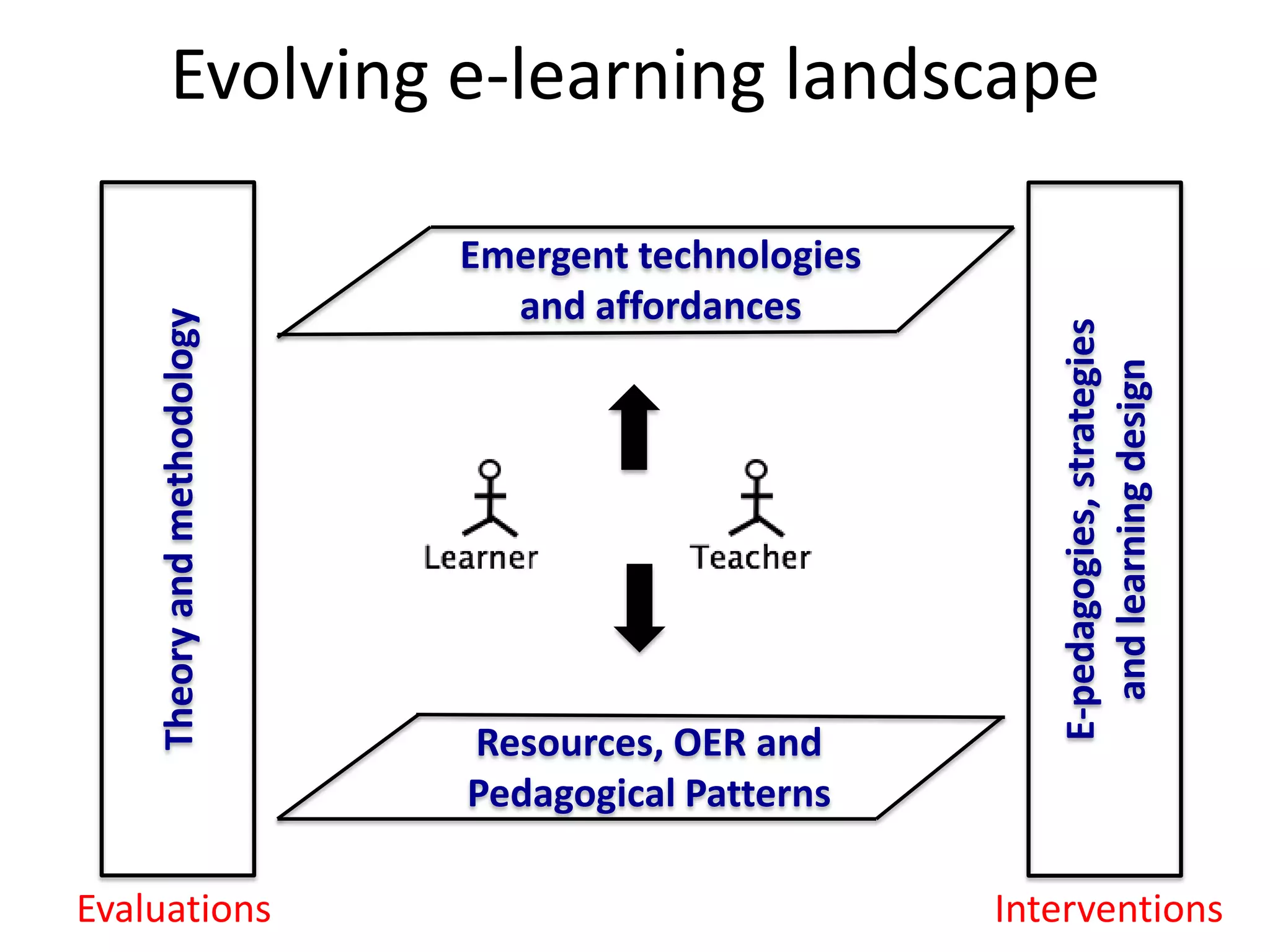
Evolving e-learning landscape

                             Emergent technologies
                               and affordances
    Theory and methodology


                                                        E-pedagogies, strategies
                                                          and learning design
                             Resources, OER and
                             Pedagogical Patterns

Evaluations                                          Interventions
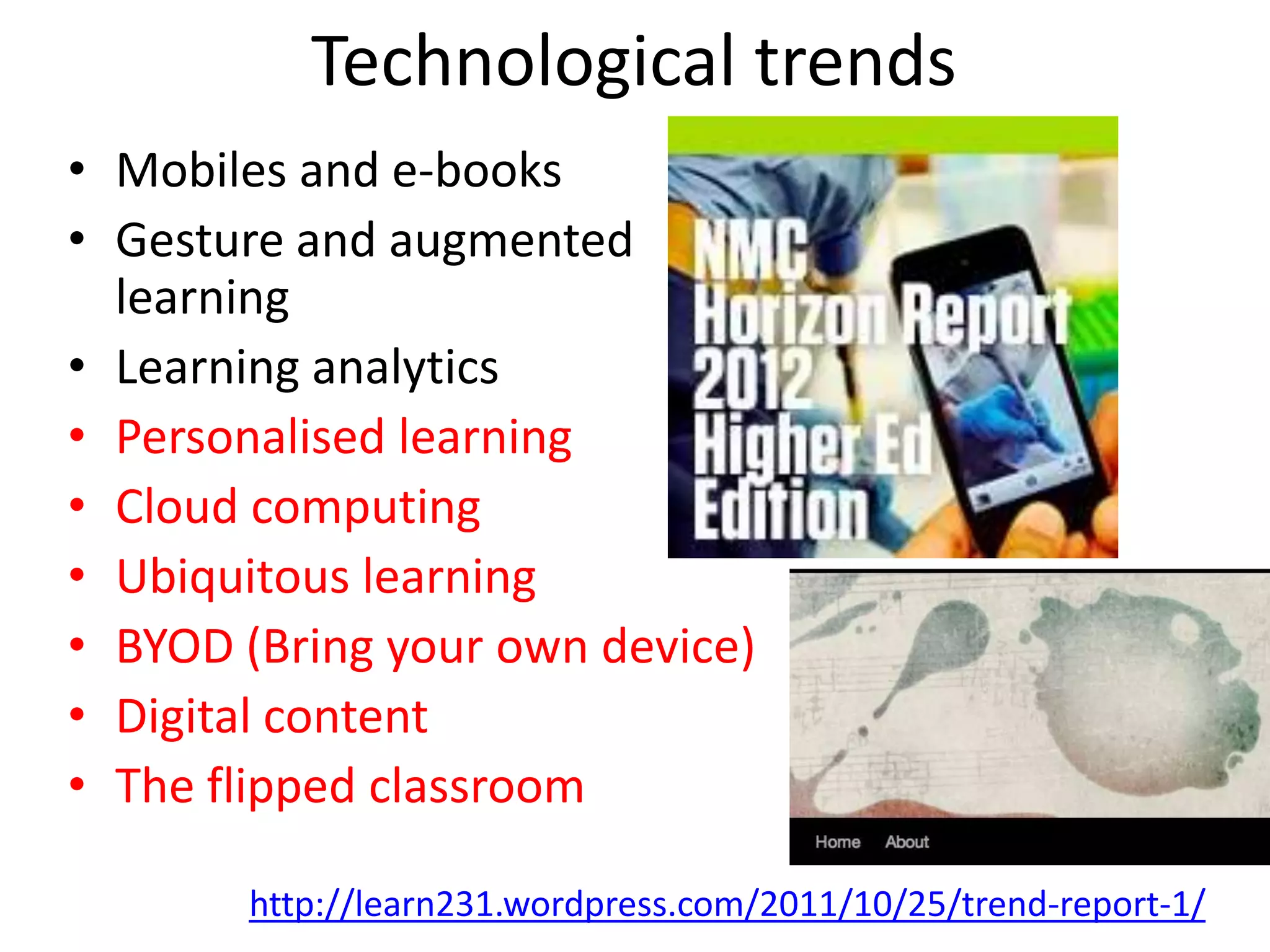
Technological trends
• Mobiles and e-books
• Gesture and augmented
  learning
• Learning analytics
• Personalised learning
• Cloud computing
• Ubiquitous learning
• BYOD (Bring your own device)
• Digital content
• The flipped classroom

       http://learn231.wordpress.com/2011/10/25/trend-report-1/
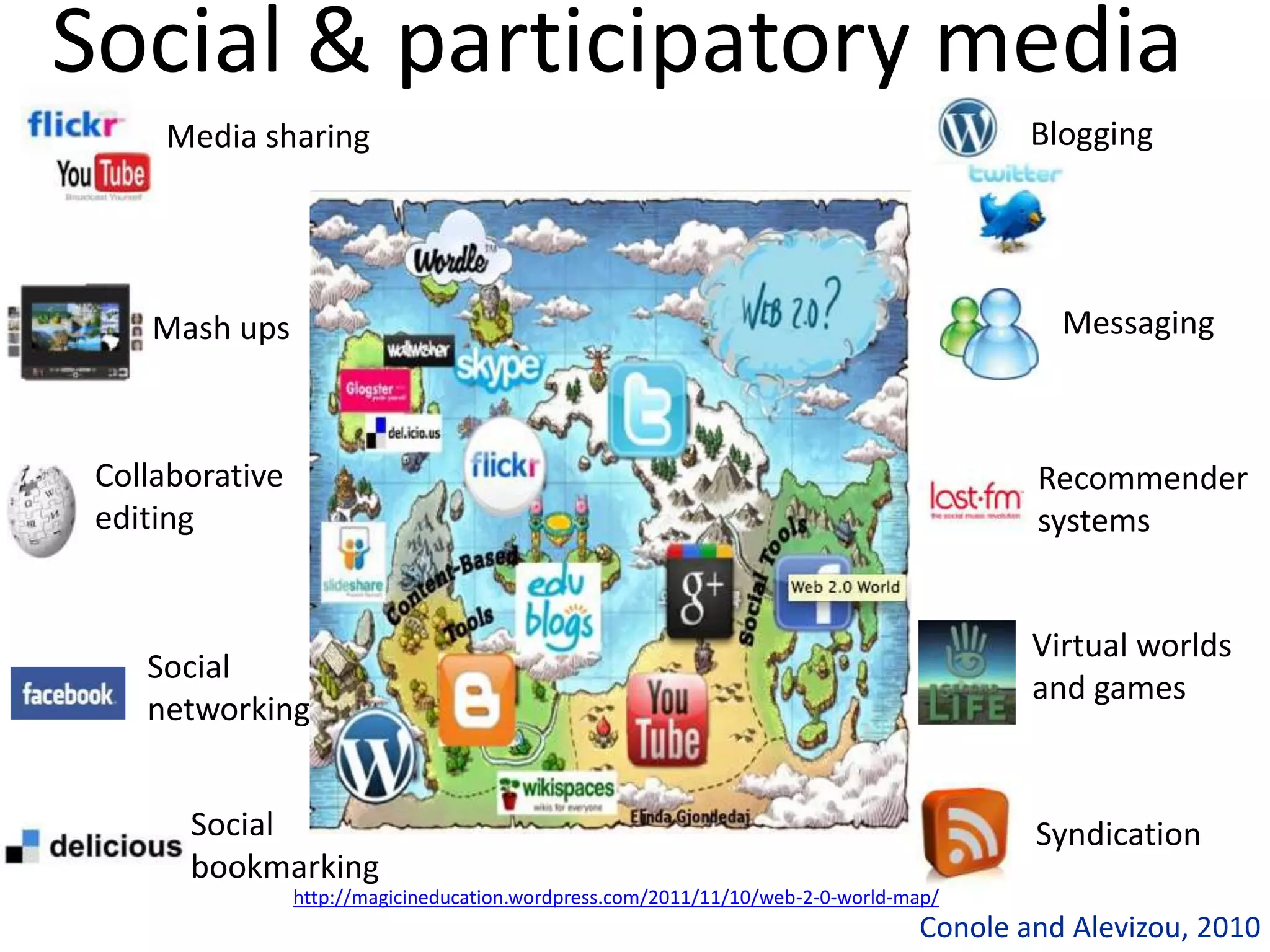
Social & participatory media
        Media sharing                                                                       Blogging


       Mash ups                                                                               Messaging


    Collaborative                                                                           Recommender
    editing                                                                                 systems


                                                                                            Virtual worlds
       Social
                                                                                            and games
       networking


          Social                                                                            Syndication
          bookmarking
                    http://magicineducation.wordpress.com/2011/11/10/web-2-0-world-map/
6
                                                                                    Conole and Alevizou, 2010
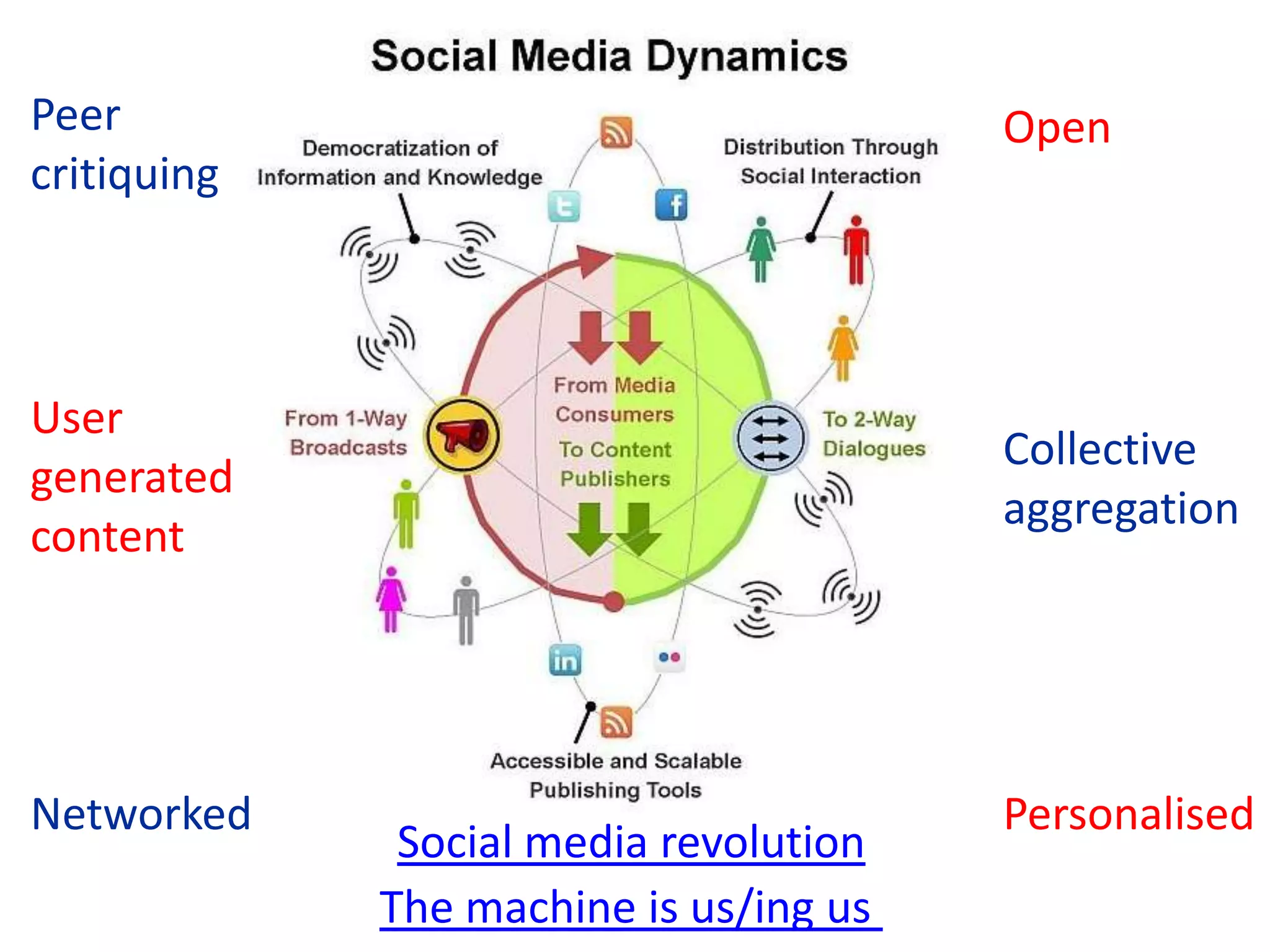
Peer                                    Open
critiquing


User
                                        Collective
generated
                                        aggregation
content


Networked                               Personalised
              Social media revolution
             The machine is us/ing us
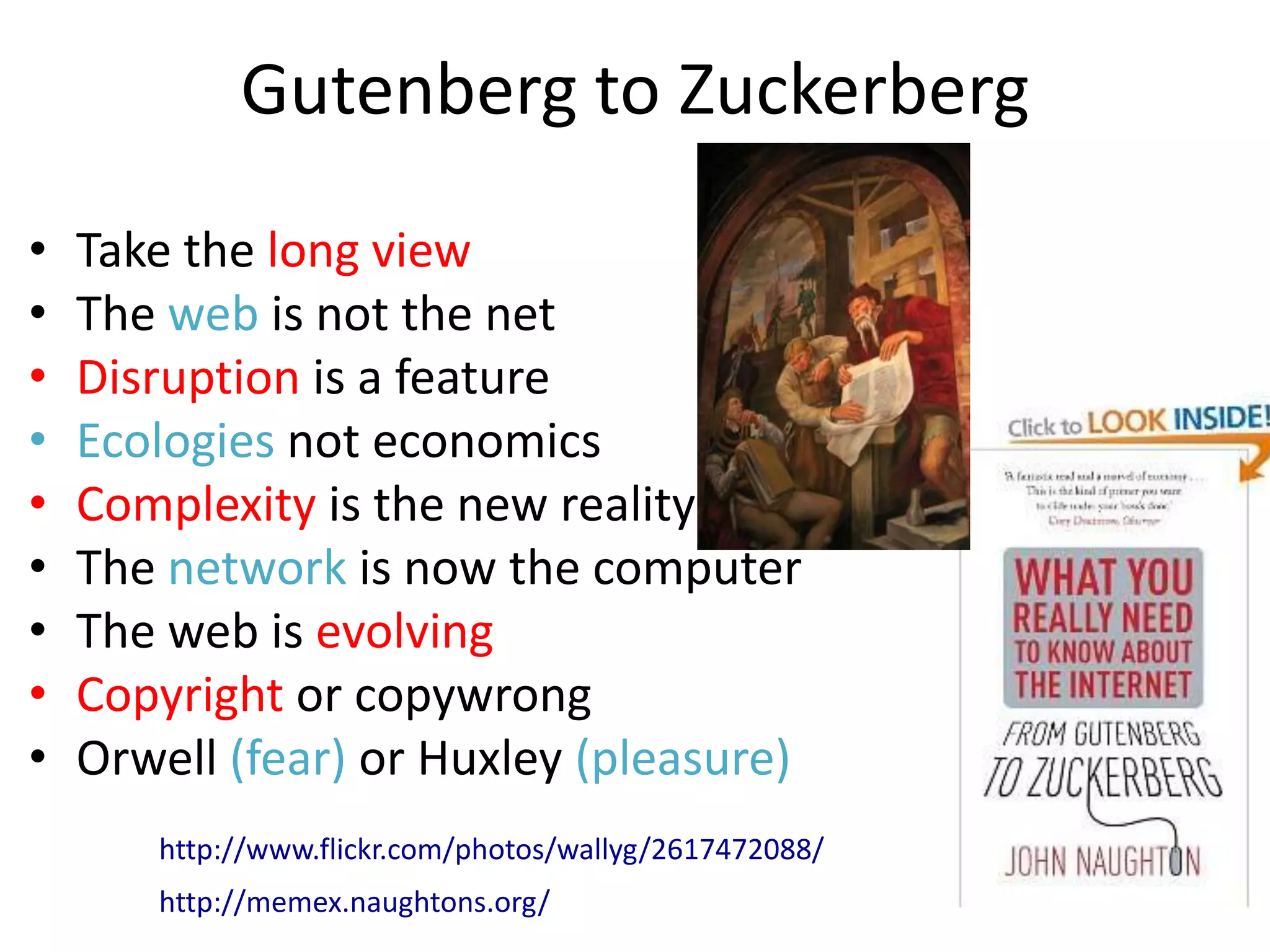
Gutenberg to Zuckerberg
•   Take the long view
•   The web is not the net
•   Disruption is a feature
•   Ecologies not economics
•   Complexity is the new reality
•   The network is now the computer
•   The web is evolving
•   Copyright or copywrong
•   Orwell (fear) or Huxley (pleasure)
       http://www.flickr.com/photos/wallyg/2617472088/
       http://memex.naughtons.org/
Disruptive technologies
• The web has transformed
  practice
• No central ownership
• Ecology of abundance
• Examples
  – Napster
  – Malware
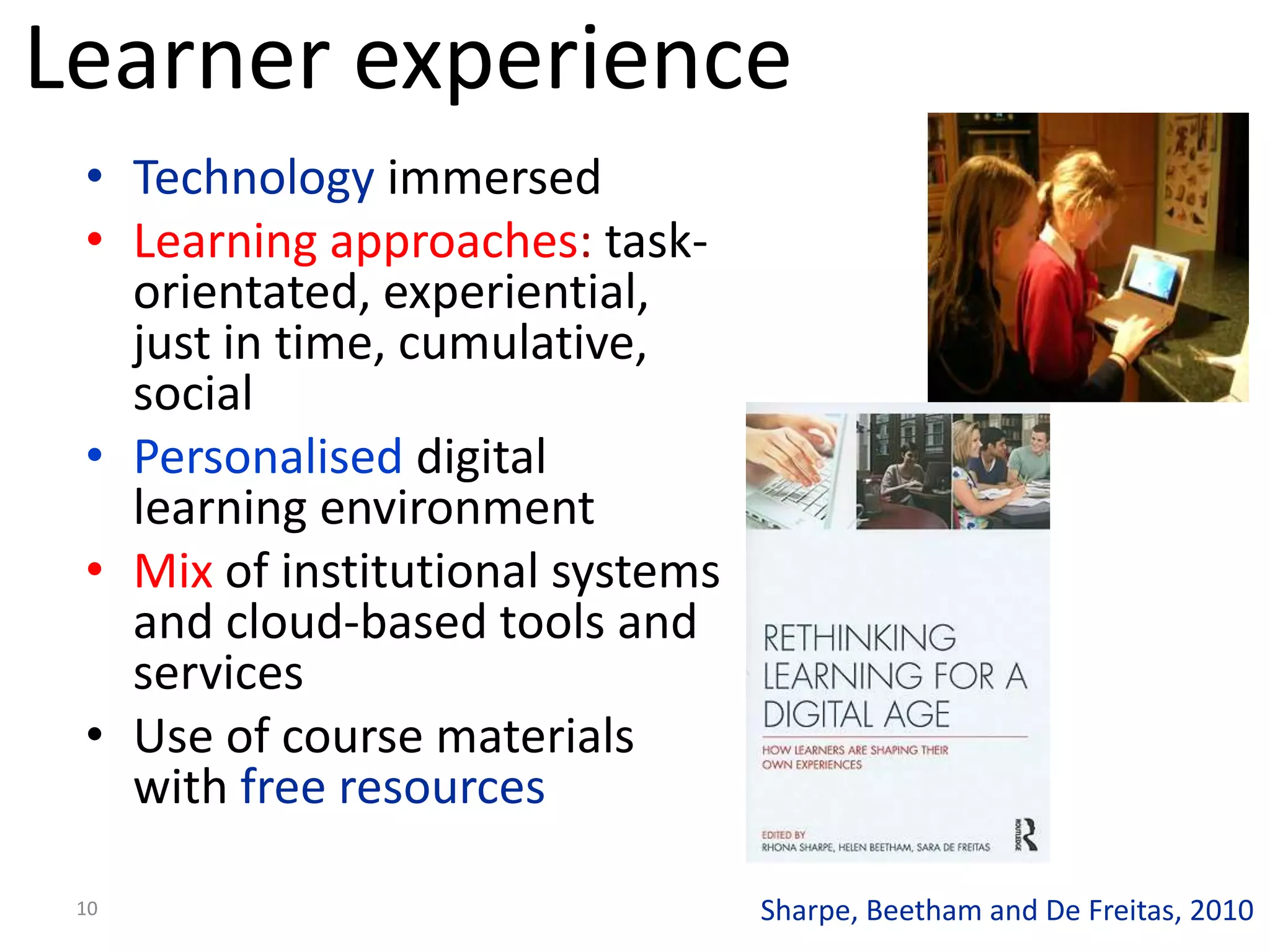
Learner experience
 • Technology immersed
 • Learning approaches: task-
   orientated, experiential,
   just in time, cumulative,
   social
 • Personalised digital
   learning environment
 • Mix of institutional systems
   and cloud-based tools and
   services
 • Use of course materials
   with free resources

 10                               Sharpe, Beetham and De Freitas, 2010
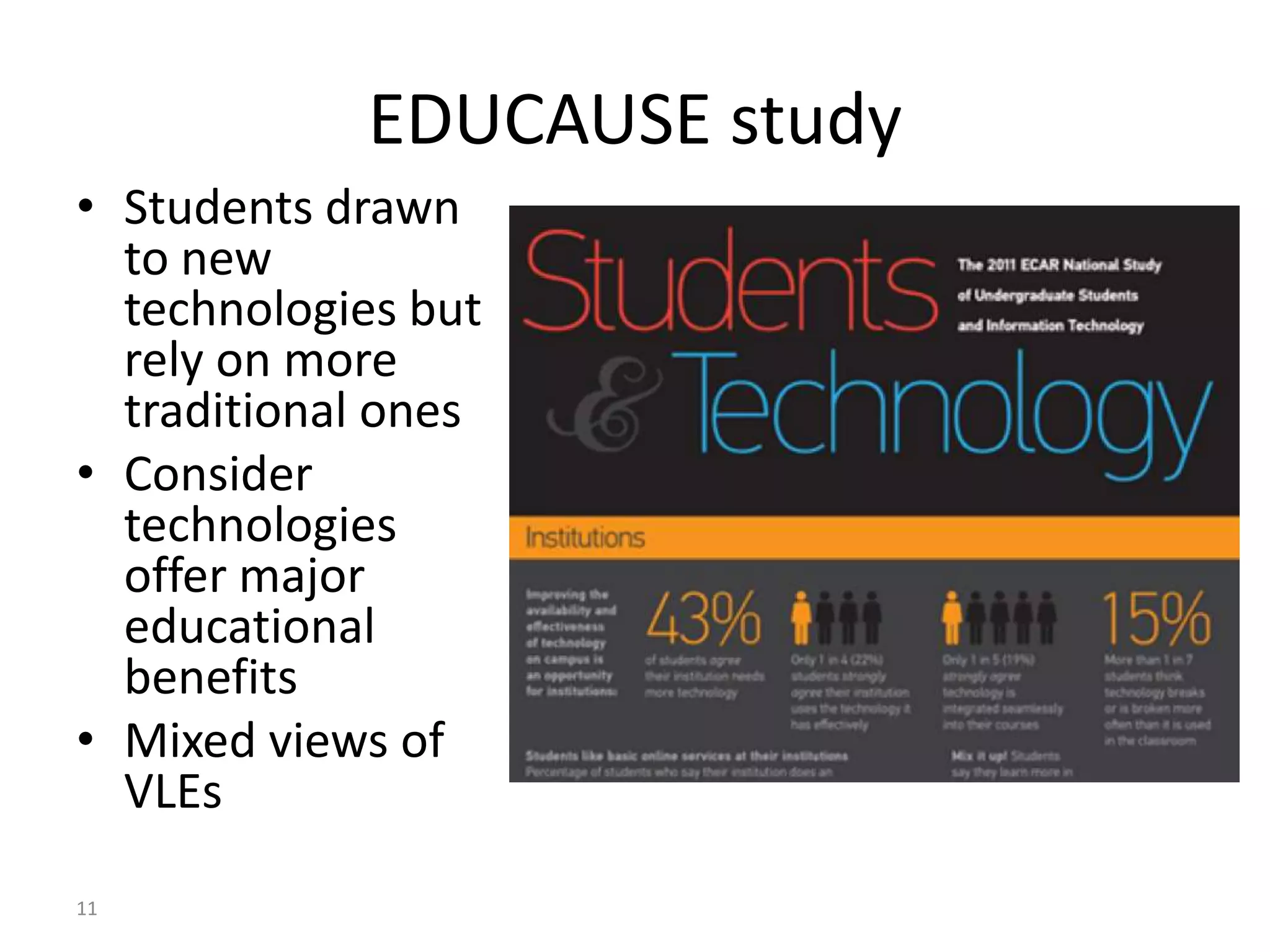
EDUCAUSE study
• Students drawn
  to new
  technologies but
  rely on more
  traditional ones
• Consider
  technologies
  offer major
  educational
  benefits
• Mixed views of
  VLEs

11
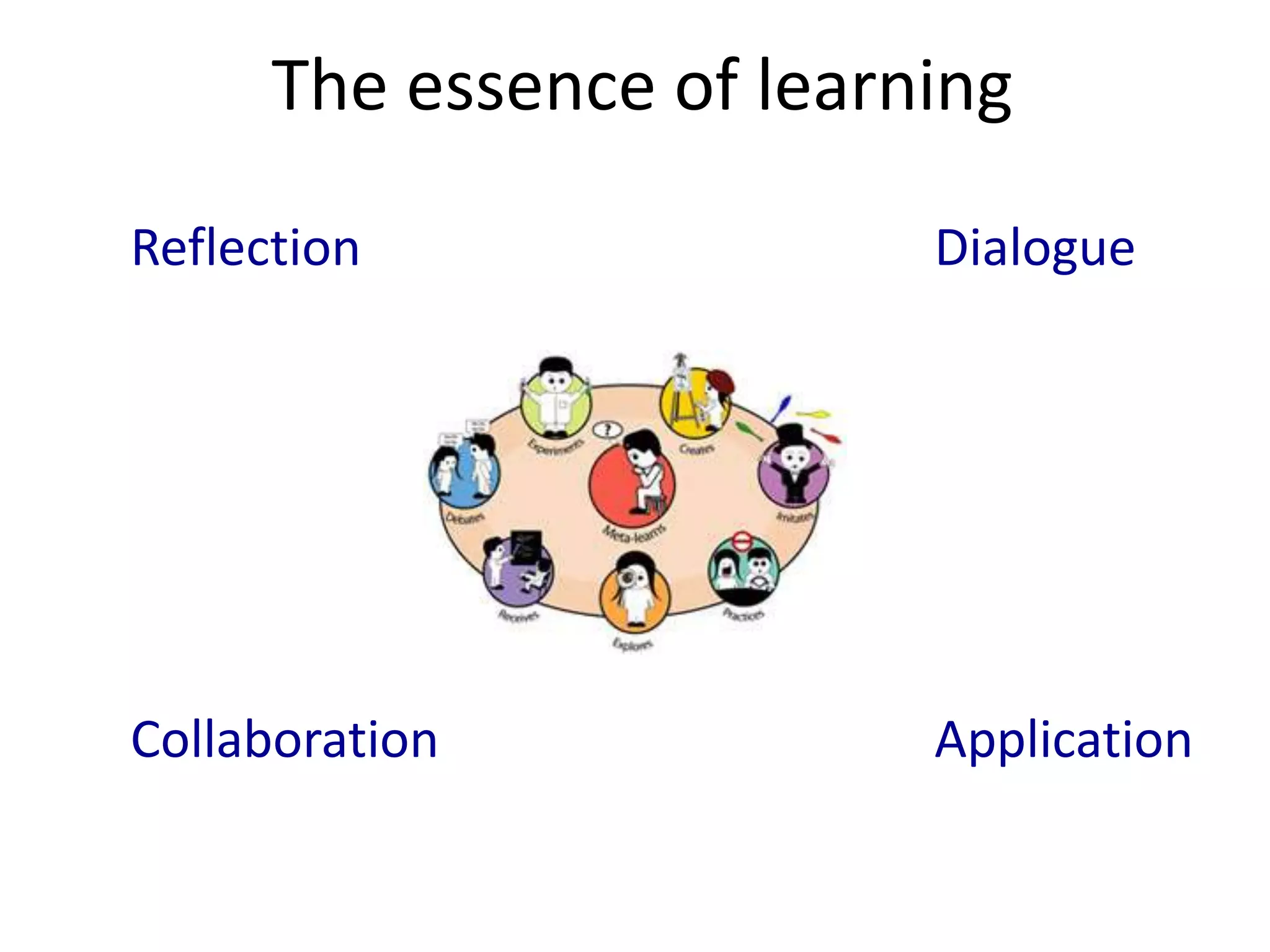
The essence of learning

Reflection                Dialogue


Collaboration             Application
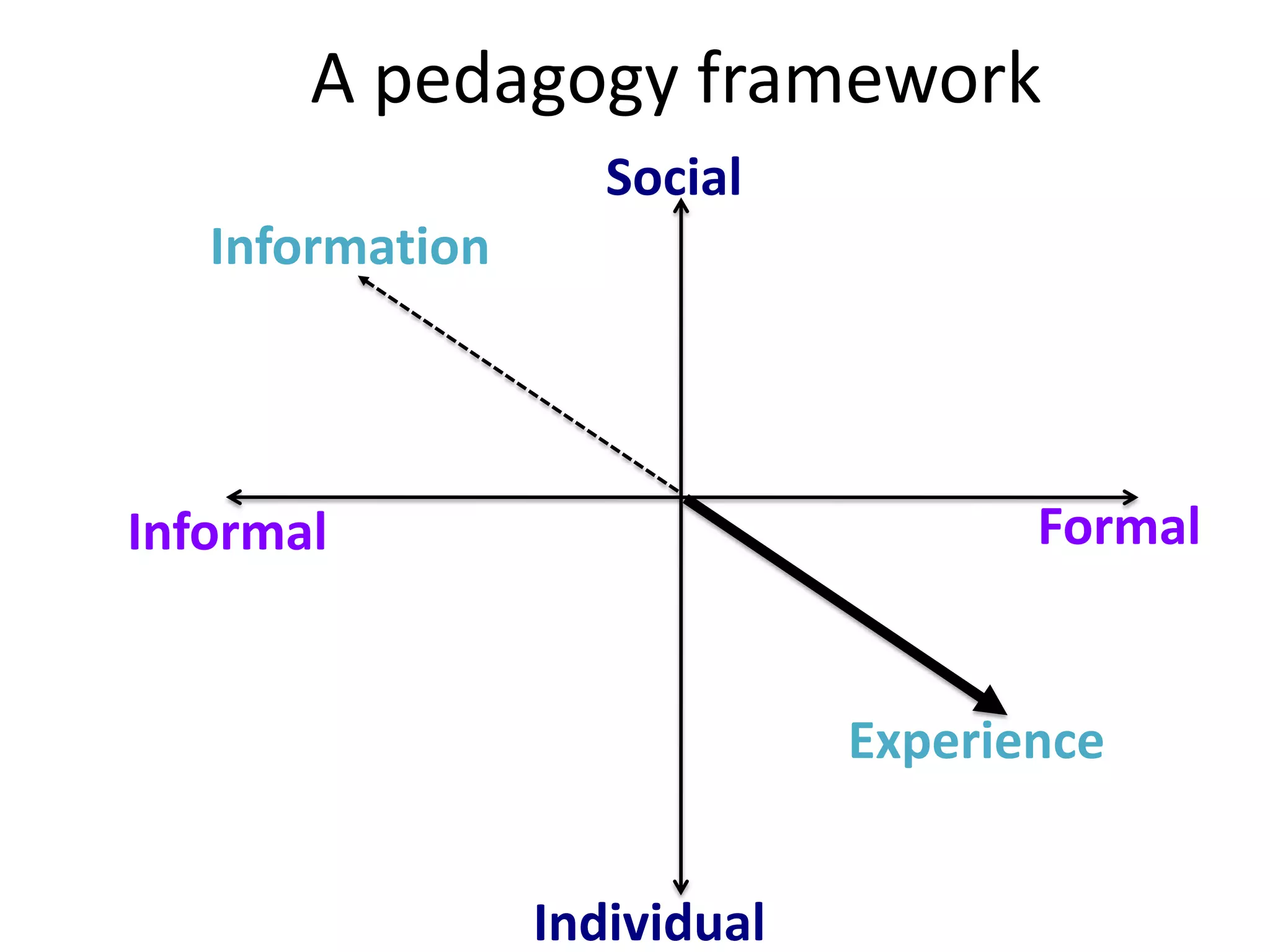
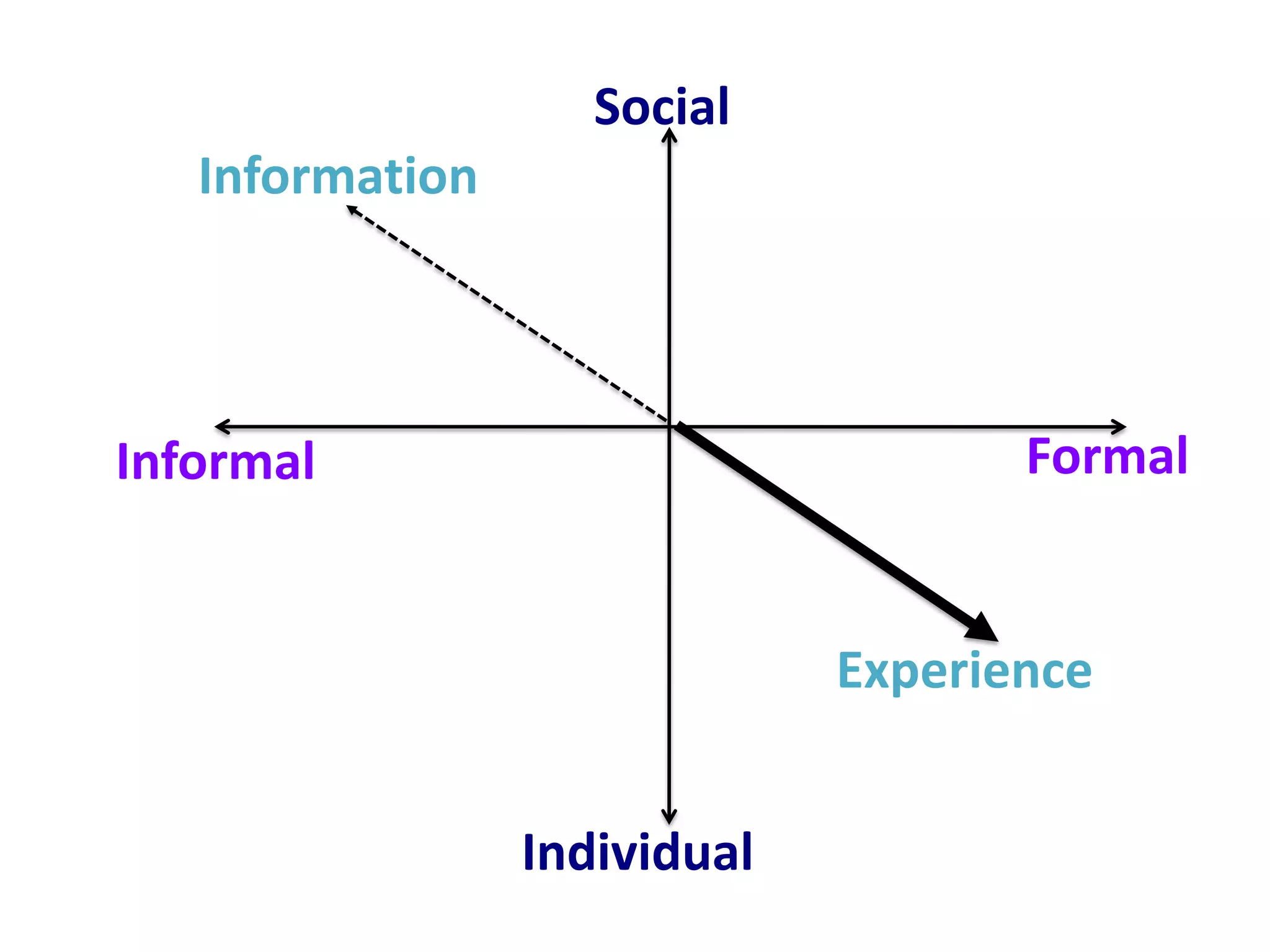
A pedagogy framework
                    Social
   Information


Informal                             Formal


                              Experience


                 Individual
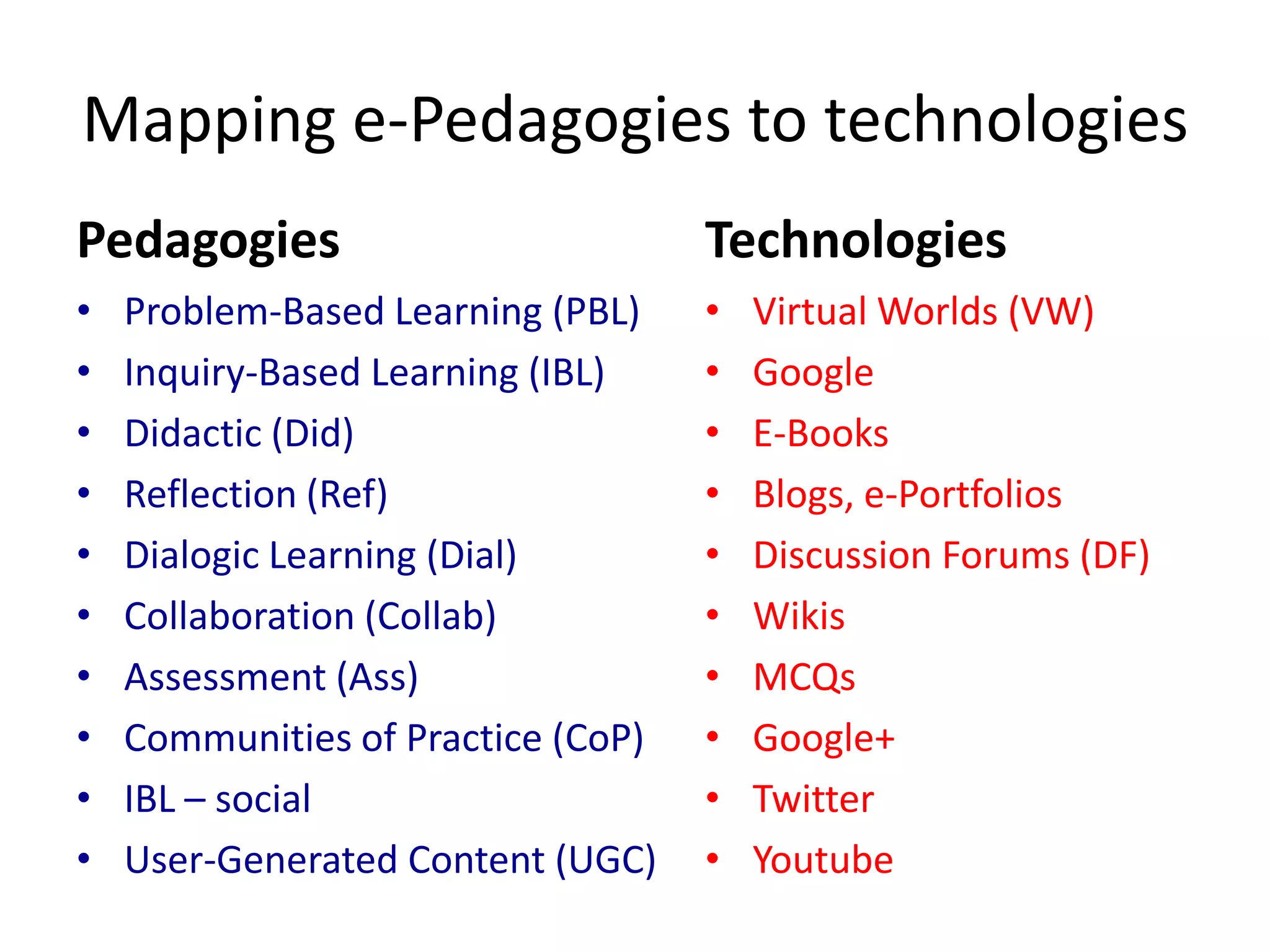
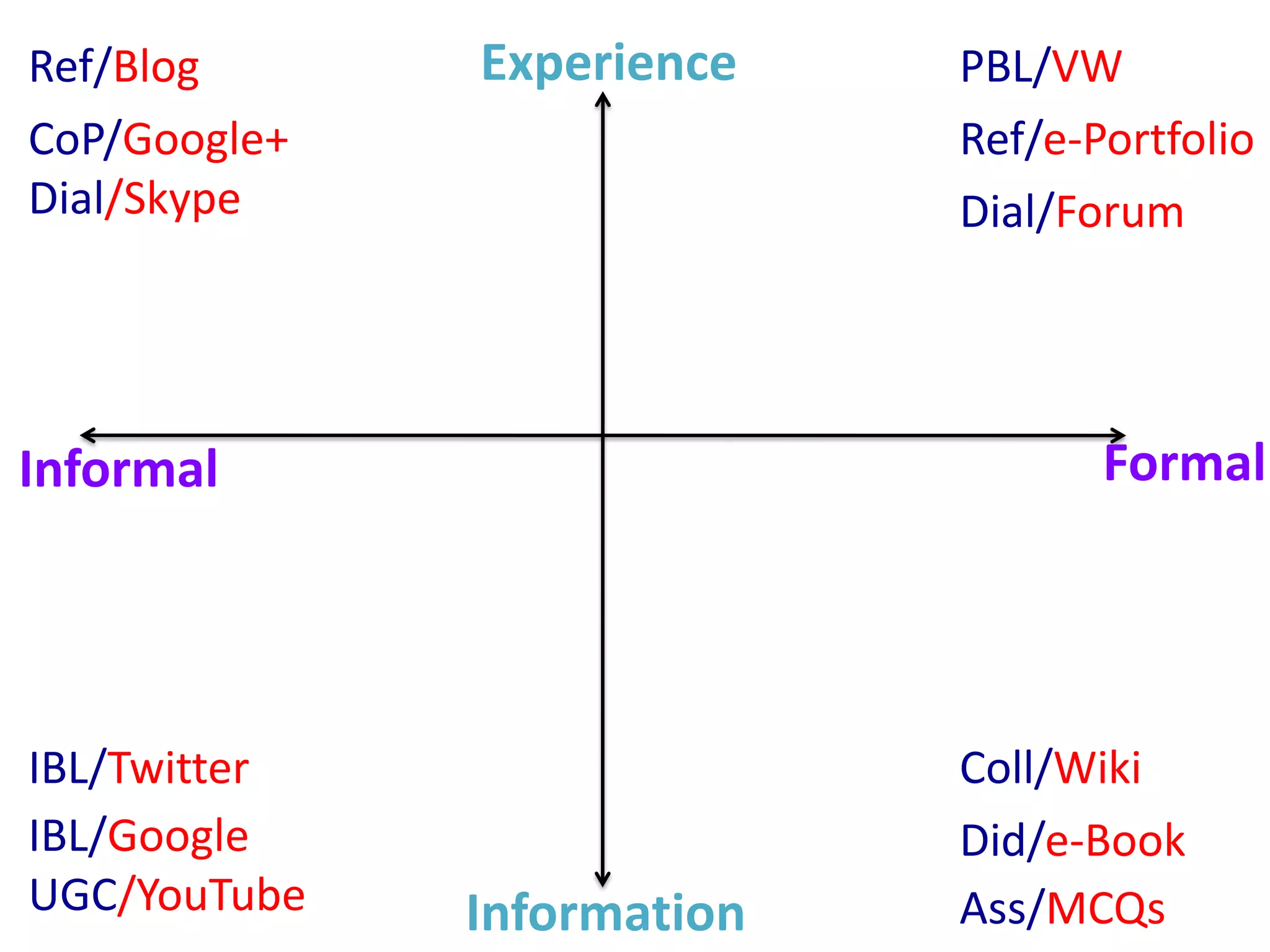
Mapping e-Pedagogies to technologies
Pedagogies                          Technologies
•   Problem-Based Learning (PBL)    •   Virtual Worlds (VW)
•   Inquiry-Based Learning (IBL)    •   Google
•   Didactic (Did)                  •   E-Books
•   Reflection (Ref)                •   Blogs, e-Portfolios
•   Dialogic Learning (Dial)        •   Discussion Forums (DF)
•   Collaboration (Collab)          •   Wikis
•   Assessment (Ass)                •   MCQs
•   Communities of Practice (CoP)   •   Google+
•   IBL – social                    •   Twitter
•   User-Generated Content (UGC)    •   Youtube
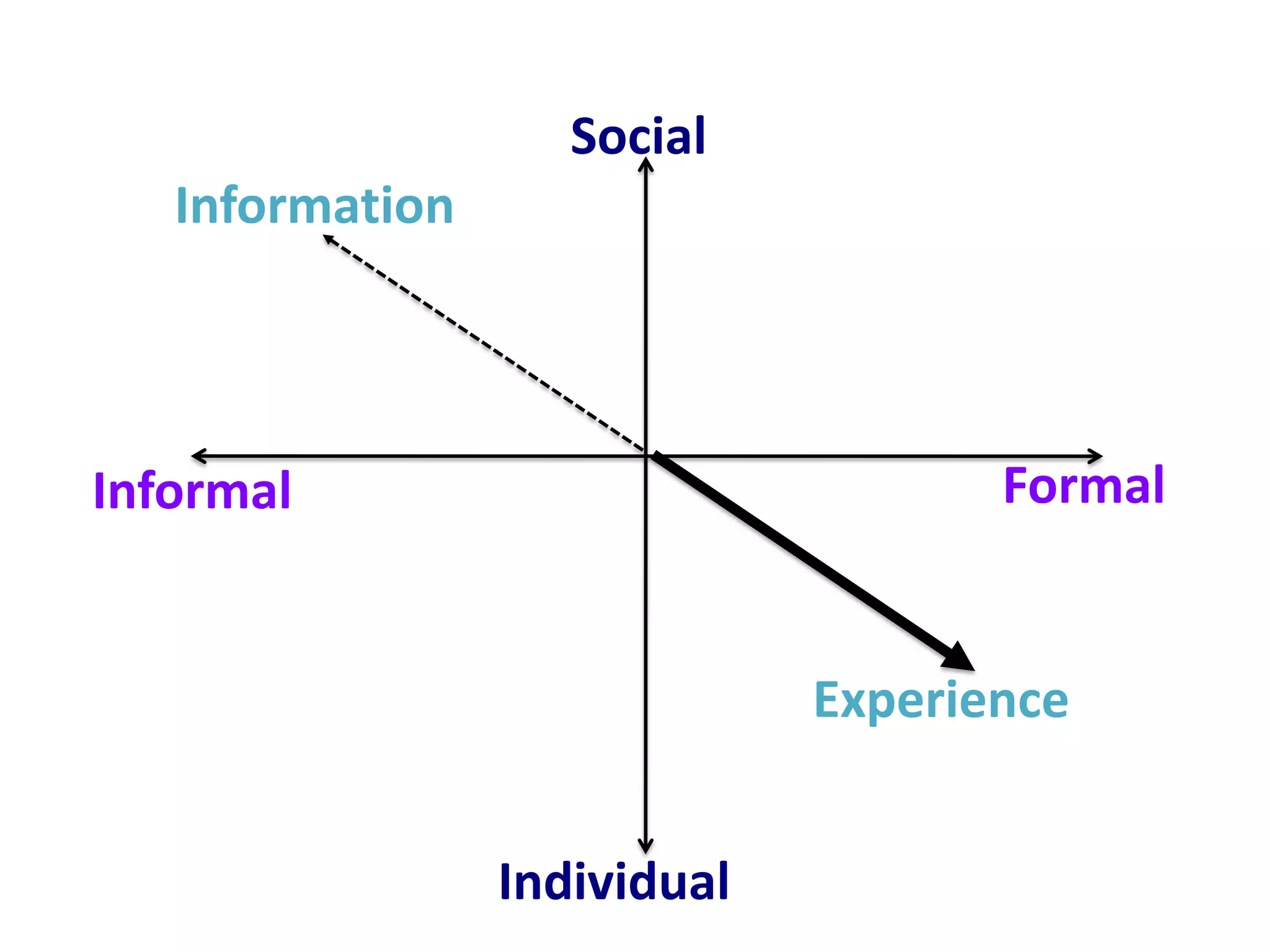
Social
   Information


Informal                             Formal


                              Experience


                 Individual
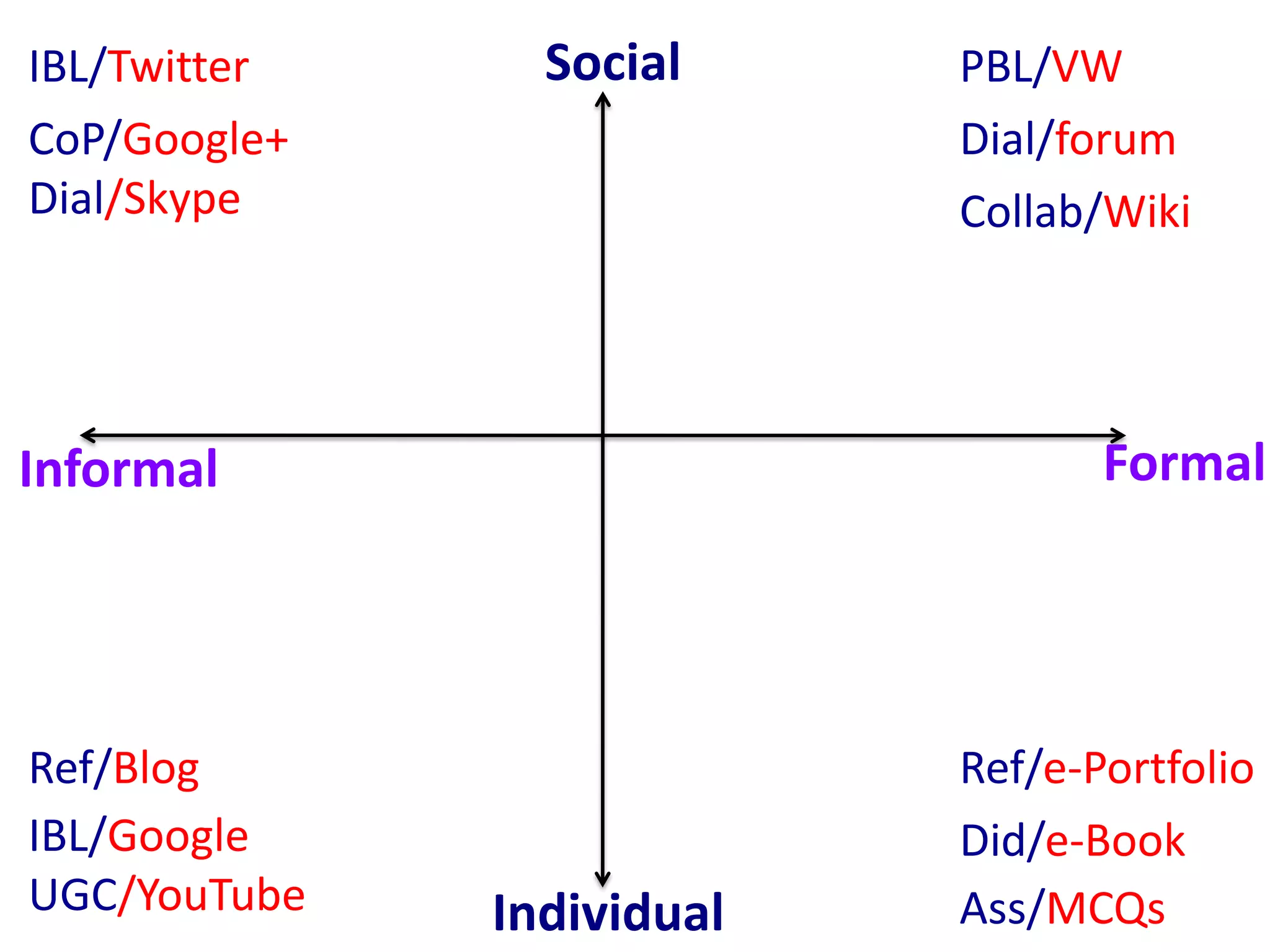
IBL/Twitter     Social     PBL/VW
CoP/Google+                Dial/forum
Dial/Skype                 Collab/Wiki


Informal                          Formal


Ref/Blog                   Ref/e-Portfolio
IBL/Google                 Did/e-Book
UGC/YouTube   Individual   Ass/MCQs
Social
   Information


Informal                             Formal


                              Experience


                 Individual
Ref/Blog      Experience    PBL/VW
CoP/Google+                 Ref/e-Portfolio
Dial/Skype                  Dial/Forum


Informal                           Formal


IBL/Twitter                 Coll/Wiki
IBL/Google                  Did/e-Book
UGC/YouTube   Information   Ass/MCQs
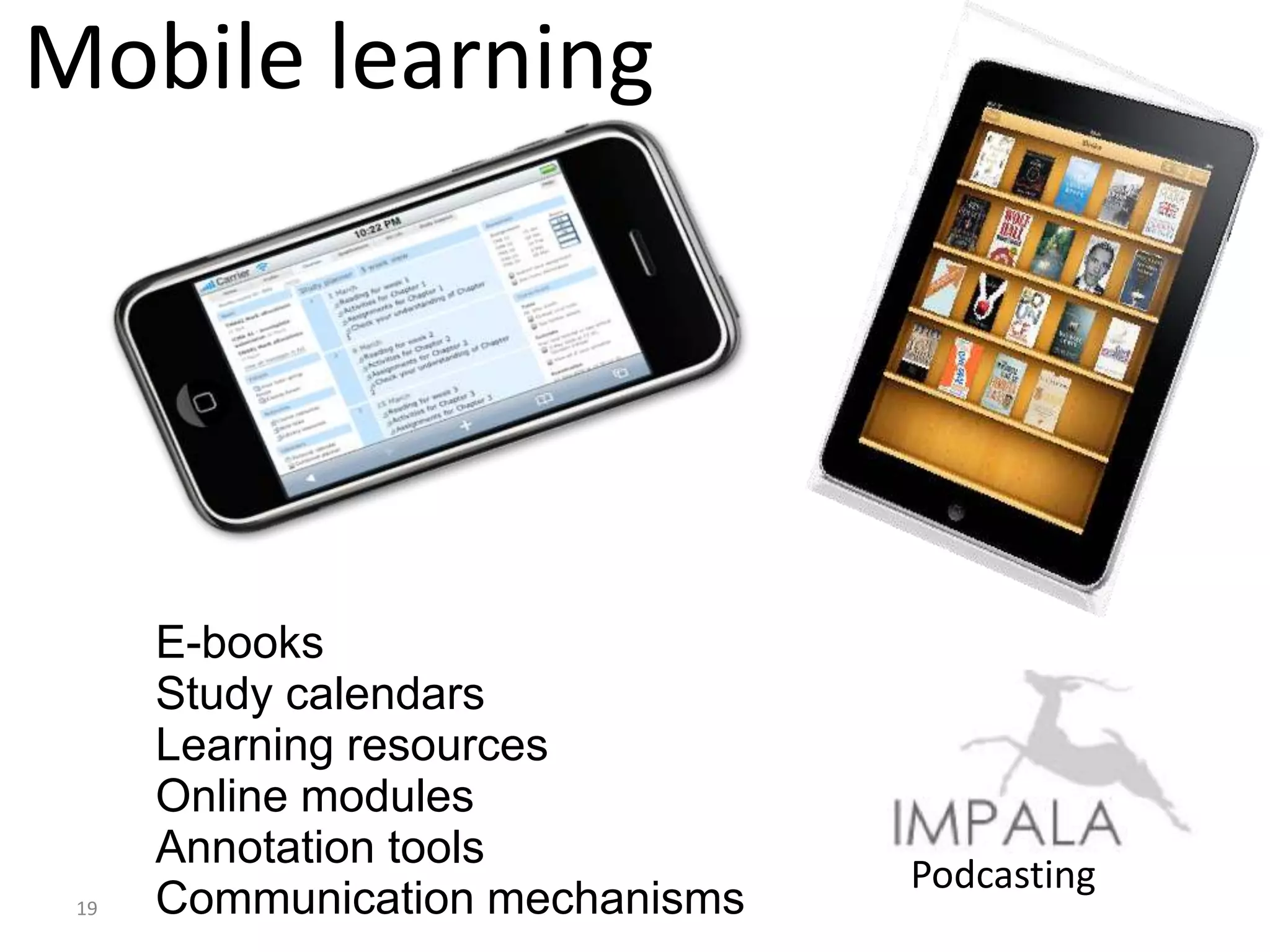
Mobile learning


      E-books
      Study calendars
      Learning resources
      Online modules
      Annotation tools
                                 Podcasting
 19   Communication mechanisms
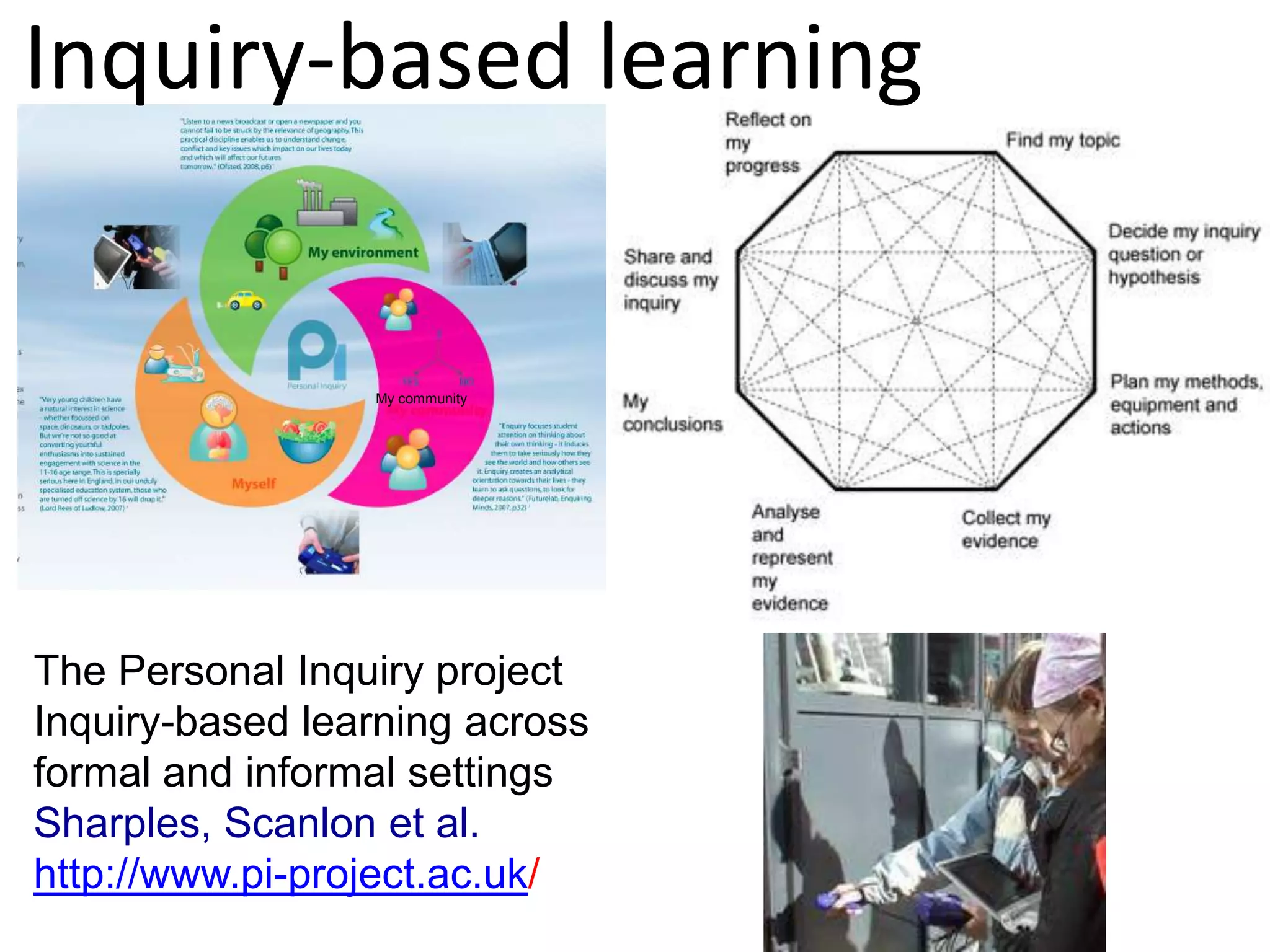
Inquiry-based learning


                 My community


The Personal Inquiry project
Inquiry-based learning across
formal and informal settings
Sharples, Scanlon et al.
http://www.pi-project.ac.uk/
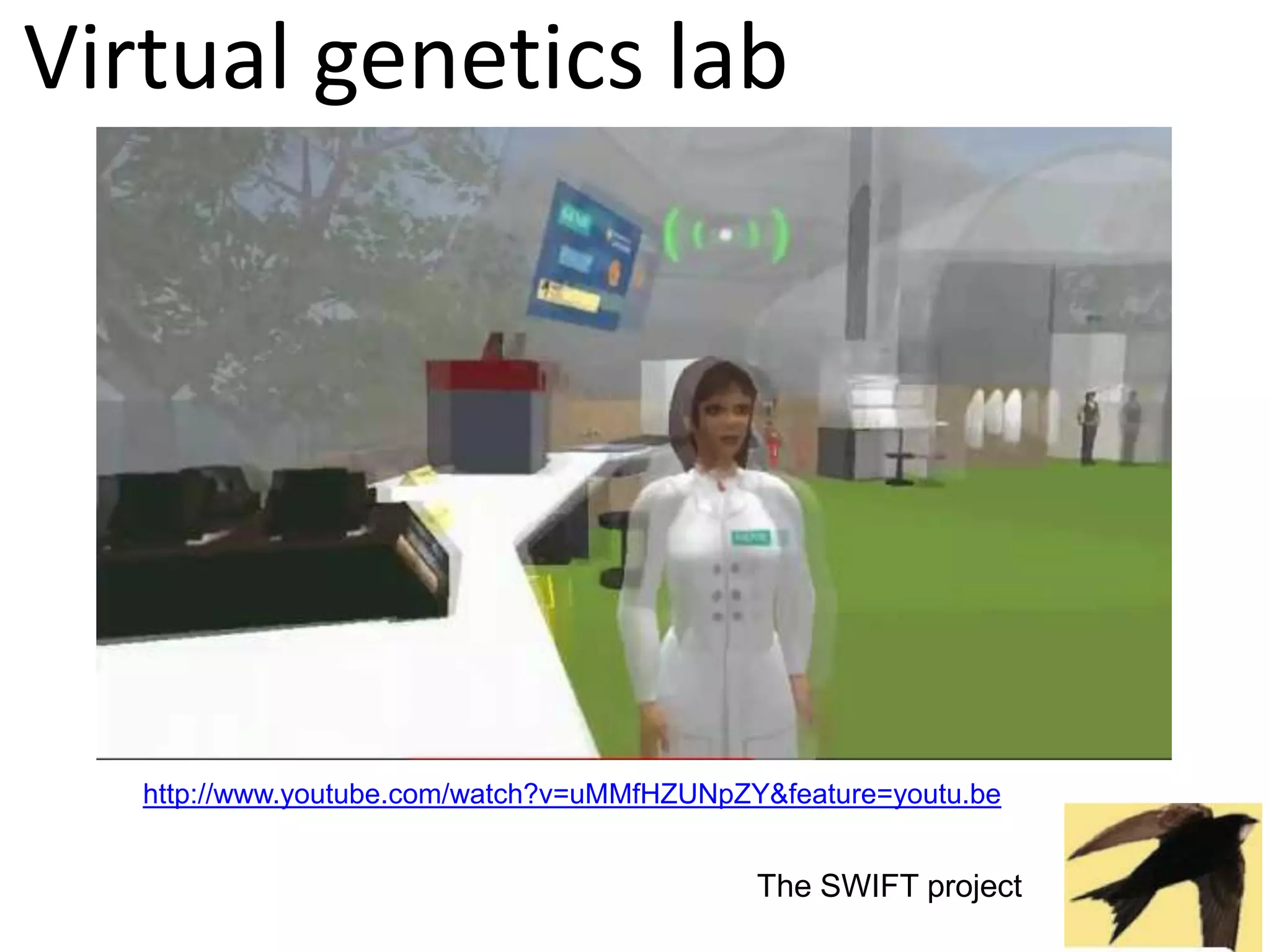
Virtual genetics lab


   http://www.youtube.com/watch?v=uMMfHZUNpZY&feature=youtu.be


                                             The SWIFT project
Open practices
Open resources                     Open courses


                   Pandora’s box

Open scholarship                   Open research
22
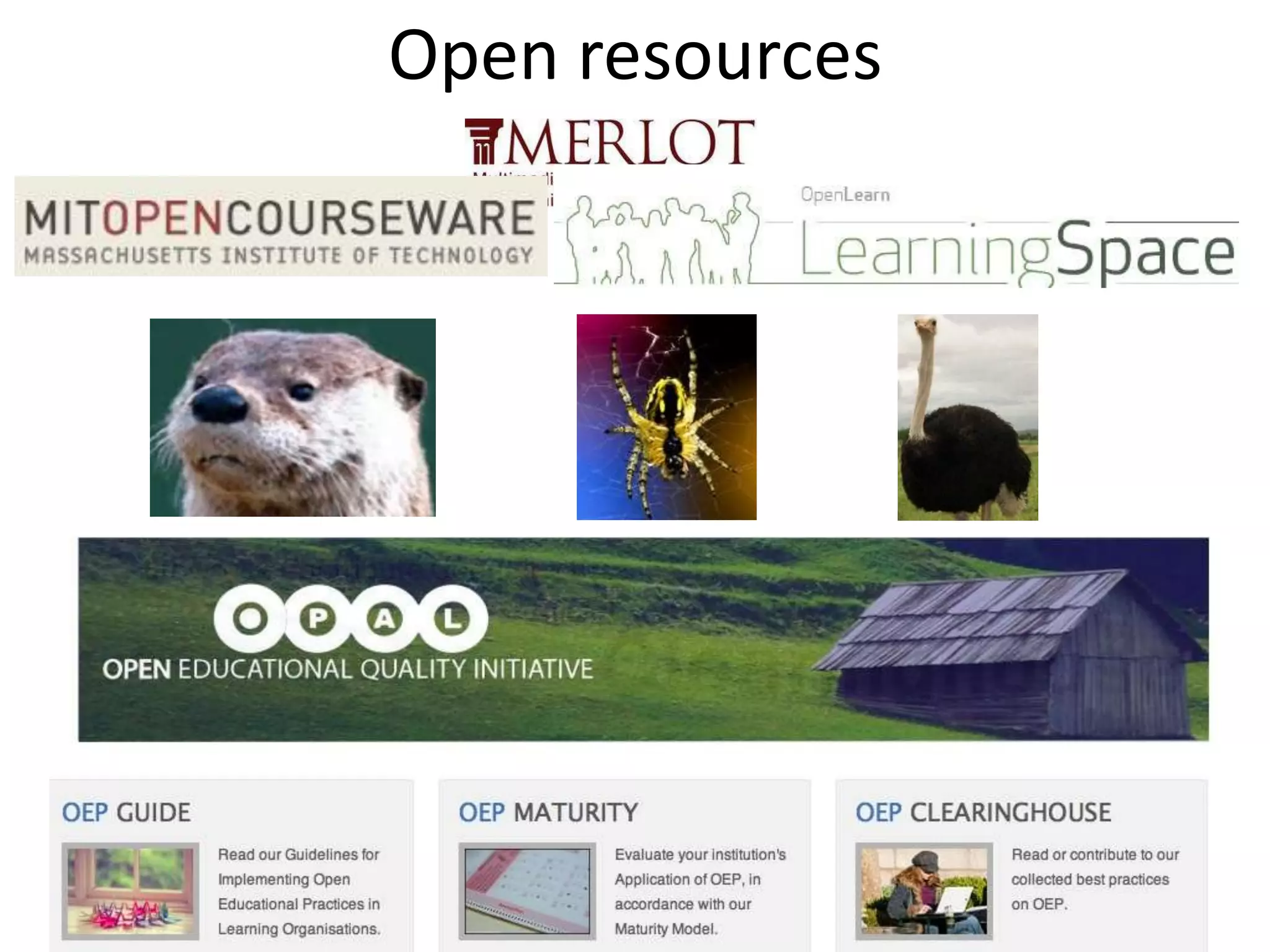
Open resources
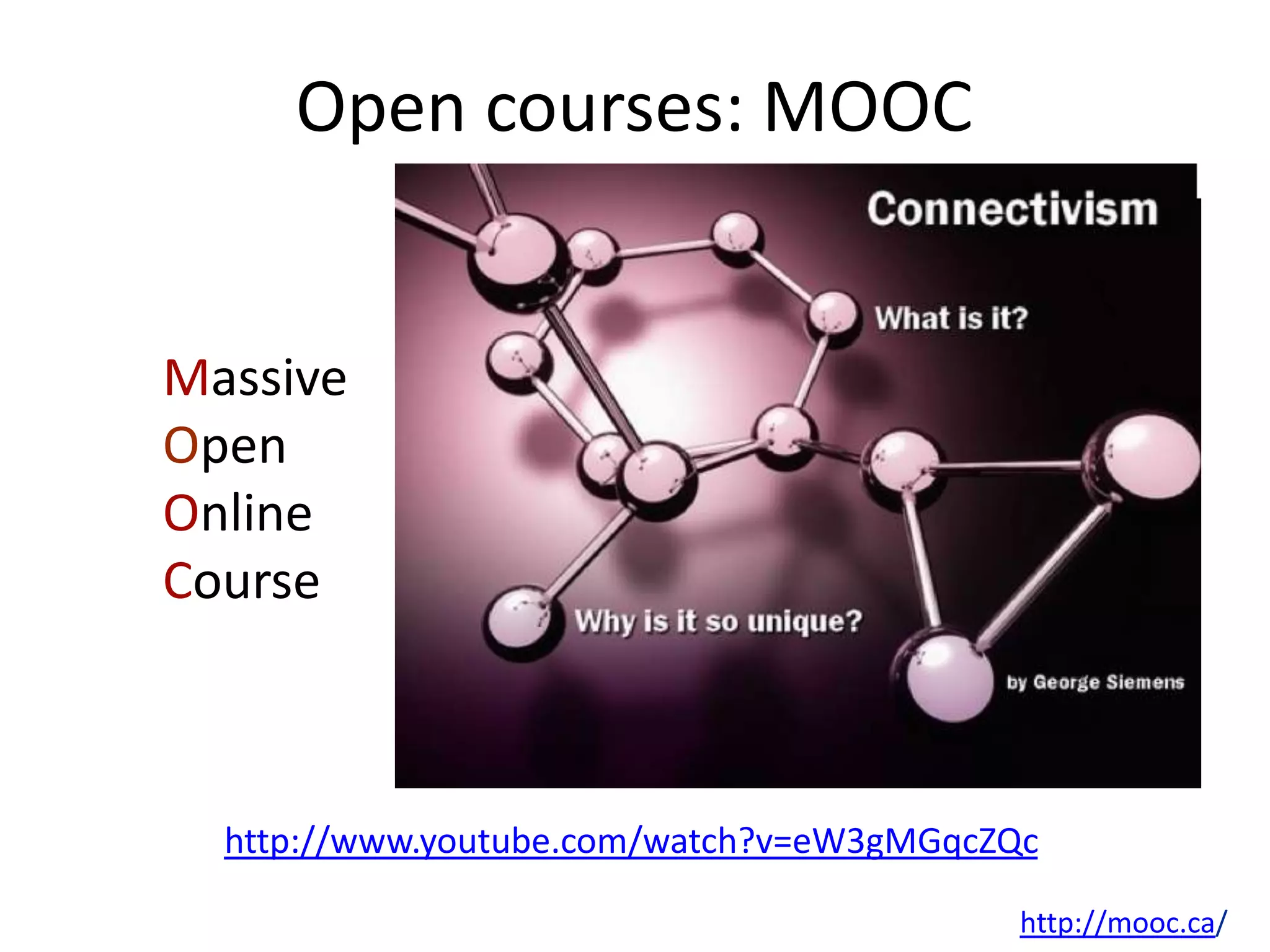
Open courses: MOOC


Massive
Open
Online
Course


  http://www.youtube.com/watch?v=eW3gMGqcZQc

                                           http://mooc.ca/
Open scholarship

• Exploiting the digital network
• New forms of dissemination
  and communication
• Promoting reflective practice
• Embracing the affordances of
  new technologies


            Weller: http://nogoodreason.typepad.co.uk/
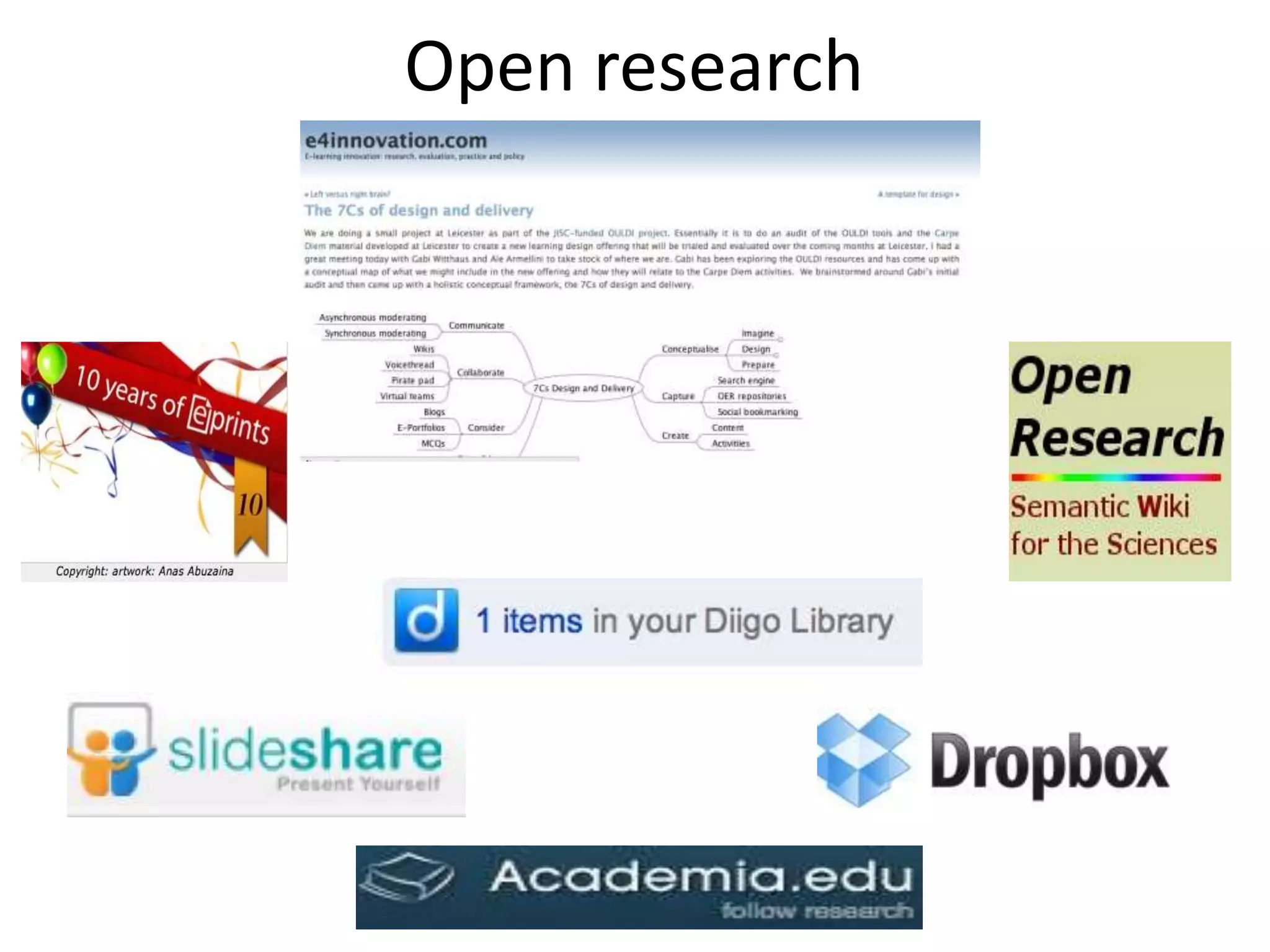
Open research
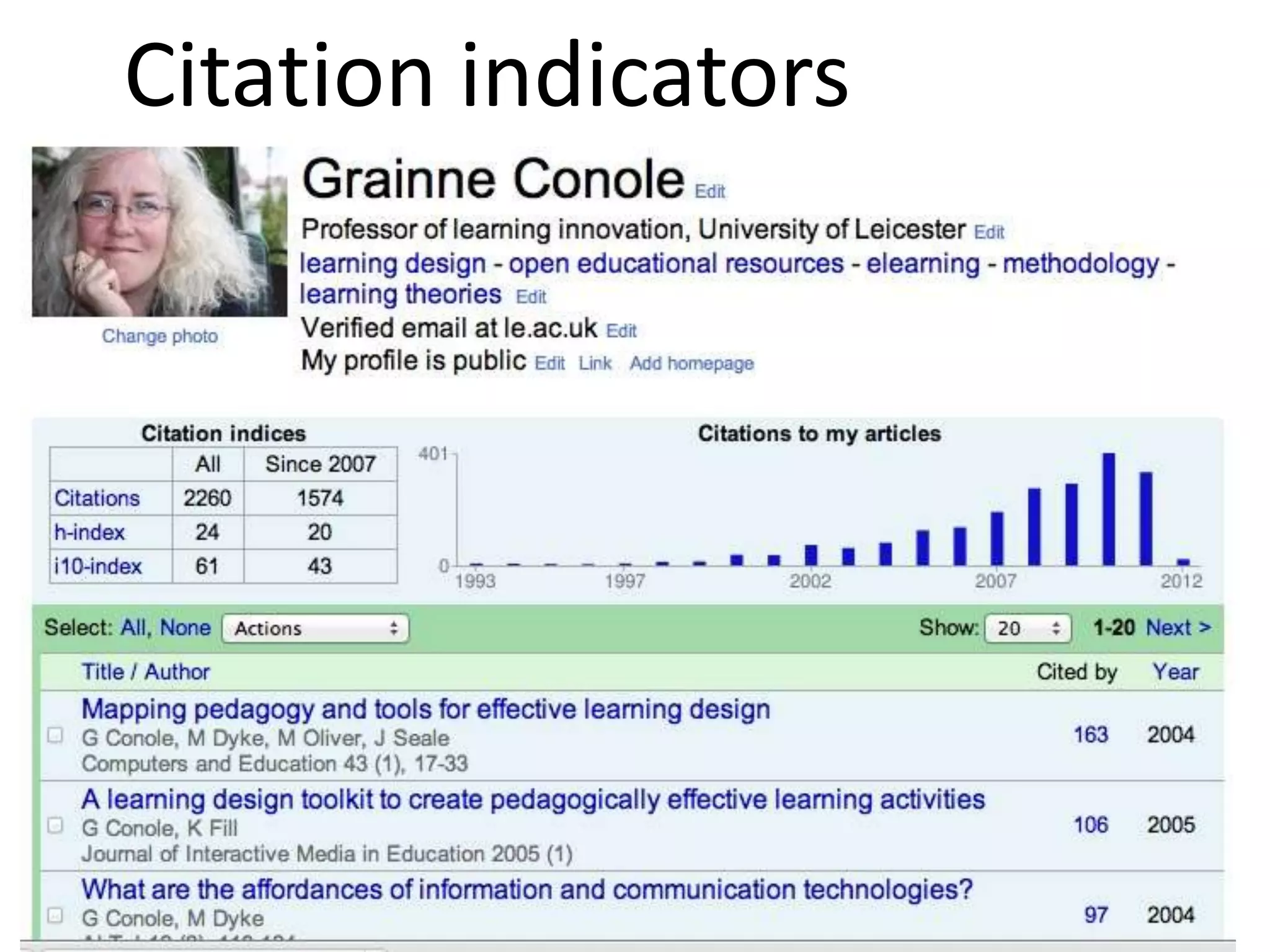
Citation indicators
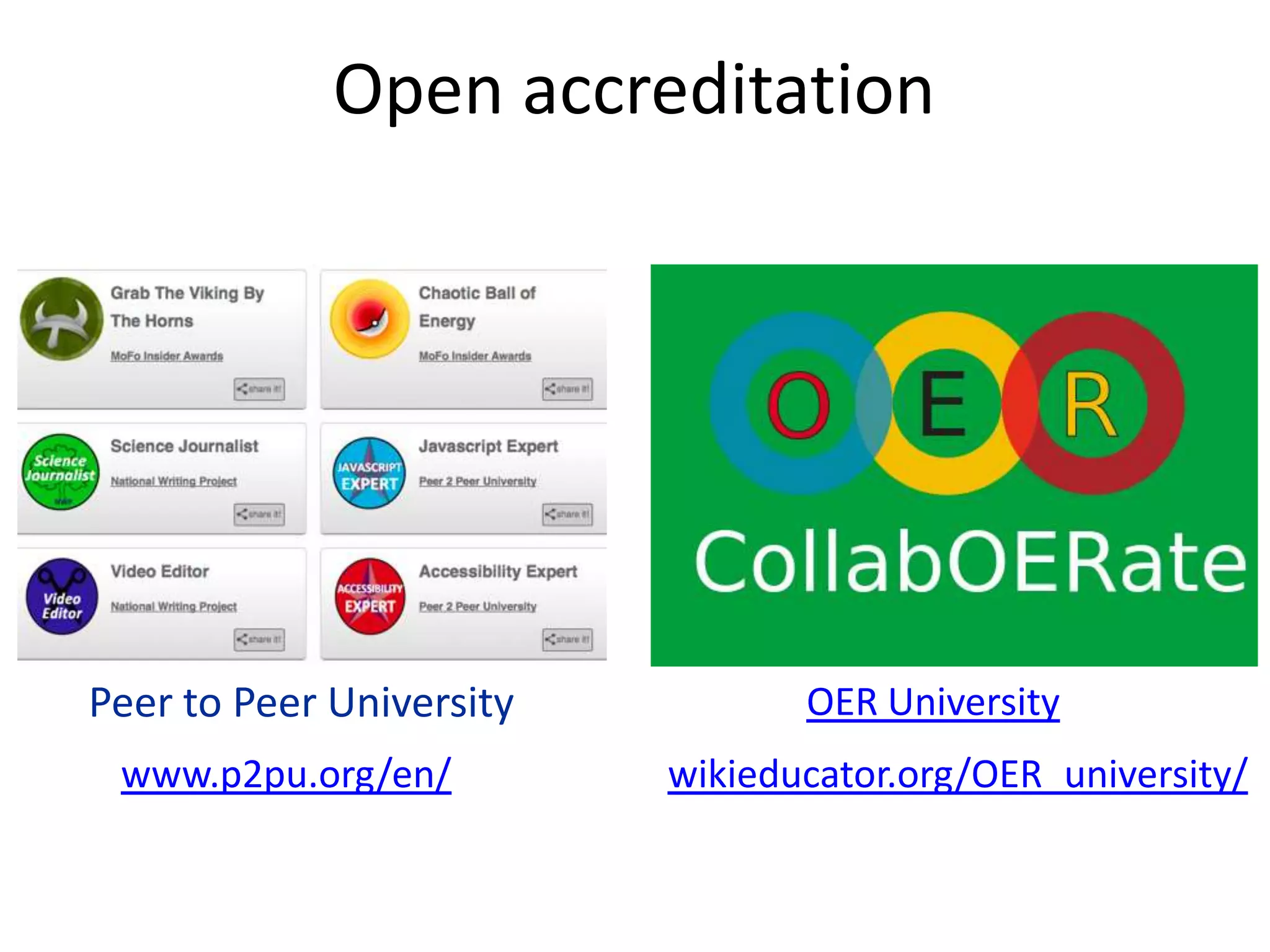
Open accreditation


Peer to Peer University          OER University
 www.p2pu.org/en/         wikieducator.org/OER_university/
Teacher practices: paradoxes
• Technologiesnot extensively
  used (Molenda)
• Lack of uptake of OER
  (McAndrew et al.)
• Little use beyond early
  adopters (Rogers)
• Despite rhetoric and funding   Pandora’s box
  little evidence of
  transformation (Cuban,
  Ehlers)
 29
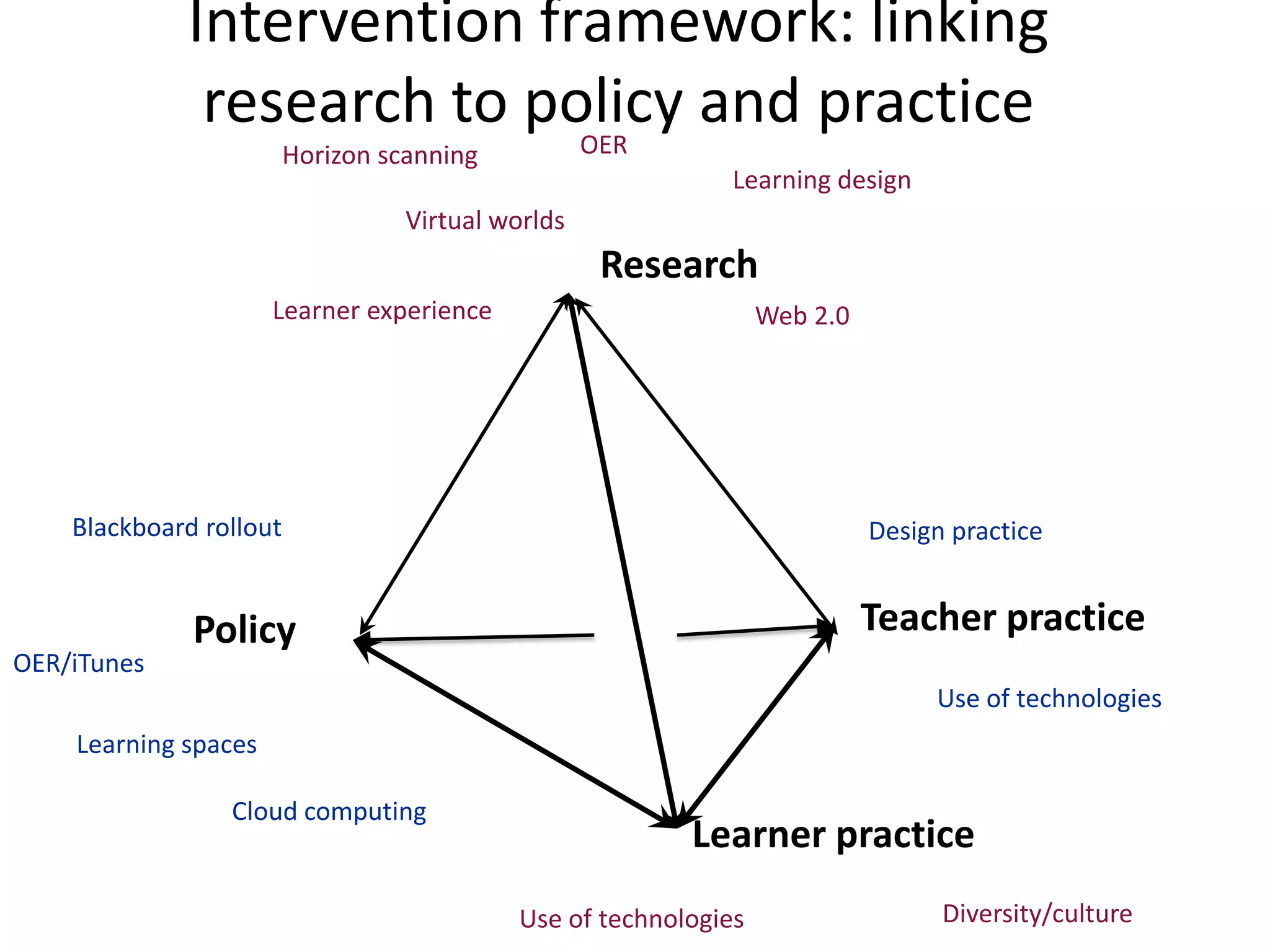
Intervention framework: linking
              research to policy and practice
                            OER
                         Horizon scanning
                                                              Learning design
                                   Virtual worlds
                                                    Research
                      Learner experience                          Web 2.0


    Blackboard rollout                                                      Design practice


              Policy                                                        Teacher practice
OER/iTunes
                                                                                 Use of technologies
    Learning spaces

                 Cloud computing
                                                          Learner practice
                                            Use of technologies                   Diversity/culture
The LMS as a Trojan horse

• LMS as a safe nursery slope
• Shift from content to
  activities
• Promote reflection and
  collaboration
• Mobile LMS
• Integration with cloud
  computing
Blackboard audit
• Data
   – Online survey (260 returns)
   – Departmental visits
• Key findings
   – Used as content repository
     and administration
   – Pockets of innovation
   – More support needed on
     effective design strategies
   – Tension between teaching
     and research
   – Usability issue
Blackboard+ at Leicester


BB plus Google+
                                   Maths video-lets

                     Prof-casts


     History conundrum            Voicethread
Learning Design
  Shift frombelief-based, implicit
      approaches todesign-
   based,explicit approaches

          Learning Design
       A design-based approach to
         creation and support of
                 courses


 Encouragesreflective,scholarly
          practices
Promotessharing and discussion
Conceptualise
                                 What do we want to design, who for
                                            and why?


                             Carpe Diem:
                        7Cs of learning Design


                                        Consolidate
                                    Evaluate and embed your design


http://beyonddistance.wordpress.com/2012/02/07/carpe-diem-the-7cs-of-design-and-delivery/
Course views
                                   Learning outcomes


                      Course map

Pedagogy profile
                                                   Course dimensions


                                   Task swimlane
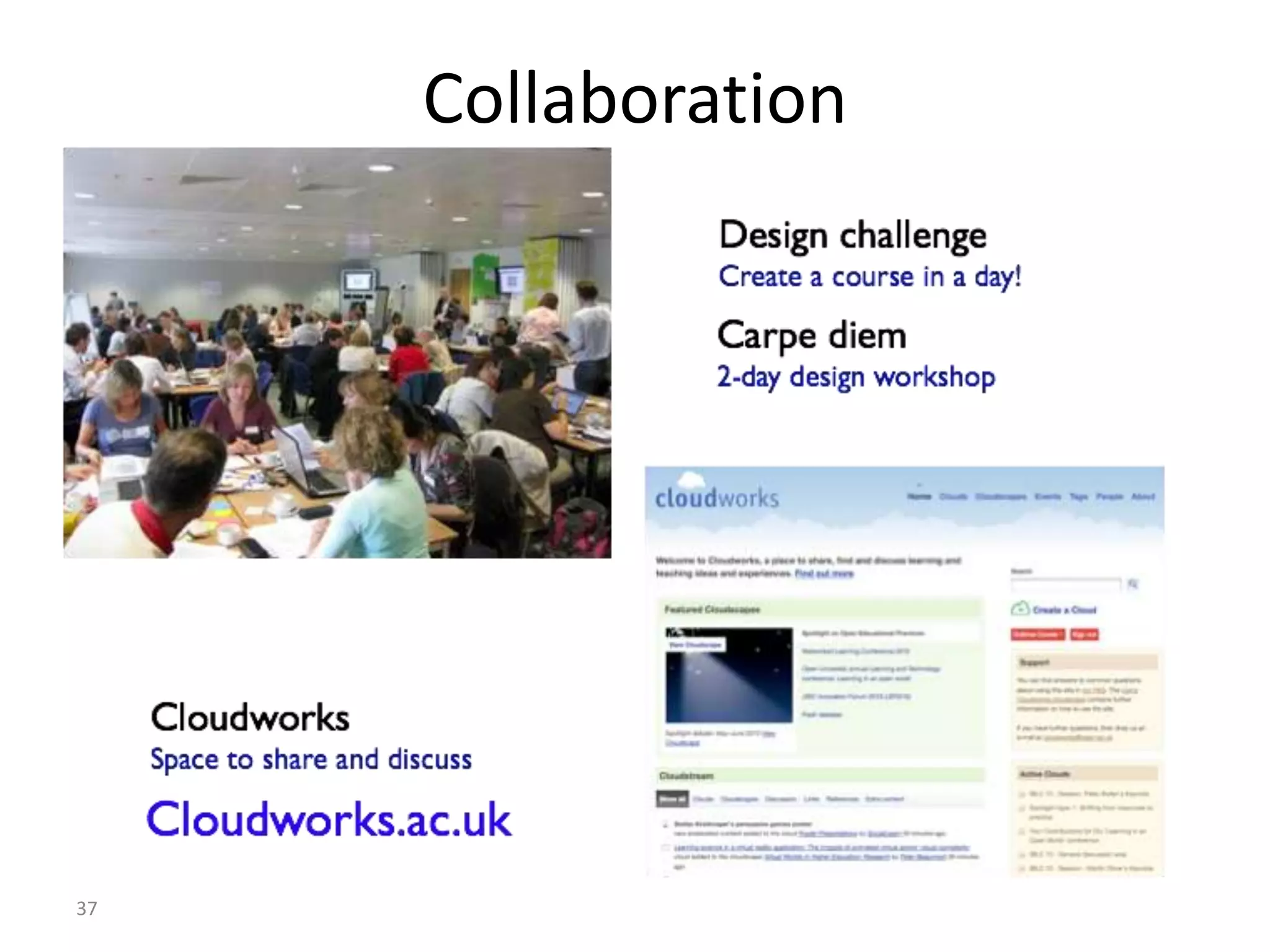
Collaboration


37
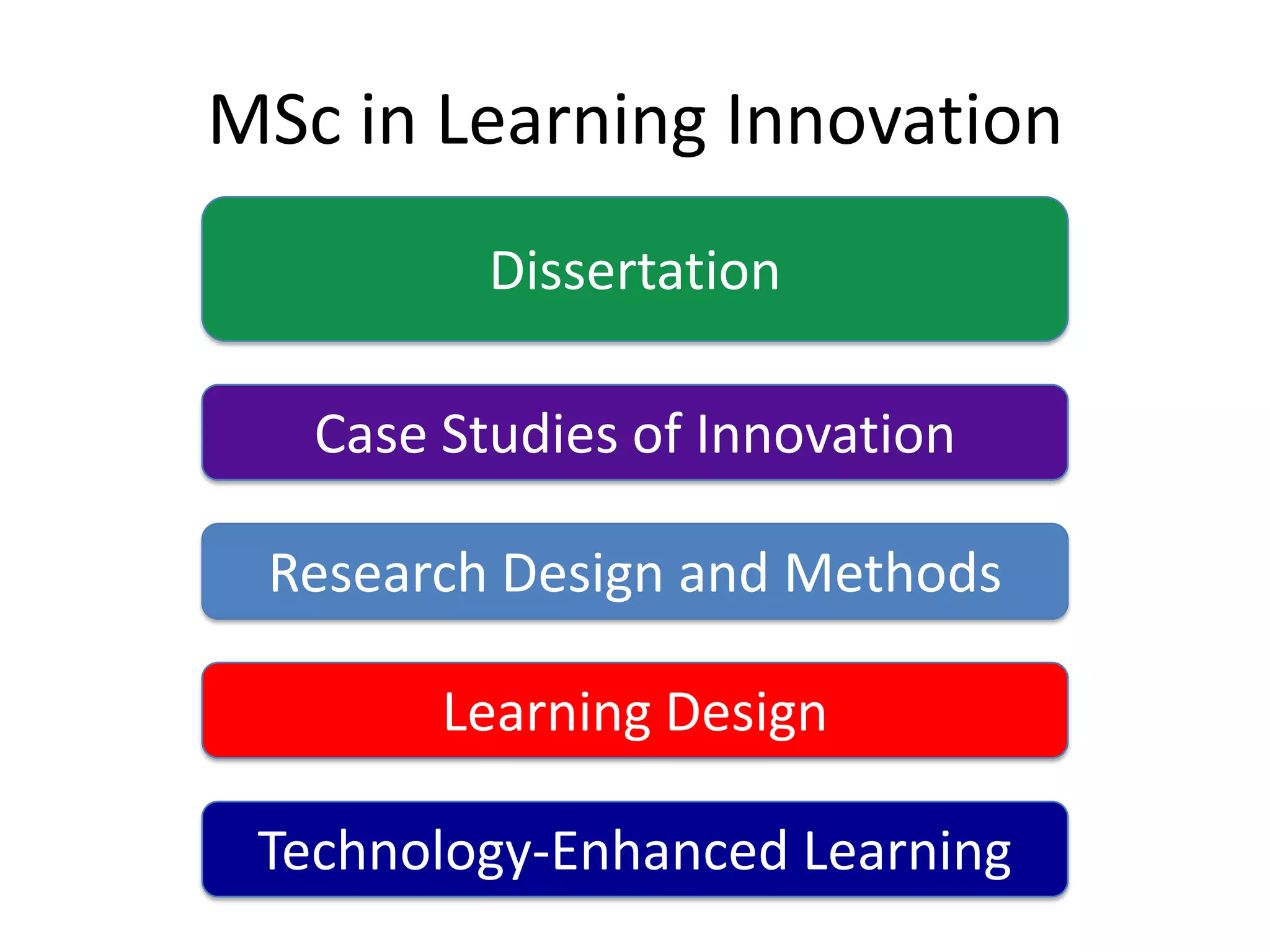
MSc in Learning Innovation
          Dissertation

   Case Studies of Innovation

 Research Design and Methods

        Learning Design

 Technology-Enhanced Learning
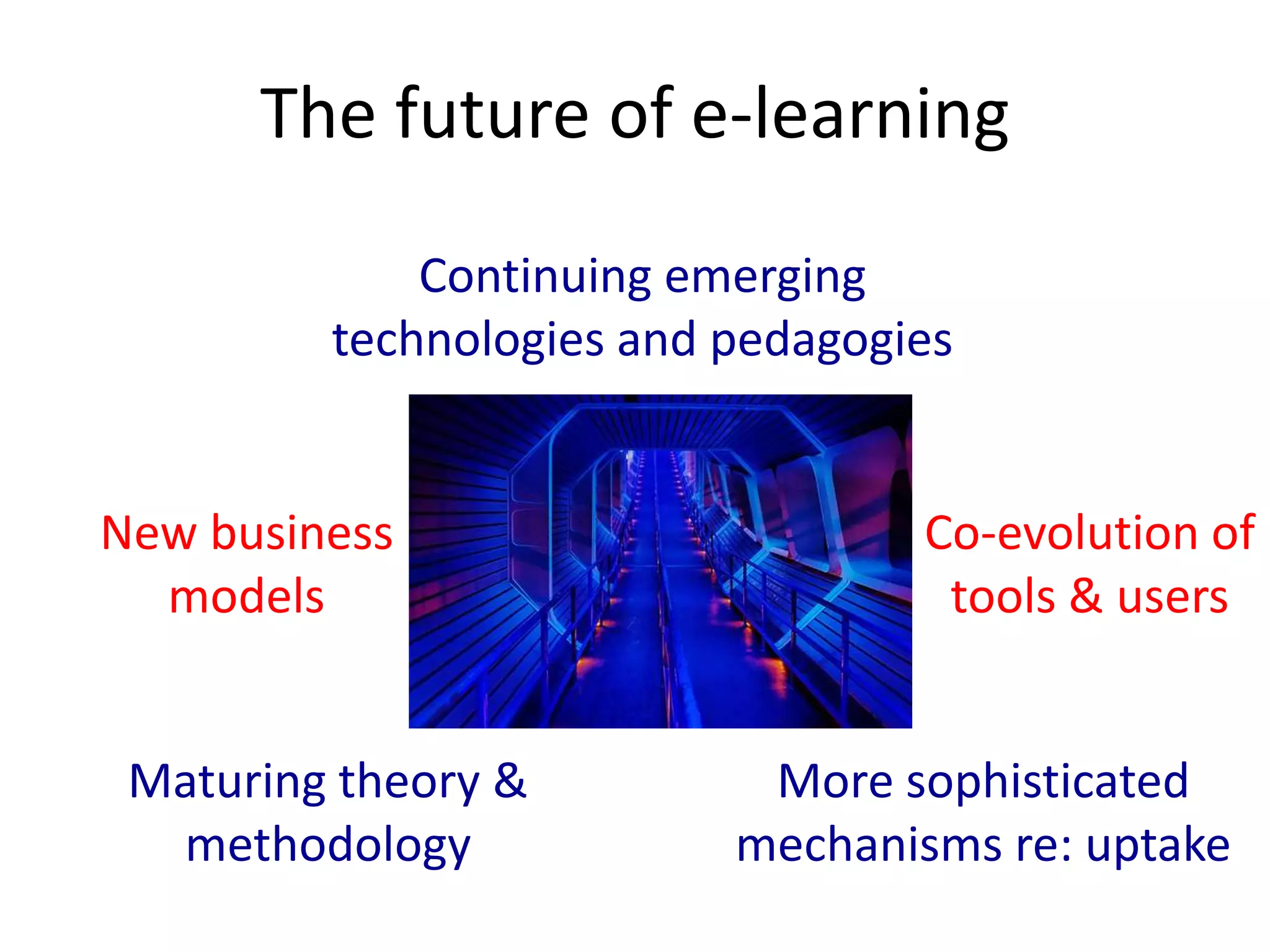
The future of e-learning
             Continuing emerging
         technologies and pedagogies


New business                      Co-evolution of
  models                           tools & users


 Maturing theory &         More sophisticated
  methodology             mechanisms re: uptake
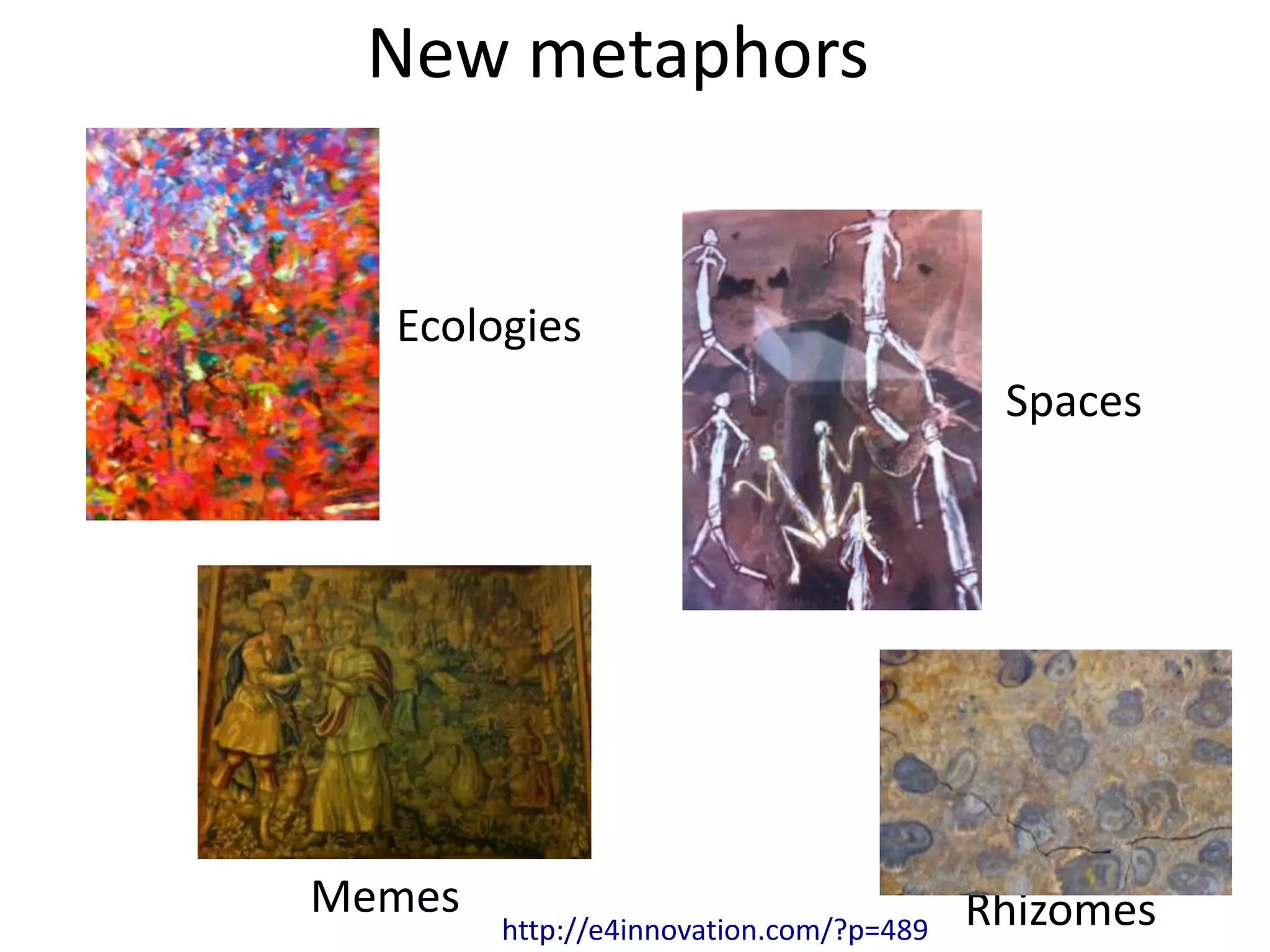
New metaphors


  Ecologies
                                          Spaces


Memes                                    Rhizomes
        http://e4innovation.com/?p=489
Final thoughts
• Participatory and social media enable new forms of
  communication and collaboration
• Communities in these spaces are complex and
  distributed
• Learners and teachers need to develop new digital
  literacy skills to harness their potential
• We need to rethinkhow we design, support and assess
  learning
• Open, participatory and social media can provide
  mechanisms for us to share and discuss teaching and
  research ideas in new ways
• We are seeing a blurring of boundaries:
  teachers/learners, teaching/research, real/virtual
  spaces, formal/informal modes of communication and
Events

 Open Education
  Week Webinars
6 – 9th March 2012


                 28 – 30th March 2012
Conole, G. (forthcoming), Designing for learning in an open world, New York: Springer
                           Chapters available on dropbox
                              grainne.conole@le.ac.uk

Conole mooc

  • 1.
    Transformation through new e-pedagogies– the future of learning Gráinne Conole, University of Leicester MOOC 2012 6th – 9th 2012
  • 2.
    Outline • The evolving landscape of e-learning • Affordances of new technologies • From Gutenberg to Zuckerberg • Learner experience • New pedagogies and implications • Open practices • Teacher practice and paradoxes • Strategies for change – Intervention framework: linking research to policy and practice – The LMS as a Trojan horse – New approaches to design
  • 3.
    Research questions • What: – Is the learner experience and teacher practice? – Are the emergent technologies and their affordances? – Resources, OER and Pedagogical Patterns are there and how are they been used? – E-Pedagogies are there and how do they facilitate different forms of learning? – New learning design approaches can be used to promote and support e-learning? – Strategies are in place to promote and support e- learning? – Theories and methodologies are been used?
  • 4.
    Evolving e-learning landscape Emergent technologies and affordances Theory and methodology E-pedagogies, strategies and learning design Resources, OER and Pedagogical Patterns Evaluations Interventions
  • 5.
    Technological trends • Mobilesand e-books • Gesture and augmented learning • Learning analytics • Personalised learning • Cloud computing • Ubiquitous learning • BYOD (Bring your own device) • Digital content • The flipped classroom http://learn231.wordpress.com/2011/10/25/trend-report-1/
  • 6.
    Social & participatorymedia Media sharing Blogging Mash ups Messaging Collaborative Recommender editing systems Virtual worlds Social and games networking Social Syndication bookmarking http://magicineducation.wordpress.com/2011/11/10/web-2-0-world-map/ 6 Conole and Alevizou, 2010
  • 7.
    Peer Open critiquing User Collective generated aggregation content Networked Personalised Social media revolution The machine is us/ing us
  • 8.
    Gutenberg to Zuckerberg • Take the long view • The web is not the net • Disruption is a feature • Ecologies not economics • Complexity is the new reality • The network is now the computer • The web is evolving • Copyright or copywrong • Orwell (fear) or Huxley (pleasure) http://www.flickr.com/photos/wallyg/2617472088/ http://memex.naughtons.org/
  • 9.
    Disruptive technologies • Theweb has transformed practice • No central ownership • Ecology of abundance • Examples – Napster – Malware
  • 10.
    Learner experience •Technology immersed • Learning approaches: task- orientated, experiential, just in time, cumulative, social • Personalised digital learning environment • Mix of institutional systems and cloud-based tools and services • Use of course materials with free resources 10 Sharpe, Beetham and De Freitas, 2010
  • 11.
    EDUCAUSE study • Studentsdrawn to new technologies but rely on more traditional ones • Consider technologies offer major educational benefits • Mixed views of VLEs 11
  • 12.
    The essence oflearning Reflection Dialogue Collaboration Application
  • 13.
    A pedagogy framework Social Information Informal Formal Experience Individual
  • 14.
    Mapping e-Pedagogies totechnologies Pedagogies Technologies • Problem-Based Learning (PBL) • Virtual Worlds (VW) • Inquiry-Based Learning (IBL) • Google • Didactic (Did) • E-Books • Reflection (Ref) • Blogs, e-Portfolios • Dialogic Learning (Dial) • Discussion Forums (DF) • Collaboration (Collab) • Wikis • Assessment (Ass) • MCQs • Communities of Practice (CoP) • Google+ • IBL – social • Twitter • User-Generated Content (UGC) • Youtube
  • 15.
    Social Information Informal Formal Experience Individual
  • 16.
    IBL/Twitter Social PBL/VW CoP/Google+ Dial/forum Dial/Skype Collab/Wiki Informal Formal Ref/Blog Ref/e-Portfolio IBL/Google Did/e-Book UGC/YouTube Individual Ass/MCQs
  • 17.
    Social Information Informal Formal Experience Individual
  • 18.
    Ref/Blog Experience PBL/VW CoP/Google+ Ref/e-Portfolio Dial/Skype Dial/Forum Informal Formal IBL/Twitter Coll/Wiki IBL/Google Did/e-Book UGC/YouTube Information Ass/MCQs
  • 19.
    Mobile learning E-books Study calendars Learning resources Online modules Annotation tools Podcasting 19 Communication mechanisms
  • 20.
    Inquiry-based learning My community The Personal Inquiry project Inquiry-based learning across formal and informal settings Sharples, Scanlon et al. http://www.pi-project.ac.uk/
  • 21.
    Virtual genetics lab http://www.youtube.com/watch?v=uMMfHZUNpZY&feature=youtu.be The SWIFT project
  • 22.
    Open practices Open resources Open courses Pandora’s box Open scholarship Open research 22
  • 23.
  • 24.
    Open courses: MOOC Massive Open Online Course http://www.youtube.com/watch?v=eW3gMGqcZQc http://mooc.ca/
  • 25.
    Open scholarship • Exploitingthe digital network • New forms of dissemination and communication • Promoting reflective practice • Embracing the affordances of new technologies Weller: http://nogoodreason.typepad.co.uk/
  • 26.
  • 27.
  • 28.
    Open accreditation Peer toPeer University OER University www.p2pu.org/en/ wikieducator.org/OER_university/
  • 29.
    Teacher practices: paradoxes •Technologiesnot extensively used (Molenda) • Lack of uptake of OER (McAndrew et al.) • Little use beyond early adopters (Rogers) • Despite rhetoric and funding Pandora’s box little evidence of transformation (Cuban, Ehlers) 29
  • 30.
    Intervention framework: linking research to policy and practice OER Horizon scanning Learning design Virtual worlds Research Learner experience Web 2.0 Blackboard rollout Design practice Policy Teacher practice OER/iTunes Use of technologies Learning spaces Cloud computing Learner practice Use of technologies Diversity/culture
  • 31.
    The LMS asa Trojan horse • LMS as a safe nursery slope • Shift from content to activities • Promote reflection and collaboration • Mobile LMS • Integration with cloud computing
  • 32.
    Blackboard audit • Data – Online survey (260 returns) – Departmental visits • Key findings – Used as content repository and administration – Pockets of innovation – More support needed on effective design strategies – Tension between teaching and research – Usability issue
  • 33.
    Blackboard+ at Leicester BBplus Google+ Maths video-lets Prof-casts History conundrum Voicethread
  • 34.
    Learning Design Shift frombelief-based, implicit approaches todesign- based,explicit approaches Learning Design A design-based approach to creation and support of courses Encouragesreflective,scholarly practices Promotessharing and discussion
  • 35.
    Conceptualise What do we want to design, who for and why? Carpe Diem: 7Cs of learning Design Consolidate Evaluate and embed your design http://beyonddistance.wordpress.com/2012/02/07/carpe-diem-the-7cs-of-design-and-delivery/
  • 36.
    Course views Learning outcomes Course map Pedagogy profile Course dimensions Task swimlane
  • 37.
  • 38.
    MSc in LearningInnovation Dissertation Case Studies of Innovation Research Design and Methods Learning Design Technology-Enhanced Learning
  • 39.
    The future ofe-learning Continuing emerging technologies and pedagogies New business Co-evolution of models tools & users Maturing theory & More sophisticated methodology mechanisms re: uptake
  • 40.
    New metaphors Ecologies Spaces Memes Rhizomes http://e4innovation.com/?p=489
  • 41.
    Final thoughts • Participatoryand social media enable new forms of communication and collaboration • Communities in these spaces are complex and distributed • Learners and teachers need to develop new digital literacy skills to harness their potential • We need to rethinkhow we design, support and assess learning • Open, participatory and social media can provide mechanisms for us to share and discuss teaching and research ideas in new ways • We are seeing a blurring of boundaries: teachers/learners, teaching/research, real/virtual spaces, formal/informal modes of communication and
  • 42.
    Events Open Education Week Webinars 6 – 9th March 2012 28 – 30th March 2012
  • 43.
    Conole, G. (forthcoming),Designing for learning in an open world, New York: Springer Chapters available on dropbox grainne.conole@le.ac.uk