The Pedagogy of MOOCs

University of Cape Town Seminar
17-Oct-2013

This presentation is based on my Pedagogy of MOOCs blog post at:
http://edtechfrontier.com/2013/05/11/the-pedagogy-of-moocs

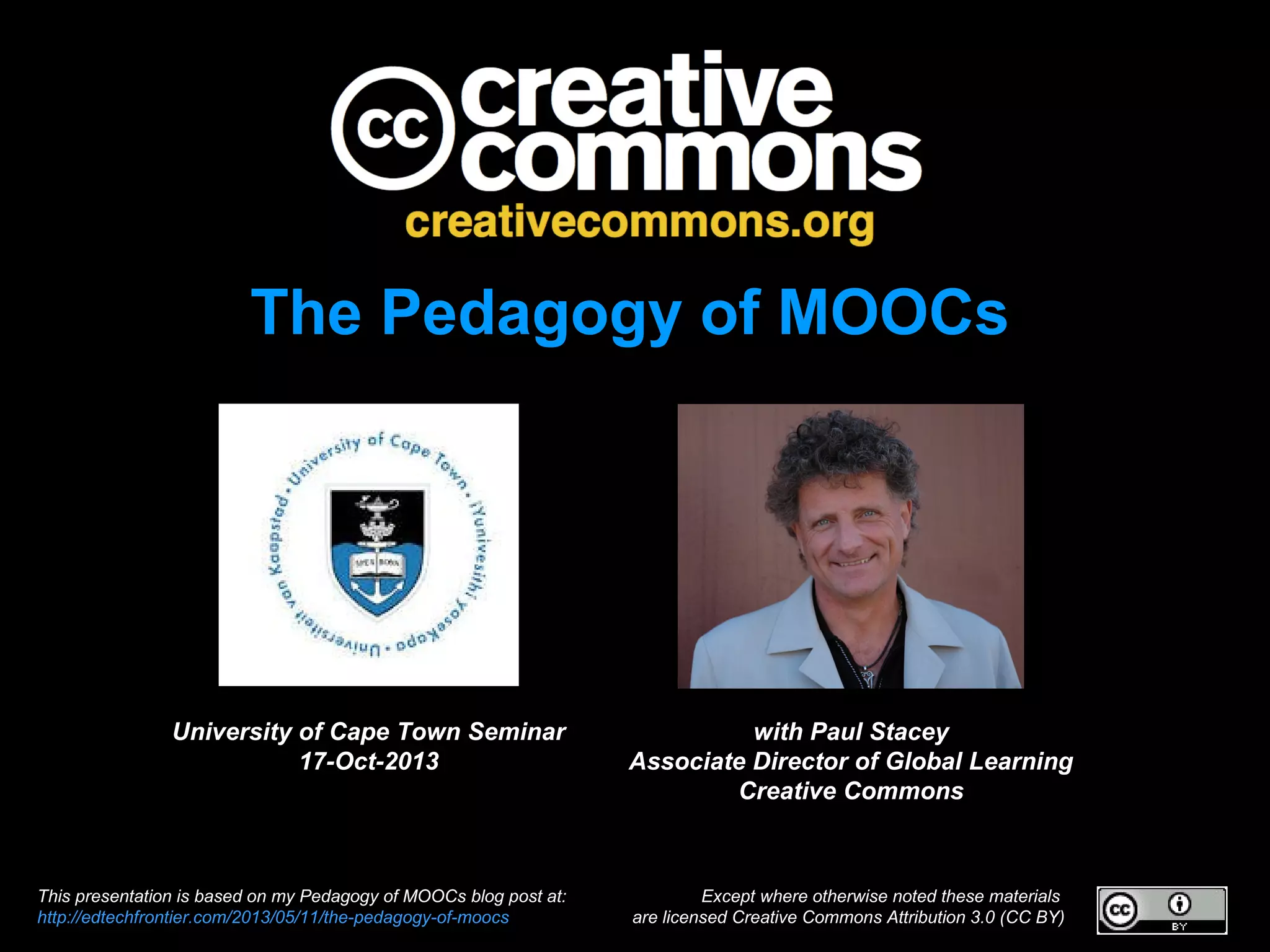
with Paul Stacey
Associate Director of Global Learning
Creative Commons

Except where otherwise noted these materials
are licensed Creative Commons Attribution 3.0 (CC BY)
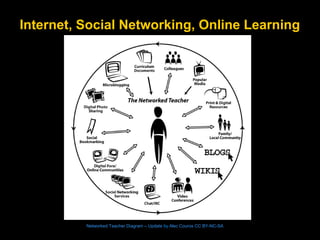
Internet, Social Networking, Online Learning

Networked Teacher Diagram – Update by Alec Couros CC BY-NC-SA
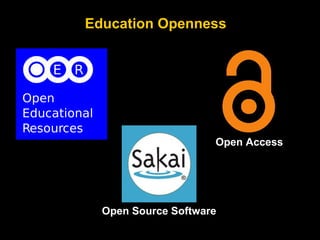
Education Openness

Open Access

Open Source Software
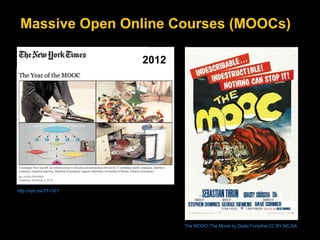
Massive Open Online Courses (MOOCs)
2012

http://nyti.ms/TTn1E7

The MOOC! The Movie by Giulia Forsythe CC BY-NC-SA
The Pedagogy of MOOCs
How can you effectively teach thousands of
students simultaneously?
I’m fascinated by the contrast between post-secondary faculty and K-12 teacher contract
agreements that limit class size and the current emergent MOOC aim of having as many
enrollments as possible. What a dichotomy.

How well are MOOC’s doing at successfully
teaching students?
Based on MOOCs equally massive dropout rates having teaching and learning success
on a massive scale will require pedagogical innovation. It’s this innovation, more than
massive enrollments or free that I think make MOOC’s important.
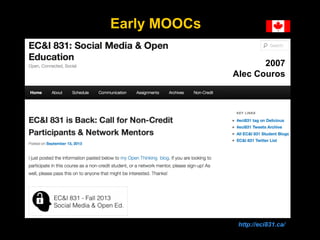
Early MOOCs
2007
Alec Couros

http://eci831.ca/
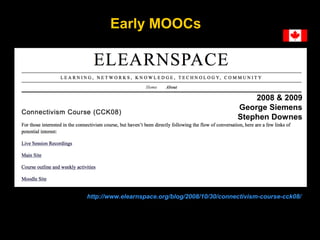
Early MOOCs

2008 & 2009
George Siemens
Stephen Downes

http://www.elearnspace.org/blog/2008/10/30/connectivism-course-cck08/
Early MOOCs

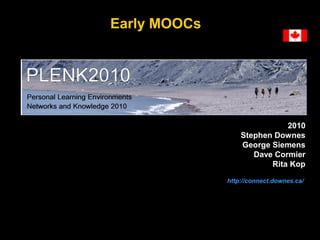
2010
Stephen Downes
George Siemens
Dave Cormier
Rita Kop
http://connect.downes.ca/
Early MOOCs

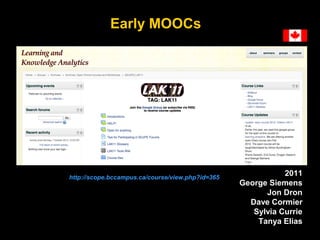
http://scope.bccampus.ca/course/view.php?id=365

2011
George Siemens
Jon Dron
Dave Cormier
Sylvia Currie
Tanya Elias
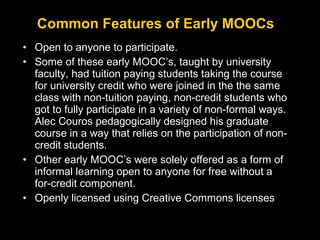
Common Features of Early MOOCs
• Open to anyone to participate.
• Some of these early MOOC’s, taught by university
faculty, had tuition paying students taking the course
for university credit who were joined in the the same
class with non-tuition paying, non-credit students who
got to fully participate in a variety of non-formal ways.
Alec Couros pedagogically designed his graduate
course in a way that relies on the participation of noncredit students.
• Other early MOOC’s were solely offered as a form of
informal learning open to anyone for free without a
for-credit component.
• Openly licensed using Creative Commons licenses
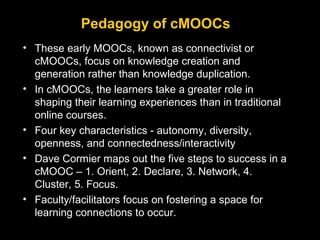
Pedagogy of cMOOCs
• These early MOOCs, known as connectivist or
cMOOCs, focus on knowledge creation and
generation rather than knowledge duplication.
• In cMOOCs, the learners take a greater role in
shaping their learning experiences than in traditional
online courses.
• Four key characteristics - autonomy, diversity,
openness, and connectedness/interactivity
• Dave Cormier maps out the five steps to success in a
cMOOC – 1. Orient, 2. Declare, 3. Network, 4.
Cluster, 5. Focus.
• Faculty/facilitators focus on fostering a space for
learning connections to occur.
Pedagogy of cMOOCs
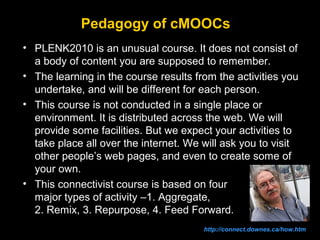
• PLENK2010 is an unusual course. It does not consist of
a body of content you are supposed to remember.
• The learning in the course results from the activities you
undertake, and will be different for each person.
• This course is not conducted in a single place or
environment. It is distributed across the web. We will
provide some facilities. But we expect your activities to
take place all over the internet. We will ask you to visit
other people’s web pages, and even to create some of
your own.
• This connectivist course is based on four
major types of activity –1. Aggregate,
2. Remix, 3. Repurpose, 4. Feed Forward.
http://connect.downes.ca/how.htm
Pedagogy of cMOOCs
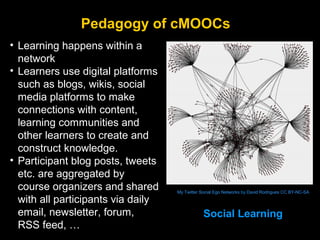
• Learning happens within a
network
• Learners use digital platforms
such as blogs, wikis, social
media platforms to make
connections with content,
learning communities and
other learners to create and
construct knowledge.
• Participant blog posts, tweets
etc. are aggregated by
course organizers and shared
with all participants via daily
email, newsletter, forum,
RSS feed, …

My Twitter Social Ego Networks by David Rodrigues CC BY-NC-SA

Social Learning
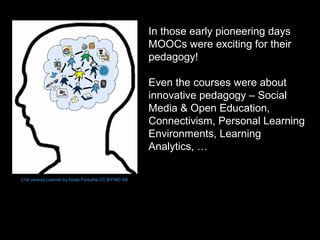
In those early pioneering days
MOOCs were exciting for their
pedagogy!
Even the courses were about
innovative pedagogy – Social
Media & Open Education,
Connectivism, Personal Learning
Environments, Learning
Analytics, …
21st century Learner by Giulia Forsythe CC BY-NC-SA
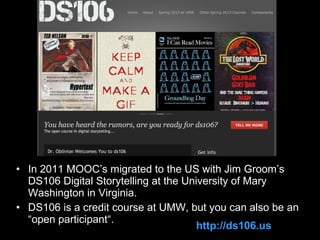
• In 2011 MOOC’s migrated to the US with Jim Groom’s
DS106 Digital Storytelling at the University of Mary
Washington in Virginia.
• DS106 is a credit course at UMW, but you can also be an
“open participant“.
http://ds106.us
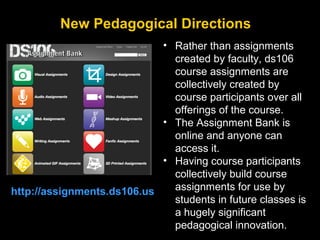
New Pedagogical Directions
• Rather than assignments
created by faculty, ds106
course assignments are
collectively created by
course participants over all
offerings of the course.
• The Assignment Bank is
online and anyone can
access it.
• Having course participants
collectively build course
assignments for use by
http://assignments.ds106.us
students in future classes is
a hugely significant
pedagogical innovation.
• ds106 is the first ever
online course with its own
radio station - ds106 radio
• The pedagogical potential
of a course radio station is
an exciting but relatively
unexplored opportunity.
http://ds106.us/ds106-radio
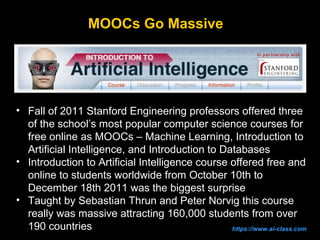
MOOCs Go Massive

• Fall of 2011 Stanford Engineering professors offered three
of the school’s most popular computer science courses for
free online as MOOCs – Machine Learning, Introduction to
Artificial Intelligence, and Introduction to Databases
• Introduction to Artificial Intelligence course offered free and
online to students worldwide from October 10th to
December 18th 2011 was the biggest surprise
• Taught by Sebastian Thrun and Peter Norvig this course
really was massive attracting 160,000 students from over
190 countries
https://www.ai-class.com
Stanford MOOC Pedagogy
• Pedagogically a step backward
• Watch video lecture recordings, read course
materials, complete assignments, take quizzes and
an exam
• Gone were the rich pedagogical innovations from
earlier MOOC’s
• Simply migrated campus-based didatic methods of
teaching to the online environment
• Absence of any effort to utilize the rich body of
research on how to teach online effectively
• While didactic, lecture based methods of teaching
have long been the mainstay of bricks and mortar
schools we know that this method of teaching does
not transfer well to online
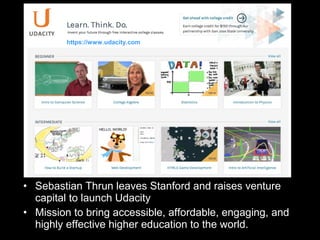
https://www.udacity.com

• Sebastian Thrun leaves Stanford and raises venture
capital to launch Udacity
• Mission to bring accessible, affordable, engaging, and
highly effective higher education to the world.
Pedagogy of Udacity
• Udacity courses include lecture videos, quizzes and
homework assignments.
• Multiple short (~5 min.) video sections make up each
course unit.
• All Udacity courses are made up of distinct units = a
week’s worth of instruction and homework.
• Since Udacity enrollment is open, you can take as
long as you want to complete.
• Udacity courses include discussion forums and a wiki
for course notes, additional explanations, examples
and extra materials.
• Each course has an area where instructors can make
comments but the pedagogical emphasis is on selfstudy.
Pedagogy of Udacity
• Udacity courses do have an informal discussion
forum where students can post any ideas and
thoughts they have about the course, ask questions,
and receive feedback from other students
• Free participation is non-credit
• A few courses can be taken for credit (from California
institutions) for a fee
• Udacity offers job placement service in partnership
with various employers
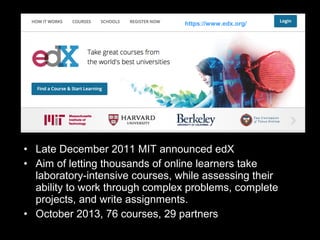
https://www.edx.org/

• Late December 2011 MIT announced edX
• Aim of letting thousands of online learners take
laboratory-intensive courses, while assessing their
ability to work through complex problems, complete
projects, and write assignments.
• October 2013, 76 courses, 29 partners
Pedagogy of edX
• As with other MOOC style offerings edX students
won’t have interaction with faculty or earn credit
toward an MIT degree.
• For a small fee students can take an assessment
which, if successfully completed, will provide them
with a certificate from edX.
• EdX offers honor code certificates, ID verified
certificates, and XSeries certificates (successfully
completing a series of courses)
• edX platform used to conduct experiments on how
students learn and how faculty can best teach.
Assessing course data, from mouse clicks to time
spent on tasks, to evaluating how students respond
to various assessments.
Pedagogy of edX
• Initial edX aim was to improve teaching and learning
of tuition paying on-campus students. Have revised
aim to developing best practices to enhance the
student experience and improve teaching and
learning both on campus and online
• Pedagogy very similar to Udacity
• Regrettably the rich body of research about online
learning is not being used
• Focus of edX so far is not on pedagogy but on
engineering an open source MOOC platform
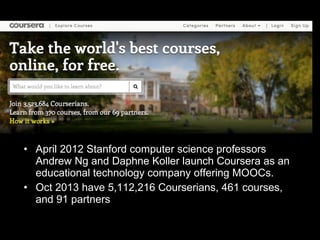
• April 2012 Stanford computer science professors
Andrew Ng and Daphne Koller launch Coursera as an
educational technology company offering MOOCs.
• Oct 2013 have 5,112,216 Courserians, 461 courses,
and 91 partners
Pedagogy of Coursera
• Video lectures, mastery learning, and peer assessment.
• Retrieval and testing for learning. Interaction = the video
frequently stops, and students are asked to answer a
simple question to test whether they are tracking the
material.
• Coursera provides university partners with a flipped
classroom. MOOC handles the lecture, course reading,
some assessment & peer-to-peer interaction for campusbased tuition paying students. On-campus activities
focused more on active learning & instructor help.
• Non-tuition paying open participants have no active
learning component. Students are tossed a tidbit of social
learning in the form of discussion forums.
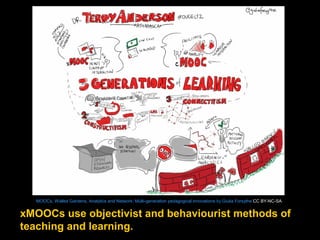
MOOCs, Walled Gardens, Analytics and Network: Multi-generation pedagogical innovations by Giulia Forsythe CC BY-NC-SA

xMOOCs use objectivist and behaviourist methods of
teaching and learning.
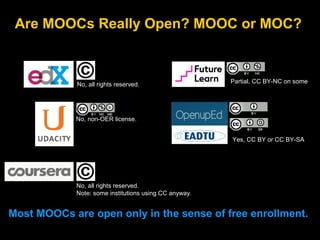
Are MOOCs Really Open? MOOC or MOC?

No, all rights reserved.

Partial, CC BY-NC on some

No, non-OER license.
Yes, CC BY or CC BY-SA

No, all rights reserved.
Note: some institutions using CC anyway.

Most MOOCs are open only in the sense of free enrollment.
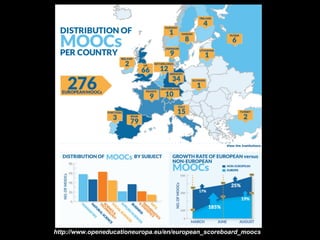
http://www.openeducationeuropa.eu/en/european_scoreboard_moocs
Recommendations for MOOC Pedagogy
• Learning is not just acquiring a body of knowledge and
skills. Learning happens through relationships.
• Online learning pedagogies can be incredibly social
even more so than campus-based courses - MOOCs
should use this long-standing practice
• The best online pedagogies are those that use the open
web and relationship to mine veins of knowledge,
expertise, and connections between students, between
students and the instructor, and between students and
others on the open web.
• Socio-constructivist and connectivist learning theories
acknowledge and embrace the social nature of learning.
• Use social learning including blogs, chat, discussion
forums, wikis, and group assignments.
Recommendations for MOOC Pedagogy
• Use peer-to-peer pedagogies over self study. We
know this improves learning outcomes. The cost of
enabling a network of peers is the same as that of
networking content – essentially zero.
• Be as open as possible. Use open pedagogies that
leverage the entire web not just the specific content
in the MOOC platform.
• Use OER and openly license your resources using
Creative Commons licenses in a way that allows
reuse, revision, remix, and redistribution.
• Leverage massive participation – have all students
contribute something that adds to or improves the
course overall.
Recommendations for UCT
• Organize an inter-disciplinary group/committee to
evaluate MOOC options and recommend a particular
MOOC provider/platform
• Define purpose of UCT doing MOOCs
• Design a UCT MOOC pedagogical strategy
• Initial MOOCs may come from academic areas
already engaged in online learning – commerce,
medicine, …
• Alternatively MOOCs could showcase courses that
highlight what makes UCT special and unique
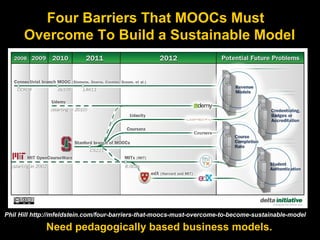
Four Barriers That MOOCs Must
Overcome To Build a Sustainable Model

Phil Hill http://mfeldstein.com/four-barriers-that-moocs-must-overcome-to-become-sustainable-model

Need pedagogically based business models.
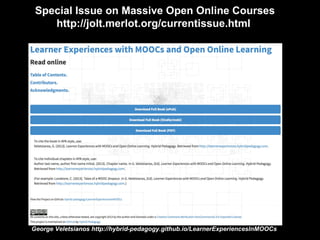
Special Issue on Massive Open Online Courses
http://jolt.merlot.org/currentissue.html

George Veletsianos http://hybrid-pedagogy.github.io/LearnerExperiencesInMOOCs
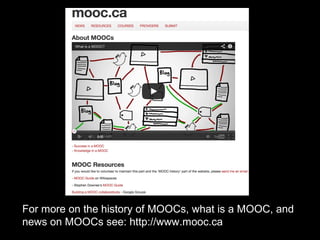
For more on the history of MOOCs, what is a MOOC, and
news on MOOCs see: http://www.mooc.ca
Paul Stacey
Q&A
Creative Commons
web site: http://creativecommons.org
e-mail: pstacey@creativecommons.org
blog: http://edtechfrontier.com
presentation slides: http://www.slideshare.net/Paul_Stacey

Pedagogy of MOOCs

  • 1.
    The Pedagogy ofMOOCs University of Cape Town Seminar 17-Oct-2013 This presentation is based on my Pedagogy of MOOCs blog post at: http://edtechfrontier.com/2013/05/11/the-pedagogy-of-moocs with Paul Stacey Associate Director of Global Learning Creative Commons Except where otherwise noted these materials are licensed Creative Commons Attribution 3.0 (CC BY)
  • 2.
    Internet, Social Networking,Online Learning Networked Teacher Diagram – Update by Alec Couros CC BY-NC-SA
  • 3.
  • 4.
    Massive Open OnlineCourses (MOOCs) 2012 http://nyti.ms/TTn1E7 The MOOC! The Movie by Giulia Forsythe CC BY-NC-SA
  • 5.
    The Pedagogy ofMOOCs How can you effectively teach thousands of students simultaneously? I’m fascinated by the contrast between post-secondary faculty and K-12 teacher contract agreements that limit class size and the current emergent MOOC aim of having as many enrollments as possible. What a dichotomy. How well are MOOC’s doing at successfully teaching students? Based on MOOCs equally massive dropout rates having teaching and learning success on a massive scale will require pedagogical innovation. It’s this innovation, more than massive enrollments or free that I think make MOOC’s important.
  • 6.
  • 7.
    Early MOOCs 2008 &2009 George Siemens Stephen Downes http://www.elearnspace.org/blog/2008/10/30/connectivism-course-cck08/
  • 8.
    Early MOOCs 2010 Stephen Downes GeorgeSiemens Dave Cormier Rita Kop http://connect.downes.ca/
  • 9.
  • 10.
    Common Features ofEarly MOOCs • Open to anyone to participate. • Some of these early MOOC’s, taught by university faculty, had tuition paying students taking the course for university credit who were joined in the the same class with non-tuition paying, non-credit students who got to fully participate in a variety of non-formal ways. Alec Couros pedagogically designed his graduate course in a way that relies on the participation of noncredit students. • Other early MOOC’s were solely offered as a form of informal learning open to anyone for free without a for-credit component. • Openly licensed using Creative Commons licenses
  • 11.
    Pedagogy of cMOOCs •These early MOOCs, known as connectivist or cMOOCs, focus on knowledge creation and generation rather than knowledge duplication. • In cMOOCs, the learners take a greater role in shaping their learning experiences than in traditional online courses. • Four key characteristics - autonomy, diversity, openness, and connectedness/interactivity • Dave Cormier maps out the five steps to success in a cMOOC – 1. Orient, 2. Declare, 3. Network, 4. Cluster, 5. Focus. • Faculty/facilitators focus on fostering a space for learning connections to occur.
  • 12.
    Pedagogy of cMOOCs •PLENK2010 is an unusual course. It does not consist of a body of content you are supposed to remember. • The learning in the course results from the activities you undertake, and will be different for each person. • This course is not conducted in a single place or environment. It is distributed across the web. We will provide some facilities. But we expect your activities to take place all over the internet. We will ask you to visit other people’s web pages, and even to create some of your own. • This connectivist course is based on four major types of activity –1. Aggregate, 2. Remix, 3. Repurpose, 4. Feed Forward. http://connect.downes.ca/how.htm
  • 13.
    Pedagogy of cMOOCs •Learning happens within a network • Learners use digital platforms such as blogs, wikis, social media platforms to make connections with content, learning communities and other learners to create and construct knowledge. • Participant blog posts, tweets etc. are aggregated by course organizers and shared with all participants via daily email, newsletter, forum, RSS feed, … My Twitter Social Ego Networks by David Rodrigues CC BY-NC-SA Social Learning
  • 14.
    In those earlypioneering days MOOCs were exciting for their pedagogy! Even the courses were about innovative pedagogy – Social Media & Open Education, Connectivism, Personal Learning Environments, Learning Analytics, … 21st century Learner by Giulia Forsythe CC BY-NC-SA
  • 15.
    • In 2011MOOC’s migrated to the US with Jim Groom’s DS106 Digital Storytelling at the University of Mary Washington in Virginia. • DS106 is a credit course at UMW, but you can also be an “open participant“. http://ds106.us
  • 16.
    New Pedagogical Directions •Rather than assignments created by faculty, ds106 course assignments are collectively created by course participants over all offerings of the course. • The Assignment Bank is online and anyone can access it. • Having course participants collectively build course assignments for use by http://assignments.ds106.us students in future classes is a hugely significant pedagogical innovation.
  • 17.
    • ds106 isthe first ever online course with its own radio station - ds106 radio • The pedagogical potential of a course radio station is an exciting but relatively unexplored opportunity. http://ds106.us/ds106-radio
  • 18.
    MOOCs Go Massive •Fall of 2011 Stanford Engineering professors offered three of the school’s most popular computer science courses for free online as MOOCs – Machine Learning, Introduction to Artificial Intelligence, and Introduction to Databases • Introduction to Artificial Intelligence course offered free and online to students worldwide from October 10th to December 18th 2011 was the biggest surprise • Taught by Sebastian Thrun and Peter Norvig this course really was massive attracting 160,000 students from over 190 countries https://www.ai-class.com
  • 19.
    Stanford MOOC Pedagogy •Pedagogically a step backward • Watch video lecture recordings, read course materials, complete assignments, take quizzes and an exam • Gone were the rich pedagogical innovations from earlier MOOC’s • Simply migrated campus-based didatic methods of teaching to the online environment • Absence of any effort to utilize the rich body of research on how to teach online effectively • While didactic, lecture based methods of teaching have long been the mainstay of bricks and mortar schools we know that this method of teaching does not transfer well to online
  • 20.
    https://www.udacity.com • Sebastian Thrunleaves Stanford and raises venture capital to launch Udacity • Mission to bring accessible, affordable, engaging, and highly effective higher education to the world.
  • 21.
    Pedagogy of Udacity •Udacity courses include lecture videos, quizzes and homework assignments. • Multiple short (~5 min.) video sections make up each course unit. • All Udacity courses are made up of distinct units = a week’s worth of instruction and homework. • Since Udacity enrollment is open, you can take as long as you want to complete. • Udacity courses include discussion forums and a wiki for course notes, additional explanations, examples and extra materials. • Each course has an area where instructors can make comments but the pedagogical emphasis is on selfstudy.
  • 22.
    Pedagogy of Udacity •Udacity courses do have an informal discussion forum where students can post any ideas and thoughts they have about the course, ask questions, and receive feedback from other students • Free participation is non-credit • A few courses can be taken for credit (from California institutions) for a fee • Udacity offers job placement service in partnership with various employers
  • 23.
    https://www.edx.org/ • Late December2011 MIT announced edX • Aim of letting thousands of online learners take laboratory-intensive courses, while assessing their ability to work through complex problems, complete projects, and write assignments. • October 2013, 76 courses, 29 partners
  • 24.
    Pedagogy of edX •As with other MOOC style offerings edX students won’t have interaction with faculty or earn credit toward an MIT degree. • For a small fee students can take an assessment which, if successfully completed, will provide them with a certificate from edX. • EdX offers honor code certificates, ID verified certificates, and XSeries certificates (successfully completing a series of courses) • edX platform used to conduct experiments on how students learn and how faculty can best teach. Assessing course data, from mouse clicks to time spent on tasks, to evaluating how students respond to various assessments.
  • 25.
    Pedagogy of edX •Initial edX aim was to improve teaching and learning of tuition paying on-campus students. Have revised aim to developing best practices to enhance the student experience and improve teaching and learning both on campus and online • Pedagogy very similar to Udacity • Regrettably the rich body of research about online learning is not being used • Focus of edX so far is not on pedagogy but on engineering an open source MOOC platform
  • 26.
    • April 2012Stanford computer science professors Andrew Ng and Daphne Koller launch Coursera as an educational technology company offering MOOCs. • Oct 2013 have 5,112,216 Courserians, 461 courses, and 91 partners
  • 27.
    Pedagogy of Coursera •Video lectures, mastery learning, and peer assessment. • Retrieval and testing for learning. Interaction = the video frequently stops, and students are asked to answer a simple question to test whether they are tracking the material. • Coursera provides university partners with a flipped classroom. MOOC handles the lecture, course reading, some assessment & peer-to-peer interaction for campusbased tuition paying students. On-campus activities focused more on active learning & instructor help. • Non-tuition paying open participants have no active learning component. Students are tossed a tidbit of social learning in the form of discussion forums.
  • 28.
    MOOCs, Walled Gardens,Analytics and Network: Multi-generation pedagogical innovations by Giulia Forsythe CC BY-NC-SA xMOOCs use objectivist and behaviourist methods of teaching and learning.
  • 29.
    Are MOOCs ReallyOpen? MOOC or MOC? No, all rights reserved. Partial, CC BY-NC on some No, non-OER license. Yes, CC BY or CC BY-SA No, all rights reserved. Note: some institutions using CC anyway. Most MOOCs are open only in the sense of free enrollment.
  • 30.
  • 31.
    Recommendations for MOOCPedagogy • Learning is not just acquiring a body of knowledge and skills. Learning happens through relationships. • Online learning pedagogies can be incredibly social even more so than campus-based courses - MOOCs should use this long-standing practice • The best online pedagogies are those that use the open web and relationship to mine veins of knowledge, expertise, and connections between students, between students and the instructor, and between students and others on the open web. • Socio-constructivist and connectivist learning theories acknowledge and embrace the social nature of learning. • Use social learning including blogs, chat, discussion forums, wikis, and group assignments.
  • 32.
    Recommendations for MOOCPedagogy • Use peer-to-peer pedagogies over self study. We know this improves learning outcomes. The cost of enabling a network of peers is the same as that of networking content – essentially zero. • Be as open as possible. Use open pedagogies that leverage the entire web not just the specific content in the MOOC platform. • Use OER and openly license your resources using Creative Commons licenses in a way that allows reuse, revision, remix, and redistribution. • Leverage massive participation – have all students contribute something that adds to or improves the course overall.
  • 33.
    Recommendations for UCT •Organize an inter-disciplinary group/committee to evaluate MOOC options and recommend a particular MOOC provider/platform • Define purpose of UCT doing MOOCs • Design a UCT MOOC pedagogical strategy • Initial MOOCs may come from academic areas already engaged in online learning – commerce, medicine, … • Alternatively MOOCs could showcase courses that highlight what makes UCT special and unique
  • 34.
    Four Barriers ThatMOOCs Must Overcome To Build a Sustainable Model Phil Hill http://mfeldstein.com/four-barriers-that-moocs-must-overcome-to-become-sustainable-model Need pedagogically based business models.
  • 35.
    Special Issue onMassive Open Online Courses http://jolt.merlot.org/currentissue.html George Veletsianos http://hybrid-pedagogy.github.io/LearnerExperiencesInMOOCs
  • 36.
    For more onthe history of MOOCs, what is a MOOC, and news on MOOCs see: http://www.mooc.ca
  • 37.
    Paul Stacey Q&A Creative Commons website: http://creativecommons.org e-mail: pstacey@creativecommons.org blog: http://edtechfrontier.com presentation slides: http://www.slideshare.net/Paul_Stacey