G O I N G B E Y O N D T H E H Y P E T O E X A M I N E T H E
E V O L U T I O N O F M O O C S
R O S E M A R R I K L A M N
N O V E M B E R 4 , 2 0 1 4
MAD about MOOCs
MAD About MOOCs Overview
 Moving past the hype/hope
 Experiencing MOOCs
 Spotlight on issues related to MOOCs
 Maturing of MOOCs
 Meeting Challenges
 Summary
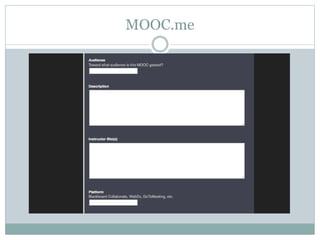
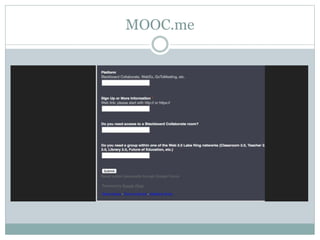
 MOOC.me
 Questions
The Hype
Are MOOCs a fad that is beginning to fade?
Content and quality of MOOCs is questionable
MOOCs create learning communities
MOOCs will provide access to
disadvantaged learners
What is the true cost of MOOCs?
MOOCs will revolutionize education
The Hype
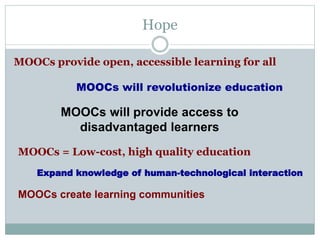
Hope
MOOCs provide open, accessible learning for all
MOOCs will revolutionize education
MOOCs = Low-cost, high quality education
MOOCs create learning communities
MOOCs will provide access to
disadvantaged learners
Expand knowledge of human-technological interaction
Why Does This Matter?
Hype
Hope
The MOOC Experience
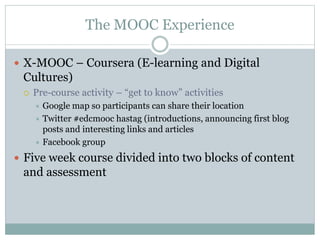
 X-MOOC – Coursera (E-learning and Digital
Cultures)
 Pre-course activity – “get to know” activities
 Google map so participants can share their location
 Twitter #edcmooc hastag (introductions, announcing first blog
posts and interesting links and articles
 Facebook group
 Five week course divided into two blocks of content
and assessment
The MOOC Experience
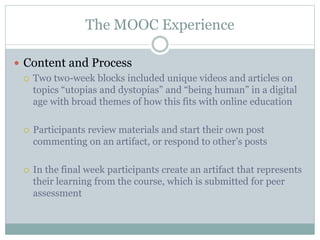
 Content and Process
 Two two-week blocks included unique videos and articles on
topics “utopias and dystopias” and “being human” in a digital
age with broad themes of how this fits with online education
 Participants review materials and start their own post
commenting on an artifact, or respond to other’s posts
 In the final week participants create an artifact that represents
their learning from the course, which is submitted for peer
assessment
The MOOC Experience
 Content and Process (cont’d)
 Participants were provided with links to different digital tools
(vimeo, wordpress, etc) to create their artifact using text,
image, sound, video or links that would be easy to assess and
available online
 Weekly “hangout” sessions with the five to six instructors from
University of Edinburgh were broadcast on Fridays
The MOOC Experience
Personal Feedback on MOOC
Pros
 It was exciting connecting with faculty from University of
Edinburgh and students from around the world
 Learned about new technologies
 Watched thought-provoking professional videos and read
academic articles on interaction between digital and human
cultures
 Learned from other’s insights about the topic
 Contributed to asynchronous discussions
The MOOC Experience
 Cons
 Time consuming: material was dense, learning the new
technologies took time
 Some threads were off-topic
 Time difference made it difficult to engage in the hangout
sessions as I was working full-time
 Thoughts on improvements
 It would have been useful to have the course begin again right
away so I could have repeated the experience – rather than
wait a year for the course to be offered again
The MOOC Experience
 AK’s Experience and List of Issues
 Academic Governance and MOOC goals
 Instructional design
 Learner motivation
 Learner engagement and participation
 Learner satisfaction
 Usability & accessibility
 Assessment challenges
 Value of completion and certification
 Sustainability and reputation
 Course content and copyright
 Teaching in a “Massive” environment
 Cultural communication and cultural hegemony
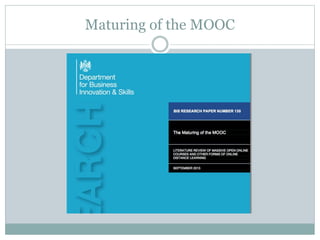
Maturing of the MOOC
Maturing of the MOOC: Literature review of Massive
Open Online Courses and Other Online Open Distance
Learning
 Pedagogy
 Accreditation
 Business model
 Learner experience
 Learning analytics
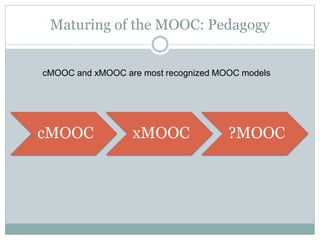
Maturing of the MOOC: Pedagogy
cMOOC xMOOC ?MOOC
cMOOC and xMOOC are most recognized MOOC models
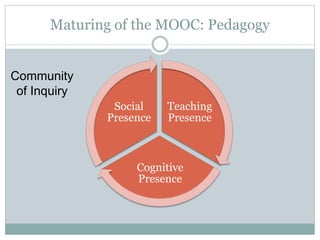
Maturing of the MOOC: Pedagogy
Teaching
Presence
Cognitive
Presence
Social
Presence
Community
of Inquiry
Maturing of the MOOC: Pedagogy
 McAuley Report:
 The extent to which it can support deep enquiry and the
creation of sophisticated knowledge
 The breadth versus the depth of participation
 Whether and under what conditions successful
participation can extend beyond those with broadband
access and sophisticated social networking skills
 Identifying the processes and practices that might encourage
lurkers, or “legitimate peripheral participants”, to take on
more active and central roles
McAuley, A., Stewart, B., Siemens, G., & Cormier, D. (2010).
The MOOC model for digital practice.
Maturing of the MOOC: Pedagogy
 McAuley Report
 The impact or value of even peripheral participation,
specifically the extent to which it might contribute to
participation in the digital economy in extra-MOOC practices
 Specific strategies to maximise the effective contribution of
facilitators in particular and more advanced participants in
general
 The role for accreditation, if any, and how it might be
implemented.
McAuley, A., Stewart, B., Siemens, G., & Cormier, D. (2010).
The MOOC model for digital practice.
Maturing of the MOOC: Pedagogy
 MOOC Pedagogy: Gleaning Good Practice from
Existing MOOCs (Mahi Bali)
 Assessed four MOOC courses against Chickering and
Gamson’s (1987) “Seven Principles of Good Practice in
Undergraduate Education”
 Concluded that “spaces for engagement” within the course,
with flexible pathways and a range of learning options
improved the learning experience
 Courses that do not promote interaction among students or
higher order thinking is shortchanging the participants
Maturing of the MOOC: Accreditation
Accreditation
Assessment
Maturing of the MOOC: Business Models
 edX partnership agreements
 Coursera partnership agreements
 Certification
 Secure assessments
 Employee recruitment
 Applicant screening
 Human tutoring or assignment marking
 Selling the MOOC platform to enterprises to use in their own
training
 Sponsorships
 Tuition fees (basically defeating the purpose of a free online course)
Maturing of the MOOC: Business Models
 SUNY (State University of New York)
 Colorado University
 intends to use the platform as a channel for buying and selling
content to extend its course offerings. This trading of content
on the platform creates revenue opportunities for Coursera – a
fact acknowledged by the company
 The Massachusetts Bay Community College (MBCC)
initiative, run in conjunction withBunker Hill
Community College (BHCC)
 deploys a “flipped classroom” model where aMOOC from MIT
provides content, but the colleges provide discussion and
supervision.
Maturing of the MOOC: Learner experience
 Learner experience
 Who are the learners?
 Drop out rate
 Skills learned – networking, critical thinking, writing
Maturing of the MOOC: Learning analytics
 Learner analytics
 Rich data from University of Edinburgh’s partnership with
Coursera
 Compared six Coursera courses:
 Introduction to Philosophy
 Critical Thinking
 E-learning and Digital Cultures
 Astrobiology
 AI Planning
 Equine Nutrition
 Learner aspirations
 Number of postings, course deliverables per student per course
Meeting Challenges
 Challenges for conceptualizing EU MOOC for
vulnerable learner groups
 Course for high school students?
 Examining the multi-lingual and community
potential of massive online courses
Why Does It Matter?
Hype
Hope
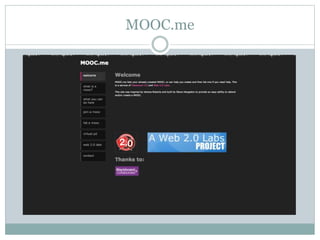
MOOC.me
MOOC.me
MOOC.me
MOOC.me
MOOC.me
Summary
 The hype about MOOCs will continue for some time
 MOOCs are morphing from cMOOC and xMOOC
models to a hybrid or new model entirely – MOOC
3.0?
 Institutions, private corporations, teachers and
learners are creating ????
Where do MOOCs go from
here….like Wayne Gretzky
…skate to where the puck will
be, not where it has been…
Questions?
?
References
 Anderson, Nick. (2013). MIT study finds learning gains for students who took free online
course. The Washington Post. September 23, 2013.
 Bates, Tony. Is online learning really cracking open the public post-secondary system? Online
learning and distance education resources. July 12, 2012. Retrieved October 21,
2014.:///Users/davidandrosemarri2/Desktop/Is%20online%20learning%20really%20cracking
%20open%20the%20public%20post-secondary%20system%3F.webarchive
 Bali, Maha (2014). MOOC Pedagogy: Gleaning Good Practice from Existing MOOCs. MERLOT
Journal of Online Learning and Teaching. 10 (1) March 2014.
 Clark, Donald (2013). Who’s Using MOOCs? 10 different target audiences.
http://donaldclarkplanb.blogspot.ca/2013/04/moocs-whos-using-moocs-10-
different.html?utm_source=dlvr.it&utm_medium=twitter
 Clinnin, Katlin (2014). Redefining the MOOC: Examining the multilingual and community
potential of massive online courses. Journal of Global Literacies, Technologies, and Emerging
Pedagogies 2(3), July 2014, pp. 140-162.
 Department of Business Innovation & Skills (2013). The Maturing of the MOOC: Literature
Review of Massive Open Online Courses and Other Forms of Online Distance Learning. BIS
Research Paper Number 130. September 2013. Retrieved October 15,
2014.https://www.gov.uk/government/uploads/system/uploads/attachment_data/file/24019
3/13-1173-maturing-of-the-mooc.pdf
References
 deWaard, Inge, Gallagher, Michael, Zelezny-Green, Ronda, Czerniewicz, Laura, Downes,
Stephen, Kukulska-Hulme, Agnes, & Willems, Julie. Challenges for Conceptualizing EU
MOOC for vulnerable learner groups. Retrieved October 28, 2014.
http://open.academia.edu/IgnatiaIngedeWaard
 deWaard, Igne, Koutropoulos, Apostolos, Keskin, Nilgun, Abajin, Sea, Hogue, Rebecca,
Rodriquez, C., & Gallagher, Michael (2011). Exploring the MOOC format as a
pedagogical approach for mLearning. 10th World Conference on Mobile and Contextual
Learning, Bejing, China. 18-21 October 2011.
 deWaard, Inge, Koutropoulos, Apostolos, Hogue, Rebecca, Abajian, Sean, Keskin, Nilgun,
Rodriquez, C., & Gallagher, Michael. (2012). Merging MOOC and mLearning for
Increased Learner Interactions. International Journal of Mobile and Blended Learning
4(4), 34-46. October – December 2012.
 Hilger, Chris (2014). edX High School Initiative Promises to Bridge College Readiness
Gap. September 30, 2014. Retrieved October 15, 2014. http://extensionengine.com/edx-
high-school-initiative-promises-to-bridge-college-readiness-gap/#.VFg9n747rIY
References
 McAuley, A., Stewart, B., Siemens, G., & Cormier, D. (2010). The MOOC model
for digital practice. Retrieved from
http://www.elearnspace.org/Articles/MOOC_Final.pdf
 Online Etymology Dictionary
http://www.etymonline.com/index.php?allowed_in_frame=0&search=mad&searchmod
e=none
 Rivard, Ry (2013). Massive (But Not Open). InsideHigherEd. May 14, 2013. Retrieved
November 1, 2014. https://www.insidehighered.com/news/2013/05/14/georgia-tech-
and-udacity-roll-out-massive-new-low-cost-degree-program
 Ruth, Stephen (2014). MOOCs and Technology to Advance Learning and Learning
Research: Can MOOCs Help Reduce College Tuition? Ubiquity. July 2014. Retrieved
October 24, 2014. http://ubiquity.acm.org
 Sandeen, C. A MOOC by any other name. ACE Newsletter. November 25, 2013. Retrieved
October 24, 2013. http://higheredtoday.org/2013/11/25/a-mooc-by-any-other-name-an-
online-course/
 Sandeen, C. From Hype to Nuanced promise: American Higher Education and the
MOOC 3.0 era. The Huffington Post. 07/18/2013. Retrieved October 31, 2014.
http://www.huffingtonpost.com/cathy-sandeen/from-hype-to-nuanced-
prom_b_3618496.html
References
 Simonson, Michael, Smaldino, Sharon, Albright, Michael, & Zvacek, Susan
(2013). Fifth Edition. Teaching and learning at a distance: foundations of
distance education. Boston, MA.
 Trucano, Michael. 12/11/2013. More about MOOCs and developing countries
EduTech: A World Bank Blog on ICT use in Education retrieved October 20,
2014
 WEU. World Education University. Retrieved October
20,2104.http://www.prnewswire.com/news-releases/mooc-20-offers-free-
for-credit-education-on-demand-world-education-university-is-the-first-
and-only-free-degree-granting-online-college-189793781.html

Mad about MOOCs

  • 1.
    G O IN G B E Y O N D T H E H Y P E T O E X A M I N E T H E E V O L U T I O N O F M O O C S R O S E M A R R I K L A M N N O V E M B E R 4 , 2 0 1 4 MAD about MOOCs
  • 2.
    MAD About MOOCsOverview  Moving past the hype/hope  Experiencing MOOCs  Spotlight on issues related to MOOCs  Maturing of MOOCs  Meeting Challenges  Summary  MOOC.me  Questions
  • 3.
    The Hype Are MOOCsa fad that is beginning to fade? Content and quality of MOOCs is questionable MOOCs create learning communities MOOCs will provide access to disadvantaged learners What is the true cost of MOOCs? MOOCs will revolutionize education
  • 4.
  • 5.
    Hope MOOCs provide open,accessible learning for all MOOCs will revolutionize education MOOCs = Low-cost, high quality education MOOCs create learning communities MOOCs will provide access to disadvantaged learners Expand knowledge of human-technological interaction
  • 6.
    Why Does ThisMatter? Hype Hope
  • 7.
    The MOOC Experience X-MOOC – Coursera (E-learning and Digital Cultures)  Pre-course activity – “get to know” activities  Google map so participants can share their location  Twitter #edcmooc hastag (introductions, announcing first blog posts and interesting links and articles  Facebook group  Five week course divided into two blocks of content and assessment
  • 8.
    The MOOC Experience Content and Process  Two two-week blocks included unique videos and articles on topics “utopias and dystopias” and “being human” in a digital age with broad themes of how this fits with online education  Participants review materials and start their own post commenting on an artifact, or respond to other’s posts  In the final week participants create an artifact that represents their learning from the course, which is submitted for peer assessment
  • 9.
    The MOOC Experience Content and Process (cont’d)  Participants were provided with links to different digital tools (vimeo, wordpress, etc) to create their artifact using text, image, sound, video or links that would be easy to assess and available online  Weekly “hangout” sessions with the five to six instructors from University of Edinburgh were broadcast on Fridays
  • 10.
    The MOOC Experience PersonalFeedback on MOOC Pros  It was exciting connecting with faculty from University of Edinburgh and students from around the world  Learned about new technologies  Watched thought-provoking professional videos and read academic articles on interaction between digital and human cultures  Learned from other’s insights about the topic  Contributed to asynchronous discussions
  • 11.
    The MOOC Experience Cons  Time consuming: material was dense, learning the new technologies took time  Some threads were off-topic  Time difference made it difficult to engage in the hangout sessions as I was working full-time  Thoughts on improvements  It would have been useful to have the course begin again right away so I could have repeated the experience – rather than wait a year for the course to be offered again
  • 12.
    The MOOC Experience AK’s Experience and List of Issues  Academic Governance and MOOC goals  Instructional design  Learner motivation  Learner engagement and participation  Learner satisfaction  Usability & accessibility  Assessment challenges  Value of completion and certification  Sustainability and reputation  Course content and copyright  Teaching in a “Massive” environment  Cultural communication and cultural hegemony
  • 13.
  • 14.
    Maturing of theMOOC Maturing of the MOOC: Literature review of Massive Open Online Courses and Other Online Open Distance Learning  Pedagogy  Accreditation  Business model  Learner experience  Learning analytics
  • 15.
    Maturing of theMOOC: Pedagogy cMOOC xMOOC ?MOOC cMOOC and xMOOC are most recognized MOOC models
  • 16.
    Maturing of theMOOC: Pedagogy Teaching Presence Cognitive Presence Social Presence Community of Inquiry
  • 17.
    Maturing of theMOOC: Pedagogy  McAuley Report:  The extent to which it can support deep enquiry and the creation of sophisticated knowledge  The breadth versus the depth of participation  Whether and under what conditions successful participation can extend beyond those with broadband access and sophisticated social networking skills  Identifying the processes and practices that might encourage lurkers, or “legitimate peripheral participants”, to take on more active and central roles McAuley, A., Stewart, B., Siemens, G., & Cormier, D. (2010). The MOOC model for digital practice.
  • 18.
    Maturing of theMOOC: Pedagogy  McAuley Report  The impact or value of even peripheral participation, specifically the extent to which it might contribute to participation in the digital economy in extra-MOOC practices  Specific strategies to maximise the effective contribution of facilitators in particular and more advanced participants in general  The role for accreditation, if any, and how it might be implemented. McAuley, A., Stewart, B., Siemens, G., & Cormier, D. (2010). The MOOC model for digital practice.
  • 19.
    Maturing of theMOOC: Pedagogy  MOOC Pedagogy: Gleaning Good Practice from Existing MOOCs (Mahi Bali)  Assessed four MOOC courses against Chickering and Gamson’s (1987) “Seven Principles of Good Practice in Undergraduate Education”  Concluded that “spaces for engagement” within the course, with flexible pathways and a range of learning options improved the learning experience  Courses that do not promote interaction among students or higher order thinking is shortchanging the participants
  • 20.
    Maturing of theMOOC: Accreditation Accreditation Assessment
  • 21.
    Maturing of theMOOC: Business Models  edX partnership agreements  Coursera partnership agreements  Certification  Secure assessments  Employee recruitment  Applicant screening  Human tutoring or assignment marking  Selling the MOOC platform to enterprises to use in their own training  Sponsorships  Tuition fees (basically defeating the purpose of a free online course)
  • 22.
    Maturing of theMOOC: Business Models  SUNY (State University of New York)  Colorado University  intends to use the platform as a channel for buying and selling content to extend its course offerings. This trading of content on the platform creates revenue opportunities for Coursera – a fact acknowledged by the company  The Massachusetts Bay Community College (MBCC) initiative, run in conjunction withBunker Hill Community College (BHCC)  deploys a “flipped classroom” model where aMOOC from MIT provides content, but the colleges provide discussion and supervision.
  • 23.
    Maturing of theMOOC: Learner experience  Learner experience  Who are the learners?  Drop out rate  Skills learned – networking, critical thinking, writing
  • 24.
    Maturing of theMOOC: Learning analytics  Learner analytics  Rich data from University of Edinburgh’s partnership with Coursera  Compared six Coursera courses:  Introduction to Philosophy  Critical Thinking  E-learning and Digital Cultures  Astrobiology  AI Planning  Equine Nutrition  Learner aspirations  Number of postings, course deliverables per student per course
  • 25.
    Meeting Challenges  Challengesfor conceptualizing EU MOOC for vulnerable learner groups  Course for high school students?  Examining the multi-lingual and community potential of massive online courses
  • 26.
    Why Does ItMatter? Hype Hope
  • 27.
  • 28.
  • 29.
  • 30.
  • 31.
  • 32.
    Summary  The hypeabout MOOCs will continue for some time  MOOCs are morphing from cMOOC and xMOOC models to a hybrid or new model entirely – MOOC 3.0?  Institutions, private corporations, teachers and learners are creating ????
  • 33.
    Where do MOOCsgo from here….like Wayne Gretzky …skate to where the puck will be, not where it has been…
  • 34.
  • 35.
    References  Anderson, Nick.(2013). MIT study finds learning gains for students who took free online course. The Washington Post. September 23, 2013.  Bates, Tony. Is online learning really cracking open the public post-secondary system? Online learning and distance education resources. July 12, 2012. Retrieved October 21, 2014.:///Users/davidandrosemarri2/Desktop/Is%20online%20learning%20really%20cracking %20open%20the%20public%20post-secondary%20system%3F.webarchive  Bali, Maha (2014). MOOC Pedagogy: Gleaning Good Practice from Existing MOOCs. MERLOT Journal of Online Learning and Teaching. 10 (1) March 2014.  Clark, Donald (2013). Who’s Using MOOCs? 10 different target audiences. http://donaldclarkplanb.blogspot.ca/2013/04/moocs-whos-using-moocs-10- different.html?utm_source=dlvr.it&utm_medium=twitter  Clinnin, Katlin (2014). Redefining the MOOC: Examining the multilingual and community potential of massive online courses. Journal of Global Literacies, Technologies, and Emerging Pedagogies 2(3), July 2014, pp. 140-162.  Department of Business Innovation & Skills (2013). The Maturing of the MOOC: Literature Review of Massive Open Online Courses and Other Forms of Online Distance Learning. BIS Research Paper Number 130. September 2013. Retrieved October 15, 2014.https://www.gov.uk/government/uploads/system/uploads/attachment_data/file/24019 3/13-1173-maturing-of-the-mooc.pdf
  • 36.
    References  deWaard, Inge,Gallagher, Michael, Zelezny-Green, Ronda, Czerniewicz, Laura, Downes, Stephen, Kukulska-Hulme, Agnes, & Willems, Julie. Challenges for Conceptualizing EU MOOC for vulnerable learner groups. Retrieved October 28, 2014. http://open.academia.edu/IgnatiaIngedeWaard  deWaard, Igne, Koutropoulos, Apostolos, Keskin, Nilgun, Abajin, Sea, Hogue, Rebecca, Rodriquez, C., & Gallagher, Michael (2011). Exploring the MOOC format as a pedagogical approach for mLearning. 10th World Conference on Mobile and Contextual Learning, Bejing, China. 18-21 October 2011.  deWaard, Inge, Koutropoulos, Apostolos, Hogue, Rebecca, Abajian, Sean, Keskin, Nilgun, Rodriquez, C., & Gallagher, Michael. (2012). Merging MOOC and mLearning for Increased Learner Interactions. International Journal of Mobile and Blended Learning 4(4), 34-46. October – December 2012.  Hilger, Chris (2014). edX High School Initiative Promises to Bridge College Readiness Gap. September 30, 2014. Retrieved October 15, 2014. http://extensionengine.com/edx- high-school-initiative-promises-to-bridge-college-readiness-gap/#.VFg9n747rIY
  • 37.
    References  McAuley, A.,Stewart, B., Siemens, G., & Cormier, D. (2010). The MOOC model for digital practice. Retrieved from http://www.elearnspace.org/Articles/MOOC_Final.pdf  Online Etymology Dictionary http://www.etymonline.com/index.php?allowed_in_frame=0&search=mad&searchmod e=none  Rivard, Ry (2013). Massive (But Not Open). InsideHigherEd. May 14, 2013. Retrieved November 1, 2014. https://www.insidehighered.com/news/2013/05/14/georgia-tech- and-udacity-roll-out-massive-new-low-cost-degree-program  Ruth, Stephen (2014). MOOCs and Technology to Advance Learning and Learning Research: Can MOOCs Help Reduce College Tuition? Ubiquity. July 2014. Retrieved October 24, 2014. http://ubiquity.acm.org  Sandeen, C. A MOOC by any other name. ACE Newsletter. November 25, 2013. Retrieved October 24, 2013. http://higheredtoday.org/2013/11/25/a-mooc-by-any-other-name-an- online-course/  Sandeen, C. From Hype to Nuanced promise: American Higher Education and the MOOC 3.0 era. The Huffington Post. 07/18/2013. Retrieved October 31, 2014. http://www.huffingtonpost.com/cathy-sandeen/from-hype-to-nuanced- prom_b_3618496.html
  • 38.
    References  Simonson, Michael,Smaldino, Sharon, Albright, Michael, & Zvacek, Susan (2013). Fifth Edition. Teaching and learning at a distance: foundations of distance education. Boston, MA.  Trucano, Michael. 12/11/2013. More about MOOCs and developing countries EduTech: A World Bank Blog on ICT use in Education retrieved October 20, 2014  WEU. World Education University. Retrieved October 20,2104.http://www.prnewswire.com/news-releases/mooc-20-offers-free- for-credit-education-on-demand-world-education-university-is-the-first- and-only-free-degree-granting-online-college-189793781.html

Editor's Notes

  • #34 http://www.youtube.com/watch?v=ByKu8BwT5K4