education: challenges and
lessons learnt in Romania
Assoc. prof. dr. Gabriela Grosseck
West University of Timisoara, Romania
Prof. univ. dr. Carmen Holotescu
“Ioan Slavici” University of Timisoara, Romania
Online Teaching Reshape Education during and after COVID-19
3 June 2020
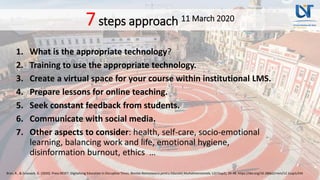
7steps approach 11 March 2020
1. What is the appropriate technology?
2. Training to use the appropriate technology.
3. Create a virtual space for your course within institutional LMS.
4. Prepare lessons for online teaching.
5. Seek constant feedback from students.
6. Communicate with social media.
7. Other aspects to consider: health, self-care, socio-emotional
learning, balancing work and life, emotional hygiene,
disinformation burnout, ethics …
Bran, R., & Grosseck, G. (2020). Press RESET: Digitalising Education in Disruptive Times. Revista Romaneasca pentru Educatie Multidimensionala, 12(1Sup2), 39-48. https://doi.org/10.18662/rrem/12.1sup1/245
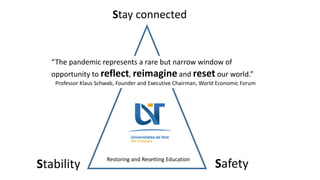
Stability Safety
Stay connected
Restoring and Resetting Education
“The pandemic represents a rare but narrow window of
opportunity to reflect, reimagine and reset our world.”
Professor Klaus Schwab, Founder and Executive Chairman, World Economic Forum
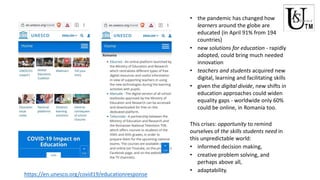
• the pandemic has changed how
learners around the globe are
educated (in April 91% from 194
countries)
• new solutions for education - rapidly
adopted, could bring much needed
innovation
• teachers and students acquired new
digital, learning and facilitating skills
• given the digital divide, new shifts in
education approaches could widen
equality gaps - worldwide only 60%
could be online, in Romania too.
This crises: opportunity to remind
ourselves of the skills students need in
this unpredictable world:
• informed decision making,
• creative problem solving, and
perhaps above all,
• adaptability.
https://en.unesco.org/covid19/educationresponse
We should rethink the role of a resilient and quality Education:
Institutional level
• motivate teachers to learn continuously (in in/formal programs,
MOOCs)
• adopt open educational practices/blended learning, integrate OERs
and MOOCs
National level
• programs for infrastructure, connectivity
• promote Open Education principles
• transparent public-private partnerships
European level
• recovery instrument NextGenerationEU: supporting distance learning
and digital skills development
• projects for opening up education, micro-credentials for formal
recognition of different learning paths (MOOCs)
International level
• collaboration for sharing best practices, for communities of practice
of teachers and policy makers
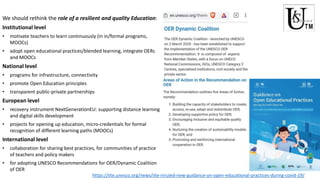
• for adopting UNESCO Recommendations for OER/Dynamic Coalition
of OER
https://iite.unesco.org/news/iite-inruled-new-guidance-on-open-educational-practices-during-covid-19/
Thank you!
Gabriela Grosseck
Twitter: @ggrosseck
Carmen Holotescu
Twitter: @cami13
FB, LinkedIn, Researchgate, Google Scholar, Slideshare

Reset education

  • 1.
    education: challenges and lessonslearnt in Romania Assoc. prof. dr. Gabriela Grosseck West University of Timisoara, Romania Prof. univ. dr. Carmen Holotescu “Ioan Slavici” University of Timisoara, Romania Online Teaching Reshape Education during and after COVID-19 3 June 2020
  • 2.
    7steps approach 11March 2020 1. What is the appropriate technology? 2. Training to use the appropriate technology. 3. Create a virtual space for your course within institutional LMS. 4. Prepare lessons for online teaching. 5. Seek constant feedback from students. 6. Communicate with social media. 7. Other aspects to consider: health, self-care, socio-emotional learning, balancing work and life, emotional hygiene, disinformation burnout, ethics … Bran, R., & Grosseck, G. (2020). Press RESET: Digitalising Education in Disruptive Times. Revista Romaneasca pentru Educatie Multidimensionala, 12(1Sup2), 39-48. https://doi.org/10.18662/rrem/12.1sup1/245
  • 3.
    Stability Safety Stay connected Restoringand Resetting Education “The pandemic represents a rare but narrow window of opportunity to reflect, reimagine and reset our world.” Professor Klaus Schwab, Founder and Executive Chairman, World Economic Forum
  • 4.
    • the pandemichas changed how learners around the globe are educated (in April 91% from 194 countries) • new solutions for education - rapidly adopted, could bring much needed innovation • teachers and students acquired new digital, learning and facilitating skills • given the digital divide, new shifts in education approaches could widen equality gaps - worldwide only 60% could be online, in Romania too. This crises: opportunity to remind ourselves of the skills students need in this unpredictable world: • informed decision making, • creative problem solving, and perhaps above all, • adaptability. https://en.unesco.org/covid19/educationresponse
  • 5.
    We should rethinkthe role of a resilient and quality Education: Institutional level • motivate teachers to learn continuously (in in/formal programs, MOOCs) • adopt open educational practices/blended learning, integrate OERs and MOOCs National level • programs for infrastructure, connectivity • promote Open Education principles • transparent public-private partnerships European level • recovery instrument NextGenerationEU: supporting distance learning and digital skills development • projects for opening up education, micro-credentials for formal recognition of different learning paths (MOOCs) International level • collaboration for sharing best practices, for communities of practice of teachers and policy makers • for adopting UNESCO Recommendations for OER/Dynamic Coalition of OER https://iite.unesco.org/news/iite-inruled-new-guidance-on-open-educational-practices-during-covid-19/
  • 6.
    Thank you! Gabriela Grosseck Twitter:@ggrosseck Carmen Holotescu Twitter: @cami13 FB, LinkedIn, Researchgate, Google Scholar, Slideshare