CASE PRESENTATION 
By 
Rasha Ali Abdel-Noor 
Lecturer of internal medicine 
&Rheumatology. 
Tanta University, Faculty of Medicine.
HISTORY 
ļ‚¢Afemale patient named F.E.E aged 47 years from Elmehalla Elkobra ,Gharbia,married and has 3 offsprings ,housewife and has no special habits. 
ļ‚¢Complaints: 
Acute sever pain in the 4 limbs mainly in the lower limbs 2 days before admission(Decemper 2013).
HISTORY OF THE PRESENT ILLNESS 
ļ‚¢ The condition has been started two days before admission by acute onset of sever pain in both lower limbs from toes till knees extending to upper limbs and it was associated by tingling and numbness sensation it was not associated with fever or any arthralgia or mucocutaneous rashes. 
ļ‚¢These symptoms occurred one week after an attack of diarrhea for which she received incomplete course of ciprofloxacine.
PAST HISTORY 
ļ‚¢No past history of diabetes or hypertension or chronic disease of medical importance. 
ļ‚¢No history of drug use or drug allergy. 
Family history: 
ļ‚¢ Irrelevant 
Social history: 
Average socioeconomic status.
EXAMINATION 
ļ‚¢General appearance: The patient was fully conscious ,alert looks ill with no special facial expression with normal decubitus in bed and average body built. 
ļ‚¢Vital signs: 
Pulse: absent radial , ulner and brachial pulsations in both upper limbs. 
absent both dorsalis pedis, ant and posterior tibial arteries weak femoral pulsations. 
Intact pulsations in both carotids about 80 b/m regular rhythm with average force and volume.
ļ‚¢BP: undetected in 4 limbs. 
ļ‚¢RR: 20 c/m 
ļ‚¢Temp: 37 C 
Head &neck: 
ļ‚¢Central trachea. 
ļ‚¢No enlarged thyroid gland. 
ļ‚¢ No congested neck viens. 
ļ‚¢No lymphadenopathy.
Chest : bilateral equal air entry with normal vesicular breathing . 
Heart: normal heart sounds ,no added sounds or murmer. 
Abdomen: lax abdomen ,no organomegaly or ascites or bruit. 
Extremities: 
ļ‚¢absent pulsations as described above. 
ļ‚¢Cold extremites ,poor capillary filling but with no colour changes or any skin lesions.
Musculoskeletal examination : 
No joint swelling, tenderness or limitation of movements 
Neurological examination: 
Motor power & deep reflexes were normal 
Sensation : parathesia at 4 limbs
INVESTIGATIONS 
Duplex study of 4 limbs: 
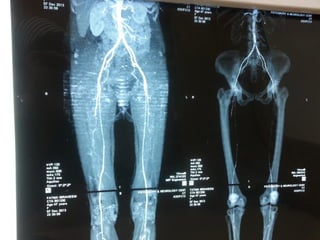
ļ‚¢Marked diffuse narrowing of arterial tree of both lower limbs starting from external iliac arteries with absent flow at both anterior tibial and dorsalis pedis arteries 
ļ‚¢Marked diffuse narrowing of both brachial arteries with absent flow in both radial and ulner arteries. 
ļ‚¢Absent atherosclerotic changes. 
ļ‚¢Patent superfical and deep venous system.
INVESTIGATIONS 
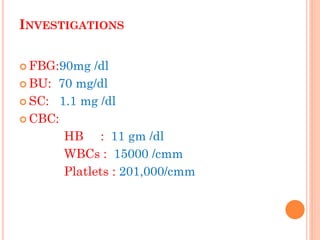
ļ‚¢FBG:90mg /dl 
ļ‚¢BU: 70 mg/dl 
ļ‚¢SC: 1.1 mg /dl 
ļ‚¢CBC: 
HB : 11 gm /dl 
WBCs : 15000 /cmm 
Platlets : 201,000/cmm
ļ‚¢L.F.T: 
Bilirubin : 1mg/l 
SGPT: 76 u/l 
SGOT: 93u/l 
S. Albumin: 3.4 gm/l 
S.globulin : 3.1 
ļ‚¢ESR: 45 1st hr ,65 2nd hr 
ļ‚¢CRP :-ve 
ļ‚¢Abd US : normal 
ļ‚¢ECG: Normal sinus rhythm. 
ļ‚¢Echo: Normal
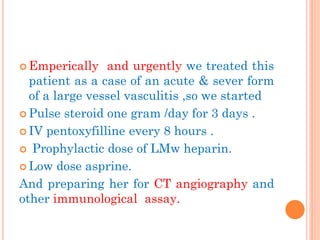
ļ‚¢Emperically and urgently we treated this patient as a case of an acute & sever form of a large vessel vasculitis ,so we started 
ļ‚¢Pulse steroid one gram /day for 3 days . 
ļ‚¢IV pentoxyfilline every 8 hours . 
ļ‚¢ Prophylactic dose of LMw heparin. 
ļ‚¢Low dose asprine. 
And preparing her for CT angiography and other immunological assay.
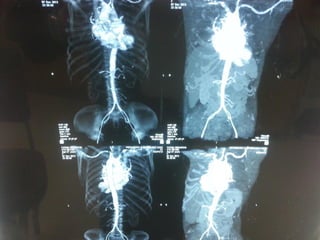
CT ANGIOGRAPHY 
ļ‚¢Normal aortic arch ,descending thoracic and abdominal aorta with diffuse narrowing of both external iliac arteries with absence of atherosclerotic changes favor the diagnosis of peripheral vasculitis.
RESPONSE 
ļ‚¢Marked improvement of her ischemic pain after the 2nd dose of pulse steroid ,but the pulsations still was undetected. 
ļ‚¢With completing her lab . Investigations: 
ļ‚¢RF : -ve 
ļ‚¢ANA: -ve 
ļ‚¢P&C (ANCA): -ve 
ļ‚¢Virology: 
HCV antibodies –ve 
HBsAg -ve
ļ‚¢HIV antibodies : positive
SURPRISE 
ļ‚¢Our patient is an HIV patient since 16 years and she is already on HAART 
ļ‚¢1-Aluvia:lopnavir200 mg &50 ritonavir 
ļ‚¢2-Aurobindo:emtricitabine 200 mg and tenofovir disoproxil fumerate 300 mg. 
She and her family denied all this history due to its social stigmata.
DILEMMA 
ļ‚¢Is this case is large vessel vasculitis associated with HIV or it is actually HIVrelated vasculitis???? 
ļ‚¢What about its treatment??? 
ļ‚¢Is it a mistake to start with pulse steroid??? 
ļ‚¢How could we continue??????
HIV RELATED VASCULOPATHY 
ļ‚¢Since the beginning of the HIV era in the early 1980s much has been written about rheumatic and immunologic complications observed in this patient population, including the co-occurrence of systemic vascular inflammatory diseases . 
Calabrase L H: Vasculitis and infection with the human immunodeficiency virus.Rheum Dis Clin North Am 1991; 17: 131-47
TYPES 
ļ‚¢Category I refers primarily to vasculitides diagnosed according to ACR classification schemes that have been reported in the setting of HIV infection. 
ļ‚¢Category II refers to secondary forms of vasculitis (e.g. where a precipitin or mechanism can be identified such as a specific infection or drug induced hypersensitivity. 
ļ‚¢ Category III describes those vascular disorders that appear to be unique and for which strong consideration should be given. 
FA L K RJ, A N D R A S S Y K e t al.: Nomenclature of systemic vasculitides.Proposal of an international consensus conference.Arthritis Rheum 1994; 37: 187-92. 
HU N D E R GG, A R E N D W P, B L O C H D A e tal.: The American College of Rheumatology 
1990 criteria for the classification of vasculitis.Introduction. Arthritis Rheum 1990; 33:1065-7.
CATEGORY I PRIMARY VASCULITIS IN HIV 
ļ‚¢HIV has infected an estimated 75 million people worldwide over the past 25 years , it should not be surprising to find documented accounts of just about any form of vascular inflammatory disease reported on a chance association basis. 
UNAIDS/WHO: AIDS epidemic update. December 2000: 1-28.
Miscellaneous disorders with vascular inflammation as a feature reported in HIV 
ļ‚¢Cutaneous PAN 
ļ‚¢Behcet’s syndrome 
ļ‚¢Primary angiitis of the central nervous system 
ļ‚¢Erythema nodosum. 
ļ‚¢ Rheumatic fever ,Erythema elivatinum diutinum. 
ļ‚¢ Degos disease 
ļ‚¢Angiocentric lymphoproliferative disorders 
ļ‚¢Coronary arteritis 
ļ‚¢Eaosinophilic vasculitis 
ļ‚¢Leukocytoclastic vasculitis with follicular accentuation
PATHOGENESIS 
ļ‚¢The pathophysiology of these reported cases is also unclear but may be due to direct or an indirect role for HIV itself. by way of uncontrolled immune activation with attendant cytokine release , which characterizes the underlying infection. 
ļ‚¢L.H. Calabrese Infection with the Human Immunodeficiency Virus type 1 and vascular inflammatory disease Clin Exp Rheumatol 2004; 22 (Suppl. 36):S87-S93.
CATEGORY II SECONDERY VASCULITIS 
ļ‚¢Given the immunopathology of progressive immunodeficiency and opportunistic infections. It is well known that vasculitis may arise in the course of virtually any type of infection (i.e,bacterial, fungal, mycobacterial, viral parasitic) and that such pathologic lesions may come about by way of direct angio-invasion or via aberrantly directed host-mediated immune defenses.
Secondary forms of vasculitis. 
ļ‚¢Infectious arteritis. 
ļ‚¢Cytomegalovirus . 
ļ‚¢Pneumocytstis carinii . 
ļ‚¢Toxoplamosis . 
ļ‚¢Herpes zoster associated . 
ļ‚¢Hepatitis C associated . 
ļ‚¢Drug-induced vasculitis . 
ļ‚¢Vasculitis associated with antiretrovirals .
CATEGORY III VASCULAR INFLAMMATORY DISORDER UNIQE TO HIV 
ļ‚¢(1) cerebral vasculopathy with aneursymal dilatation in HIV infected children. 
ļ‚¢(2) large vessel disease in HIV infected patients . 
T V MULAUDZI Vasculopathy is a major feature of HIV disease. CME July 2009 Vol.27
Aneurysms 
ļ‚¢This disease affects much younger patients The median age is between 30 and 40 years. However, the majority of patients infected with HIV are females and the reason for the male preponderance of aneurysmal disease is unknown. 
ļ‚¢The pathogenesis of the aneurysms is uncertain. Histology shows obliterative endarteritis involving the vasa vasora of the major vessels. These vessels are surrounded by neutrophils, which in turn are surrounded by a cuff of plasma cells, lymphocytes and monocytes. This eventually leads to thrombotic occlusion of the vasa vasora with transmural necrosis of the vessel wall, probably due to ischaemia.
ļ‚¢The common sites for the aneurysms are the common carotid and the superficial femoral artery .They can, however, be found throughout the body, tend to be multiple, and typically have a multi- loculated appearance . Many are in fact false aneurysms due to disruption of the vessel wall at the point of transmural necrosis.
OCCLUSIVE DISEASE 
ļ‚¢HIV-associated arterial occlusive disease is recognised as a specific clinical entity. As for aneurysmal disease, young males with a median age of 30 - 40 years are mainly affected; it is difficult to explain this male preponderance. 
ļ‚¢The underlying cause of occlusive disease is thought to be related to vasculitis. The histological findings are similar to those found in HIV-associated aneurysmal disease. It has been suggested that a hypercoagulable state might be involved. There have been reported findings of anti-phospholipid antibody syndrome, deficiencies of free protein S, protein C and anti- thrombin 3, but these have been sporadic reports.
ļ‚¢Clinically most patients present with advanced disease and critical ischaemia affecting the lower limb. In most patients the disease is confined to one limb, for reasons that are obscure. It is interesting to note that on Duplex Doppler imaging there is what appears to be a pathognomonic sign with hypoechoic spotting within the arterial wall (string of pearls sign). 
ļ‚¢Mulaudzi TV, Robbs JV, Pillay W, et al. Thrombectomy in HIV related peripheral arterial thrombosis: a preliminary report. Eur J Vasc Endovasc Surg 2005; 30(1): 102-106. 
ļ‚¢ Nair R, Robbs JV, Chetty R, Naidoo NG, Woolgar J. Occlusive arterial disease in HIV-infected patients: a preliminary report. Eur J Vasc Endovasc Surg 2000; 20: 353-357. 
ļ‚¢ Botes K, Van Marle J. Surgical intervention for HIV-related vascular disease. Eur J Vasc Endovasc Surg 2007; 34: 390-396.
HIV& TAKAYASU 
ļ‚¢There is striking clinicopathologic overlap withTakayasu's disease. 
ļ‚¢Features of similarity include : 
the young age of the patients, presence of multiple aneurysms, involvement of large vessels, arteritic and postarteritic changes of the vasa vasora, a temporal sequence of events (active and healing stages), and the absence of an obvious causative agent.
ļ‚¢Differences from Takayasu's: 
disease are the predominance of males, the proliferation of slit-like vascular spaces in the adventitia,the pronounced leukocytoclastic vasculitis of the vasa vasora, the absence of prominent intimal proliferation and atherosclerosis, and the clustering of the cases that coincides with the HIV/AIDS epidemic. 
ļ‚¢The overlap with Takayasu's disease is not surprising given its so called idiopathic etiopathogenesis and overlap with several arteritides. In other words, there is a chance association between H1Vand vasculitis. 
ļ‚¢RUN JAN CHETTY, SIXTO BATITANG AND RAJ NAIR, Large Artery Vasculopathy in HIV-Positive Patients: 
Another Vasculitic Enigma HUM PATHOL 2000 31:374-379
TREATMENT 
ļ‚¢Therapy for HIV-associated vasculitis remains controversial and problematic, with the largest reported experience being that of Guillevin and colleagues who advocate a combination of glucocorticoids, apheresis and antiviral therapy . 
ļ‚¢GISSELBRECHT M, COHEN P, LORTHOLARY O et al.: Human immunodeficiency virus related vasculitis. Clinical presentation of and therapeutic approach to eight cases. Ann Med Interne (Paris) 1998; 149: 398-405.
ļ‚¢Standard treatment has been offered for aneurysms, including prosthetic grafts, and relatively recently, endovascular therapy has been performed with stent 
ļ‚¢occlusive disease 
In 33 of 36 (71%) patients, salvage was attempted comprising thrombectomy with or without thrombolysis; bypass was attempted in the remaining three patients. 
Of the 64 patients, who had chronic occlusive disease, primary amputation was necessary in 30 (47%) while no treatment was offered to nine (14%) who were deemed to be pre terminal. 
Twenty-one patients were offered bypass surgery, and four an endovascular procedure
SO OUR DECISSION WAS: 
ļ‚¢To continue on 40 mg prednisolone 
ļ‚¢Oral pentoxyphylline 
ļ‚¢Low dose asprine 
Follow up after two week: 
ļ‚¢She was very well no ischemic pain but only mild neuropathic pain for which pregabalin was prescribed. 
ļ‚¢Pulse was detected well in her RT radial ,ulner and brachial also her left dorsalis pedis and ant tibial. 
ļ‚¢Felt but weaker lt radial and ulner. 
ļ‚¢Still undetected in her RT dorsalis pedis.
NEW DOPPLER AFTER ONE MONTH 
ļ‚¢Patent venous and arterial system of both upper and lower limbs with no plaques or stenosis with only biphasic flow for follow up.
ļ‚¢So we started gradual withdrwal of steroid dose 5mg every week till it was completely stopped. 
ļ‚¢Patient is now on pregabalin only and HAART. 
ļ‚¢Another doppler study was done after steroid withdrwal and it showed the same results.
CBC: ( 4-4-2014) 
ļ‚¢HB:12.6 
ļ‚¢Platlets:247,000 
ļ‚¢WBCs:5800 
Immunophenotyping: 
ļ‚¢CD4 : 734 (38%) N(430-1600) 
ļ‚¢CD8 : 618 (32%) N(280-1100) 
ļ‚¢CD4/CD8 : 1.2 N(1.2-6.2) 
ļ‚¢Viral load: ??
DILEMMA 
ļ‚¢Is this case is large vessel vasculitis associated with HIV or it is actually HIVrelated vasculitis???? 
ļ‚¢What about its treatment??? 
ļ‚¢Is it a mistake to start with pulse steroid??? 
ļ‚¢How could we continue??????
OUR CASE IS: 
HIV RELATED LARGE VESSLE VASCULITIS 
CATEGORY III
Case Presentation
Case Presentation
Case Presentation

Case Presentation

  • 1.
    CASE PRESENTATION By Rasha Ali Abdel-Noor Lecturer of internal medicine &Rheumatology. Tanta University, Faculty of Medicine.
  • 2.
    HISTORY ļ‚¢Afemale patientnamed F.E.E aged 47 years from Elmehalla Elkobra ,Gharbia,married and has 3 offsprings ,housewife and has no special habits. ļ‚¢Complaints: Acute sever pain in the 4 limbs mainly in the lower limbs 2 days before admission(Decemper 2013).
  • 3.
    HISTORY OF THEPRESENT ILLNESS ļ‚¢ The condition has been started two days before admission by acute onset of sever pain in both lower limbs from toes till knees extending to upper limbs and it was associated by tingling and numbness sensation it was not associated with fever or any arthralgia or mucocutaneous rashes. ļ‚¢These symptoms occurred one week after an attack of diarrhea for which she received incomplete course of ciprofloxacine.
  • 4.
    PAST HISTORY ļ‚¢Nopast history of diabetes or hypertension or chronic disease of medical importance. ļ‚¢No history of drug use or drug allergy. Family history: ļ‚¢ Irrelevant Social history: Average socioeconomic status.
  • 5.
    EXAMINATION ļ‚¢General appearance:The patient was fully conscious ,alert looks ill with no special facial expression with normal decubitus in bed and average body built. ļ‚¢Vital signs: Pulse: absent radial , ulner and brachial pulsations in both upper limbs. absent both dorsalis pedis, ant and posterior tibial arteries weak femoral pulsations. Intact pulsations in both carotids about 80 b/m regular rhythm with average force and volume.
  • 6.
    ļ‚¢BP: undetected in4 limbs. ļ‚¢RR: 20 c/m ļ‚¢Temp: 37 C Head &neck: ļ‚¢Central trachea. ļ‚¢No enlarged thyroid gland. ļ‚¢ No congested neck viens. ļ‚¢No lymphadenopathy.
  • 7.
    Chest : bilateralequal air entry with normal vesicular breathing . Heart: normal heart sounds ,no added sounds or murmer. Abdomen: lax abdomen ,no organomegaly or ascites or bruit. Extremities: ļ‚¢absent pulsations as described above. ļ‚¢Cold extremites ,poor capillary filling but with no colour changes or any skin lesions.
  • 8.
    Musculoskeletal examination : No joint swelling, tenderness or limitation of movements Neurological examination: Motor power & deep reflexes were normal Sensation : parathesia at 4 limbs
  • 9.
    INVESTIGATIONS Duplex studyof 4 limbs: ļ‚¢Marked diffuse narrowing of arterial tree of both lower limbs starting from external iliac arteries with absent flow at both anterior tibial and dorsalis pedis arteries ļ‚¢Marked diffuse narrowing of both brachial arteries with absent flow in both radial and ulner arteries. ļ‚¢Absent atherosclerotic changes. ļ‚¢Patent superfical and deep venous system.
  • 10.
    INVESTIGATIONS ļ‚¢FBG:90mg /dl ļ‚¢BU: 70 mg/dl ļ‚¢SC: 1.1 mg /dl ļ‚¢CBC: HB : 11 gm /dl WBCs : 15000 /cmm Platlets : 201,000/cmm
  • 11.
    ļ‚¢L.F.T: Bilirubin :1mg/l SGPT: 76 u/l SGOT: 93u/l S. Albumin: 3.4 gm/l S.globulin : 3.1 ļ‚¢ESR: 45 1st hr ,65 2nd hr ļ‚¢CRP :-ve ļ‚¢Abd US : normal ļ‚¢ECG: Normal sinus rhythm. ļ‚¢Echo: Normal
  • 12.
    ļ‚¢Emperically and urgentlywe treated this patient as a case of an acute & sever form of a large vessel vasculitis ,so we started ļ‚¢Pulse steroid one gram /day for 3 days . ļ‚¢IV pentoxyfilline every 8 hours . ļ‚¢ Prophylactic dose of LMw heparin. ļ‚¢Low dose asprine. And preparing her for CT angiography and other immunological assay.
  • 13.
    CT ANGIOGRAPHY ļ‚¢Normalaortic arch ,descending thoracic and abdominal aorta with diffuse narrowing of both external iliac arteries with absence of atherosclerotic changes favor the diagnosis of peripheral vasculitis.
  • 19.
    RESPONSE ļ‚¢Marked improvementof her ischemic pain after the 2nd dose of pulse steroid ,but the pulsations still was undetected. ļ‚¢With completing her lab . Investigations: ļ‚¢RF : -ve ļ‚¢ANA: -ve ļ‚¢P&C (ANCA): -ve ļ‚¢Virology: HCV antibodies –ve HBsAg -ve
  • 20.
  • 22.
    SURPRISE ļ‚¢Our patientis an HIV patient since 16 years and she is already on HAART ļ‚¢1-Aluvia:lopnavir200 mg &50 ritonavir ļ‚¢2-Aurobindo:emtricitabine 200 mg and tenofovir disoproxil fumerate 300 mg. She and her family denied all this history due to its social stigmata.
  • 23.
    DILEMMA ļ‚¢Is thiscase is large vessel vasculitis associated with HIV or it is actually HIVrelated vasculitis???? ļ‚¢What about its treatment??? ļ‚¢Is it a mistake to start with pulse steroid??? ļ‚¢How could we continue??????
  • 24.
    HIV RELATED VASCULOPATHY ļ‚¢Since the beginning of the HIV era in the early 1980s much has been written about rheumatic and immunologic complications observed in this patient population, including the co-occurrence of systemic vascular inflammatory diseases . Calabrase L H: Vasculitis and infection with the human immunodeficiency virus.Rheum Dis Clin North Am 1991; 17: 131-47
  • 26.
    TYPES ļ‚¢Category Irefers primarily to vasculitides diagnosed according to ACR classification schemes that have been reported in the setting of HIV infection. ļ‚¢Category II refers to secondary forms of vasculitis (e.g. where a precipitin or mechanism can be identified such as a specific infection or drug induced hypersensitivity. ļ‚¢ Category III describes those vascular disorders that appear to be unique and for which strong consideration should be given. FA L K RJ, A N D R A S S Y K e t al.: Nomenclature of systemic vasculitides.Proposal of an international consensus conference.Arthritis Rheum 1994; 37: 187-92. HU N D E R GG, A R E N D W P, B L O C H D A e tal.: The American College of Rheumatology 1990 criteria for the classification of vasculitis.Introduction. Arthritis Rheum 1990; 33:1065-7.
  • 27.
    CATEGORY I PRIMARYVASCULITIS IN HIV ļ‚¢HIV has infected an estimated 75 million people worldwide over the past 25 years , it should not be surprising to find documented accounts of just about any form of vascular inflammatory disease reported on a chance association basis. UNAIDS/WHO: AIDS epidemic update. December 2000: 1-28.
  • 29.
    Miscellaneous disorders withvascular inflammation as a feature reported in HIV ļ‚¢Cutaneous PAN ļ‚¢Behcet’s syndrome ļ‚¢Primary angiitis of the central nervous system ļ‚¢Erythema nodosum. ļ‚¢ Rheumatic fever ,Erythema elivatinum diutinum. ļ‚¢ Degos disease ļ‚¢Angiocentric lymphoproliferative disorders ļ‚¢Coronary arteritis ļ‚¢Eaosinophilic vasculitis ļ‚¢Leukocytoclastic vasculitis with follicular accentuation
  • 30.
    PATHOGENESIS ļ‚¢The pathophysiologyof these reported cases is also unclear but may be due to direct or an indirect role for HIV itself. by way of uncontrolled immune activation with attendant cytokine release , which characterizes the underlying infection. ļ‚¢L.H. Calabrese Infection with the Human Immunodeficiency Virus type 1 and vascular inflammatory disease Clin Exp Rheumatol 2004; 22 (Suppl. 36):S87-S93.
  • 31.
    CATEGORY II SECONDERYVASCULITIS ļ‚¢Given the immunopathology of progressive immunodeficiency and opportunistic infections. It is well known that vasculitis may arise in the course of virtually any type of infection (i.e,bacterial, fungal, mycobacterial, viral parasitic) and that such pathologic lesions may come about by way of direct angio-invasion or via aberrantly directed host-mediated immune defenses.
  • 32.
    Secondary forms ofvasculitis. ļ‚¢Infectious arteritis. ļ‚¢Cytomegalovirus . ļ‚¢Pneumocytstis carinii . ļ‚¢Toxoplamosis . ļ‚¢Herpes zoster associated . ļ‚¢Hepatitis C associated . ļ‚¢Drug-induced vasculitis . ļ‚¢Vasculitis associated with antiretrovirals .
  • 33.
    CATEGORY III VASCULARINFLAMMATORY DISORDER UNIQE TO HIV ļ‚¢(1) cerebral vasculopathy with aneursymal dilatation in HIV infected children. ļ‚¢(2) large vessel disease in HIV infected patients . T V MULAUDZI Vasculopathy is a major feature of HIV disease. CME July 2009 Vol.27
  • 35.
    Aneurysms ļ‚¢This diseaseaffects much younger patients The median age is between 30 and 40 years. However, the majority of patients infected with HIV are females and the reason for the male preponderance of aneurysmal disease is unknown. ļ‚¢The pathogenesis of the aneurysms is uncertain. Histology shows obliterative endarteritis involving the vasa vasora of the major vessels. These vessels are surrounded by neutrophils, which in turn are surrounded by a cuff of plasma cells, lymphocytes and monocytes. This eventually leads to thrombotic occlusion of the vasa vasora with transmural necrosis of the vessel wall, probably due to ischaemia.
  • 36.
    ļ‚¢The common sitesfor the aneurysms are the common carotid and the superficial femoral artery .They can, however, be found throughout the body, tend to be multiple, and typically have a multi- loculated appearance . Many are in fact false aneurysms due to disruption of the vessel wall at the point of transmural necrosis.
  • 38.
    OCCLUSIVE DISEASE ļ‚¢HIV-associatedarterial occlusive disease is recognised as a specific clinical entity. As for aneurysmal disease, young males with a median age of 30 - 40 years are mainly affected; it is difficult to explain this male preponderance. ļ‚¢The underlying cause of occlusive disease is thought to be related to vasculitis. The histological findings are similar to those found in HIV-associated aneurysmal disease. It has been suggested that a hypercoagulable state might be involved. There have been reported findings of anti-phospholipid antibody syndrome, deficiencies of free protein S, protein C and anti- thrombin 3, but these have been sporadic reports.
  • 39.
    ļ‚¢Clinically most patientspresent with advanced disease and critical ischaemia affecting the lower limb. In most patients the disease is confined to one limb, for reasons that are obscure. It is interesting to note that on Duplex Doppler imaging there is what appears to be a pathognomonic sign with hypoechoic spotting within the arterial wall (string of pearls sign). ļ‚¢Mulaudzi TV, Robbs JV, Pillay W, et al. Thrombectomy in HIV related peripheral arterial thrombosis: a preliminary report. Eur J Vasc Endovasc Surg 2005; 30(1): 102-106. ļ‚¢ Nair R, Robbs JV, Chetty R, Naidoo NG, Woolgar J. Occlusive arterial disease in HIV-infected patients: a preliminary report. Eur J Vasc Endovasc Surg 2000; 20: 353-357. ļ‚¢ Botes K, Van Marle J. Surgical intervention for HIV-related vascular disease. Eur J Vasc Endovasc Surg 2007; 34: 390-396.
  • 40.
    HIV& TAKAYASU ļ‚¢Thereis striking clinicopathologic overlap withTakayasu's disease. ļ‚¢Features of similarity include : the young age of the patients, presence of multiple aneurysms, involvement of large vessels, arteritic and postarteritic changes of the vasa vasora, a temporal sequence of events (active and healing stages), and the absence of an obvious causative agent.
  • 41.
    ļ‚¢Differences from Takayasu's: disease are the predominance of males, the proliferation of slit-like vascular spaces in the adventitia,the pronounced leukocytoclastic vasculitis of the vasa vasora, the absence of prominent intimal proliferation and atherosclerosis, and the clustering of the cases that coincides with the HIV/AIDS epidemic. ļ‚¢The overlap with Takayasu's disease is not surprising given its so called idiopathic etiopathogenesis and overlap with several arteritides. In other words, there is a chance association between H1Vand vasculitis. ļ‚¢RUN JAN CHETTY, SIXTO BATITANG AND RAJ NAIR, Large Artery Vasculopathy in HIV-Positive Patients: Another Vasculitic Enigma HUM PATHOL 2000 31:374-379
  • 43.
    TREATMENT ļ‚¢Therapy forHIV-associated vasculitis remains controversial and problematic, with the largest reported experience being that of Guillevin and colleagues who advocate a combination of glucocorticoids, apheresis and antiviral therapy . ļ‚¢GISSELBRECHT M, COHEN P, LORTHOLARY O et al.: Human immunodeficiency virus related vasculitis. Clinical presentation of and therapeutic approach to eight cases. Ann Med Interne (Paris) 1998; 149: 398-405.
  • 45.
    ļ‚¢Standard treatment hasbeen offered for aneurysms, including prosthetic grafts, and relatively recently, endovascular therapy has been performed with stent ļ‚¢occlusive disease In 33 of 36 (71%) patients, salvage was attempted comprising thrombectomy with or without thrombolysis; bypass was attempted in the remaining three patients. Of the 64 patients, who had chronic occlusive disease, primary amputation was necessary in 30 (47%) while no treatment was offered to nine (14%) who were deemed to be pre terminal. Twenty-one patients were offered bypass surgery, and four an endovascular procedure
  • 46.
    SO OUR DECISSIONWAS: ļ‚¢To continue on 40 mg prednisolone ļ‚¢Oral pentoxyphylline ļ‚¢Low dose asprine Follow up after two week: ļ‚¢She was very well no ischemic pain but only mild neuropathic pain for which pregabalin was prescribed. ļ‚¢Pulse was detected well in her RT radial ,ulner and brachial also her left dorsalis pedis and ant tibial. ļ‚¢Felt but weaker lt radial and ulner. ļ‚¢Still undetected in her RT dorsalis pedis.
  • 47.
    NEW DOPPLER AFTERONE MONTH ļ‚¢Patent venous and arterial system of both upper and lower limbs with no plaques or stenosis with only biphasic flow for follow up.
  • 52.
    ļ‚¢So we startedgradual withdrwal of steroid dose 5mg every week till it was completely stopped. ļ‚¢Patient is now on pregabalin only and HAART. ļ‚¢Another doppler study was done after steroid withdrwal and it showed the same results.
  • 53.
    CBC: ( 4-4-2014) ļ‚¢HB:12.6 ļ‚¢Platlets:247,000 ļ‚¢WBCs:5800 Immunophenotyping: ļ‚¢CD4 : 734 (38%) N(430-1600) ļ‚¢CD8 : 618 (32%) N(280-1100) ļ‚¢CD4/CD8 : 1.2 N(1.2-6.2) ļ‚¢Viral load: ??
  • 54.
    DILEMMA ļ‚¢Is thiscase is large vessel vasculitis associated with HIV or it is actually HIVrelated vasculitis???? ļ‚¢What about its treatment??? ļ‚¢Is it a mistake to start with pulse steroid??? ļ‚¢How could we continue??????
  • 55.
    OUR CASE IS: HIV RELATED LARGE VESSLE VASCULITIS CATEGORY III