SYSTEMIC SCLEROSISDr.PRAVEEN NAGULA
  It is much simpler to buy books than to read them and easier to read them than to absorb their contents. SIR WILLIAM OSLER
BackgroundScleroderma is derived from the greek words skleros (hard or indurated) and derma (skin). HIPPOCRATES first described this condition as thickened skin.First detailed description by Carlo Curzio in 1752.Term scleroderma --- GiovambattistaFantonettiSystemic nature of the disease by Robert H.Goetz.
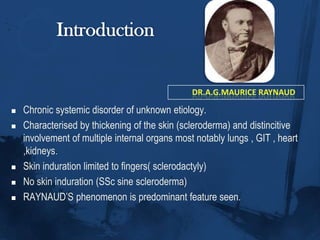
IntroductionDr.a.g.mauriceraynaudChronic systemic disorder of unknown etiology.Characterised by thickening of the skin (scleroderma) and distincitive  involvement of multiple internal organs most notably lungs , GIT , heart ,kidneys.Skin induration limited to fingers( sclerodactyly)No skin induration (SSc sine scleroderma)RAYNAUD’S phenomenon is predominant feature seen.
CASEA 40-year-old white woman with a 2-year history of Raynaud's phenomenon presented because the skin on her hands was beginning to feel tight.
Five weeks earlier, her hands had been swollen, erythematous, and pruritic, but these symptoms resolved without treatment.
The patient also described flulike symptoms during this same period of time.
 The review of systems was significant for slight dyspnea without chest pain, heartburn, difficulty swallowing pills, bloating, and abdominal distention.
The patient's work-up included pulmonary function tests, which revealed a reduction in vital capacity and a decreased lung compliance.The results of her blood work included an elevated sedimentation rate, positive antinuclear antibodies, and positive anticentromere antibodies…Scleroderma with calcinosis, Raynaud's phenomenon, esophageal dysfunction, sclerodactyly, and telangiectasia (the CREST variant of limited scleroderma).
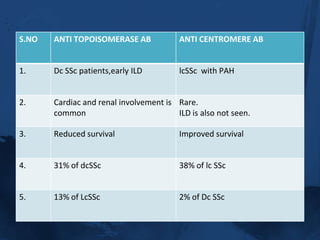
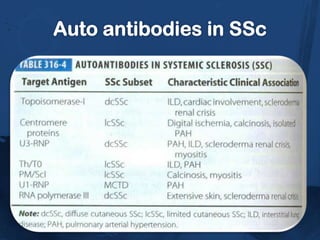
DefinitionSSc is a multisystemic ,autoimmune disease affecting small arteries,microvessels and fibroblasts resulting in vascular obliteration,collagen accumulation and scarring (fibrosis) of skin and internal organs.Leads to hidebound skin,damage of GIT,Lungs,Kidney,Heart.Serologic specificity  of the disease is the presence of ANA ,directed against cellular nuclear enzymes, like DNA topoisomerase -1 (anti –Topo 1 ) and RNA polymerase,as well as centromeric proteins (anticentromereAb)
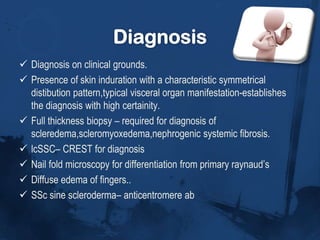
Diagnostic criteriaThe AMERICAN COLLEGE OF RHEUMATOLOGY (ACR) criteria for the classification of systemic sclerosis.One major criteria,two or more minor criteria for diagnosis.MAJOR criterion : PROXIMAL scleroderma –characterized by SYMMETRICAL thickening,tightening and induration  of the skin of the fingers and the skin proximal to the MCP /MTP joints. these changes may affect  the entire extremity,face,neck,trunk.MINOR1.SCLERODACTYLY – thickening,induration,tightening of the skin limited only to fingers.2.DIGITAL PITTING SCARS/LOSS OF SUBSTANCE FROM THE FINGER PAD–due to ischemia.3.BIBASILAR PULMONARY FIBROSIS-b/l reticular pattern of linear or lineonodular densities in basilar portions of the lung on CXR.diffuse mottling/honey comb lung  not attributable to primary pulmonary disease
EpidemiologyAcquired sporadic disease
Affects all races.
Incidence is 9-19 cases/million/year.
Female predominance.
Child bearing ages.
African americans >whites..earlier age
Non mendelian pattern of inheritance.
Concordance among twins is low.,but ANA is high..
Juvenile onset systemic sclerosis is uncommon.
No data on the prevalence of scleroderma in INDIA.EtiologyExact etiology is unclear.Environmental factors triggers or acclerators for the development of SSc  - silica exposure,vinylchloride,trichloroethylene,epoxy resins,benzene,CCl4Radiation exposure /radiotherapyCMV,HHV 5,PBV B19 Drugs– bleomycin,pentazocine.l-tryptophanCommon in coal and gold miners.Do not explain the spontaneously developed disease.
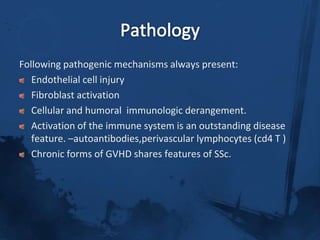
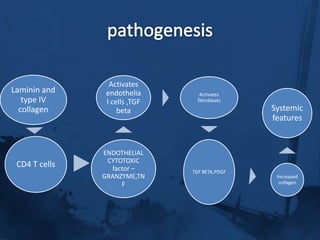
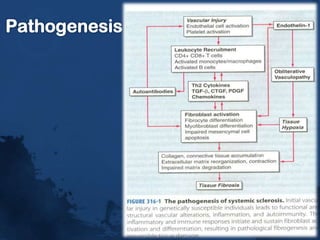
PathologyFollowing pathogenic mechanisms always present:Endothelial cell injuryFibroblast activationCellular and humoral  immunologic derangement.Activation of the immune system is an outstanding disease feature. –autoantibodies,perivascular lymphocytes (cd4 T )Chronic forms of GVHD shares features of SSc.
pathogenesis
Pathogenesis
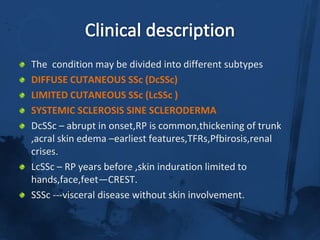
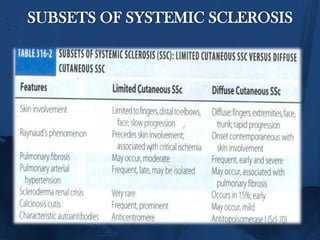
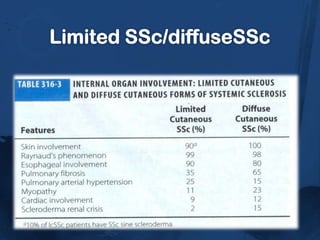
Clinical descriptionThe  condition may be divided into different subtypesDIFFUSE CUTANEOUS SSc (DcSSc)LIMITED CUTANEOUS SSc (LcSSc )SYSTEMIC SCLEROSIS SINE SCLERODERMADcSSc – abrupt in onset,RP is common,thickening of trunk ,acral skin edema –earliest features,TFRs,Pfbirosis,renal crises.LcSSc – RP years before ,skin induration limited to hands,face,feet—CREST.SSSc ---visceral disease without skin involvement.
SUBSETS OF SYSTEMIC SCLEROSIS
Limited SSc/diffuseSSc
SYSTEMIC SCLEROSISclinical features-managementDr.PraveenNagula
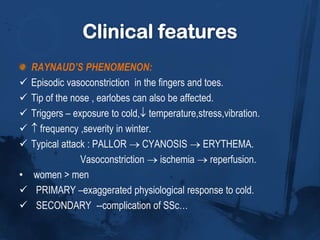
Clinical featuresRAYNAUD’S PHENOMENON:Episodic vasoconstriction  in the fingers and toes.
Tip of the nose , earlobes can also be affected.
Triggers – exposure to cold, temperature,stress,vibration.
 frequency ,severity in winter.
Typical attack : PALLOR  CYANOSIS  ERYTHEMA.                         Vasoconstriction  ischemia  reperfusion. women > men
  PRIMARY –exaggerated physiological response to cold.
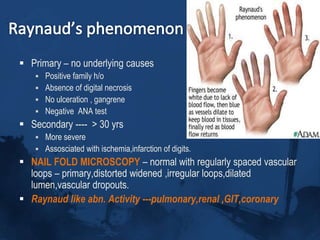
  SECONDARY  --complication of SSc…Raynaud’s phenomenonPrimary – no underlying causes
Positive family h/o
Absence of digital necrosis
No ulceration , gangrene
Negative  ANA test
Secondary ----  > 30 yrs
More severe
Assosciated with ischemia,infarction of digits.
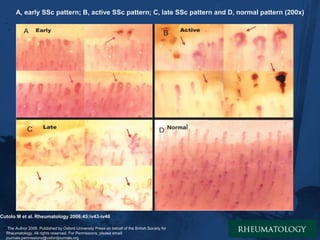
NAIL FOLD MICROSCOPY – normal with regularly spaced vascular loops – primary,distorted widened ,irregular loops,dilatedlumen,vascular dropouts.
Raynaud like abn. Activity ---pulmonary,renal ,GIT,coronaryA, early SSc pattern; B, active SSc pattern; C, late SSc pattern and D, normal pattern (200x)Cutolo M et al. Rheumatology 2006;45:iv43-iv46© The Author 2006. Published by Oxford University Press on behalf of the British Society for Rheumatology. All rights reserved. For Permissions, please email: journals.permissions@oxfordjournals.org
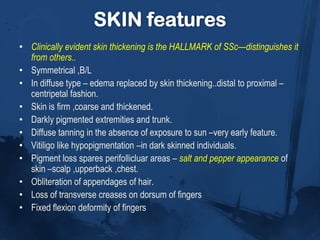
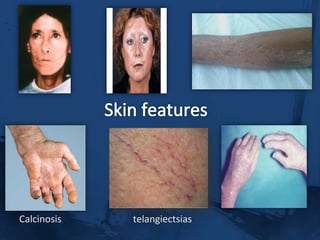
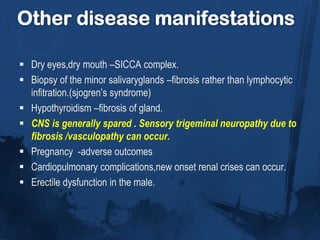
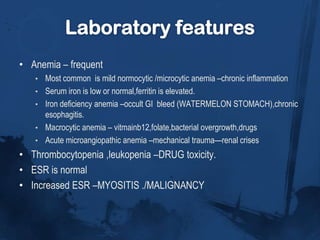
SKIN featuresClinically evident skin thickening is the HALLMARK of SSc—distinguishes it from others..
Symmetrical ,B/L
In diffuse type – edema replaced by skin thickening..distal to proximal – centripetal fashion.
Skin is firm ,coarse and thickened.
Darkly pigmented extremities and trunk.
Diffuse tanning in the absence of exposure to sun –very early feature.
Vitiligo like hypopigmentation –in dark skinned individuals.
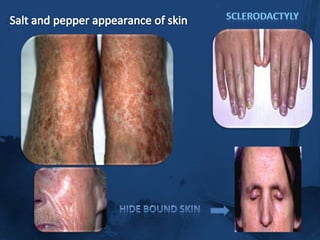
Pigment loss spares perifollicluar areas – salt and pepper appearance of skin –scalp ,upperback ,chest.
Obliteration of appendages of hair.
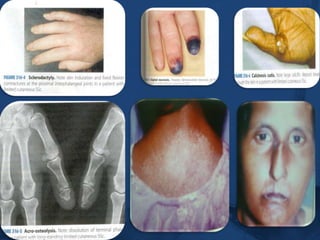
Loss of transverse creases on dorsum of fingers
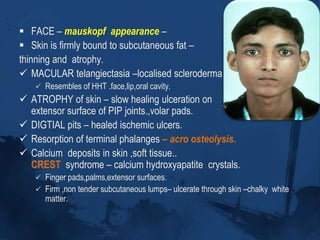
Fixed flexion deformity of fingers FACE – mauskopf  appearance –
Skin is firmly bound to subcutaneous fat –thinning and  atrophy.MACULAR telangiectasia –localised scleroderma
Resembles of HHT .face,lip,oral cavity.
ATROPHY of skin – slow healing ulceration on                                extensor surface of PIP joints.,volar pads.
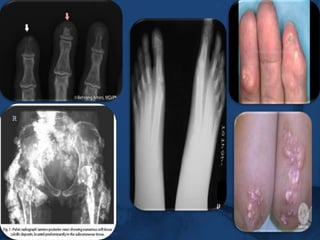
DIGTIAL pits – healed ischemic ulcers.
Resorption of terminal phalanges – acroosteolysis.

Systemic sclerosis..scleroderma

  • 1.
  • 2.
    Itis much simpler to buy books than to read them and easier to read them than to absorb their contents. SIR WILLIAM OSLER
  • 3.
    BackgroundScleroderma is derivedfrom the greek words skleros (hard or indurated) and derma (skin). HIPPOCRATES first described this condition as thickened skin.First detailed description by Carlo Curzio in 1752.Term scleroderma --- GiovambattistaFantonettiSystemic nature of the disease by Robert H.Goetz.
  • 4.
    IntroductionDr.a.g.mauriceraynaudChronic systemic disorderof unknown etiology.Characterised by thickening of the skin (scleroderma) and distincitive involvement of multiple internal organs most notably lungs , GIT , heart ,kidneys.Skin induration limited to fingers( sclerodactyly)No skin induration (SSc sine scleroderma)RAYNAUD’S phenomenon is predominant feature seen.
  • 5.
    CASEA 40-year-old whitewoman with a 2-year history of Raynaud's phenomenon presented because the skin on her hands was beginning to feel tight.
  • 6.
    Five weeks earlier,her hands had been swollen, erythematous, and pruritic, but these symptoms resolved without treatment.
  • 7.
    The patient alsodescribed flulike symptoms during this same period of time.
  • 8.
    The reviewof systems was significant for slight dyspnea without chest pain, heartburn, difficulty swallowing pills, bloating, and abdominal distention.
  • 9.
    The patient's work-upincluded pulmonary function tests, which revealed a reduction in vital capacity and a decreased lung compliance.The results of her blood work included an elevated sedimentation rate, positive antinuclear antibodies, and positive anticentromere antibodies…Scleroderma with calcinosis, Raynaud's phenomenon, esophageal dysfunction, sclerodactyly, and telangiectasia (the CREST variant of limited scleroderma).
  • 10.
    DefinitionSSc is amultisystemic ,autoimmune disease affecting small arteries,microvessels and fibroblasts resulting in vascular obliteration,collagen accumulation and scarring (fibrosis) of skin and internal organs.Leads to hidebound skin,damage of GIT,Lungs,Kidney,Heart.Serologic specificity of the disease is the presence of ANA ,directed against cellular nuclear enzymes, like DNA topoisomerase -1 (anti –Topo 1 ) and RNA polymerase,as well as centromeric proteins (anticentromereAb)
  • 11.
    Diagnostic criteriaThe AMERICANCOLLEGE OF RHEUMATOLOGY (ACR) criteria for the classification of systemic sclerosis.One major criteria,two or more minor criteria for diagnosis.MAJOR criterion : PROXIMAL scleroderma –characterized by SYMMETRICAL thickening,tightening and induration of the skin of the fingers and the skin proximal to the MCP /MTP joints. these changes may affect the entire extremity,face,neck,trunk.MINOR1.SCLERODACTYLY – thickening,induration,tightening of the skin limited only to fingers.2.DIGITAL PITTING SCARS/LOSS OF SUBSTANCE FROM THE FINGER PAD–due to ischemia.3.BIBASILAR PULMONARY FIBROSIS-b/l reticular pattern of linear or lineonodular densities in basilar portions of the lung on CXR.diffuse mottling/honey comb lung not attributable to primary pulmonary disease
  • 12.
  • 13.
  • 14.
    Incidence is 9-19cases/million/year.
  • 15.
  • 16.
  • 17.
  • 18.
    Non mendelian patternof inheritance.
  • 19.
    Concordance among twinsis low.,but ANA is high..
  • 20.
    Juvenile onset systemicsclerosis is uncommon.
  • 21.
    No data onthe prevalence of scleroderma in INDIA.EtiologyExact etiology is unclear.Environmental factors triggers or acclerators for the development of SSc - silica exposure,vinylchloride,trichloroethylene,epoxy resins,benzene,CCl4Radiation exposure /radiotherapyCMV,HHV 5,PBV B19 Drugs– bleomycin,pentazocine.l-tryptophanCommon in coal and gold miners.Do not explain the spontaneously developed disease.
  • 22.
    PathologyFollowing pathogenic mechanismsalways present:Endothelial cell injuryFibroblast activationCellular and humoral immunologic derangement.Activation of the immune system is an outstanding disease feature. –autoantibodies,perivascular lymphocytes (cd4 T )Chronic forms of GVHD shares features of SSc.
  • 23.
  • 24.
  • 25.
    Clinical descriptionThe condition may be divided into different subtypesDIFFUSE CUTANEOUS SSc (DcSSc)LIMITED CUTANEOUS SSc (LcSSc )SYSTEMIC SCLEROSIS SINE SCLERODERMADcSSc – abrupt in onset,RP is common,thickening of trunk ,acral skin edema –earliest features,TFRs,Pfbirosis,renal crises.LcSSc – RP years before ,skin induration limited to hands,face,feet—CREST.SSSc ---visceral disease without skin involvement.
  • 26.
  • 27.
  • 28.
  • 29.
    Clinical featuresRAYNAUD’S PHENOMENON:Episodicvasoconstriction in the fingers and toes.
  • 30.
    Tip of thenose , earlobes can also be affected.
  • 31.
    Triggers – exposureto cold, temperature,stress,vibration.
  • 32.
  • 33.
    Typical attack :PALLOR  CYANOSIS  ERYTHEMA. Vasoconstriction  ischemia  reperfusion. women > men
  • 34.
    PRIMARY–exaggerated physiological response to cold.
  • 35.
    SECONDARY --complication of SSc…Raynaud’s phenomenonPrimary – no underlying causes
  • 36.
  • 37.
  • 38.
  • 39.
  • 40.
  • 41.
  • 42.
  • 43.
    NAIL FOLD MICROSCOPY– normal with regularly spaced vascular loops – primary,distorted widened ,irregular loops,dilatedlumen,vascular dropouts.
  • 44.
    Raynaud like abn.Activity ---pulmonary,renal ,GIT,coronaryA, early SSc pattern; B, active SSc pattern; C, late SSc pattern and D, normal pattern (200x)Cutolo M et al. Rheumatology 2006;45:iv43-iv46© The Author 2006. Published by Oxford University Press on behalf of the British Society for Rheumatology. All rights reserved. For Permissions, please email: journals.permissions@oxfordjournals.org
  • 45.
    SKIN featuresClinically evidentskin thickening is the HALLMARK of SSc—distinguishes it from others..
  • 46.
  • 47.
    In diffuse type– edema replaced by skin thickening..distal to proximal – centripetal fashion.
  • 48.
    Skin is firm,coarse and thickened.
  • 49.
  • 50.
    Diffuse tanning inthe absence of exposure to sun –very early feature.
  • 51.
    Vitiligo like hypopigmentation–in dark skinned individuals.
  • 52.
    Pigment loss sparesperifollicluar areas – salt and pepper appearance of skin –scalp ,upperback ,chest.
  • 53.
  • 54.
    Loss of transversecreases on dorsum of fingers
  • 55.
    Fixed flexion deformityof fingers FACE – mauskopf appearance –
  • 56.
    Skin is firmlybound to subcutaneous fat –thinning and atrophy.MACULAR telangiectasia –localised scleroderma
  • 57.
    Resembles of HHT.face,lip,oral cavity.
  • 58.
    ATROPHY of skin– slow healing ulceration on extensor surface of PIP joints.,volar pads.
  • 59.
    DIGTIAL pits –healed ischemic ulcers.
  • 60.
    Resorption of terminalphalanges – acroosteolysis.