CASE PRESENTATION
OF
DIABETIC FOOT
By: Dr. Gowri Shankar B
Under the guidance of
Dr. Trupti pethkar
History
Pt. Abdul Sattar S/o Abdul Karim, 56 yrs. Muslim,. R/o
Aroli admitted on 22/08/17
Chief complaints-
# Pins and needle sensation × 1 year
# nonhealing Ulcer on right foot post amputation
× 1 month
History
HOPI-
 Pins & needle sensation Left foot both
feet ( Associated heaviness)
 Ulcer following trauma Papule pustule
ulcer wet gangrene debridement
and amputation of lateral four toes
 Discharge: yellow, foul smelling, blood stained
 No h/o fever with chills/cough / cold
 No h/s/o burning micturition / APD/loose
stools
 No h/o blurring of vision/altered color
perception
 No h/s/o hypo/hyperglycecmic episodes
 No h/o swelling of face or body.
 No h/o chest pain/ palpitations/ excertional
breathlessness.
 No h/o fainting episodes/altered sensorium
History
Past history
 K/c of type2 DM, Diagnosed 10 yrs back .
 Taking treatment for past 10 years OHG drugs and has stopped
insulin from last 5-6 months.
 Underwent amputation of 2nd to 5th toes, 1months back under
spinal anesthesia , uneventfull.
 No history of Tuberculosis, hypertension, asthma, paralysis,
thyroid dysfunction was obtained. No history of furuncles or
abscesses at other body parts was noted.
Drug history
 The patient was on Glybenclamide 10 mg OD for first 8 years of
DM.
 For last 2 years he has been taking Glymeperide and Metformin
combination (2.5/500 mg), BD. – non compliant stopped since 3
months.
 Gabapentine 400 mg /day was also taken on and off.
 Since hospitalization, he is on regular insulin 6-6-6 units.
 He is taking aspirin 75 mg HS for last two months.
Personal History
 The patient is a Muslim male, laborer by profession, he
is non-vegetarian, non-alcoholic, non smoker.
 He is having frequency of urination around 15 per day
including 3-4 times at night and constipation with
frequency of once in three days. His appetite is normal
but complains of losing the taste of the food he eats,
and thus ensuing decreased intake and slow weight loss
for past few years.
General physical Examination
 The patient at time of examination was conscious, co-
operative and oriented to time place and person. He
was lying comfortably supine with right leg resting
slightly abducted and flexed at knee on a pillow.
General built of the patient is cachexic. Normal age
related graying of hair and frowning of forehead seen.
 Pallor-, Icterus -, clubbing -,cyanosis - , edema +
Right inguinal lymph nodes - 3×2 cm in size discrete,
firm, mobile, non tender, non –erythematous.
VITALS
 PR - 84 / min (right radial ). Regular rhythm with normal pulse
volume. All peripheral pulses palpable including dorsalis pedis
on affected side, No radio-femoral delay
 BP – 128/86 mm Hg right brachial in supine position and
102/76 mm Hg on standing
 Temperature afebrile
 RR – Thoraco-abdomional, rate 16/min, no accessory muscles
being used.
General physical Examination
Airway
 Mouth opening – >2fingers
 Modified mallampatti score - I
 Thyro mental distance - >3fingers
 Hyomental disatance > 3 fingers
 Dentition – normal , no caps or dentures
 Prayers sign - negative.
 Palm print test – not done.
General physical Examination
Local examination-Ulcer
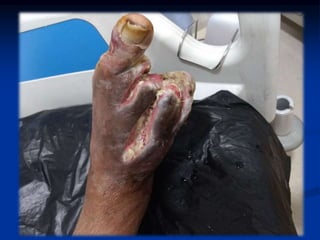
 Inspection- Single large irregular ulcer, 7-8 cm in size,
extending from base of amputated stump of 2nd metatarsal
to 5th metatarsal, inflamed, edematous, sloping edge, red
floor with granulation tissue.
 Palpation- Tender, sloping edges with irregular margins,
indurated base, depth 3mm, bleeding on touch, mobile,
warm surrounding skin , peripheral pulses palpable.(dorsalis
pedis and posterior tibial)
Systemic examination
 CVS – S1 S 2 heard, no murmurs.
 RS- b/l AEE, no added sounds.
 P/A- soft , bowel sounds present.
 CNS- HMF normal, NFND .
Provisional diagnosis
50yr male known type 2 diabetic on irregular
treatment with associated peripheral
neuropathy presenting with non healing
amputated stump ulcer on right foot for
debridement.
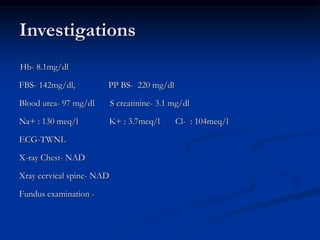
Investigations
Hb- 8.1mg/dl
FBS- 142mg/dl, PP BS- 220 mg/dl
Blood urea- 97 mg/dl S creatinine- 3.1 mg/dl
Na+ : 130 meq/l K+ : 3.7meq/l Cl- : 104meq/l
ECG-TWNL
X-ray Chest- NAD
Xray cervical spine- NAD
Fundus examination -
Discussion
Diabetes mellitus (WHO) -
A metabolic disorder of multiple etiology
characterized by chronic hyperglycemia with
disturbances of carbohydrate, fat and protein
metabolism resulting from defects in insulin secretion,
insulin action or both.
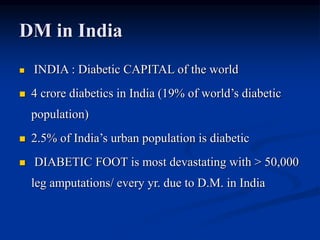
DM in India
 INDIA : Diabetic CAPITAL of the world
 4 crore diabetics in India (19% of world’s diabetic
population)
 2.5% of India’s urban population is diabetic
 DIABETIC FOOT is most devastating with > 50,000
leg amputations/ every yr. due to D.M. in India
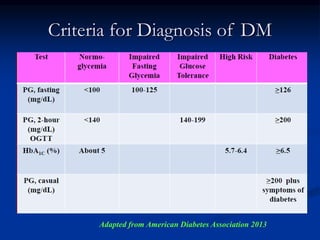
Criteria for Diagnosis of DM
Adapted from American Diabetes Association 2013
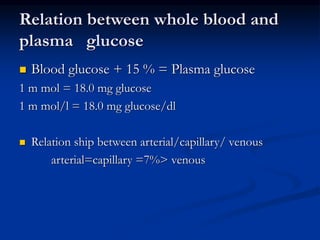
Relation between whole blood and
plasma glucose
 Blood glucose + 15 % = Plasma glucose
1 m mol = 18.0 mg glucose
1 m mol/l = 18.0 mg glucose/dl
 Relation ship between arterial/capillary/ venous
arterial=capillary =7%> venous
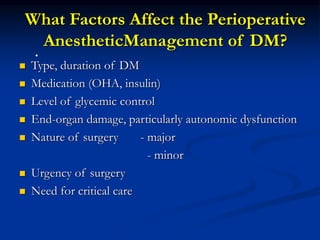
What Factors Affect the Perioperative
AnestheticManagement of DM?
 Type, duration of DM
 Medication (OHA, insulin)
 Level of glycemic control
 End-organ damage, particularly autonomic dysfunction
 Nature of surgery - major
- minor
 Urgency of surgery
 Need for critical care
•
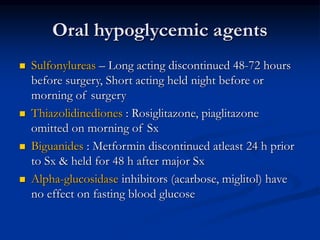
Oral hypoglycemic agents
 Sulfonylureas – Long acting discontinued 48-72 hours
before surgery, Short acting held night before or
morning of surgery
 Thiazolidinediones : Rosiglitazone, piaglitazone
omitted on morning of Sx
 Biguanides : Metformin discontinued atleast 24 h prior
to Sx & held for 48 h after major Sx
 Alpha-glucosidase inhibitors (acarbose, miglitol) have
no effect on fasting blood glucose
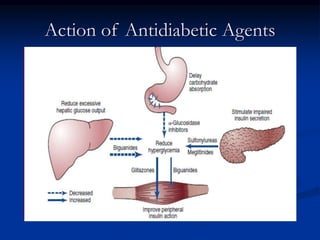
Action of Antidiabetic Agents
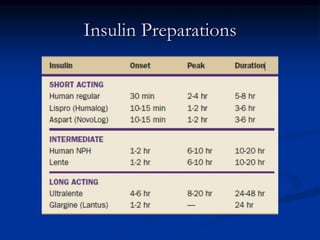
Insulin Preparations
??????
But why regular treatment ?
What is glycemic control?
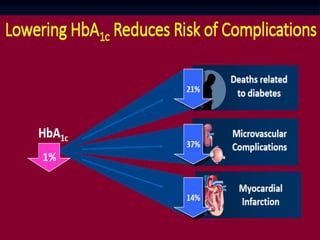
HBA1C?
Complications
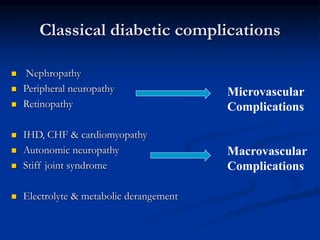
Classical diabetic complications
 Nephropathy
 Peripheral neuropathy
 Retinopathy
 IHD, CHF & cardiomyopathy
 Autonomic neuropathy
 Stiff joint syndrome
 Electrolyte & metabolic derangement
Microvascular
Complications
Macrovascular
Complications
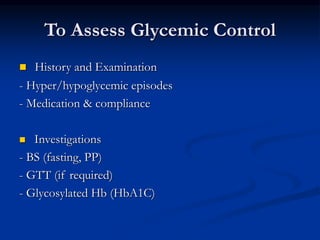
To Assess Glycemic Control
 History and Examination
- Hyper/hypoglycemic episodes
- Medication & compliance
 Investigations
- BS (fasting, PP)
- GTT (if required)
- Glycosylated Hb (HbA1C)
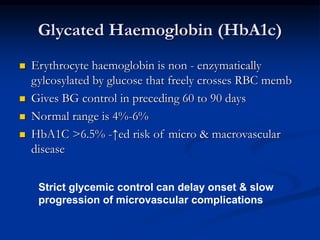
 Erythrocyte haemoglobin is non - enzymatically
gylcosylated by glucose that freely crosses RBC memb
 Gives BG control in preceding 60 to 90 days
 Normal range is 4%-6%
 HbA1C >6.5% -↑ed risk of micro & macrovascular
disease
Glycated Haemoglobin (HbA1c)
Strict glycemic control can delay onset & slow
progression of microvascular complications
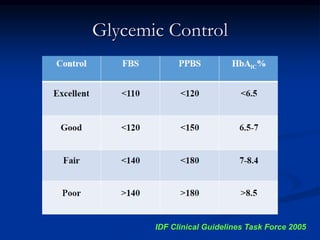
Glycemic Control
IDF Clinical Guidelines Task Force 2005
Nephropathy
Peripheral neuropathy
Retinopathy
Microvascular
Complications- how to assess?
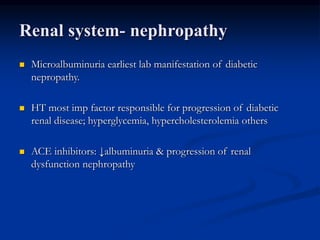
 Microalbuminuria earliest lab manifestation of diabetic
nepropathy.
 HT most imp factor responsible for progression of diabetic
renal disease; hyperglycemia, hypercholesterolemia others
 ACE inhibitors: ↓albuminuria & progression of renal
dysfunction nephropathy
Renal system- nephropathy
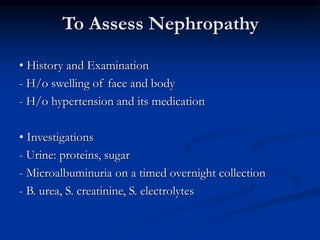
To Assess Nephropathy
• History and Examination
- H/o swelling of face and body
- H/o hypertension and its medication
• Investigations
- Urine: proteins, sugar
- Microalbuminuria on a timed overnight collection
- B. urea, S. creatinine, S. electrolytes
 More chances of ARF( 7%), most common major complication
in perioperative period, due to
- Intrinsic renal disease.
- Hemodynamic impairment
-Urosepsis
 UTI-most common post op complication in diabetics
undergoing surgery
 Adequate renal perfusion, avoiding nephrotoxins, hemodynamic
monitoring ↓risk of postop renal dysfunction
Renal system- nephropathy
To assess Peripheral Neuropathy
• History and Examination
- Foot ulcers
- Paresthesias, dysthesias, neuropathic pain
Sensorimotor loss appears in toes or feet & progresses
proximally in a "stocking and glove" distribution
• Investigations
- Loss of light touch, propioception, pain, temperature
To Assess Retinopathy
• History and Examination
- Vision deterioration
- Changes in color vision
• Investigation
- Ophthalmologic examination- fundus
IHD, CAD, CHF & cardiomyopathy
Autonomic neuropathy
Stiff joint syndrome
Macrovascular
Complications
Cardiovascular system
 Premature atheroma formation
 Chances of CAD (Male-double risk ; female-triple)
 Incidence of silent MI
 HT (29-54%) and its sequelae
 Cardiac dysautonomia may present with :
 Sudden hypotension on induction
 Absence of tachy. and HT with intubation
 Diabetic cardiomyopathy
To Assess Ischemic Heart Disease,
CHF & Cardiomyopathy
• History and Examination
- Angina or MI
- Breathlessness
- Poor exercise tolerance
- Edema feet, enlarged liver, raised JVP, basal crepts, S3/S4
• Investigations
- ECG
- X-ray Chest
- Echocardiography
Preoperative Cardiovascular
Screening
• Asymptomatic diabetic pt who has some or all risk
factors such as advanced age, smoking, hyperlipidemia &
HT
• Stress testing should be considered in patients with
multiple cardiac risk factors & poor or indeterminate
exercise tolerance
• Those with high risk diabetics, ‘metabolic syndrome’,
undergoing major elective non‐cardiac surgery
Respiratory system
• More chances of resp tract infections
• ↓ ventilatory response to PaCO2 & PaO2
• ↑ susceptibility to ventilatory depressant drugs
• ↓ FVC & FEV (glycosylation of tissue proteins), ↓ lung diffusing
capacity
• ↓ 2,3 DPG → ↓ release of O2 to tissues
• DM affects O2 transport by causing glucose to covalently bind to
Hb & alters allosteric interactions b/w β chains
 Changes in the vasonervorum with resulting ischemia ?
cause
 Increased sorbitol in feeding vessels block flow and causes
nerve ischemia
 Intraneural acculmulation of advanced products of
glycosylation
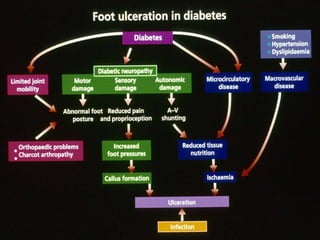
 Abnormalities of all three neurologic systems
contribute to ulceration
 Autonomic system regulates sweating and perfusion
to the limb
 Loss of autonomic control inhibits thermoregulatory
function and sweating
 Result is dry, scaly and stiff skin that is prone to
cracking and allows a portal of entry for bacteria
leading to ulcer.
www.plymouthdiabetes.org.uk/
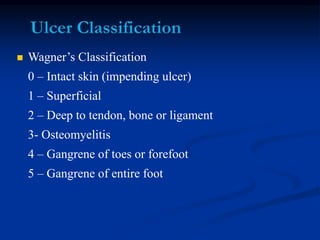
 Wagner’s Classification
0 – Intact skin (impending ulcer)
1 – Superficial
2 – Deep to tendon, bone or ligament
3- Osteomyelitis
4 – Gangrene of toes or forefoot
5 – Gangrene of entire foot
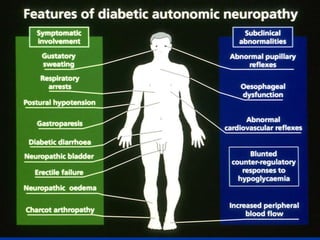
To Assess Autonomic Neuropathy
(DAN)
History and Examination
- Early satiety, hypoglycemia unawareness
- Lack of sweating
- Gastroparesis in form of nausea, vomiting, bloating, reflux
nocturnal diarrhea, constipation, abdominal distension
- Postural syncope (orthostatic hypotension)
- Bladder atony & urinary retention
- Impotence/erectile dysfunction, retrograde ejaculation
- Palpitations, Irregular pulse
- Sensory discomfort of lower limbs
www.plymouthdiabetes.org.uk/
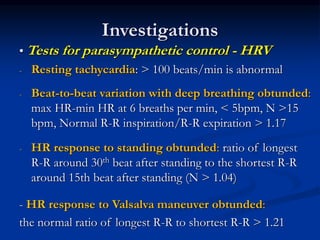
Investigations
• Tests for parasympathetic control - HRV
- Resting tachycardia: > 100 beats/min is abnormal
- Beat-to-beat variation with deep breathing obtunded:
max HR-min HR at 6 breaths per min, < 5bpm, N >15
bpm, Normal R-R inspiration/R-R expiration > 1.17
- HR response to standing obtunded: ratio of longest
R-R around 30th beat after standing to the shortest R-R
around 15th beat after standing (N > 1.04)
- HR response to Valsalva maneuver obtunded:
the normal ratio of longest R-R to shortest R-R > 1.21
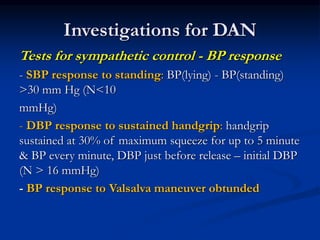
Tests for sympathetic control - BP response
- SBP response to standing: BP(lying) - BP(standing)
>30 mm Hg (N<10
mmHg)
- DBP response to sustained handgrip: handgrip
sustained at 30% of maximum squeeze for up to 5 minute
& BP every minute, DBP just before release – initial DBP
(N > 16 mmHg)
- BP response to Valsalva maneuver obtunded
Investigations for DAN
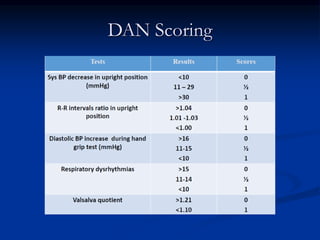
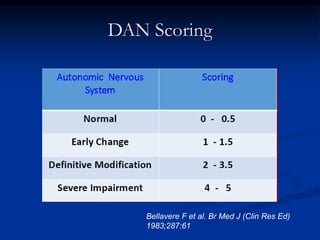
DAN Scoring
DAN Scoring
Bellavere F et al. Br Med J (Clin Res Ed)
1983;287:61
To Assess Stiff Joint Syndrome
Prayer Sign”- inability to approximate the palmar
surfaces of phalangeal joints despite max effort
- “Palm print test” - Degree of interphalangeal joint
involvement assessed by scoring the ink impression made
by palm of dominant hand
- Non-familial short stature
- Tight-waxy skin
• Investigations
- X-ray CS to delineate limited atlanto-axial extension
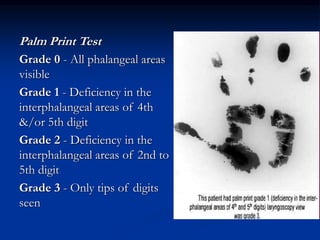
Palm Print Test
Grade 0 - All phalangeal areas
visible
Grade 1 - Deficiency in the
interphalangeal areas of 4th
&/or 5th digit
Grade 2 - Deficiency in the
interphalangeal areas of 2nd to
5th digit
Grade 3 - Only tips of digits
seen
A Positive
"Prayer Sign"
To Assess Electrolyte &
Metabolic Derangements
• History and Examination
- Non-compliance of drug
- Severe infection or starvation
- Poor control in the past few days/weeks
- S/S of hypoglycemia or ketoacidosis
• Investigations
- ABG & electrolytes
Acute metabolic Effects of
Hyperglycemia
• Dehydration - osmotic diuretic effect of glycosuria
• Acidemia - accumulation of lactic &/or ketoacids
• Dyselectrolemia - hypophosphatemia
• Hyperviscosity with ↑ed thromogenic complications
• Exacerbation of brain, SC & renal ischemic damage
• Impaired immune system response → postop infection ↑
• Impaired consciousness
“Permissive Hyperglycemia”
Unacceptable
Clinical Significance
• Impaired host response to infection → aseptic
precautions
• Decreased mobility in TM, atlanto-occipital joint &
cervical spine – restricted neck movements & difficult
laryngoscopy
• Proliferative retinopathy - vitreous H’ge on laryngoscopy
& intubation
• CAD & IHD - myocardial ischemia
• Hypertension - pressor response to L&I, poor
intraoperative BP control, cerebrovascular infarction
Autonomic neuropathy
• ↓compensatory cardiovascular response - IPPV, bld loss,
position change, drugs, SA > hypotension
• Blunted response to atropine
• Full stomach - risk of aspiration, longer preop fasting, RSI
• Impaired ventilatory responses to hypoxia, hypercarbia –
resp arrest
• Increased risk of dysrhythmias due to loss of HRV
• Urinary stasis - unnecessary bladder catheterization
• Loss of signs of hypoglycemia
• Hypothermia - increased risk intraoperatively
Clinical Significance
Neuropathy & vascular compromise:
- ↑ risk for ischemia in pressure points while shifting & positioning
(heel ulceration)
- ↑ incidence of nerve injury & ischemia
- implications for RA
• Renal disease - impaired drug excretion, renal ischemia,
more likely to develop postoperative renal failure
• Associated complications - DKA/NKHC
- hypoglycemia
Clinical Significance
Diabetes & Accelerated
Physiologic Aging
• Adverse perioperative outcomes repeatedly &
substantially correlated with age of patient
• Type 1 diabetic with poor control of BS ages approx
1.75 yrs physiologically for every chronologic yr of
disease, 1.25 years if BS controlled tightly
• Type 2 diabetic ages about 1.5 yrs for every chronologic
yr of disease, 1.06 yrs with tight control of BS & BP
Does DM Increase Perioperative
Risk?
• Yes, average diabetic pt presents a higher perioperative
risk than average non-diabetic pt
• Common postoperative complications - delayed wound
healing, sepsis, urinary retention & infection, angina, MI,
hypotension/HT, episodes of hyper or hypoglycemia,
DKA
Increased Morbidity & Mortality
Intensive Monitoring Longer Hospital Stay
Perioperative Problems in
Diabetic Patient
• Surgical induction of stress response with catabolic
hormone secretion →anti‐insulin effect → insulin
requirements in this period unpredictable
• Surgery associated with a reduction in insulin sensitivity
• Interruption of food intake, esp after GI procedures
• Altered consciousness, which masks sx of hypoglycemia
• Circulatory disturbances associated with anaesthesia &
surgery, which alters absorption of subcutaneous insulin
Anaesthetic
considerations
Anaesthetic Technique & the
Diabetic Patient
• Anaesthetic techniques (GA/RA or N blockade) may
modulate secretion of catabolic hormones & any residual
insulin secretion
• Perioperative increase in epinephrine & cortisol conc in
pts under GA is blocked by EA → much less disruption
of glucose metabolism
• Induction agents affect glucose homeostasis
perioperatively ->clinically not significant
Anaesthetic Agents & DM
• Etomidate blocks adrenal steroidogenesis → cortisol syn
• ↓ hyperglycemic response to surgery by approx 1mmol/L
• Benzodiazepines in high doses
- ↓secretion of ACTH → ↓ production of cortisol
- ↓ sympathetic stimulation→↓in glycemic response
• High‐dose opiate techniques block SNS & hypothalamic-
pituitary axis → abolish hyperglycemia
• Halothane, enflurane, isoflurane inhibit insulin response to
glucose in a reversible & dose‐dependent manner
Anaesthetic management goals
1 To maintain glycaemic control
2 To avoid further deterioration of pre-existing
end organ damage
3 To shift patient soon on pre op glycaemic
control - drugs
Preoperative assessment -Aims
 23% of diabetics diagnosed prior to surgery
 Type of DM & its duration
 Pre op evaluation and treatment of end organ damage
which is responsible for 5-fold increase in perioperative
mortality associated with D.M.
 Assessment of B. sugar control and to obtain a
reasonable control with change to short acting drugs
 Limit hospital stay and decrease cost
 Quantification of risk
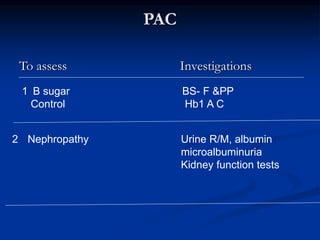
PAC
To assess Investigations
1 B sugar BS- F &PP
Control Hb1 A C
2 Nephropathy Urine R/M, albumin
microalbuminuria
Kidney function tests
PAC
To assess Investigations
3 Cardiac ECG
status Chest X ray
ECHO
4 PVD H/o intermittent claudication
Blanching of feet
Non healing ulcers
5 Retinopathy Fundus exam
PAC
To assess Investigations
6 Stiff joint X ray Cervical spine
syndrome (lateral)
7 Metabolic & ABG
electrolyte S electrolytes
Ketones-urine
Postural changes in BP
Aims of Peri-operative Glucose
Management
• Avoid hypoglycaemia (intraop BG 120-180mg/dl)
• Minimize hyperglycemia
• Avoid loss of electrolytes (potassium, magnesium &
phosphate)
• Prevent lipolysis & proteolysis
• All patients with diabetes treated with insulin should be
managed same way, irrespective of whether they have type 1
or type 2 DM
Preoperative Orders
• 1st on list
• Last dose of long acting sulfonylureas chlorpropamide)
on morning of day before surgery
• OHA/insulin to continue till night prior to surgery
• NPO for 12 hrs preop
• On morning of surgery, omit OHA/normal SC insulin
• Investigations - FBS, serum electrolytes morning of
surgery
• Gastric prokinetic agent + H2 blocker
• Sedation & anxiolysis, other medications (anti-
hypertensives) continued
• IV line - GI infusion started on morning of surgery
after taking sample for fasting BS
• To arrange for dextrostix, insulin, glucometer etc
Preoperative Orders
How Do You Manage the Insulin &
Glucose Requirements on Day of
Surgery?
• No glucose no insulin regimen NOT recommended
• Glucose to prevent hypoglycemia, periop glucose
enhances postop glucose
utilization rates
• Insulin to prevent hyperglycemia, lipolysis & proteolysis
• 1 gm of glucose neutralized by 0.32 U of insulin, 500ml
5%D = 25gms = 8 U
Intraoperative glucose control
 Subcut insulin not advised – potentially erratic
absorption secondary to altered regional blood flow,
tissue edema, or fluid shifts during Sx
 Iv bolus of insulin : very short half life (8 min),
dangerous iatrogenic hypokalemia, hypophosphatemia,
hypomagnesimia, hypoglycemia
 Iv insulin infusion preferred
 Adsorption of onto surface of syringes, iv fluid bags &
iv sets - unavoidable problem. Flush line & discard -
saturates insulin binding sites of tubing
Factors considered in selecting a
regimen for glycemic control
 Type of DM and treatment
 How aggressively eu-glycemia sought
 Whether patient takes insulin
 Surgery minor & in an ambulatory unit
 Surgery elective or emergency
 Ability of hospital resources
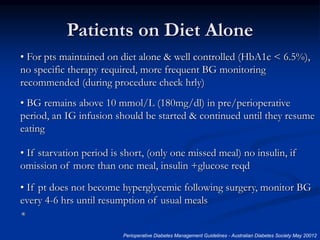
Patients on Diet Alone
• For pts maintained on diet alone & well controlled (HbA1c < 6.5%),
no specific therapy required, more frequent BG monitoring
recommended (during procedure check hrly)
• BG remains above 10 mmol/L (180mg/dl) in pre/perioperative
period, an IG infusion should be started & continued until they resume
eating
• If starvation period is short, (only one missed meal) no insulin, if
omission of more than one meal, insulin +glucose reqd
• If pt does not become hyperglycemic following surgery, monitor BG
every 4-6 hrs until resumption of usual meals
*
Perioperative Diabetes Management Guidelines - Australian Diabetes Society May 20012
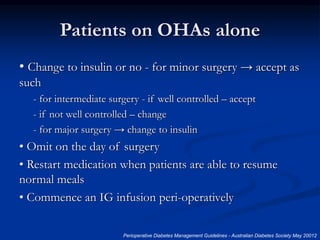
Patients on OHAs alone
• Change to insulin or no - for minor surgery → accept as
such
- for intermediate surgery - if well controlled – accept
- if not well controlled – change
- for major surgery → change to insulin
• Omit on the day of surgery
• Restart medication when patients are able to resume
normal meals
• Commence an IG infusion peri-operatively
Perioperative Diabetes Management Guidelines - Australian Diabetes Society May 20012
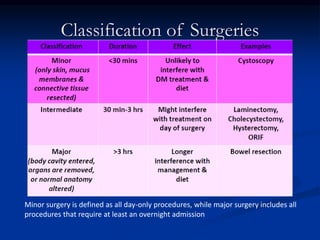
Classification of Surgeries
Minor surgery is defined as all day-only procedures, while major surgery includes all
procedures that require at least an overnight admission
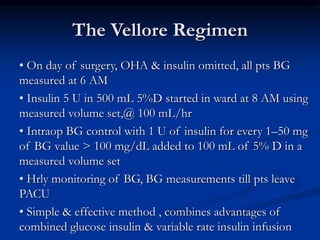
The Vellore Regimen
• On day of surgery, OHA & insulin omitted, all pts BG
measured at 6 AM
• Insulin 5 U in 500 mL 5%D started in ward at 8 AM using
measured volume set,@ 100 mL/hr
• Intraop BG control with 1 U of insulin for every 1–50 mg
of BG value > 100 mg/dL added to 100 mL of 5% D in a
measured volume set
• Hrly monitoring of BG, BG measurements till pts leave
PACU
• Simple & effective method , combines advantages of
combined glucose insulin & variable rate insulin infusion
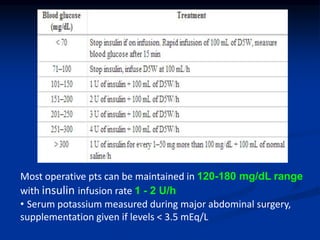
Most operative pts can be maintained in 120-180 mg/dL range
with insulin infusion rate 1 - 2 U/h
• Serum potassium measured during major abdominal surgery,
supplementation given if levels < 3.5 mEq/L
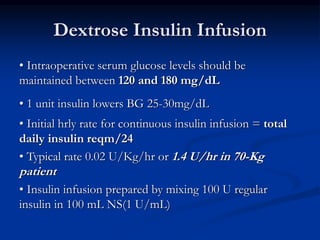
Dextrose Insulin Infusion
• Intraoperative serum glucose levels should be
maintained between 120 and 180 mg/dL
• 1 unit insulin lowers BG 25-30mg/dL
• Initial hrly rate for continuous insulin infusion = total
daily insulin reqm/24
• Typical rate 0.02 U/Kg/hr or 1.4 U/hr in 70-Kg
patient
• Insulin infusion prepared by mixing 100 U regular
insulin in 100 mL NS(1 U/mL)
Insulin infusion accompanied by an infusion of 5% D in
half-NS with 20
mEq/L KCl at 100-150 mL/hr
• Insulin infusion requirements higher for
- CABG surgery
- solid organ transplant
- pts receiving steroids
- pts with severe infection
- pts receiving hyperalimentation
- pts on vasopressor infusions
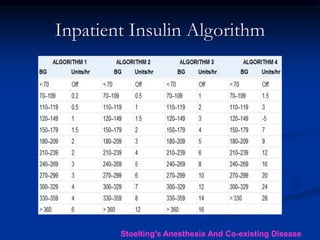
• Algorithm 1: Start for most patients
Inpatient Insulin Algorithm
Stoelting's Anesthesia And Co-existing Disease
• Algorithm 2: Start if pt requires higher insulin or
receiving >80 U/d insulin as outpatient
• Moving up: algorithm failure defined as BG outside
goal range for 2 hrs & level does not change by at least 60
mg/dL within 1 hr
• Moving down: When BG is < 70 mg/dL for two
checks OR if BG decreases by > 100 mg/dL in an hour
• Pt monitoring: Check BG every hr until it is within goal
range for 4 hr, then every 2 hr for 4 hr, & if it remains at
goal, may ↓ to every 4 hr
Postoperatively
• Recommence OHA - 1/2 dose with first meal
- full dose next day
• Recommence normal SC insulin with first meal
• Major surgery - continue insulin infusion till regular diet
- regular insulin once pt starts orally
• Avoid metformin in hepatic or renal insufficiency or
CHF
• Inadequate pain relief ↑es catabolic hormone secretion
• Hyperglycemia detected postop in pts not previously
known to have DM should be managed as if DM present
& diagnosis reconsidered once pt has recovered.
Tight control regimen
 Aim : 79-120 mg/dl
 Protocol
 Evening before, do pre-prandial blood glucose
 Begin iv 5%D @ 50 ml/hr/70 kg
 Piggyback to 5%D, infusion of regular insulin (50 U in 250 ml
0.9% NS)
 Insulin infusion rate (U/hr) plasma glucose (mg/dl) / 150 or
/100 if on steroids or severe infection
 Repeat blood glucose every 4 hours
 Day of surgery : Non dextrose containing solutions,
 Monitor blood glucose at start & every 1-2 hours
GENERAL
VS
Regional anaesthesia
 No absolute indication for spinal or epidural
anesthesia
 May improve outcome in selected situations
 Extend analgesia into postoperative period
Advantages of regional anaesthesia
in diabetics
 Awake pt, intraop hypoglycemia (early recognition of
hypoglycemia) can be noticed
 Risk of aspiration, PONV chances
 Blunt stress response to surgical stimulation
 Avoidance of endotracheal intubation { stiff joint syndrome &
Gastroparesis}
 Metabolic effects of anaesthetic agents avoided
Advantages of regional anaesthesia in
diabetics
 Lower the incidence of postoperative thromboembolic events
 Decrease intraoperative blood loss
 Insulin response to hyperglycemia
• high thoracic (T1-T6) blockade > inhibited
• low blockade (T9 - T12) > no effect
 Epidural anaesthesia block catecholamine release irrespective of
the segmental level
 Rapid return to diet and insulin/ OHA
Disadvantages of Regional
Anaesthesia in Diabetic patients
 Risk of nerve injuries, higher adrenaline use increases risk of
ischemic injury
 LA requirement is low - sensitivity
 Risk of infection
 Epidural abscess
 Contraindicated in presence of peripheral neuropathy
PRECAUTIONS
Document peripheral neuropathy
• Relative contraindication
• Keeps patients & relatives informed
• Avoids medico-legal issues later on
• Pt with autonomic neuropathy - profound Hypotension
may occur with deleterious consequences in a pt with
co‐existing CAD, cerebrovascular or renovascular disease
• Use of continuous techniques DOES NOT predispose pt
to persistent neuropathy after surgery*
Anesth Analg 2003; 96:247-52
General Anaesthesia
 Should be considered in
-Presence of cardiovascular or renal disease
-Prevention of intraoperative hypoglycemia
and hypotension
-Autonomic neuropathy
-Protection of pressure sores
General Anaesthesia
 Anaesthesia - if gastric stasis a rapid sequence induction
should be used. A nasogastric tube can be used to empty the
stomach and allow a safer awakening.
 Treat hypotension promptly. Hartmanns solution (Ringers
lactate) should not be used in diabetic patients as the lactate it
contains may be converted to glucose by the liver and cause
hyperglycaemia.
General Anaesthesia
 IV induction agents normally cause hypotension on
injection due to vasodilatation. If a patient has a damaged
autonomic nervous system (and many diabetics do), then
they cannot compensate by vasoconstricting, and the
hypotension is worsened. Reducing the dose of drug and
giving it slowly helps to minimise this effect.
 Sudden bradycardias should respond to atropine 0.3mg iv, repeated
as necessary (maximum 2 mg). Tachycardias, if not due to light
anaesthesia or pain, may respond to gentle massage on one side of
the neck over the carotid artery. If not then consider a beta-blocker
Stress response and glucose
metabolism
 Glucagon, epinephrine, GH, steroids, Insulin
 Insulin resistance in post operative period
 Consequences
- Osmolar diuresis-dehydration
-disrupts autoregulation of vascular beds
-impaired wound healing
-decreased chemotaxis and impaired phagocytosis
-more acute complications
Diabetes & Emergency Surgery
 Usually infected
 Usually uncontrolled
 Dehydration
 Metabolic decompensation
 Resistance to insulin
Check blood glucose
1. <250 mg / dl, iv insulin – glucose, delay surgery till hydrated and
electrolytes corrected
2. >250 mg /dl, check ketones, arterial blood gas, anion gap. If DKA
present
 Large volume of normal saline iv
 Regular insulin 0.1U/ Kg/h after initial bolus of 0.15 U/Kg. Blood
glucose monitoring 1 hourly
 Potassium, magnesium and phosphate monitored 2 hourly and replaced
accordingly
 Blood glucose < 250 g/dl start 5% dextrose with insulin.
 Once acidosis corrected, blood glucose < 200 mg/dl, patient may be
taken for surgery
104
Postoperative Complications
 Hypoglycemia
 Hyperglycemia – DKA, NKHC
 Infections
 Delayed wound healing
 Periop MI risk watch till 72 hrs
 Problems due to autonomic neuropathy, postural
 hypotension, atonic bleeding, urinary retention
 PONV
 Pain
Hypoglycemia
Most frequent and dangerous complication of Insulin
therapy
Exacerbated by simultaneous administration of alcohol,
OHA, ACE inhibitors, MAO inhibitors, and
nonselective beta blockers
Plasma glucose level less than 50 mg/dL
If unconscious: 50 ml of 50% dextrose (D50)
which increases glucose 100 mg/dLor 2 mg/dL/mL
Insulin
questions
 RL / bank blood
 Adsorption of insulin,
 Older rgimens
 Intraop -Hypo/hyperglycemia
 Emergencies- DKA
 DKS vs NKHC
 Shift To Insulin ??
 Surgery classsification
Thanks..!
RL / bank blood
• Lactate is a gluconeogenic substrate, RL = 28 mEq/L
• Bank blood = variable amounts (anaerobic metabolism during
storage)
• Hepatic conversion to glucose → hyperglycemia aggravated
• Rapid infusion of RL↑ BG by no more than 1 mmol/L
• RL/blood NOT contraindicated but inappropriate as these
can confound
calculation of glucose load & insulin requirements somewhat
Shift To Insulin ??
• No - Well-controlled type 2 DM (on OHA), minor
surgery
• Yes - Poorly controlled type 2 DM
- Well-controlled type 2 DM for major surgery
- Type 1 DM having minor surgery or major surgery
• Switch to combination of short & intermediate acting
insulin
• Diet controlled type 2 DM - treat as non-diabetic,
Monitor, before
surgery, hourly, treat if increased
Adsorption of Insulin
• Significant amounts of insulin adsorbed on to giving
sets: high‐volume, low‐insulin conc regimen used
• Reducing initial rates of insulin delivery
• In sol with conc of insulin of ∼10U/L, effect is
minimal
• Strategies to minimize - use concentrated solutions
- use smaller containers
- use shorter tubings
- prime tubing with insulinized sol
- add whole blood/human albumin
Hyperglycemia Intraoperatively??
• Intraoperative hyperglycemia - BG level >250 mg/dL
• Each unit of regular insulin ↓es BG by approx 30
mg/dL
• Increase infusion rate, small doses as single IV bolus
• BG monitored frequently to dictate further therapy
Hypoglycemia
• Plasma glucose level less than 50mg/dL
• Exacerbated by simultaneous administration of alcohol,
OHA, ACE inhibitors, MAO inhibitors, nonselective β
blockers, in poorly controlled pts, liver disease, fasting,
sepsis, equipment failure
Awake patient
• Adrenergic symptoms: sweating, tachycardia, pallor,
palpitations, restlessness
• Neuroglycopenic: fatigue, confusion, headache,
incomprehensible speech, somnolence, convulsions, coma
Under GA - initially sx of sympathetic stimulation:
sweating, tachycardia, hypertension, &/or dilated pupils
• Clinically significant hypoglycemia defined by Whipple’s
triad: symptoms of neuroglycopenia, BG conc <40
mg/dL & relief of symptoms with glucose
• Treatment - if conscious → oral glucose (sugar cube,
juice) - if unconscious →
25ml of 50%D IV (↑ BG level 100 mg/dl)
glucagon 0.5-1.0 mg IV/IM/SC
Hypoglycemia
Start aggressive treatment of DKA
• Aims: - Rehydration (water and salt)→ reestablish
U/O
- Lower blood sugar
- Correction of potassium depletion
• Partial correction of hyperglycemia, metabolic
acidosis & ketosis
• Start treatment of infectious process
(antibiotics), if present
Treatment of DKA
• Volume resuscitation - start an IV infusion of 0.9 % NS
as
-1 litre over 30 min
- then 1 litre over 1 hr
- then 1 litre over 2 hrs
• Continue 2-4 hrly until BG below 250mg/dL, then add 5%
D to IV fluids, then 0.45% NS @ 250ml/hr
• Use BP, HR, CVP, conscious level to judge fluid amount
• Insulin - 50U in 50ml 0.9% NS, at a fixed r/o 0.1 /kg/hr,
i.e. 7ml/hr in 70kg pt - called fixed rate IVII
• Max r/o ↓ in BG fairly constant -75 to 100 mg/dL/hr
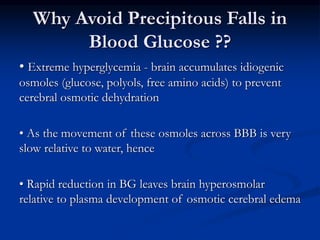
Why Avoid Precipitous Falls in
Blood Glucose ??
• Extreme hyperglycemia - brain accumulates idiogenic
osmoles (glucose, polyols, free amino acids) to prevent
cerebral osmotic dehydration
• As the movement of these osmoles across BBB is very
slow relative to water, hence
• Rapid reduction in BG leaves brain hyperosmolar
relative to plasma development of osmotic cerebral edema
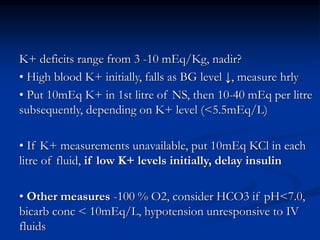
K+ deficits range from 3 -10 mEq/Kg, nadir?
• High blood K+ initially, falls as BG level ↓, measure hrly
• Put 10mEq K+ in 1st litre of NS, then 10-40 mEq per litre
subsequently, depending on K+ level (<5.5mEq/L)
• If K+ measurements unavailable, put 10mEq KCl in each
litre of fluid, if low K+ levels initially, delay insulin
• Other measures -100 % O2, consider HCO3 if pH<7.0,
bicarb conc < 10mEq/L, hypotension unresponsive to IV
fluids
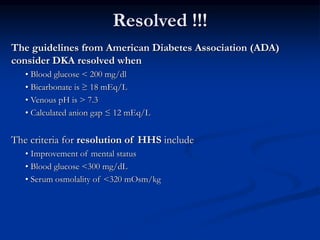
Resolved !!!
The guidelines from American Diabetes Association (ADA)
consider DKA resolved when
• Blood glucose < 200 mg/dl
• Bicarbonate is ≥ 18 mEq/L
• Venous pH is > 7.3
• Calculated anion gap ≤ 12 mEq/L
The criteria for resolution of HHS include
• Improvement of mental status
• Blood glucose <300 mg/dL
• Serum osmolality of <320 mOsm/kg
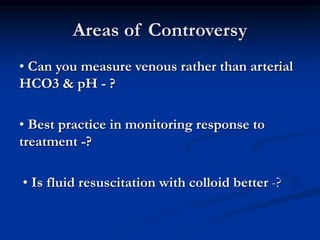
Areas of Controversy
• Can you measure venous rather than arterial
HCO3 & pH - ?
• Best practice in monitoring response to
treatment -?
• Is fluid resuscitation with colloid better -?
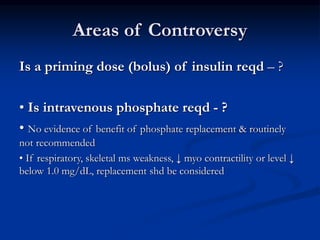
Is a priming dose (bolus) of insulin reqd – ?
• Is intravenous phosphate reqd - ?
• No evidence of benefit of phosphate replacement & routinely
not recommended
• If respiratory, skeletal ms weakness, ↓ myo contractility or level ↓
below 1.0 mg/dL, replacement shd be considered
Areas of Controversy
Diabetic Ketoacidosis
(DKA) vs.
Hyperglycemic
Nonketotic Coma
(HNKC)
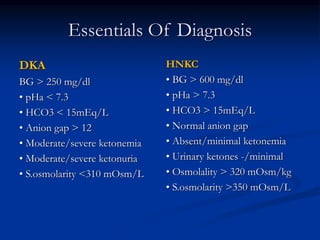
Essentials Of Diagnosis
DKA
BG > 250 mg/dl
• pHa < 7.3
• HCO3 < 15mEq/L
• Anion gap > 12
• Moderate/severe ketonemia
• Moderate/severe ketonuria
• S.osmolarity <310 mOsm/L
HNKC
• BG > 600 mg/dl
• pHa > 7.3
• HCO3 > 15mEq/L
• Normal anion gap
• Absent/minimal ketonemia
• Urinary ketones -/minimal
• Osmolality > 320 mOsm/kg
• S.osmolarity >350 mOsm/L
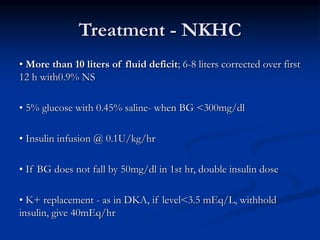
Treatment - NKHC
• More than 10 liters of fluid deficit; 6-8 liters corrected over first
12 h with0.9% NS
• 5% glucose with 0.45% saline- when BG <300mg/dl
• Insulin infusion @ 0.1U/kg/hr
• If BG does not fall by 50mg/dl in 1st hr, double insulin dose
• K+ replacement - as in DKA, if level<3.5 mEq/L, withhold
insulin, give 40mEq/hr
Why Avoid Precipitous Falls in
Blood Glucose ??
• Extreme hyperglycemia - brain accumulates idiogenic
osmoles (glucose, polyols, free amino acids) to prevent
cerebral osmotic dehydration
• As the movement of these osmoles across BBB is very
slow relative to water, hence
• Rapid reduction in BG leaves brain hyperosmolar
relative to plasma development of osmotic cerebral edema
Thanks..!

Diabetic foot case presentation

  • 1.
    CASE PRESENTATION OF DIABETIC FOOT By:Dr. Gowri Shankar B Under the guidance of Dr. Trupti pethkar
  • 2.
    History Pt. Abdul SattarS/o Abdul Karim, 56 yrs. Muslim,. R/o Aroli admitted on 22/08/17 Chief complaints- # Pins and needle sensation × 1 year # nonhealing Ulcer on right foot post amputation × 1 month
  • 3.
    History HOPI-  Pins &needle sensation Left foot both feet ( Associated heaviness)  Ulcer following trauma Papule pustule ulcer wet gangrene debridement and amputation of lateral four toes  Discharge: yellow, foul smelling, blood stained  No h/o fever with chills/cough / cold  No h/s/o burning micturition / APD/loose stools
  • 4.
     No h/oblurring of vision/altered color perception  No h/s/o hypo/hyperglycecmic episodes  No h/o swelling of face or body.  No h/o chest pain/ palpitations/ excertional breathlessness.  No h/o fainting episodes/altered sensorium History
  • 5.
    Past history  K/cof type2 DM, Diagnosed 10 yrs back .  Taking treatment for past 10 years OHG drugs and has stopped insulin from last 5-6 months.  Underwent amputation of 2nd to 5th toes, 1months back under spinal anesthesia , uneventfull.  No history of Tuberculosis, hypertension, asthma, paralysis, thyroid dysfunction was obtained. No history of furuncles or abscesses at other body parts was noted.
  • 6.
    Drug history  Thepatient was on Glybenclamide 10 mg OD for first 8 years of DM.  For last 2 years he has been taking Glymeperide and Metformin combination (2.5/500 mg), BD. – non compliant stopped since 3 months.  Gabapentine 400 mg /day was also taken on and off.  Since hospitalization, he is on regular insulin 6-6-6 units.  He is taking aspirin 75 mg HS for last two months.
  • 7.
    Personal History  Thepatient is a Muslim male, laborer by profession, he is non-vegetarian, non-alcoholic, non smoker.  He is having frequency of urination around 15 per day including 3-4 times at night and constipation with frequency of once in three days. His appetite is normal but complains of losing the taste of the food he eats, and thus ensuing decreased intake and slow weight loss for past few years.

  • 8.
    General physical Examination The patient at time of examination was conscious, co- operative and oriented to time place and person. He was lying comfortably supine with right leg resting slightly abducted and flexed at knee on a pillow. General built of the patient is cachexic. Normal age related graying of hair and frowning of forehead seen.  Pallor-, Icterus -, clubbing -,cyanosis - , edema + Right inguinal lymph nodes - 3×2 cm in size discrete, firm, mobile, non tender, non –erythematous.
  • 9.
    VITALS  PR -84 / min (right radial ). Regular rhythm with normal pulse volume. All peripheral pulses palpable including dorsalis pedis on affected side, No radio-femoral delay  BP – 128/86 mm Hg right brachial in supine position and 102/76 mm Hg on standing  Temperature afebrile  RR – Thoraco-abdomional, rate 16/min, no accessory muscles being used. General physical Examination
  • 10.
    Airway  Mouth opening– >2fingers  Modified mallampatti score - I  Thyro mental distance - >3fingers  Hyomental disatance > 3 fingers  Dentition – normal , no caps or dentures  Prayers sign - negative.  Palm print test – not done. General physical Examination
  • 11.
    Local examination-Ulcer  Inspection-Single large irregular ulcer, 7-8 cm in size, extending from base of amputated stump of 2nd metatarsal to 5th metatarsal, inflamed, edematous, sloping edge, red floor with granulation tissue.  Palpation- Tender, sloping edges with irregular margins, indurated base, depth 3mm, bleeding on touch, mobile, warm surrounding skin , peripheral pulses palpable.(dorsalis pedis and posterior tibial)
  • 13.
    Systemic examination  CVS– S1 S 2 heard, no murmurs.  RS- b/l AEE, no added sounds.  P/A- soft , bowel sounds present.  CNS- HMF normal, NFND .
  • 14.
    Provisional diagnosis 50yr maleknown type 2 diabetic on irregular treatment with associated peripheral neuropathy presenting with non healing amputated stump ulcer on right foot for debridement.
  • 15.
    Investigations Hb- 8.1mg/dl FBS- 142mg/dl,PP BS- 220 mg/dl Blood urea- 97 mg/dl S creatinine- 3.1 mg/dl Na+ : 130 meq/l K+ : 3.7meq/l Cl- : 104meq/l ECG-TWNL X-ray Chest- NAD Xray cervical spine- NAD Fundus examination -
  • 16.
  • 17.
    Diabetes mellitus (WHO)- A metabolic disorder of multiple etiology characterized by chronic hyperglycemia with disturbances of carbohydrate, fat and protein metabolism resulting from defects in insulin secretion, insulin action or both.
  • 18.
    DM in India INDIA : Diabetic CAPITAL of the world  4 crore diabetics in India (19% of world’s diabetic population)  2.5% of India’s urban population is diabetic  DIABETIC FOOT is most devastating with > 50,000 leg amputations/ every yr. due to D.M. in India
  • 19.
    Criteria for Diagnosisof DM Adapted from American Diabetes Association 2013
  • 20.
    Relation between wholeblood and plasma glucose  Blood glucose + 15 % = Plasma glucose 1 m mol = 18.0 mg glucose 1 m mol/l = 18.0 mg glucose/dl  Relation ship between arterial/capillary/ venous arterial=capillary =7%> venous
  • 21.
    What Factors Affectthe Perioperative AnestheticManagement of DM?  Type, duration of DM  Medication (OHA, insulin)  Level of glycemic control  End-organ damage, particularly autonomic dysfunction  Nature of surgery - major - minor  Urgency of surgery  Need for critical care •
  • 22.
    Oral hypoglycemic agents Sulfonylureas – Long acting discontinued 48-72 hours before surgery, Short acting held night before or morning of surgery  Thiazolidinediones : Rosiglitazone, piaglitazone omitted on morning of Sx  Biguanides : Metformin discontinued atleast 24 h prior to Sx & held for 48 h after major Sx  Alpha-glucosidase inhibitors (acarbose, miglitol) have no effect on fasting blood glucose
  • 23.
  • 24.
  • 25.
    ?????? But why regulartreatment ? What is glycemic control? HBA1C? Complications
  • 26.
    Classical diabetic complications Nephropathy  Peripheral neuropathy  Retinopathy  IHD, CHF & cardiomyopathy  Autonomic neuropathy  Stiff joint syndrome  Electrolyte & metabolic derangement Microvascular Complications Macrovascular Complications
  • 27.
    To Assess GlycemicControl  History and Examination - Hyper/hypoglycemic episodes - Medication & compliance  Investigations - BS (fasting, PP) - GTT (if required) - Glycosylated Hb (HbA1C)
  • 28.
     Erythrocyte haemoglobinis non - enzymatically gylcosylated by glucose that freely crosses RBC memb  Gives BG control in preceding 60 to 90 days  Normal range is 4%-6%  HbA1C >6.5% -↑ed risk of micro & macrovascular disease Glycated Haemoglobin (HbA1c) Strict glycemic control can delay onset & slow progression of microvascular complications
  • 29.
    Glycemic Control IDF ClinicalGuidelines Task Force 2005
  • 31.
  • 32.
     Microalbuminuria earliestlab manifestation of diabetic nepropathy.  HT most imp factor responsible for progression of diabetic renal disease; hyperglycemia, hypercholesterolemia others  ACE inhibitors: ↓albuminuria & progression of renal dysfunction nephropathy Renal system- nephropathy
  • 33.
    To Assess Nephropathy •History and Examination - H/o swelling of face and body - H/o hypertension and its medication • Investigations - Urine: proteins, sugar - Microalbuminuria on a timed overnight collection - B. urea, S. creatinine, S. electrolytes
  • 34.
     More chancesof ARF( 7%), most common major complication in perioperative period, due to - Intrinsic renal disease. - Hemodynamic impairment -Urosepsis  UTI-most common post op complication in diabetics undergoing surgery  Adequate renal perfusion, avoiding nephrotoxins, hemodynamic monitoring ↓risk of postop renal dysfunction Renal system- nephropathy
  • 35.
    To assess PeripheralNeuropathy • History and Examination - Foot ulcers - Paresthesias, dysthesias, neuropathic pain Sensorimotor loss appears in toes or feet & progresses proximally in a "stocking and glove" distribution • Investigations - Loss of light touch, propioception, pain, temperature
  • 36.
    To Assess Retinopathy •History and Examination - Vision deterioration - Changes in color vision • Investigation - Ophthalmologic examination- fundus
  • 37.
    IHD, CAD, CHF& cardiomyopathy Autonomic neuropathy Stiff joint syndrome Macrovascular Complications
  • 38.
    Cardiovascular system  Prematureatheroma formation  Chances of CAD (Male-double risk ; female-triple)  Incidence of silent MI  HT (29-54%) and its sequelae  Cardiac dysautonomia may present with :  Sudden hypotension on induction  Absence of tachy. and HT with intubation  Diabetic cardiomyopathy
  • 39.
    To Assess IschemicHeart Disease, CHF & Cardiomyopathy • History and Examination - Angina or MI - Breathlessness - Poor exercise tolerance - Edema feet, enlarged liver, raised JVP, basal crepts, S3/S4 • Investigations - ECG - X-ray Chest - Echocardiography
  • 40.
    Preoperative Cardiovascular Screening • Asymptomaticdiabetic pt who has some or all risk factors such as advanced age, smoking, hyperlipidemia & HT • Stress testing should be considered in patients with multiple cardiac risk factors & poor or indeterminate exercise tolerance • Those with high risk diabetics, ‘metabolic syndrome’, undergoing major elective non‐cardiac surgery
  • 41.
    Respiratory system • Morechances of resp tract infections • ↓ ventilatory response to PaCO2 & PaO2 • ↑ susceptibility to ventilatory depressant drugs • ↓ FVC & FEV (glycosylation of tissue proteins), ↓ lung diffusing capacity • ↓ 2,3 DPG → ↓ release of O2 to tissues • DM affects O2 transport by causing glucose to covalently bind to Hb & alters allosteric interactions b/w β chains
  • 42.
     Changes inthe vasonervorum with resulting ischemia ? cause  Increased sorbitol in feeding vessels block flow and causes nerve ischemia  Intraneural acculmulation of advanced products of glycosylation  Abnormalities of all three neurologic systems contribute to ulceration
  • 43.
     Autonomic systemregulates sweating and perfusion to the limb  Loss of autonomic control inhibits thermoregulatory function and sweating  Result is dry, scaly and stiff skin that is prone to cracking and allows a portal of entry for bacteria leading to ulcer.
  • 44.
  • 45.
     Wagner’s Classification 0– Intact skin (impending ulcer) 1 – Superficial 2 – Deep to tendon, bone or ligament 3- Osteomyelitis 4 – Gangrene of toes or forefoot 5 – Gangrene of entire foot
  • 46.
    To Assess AutonomicNeuropathy (DAN) History and Examination - Early satiety, hypoglycemia unawareness - Lack of sweating - Gastroparesis in form of nausea, vomiting, bloating, reflux nocturnal diarrhea, constipation, abdominal distension - Postural syncope (orthostatic hypotension) - Bladder atony & urinary retention - Impotence/erectile dysfunction, retrograde ejaculation - Palpitations, Irregular pulse - Sensory discomfort of lower limbs
  • 47.
  • 48.
    Investigations • Tests forparasympathetic control - HRV - Resting tachycardia: > 100 beats/min is abnormal - Beat-to-beat variation with deep breathing obtunded: max HR-min HR at 6 breaths per min, < 5bpm, N >15 bpm, Normal R-R inspiration/R-R expiration > 1.17 - HR response to standing obtunded: ratio of longest R-R around 30th beat after standing to the shortest R-R around 15th beat after standing (N > 1.04) - HR response to Valsalva maneuver obtunded: the normal ratio of longest R-R to shortest R-R > 1.21
  • 49.
    Tests for sympatheticcontrol - BP response - SBP response to standing: BP(lying) - BP(standing) >30 mm Hg (N<10 mmHg) - DBP response to sustained handgrip: handgrip sustained at 30% of maximum squeeze for up to 5 minute & BP every minute, DBP just before release – initial DBP (N > 16 mmHg) - BP response to Valsalva maneuver obtunded Investigations for DAN
  • 50.
  • 51.
    DAN Scoring Bellavere Fet al. Br Med J (Clin Res Ed) 1983;287:61
  • 52.
    To Assess StiffJoint Syndrome Prayer Sign”- inability to approximate the palmar surfaces of phalangeal joints despite max effort - “Palm print test” - Degree of interphalangeal joint involvement assessed by scoring the ink impression made by palm of dominant hand - Non-familial short stature - Tight-waxy skin • Investigations - X-ray CS to delineate limited atlanto-axial extension
  • 53.
    Palm Print Test Grade0 - All phalangeal areas visible Grade 1 - Deficiency in the interphalangeal areas of 4th &/or 5th digit Grade 2 - Deficiency in the interphalangeal areas of 2nd to 5th digit Grade 3 - Only tips of digits seen
  • 54.
  • 55.
    To Assess Electrolyte& Metabolic Derangements • History and Examination - Non-compliance of drug - Severe infection or starvation - Poor control in the past few days/weeks - S/S of hypoglycemia or ketoacidosis • Investigations - ABG & electrolytes
  • 56.
    Acute metabolic Effectsof Hyperglycemia • Dehydration - osmotic diuretic effect of glycosuria • Acidemia - accumulation of lactic &/or ketoacids • Dyselectrolemia - hypophosphatemia • Hyperviscosity with ↑ed thromogenic complications • Exacerbation of brain, SC & renal ischemic damage • Impaired immune system response → postop infection ↑ • Impaired consciousness “Permissive Hyperglycemia” Unacceptable
  • 57.
    Clinical Significance • Impairedhost response to infection → aseptic precautions • Decreased mobility in TM, atlanto-occipital joint & cervical spine – restricted neck movements & difficult laryngoscopy • Proliferative retinopathy - vitreous H’ge on laryngoscopy & intubation • CAD & IHD - myocardial ischemia • Hypertension - pressor response to L&I, poor intraoperative BP control, cerebrovascular infarction
  • 58.
    Autonomic neuropathy • ↓compensatorycardiovascular response - IPPV, bld loss, position change, drugs, SA > hypotension • Blunted response to atropine • Full stomach - risk of aspiration, longer preop fasting, RSI • Impaired ventilatory responses to hypoxia, hypercarbia – resp arrest • Increased risk of dysrhythmias due to loss of HRV • Urinary stasis - unnecessary bladder catheterization • Loss of signs of hypoglycemia • Hypothermia - increased risk intraoperatively Clinical Significance
  • 59.
    Neuropathy & vascularcompromise: - ↑ risk for ischemia in pressure points while shifting & positioning (heel ulceration) - ↑ incidence of nerve injury & ischemia - implications for RA • Renal disease - impaired drug excretion, renal ischemia, more likely to develop postoperative renal failure • Associated complications - DKA/NKHC - hypoglycemia Clinical Significance
  • 60.
    Diabetes & Accelerated PhysiologicAging • Adverse perioperative outcomes repeatedly & substantially correlated with age of patient • Type 1 diabetic with poor control of BS ages approx 1.75 yrs physiologically for every chronologic yr of disease, 1.25 years if BS controlled tightly • Type 2 diabetic ages about 1.5 yrs for every chronologic yr of disease, 1.06 yrs with tight control of BS & BP
  • 61.
    Does DM IncreasePerioperative Risk? • Yes, average diabetic pt presents a higher perioperative risk than average non-diabetic pt • Common postoperative complications - delayed wound healing, sepsis, urinary retention & infection, angina, MI, hypotension/HT, episodes of hyper or hypoglycemia, DKA Increased Morbidity & Mortality Intensive Monitoring Longer Hospital Stay
  • 62.
    Perioperative Problems in DiabeticPatient • Surgical induction of stress response with catabolic hormone secretion →anti‐insulin effect → insulin requirements in this period unpredictable • Surgery associated with a reduction in insulin sensitivity • Interruption of food intake, esp after GI procedures • Altered consciousness, which masks sx of hypoglycemia • Circulatory disturbances associated with anaesthesia & surgery, which alters absorption of subcutaneous insulin
  • 63.
  • 64.
    Anaesthetic Technique &the Diabetic Patient • Anaesthetic techniques (GA/RA or N blockade) may modulate secretion of catabolic hormones & any residual insulin secretion • Perioperative increase in epinephrine & cortisol conc in pts under GA is blocked by EA → much less disruption of glucose metabolism • Induction agents affect glucose homeostasis perioperatively ->clinically not significant
  • 65.
    Anaesthetic Agents &DM • Etomidate blocks adrenal steroidogenesis → cortisol syn • ↓ hyperglycemic response to surgery by approx 1mmol/L • Benzodiazepines in high doses - ↓secretion of ACTH → ↓ production of cortisol - ↓ sympathetic stimulation→↓in glycemic response • High‐dose opiate techniques block SNS & hypothalamic- pituitary axis → abolish hyperglycemia • Halothane, enflurane, isoflurane inhibit insulin response to glucose in a reversible & dose‐dependent manner
  • 66.
    Anaesthetic management goals 1To maintain glycaemic control 2 To avoid further deterioration of pre-existing end organ damage 3 To shift patient soon on pre op glycaemic control - drugs
  • 67.
    Preoperative assessment -Aims 23% of diabetics diagnosed prior to surgery  Type of DM & its duration  Pre op evaluation and treatment of end organ damage which is responsible for 5-fold increase in perioperative mortality associated with D.M.  Assessment of B. sugar control and to obtain a reasonable control with change to short acting drugs  Limit hospital stay and decrease cost  Quantification of risk
  • 68.
    PAC To assess Investigations 1B sugar BS- F &PP Control Hb1 A C 2 Nephropathy Urine R/M, albumin microalbuminuria Kidney function tests
  • 69.
    PAC To assess Investigations 3Cardiac ECG status Chest X ray ECHO 4 PVD H/o intermittent claudication Blanching of feet Non healing ulcers 5 Retinopathy Fundus exam
  • 70.
    PAC To assess Investigations 6Stiff joint X ray Cervical spine syndrome (lateral) 7 Metabolic & ABG electrolyte S electrolytes Ketones-urine Postural changes in BP
  • 71.
    Aims of Peri-operativeGlucose Management • Avoid hypoglycaemia (intraop BG 120-180mg/dl) • Minimize hyperglycemia • Avoid loss of electrolytes (potassium, magnesium & phosphate) • Prevent lipolysis & proteolysis • All patients with diabetes treated with insulin should be managed same way, irrespective of whether they have type 1 or type 2 DM
  • 72.
    Preoperative Orders • 1ston list • Last dose of long acting sulfonylureas chlorpropamide) on morning of day before surgery • OHA/insulin to continue till night prior to surgery • NPO for 12 hrs preop • On morning of surgery, omit OHA/normal SC insulin • Investigations - FBS, serum electrolytes morning of surgery
  • 73.
    • Gastric prokineticagent + H2 blocker • Sedation & anxiolysis, other medications (anti- hypertensives) continued • IV line - GI infusion started on morning of surgery after taking sample for fasting BS • To arrange for dextrostix, insulin, glucometer etc Preoperative Orders
  • 74.
    How Do YouManage the Insulin & Glucose Requirements on Day of Surgery? • No glucose no insulin regimen NOT recommended • Glucose to prevent hypoglycemia, periop glucose enhances postop glucose utilization rates • Insulin to prevent hyperglycemia, lipolysis & proteolysis • 1 gm of glucose neutralized by 0.32 U of insulin, 500ml 5%D = 25gms = 8 U
  • 75.
    Intraoperative glucose control Subcut insulin not advised – potentially erratic absorption secondary to altered regional blood flow, tissue edema, or fluid shifts during Sx  Iv bolus of insulin : very short half life (8 min), dangerous iatrogenic hypokalemia, hypophosphatemia, hypomagnesimia, hypoglycemia  Iv insulin infusion preferred  Adsorption of onto surface of syringes, iv fluid bags & iv sets - unavoidable problem. Flush line & discard - saturates insulin binding sites of tubing
  • 76.
    Factors considered inselecting a regimen for glycemic control  Type of DM and treatment  How aggressively eu-glycemia sought  Whether patient takes insulin  Surgery minor & in an ambulatory unit  Surgery elective or emergency  Ability of hospital resources
  • 77.
    Patients on DietAlone • For pts maintained on diet alone & well controlled (HbA1c < 6.5%), no specific therapy required, more frequent BG monitoring recommended (during procedure check hrly) • BG remains above 10 mmol/L (180mg/dl) in pre/perioperative period, an IG infusion should be started & continued until they resume eating • If starvation period is short, (only one missed meal) no insulin, if omission of more than one meal, insulin +glucose reqd • If pt does not become hyperglycemic following surgery, monitor BG every 4-6 hrs until resumption of usual meals * Perioperative Diabetes Management Guidelines - Australian Diabetes Society May 20012
  • 78.
    Patients on OHAsalone • Change to insulin or no - for minor surgery → accept as such - for intermediate surgery - if well controlled – accept - if not well controlled – change - for major surgery → change to insulin • Omit on the day of surgery • Restart medication when patients are able to resume normal meals • Commence an IG infusion peri-operatively Perioperative Diabetes Management Guidelines - Australian Diabetes Society May 20012
  • 79.
    Classification of Surgeries Minorsurgery is defined as all day-only procedures, while major surgery includes all procedures that require at least an overnight admission
  • 80.
    The Vellore Regimen •On day of surgery, OHA & insulin omitted, all pts BG measured at 6 AM • Insulin 5 U in 500 mL 5%D started in ward at 8 AM using measured volume set,@ 100 mL/hr • Intraop BG control with 1 U of insulin for every 1–50 mg of BG value > 100 mg/dL added to 100 mL of 5% D in a measured volume set • Hrly monitoring of BG, BG measurements till pts leave PACU • Simple & effective method , combines advantages of combined glucose insulin & variable rate insulin infusion
  • 81.
    Most operative ptscan be maintained in 120-180 mg/dL range with insulin infusion rate 1 - 2 U/h • Serum potassium measured during major abdominal surgery, supplementation given if levels < 3.5 mEq/L
  • 82.
    Dextrose Insulin Infusion •Intraoperative serum glucose levels should be maintained between 120 and 180 mg/dL • 1 unit insulin lowers BG 25-30mg/dL • Initial hrly rate for continuous insulin infusion = total daily insulin reqm/24 • Typical rate 0.02 U/Kg/hr or 1.4 U/hr in 70-Kg patient • Insulin infusion prepared by mixing 100 U regular insulin in 100 mL NS(1 U/mL)
  • 83.
    Insulin infusion accompaniedby an infusion of 5% D in half-NS with 20 mEq/L KCl at 100-150 mL/hr • Insulin infusion requirements higher for - CABG surgery - solid organ transplant - pts receiving steroids - pts with severe infection - pts receiving hyperalimentation - pts on vasopressor infusions • Algorithm 1: Start for most patients
  • 84.
    Inpatient Insulin Algorithm Stoelting'sAnesthesia And Co-existing Disease
  • 85.
    • Algorithm 2:Start if pt requires higher insulin or receiving >80 U/d insulin as outpatient • Moving up: algorithm failure defined as BG outside goal range for 2 hrs & level does not change by at least 60 mg/dL within 1 hr • Moving down: When BG is < 70 mg/dL for two checks OR if BG decreases by > 100 mg/dL in an hour • Pt monitoring: Check BG every hr until it is within goal range for 4 hr, then every 2 hr for 4 hr, & if it remains at goal, may ↓ to every 4 hr
  • 86.
    Postoperatively • Recommence OHA- 1/2 dose with first meal - full dose next day • Recommence normal SC insulin with first meal • Major surgery - continue insulin infusion till regular diet - regular insulin once pt starts orally • Avoid metformin in hepatic or renal insufficiency or CHF • Inadequate pain relief ↑es catabolic hormone secretion • Hyperglycemia detected postop in pts not previously known to have DM should be managed as if DM present & diagnosis reconsidered once pt has recovered.
  • 87.
    Tight control regimen Aim : 79-120 mg/dl  Protocol  Evening before, do pre-prandial blood glucose  Begin iv 5%D @ 50 ml/hr/70 kg  Piggyback to 5%D, infusion of regular insulin (50 U in 250 ml 0.9% NS)  Insulin infusion rate (U/hr) plasma glucose (mg/dl) / 150 or /100 if on steroids or severe infection  Repeat blood glucose every 4 hours  Day of surgery : Non dextrose containing solutions,  Monitor blood glucose at start & every 1-2 hours
  • 88.
  • 89.
    Regional anaesthesia  Noabsolute indication for spinal or epidural anesthesia  May improve outcome in selected situations  Extend analgesia into postoperative period
  • 90.
    Advantages of regionalanaesthesia in diabetics  Awake pt, intraop hypoglycemia (early recognition of hypoglycemia) can be noticed  Risk of aspiration, PONV chances  Blunt stress response to surgical stimulation  Avoidance of endotracheal intubation { stiff joint syndrome & Gastroparesis}  Metabolic effects of anaesthetic agents avoided
  • 91.
    Advantages of regionalanaesthesia in diabetics  Lower the incidence of postoperative thromboembolic events  Decrease intraoperative blood loss  Insulin response to hyperglycemia • high thoracic (T1-T6) blockade > inhibited • low blockade (T9 - T12) > no effect  Epidural anaesthesia block catecholamine release irrespective of the segmental level  Rapid return to diet and insulin/ OHA
  • 92.
    Disadvantages of Regional Anaesthesiain Diabetic patients  Risk of nerve injuries, higher adrenaline use increases risk of ischemic injury  LA requirement is low - sensitivity  Risk of infection  Epidural abscess  Contraindicated in presence of peripheral neuropathy
  • 93.
    PRECAUTIONS Document peripheral neuropathy •Relative contraindication • Keeps patients & relatives informed • Avoids medico-legal issues later on • Pt with autonomic neuropathy - profound Hypotension may occur with deleterious consequences in a pt with co‐existing CAD, cerebrovascular or renovascular disease • Use of continuous techniques DOES NOT predispose pt to persistent neuropathy after surgery* Anesth Analg 2003; 96:247-52
  • 94.
    General Anaesthesia  Shouldbe considered in -Presence of cardiovascular or renal disease -Prevention of intraoperative hypoglycemia and hypotension -Autonomic neuropathy -Protection of pressure sores
  • 95.
    General Anaesthesia  Anaesthesia- if gastric stasis a rapid sequence induction should be used. A nasogastric tube can be used to empty the stomach and allow a safer awakening.  Treat hypotension promptly. Hartmanns solution (Ringers lactate) should not be used in diabetic patients as the lactate it contains may be converted to glucose by the liver and cause hyperglycaemia.
  • 96.
    General Anaesthesia  IVinduction agents normally cause hypotension on injection due to vasodilatation. If a patient has a damaged autonomic nervous system (and many diabetics do), then they cannot compensate by vasoconstricting, and the hypotension is worsened. Reducing the dose of drug and giving it slowly helps to minimise this effect.  Sudden bradycardias should respond to atropine 0.3mg iv, repeated as necessary (maximum 2 mg). Tachycardias, if not due to light anaesthesia or pain, may respond to gentle massage on one side of the neck over the carotid artery. If not then consider a beta-blocker
  • 97.
    Stress response andglucose metabolism  Glucagon, epinephrine, GH, steroids, Insulin  Insulin resistance in post operative period  Consequences - Osmolar diuresis-dehydration -disrupts autoregulation of vascular beds -impaired wound healing -decreased chemotaxis and impaired phagocytosis -more acute complications
  • 98.
    Diabetes & EmergencySurgery  Usually infected  Usually uncontrolled  Dehydration  Metabolic decompensation  Resistance to insulin
  • 99.
    Check blood glucose 1.<250 mg / dl, iv insulin – glucose, delay surgery till hydrated and electrolytes corrected 2. >250 mg /dl, check ketones, arterial blood gas, anion gap. If DKA present  Large volume of normal saline iv  Regular insulin 0.1U/ Kg/h after initial bolus of 0.15 U/Kg. Blood glucose monitoring 1 hourly  Potassium, magnesium and phosphate monitored 2 hourly and replaced accordingly  Blood glucose < 250 g/dl start 5% dextrose with insulin.  Once acidosis corrected, blood glucose < 200 mg/dl, patient may be taken for surgery 104
  • 100.
    Postoperative Complications  Hypoglycemia Hyperglycemia – DKA, NKHC  Infections  Delayed wound healing  Periop MI risk watch till 72 hrs  Problems due to autonomic neuropathy, postural  hypotension, atonic bleeding, urinary retention  PONV  Pain
  • 101.
    Hypoglycemia Most frequent anddangerous complication of Insulin therapy Exacerbated by simultaneous administration of alcohol, OHA, ACE inhibitors, MAO inhibitors, and nonselective beta blockers Plasma glucose level less than 50 mg/dL If unconscious: 50 ml of 50% dextrose (D50) which increases glucose 100 mg/dLor 2 mg/dL/mL Insulin
  • 102.
    questions  RL /bank blood  Adsorption of insulin,  Older rgimens  Intraop -Hypo/hyperglycemia  Emergencies- DKA  DKS vs NKHC  Shift To Insulin ??  Surgery classsification
  • 103.
  • 104.
    RL / bankblood • Lactate is a gluconeogenic substrate, RL = 28 mEq/L • Bank blood = variable amounts (anaerobic metabolism during storage) • Hepatic conversion to glucose → hyperglycemia aggravated • Rapid infusion of RL↑ BG by no more than 1 mmol/L • RL/blood NOT contraindicated but inappropriate as these can confound calculation of glucose load & insulin requirements somewhat
  • 105.
    Shift To Insulin?? • No - Well-controlled type 2 DM (on OHA), minor surgery • Yes - Poorly controlled type 2 DM - Well-controlled type 2 DM for major surgery - Type 1 DM having minor surgery or major surgery • Switch to combination of short & intermediate acting insulin • Diet controlled type 2 DM - treat as non-diabetic, Monitor, before surgery, hourly, treat if increased
  • 106.
    Adsorption of Insulin •Significant amounts of insulin adsorbed on to giving sets: high‐volume, low‐insulin conc regimen used • Reducing initial rates of insulin delivery • In sol with conc of insulin of ∼10U/L, effect is minimal • Strategies to minimize - use concentrated solutions - use smaller containers - use shorter tubings - prime tubing with insulinized sol - add whole blood/human albumin
  • 107.
    Hyperglycemia Intraoperatively?? • Intraoperativehyperglycemia - BG level >250 mg/dL • Each unit of regular insulin ↓es BG by approx 30 mg/dL • Increase infusion rate, small doses as single IV bolus • BG monitored frequently to dictate further therapy
  • 108.
    Hypoglycemia • Plasma glucoselevel less than 50mg/dL • Exacerbated by simultaneous administration of alcohol, OHA, ACE inhibitors, MAO inhibitors, nonselective β blockers, in poorly controlled pts, liver disease, fasting, sepsis, equipment failure Awake patient • Adrenergic symptoms: sweating, tachycardia, pallor, palpitations, restlessness • Neuroglycopenic: fatigue, confusion, headache, incomprehensible speech, somnolence, convulsions, coma
  • 109.
    Under GA -initially sx of sympathetic stimulation: sweating, tachycardia, hypertension, &/or dilated pupils • Clinically significant hypoglycemia defined by Whipple’s triad: symptoms of neuroglycopenia, BG conc <40 mg/dL & relief of symptoms with glucose • Treatment - if conscious → oral glucose (sugar cube, juice) - if unconscious → 25ml of 50%D IV (↑ BG level 100 mg/dl) glucagon 0.5-1.0 mg IV/IM/SC Hypoglycemia
  • 110.
    Start aggressive treatmentof DKA • Aims: - Rehydration (water and salt)→ reestablish U/O - Lower blood sugar - Correction of potassium depletion • Partial correction of hyperglycemia, metabolic acidosis & ketosis • Start treatment of infectious process (antibiotics), if present
  • 111.
    Treatment of DKA •Volume resuscitation - start an IV infusion of 0.9 % NS as -1 litre over 30 min - then 1 litre over 1 hr - then 1 litre over 2 hrs • Continue 2-4 hrly until BG below 250mg/dL, then add 5% D to IV fluids, then 0.45% NS @ 250ml/hr • Use BP, HR, CVP, conscious level to judge fluid amount • Insulin - 50U in 50ml 0.9% NS, at a fixed r/o 0.1 /kg/hr, i.e. 7ml/hr in 70kg pt - called fixed rate IVII • Max r/o ↓ in BG fairly constant -75 to 100 mg/dL/hr
  • 112.
    Why Avoid PrecipitousFalls in Blood Glucose ?? • Extreme hyperglycemia - brain accumulates idiogenic osmoles (glucose, polyols, free amino acids) to prevent cerebral osmotic dehydration • As the movement of these osmoles across BBB is very slow relative to water, hence • Rapid reduction in BG leaves brain hyperosmolar relative to plasma development of osmotic cerebral edema
  • 113.
    K+ deficits rangefrom 3 -10 mEq/Kg, nadir? • High blood K+ initially, falls as BG level ↓, measure hrly • Put 10mEq K+ in 1st litre of NS, then 10-40 mEq per litre subsequently, depending on K+ level (<5.5mEq/L) • If K+ measurements unavailable, put 10mEq KCl in each litre of fluid, if low K+ levels initially, delay insulin • Other measures -100 % O2, consider HCO3 if pH<7.0, bicarb conc < 10mEq/L, hypotension unresponsive to IV fluids
  • 114.
    Resolved !!! The guidelinesfrom American Diabetes Association (ADA) consider DKA resolved when • Blood glucose < 200 mg/dl • Bicarbonate is ≥ 18 mEq/L • Venous pH is > 7.3 • Calculated anion gap ≤ 12 mEq/L The criteria for resolution of HHS include • Improvement of mental status • Blood glucose <300 mg/dL • Serum osmolality of <320 mOsm/kg
  • 115.
    Areas of Controversy •Can you measure venous rather than arterial HCO3 & pH - ? • Best practice in monitoring response to treatment -? • Is fluid resuscitation with colloid better -?
  • 116.
    Is a primingdose (bolus) of insulin reqd – ? • Is intravenous phosphate reqd - ? • No evidence of benefit of phosphate replacement & routinely not recommended • If respiratory, skeletal ms weakness, ↓ myo contractility or level ↓ below 1.0 mg/dL, replacement shd be considered Areas of Controversy
  • 117.
  • 118.
    Essentials Of Diagnosis DKA BG> 250 mg/dl • pHa < 7.3 • HCO3 < 15mEq/L • Anion gap > 12 • Moderate/severe ketonemia • Moderate/severe ketonuria • S.osmolarity <310 mOsm/L HNKC • BG > 600 mg/dl • pHa > 7.3 • HCO3 > 15mEq/L • Normal anion gap • Absent/minimal ketonemia • Urinary ketones -/minimal • Osmolality > 320 mOsm/kg • S.osmolarity >350 mOsm/L
  • 119.
    Treatment - NKHC •More than 10 liters of fluid deficit; 6-8 liters corrected over first 12 h with0.9% NS • 5% glucose with 0.45% saline- when BG <300mg/dl • Insulin infusion @ 0.1U/kg/hr • If BG does not fall by 50mg/dl in 1st hr, double insulin dose • K+ replacement - as in DKA, if level<3.5 mEq/L, withhold insulin, give 40mEq/hr
  • 120.
    Why Avoid PrecipitousFalls in Blood Glucose ?? • Extreme hyperglycemia - brain accumulates idiogenic osmoles (glucose, polyols, free amino acids) to prevent cerebral osmotic dehydration • As the movement of these osmoles across BBB is very slow relative to water, hence • Rapid reduction in BG leaves brain hyperosmolar relative to plasma development of osmotic cerebral edema
  • 121.

Editor's Notes

  • #36 Diabetic ulcers - pain & temp insensitivity, impaired perfusion, autonomic dysfunction
  • #39 Sudden death
  • #61 Diabetic’s physiologic age (Real Age) considerably higher than calendar age just by virtue of having disease
  • #92 Indications • Pregnancy, CPB, neurological surgeries, reqr OLDER-----Albertis AND HIRSCH REGIMEN NOT RECOMMENDED
  • #100 ( as it can mask hypoglycemia and may exacerbate respiratory depression with opioids)
  • #101 (propanolol 1mg increments: max 10mg total or labetalol 5mg increments: max 200mg in total).
  • #115 BS ↑es approx 30 mg/dL for each 7.5 g bolus of glucose in an adult
  • #121 Areas of Controversy • Can you measure venous rather than arterial HCO3 & pH - difference between venous & arterial pH is 0.02-0.15 pH units & b/w HCO3 is 1.88 mmol/L • Not necessary to use arterial blood to measure AB status • Best practice in monitoring response to treatment - Ketonemia hallmark of DKA - blood ketones measurement • Is fluid resuscitation with colloid better -more physiological to replace electrolyte loss with crystalloids*
  • #122 Is a priming dose (bolus) of insulin reqd - not necessary provided insulin infusion started promptly at a dose of at least 0.1U/kg/hour Kitabchi AE et al. Diabetes Care 2009; 32:1335 • Is intravenous phosphate reqd - phosphate deficits in DKA substantial, averaging 1 mmol/Kg • No evidence of benefit of phosphate replacement & routinely not recommended • If respiratory, skeletal ms weakness, ↓ myo contractility or level ↓ below 1.0 mg/dL, replacement shd be considered