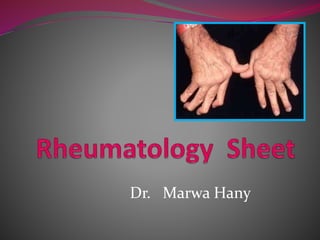
Dr. Marwa Hany
• To understand what are rheumatic diseases & what 
are the different types 
• To be able to take detailed history from a patient with 
rheumatological disease 
• To be able to interpret collected information in the sheet 
• To understand the importance of early and appropriate 
care of patients with rheumatic diseases
• What is a rheumatic disease ? 
• What is the classification ? 
• What are the different types ?
A Rheumatic Disease is ….. 
a disease of the Musculoskeletal System
Classification 
Inflammatory Diseases 
Mechanical/ Degenerative Diseases
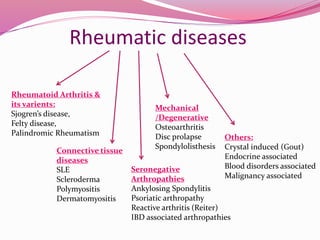
Rheumatic diseases 
Rheumatoid Arthritis & 
its varients: 
Sjogren’s disease, 
Felty disease, 
Palindromic Rheumatism 
Connective tissue 
diseases 
SLE 
Scleroderma 
Polymyositis 
Dermatomyositis 
Mechanical 
/Degenerative 
Osteoarthritis 
Disc prolapse 
Spondylolisthesis 
Others: 
Crystal induced (Gout) 
Endocrine associated 
Blood disorders associated 
Malignancy associated 
Seronegative 
Arthropathies 
Ankylosing Spondylitis 
Psoriatic arthropathy 
Reactive arthritis (Reiter) 
IBD associated arthropathies
Joint Nomencalture
• Personal History 
• Complaint 
• Present History 
• Gynacologic & Obstetric 
• Past History 
• Family History
Personal History 
 Name: 
to be familiar with the patient 
 Sex: 
SLE 
RA 
AS 
SLE & RA are more common in females, while 
Ankylosing spondylitis is more common in males
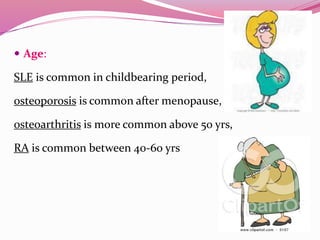
 Age: 
SLE is common in childbearing period, 
osteoporosis is common after menopause, 
osteoarthritis is more common above 50 yrs, 
RA is common between 40-60 yrs
 Occupation: 
Disc prolapse is common in labourers, surgeons & drivers, 
Scleroderma is common in workers in silica industries, 
Raynaud’ s phenomena is common with use of vibrating 
tools
 Marital status & Offspings: for selection of different 
drugs since that some drugs affect ovarian & testicular 
function like cyclophosphamide
 Special habits: 
In disc prolapse smoking worsens disc perfusion & also 
coughing associated with smoking increases the 
symptoms, 
In RA smoking induces the production of rheumatoid 
factor & anti-CCP
Complaint 
Write it in patient’s own words 
 Pain 
 Pain & swelling 
 Limitation of movement 
 Deformity
Present History 
Analysis of the patient’s complaint: 
• Onset, Course, Duration 
• Number of joints affected 
• Distribution of joint involvement 
• Symptoms increase by & decrease by 
• Associated symptoms
 Onset: 
Acute onset may occur in traumatic, inflammatory & 
infectious arthropathies. 
Gradual onset may occur in some inflammatory & 
degenerative conditions like RA and OA
 Course: 
Progressive/additive course: symptoms occur in some joints 
and persists with subsequent involvement of other joints as in 
RA & SLE. 
Regressive course: symptoms are self limited as is viral arthritis . 
Intermittent course: repetitive attacks of arthritis with complete 
remission inbetween attacks as in gout 
Migratory course: symptoms occur in some joints for a few days 
then disappear to appear in other joints as in rheumatic fever
 Number of joints affected: 
Monoarticular affection involvement of 
one joint as in traumatic, septic & crystal 
arthropathies 
Oligoarticular affection involvement of 
4 joints or less as in seronegative 
arthropathies 
Polyarticular affection involvement of 
more than 4 joints as in RA
 Distribution of joint affection: 
Small joints of the hands & feet are 
commonly involved in RA 
Large weight bearing joints like 
knees & hips are affected in OA 
Axial and large girdle joints like 
shoulders & hips are affected in AS
 Symptoms increase or decrease by: 
Inflammatory conditions symptoms are increased by 
rest & relieved by movement, while in 
Degenerative/ Mechanical conditions symptoms are 
increased by movement & relieved by rest
 Erythema & warmth: its site and its relation to joint 
(erythema & warmth are more marked in septic 
arthritis, and in crystal arthropathies but may occur 
with others)
 Morning stiffness : inability to move joints through 
available range of motion marked in the early 
morning improving with moving the joint 
( morning stiffness > 1 hr occurs in RA, morning 
stiffness less than 30 min occurs in OA ) 
 Inactivity stiffness : gelling of the joint after a small 
period of inactivity ( as in OA )
Comment as follows: 
Condition started….. onset, course, duration, 
site & radiation, character, increases by, decreases by, 
association with other symptoms ( swelling, 
limitation, warmth, erythema, morning/ inactivity 
stiffness)
 Arthralgia is defined as pain without 
other signs of inflammation 
 Arthritis is defined as inflammation 
of the joint where pain is also 
associated with other signs of 
inflammation like swelling, limitation 
of movement, warmth & erythema
Extra-articular features: 
 Fever, weight loss, myalgias, 
arthralgias: may occur with 
inflammatory arthropathies like 
SLE, infectious arthropathies, 
and in vasculitis
 Photosensitivity, falling of hair, oral ulcers, skin 
rash: as in SLE 
 Subcutaneous nodules, dryness of eye & mouth, 
lymphadenopathy: in RA patients and variants like 
Sjogren’s and Felty’s 
 Genital ulcers, heel pain, preceding dysuria or 
diarhea, scaly skin lesions, bowel complaint as in 
seronegative arthropathies
Systemic review: 
 Symptoms suggestive of cardiac affection; chest pain, 
exertional dysnea, palpitation( valvular disease may occur in 
rheumatic fever, RA, Ankylosing spondylitis, while 
pericardial effusions & pericarditis may occur in SLE ) 
 Symptoms suggestive of pulmonary affection; dysnea, 
cough, sputum, chest pain, heamoptysis ( interstitial lung 
fibrosis occurs in scleroderma & methotrexate use in RA, 
apical lung fibrosis in AS, pleurisy& pleural effusion in SLE)
 Symptoms suggestive of urologic affection; dysuria, 
heamaturia, loin pain ( Glomerulonephritis in SLE & 
vasculitis) 
 Symptoms suggestive of neurologic affection; motor 
weakness, parasthesia, sensory loss, sphincteric 
disturbance ( as in disc prolapse), coma, convulsions, 
persisting headache not responding to analgesics, 
hemiparesis ( as in SLE)
 Symptoms suggestive of GIT affection; nausea, 
vomiting, diarhea, abdominal pain, melena, 
constipation ( inflammatory bowel associated 
arthropathies, pancreatitis in SLE, mesenteric 
vascular occlusion in vasculitis)
Gynecological &Obstetric History 
 RA tends to go into remission in pregnancy, while SLE 
flares in pregnancy 
 Fetal losses may occur in SLE pts with APA syndrome 
 Menstrual irregularities may be associated with drug 
intake like corticosteroids & cyclophosphamide 
 Some drugs used for rheumatic diseases are 
contraindicated in pregnant & lactating females
Past History 
 Trauma: may precede disc prolapse, traumatic arthritis, 
ligament sprains 
 Diabetes mellitus: increased incidence of carpal tunnel 
syndrome, shoulder periarthritis, limited mobility of hand 
joints 
 Hypertension: either primary or secondary due to steroid 
use, renal disease due to SLE 0r vasculitis 
 Drug intake: Drug- induced lupus, drug-drug interactions
 Endocrinal disorders; hyper/hypothyroidism, 
hypo/hyperparathyroidism, acromegally and cushing all 
are associated with many musculoskeletal conditions 
 Hematologic diseases; hemophilia may be associated 
with hemophilic arthropathy & muscle hematoma 
 Malignancies: metastasis to joints, paraneoplastic 
conditions
Family History 
 Similar conditions: increased risk of development 
of RA & SLE & JIA in first degree relatives 
 Related conditions: history of psoriases, 
inflammatory bowel disease, ankylosing spondylitis 
in relatives ( seronegative arthropathies)
• General Examination 
• Local Examination
General Examination 
 Patient appears mildly/moderately or severely ill, lying 
comfortable in bed, cooperative/un, of average body 
built/ overweight/ underweight 
 Vital signs: 
Blp, pulse, temp, resp rate
Regions: 
 Head: hair ( alopecia), face ( cushiongoid, malar rash), 
eyebrows ( lost outer third), mouth ( oral ulcers, limited 
mouth aperture), nose ( nasal ulcers), eye (red)
 Neck: lymphadenopathy, thyroid swelling 
 Upper limb: pallor, cyanosis, erythema, tremors, rash 
 Lower limb: oedema, cyanosis/gangrene, leg ulcers
Local Examination 
 Inspection : swelling, muscle wasting, deformity, skin 
changes (rash, scars) 
 Palpation: tenderness, temperature, crepitus, synovial 
thickening, confirm nature of swelling 
 ROM: Active, Passive 
 Special Tests: specific for each region
Rheumatology Sheet

Rheumatology Sheet

  • 1.
  • 2.
    • To understandwhat are rheumatic diseases & what are the different types • To be able to take detailed history from a patient with rheumatological disease • To be able to interpret collected information in the sheet • To understand the importance of early and appropriate care of patients with rheumatic diseases
  • 3.
    • What isa rheumatic disease ? • What is the classification ? • What are the different types ?
  • 4.
    A Rheumatic Diseaseis ….. a disease of the Musculoskeletal System
  • 5.
    Classification Inflammatory Diseases Mechanical/ Degenerative Diseases
  • 6.
    Rheumatic diseases RheumatoidArthritis & its varients: Sjogren’s disease, Felty disease, Palindromic Rheumatism Connective tissue diseases SLE Scleroderma Polymyositis Dermatomyositis Mechanical /Degenerative Osteoarthritis Disc prolapse Spondylolisthesis Others: Crystal induced (Gout) Endocrine associated Blood disorders associated Malignancy associated Seronegative Arthropathies Ankylosing Spondylitis Psoriatic arthropathy Reactive arthritis (Reiter) IBD associated arthropathies
  • 7.
  • 8.
    • Personal History • Complaint • Present History • Gynacologic & Obstetric • Past History • Family History
  • 9.
    Personal History Name: to be familiar with the patient  Sex: SLE RA AS SLE & RA are more common in females, while Ankylosing spondylitis is more common in males
  • 10.
     Age: SLEis common in childbearing period, osteoporosis is common after menopause, osteoarthritis is more common above 50 yrs, RA is common between 40-60 yrs
  • 11.
     Occupation: Discprolapse is common in labourers, surgeons & drivers, Scleroderma is common in workers in silica industries, Raynaud’ s phenomena is common with use of vibrating tools
  • 12.
     Marital status& Offspings: for selection of different drugs since that some drugs affect ovarian & testicular function like cyclophosphamide
  • 13.
     Special habits: In disc prolapse smoking worsens disc perfusion & also coughing associated with smoking increases the symptoms, In RA smoking induces the production of rheumatoid factor & anti-CCP
  • 14.
    Complaint Write itin patient’s own words  Pain  Pain & swelling  Limitation of movement  Deformity
  • 15.
    Present History Analysisof the patient’s complaint: • Onset, Course, Duration • Number of joints affected • Distribution of joint involvement • Symptoms increase by & decrease by • Associated symptoms
  • 16.
     Onset: Acuteonset may occur in traumatic, inflammatory & infectious arthropathies. Gradual onset may occur in some inflammatory & degenerative conditions like RA and OA
  • 17.
     Course: Progressive/additivecourse: symptoms occur in some joints and persists with subsequent involvement of other joints as in RA & SLE. Regressive course: symptoms are self limited as is viral arthritis . Intermittent course: repetitive attacks of arthritis with complete remission inbetween attacks as in gout Migratory course: symptoms occur in some joints for a few days then disappear to appear in other joints as in rheumatic fever
  • 18.
     Number ofjoints affected: Monoarticular affection involvement of one joint as in traumatic, septic & crystal arthropathies Oligoarticular affection involvement of 4 joints or less as in seronegative arthropathies Polyarticular affection involvement of more than 4 joints as in RA
  • 19.
     Distribution ofjoint affection: Small joints of the hands & feet are commonly involved in RA Large weight bearing joints like knees & hips are affected in OA Axial and large girdle joints like shoulders & hips are affected in AS
  • 20.
     Symptoms increaseor decrease by: Inflammatory conditions symptoms are increased by rest & relieved by movement, while in Degenerative/ Mechanical conditions symptoms are increased by movement & relieved by rest
  • 21.
     Erythema &warmth: its site and its relation to joint (erythema & warmth are more marked in septic arthritis, and in crystal arthropathies but may occur with others)
  • 22.
     Morning stiffness: inability to move joints through available range of motion marked in the early morning improving with moving the joint ( morning stiffness > 1 hr occurs in RA, morning stiffness less than 30 min occurs in OA )  Inactivity stiffness : gelling of the joint after a small period of inactivity ( as in OA )
  • 23.
    Comment as follows: Condition started….. onset, course, duration, site & radiation, character, increases by, decreases by, association with other symptoms ( swelling, limitation, warmth, erythema, morning/ inactivity stiffness)
  • 24.
     Arthralgia isdefined as pain without other signs of inflammation  Arthritis is defined as inflammation of the joint where pain is also associated with other signs of inflammation like swelling, limitation of movement, warmth & erythema
  • 25.
    Extra-articular features: Fever, weight loss, myalgias, arthralgias: may occur with inflammatory arthropathies like SLE, infectious arthropathies, and in vasculitis
  • 26.
     Photosensitivity, fallingof hair, oral ulcers, skin rash: as in SLE  Subcutaneous nodules, dryness of eye & mouth, lymphadenopathy: in RA patients and variants like Sjogren’s and Felty’s  Genital ulcers, heel pain, preceding dysuria or diarhea, scaly skin lesions, bowel complaint as in seronegative arthropathies
  • 27.
    Systemic review: Symptoms suggestive of cardiac affection; chest pain, exertional dysnea, palpitation( valvular disease may occur in rheumatic fever, RA, Ankylosing spondylitis, while pericardial effusions & pericarditis may occur in SLE )  Symptoms suggestive of pulmonary affection; dysnea, cough, sputum, chest pain, heamoptysis ( interstitial lung fibrosis occurs in scleroderma & methotrexate use in RA, apical lung fibrosis in AS, pleurisy& pleural effusion in SLE)
  • 28.
     Symptoms suggestiveof urologic affection; dysuria, heamaturia, loin pain ( Glomerulonephritis in SLE & vasculitis)  Symptoms suggestive of neurologic affection; motor weakness, parasthesia, sensory loss, sphincteric disturbance ( as in disc prolapse), coma, convulsions, persisting headache not responding to analgesics, hemiparesis ( as in SLE)
  • 29.
     Symptoms suggestiveof GIT affection; nausea, vomiting, diarhea, abdominal pain, melena, constipation ( inflammatory bowel associated arthropathies, pancreatitis in SLE, mesenteric vascular occlusion in vasculitis)
  • 30.
    Gynecological &Obstetric History  RA tends to go into remission in pregnancy, while SLE flares in pregnancy  Fetal losses may occur in SLE pts with APA syndrome  Menstrual irregularities may be associated with drug intake like corticosteroids & cyclophosphamide  Some drugs used for rheumatic diseases are contraindicated in pregnant & lactating females
  • 31.
    Past History Trauma: may precede disc prolapse, traumatic arthritis, ligament sprains  Diabetes mellitus: increased incidence of carpal tunnel syndrome, shoulder periarthritis, limited mobility of hand joints  Hypertension: either primary or secondary due to steroid use, renal disease due to SLE 0r vasculitis  Drug intake: Drug- induced lupus, drug-drug interactions
  • 32.
     Endocrinal disorders;hyper/hypothyroidism, hypo/hyperparathyroidism, acromegally and cushing all are associated with many musculoskeletal conditions  Hematologic diseases; hemophilia may be associated with hemophilic arthropathy & muscle hematoma  Malignancies: metastasis to joints, paraneoplastic conditions
  • 33.
    Family History Similar conditions: increased risk of development of RA & SLE & JIA in first degree relatives  Related conditions: history of psoriases, inflammatory bowel disease, ankylosing spondylitis in relatives ( seronegative arthropathies)
  • 34.
    • General Examination • Local Examination
  • 35.
    General Examination Patient appears mildly/moderately or severely ill, lying comfortable in bed, cooperative/un, of average body built/ overweight/ underweight  Vital signs: Blp, pulse, temp, resp rate
  • 36.
    Regions:  Head:hair ( alopecia), face ( cushiongoid, malar rash), eyebrows ( lost outer third), mouth ( oral ulcers, limited mouth aperture), nose ( nasal ulcers), eye (red)
  • 37.
     Neck: lymphadenopathy,thyroid swelling  Upper limb: pallor, cyanosis, erythema, tremors, rash  Lower limb: oedema, cyanosis/gangrene, leg ulcers
  • 38.
    Local Examination Inspection : swelling, muscle wasting, deformity, skin changes (rash, scars)  Palpation: tenderness, temperature, crepitus, synovial thickening, confirm nature of swelling  ROM: Active, Passive  Special Tests: specific for each region