Vasculitis  Dr Basavaraj P Bommanahalli Assistant Professor Dept of Pathology  SSIMS RC Davanagere Karnataka
Def: inflammation of wall of the vessels  c/f constitutional signs & symptoms fever, myalgia, arthralgia  signs of ischemia
Pathogenesis  Direct infection:  Bacterial Rocky Mountain Spotted fever  Syphilis  Fungal : aspergillosis, mucormycosis  Viral: herpes zoster- varicella
Immunologic   Immune complex mediated  Antineutrophil cytoplasmic antibody (ANCA) mediated  Cell mediated  Direct antibody mediated  Idiopathic
Classification  Large vessel vasculitis   Giant cell arteritis Takayasu arteritis  Medium sized vessel vasculitis   Polyarteritis nodosa Kawasaki disease   Small vessel vasculitis   Wegener granulomatosis  Churg- stauss syndrome  Microscopic polyangitis
Giant cell (temporal) arteritis   Most common systemic arteritis  Acute, chronic granulomatous lesion  Large arteries   Aorta & its branches  Temporal artery  Vertebral artery Ophthalmic artery
Segmental involvement  Nodular thickening  & narrow lumen  Granulomatous inflammation  Giant cells (foreign body & Langhans) Lymphocytes   Fragmentation of internal elastic lamina  Later fibrosis
C/F  Always > 50 yrs  Increased ESR Pain & tenderness, nodular temporal A Black outs, permanent visual loss  Biopsy is confirmatory  Anti-inflammatory drugs are effective
Takayasu arteritis  Granulomatous inflammation  Characterised by  Ocular disturbances  Weakening of pulses in the upper extremities pulseless disease   Fibrous thickening of arch of aorta & branches  Associated with HLA A24-B52-DR2
Arch of aorta & its branches  Pulmonary artery  Coronary & renal arteries   Morphology similar to giant cell arteritis with necrosis  Younger age group
C/F  Lower BP & weak pulses in upper limbs  Total blindness  HTN  Claudication
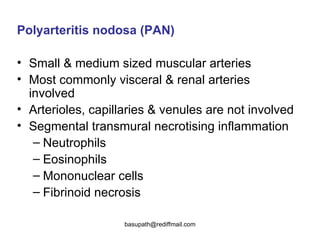
Polyarteritis nodosa (PAN) Small & medium sized muscular arteries  Most commonly visceral & renal arteries involved  Arterioles, capillaries & venules are not involved  Segmental transmural necrotising inflammation  Neutrophils Eosinophils Mononuclear cells  Fibrinoid necrosis
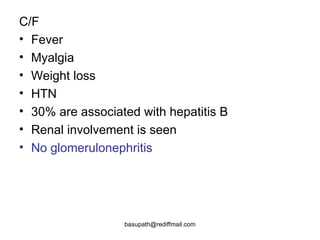
C/F  Fever Myalgia  Weight loss  HTN 30% are associated with hepatitis B  Renal involvement is seen  No glomerulonephritis
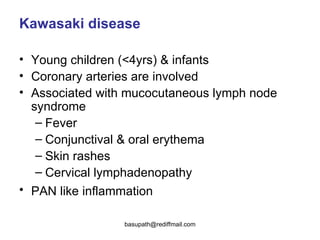
Kawasaki disease   Young children (<4yrs) & infants  Coronary arteries are involved  Associated with mucocutaneous lymph node syndrome  Fever Conjunctival & oral erythema Skin rashes  Cervical lymphadenopathy PAN like inflammation
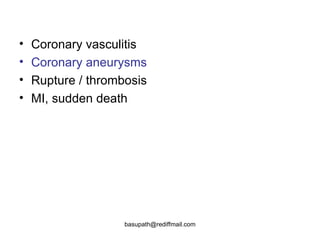
Coronary vasculitis Coronary aneurysms  Rupture / thrombosis  MI, sudden death
Wegener granulomatosis   Classic type  Triad  Acute necrotising granulomas of upper respiratory tract Granulomatous vasculitis of lung & upper respiratory tract  Focal necrotising crescentic glomerulonephritis  Limited type : restricted to respiratory tract
Pathogenesis  Immune complex mediated  Cell mediated  C/F  M >F 4 th  – 5 th  decade c-ANCA + in 95 %  of cases
Thromboangitis obliterans /  Buerger disease  Characterised by  Segmental thrombosing acute & chronic inflammation of medium sized & small arteries : tibial/ radial a Extending to veins & nerves of extremities
Begins < 35yrs Strongly associated with smoking  Hypersensitivity to intradermally tobacco extract  Associated with HLA-A9, HLA-B5  Prevalent in Israel, Japan, India than US & Europe
Segmental acute & chronic vasculitis  Lower & upper extremities  Thrombosis – recanalisation  Contiguous involvement of veins & nerves  C/F  Gangrene  Chronic ulcerations  Severe pain: resting pain  : nerve involvement
Raynaud phenomenon  : Paroxysmal pallor, cyanosis of digits of hands or feet and tips of nose & ear  Due to cold induced vasoconstriction precapillary arterioles & digital arteries Long standing cases associated with atrophy of skin, subcutaneous tissue & muscle
Primary   Exaggeration of normal central and local vasomotor response to cold & emotion  3-5% of population Median age-14yrs No arterial pathology Secondary  Associated with SLE, systemic sclerosis, atherosclerosis, Buerger disease  > 30 yrs  + vascular pathology
Tumors of vessels   Benign neoplasms/ developmental /acquired conditions   Hemangioma  Capillary Cavernous  Pyogenic   Lymphangioma Vascular ectasia Bacillary angiomatosis  Intermediate grade neoplasms Kaposi sarcoma  Hemangioendothelioma  Malignant neoplasm Angiosarcoma  Hemangiopericytoma
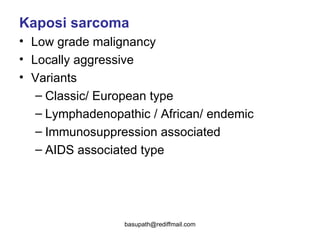
Kaposi sarcoma   Low grade malignancy Locally aggressive  Variants  Classic/ European type Lymphadenopathic / African/ endemic  Immunosuppression associated  AIDS associated type
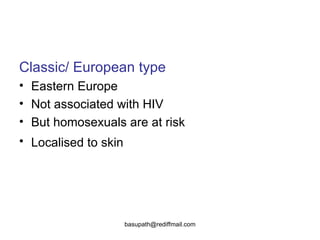
Classic/ European type Eastern Europe  Not associated with HIV But homosexuals are at risk Localised to skin
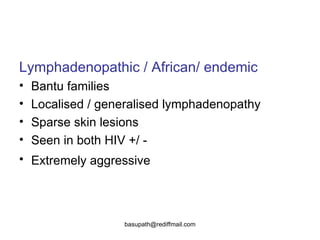
Lymphadenopathic / African/ endemic  Bantu families  Localised / generalised lymphadenopathy Sparse skin lesions  Seen in both HIV +/ - Extremely aggressive
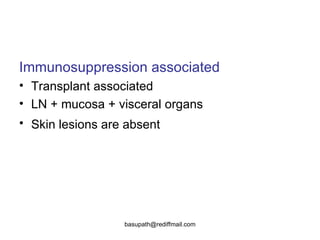
Immunosuppression associated Transplant associated  LN + mucosa + visceral organs  Skin lesions are absent
AIDS associated   Seen in 1/3 rd of AIDS  pts  Male homosexuals  LN + mucosa + skin + viscera  Early widespread dissemination
Gross   Patch  Plaque  Nodular lesions  Microscopy   Dilated irregular, angulated blood vessels lined by endothelial cells  Spindled cells containing pink hyaline globules Hemosiderin laden macrophages  Mitotic figures
KS associated Herpes virus (KSHV) / HHV-8 Inhibits apoptosis  Increases production of p53 inhibitors  Rx : excision + radiotherapy + chemotherapy

C:\Fakepath\Vasculitis

  • 1.
    Vasculitis DrBasavaraj P Bommanahalli Assistant Professor Dept of Pathology SSIMS RC Davanagere Karnataka
  • 2.
    Def: inflammation ofwall of the vessels c/f constitutional signs & symptoms fever, myalgia, arthralgia signs of ischemia
  • 3.
    Pathogenesis Directinfection: Bacterial Rocky Mountain Spotted fever Syphilis Fungal : aspergillosis, mucormycosis Viral: herpes zoster- varicella
  • 4.
    Immunologic Immune complex mediated Antineutrophil cytoplasmic antibody (ANCA) mediated Cell mediated Direct antibody mediated Idiopathic
  • 5.
    Classification Largevessel vasculitis Giant cell arteritis Takayasu arteritis Medium sized vessel vasculitis Polyarteritis nodosa Kawasaki disease Small vessel vasculitis Wegener granulomatosis Churg- stauss syndrome Microscopic polyangitis
  • 6.
    Giant cell (temporal)arteritis Most common systemic arteritis Acute, chronic granulomatous lesion Large arteries Aorta & its branches Temporal artery Vertebral artery Ophthalmic artery
  • 7.
    Segmental involvement Nodular thickening & narrow lumen Granulomatous inflammation Giant cells (foreign body & Langhans) Lymphocytes Fragmentation of internal elastic lamina Later fibrosis
  • 8.
    C/F Always> 50 yrs Increased ESR Pain & tenderness, nodular temporal A Black outs, permanent visual loss Biopsy is confirmatory Anti-inflammatory drugs are effective
  • 9.
    Takayasu arteritis Granulomatous inflammation Characterised by Ocular disturbances Weakening of pulses in the upper extremities pulseless disease Fibrous thickening of arch of aorta & branches Associated with HLA A24-B52-DR2
  • 10.
    Arch of aorta& its branches Pulmonary artery Coronary & renal arteries Morphology similar to giant cell arteritis with necrosis Younger age group
  • 11.
    C/F LowerBP & weak pulses in upper limbs Total blindness HTN Claudication
  • 12.
    Polyarteritis nodosa (PAN)Small & medium sized muscular arteries Most commonly visceral & renal arteries involved Arterioles, capillaries & venules are not involved Segmental transmural necrotising inflammation Neutrophils Eosinophils Mononuclear cells Fibrinoid necrosis
  • 13.
    C/F FeverMyalgia Weight loss HTN 30% are associated with hepatitis B Renal involvement is seen No glomerulonephritis
  • 14.
    Kawasaki disease Young children (<4yrs) & infants Coronary arteries are involved Associated with mucocutaneous lymph node syndrome Fever Conjunctival & oral erythema Skin rashes Cervical lymphadenopathy PAN like inflammation
  • 15.
    Coronary vasculitis Coronaryaneurysms Rupture / thrombosis MI, sudden death
  • 16.
    Wegener granulomatosis Classic type Triad Acute necrotising granulomas of upper respiratory tract Granulomatous vasculitis of lung & upper respiratory tract Focal necrotising crescentic glomerulonephritis Limited type : restricted to respiratory tract
  • 17.
    Pathogenesis Immunecomplex mediated Cell mediated C/F M >F 4 th – 5 th decade c-ANCA + in 95 % of cases
  • 18.
    Thromboangitis obliterans / Buerger disease Characterised by Segmental thrombosing acute & chronic inflammation of medium sized & small arteries : tibial/ radial a Extending to veins & nerves of extremities
  • 19.
    Begins < 35yrsStrongly associated with smoking Hypersensitivity to intradermally tobacco extract Associated with HLA-A9, HLA-B5 Prevalent in Israel, Japan, India than US & Europe
  • 20.
    Segmental acute &chronic vasculitis Lower & upper extremities Thrombosis – recanalisation Contiguous involvement of veins & nerves C/F Gangrene Chronic ulcerations Severe pain: resting pain : nerve involvement
  • 21.
    Raynaud phenomenon : Paroxysmal pallor, cyanosis of digits of hands or feet and tips of nose & ear Due to cold induced vasoconstriction precapillary arterioles & digital arteries Long standing cases associated with atrophy of skin, subcutaneous tissue & muscle
  • 22.
    Primary Exaggeration of normal central and local vasomotor response to cold & emotion 3-5% of population Median age-14yrs No arterial pathology Secondary Associated with SLE, systemic sclerosis, atherosclerosis, Buerger disease > 30 yrs + vascular pathology
  • 23.
    Tumors of vessels Benign neoplasms/ developmental /acquired conditions Hemangioma Capillary Cavernous Pyogenic Lymphangioma Vascular ectasia Bacillary angiomatosis Intermediate grade neoplasms Kaposi sarcoma Hemangioendothelioma Malignant neoplasm Angiosarcoma Hemangiopericytoma
  • 24.
    Kaposi sarcoma Low grade malignancy Locally aggressive Variants Classic/ European type Lymphadenopathic / African/ endemic Immunosuppression associated AIDS associated type
  • 25.
    Classic/ European typeEastern Europe Not associated with HIV But homosexuals are at risk Localised to skin
  • 26.
    Lymphadenopathic / African/endemic Bantu families Localised / generalised lymphadenopathy Sparse skin lesions Seen in both HIV +/ - Extremely aggressive
  • 27.
    Immunosuppression associated Transplantassociated LN + mucosa + visceral organs Skin lesions are absent
  • 28.
    AIDS associated Seen in 1/3 rd of AIDS pts Male homosexuals LN + mucosa + skin + viscera Early widespread dissemination
  • 29.
    Gross Patch Plaque Nodular lesions Microscopy Dilated irregular, angulated blood vessels lined by endothelial cells Spindled cells containing pink hyaline globules Hemosiderin laden macrophages Mitotic figures
  • 30.
    KS associated Herpesvirus (KSHV) / HHV-8 Inhibits apoptosis Increases production of p53 inhibitors Rx : excision + radiotherapy + chemotherapy