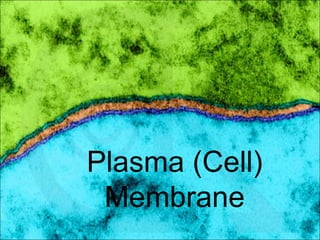
Plasma (Cell)
Membrane
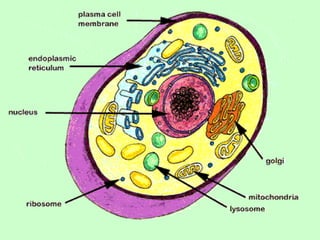
The plasma membrane
provides a barrier
between the internal
components of a cell
and its external
environment.
Homeostasis
• The plasma membrane is the
key to maintaining an
equilibrium between internal
and external conditions.
• Homeostasis is necessary to
create conditions suitable for
life.
A type of lipids called
phospholipids
compose the primary
components of the
cell membrane
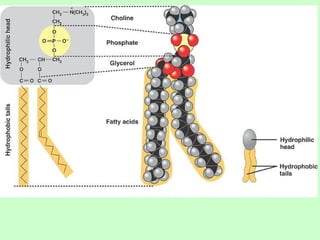
The phospholipids in
the plasma
membrane have a
glycerol backbone,
two fatty acid chains,
and a phosphate.
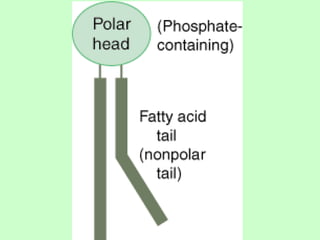
The two fatty acid
tails of the
phospholipids are
nonpolar, the head of
the phosphate is
polar.
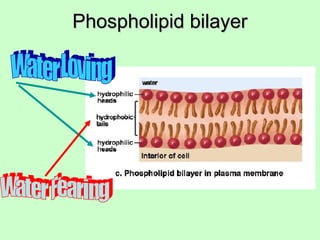
Water on the outside of
the membrane is polar,
which attracts the head
of the phosphate
turning the tails inside
toward each other
forming a bilayer.
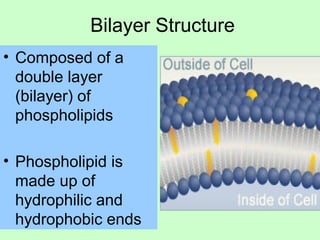
Bilayer Structure
• Composed of a
double layer
(bilayer) of
phospholipids
• Phospholipid is
made up of
hydrophilic and
hydrophobic ends
The plasma
membrane is
water insoluble in
the middle. (no
Water)
Phospholipid bilayerPhospholipid bilayer
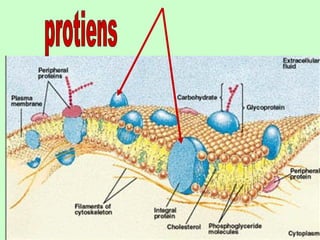
The plasma membrane
is a bilayer of
phospholipids with
proteins on the surface.
The scattered proteins
form a mosaic pattern.
The membrane is
fluid because the
molecules can float
side to side within
the membrane.Interactive Educational Animations
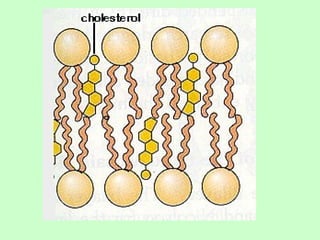
10. Cholesterol is found in
the plasma membranes
(highest in animal cells).
It is a steroid.
The human body
produces 85% of the
cholesterol its cells need.
Cholesterol
Cholesterol helps
stabilize phospholipids
because it prevents the
chains of the fatty acid
in the phospholipids
from sticking together.
Selectively Permeable
•The property of the
membrane that allows
some materials to
pass through while
keeping others out.

Plasma membrane notes (simple)