WHAT IS CELLMEMBRANE ?
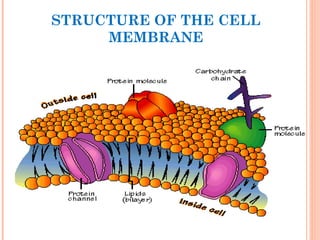
The cell membrane (also called the plasma membrane
plasma membrane or plasmalemma
plasmalemma) is a
biological membrane separating the interior of a cell from the outside
environment
It appears in thin sections with the electron microscope as a triple-layered
structure about 7.5–10 nanometers thick
Term coined by C. Nageli and C. Cramer
C. Nageli and C. Cramer in 1855, and Plasmalemma coined
by J. Q. Plowe
J. Q. Plowe in 1931
4
5.
CELL MEMBRANE
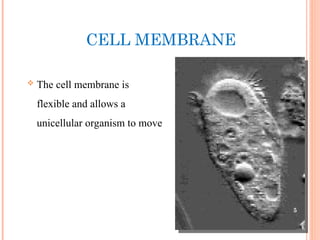
Thecell membrane is
flexible and allows a
unicellular organism to move
5
CHEMICAL COMPOSITION
CHEMICAL COMPOSITION
1.Lipids
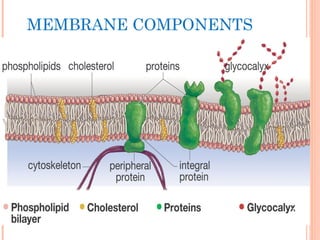
1. Lipids -four major classes of lipids are commonly present in the
plasma membrane: phospholipids (most abundant), spingolipids,
glycolipids and sterols (e.g. cholesterol). All of them are amphipathic.
Cholesterol is abundant in mammalian cell and is absent in
prokaryotic cells
2. Proteins-
2. Proteins-plasma membrane contains about 50% protein. Amount
and type is variable. Myelin cells contains about 25% protein
internal membranes of chloroplast and mitochondria contains 50%
protein. Proteins of plasma membranes are of two types ectoproteins
ectoproteins
and endoproteins
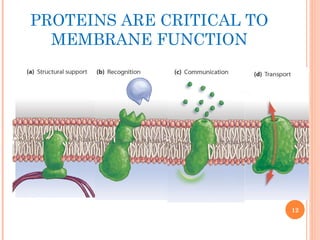
endoproteins. Plasma membranes contains structural proteins,
transport proteins and enzymes. Some of them acts as receptors.
7
8.
CONT…
(enzymes present inthe plasma membrane are Acetyl
phosphatase, acid phosphatase
acid phosphatase, ATPase, RNAase, maltase,
lactase, phospholipase etc)
3.
3. Carbohydrates-
Carbohydrates- they are present only in the plasma
membrane and are present exterior (glycoproteins) or polar
end of phospholipids at the external surface of plasma
membrane
8
9.
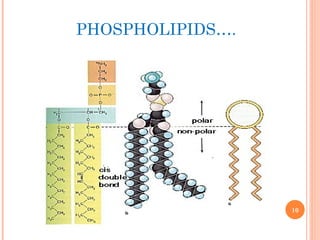
PHOSPHOLIPIDS
Phospholipids (PL)molecule has a polar head and nonpolar tails
The polar head is charged and hydrophilic (loves water) facing
outward, contains a – PO4 group & glycerol
The nonpolar tails are hydrophobic (hates water) facing inward
contains 2 fatty acid chains that are nonpolar
When PL placed in water form spherical bilayer
9
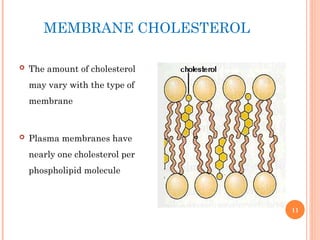
MEMBRANE CHOLESTEROL
Theamount of cholesterol
may vary with the type of
membrane
Plasma membranes have
nearly one cholesterol per
phospholipid molecule
11
FUNCTIONS OF PLASMA
MEMBRANE
Keepsa cell intact
Protective barrier
Regulate transport in & out of cell (selectively
permeable)
Small lipid-soluble molecules, e.g. oxygen and carbon
dioxide can pass easily
Water can freely cross the membrane
17
18.
FUNCTIONS OF PLASMAMEMBRANE…
Ions and large molecules cannot cross without assistance
Allow cell recognition
Provide anchoring sites for filaments of cytoskeleton
Provide a binding site for enzymes
Interlocking surfaces bind cells together (junctions)
Contains the cytoplasm (fluid in cell)
18
19.
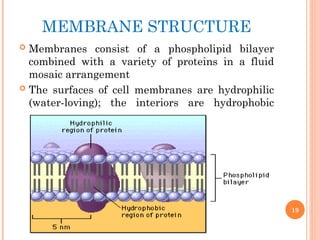
MEMBRANE STRUCTURE
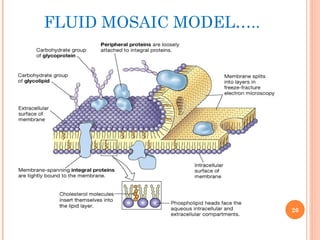
Membranesconsist of a phospholipid bilayer
combined with a variety of proteins in a fluid
mosaic arrangement
The surfaces of cell membranes are hydrophilic
(water-loving); the interiors are hydrophobic
19
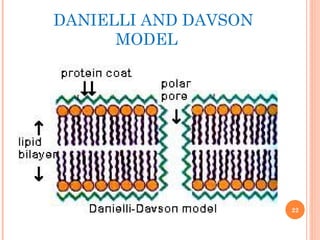
DANIELLI AND DAVSONMODEL
In 1935, Danielli and Davson
Danielli and Davson studied triglyceride lipid
bilayers over a water surface
They found that they arranged themselves with the
polar heads facing outward
It always formed droplets (oil in water) and the surface
tension was much higher than that of cells
Called as Sandwich model
Called as Sandwich model
21
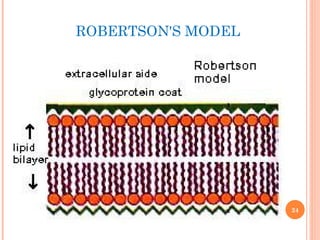
ROBERTSON'S MODEL
In1965, Robertson
Robertson noted the structure of membranes
seen in the electron micrographs
He saw no spaces for pores in the electron micrographs
He hypothesized that the railroad track appearance
came from the binding of osmium tetroxide to proteins
and polar groups of lipids
Proposed unit membrane hypothesis
23
FLUID MOSAIC MODEL
According to S. J. Singer and Garth Nicolson 1972
S. J. Singer and Garth Nicolson 1972, the
biological membranes can be considered as a two-
dimensional liquid where all lipid and protein molecules
diffuse more or less freely
Singer studied phospholipid bilayers and found that they
can form a flattened surface on water, with no
requirement for a protein coat
It occurs in form of globular protein
Widely accepted model
Widely accepted model
25