What is Differential equation?
 If y is a function of x, then we denote it
as y = f(x). Here x is called an
independent variable and y is called a
dependent variable.
 If there is a equation dy/dx = g(x) ,then
this equation contains the variable x
and derivative of y w.r.t x. This type of
an equation is known as a Differential
Equation.
Order of Differential Equation
 Order of the highest order derivative of
the dependent variable with respect to
the independent variable occurring in
a given differential equation is called
the order of differential equation.
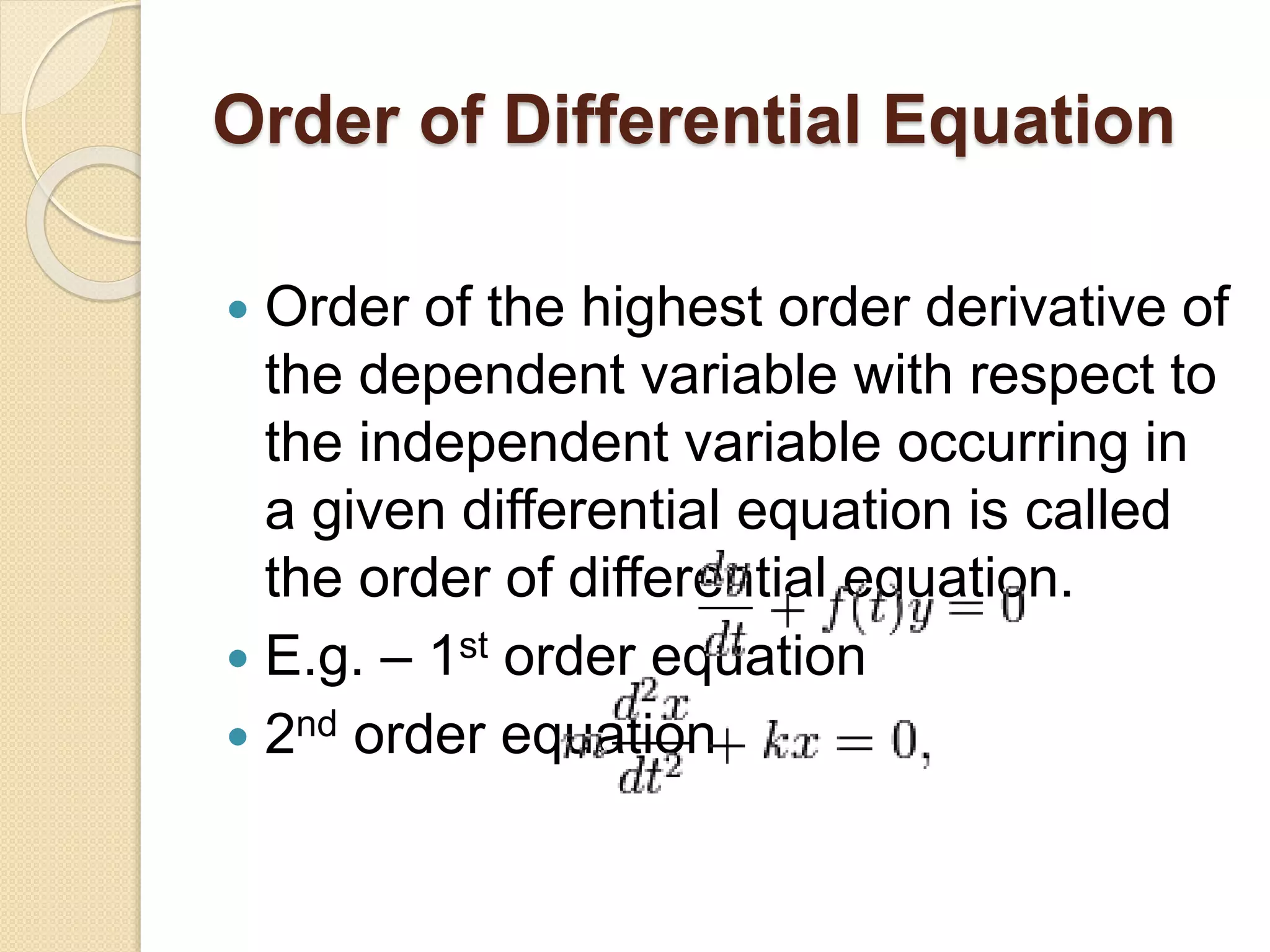
 E.g. – 1st order equation
 2nd order equation
Degree of Differential Equation
 When a differential equation is in a
polynomial form in derivatives, the
highest power of the highest order
derivative occuring in the differential
equation is called the degree of the
differential equation.
 E.g. – Degree – 1 ,(d²y/dx) + dy/dx = 0
Degree – 2 , (d²y/dx)² + dy/dx = 0
Solution of differential
equations of the first order
and first degree
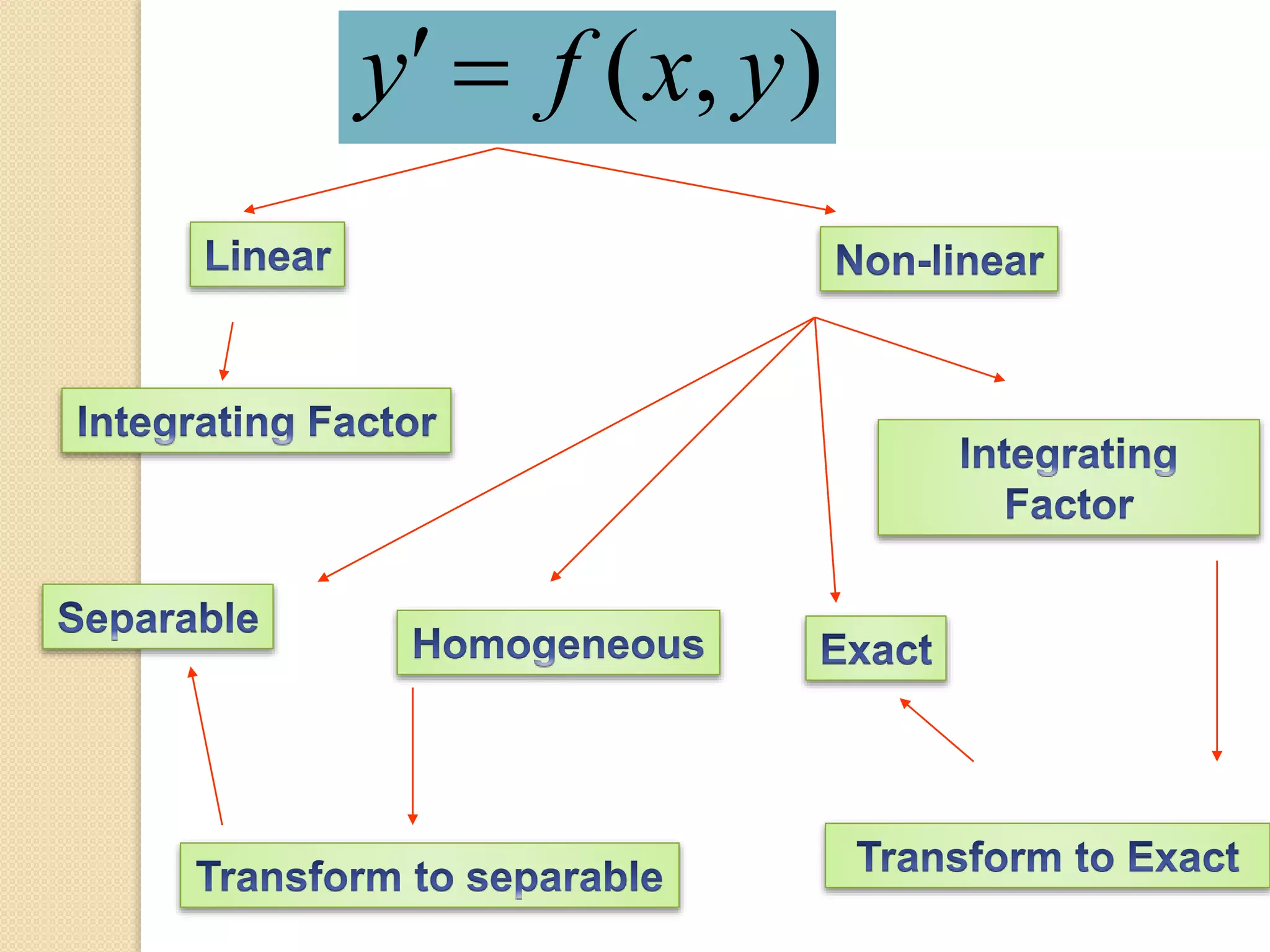
 Differential equations of 1st order can
be solved by many methods ,some of
the methods are as follows :-
1. Variable Separable Method
2. Exact equation method
3. Homogenous equation method
4. Linear equation method
Solution of differential
equations of the first order
and first degree
5. Non-Linear Equation method
(Bernoulli's equation)
6. Non-Exact Equation method
( , )y f x y 
Important Forms of the
method
 Here are some important forms of the
method through which we can know
the form of equation and then use or
apply the method which is required :-
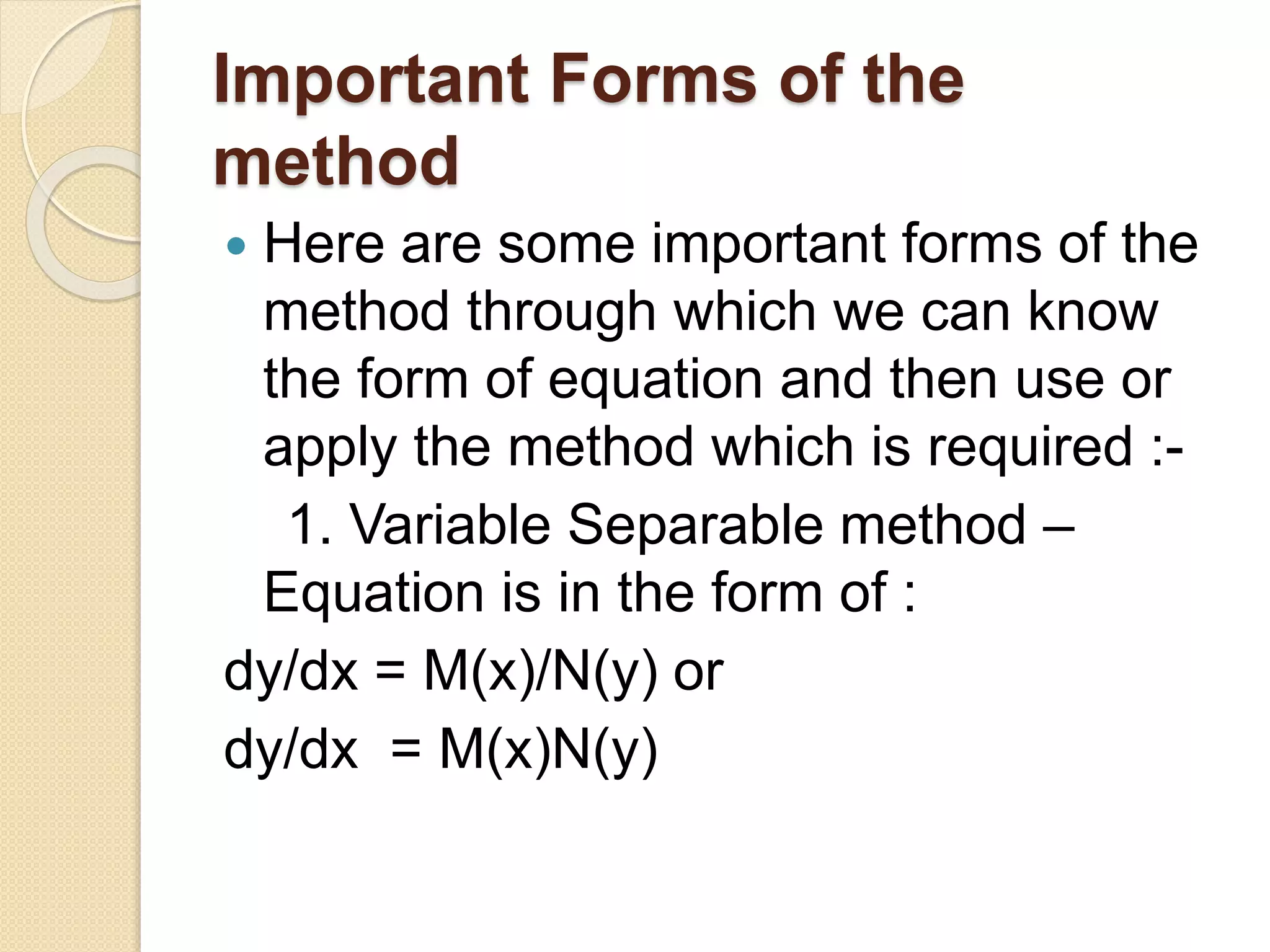
1. Variable Separable method –
Equation is in the form of :
dy/dx = M(x)/N(y) or
dy/dx = M(x)N(y)
Important Forms of the
method
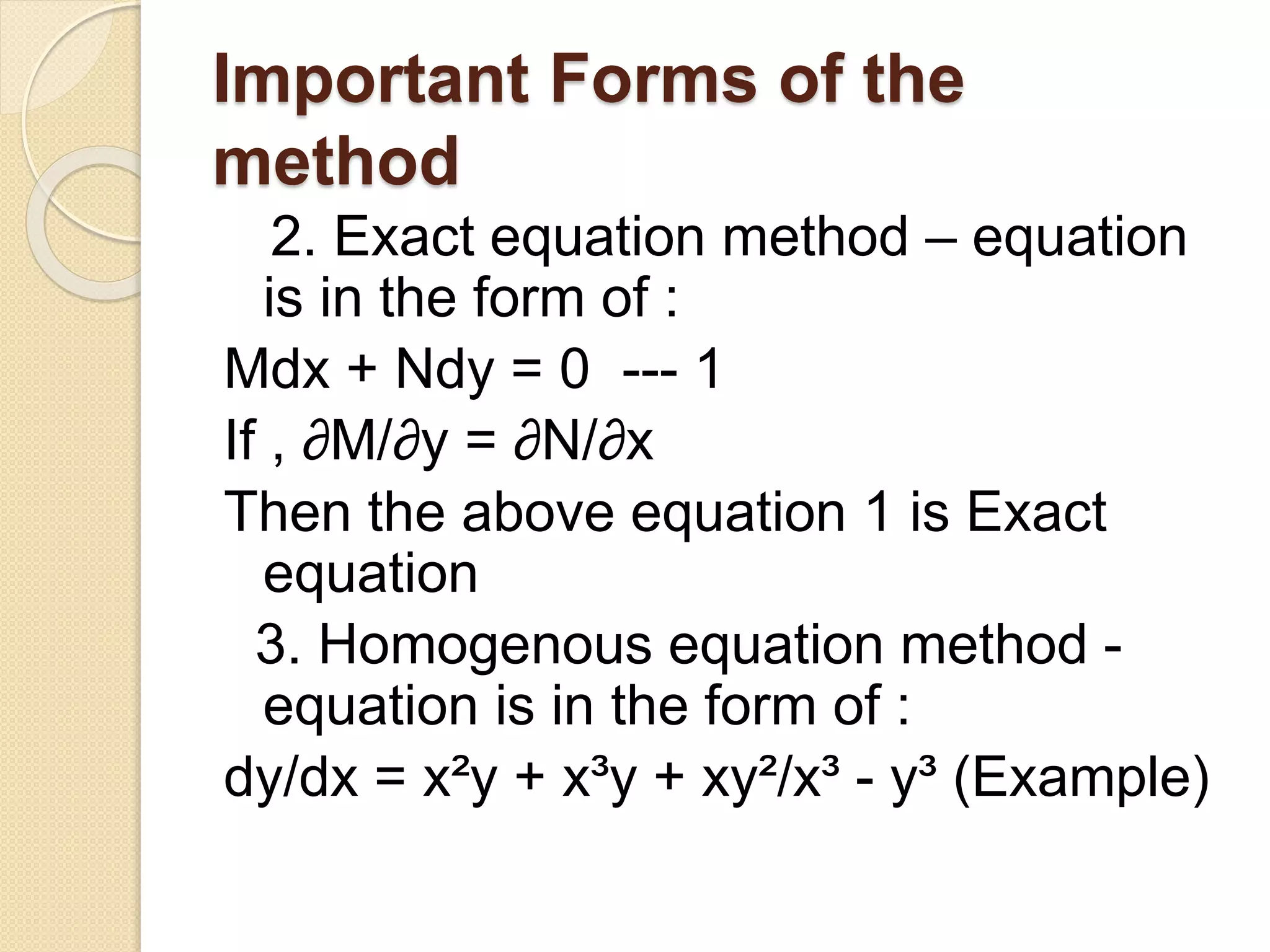
2. Exact equation method – equation
is in the form of :
Mdx + Ndy = 0 --- 1
If , ∂M/∂y = ∂N/∂x
Then the above equation 1 is Exact
equation
3. Homogenous equation method -
equation is in the form of :
dy/dx = x²y + x³y + xy²/x³ - y³ (Example)
Important Forms of the
method
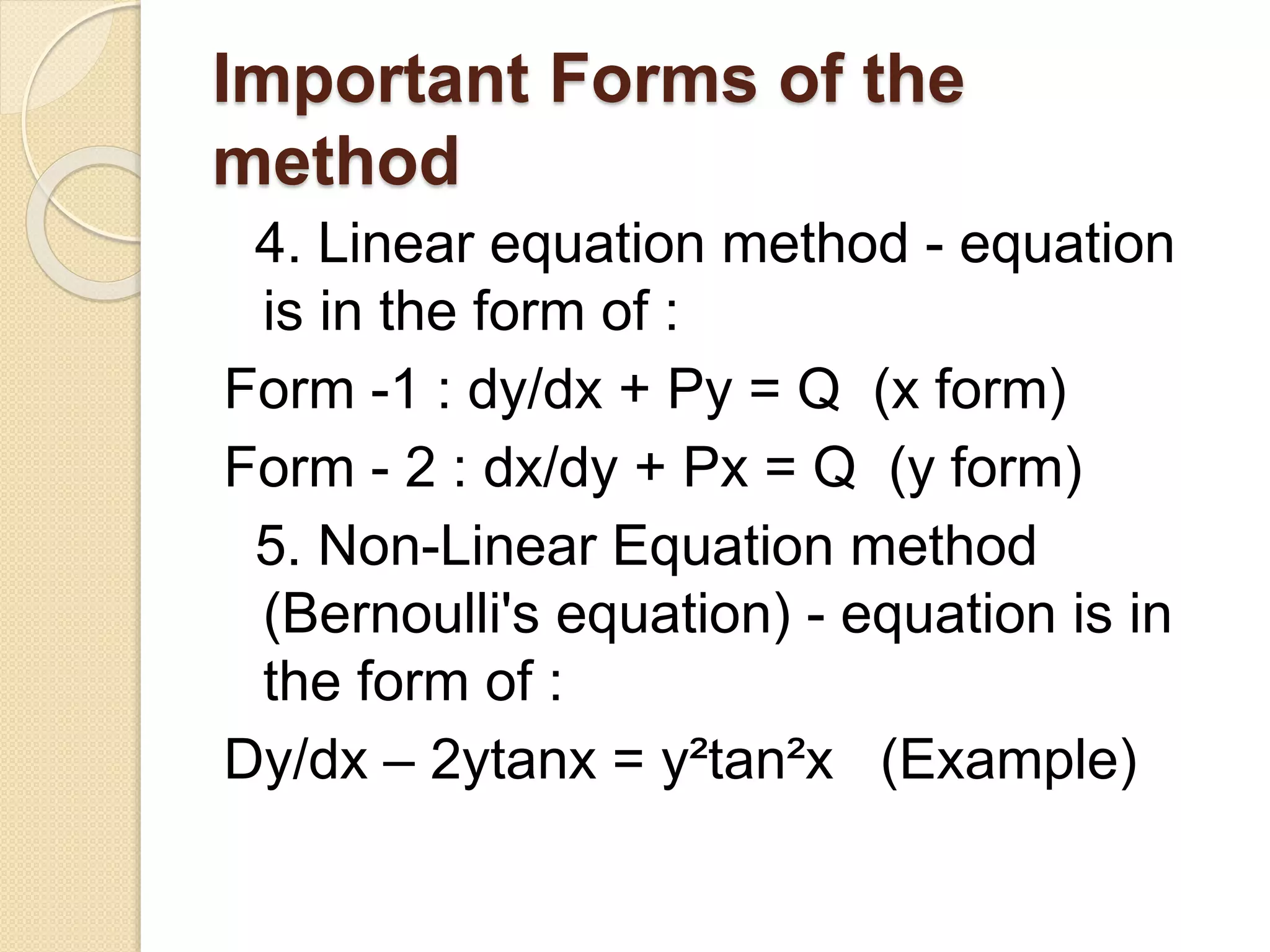
4. Linear equation method - equation
is in the form of :
Form -1 : dy/dx + Py = Q (x form)
Form - 2 : dx/dy + Px = Q (y form)
5. Non-Linear Equation method
(Bernoulli's equation) - equation is in
the form of :
Dy/dx – 2ytanx = y²tan²x (Example)
Important Forms of the
method
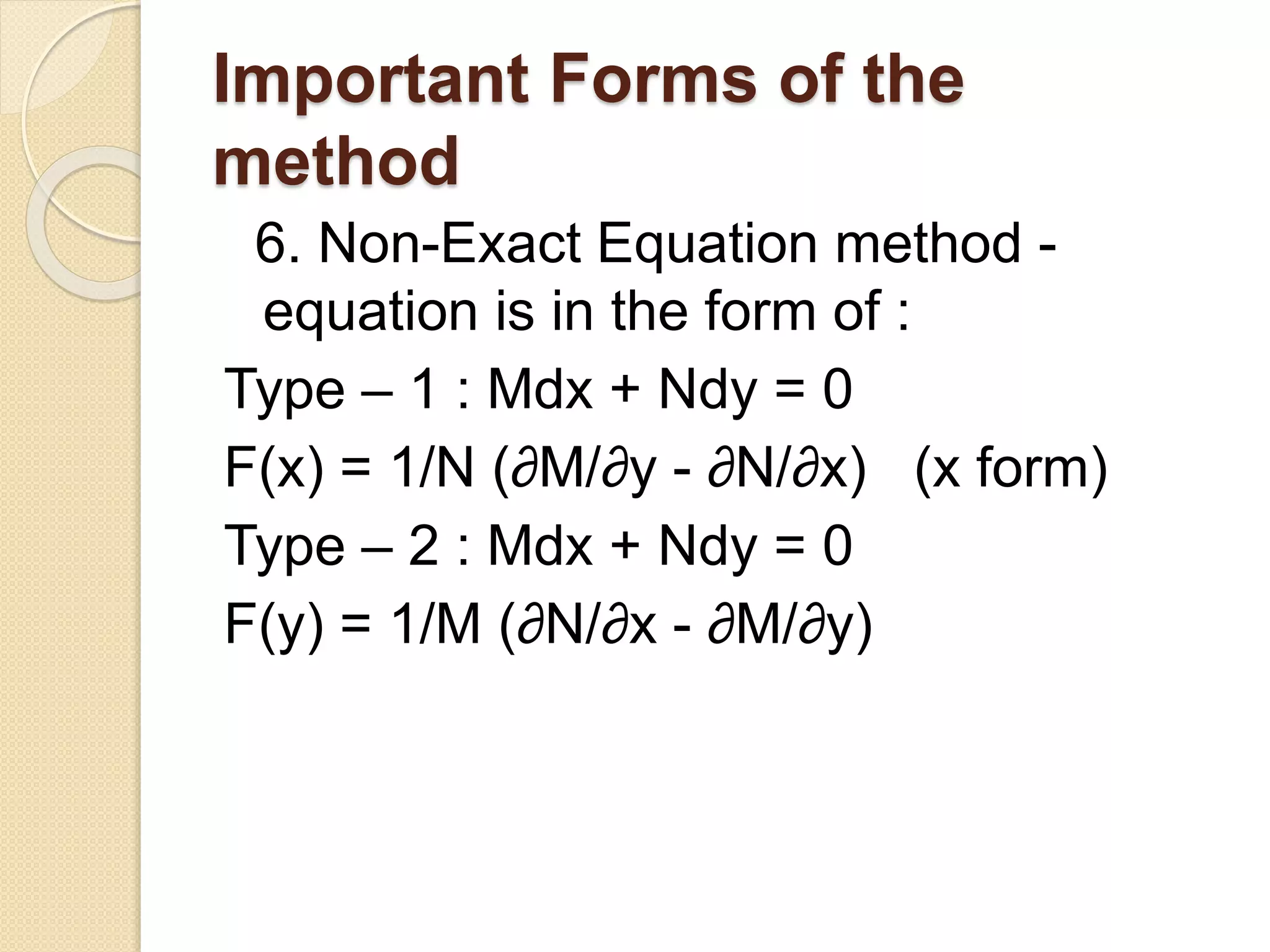
6. Non-Exact Equation method -
equation is in the form of :
Type – 1 : Mdx + Ndy = 0
F(x) = 1/N (∂M/∂y - ∂N/∂x) (x form)
Type – 2 : Mdx + Ndy = 0
F(y) = 1/M (∂N/∂x - ∂M/∂y)
1st Order DE - Homogeneous Equations
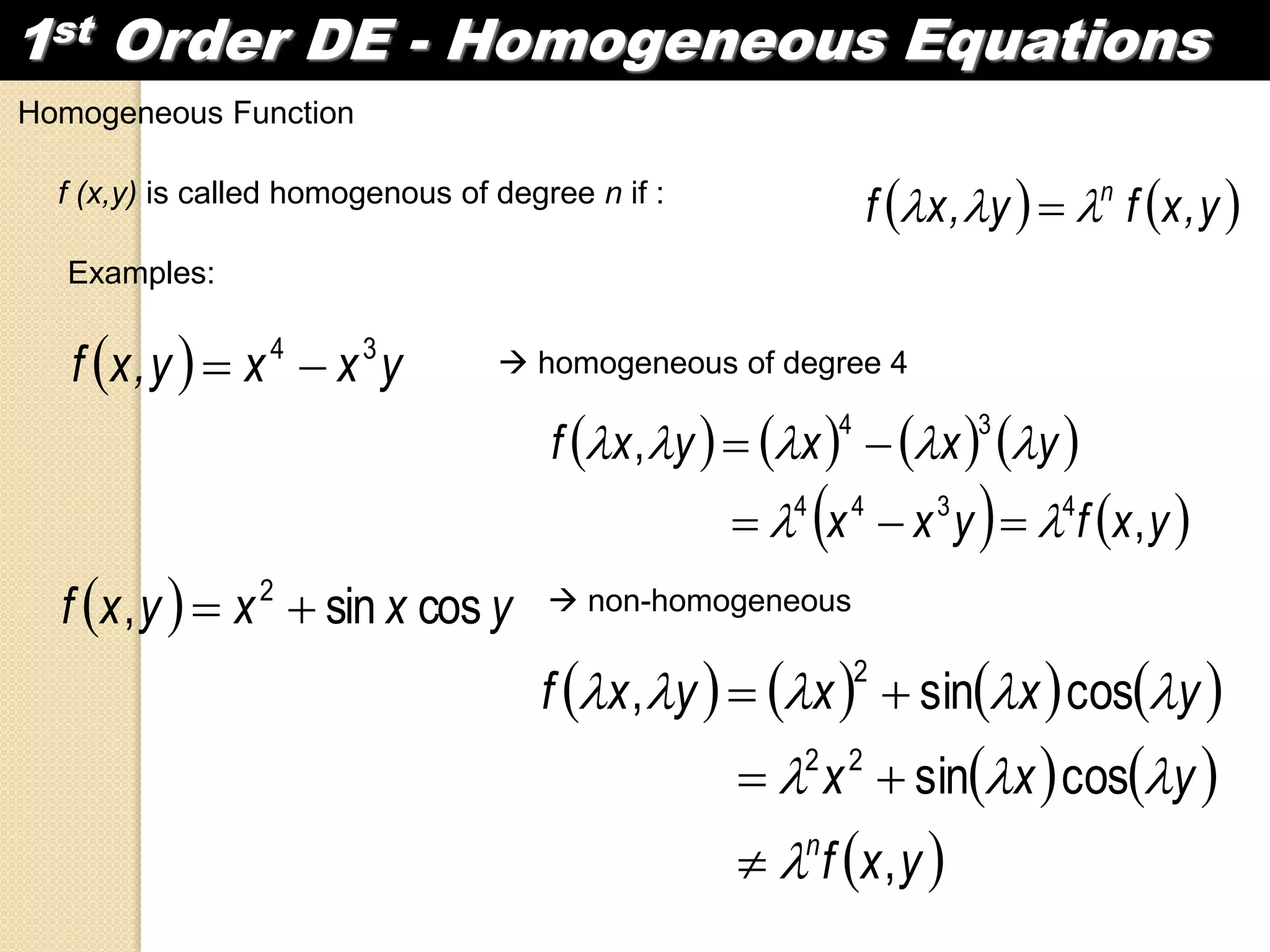
Homogeneous Function
f (x,y) is called homogenous of degree n if :
   y,xfy,xf n
 
Examples:
  yxxy,xf 34
  homogeneous of degree 4
       
   yxfyxx
yxxyxf
,
,
4344
34




  yxxyxf cossin, 2
  non-homogeneous
       
   
 yxf
yxx
yxxyxf
n
,
cossin
cossin,
22
2






1st Order DE - Homogeneous Equations
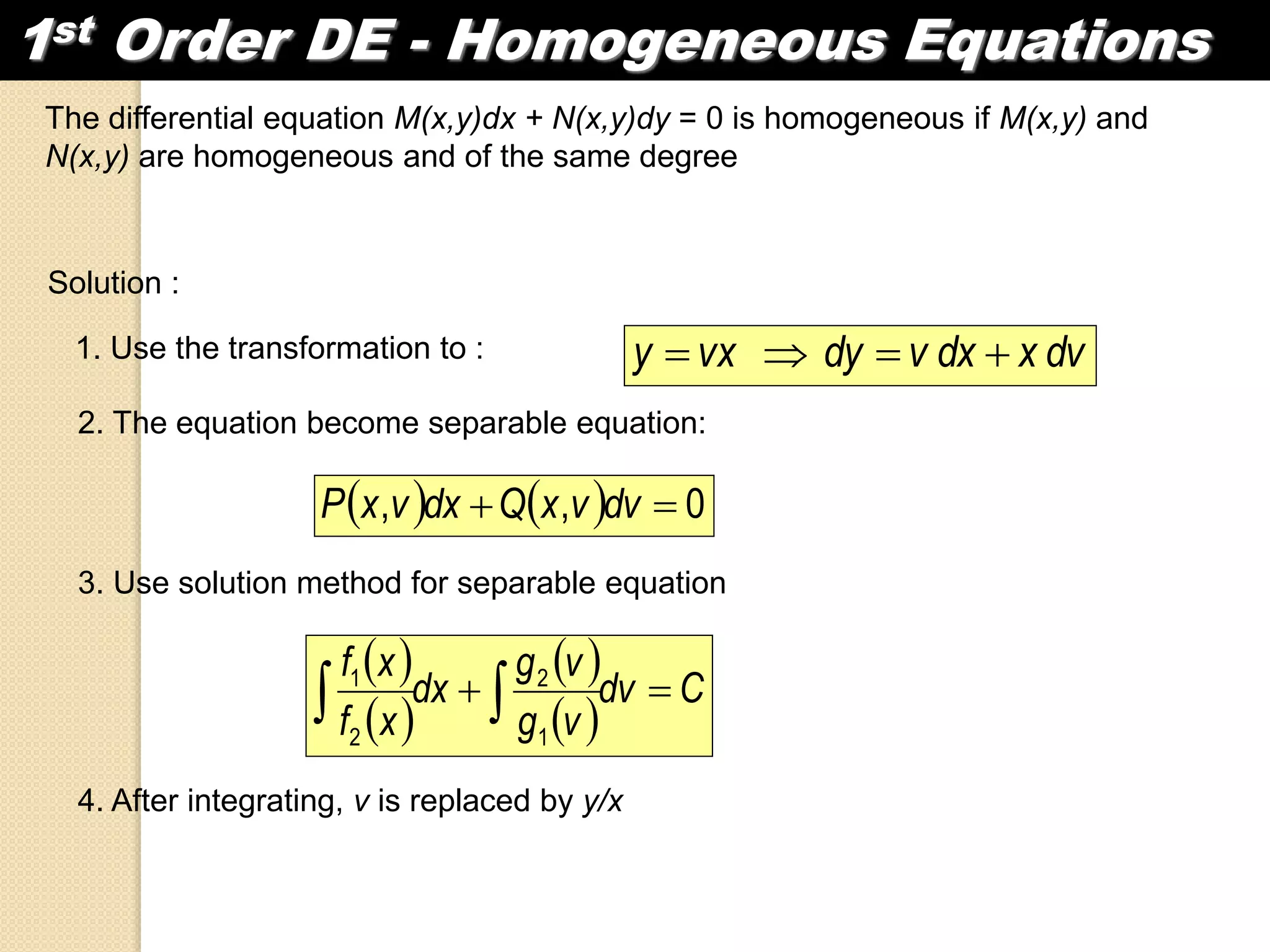
The differential equation M(x,y)dx + N(x,y)dy = 0 is homogeneous if M(x,y) and
N(x,y) are homogeneous and of the same degree
Solution :
1. Use the transformation to : dvxdxvdyvxy 
2. The equation become separable equation:
    0,,  dvvxQdxvxP
3. Use solution method for separable equation
 
 
 
 
Cdv
vg
vg
dx
xf
xf
  1
2
2
1
4. After integrating, v is replaced by y/x
Variable – separable example
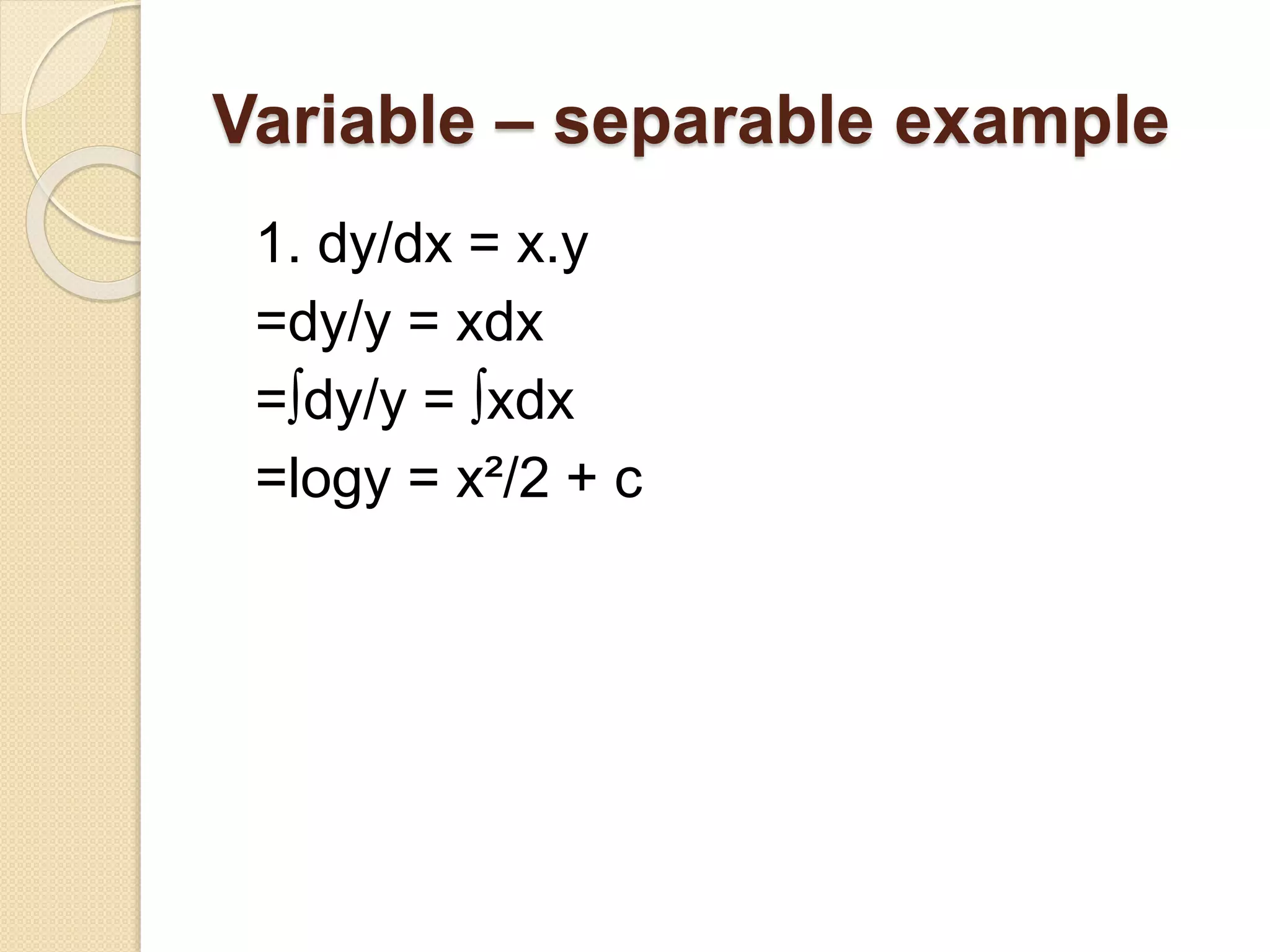
1. dy/dx = x.y
=dy/y = xdx
=∫dy/y = ∫xdx
=logy = x²/2 + c
Exact Equation Example
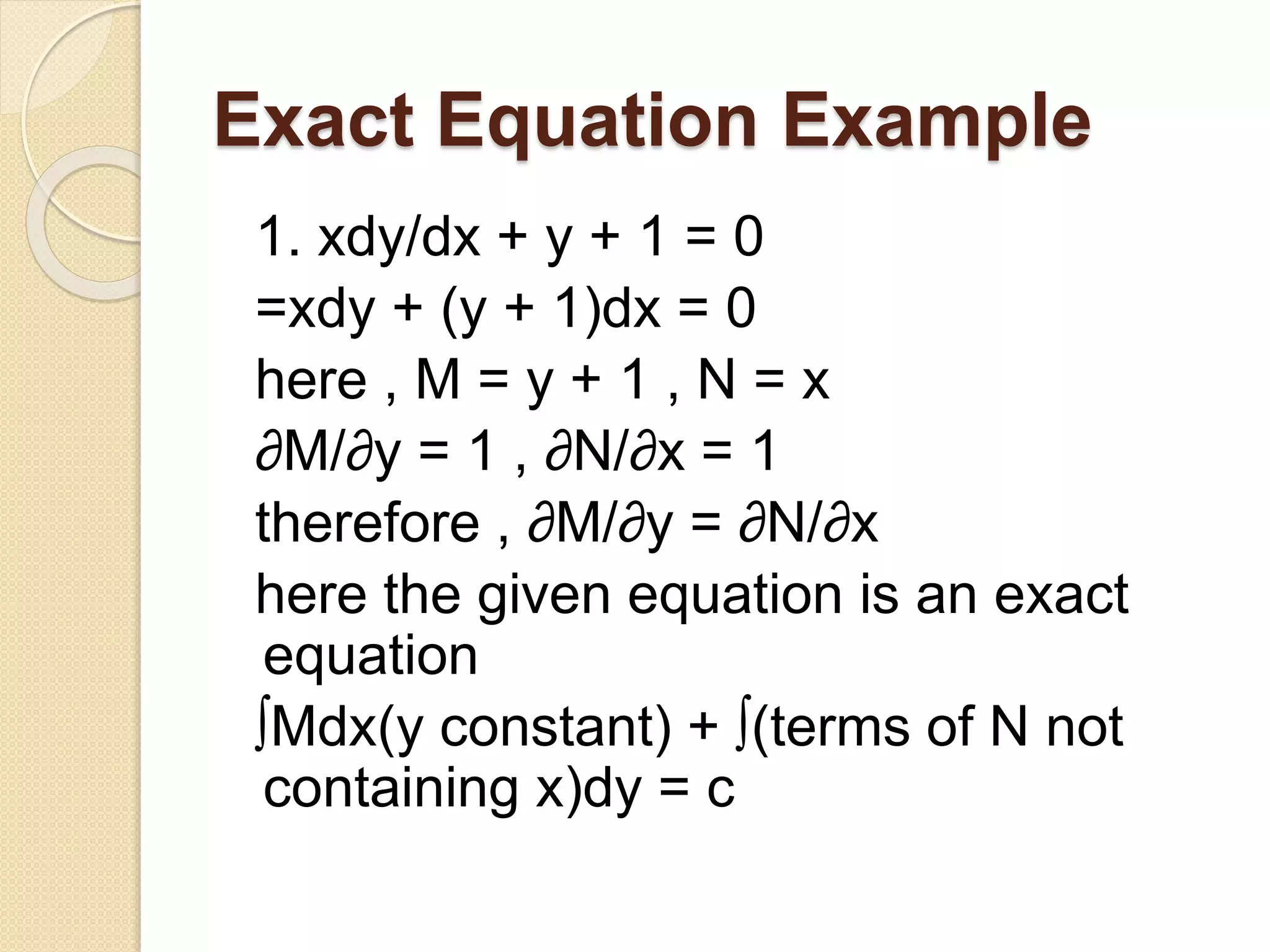
1. xdy/dx + y + 1 = 0
=xdy + (y + 1)dx = 0
here , M = y + 1 , N = x
∂M/∂y = 1 , ∂N/∂x = 1
therefore , ∂M/∂y = ∂N/∂x
here the given equation is an exact
equation
∫Mdx(y constant) + ∫(terms of N not
containing x)dy = c
Exact Equation Example
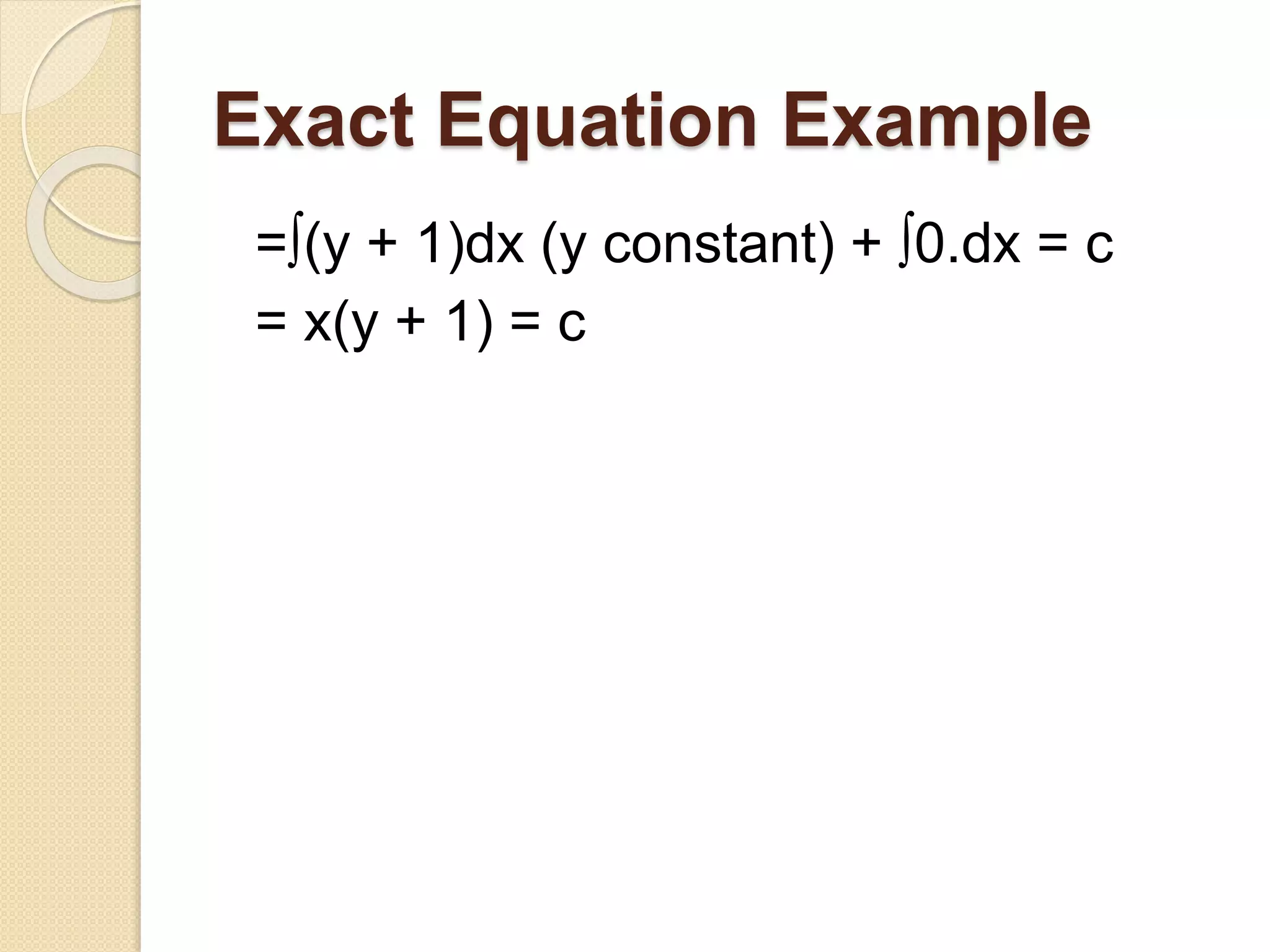
=∫(y + 1)dx (y constant) + ∫0.dx = c
= x(y + 1) = c

Differential equations of first order

  • 1.
    What is Differentialequation?  If y is a function of x, then we denote it as y = f(x). Here x is called an independent variable and y is called a dependent variable.  If there is a equation dy/dx = g(x) ,then this equation contains the variable x and derivative of y w.r.t x. This type of an equation is known as a Differential Equation.
  • 2.
    Order of DifferentialEquation  Order of the highest order derivative of the dependent variable with respect to the independent variable occurring in a given differential equation is called the order of differential equation.  E.g. – 1st order equation  2nd order equation
  • 3.
    Degree of DifferentialEquation  When a differential equation is in a polynomial form in derivatives, the highest power of the highest order derivative occuring in the differential equation is called the degree of the differential equation.  E.g. – Degree – 1 ,(d²y/dx) + dy/dx = 0 Degree – 2 , (d²y/dx)² + dy/dx = 0
  • 4.
    Solution of differential equationsof the first order and first degree  Differential equations of 1st order can be solved by many methods ,some of the methods are as follows :- 1. Variable Separable Method 2. Exact equation method 3. Homogenous equation method 4. Linear equation method
  • 5.
    Solution of differential equationsof the first order and first degree 5. Non-Linear Equation method (Bernoulli's equation) 6. Non-Exact Equation method
  • 6.
    ( , )yf x y 
  • 7.
    Important Forms ofthe method  Here are some important forms of the method through which we can know the form of equation and then use or apply the method which is required :- 1. Variable Separable method – Equation is in the form of : dy/dx = M(x)/N(y) or dy/dx = M(x)N(y)
  • 8.
    Important Forms ofthe method 2. Exact equation method – equation is in the form of : Mdx + Ndy = 0 --- 1 If , ∂M/∂y = ∂N/∂x Then the above equation 1 is Exact equation 3. Homogenous equation method - equation is in the form of : dy/dx = x²y + x³y + xy²/x³ - y³ (Example)
  • 9.
    Important Forms ofthe method 4. Linear equation method - equation is in the form of : Form -1 : dy/dx + Py = Q (x form) Form - 2 : dx/dy + Px = Q (y form) 5. Non-Linear Equation method (Bernoulli's equation) - equation is in the form of : Dy/dx – 2ytanx = y²tan²x (Example)
  • 10.
    Important Forms ofthe method 6. Non-Exact Equation method - equation is in the form of : Type – 1 : Mdx + Ndy = 0 F(x) = 1/N (∂M/∂y - ∂N/∂x) (x form) Type – 2 : Mdx + Ndy = 0 F(y) = 1/M (∂N/∂x - ∂M/∂y)
  • 11.
    1st Order DE- Homogeneous Equations Homogeneous Function f (x,y) is called homogenous of degree n if :    y,xfy,xf n   Examples:   yxxy,xf 34   homogeneous of degree 4            yxfyxx yxxyxf , , 4344 34       yxxyxf cossin, 2   non-homogeneous              yxf yxx yxxyxf n , cossin cossin, 22 2      
  • 12.
    1st Order DE- Homogeneous Equations The differential equation M(x,y)dx + N(x,y)dy = 0 is homogeneous if M(x,y) and N(x,y) are homogeneous and of the same degree Solution : 1. Use the transformation to : dvxdxvdyvxy  2. The equation become separable equation:     0,,  dvvxQdxvxP 3. Use solution method for separable equation         Cdv vg vg dx xf xf   1 2 2 1 4. After integrating, v is replaced by y/x
  • 13.
    Variable – separableexample 1. dy/dx = x.y =dy/y = xdx =∫dy/y = ∫xdx =logy = x²/2 + c
  • 14.
    Exact Equation Example 1.xdy/dx + y + 1 = 0 =xdy + (y + 1)dx = 0 here , M = y + 1 , N = x ∂M/∂y = 1 , ∂N/∂x = 1 therefore , ∂M/∂y = ∂N/∂x here the given equation is an exact equation ∫Mdx(y constant) + ∫(terms of N not containing x)dy = c
  • 15.
    Exact Equation Example =∫(y+ 1)dx (y constant) + ∫0.dx = c = x(y + 1) = c