RIGID ENDOSCOPIC EVALUATION OF
CONVENTIONAL CURETTAGE
ADENOIDECTOMY
D REGMI, N N MATHUR, M BHATTARAI
Dept.of otolaryngology & head and neck
surgery.
B P Koirala Institute of Health Sciences,
Dharan, Nepal.
Introduction By: Dr.Roohia
Disscussion By: Dr. Krishna
Sumanth
INTRODUCTION




Adenoidectomy is a most common surgical
procedure perfomed in childrens.
Conventional curettage commonly used
technique in adenoidectomy.
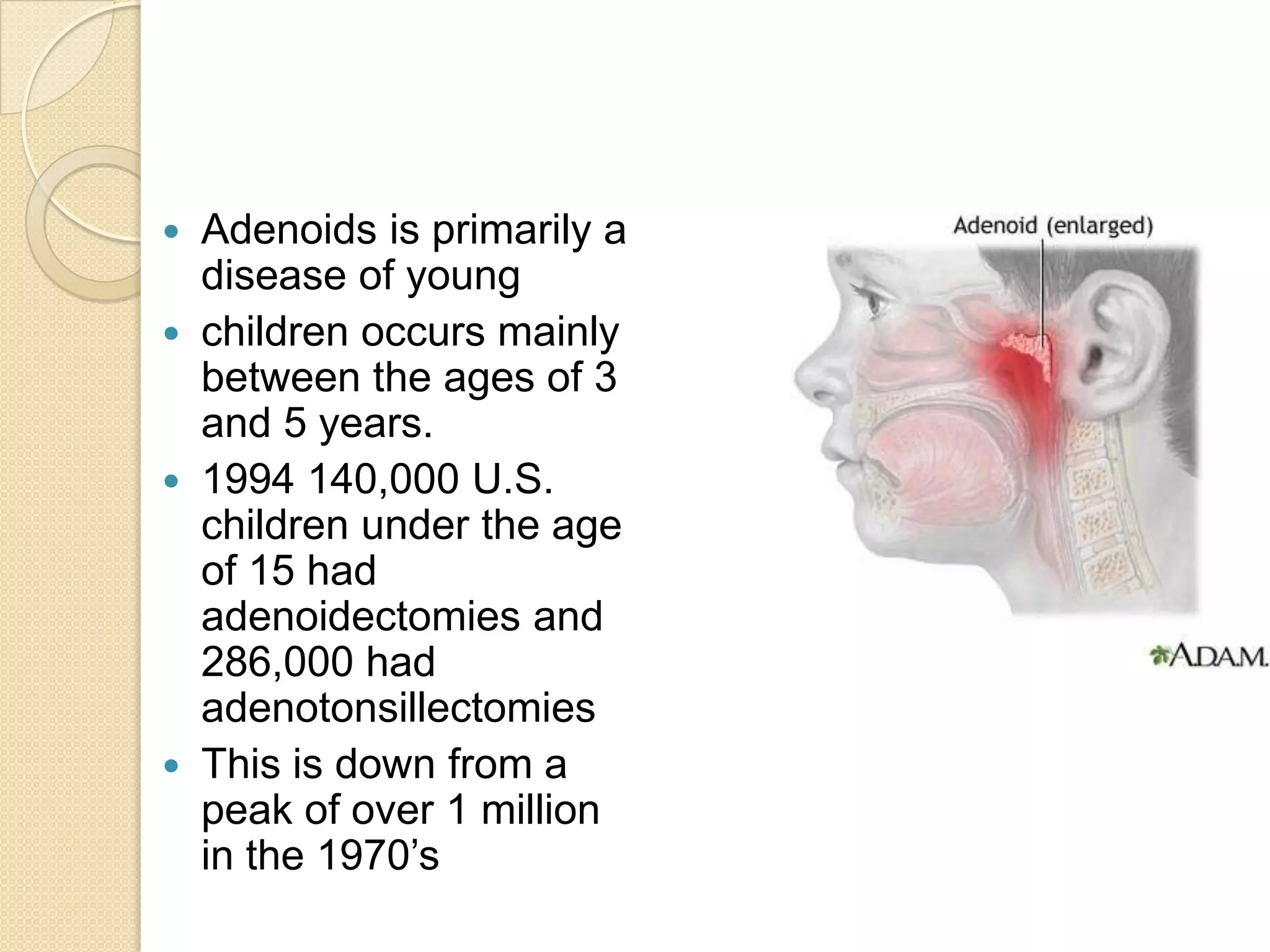
Adenoids is primarily a
disease of young
 children occurs mainly
between the ages of 3
and 5 years.
 1994 140,000 U.S.
children under the age
of 15 had
adenoidectomies and
286,000 had
adenotonsillectomies
 This is down from a
peak of over 1 million
in the 1970’s

HISTORY










1867 Wilhelm Meyer reports removal of
“adenoid vegetations” through the nose with a
ring knife.
In 1885, Gottstein described the first adenoid
curette
Pearl & Manoukian had reportedly removed
adenoids viewing it indirectly with a laryngeal
mirror.
Canon popularized the use of rigid endoscopy in
visualising and removal of adenoid remanants
after blind currett.
Wan et al have introduced the transoral
adenoidectomy under endoscopic guidance.
In 1992, Becker et al, reported the use of
endoscopy assisted adenoidectomy.
NASOPHARYNGEAL TONSIL


Adenoids is the
hypertrophied
mass of lymphoid
tissue situated at
the junction of roof
& post. wall of
nasopharynx.
 The mass of
lymphoid tissue is
termed as
Adenoids only
when it is
hypertrophied.
Adenoids










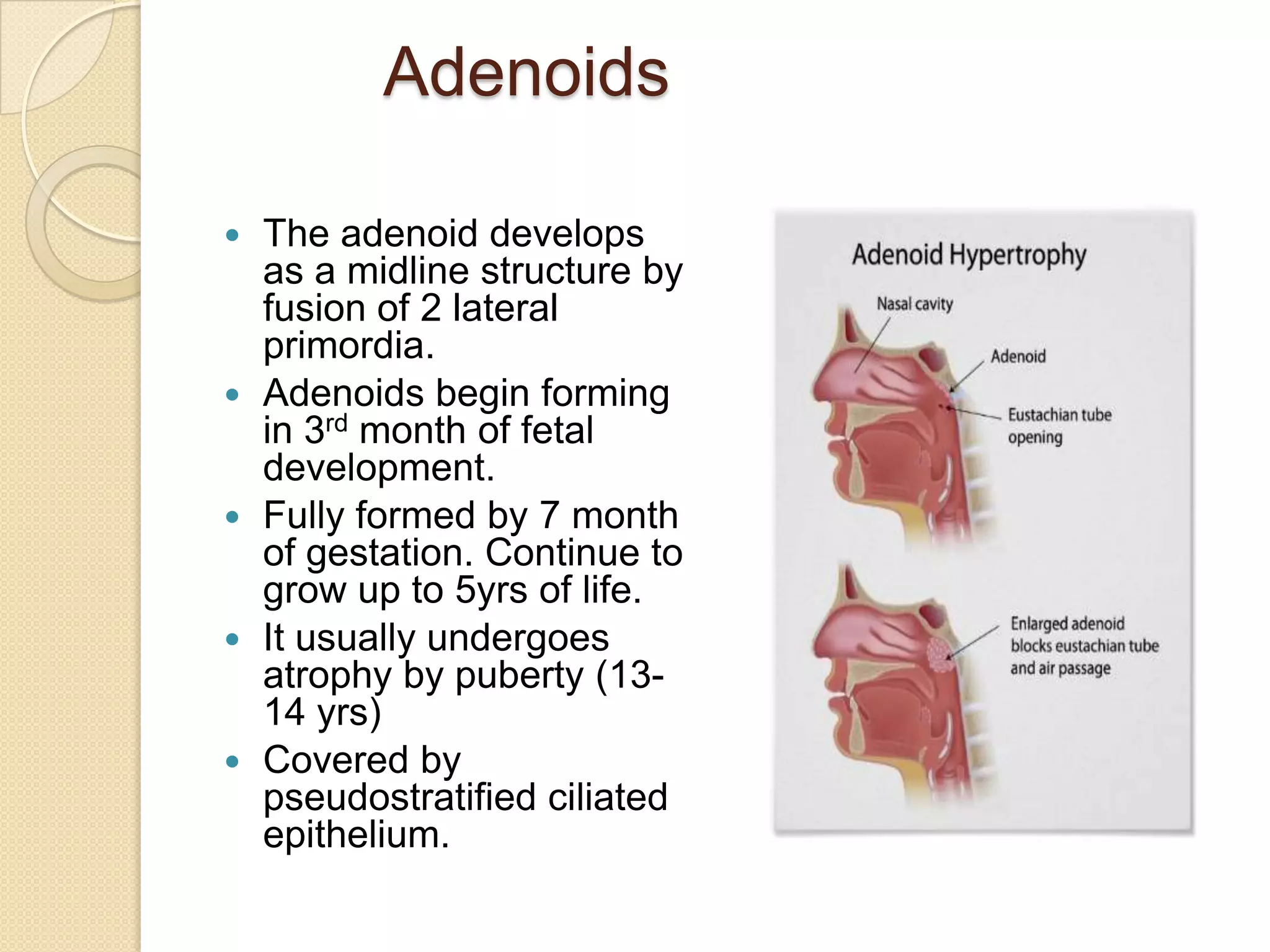
The adenoid develops
as a midline structure by
fusion of 2 lateral
primordia.
Adenoids begin forming
in 3rd month of fetal
development.
Fully formed by 7 month
of gestation. Continue to
grow up to 5yrs of life.
It usually undergoes
atrophy by puberty (1314 yrs)
Covered by
pseudostratified ciliated
epithelium.
Adenoids is a nasopharyngeal
lymphoid tissue is a part of the
Waldeyer’s ring which includes:






Palatine tonsil.
Adenoids.
Lingual tonsils.
Tubal tonsils.
Lateral
pharyngeal bands









Extend to the fossa of
Rosenmuller and to the
eustachian tube orifice
as Gerlach’s tonsil.
truncated pyramid.
Base- at junc of roof &
post. Wall of
nasopharynx.
Apex- towards septum
No crypts & capsule.
Vertical folds extends
forwars & laterally from
midian blind
recess(pharyngeal
bursa/bursa of luschka)
BLOOD SUPPLY











1. Ascending pharyngeal artery
2. Ascending palatine artery
3. Pharyngeal branch of internal
maxillary artery
4. Artery of pterygoid canal
5. Contributions from tonsillar
branch of facial artery
6. basishpenoid artery
Venous drainage from the adenoid
is through the pharyngeal plexus
which in turn drain into the internal
jugular vein.
Nerve supply: pharyngeal plexus.
Lymphatics: in to retropharyngeal
&pharyngo maxillary space L.nodes.
Upper deep jugular
nodes, Parapharyngeal nodes. there
are no afferents.
Immunology




Exposed to ingested
or inspired antigens
passed through the
epithelial layer
Immunologic
structure is divided
into 4 compartments:
reticular crypt
epithelium, extra
follicular
area, mantle zone of
the lymphoid
follicle, and the
germinal center of
the lymphoid follicle
Membrane cells and
antigen presenting
cells are involved in
transport of antigen
from the surface to the
lymphoid follicle
 Antigen is presented
to T-helper cells
 T-helper cells induce B
cells in germinal
center to produce
antibody
 Secretory IgA is
primary antibody
produced
 Involved in local
immunity

pathophysiology













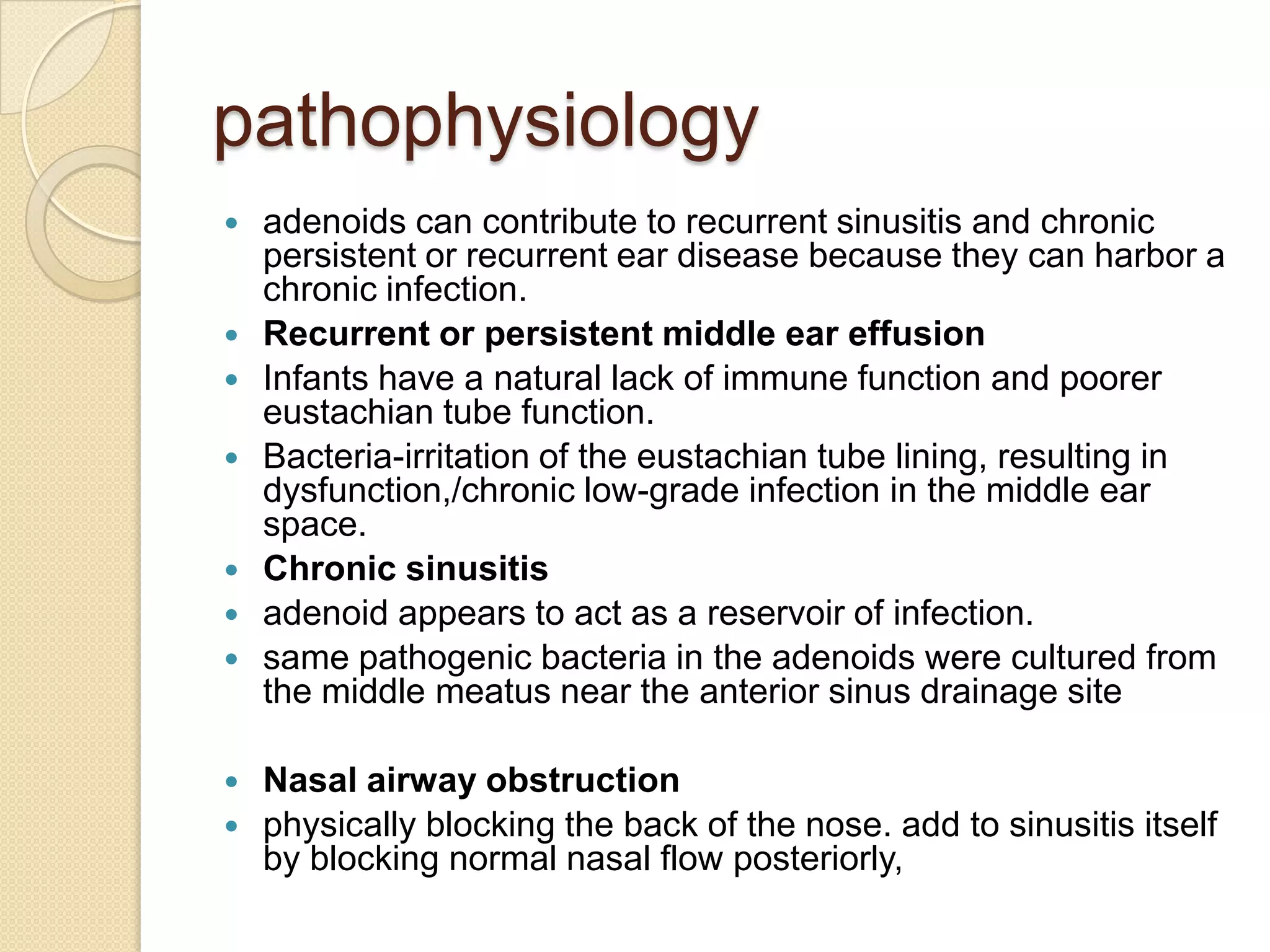
adenoids can contribute to recurrent sinusitis and chronic
persistent or recurrent ear disease because they can harbor a
chronic infection.
Recurrent or persistent middle ear effusion
Infants have a natural lack of immune function and poorer
eustachian tube function.
Bacteria-irritation of the eustachian tube lining, resulting in
dysfunction,/chronic low-grade infection in the middle ear
space.
Chronic sinusitis
adenoid appears to act as a reservoir of infection.
same pathogenic bacteria in the adenoids were cultured from
the middle meatus near the anterior sinus drainage site
Nasal airway obstruction
physically blocking the back of the nose. add to sinusitis itself
by blocking normal nasal flow posteriorly,
Predisposing factors:
A) General:
 1) Environmental pollution.
 2) Allergy.
 3) Bad Hygiene
 4) Poor general health


B) Local:
 1) Recurrent upper respiratory
infections.
 2) Chronic tonsillitis.

Clinical picture
A) Nasal obstruction,
 1) Mouth breathing.
 2) Snoring.
 3) Difficulty of suckling and
eating.
 4) Nasal tone of the voice

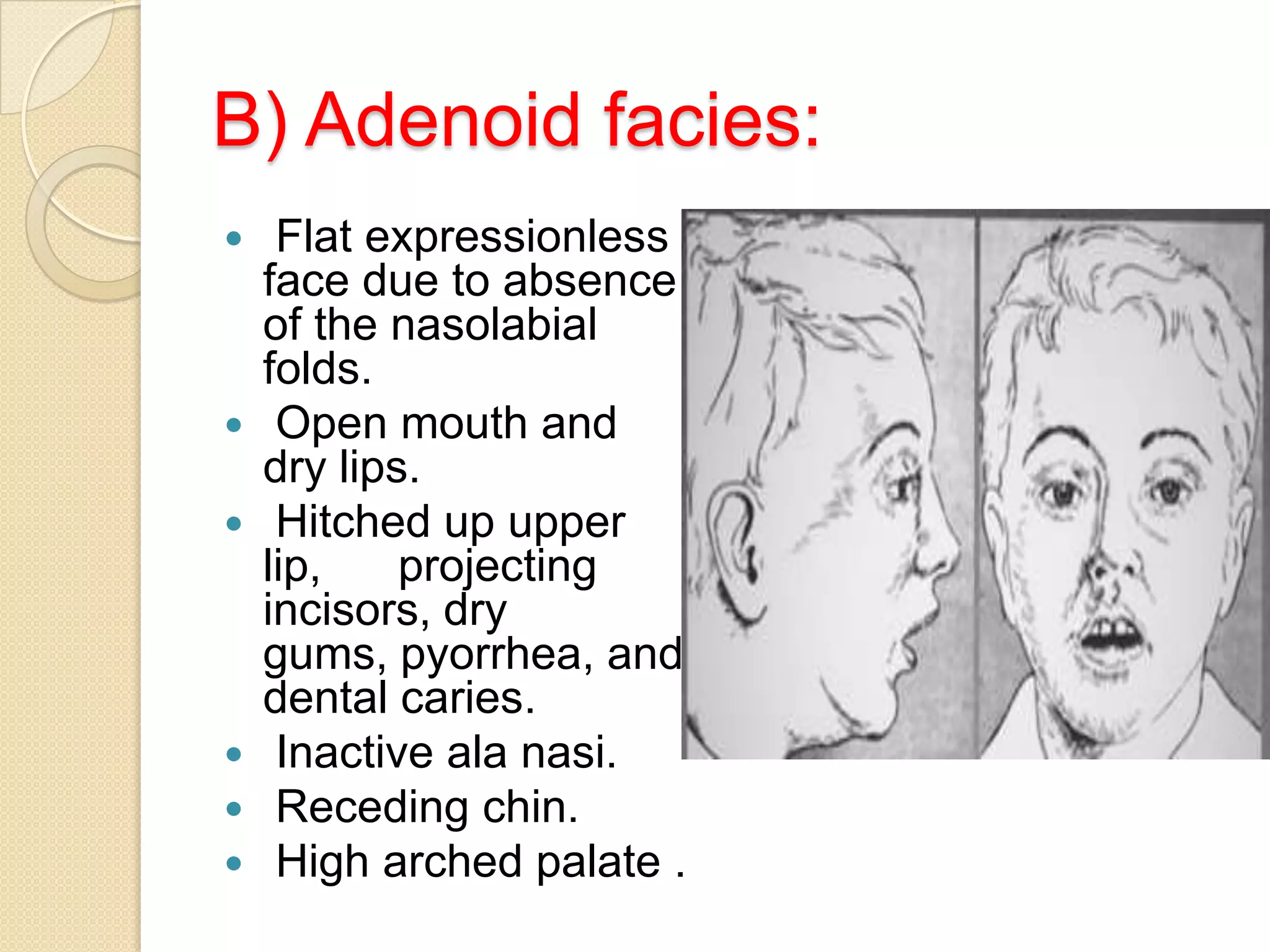
B) Adenoid facies:









Flat expressionless
face due to absence
of the nasolabial
folds.
Open mouth and
dry lips.
Hitched up upper
lip,
projecting
incisors, dry
gums, pyorrhea, and
dental caries.
Inactive ala nasi.
Receding chin.
High arched palate .
C) Mucopurulent anterior and
posterior nasal discharge.
D) Sleep disturbances:
1) Snoring.
2) Sleep apnea .
3) Nocturnal enuresis due to
hypercapnia.
E) Respiratory manifestations:
1) Irritant cough
2) Recurrent pharyngitis, laryngitis, and
chest infections.
F) Recurrent ear aches and deafness due
to
obstruction of the eustachian tubes
causing recurrent
otitis media and middle ear effusions
G) Symptoms of throat : due to recurrent
pharyngitis,tonsillitis, mouth breathing
recurrent sore throat,dysphagia,voice
change,poor eaters, ,malnutrition.
.
H) Decreased mental performance due
to
sleep disturbances, hypoxia, defective
hearing, and
recurrent respiratory infections causing
long periods of absences from school.
I) Feeding problems: loss of
appetite, indigestion,
and vomiting due to swallowed
secretions.
J) Skeletal changes :including pigeon
chest,
Harrison’s sulci, and depressed
xiphisternum.
Diagnosis









Clinical picture.
Investigations may
be done:
Posterior
rhinoscopy
Digital palpation
Endoscopic exam
Lateral x-ray of the
Nasopharynx.
CT
MRI
ENDOSCOPY
RIGID

ENDOSCOPY

FLEXIBLE ENDOSCOPY
Types of rigid endoscopes


Adults: 4mm



Children: 2.7mm



Viewing angles: 0
degree,30,45,70,90,120



Length: 10 cm,17 cm,24 cm
Grading
Clemens &mcmurray
 GRADE I- adenoid tissue filling 1/3rd
the
vertical
ht of choana
 GRADE II-upto 2/3rd
 GRADE III- from 2/3rd to nearly all but
not completely filling of choana
 GRADE IV-with complete choanal
obstruction
Modified josephson et al
 Airway , Choana, Eustachian tube
A0- no adenoids
C0- no
obstruction
A1-25% airway block C1-50%
A2-26-50%
C2-100%
A3-51-75%
A4-75-100%
E0-no ET block
E1-ET block
Differential diagnosis
Choanal atresia
 Chr.hypertrophic rhinitis,septal
deviation,nasal polyposis
 Juvenile angiofibroma
 Thornwald’s cyst,malignant
lymphoma,chordoma,lyphoepithelial
carcinoma

Complications
1. Middle ear effusions and otitis
media.
 2. Recurrent respiratory infections.
 3. Disturbed learning, easy fatigue,
and
genaral poor health
 4.older children; increased ventilatory
resistance leads to
 moderate cardiac enlargement
 RVH to Corpulmonale
 pulm.oedema &pco2

MANAGEMENT
Medical: for mild/infrequent symp
Adequate nutrition, Antibiotics, Anti
inflammatory analgesics,Nasal
decongestant drops,steroid sprays like
mometasone.
 These children must undergo a complete
course of medical treatment. (2wks)
 The ideal drug of choice is penicllin
group.
 Ampicillin or Amoxycillin can
be administered in doses ranging 40 - 50
mg /kg body weight.
 Erythromycin & cefalosporins can be
Surgical


Adenoidectomy



Current clinical indicators from AAOHNS:
◦ 4 or more episodes of recurrent purulent
rhinorrhea in prior 12 months in a child <12. One
episode documented by intranasal examination
or diagnostic imaging.
◦ Persisting symptoms of adenoiditis after 2
courses of antibiotic therapy. One course of
antibiotics should be with a beta-lactamase
stable antibiotic for at least 2 weeks.
◦ Sleep disturbance with nasal airway obstruction
persisting for at least 3 months
◦ Hyponasal or hypernasal speech
◦ Otitis media with effusion >3 months or second
set of tubes
◦ Dental malocclusion or orofacial growth
disturbance documented by orthodontist
◦ Cardiopulmonary complications including cor
pulmonale, pulmonary hypertension, right
ventricular hypertrophy associated with upper
airway obstruction
◦ Otitis media with effusion over age 4
Contraindications:
 Age <3yrs.
 Bleeding disorders.
 Acute infections.
 Epidemics of polio.
 Cleft palate, short palate
 Velopharyngeal insufficiency.
Types of adenoidectomy


Conventional curettage:
Nasal endoscopic
adenoidectomy
Oral endoscopic
adenoidectomy
Micro debrider


Micro debrider



Micro debrider-tip
blade
Microdebrider adenoidectomy
Mirror asissted microdebrider
adenoidectomy
Coblation adenoidectomy
The Nd: YAG laser :has additionally been
accustomed to take away the adenoids.
However, this method is responsible for
scarring of tissue and it is generally avoided.
 Adenoid punch device: An adenoid punch is
really a curved device having a chamber
that's placed within the adenoids. The
chamber includes a knife blade sliding-door
to section from the adenoids which are then
housed within the chamber and removed
using the instrument.

BOVIE SUCTION
COAGULATOR
POST OP CARE
1. Immediate general care
(a) Keep the patient in coma position until fully
recovered from anaesthesia.
(b) Keep a watch on bleeding from the nose and
mouth.
(c) Keep check on vital signs, e.g.
pulse, respiration and blood pressure.

2. Diet
When patient is fully recovered he is to take
liquids, e.g. cold milk or ice cream.
3. Nasal saline drops
4. Analgesics
Pain, locally in the throat and referred
to ear, can be relieved by analgesics like
paracetamol. There is no dysphagia and
patient is up and about early.
5. Antibiotics A suitable antibiotic can
be giv en orally or by injection for a
week.
Patient is usually sent home 24 hours
after operation unless there is some
complication. Patient can resume his
normal duties within 2 weeks
POST OP COMPLICATIONS











1. Haemorrhage, usually seen in immediate postoperative period.
2. Injury to eustachian tube opening.
3. Injury to pharyngeal musculature and vertebrae. Care
should be taken when operating patients of Down's
syndrome as 10-20% of them have atlanto-axial
instability.
4. Griesel syndrome. Patient complains of neck pain
and develops torticollis. Mostly it is due to spasm of
paraspinal muscles, but can be due to atlanto-axial
dislocation requiring cervical collar and even traction.
5. Velopharyngeal insufficiency.
6. Nasopharyngeal stenosis due to scarring.
7. Recurrence. This is due to regrowth of adenoid tissue
left behind
THANK YOU

ADENOIDS&ADENOIDECTOMY BY ROOHIA

  • 1.
    RIGID ENDOSCOPIC EVALUATIONOF CONVENTIONAL CURETTAGE ADENOIDECTOMY D REGMI, N N MATHUR, M BHATTARAI Dept.of otolaryngology & head and neck surgery. B P Koirala Institute of Health Sciences, Dharan, Nepal. Introduction By: Dr.Roohia Disscussion By: Dr. Krishna Sumanth
  • 2.
    INTRODUCTION   Adenoidectomy is amost common surgical procedure perfomed in childrens. Conventional curettage commonly used technique in adenoidectomy.
  • 3.
    Adenoids is primarilya disease of young  children occurs mainly between the ages of 3 and 5 years.  1994 140,000 U.S. children under the age of 15 had adenoidectomies and 286,000 had adenotonsillectomies  This is down from a peak of over 1 million in the 1970’s 
  • 4.
    HISTORY       1867 Wilhelm Meyerreports removal of “adenoid vegetations” through the nose with a ring knife. In 1885, Gottstein described the first adenoid curette Pearl & Manoukian had reportedly removed adenoids viewing it indirectly with a laryngeal mirror. Canon popularized the use of rigid endoscopy in visualising and removal of adenoid remanants after blind currett. Wan et al have introduced the transoral adenoidectomy under endoscopic guidance. In 1992, Becker et al, reported the use of endoscopy assisted adenoidectomy.
  • 5.
    NASOPHARYNGEAL TONSIL  Adenoids isthe hypertrophied mass of lymphoid tissue situated at the junction of roof & post. wall of nasopharynx.  The mass of lymphoid tissue is termed as Adenoids only when it is hypertrophied.
  • 6.
    Adenoids      The adenoid develops asa midline structure by fusion of 2 lateral primordia. Adenoids begin forming in 3rd month of fetal development. Fully formed by 7 month of gestation. Continue to grow up to 5yrs of life. It usually undergoes atrophy by puberty (1314 yrs) Covered by pseudostratified ciliated epithelium.
  • 7.
    Adenoids is anasopharyngeal lymphoid tissue is a part of the Waldeyer’s ring which includes:      Palatine tonsil. Adenoids. Lingual tonsils. Tubal tonsils. Lateral pharyngeal bands
  • 8.
          Extend to thefossa of Rosenmuller and to the eustachian tube orifice as Gerlach’s tonsil. truncated pyramid. Base- at junc of roof & post. Wall of nasopharynx. Apex- towards septum No crypts & capsule. Vertical folds extends forwars & laterally from midian blind recess(pharyngeal bursa/bursa of luschka)
  • 9.
    BLOOD SUPPLY          1. Ascendingpharyngeal artery 2. Ascending palatine artery 3. Pharyngeal branch of internal maxillary artery 4. Artery of pterygoid canal 5. Contributions from tonsillar branch of facial artery 6. basishpenoid artery Venous drainage from the adenoid is through the pharyngeal plexus which in turn drain into the internal jugular vein. Nerve supply: pharyngeal plexus. Lymphatics: in to retropharyngeal &pharyngo maxillary space L.nodes. Upper deep jugular nodes, Parapharyngeal nodes. there are no afferents.
  • 10.
    Immunology   Exposed to ingested orinspired antigens passed through the epithelial layer Immunologic structure is divided into 4 compartments: reticular crypt epithelium, extra follicular area, mantle zone of the lymphoid follicle, and the germinal center of the lymphoid follicle
  • 11.
    Membrane cells and antigenpresenting cells are involved in transport of antigen from the surface to the lymphoid follicle  Antigen is presented to T-helper cells  T-helper cells induce B cells in germinal center to produce antibody  Secretory IgA is primary antibody produced  Involved in local immunity 
  • 13.
    pathophysiology          adenoids can contributeto recurrent sinusitis and chronic persistent or recurrent ear disease because they can harbor a chronic infection. Recurrent or persistent middle ear effusion Infants have a natural lack of immune function and poorer eustachian tube function. Bacteria-irritation of the eustachian tube lining, resulting in dysfunction,/chronic low-grade infection in the middle ear space. Chronic sinusitis adenoid appears to act as a reservoir of infection. same pathogenic bacteria in the adenoids were cultured from the middle meatus near the anterior sinus drainage site Nasal airway obstruction physically blocking the back of the nose. add to sinusitis itself by blocking normal nasal flow posteriorly,
  • 14.
    Predisposing factors: A) General: 1) Environmental pollution.  2) Allergy.  3) Bad Hygiene  4) Poor general health  B) Local:  1) Recurrent upper respiratory infections.  2) Chronic tonsillitis. 
  • 15.
    Clinical picture A) Nasalobstruction,  1) Mouth breathing.  2) Snoring.  3) Difficulty of suckling and eating.  4) Nasal tone of the voice 
  • 16.
    B) Adenoid facies:       Flatexpressionless face due to absence of the nasolabial folds. Open mouth and dry lips. Hitched up upper lip, projecting incisors, dry gums, pyorrhea, and dental caries. Inactive ala nasi. Receding chin. High arched palate .
  • 17.
    C) Mucopurulent anteriorand posterior nasal discharge. D) Sleep disturbances: 1) Snoring. 2) Sleep apnea . 3) Nocturnal enuresis due to hypercapnia.
  • 18.
    E) Respiratory manifestations: 1)Irritant cough 2) Recurrent pharyngitis, laryngitis, and chest infections. F) Recurrent ear aches and deafness due to obstruction of the eustachian tubes causing recurrent otitis media and middle ear effusions G) Symptoms of throat : due to recurrent pharyngitis,tonsillitis, mouth breathing recurrent sore throat,dysphagia,voice change,poor eaters, ,malnutrition. .
  • 19.
    H) Decreased mentalperformance due to sleep disturbances, hypoxia, defective hearing, and recurrent respiratory infections causing long periods of absences from school. I) Feeding problems: loss of appetite, indigestion, and vomiting due to swallowed secretions. J) Skeletal changes :including pigeon chest, Harrison’s sulci, and depressed xiphisternum.
  • 20.
    Diagnosis         Clinical picture. Investigations may bedone: Posterior rhinoscopy Digital palpation Endoscopic exam Lateral x-ray of the Nasopharynx. CT MRI
  • 21.
  • 22.
    Types of rigidendoscopes  Adults: 4mm  Children: 2.7mm  Viewing angles: 0 degree,30,45,70,90,120  Length: 10 cm,17 cm,24 cm
  • 24.
    Grading Clemens &mcmurray  GRADEI- adenoid tissue filling 1/3rd the vertical ht of choana  GRADE II-upto 2/3rd  GRADE III- from 2/3rd to nearly all but not completely filling of choana  GRADE IV-with complete choanal obstruction
  • 25.
    Modified josephson etal  Airway , Choana, Eustachian tube A0- no adenoids C0- no obstruction A1-25% airway block C1-50% A2-26-50% C2-100% A3-51-75% A4-75-100% E0-no ET block E1-ET block
  • 26.
    Differential diagnosis Choanal atresia Chr.hypertrophic rhinitis,septal deviation,nasal polyposis  Juvenile angiofibroma  Thornwald’s cyst,malignant lymphoma,chordoma,lyphoepithelial carcinoma 
  • 27.
    Complications 1. Middle eareffusions and otitis media.  2. Recurrent respiratory infections.  3. Disturbed learning, easy fatigue, and genaral poor health  4.older children; increased ventilatory resistance leads to  moderate cardiac enlargement  RVH to Corpulmonale  pulm.oedema &pco2 
  • 28.
    MANAGEMENT Medical: for mild/infrequentsymp Adequate nutrition, Antibiotics, Anti inflammatory analgesics,Nasal decongestant drops,steroid sprays like mometasone.  These children must undergo a complete course of medical treatment. (2wks)  The ideal drug of choice is penicllin group.  Ampicillin or Amoxycillin can be administered in doses ranging 40 - 50 mg /kg body weight.  Erythromycin & cefalosporins can be
  • 29.
    Surgical  Adenoidectomy  Current clinical indicatorsfrom AAOHNS: ◦ 4 or more episodes of recurrent purulent rhinorrhea in prior 12 months in a child <12. One episode documented by intranasal examination or diagnostic imaging. ◦ Persisting symptoms of adenoiditis after 2 courses of antibiotic therapy. One course of antibiotics should be with a beta-lactamase stable antibiotic for at least 2 weeks. ◦ Sleep disturbance with nasal airway obstruction persisting for at least 3 months
  • 30.
    ◦ Hyponasal orhypernasal speech ◦ Otitis media with effusion >3 months or second set of tubes ◦ Dental malocclusion or orofacial growth disturbance documented by orthodontist ◦ Cardiopulmonary complications including cor pulmonale, pulmonary hypertension, right ventricular hypertrophy associated with upper airway obstruction ◦ Otitis media with effusion over age 4
  • 31.
    Contraindications:  Age <3yrs. Bleeding disorders.  Acute infections.  Epidemics of polio.  Cleft palate, short palate  Velopharyngeal insufficiency.
  • 32.
  • 33.
  • 34.
  • 35.
  • 36.
  • 37.
  • 38.
  • 40.
    The Nd: YAGlaser :has additionally been accustomed to take away the adenoids. However, this method is responsible for scarring of tissue and it is generally avoided.  Adenoid punch device: An adenoid punch is really a curved device having a chamber that's placed within the adenoids. The chamber includes a knife blade sliding-door to section from the adenoids which are then housed within the chamber and removed using the instrument. 
  • 41.
  • 42.
    POST OP CARE 1.Immediate general care (a) Keep the patient in coma position until fully recovered from anaesthesia. (b) Keep a watch on bleeding from the nose and mouth. (c) Keep check on vital signs, e.g. pulse, respiration and blood pressure. 2. Diet When patient is fully recovered he is to take liquids, e.g. cold milk or ice cream. 3. Nasal saline drops
  • 43.
    4. Analgesics Pain, locallyin the throat and referred to ear, can be relieved by analgesics like paracetamol. There is no dysphagia and patient is up and about early. 5. Antibiotics A suitable antibiotic can be giv en orally or by injection for a week. Patient is usually sent home 24 hours after operation unless there is some complication. Patient can resume his normal duties within 2 weeks
  • 44.
    POST OP COMPLICATIONS        1.Haemorrhage, usually seen in immediate postoperative period. 2. Injury to eustachian tube opening. 3. Injury to pharyngeal musculature and vertebrae. Care should be taken when operating patients of Down's syndrome as 10-20% of them have atlanto-axial instability. 4. Griesel syndrome. Patient complains of neck pain and develops torticollis. Mostly it is due to spasm of paraspinal muscles, but can be due to atlanto-axial dislocation requiring cervical collar and even traction. 5. Velopharyngeal insufficiency. 6. Nasopharyngeal stenosis due to scarring. 7. Recurrence. This is due to regrowth of adenoid tissue left behind
  • 45.