BY
DR.ROOHIA
 Inroduction
 Frequency
 Pathology
 Clinical presentation
 “Craniopharyngioma”
was the name
introduced by Cushing
for tumors derived
“from epithelial rests
ascribable to an
imperfect closure of the
hypophysial or
craniopharyngeal duct.”
 Craniopharyngiomas
are benign tumors that
occur at the base of the
brain, above the
pituitary gland.
 Craniopharyngioma is a slow-growing, extra-
axial, epithelial-squamous, calcified, cystic
tumor. ( WHO grade I)
 arising from remnants of the
craniopharyngeal duct and/or Rathke cleft
and occupying the (supra)sellar region.
 INCIDENCE:
 Annual incidence rate being between 0.5 and 2.5
new cases per million population per year.
Age:
 Bimodal- 5-10yr & 50-60yr
 Adults- 1-3% of intracranial tumors
- 13-15% sellar or supra sellar
 Childrens-56% of sellar or supra sellar tumors.
Sex:
slight male predominance 55%
Race:
Higher in Africa,Far east & Japan(18,16,10.5%)
 The embryogenetic theory
 The embryogenetic theory relates to the
development of the adenohypophysis and
transformation of the remnant ectoblastic cells
of the craniopharyngeal duct and the involuted
Rathke pouch.
 Rathke pouch and the infundibulum develop
during the fourth week of gestation and together
form the hypophysis.
 Rathke cleft, together with remnants of the
craniopharyngeal duct, can be the site of origin of
craniopharyngiomas.
 The metaplastic theory
 The metaplastic theory relates to the residual
squamous epithelium which may undergo
metaplasia.
 The dual theory explains the craniopharyngioma
spectrum
1. adamantinous type (most prevalent in
childhood) to embryonic remnants.
2. adult type (squamous papillary) to metaplastic
foci derived from mature cells of the
anteriorhypophysis.
3. Mixed type – 15%
 Some craniopharyngiomas are monoclonal in
origin, and cytogenetic abnormalities have
been reported in chromosomes 2 and 12.
 Mutations of the β-catenin gene have been
identified in 70% of adamantinomatous
craniopharyngiomas.
 GROSS: smooth lobulated capsule
 Solid- calcified
 Cystic-machine oil
(crankcase oil)
 Epithelial lesion with
peripheral palisading of
basal squamous epithelium
surrounding loosely
arranged epithelial cells, the
so-called "stellate
reticulum" and nodules of
keratin and variable
calcification are typical
histologic features of a
craniopharyngioma.
 These nodules are referred
to as "wet" keratin because
of the plump appearance of
the keratinocytes.
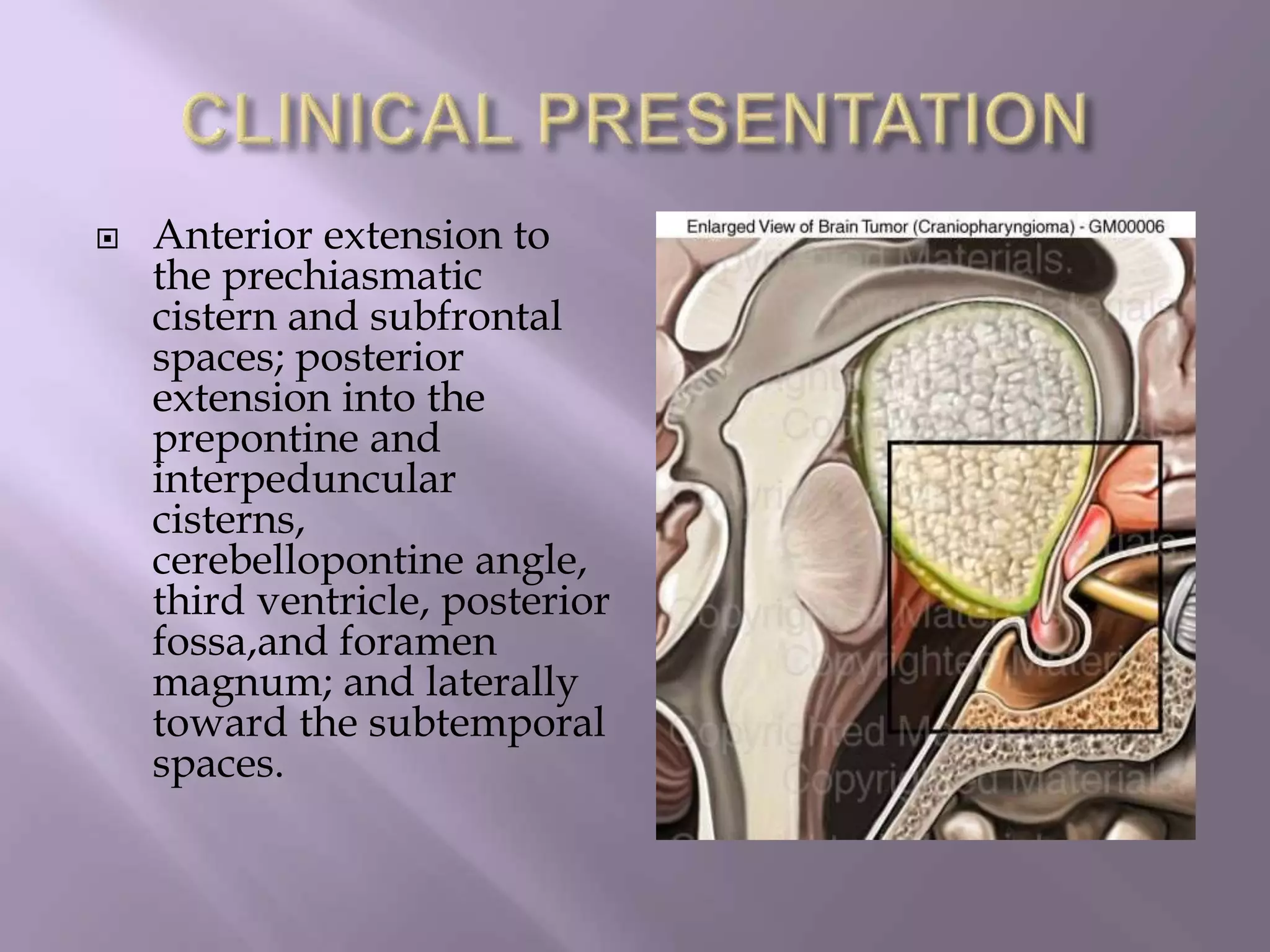
 composed of simple
squamous epithelium
and fibrovascular
islands of connective
tissue.
 The brain
parenchyma that
surrounds both
variants of
craniopharyngioma is
typically gliotic and
often shows profuse
numbers of
eosinophilic
Rosenthal fibers.

Rosenthal fibers in neuropil surrounding
the craniopharyngioma.
Adamantinomatous
craniopharyngiomas
 More common
 Occur at a younger age
 Commonly calcified
 Commonly cystic and filled
with cholesterol-rich fluid or
soft necrotic debris.
 A palisading layer of basaloid
epithelium surrounds
irregularly arranged cells that
resemble the stellate reticulum
of the epidermis. These nests
may be solid but often form a
complex trabecular network of
microcysts. Bands of fibrous
tissue weave between nests of
epithelial cells and around
cyst
 Keratin nodules are commonly
seen.
Papillary craniopharyngiomas
 Less common
 Occur at an older age
 Calcification is less common
 Commonly solid.
 Squamous epithelial nests
that surround loose
fibrovascular tissue rather
than microcysts create a
solid tumor with a
pseudopapillary pattern.
 Keratin nodules are not
seen.
 A1 segment of the anterior cerebral artery.
 proximal portion of the posterior
communicating artery.
 intracavernous meningohypophyseal arteries.
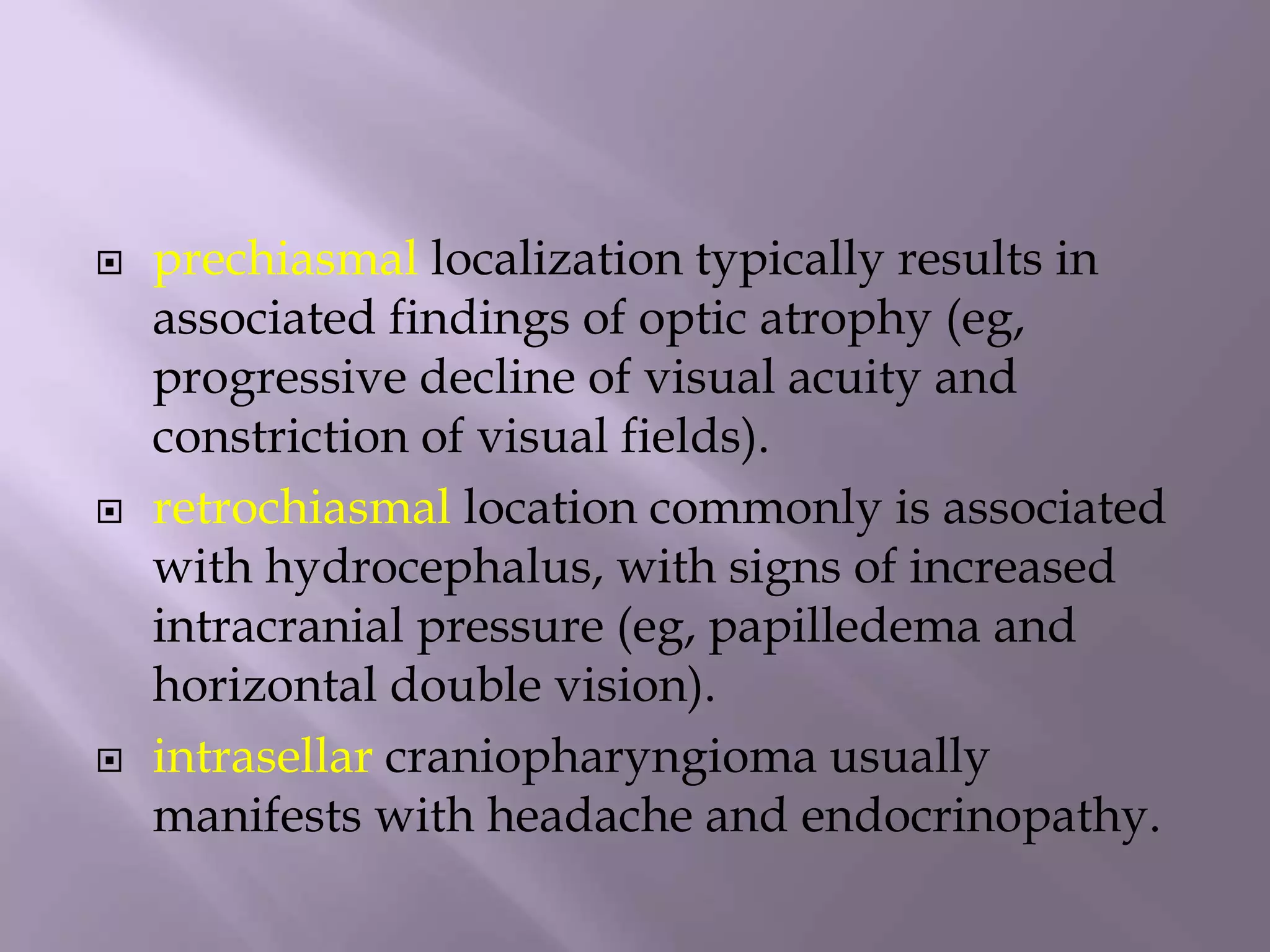
 Anterior extension to
the prechiasmatic
cistern and subfrontal
spaces; posterior
extension into the
prepontine and
interpeduncular
cisterns,
cerebellopontine angle,
third ventricle, posterior
fossa,and foramen
magnum; and laterally
toward the subtemporal
spaces.
 headaches and raised ICP
 visual symptoms
 20% of children
 80% adults
 hormonal imbalances
 short stature and delayed
puberty in children
 decreased libido
 amenorrhoea
 diabetes insipidus
 behavioural change due to
frontal or temporal
extension
 prechiasmal localization typically results in
associated findings of optic atrophy (eg,
progressive decline of visual acuity and
constriction of visual fields).
 retrochiasmal location commonly is associated
with hydrocephalus, with signs of increased
intracranial pressure (eg, papilledema and
horizontal double vision).
 intrasellar craniopharyngioma usually
manifests with headache and endocrinopathy.
 Hoffman et al: sella turcica
optic chiasm
floor of 3rd ventricle
1. Prechiasmatic
2. Retrochiasmatic
3. Subchiasmatic
4. intraventricular
 Sammi et al: vertical projection
 Grade I- intra sellar/infra diaphragmatic
 Grade II-Occupying cistern with/with out an
intrasellar component.
 Grade III- Lower ½ of 3rd ventricle
 Grade IV- Upper ½ of 3rd ventricle
 Grade V- Reaching the septum pllucidum or
lateral ventricle.
 Rathke's cleft cyst
 no solid / enhancing component
 unilocular
 majority are completely or mostly intrasellar
 Pituitary macroadenoma (with cystic degeneration /
necrosis)
 can look very similar
 usually has intrasellar epicentre with pituitary fossa
enlargement rather than suprasellar epicentre
 despite occasional presence of T1 bright cystic regions,
calcification in these cases is often absent (whereas
most adamantinomatous craniopharyngiomas are calcified)
 Intracranial teratoma
 presence of fat is helpful, but requires fat saturated sequences
or CT of confirm
THANK YOU

craniopharyngioma

  • 1.
  • 2.
     Inroduction  Frequency Pathology  Clinical presentation
  • 3.
     “Craniopharyngioma” was thename introduced by Cushing for tumors derived “from epithelial rests ascribable to an imperfect closure of the hypophysial or craniopharyngeal duct.”  Craniopharyngiomas are benign tumors that occur at the base of the brain, above the pituitary gland.
  • 4.
     Craniopharyngioma isa slow-growing, extra- axial, epithelial-squamous, calcified, cystic tumor. ( WHO grade I)  arising from remnants of the craniopharyngeal duct and/or Rathke cleft and occupying the (supra)sellar region.
  • 5.
     INCIDENCE:  Annualincidence rate being between 0.5 and 2.5 new cases per million population per year. Age:  Bimodal- 5-10yr & 50-60yr  Adults- 1-3% of intracranial tumors - 13-15% sellar or supra sellar  Childrens-56% of sellar or supra sellar tumors. Sex: slight male predominance 55% Race: Higher in Africa,Far east & Japan(18,16,10.5%)
  • 6.
     The embryogenetictheory  The embryogenetic theory relates to the development of the adenohypophysis and transformation of the remnant ectoblastic cells of the craniopharyngeal duct and the involuted Rathke pouch.  Rathke pouch and the infundibulum develop during the fourth week of gestation and together form the hypophysis.  Rathke cleft, together with remnants of the craniopharyngeal duct, can be the site of origin of craniopharyngiomas.
  • 7.
     The metaplastictheory  The metaplastic theory relates to the residual squamous epithelium which may undergo metaplasia.  The dual theory explains the craniopharyngioma spectrum 1. adamantinous type (most prevalent in childhood) to embryonic remnants. 2. adult type (squamous papillary) to metaplastic foci derived from mature cells of the anteriorhypophysis. 3. Mixed type – 15%
  • 8.
     Some craniopharyngiomasare monoclonal in origin, and cytogenetic abnormalities have been reported in chromosomes 2 and 12.  Mutations of the β-catenin gene have been identified in 70% of adamantinomatous craniopharyngiomas.
  • 9.
     GROSS: smoothlobulated capsule  Solid- calcified  Cystic-machine oil (crankcase oil)
  • 10.
     Epithelial lesionwith peripheral palisading of basal squamous epithelium surrounding loosely arranged epithelial cells, the so-called "stellate reticulum" and nodules of keratin and variable calcification are typical histologic features of a craniopharyngioma.  These nodules are referred to as "wet" keratin because of the plump appearance of the keratinocytes.
  • 12.
     composed ofsimple squamous epithelium and fibrovascular islands of connective tissue.
  • 13.
     The brain parenchymathat surrounds both variants of craniopharyngioma is typically gliotic and often shows profuse numbers of eosinophilic Rosenthal fibers.  Rosenthal fibers in neuropil surrounding the craniopharyngioma.
  • 14.
    Adamantinomatous craniopharyngiomas  More common Occur at a younger age  Commonly calcified  Commonly cystic and filled with cholesterol-rich fluid or soft necrotic debris.  A palisading layer of basaloid epithelium surrounds irregularly arranged cells that resemble the stellate reticulum of the epidermis. These nests may be solid but often form a complex trabecular network of microcysts. Bands of fibrous tissue weave between nests of epithelial cells and around cyst  Keratin nodules are commonly seen. Papillary craniopharyngiomas  Less common  Occur at an older age  Calcification is less common  Commonly solid.  Squamous epithelial nests that surround loose fibrovascular tissue rather than microcysts create a solid tumor with a pseudopapillary pattern.  Keratin nodules are not seen.
  • 15.
     A1 segmentof the anterior cerebral artery.  proximal portion of the posterior communicating artery.  intracavernous meningohypophyseal arteries.
  • 16.
     Anterior extensionto the prechiasmatic cistern and subfrontal spaces; posterior extension into the prepontine and interpeduncular cisterns, cerebellopontine angle, third ventricle, posterior fossa,and foramen magnum; and laterally toward the subtemporal spaces.
  • 17.
     headaches andraised ICP  visual symptoms  20% of children  80% adults  hormonal imbalances  short stature and delayed puberty in children  decreased libido  amenorrhoea  diabetes insipidus  behavioural change due to frontal or temporal extension
  • 18.
     prechiasmal localizationtypically results in associated findings of optic atrophy (eg, progressive decline of visual acuity and constriction of visual fields).  retrochiasmal location commonly is associated with hydrocephalus, with signs of increased intracranial pressure (eg, papilledema and horizontal double vision).  intrasellar craniopharyngioma usually manifests with headache and endocrinopathy.
  • 19.
     Hoffman etal: sella turcica optic chiasm floor of 3rd ventricle 1. Prechiasmatic 2. Retrochiasmatic 3. Subchiasmatic 4. intraventricular
  • 20.
     Sammi etal: vertical projection  Grade I- intra sellar/infra diaphragmatic  Grade II-Occupying cistern with/with out an intrasellar component.  Grade III- Lower ½ of 3rd ventricle  Grade IV- Upper ½ of 3rd ventricle  Grade V- Reaching the septum pllucidum or lateral ventricle.
  • 21.
     Rathke's cleftcyst  no solid / enhancing component  unilocular  majority are completely or mostly intrasellar  Pituitary macroadenoma (with cystic degeneration / necrosis)  can look very similar  usually has intrasellar epicentre with pituitary fossa enlargement rather than suprasellar epicentre  despite occasional presence of T1 bright cystic regions, calcification in these cases is often absent (whereas most adamantinomatous craniopharyngiomas are calcified)  Intracranial teratoma  presence of fat is helpful, but requires fat saturated sequences or CT of confirm
  • 22.