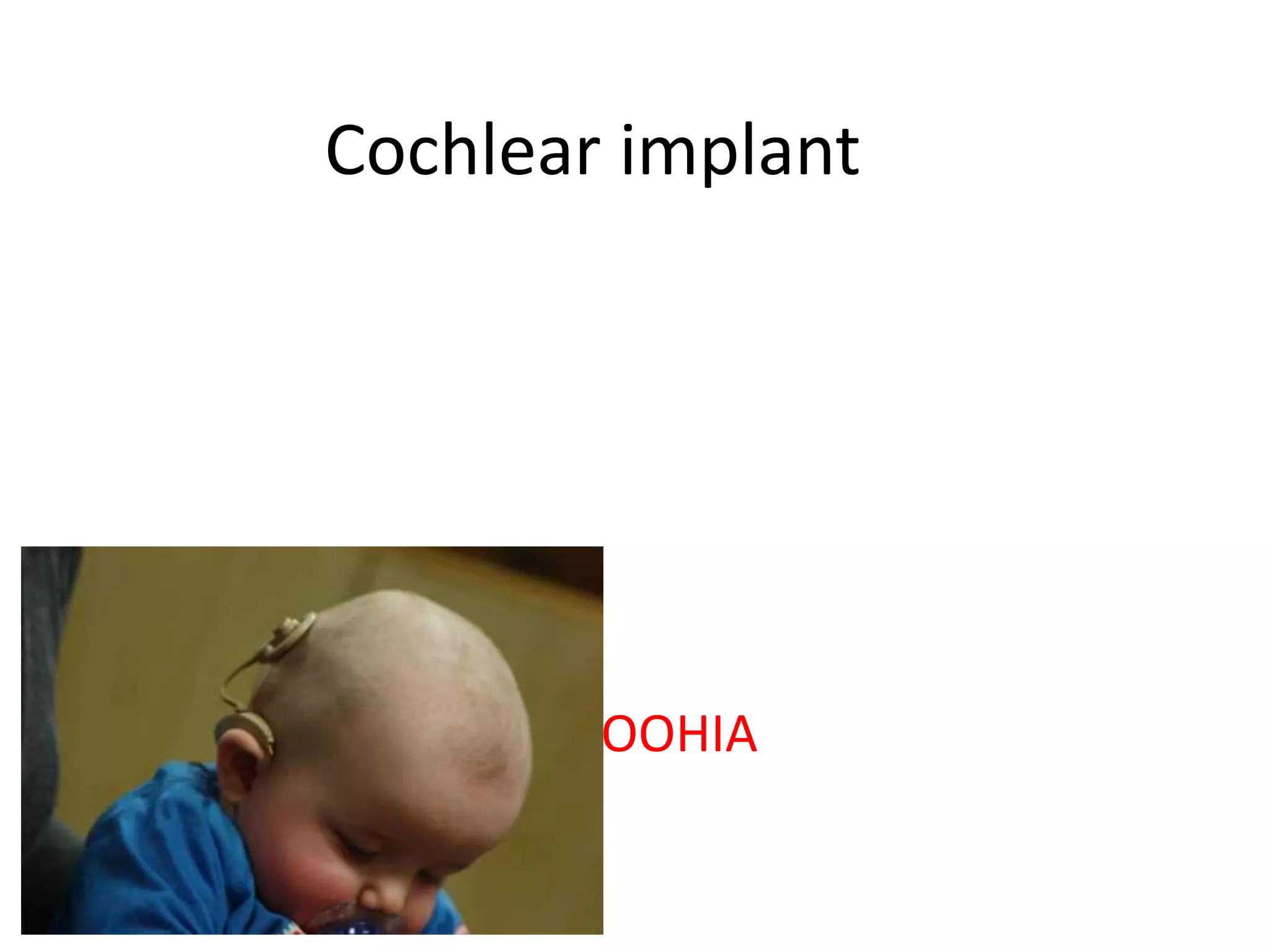
Cochlear implant
DR.ROOHIA
Definition
• Cochlear implants are surgically placed
electrical device that receive sound and
transmit the resulting electrical signals to
electrodes implanted in the cochlea of the ear.
• The signals stimulate cochlea, allowing patient
to hear.
• It is also known as Bionic ear.
Parts of cochlear implant
• External
– Microphone
– Speech processor
– Transmitter
• Internal
– Receiver and stimulator
– An array of up to 22
electrodes
TYPES OF COCHLEAR IMPLANTS
– Advanced Bionics
– nucleus
– MED-EL
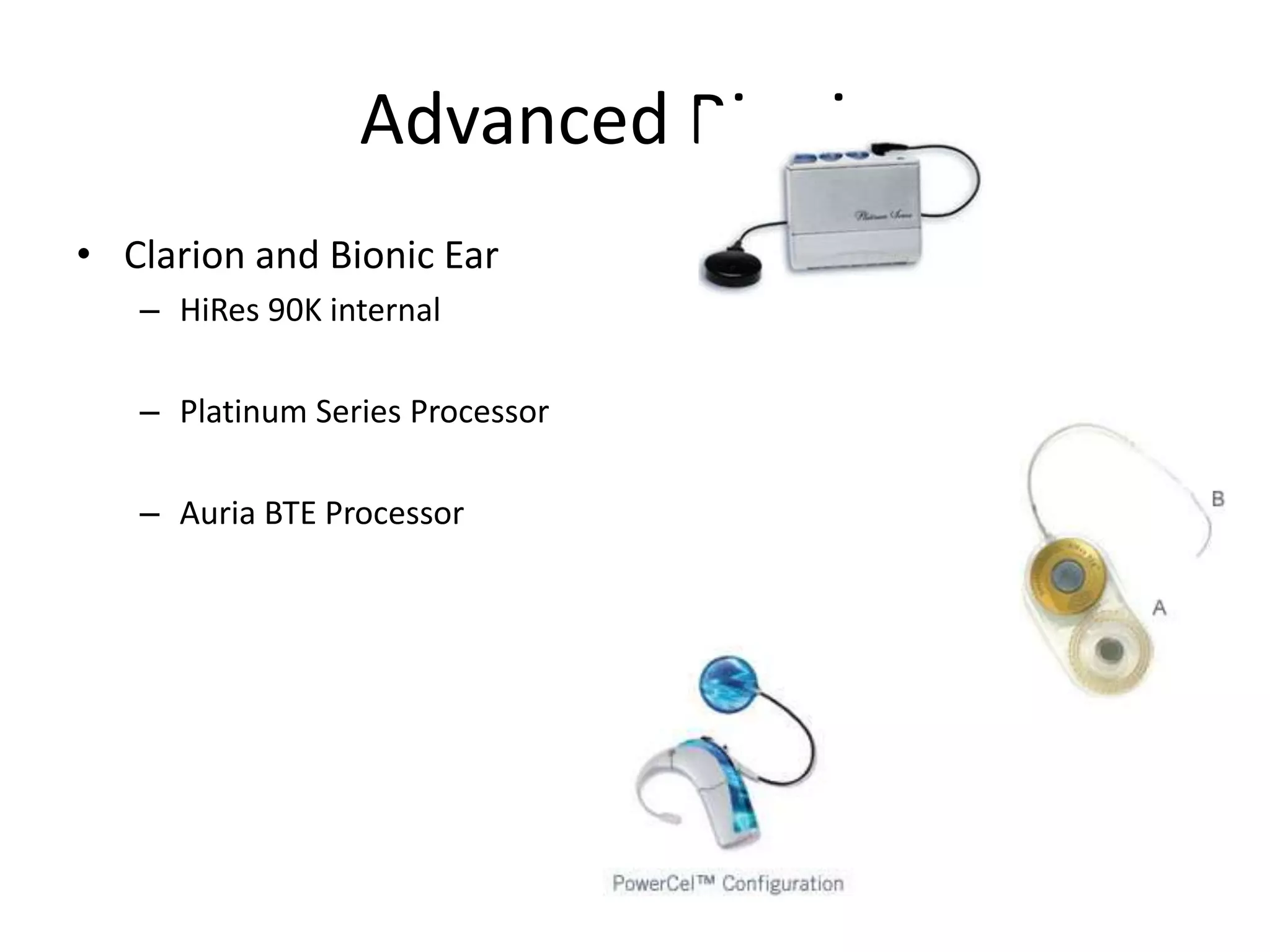
Advanced Bionics
• Clarion and Bionic Ear
– HiRes 90K internal
– Platinum Series Processor
– Auria BTE Processor
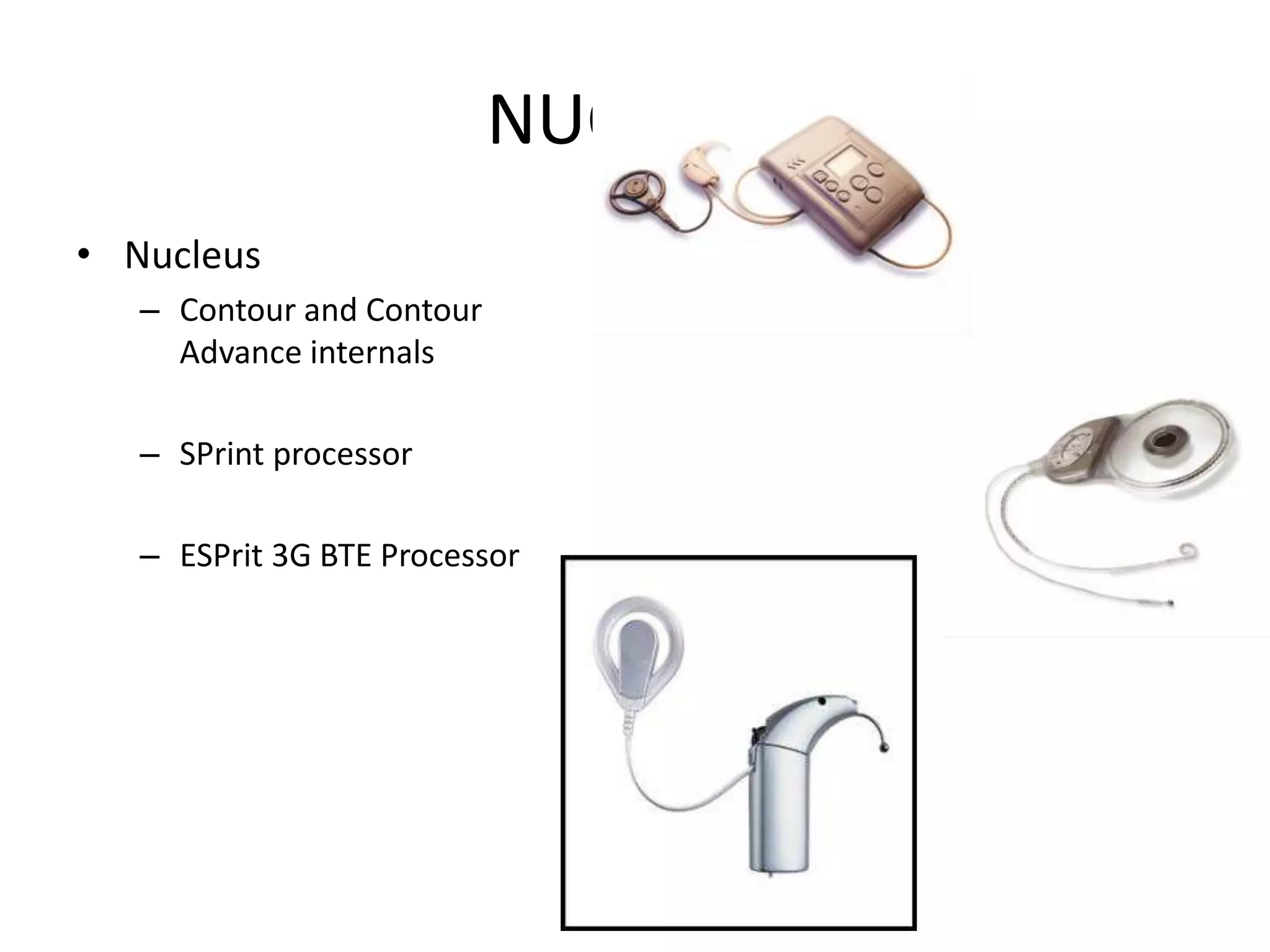
NUCLEUS
• Nucleus
– Contour and Contour
Advance internals
– SPrint processor
– ESPrit 3G BTE Processor
MED-EL
• Combi 40+ internal
• Tempo+ BTE processor
with 5 modular options
• CIS-PRO+ body
processor
Common Features of CI Sound
Processors
• Power Switch
– On-Off
• Battery
– Charge Meter
• Display
• Lights
• Program Control
– Selects Program or MAP loaded into the processor
• Individual programs may have differing parameters such as speech encoder
strategy, rate of stimulation, pulse width
• Individual programs have different electrical dynamic ranges for each electrode
which affect the perception of soft, average, and loud sounds
How does the cochlear implant works
Complications:
Cochlear Implant Surgery
• Operation lasts about three hours.(GA)
• Usually performed as outpatient
• Performed by Otolaryngologist
CANDIDACY PROFILE FOR COCHLEAR
IMPLANTS
• B/L severe to profound SNHL
• Little or no benefit from hearing aids
• No medical contrindication for surgey
• Realistic expectation
• Good family &social support towards
habilitation
• Adequate cognitive function to be able to use
the device.
Pre-implantation Process
• Medical Evaluation. ENT examines the outer,
middle and inner ear (otological examination)
• Physical examination
• Imagery Evaluation: x-ray, CT scans, MRI
• Audiological evaluation: Audiologist tests
hearing.
 PTA
 Speech discrimination
 Tympanometry
 OAE
 ABR
 Auditory steady state response(ASSR)
• Speech and Language Testing
SURGICAL TECHNIQUE
• Facial recess approach
• Pericanal techniques
eg;suprameatal approach
Step 1 - Flap marking and incision design
• After the skin/subcutaneous tissue flap has
been elevated, a separate anteriorly based
pericranial flap is then elevated
• The subcutaneous pericranial flap should be
2 to 3 cm in the cephalocaudal dimension
and at least 2 cm in length
Step 2 - Mastoidectomy and posterior tympanotomy
• The mastoidectomy cavity should not be
• saucerized. The edges should be left as acute
as possible.
• These edges will help retain the electrode
leads
• within the confines of the mastoid cavity
Step 3 - Cochlear implant receiver well drill out with
tie-down holes
• Using a mock-up of the transducer for sizing,
a well is drilled into the outer cortex of the
parietal bone to accept the transducer
magnet housing
• Small holes are drilled at the periphery of the
well to allow stay sutures to pass through.
• These suture will be used to secure down the
implant
• Stay sutures are then passed through the
holes
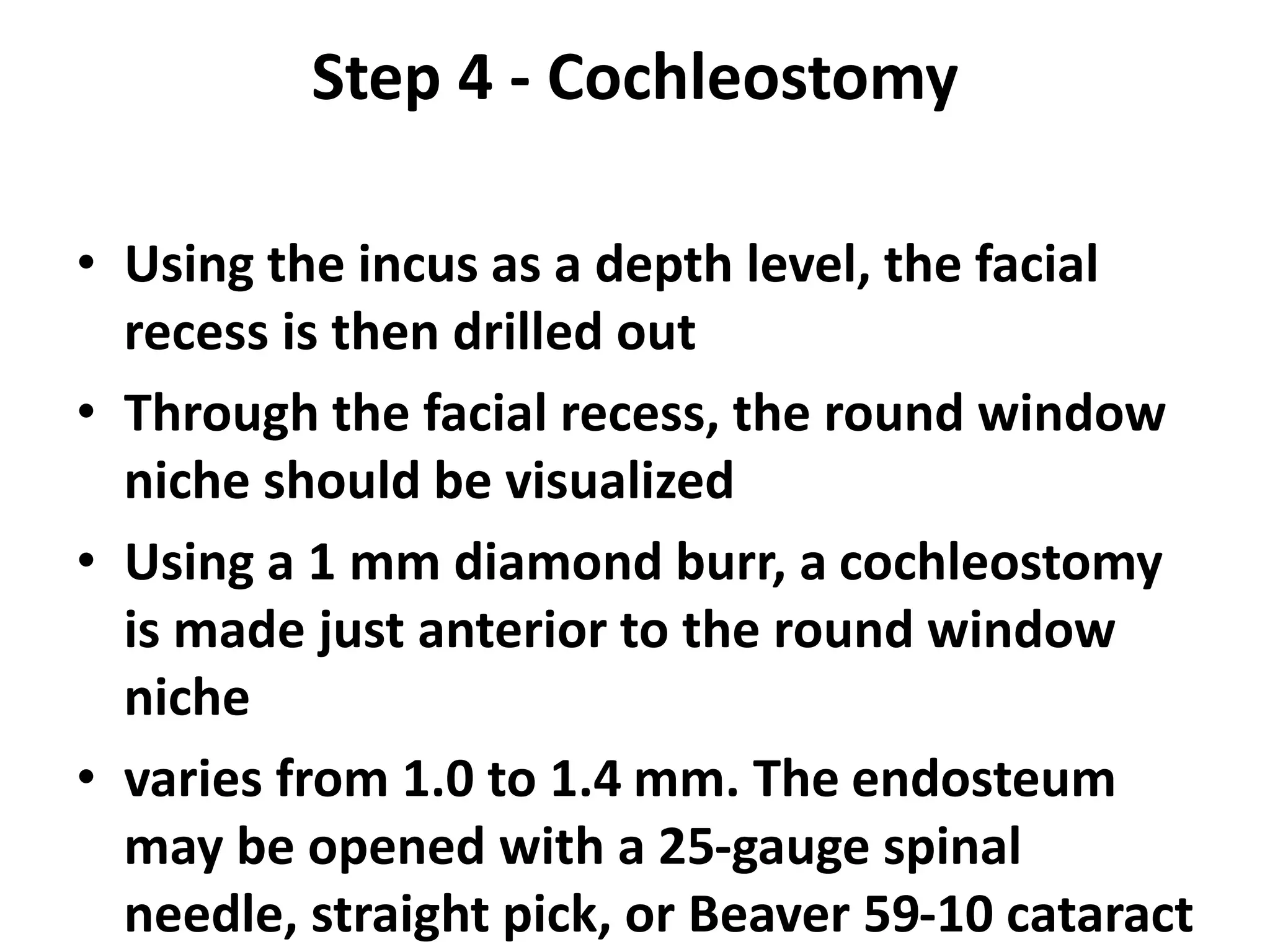
Step 4 - Cochleostomy
• Using the incus as a depth level, the facial
recess is then drilled out
• Through the facial recess, the round window
niche should be visualized
• Using a 1 mm diamond burr, a cochleostomy
is made just anterior to the round window
niche
• varies from 1.0 to 1.4 mm. The endosteum
may be opened with a 25-gauge spinal
needle, straight pick, or Beaver 59-10 cataract
Step 5 - Implant tie down and electrode
insertion
• The pocket for the receiver
stimulator is copiously
irrigated with dilute
bacitracin solution,
• any final hemostasis
necessary is undertaken.
Monopolar
electrocoagulation systems
are turned off and
unplugged.
• The transducer is then laid
into the well and secured
with the stay sutures
• Hyaluronic acid or 50%
glycerine may be used to
keep blood out of the
scala during electrode
insertion and to lubricate
the electrode
• The electrode array is
then inserted into the
cochleostomy and the
accompanying guidewire
is removed
• Small pieces of harvested periosteum are
packed in the cochleostomy around the
electrode array, sealing the hole
• Fibrin glue is then used to help secure the
electrode array in place
• The wound is then closed in layered fashion
and a standard mastoid dressing is applied
• Goals of Surgery:
• The surgical technique used for cochlear
implants aims to:
• Insert the electrode array without causing
damage to the scala tympani
• Place the implant package against the side of
the head so it is less prone to external trauma
• To secure both the electrode array and the
implant package to prevent migration after
surgery
• To implant all the internal components
without damaging the tympanic membrane,
ear canal, facial nerve, scalp or any other
surrounding tissue
COMPLICATIONS
• (1) Scalp Flap Problems – can include infection,
necrosis and thickness. Infections require
immediate treatment with antibiotics.. In this
case, thick flaps have to be carefully thinned by a
surgeon.
• (2) Otitis Media – is an infection of the middle
ear, administration of antibiotics and sometimes
pain reliever.
• (3) Meningitis –. This is a rare postoperative
complication but has the potential to be serious.
Cerebrospinal fluid (CSF) may leak and cause
• 4) Facial nerve paralysis – Electromyographic
monitoring of the facial during the surgery can
help reduce the possibility of paralysis.
• (5) Tinnitus –. Tinnitus may be the result of
further damage to existing hair cells.
• (6) Vertigo – or dizziness may be caused by
labyrinthitis, inflammation of the part of the
ear responsible for balance, and is a larger
issue for the elderly who have more difficulty
compensating.
• 7) Device migration – is a rare complication. If
the implant package is not secured it may create
shear forces that can break the electrode.
• (8) Device failure – can result from
manufacturing defects or from trauma. Delayed
device failure occurs in about 1.5% of implants
and need to be replaced.Tests during the
operation procedure can avoid implanting a
defective device.
• (9) Facial nerve stimulation – occurs when
stimulation to the electrode is conducted through
bone and also stimulates the facial nerve. This
type of complication is fixed by changing the
Activation and Initial Fitting
• An audiologist fits the patient with:
– A microphone (resembles
a BTE hearing aid)
– A speech processor (may be
housed with the microphone or
worn at chest-level)
Activation and Initial Fitting
• Audiologist runs standard check
of the speech processor
• Initial activation and programming
(mapping) of the implant
– Mapping- a set of parameters of electrode stimulation that gives the
patient maximum hearing
– Establishment of electrical dynamic range
– May occur over several appointments because the
patient will adjust to sound as s/he gains
experience with the implant
• How is mapping conducted?
• Using speech (subjective)
• Using tones/beeps/bursts
(subjective)
• Neural Response Telemetry (objective)
– Telemetry is the remote measurement of various electrical
parameters (in our case, through implant feedback)
– Neural Response Telemetry measures the response of the
auditory nerve to electrical stimulation via a cochlear implant
(The Hearing House).
– NRT takes about 5 minutes to complete
Follow-Up to Initial Fitting
• May include several visits over the span of weeks or months
• Why is this such a lengthy process?
– Each electrode in the cochlea is activated
– Each electrode must be programmed and adjusted into the
speech processor
– Can create programs for special listening situations
– The patient develops more skill from using the implant, thus
more adjustments must be made as skill improves
– Over time, less adjustments are necessary and the patient will
return to the CI center every 6 months or annually
– Appointment time can be spent on education and rehabilitation
Aural Rehabilitation
Teaches the patient how to use the CI and respond
to auditory input
– Listen to an array of auditory stimuli
– Improve speech (expressive and receptive)
– Use speech-reading
Complications:
• Early complications
• (1) Scalp Flap Problems
• (2) Meningitis
• (3) Facial nerve paralysis
• (4) Tinnitus
• (5) Vertigo
• (6) Device migration
• (7) Device failure
• (8) Facial nerve
stimulation
• Late complications
• 1)exposure of device
&extrusion
• 2)pain at the site of
implant
• 3)migration/displacement
of device
• 5)late device failure
• 6)otitis media
COCHLEAR IMPLANT FAILURE
• Hard Failures occur when the device fails to deliver any stimulation to the
cochlea
– Stimulator fails
– Speech processor fails to establish link with implanted system
– no auditory input to patient
• Soft Failures occur when the speech processor maintains a lock with the internal
system but fails to deliver proper stimulation
– Auditory symptoms - subjective decrease in performance, lack of sound perception, severe
tinnitus, sound hypersensitivity, atypical tinnitus (thumping, engine like noise, airplane sounds,
clicks, pops, sirens)
– Non auditory symptoms – pain, shocking sensations, vertigo, facial twitching
– Performance-related issues
• Medcal complications (asom/csom)
• Skin infection
• Device misplacement
• Electrode extrusion
Implant Failure Diagnosis
• Initial testing
– Patient’s history
– Recent changes in MAP (patient’s individualized fitting program)
– Reprogramming MAP if necessary
– Check external components - cables
• Impedance testing of electrode using clinical software
• EFI(Electrical field imaging)
• Link Test
– Integrity of linkage between the inside and outside of device
– Determine if there is sufficient energy to power device at all instances
THANK YOU

Cochlear implantation

  • 1.
  • 2.
    Definition • Cochlear implantsare surgically placed electrical device that receive sound and transmit the resulting electrical signals to electrodes implanted in the cochlea of the ear. • The signals stimulate cochlea, allowing patient to hear. • It is also known as Bionic ear.
  • 3.
    Parts of cochlearimplant • External – Microphone – Speech processor – Transmitter • Internal – Receiver and stimulator – An array of up to 22 electrodes
  • 4.
    TYPES OF COCHLEARIMPLANTS – Advanced Bionics – nucleus – MED-EL
  • 5.
    Advanced Bionics • Clarionand Bionic Ear – HiRes 90K internal – Platinum Series Processor – Auria BTE Processor
  • 6.
    NUCLEUS • Nucleus – Contourand Contour Advance internals – SPrint processor – ESPrit 3G BTE Processor
  • 7.
    MED-EL • Combi 40+internal • Tempo+ BTE processor with 5 modular options • CIS-PRO+ body processor
  • 8.
    Common Features ofCI Sound Processors • Power Switch – On-Off • Battery – Charge Meter • Display • Lights • Program Control – Selects Program or MAP loaded into the processor • Individual programs may have differing parameters such as speech encoder strategy, rate of stimulation, pulse width • Individual programs have different electrical dynamic ranges for each electrode which affect the perception of soft, average, and loud sounds
  • 9.
    How does thecochlear implant works Complications:
  • 11.
    Cochlear Implant Surgery •Operation lasts about three hours.(GA) • Usually performed as outpatient • Performed by Otolaryngologist
  • 12.
    CANDIDACY PROFILE FORCOCHLEAR IMPLANTS • B/L severe to profound SNHL • Little or no benefit from hearing aids • No medical contrindication for surgey • Realistic expectation • Good family &social support towards habilitation • Adequate cognitive function to be able to use the device.
  • 13.
    Pre-implantation Process • MedicalEvaluation. ENT examines the outer, middle and inner ear (otological examination) • Physical examination • Imagery Evaluation: x-ray, CT scans, MRI • Audiological evaluation: Audiologist tests hearing.  PTA  Speech discrimination  Tympanometry  OAE  ABR  Auditory steady state response(ASSR) • Speech and Language Testing
  • 15.
    SURGICAL TECHNIQUE • Facialrecess approach • Pericanal techniques eg;suprameatal approach
  • 18.
    Step 1 -Flap marking and incision design
  • 19.
    • After theskin/subcutaneous tissue flap has been elevated, a separate anteriorly based pericranial flap is then elevated • The subcutaneous pericranial flap should be 2 to 3 cm in the cephalocaudal dimension and at least 2 cm in length
  • 20.
    Step 2 -Mastoidectomy and posterior tympanotomy
  • 21.
    • The mastoidectomycavity should not be • saucerized. The edges should be left as acute as possible. • These edges will help retain the electrode leads • within the confines of the mastoid cavity
  • 22.
    Step 3 -Cochlear implant receiver well drill out with tie-down holes
  • 23.
    • Using amock-up of the transducer for sizing, a well is drilled into the outer cortex of the parietal bone to accept the transducer magnet housing • Small holes are drilled at the periphery of the well to allow stay sutures to pass through. • These suture will be used to secure down the implant • Stay sutures are then passed through the holes
  • 25.
    Step 4 -Cochleostomy • Using the incus as a depth level, the facial recess is then drilled out • Through the facial recess, the round window niche should be visualized • Using a 1 mm diamond burr, a cochleostomy is made just anterior to the round window niche • varies from 1.0 to 1.4 mm. The endosteum may be opened with a 25-gauge spinal needle, straight pick, or Beaver 59-10 cataract
  • 27.
    Step 5 -Implant tie down and electrode insertion • The pocket for the receiver stimulator is copiously irrigated with dilute bacitracin solution, • any final hemostasis necessary is undertaken. Monopolar electrocoagulation systems are turned off and unplugged. • The transducer is then laid into the well and secured with the stay sutures
  • 28.
    • Hyaluronic acidor 50% glycerine may be used to keep blood out of the scala during electrode insertion and to lubricate the electrode • The electrode array is then inserted into the cochleostomy and the accompanying guidewire is removed
  • 29.
    • Small piecesof harvested periosteum are packed in the cochleostomy around the electrode array, sealing the hole • Fibrin glue is then used to help secure the electrode array in place • The wound is then closed in layered fashion and a standard mastoid dressing is applied
  • 30.
    • Goals ofSurgery: • The surgical technique used for cochlear implants aims to: • Insert the electrode array without causing damage to the scala tympani • Place the implant package against the side of the head so it is less prone to external trauma
  • 31.
    • To secureboth the electrode array and the implant package to prevent migration after surgery • To implant all the internal components without damaging the tympanic membrane, ear canal, facial nerve, scalp or any other surrounding tissue
  • 32.
    COMPLICATIONS • (1) ScalpFlap Problems – can include infection, necrosis and thickness. Infections require immediate treatment with antibiotics.. In this case, thick flaps have to be carefully thinned by a surgeon. • (2) Otitis Media – is an infection of the middle ear, administration of antibiotics and sometimes pain reliever. • (3) Meningitis –. This is a rare postoperative complication but has the potential to be serious. Cerebrospinal fluid (CSF) may leak and cause
  • 33.
    • 4) Facialnerve paralysis – Electromyographic monitoring of the facial during the surgery can help reduce the possibility of paralysis. • (5) Tinnitus –. Tinnitus may be the result of further damage to existing hair cells. • (6) Vertigo – or dizziness may be caused by labyrinthitis, inflammation of the part of the ear responsible for balance, and is a larger issue for the elderly who have more difficulty compensating.
  • 34.
    • 7) Devicemigration – is a rare complication. If the implant package is not secured it may create shear forces that can break the electrode. • (8) Device failure – can result from manufacturing defects or from trauma. Delayed device failure occurs in about 1.5% of implants and need to be replaced.Tests during the operation procedure can avoid implanting a defective device. • (9) Facial nerve stimulation – occurs when stimulation to the electrode is conducted through bone and also stimulates the facial nerve. This type of complication is fixed by changing the
  • 35.
    Activation and InitialFitting • An audiologist fits the patient with: – A microphone (resembles a BTE hearing aid) – A speech processor (may be housed with the microphone or worn at chest-level)
  • 36.
    Activation and InitialFitting • Audiologist runs standard check of the speech processor • Initial activation and programming (mapping) of the implant – Mapping- a set of parameters of electrode stimulation that gives the patient maximum hearing – Establishment of electrical dynamic range – May occur over several appointments because the patient will adjust to sound as s/he gains experience with the implant
  • 37.
    • How ismapping conducted? • Using speech (subjective) • Using tones/beeps/bursts (subjective) • Neural Response Telemetry (objective) – Telemetry is the remote measurement of various electrical parameters (in our case, through implant feedback) – Neural Response Telemetry measures the response of the auditory nerve to electrical stimulation via a cochlear implant (The Hearing House). – NRT takes about 5 minutes to complete
  • 38.
    Follow-Up to InitialFitting • May include several visits over the span of weeks or months • Why is this such a lengthy process? – Each electrode in the cochlea is activated – Each electrode must be programmed and adjusted into the speech processor – Can create programs for special listening situations – The patient develops more skill from using the implant, thus more adjustments must be made as skill improves – Over time, less adjustments are necessary and the patient will return to the CI center every 6 months or annually – Appointment time can be spent on education and rehabilitation
  • 39.
    Aural Rehabilitation Teaches thepatient how to use the CI and respond to auditory input – Listen to an array of auditory stimuli – Improve speech (expressive and receptive) – Use speech-reading
  • 40.
    Complications: • Early complications •(1) Scalp Flap Problems • (2) Meningitis • (3) Facial nerve paralysis • (4) Tinnitus • (5) Vertigo • (6) Device migration • (7) Device failure • (8) Facial nerve stimulation • Late complications • 1)exposure of device &extrusion • 2)pain at the site of implant • 3)migration/displacement of device • 5)late device failure • 6)otitis media
  • 41.
    COCHLEAR IMPLANT FAILURE •Hard Failures occur when the device fails to deliver any stimulation to the cochlea – Stimulator fails – Speech processor fails to establish link with implanted system – no auditory input to patient • Soft Failures occur when the speech processor maintains a lock with the internal system but fails to deliver proper stimulation – Auditory symptoms - subjective decrease in performance, lack of sound perception, severe tinnitus, sound hypersensitivity, atypical tinnitus (thumping, engine like noise, airplane sounds, clicks, pops, sirens) – Non auditory symptoms – pain, shocking sensations, vertigo, facial twitching – Performance-related issues • Medcal complications (asom/csom) • Skin infection • Device misplacement • Electrode extrusion
  • 42.
    Implant Failure Diagnosis •Initial testing – Patient’s history – Recent changes in MAP (patient’s individualized fitting program) – Reprogramming MAP if necessary – Check external components - cables • Impedance testing of electrode using clinical software • EFI(Electrical field imaging) • Link Test – Integrity of linkage between the inside and outside of device – Determine if there is sufficient energy to power device at all instances
  • 43.