Downloaded 72 times





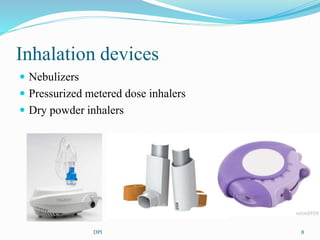




This document discusses dry powder inhalers (DPIs) for pulmonary drug delivery. It covers the ideal characteristics of DPIs including being easy to use, delivering multiple doses, minimizing moisture and adhesion, and providing accurate, uniform and consistent delivery. The document discusses DPI design considerations like capsule opening mechanisms, airflow, and mouthpiece design. It also addresses issues with single and multiple dose devices. Additionally, it outlines drug delivery mechanisms for DPIs and factors that affect their performance like humidity, particle size, and physical properties of powders. Common DPI technologies are also presented along with current trends in DPI development.


![Pulmonary drug delivery system [PDDS]](https://cdn.slidesharecdn.com/ss_thumbnails/pulmonarydrugdeliverysystem-160619063517-thumbnail.jpg?width=640&height=640&fit=bounds)


