BY: DR.SHILPA PRAJAPATI (1ST YEAR MPT)
CONTENTS

ļ‚› Inhalation-   Definition

ļ‚› Common      conditions

ļ‚› Advantages     and disadvantages

ļ‚› Inhalant   drugs

ļ‚› Types
Inhalation- Definition
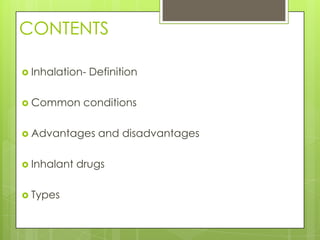
ļ‚› Inhalationis any drug or solution of
 drugs administered by the nasal or oral
 respiratory route.

ļ‚› Inhalation(also known as inspiration) is
 the movement of air from the external
 environment, through the air ways, and
 into the alveoli.
Particle Size
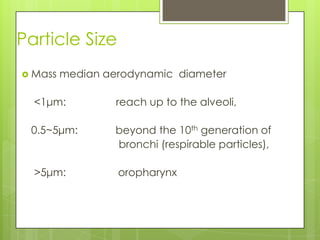
ļ‚› Mass   median aerodynamic diameter

  <1μm:           reach up to the alveoli,

 0.5~5μm:         beyond the 10th generation of
                  bronchi (respirable particles),

  >5μm:           oropharynx
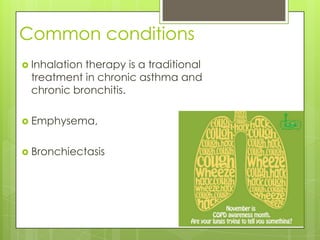
Common conditions
ļ‚› Inhalation
           therapy is a traditional
 treatment in chronic asthma and
 chronic bronchitis.

ļ‚› Emphysema,


ļ‚› Bronchiectasis
Advantages and
disadvantages
  ļ‚› Advantages:
    - Less systemic toxicity
    - More rapid onset of medication
    - Delivery to target of action
    - Higher concentrations available in the
    lung
  ļ‚› Disadvantages:
     - Time and effort consuming
     - Limitation of delivery device
Inhalant drugs
  ļ‚› Antiallergicagents
        Budesonide (glucocortico steroid)
        Cromolyn sodium(Cromoglicic acid)
  ļ‚› Bronchodilators
        Salbutamol (β2 agonist)
        Terbutaline (β2 agonist)
        anti-cholinergic
  ļ‚› Anesthetics
        Opioids
Inhalant drugs

  ļ‚› Mucolytic  agents
        Acetein (Acetylcysteine)
        Mistabron (Mesna)
  ļ‚› Antimicrobials
        Tobramycin(anti bacterial)
        Pentamidine(anti fungal)
        Ribavirin(antiviral)
        Amphotericin
Device
ļ‚› Selections      of device include:

  ļ‚›   Nebulizer: small volume,
       large volume, ultrasonic

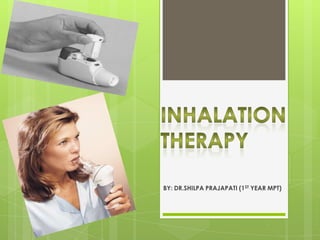
  ļ‚›   Metered dose inhaler, MDI

  ļ‚›   Dry powder inhaler, DPI

  ļ‚›   Spacer

  ļ‚›   Rotahaler

  ļ‚›   spinhaler
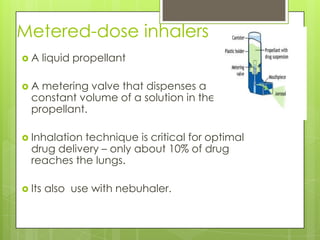
Metered-dose inhalers
ļ‚›A      liquid propellant

ļ‚›A  metering valve that dispenses a
  constant volume of a solution in the
  propellant.

ļ‚› Inhalationtechnique is critical for optimal
  drug delivery – only about 10% of drug
  reaches the lungs.

ļ‚› Its   also use with nebuhaler.
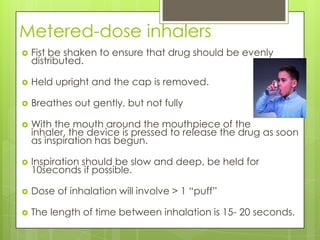
Metered-dose inhalers
ļ‚›   Fist be shaken to ensure that drug should be evenly
    distributed.

ļ‚›   Held upright and the cap is removed.

ļ‚›   Breathes out gently, but not fully

ļ‚›   With the mouth around the mouthpiece of the
    inhaler, the device is pressed to release the drug as soon
    as inspiration has begun.

ļ‚›   Inspiration should be slow and deep, be held for
    10seconds if possible.

ļ‚›   Dose of inhalation will involve > 1 ā€œpuffā€

ļ‚›   The length of time between inhalation is 15- 20 seconds.
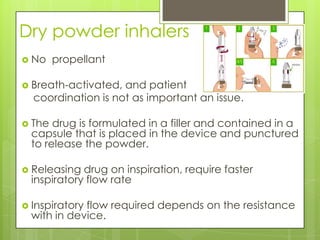
Dry powder inhalers
ļ‚› No    propellant

ļ‚› Breath-activated, and patient
  coordination is not as important an issue.

ļ‚› The  drug is formulated in a filler and contained in a
  capsule that is placed in the device and punctured
  to release the powder.

ļ‚› Releasing  drug on inspiration, require faster
  inspiratory flow rate

ļ‚› Inspiratoryflow required depends on the resistance
  with in device.
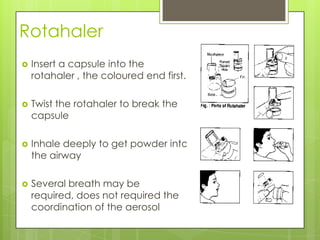
Rotahaler
ļ‚›   Insert a capsule into the
    rotahaler , the coloured end first.

ļ‚›   Twist the rotahaler to break the
    capsule

ļ‚›   Inhale deeply to get powder into
    the airway

ļ‚›   Several breath may be
    required, does not required the
    coordination of the aerosol
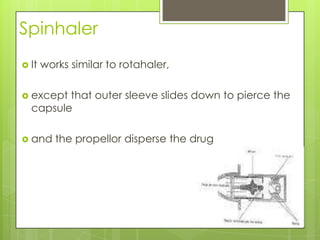
Spinhaler
ļ‚› It   works similar to rotahaler,

ļ‚› except that outer sleeve slides down to pierce the
  capsule

ļ‚› and     the propellor disperse the drug
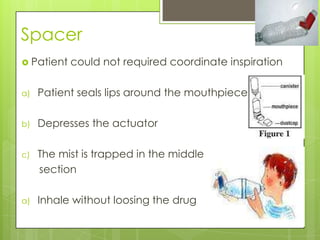
Spacer
ļ‚› Patient   could not required coordinate inspiration

a)   Patient seals lips around the mouthpiece

b)   Depresses the actuator

c)   The mist is trapped in the middle
     section

a)   Inhale without loosing the drug
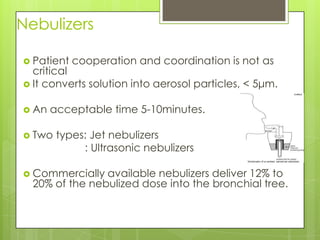
Nebulizers

ļ‚› Patient   cooperation and coordination is not as
  critical
ļ‚› It converts solution into aerosol particles, < 5μm.


ļ‚› An   acceptable time 5-10minutes.

ļ‚› Two   types: Jet nebulizers
             : Ultrasonic nebulizers

ļ‚› Commercially  available nebulizers deliver 12% to
  20% of the nebulized dose into the bronchial tree.
Jet nebulizer
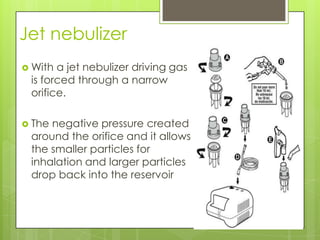
ļ‚› With a jet nebulizer driving gas
 is forced through a narrow
 orifice.

ļ‚› Thenegative pressure created
 around the orifice and it allows
 the smaller particles for
 inhalation and larger particles
 drop back into the reservoir
18


       Some Disadvantages of Jet
       Nebulizers
        ļ‚› Less portable than inhalers
        ļ‚› Requires power
          source, maintenance, and cleaning
        ļ‚› Output is device dependent
        ļ‚› Delivery may take 5 to 10 minutes or
          longer


O’Donohue et al. Chest. 1996;109:814-820; Dolovich et al. Chest. 2005;127:335-376; Pulmicort
Respules 0.25 and 0.5 mg [package insert]. Wilmington, DE: AstraZeneca LP, 6/2005. NAEPP.
Publication no. 97-4051.
Ultrasonic nebulizers
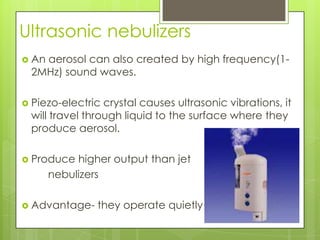
ļ‚› An
   aerosol can also created by high frequency(1-
 2MHz) sound waves.

ļ‚› Piezo-electric crystal causes ultrasonic vibrations, it
 will travel through liquid to the surface where they
 produce aerosol.

ļ‚› Produce   higher output than jet
       nebulizers

ļ‚› Advantage-    they operate quietly
Inhaled Beta-2 Agonist
Bronchodilators
ļ‚› Short-acting     (3~6hr)
  ļ‚›   Salbutamol / Albuterol (Ventolin)
  ļ‚›   Terbutaline (Bricanyl)
  ļ‚›   Fenoterol (Berotec)


ļ‚› Long-acting      (>12hr)
  ļ‚›   Salmeterol
  ļ‚›   Formoterol
Inhaled Anti-cholinergics
ļ‚› Ipratropium   bromide (Atrovent)


Inhaled Corticosteroids

ļ‚› Beclomethasone


ļ‚› Triamcinolone


ļ‚› Budesonide    (Pulmicort)
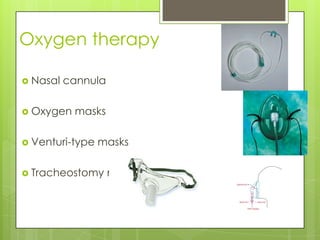
Oxygen therapy

ļ‚› Nasal   cannula

ļ‚› Oxygen   masks

ļ‚› Venturi-type   masks

ļ‚› Tracheostomy      masks
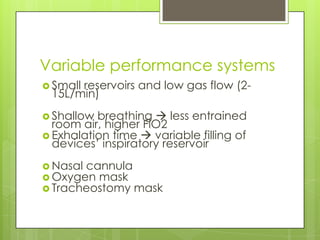
Variable performance systems
ļ‚› Small
      reservoirs and low gas flow (2-
 15L/min)
ļ‚› Shallow breathing  less entrained
  room air, higher FiO2
ļ‚› Exhalation time  variable filling of
  devices’ inspiratory reservoir
ļ‚› Nasal cannula
ļ‚› Oxygen mask
ļ‚› Tracheostomy mask
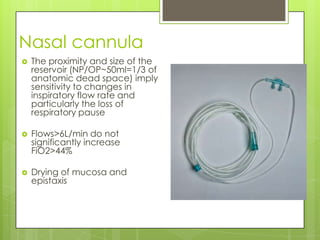
Nasal cannula
ļ‚›   The proximity and size of the
    reservoir (NP/OP~50ml=1/3 of
    anatomic dead space) imply
    sensitivity to changes in
    inspiratory flow rate and
    particularly the loss of
    respiratory pause

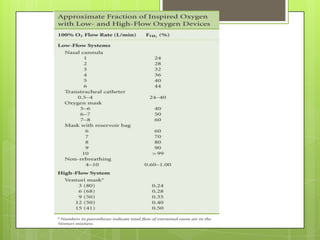
ļ‚›   Flows>6L/min do not
    significantly increase
    FiO2>44%

ļ‚›   Drying of mucosa and
    epistaxis
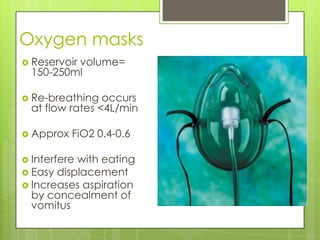
Oxygen masks
ļ‚› Reservoir
          volume=
  150-250ml

ļ‚› Re-breathing   occurs
  at flow rates <4L/min

ļ‚› Approx   FiO2 0.4-0.6

ļ‚› Interferewith eating
ļ‚› Easy displacement
ļ‚› Increases aspiration
  by concealment of
  vomitus
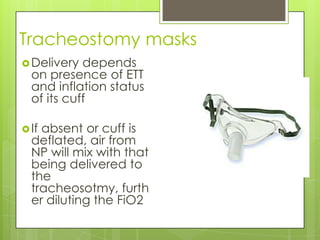
Tracheostomy masks
ļ‚› Delivery  depends
  on presence of ETT
  and inflation status
  of its cuff

ļ‚› Ifabsent or cuff is
  deflated, air from
  NP will mix with that
  being delivered to
  the
  tracheosotmy, furth
  er diluting the FiO2
Fixed performance systems
ļ‚› Socalled because O2 delivery is
 independent of the patient factors
 outlined above

ļ‚› Venturi-type masks
ļ‚› Anesthestic breathing circuits
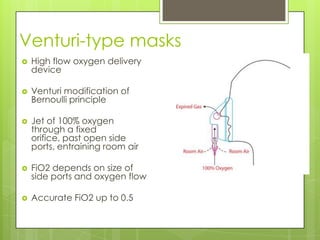
Venturi-type masks
ļ‚›   High flow oxygen delivery
    device

ļ‚›   Venturi modification of
    Bernoulli principle

ļ‚›   Jet of 100% oxygen
    through a fixed
    orifice, past open side
    ports, entraining room air

ļ‚›   FiO2 depends on size of
    side ports and oxygen flow

ļ‚›   Accurate FiO2 up to 0.5
Anaesthestic breathing circuits
ļ‚› Closed   system with valves (e.g. Ambu-
  bag)
ļ‚› Reservoir volume = 600-1000ml
ļ‚› Re-breathing at low flows (most require
  flows >150ml/kg)
ļ‚› Theoretically capable of delivery FiO2 1.0
  but practically ~0.6-0.8 due to sealing
  problem
Complications
ļ‚› Barotrauma   (middle ear and sinuses), gas
  embolism on decompression
ļ‚› Oxygen toxicity
ļ‚› Visual problem (myopia, cataract)
Humidification
ļ‚›A device to provide humidification of the air ways
 may be considered if either the normal means of
 humidifying the air ways or the mucociliary
 escalator are not functioning effectively.

ļ‚› The upper air ways acts as a heat and moisture
 exchanger with the fully saturated expired gas
 giving up some heat and water to the mucosa.

ļ‚› The epithelial lining of the airways from trachea to
 the respiratory bronchioles contains ciliated cells
 which are responsible for moving mucus proximally
 to the level of larynx.
Humidification
ļ‚› Theefficiency of mucus transport is dependent on
 current functioning cilia and the composition of
 peri-ciliary and mucus layers.

ļ‚› Viscosity   of mucus is increased during bacterial
 infection

ļ‚› Humidification
              has been shown to enhance
 tracheobronchial clearance
Humidification
ļ‚› Conway   (1992) hypothesizes that humidification by
 water or saline aerosol produces an increase in
 depth of the peri-ciliary and mucus layers, there by
 decreasing viscosity and enhancing the shearing
 of secretions by huffing or coughing.

ļ‚› Humidificationmay be indicated to assist clearance
 of secretions when the clearance mechanisms is
 not optimally effective or when the normal heat or
 moisture exchange system of the upper airways is
 by passed by an endotracheal or tracheostomy
 tube.
Humidification
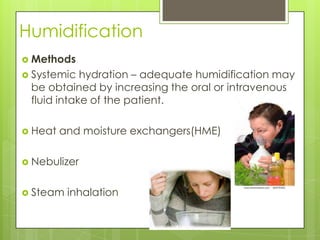
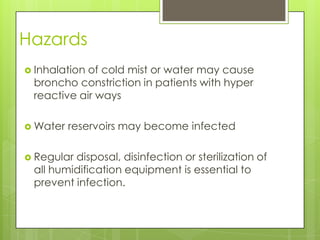
ļ‚› Methods
ļ‚› Systemic  hydration – adequate humidification may
 be obtained by increasing the oral or intravenous
 fluid intake of the patient.

ļ‚› Heat   and moisture exchangers(HME)

ļ‚› Nebulizer


ļ‚› Steam   inhalation
Hazards
ļ‚› Inhalationof cold mist or water may cause
 broncho constriction in patients with hyper
 reactive air ways

ļ‚› Water   reservoirs may become infected

ļ‚› Regulardisposal, disinfection or sterilization of
 all humidification equipment is essential to
 prevent infection.
References
1.   Cash’s text book, 4th Edition

2.   Physiotherapy for respiratory and cardiac
     problems, Jennifer A Pryor and Barbara A
     Webber, 3rd Edition

3.   Cardiopulmonary physical therapy, By: Elizabeth
     Dean, 3rd Edition

4.   Medical pharmacology, by: K D Tripathi, 4th Edition
Thank you for your attention!

Inhalation therapy

  • 1.
  • 2.
    CONTENTS ļ‚› Inhalation- Definition ļ‚› Common conditions ļ‚› Advantages and disadvantages ļ‚› Inhalant drugs ļ‚› Types
  • 3.
    Inhalation- Definition ļ‚› Inhalationisany drug or solution of drugs administered by the nasal or oral respiratory route. ļ‚› Inhalation(also known as inspiration) is the movement of air from the external environment, through the air ways, and into the alveoli.
  • 4.
    Particle Size ļ‚› Mass median aerodynamic diameter <1μm: reach up to the alveoli, 0.5~5μm: beyond the 10th generation of bronchi (respirable particles), >5μm: oropharynx
  • 5.
    Common conditions ļ‚› Inhalation therapy is a traditional treatment in chronic asthma and chronic bronchitis. ļ‚› Emphysema, ļ‚› Bronchiectasis
  • 6.
    Advantages and disadvantages ļ‚› Advantages: - Less systemic toxicity - More rapid onset of medication - Delivery to target of action - Higher concentrations available in the lung ļ‚› Disadvantages: - Time and effort consuming - Limitation of delivery device
  • 7.
    Inhalant drugs ļ‚› Antiallergicagents Budesonide (glucocortico steroid) Cromolyn sodium(Cromoglicic acid) ļ‚› Bronchodilators Salbutamol (β2 agonist) Terbutaline (β2 agonist) anti-cholinergic ļ‚› Anesthetics Opioids
  • 8.
    Inhalant drugs ļ‚› Mucolytic agents Acetein (Acetylcysteine) Mistabron (Mesna) ļ‚› Antimicrobials Tobramycin(anti bacterial) Pentamidine(anti fungal) Ribavirin(antiviral) Amphotericin
  • 9.
    Device ļ‚› Selections of device include: ļ‚› Nebulizer: small volume, large volume, ultrasonic ļ‚› Metered dose inhaler, MDI ļ‚› Dry powder inhaler, DPI ļ‚› Spacer ļ‚› Rotahaler ļ‚› spinhaler
  • 10.
    Metered-dose inhalers ļ‚›A liquid propellant ļ‚›A metering valve that dispenses a constant volume of a solution in the propellant. ļ‚› Inhalationtechnique is critical for optimal drug delivery – only about 10% of drug reaches the lungs. ļ‚› Its also use with nebuhaler.
  • 11.
    Metered-dose inhalers ļ‚› Fist be shaken to ensure that drug should be evenly distributed. ļ‚› Held upright and the cap is removed. ļ‚› Breathes out gently, but not fully ļ‚› With the mouth around the mouthpiece of the inhaler, the device is pressed to release the drug as soon as inspiration has begun. ļ‚› Inspiration should be slow and deep, be held for 10seconds if possible. ļ‚› Dose of inhalation will involve > 1 ā€œpuffā€ ļ‚› The length of time between inhalation is 15- 20 seconds.
  • 12.
    Dry powder inhalers ļ‚›No propellant ļ‚› Breath-activated, and patient coordination is not as important an issue. ļ‚› The drug is formulated in a filler and contained in a capsule that is placed in the device and punctured to release the powder. ļ‚› Releasing drug on inspiration, require faster inspiratory flow rate ļ‚› Inspiratoryflow required depends on the resistance with in device.
  • 13.
    Rotahaler ļ‚› Insert a capsule into the rotahaler , the coloured end first. ļ‚› Twist the rotahaler to break the capsule ļ‚› Inhale deeply to get powder into the airway ļ‚› Several breath may be required, does not required the coordination of the aerosol
  • 14.
    Spinhaler ļ‚› It works similar to rotahaler, ļ‚› except that outer sleeve slides down to pierce the capsule ļ‚› and the propellor disperse the drug
  • 15.
    Spacer ļ‚› Patient could not required coordinate inspiration a) Patient seals lips around the mouthpiece b) Depresses the actuator c) The mist is trapped in the middle section a) Inhale without loosing the drug
  • 16.
    Nebulizers ļ‚› Patient cooperation and coordination is not as critical ļ‚› It converts solution into aerosol particles, < 5μm. ļ‚› An acceptable time 5-10minutes. ļ‚› Two types: Jet nebulizers : Ultrasonic nebulizers ļ‚› Commercially available nebulizers deliver 12% to 20% of the nebulized dose into the bronchial tree.
  • 17.
    Jet nebulizer ļ‚› Witha jet nebulizer driving gas is forced through a narrow orifice. ļ‚› Thenegative pressure created around the orifice and it allows the smaller particles for inhalation and larger particles drop back into the reservoir
  • 18.
    18 Some Disadvantages of Jet Nebulizers ļ‚› Less portable than inhalers ļ‚› Requires power source, maintenance, and cleaning ļ‚› Output is device dependent ļ‚› Delivery may take 5 to 10 minutes or longer O’Donohue et al. Chest. 1996;109:814-820; Dolovich et al. Chest. 2005;127:335-376; Pulmicort Respules 0.25 and 0.5 mg [package insert]. Wilmington, DE: AstraZeneca LP, 6/2005. NAEPP. Publication no. 97-4051.
  • 19.
    Ultrasonic nebulizers ļ‚› An aerosol can also created by high frequency(1- 2MHz) sound waves. ļ‚› Piezo-electric crystal causes ultrasonic vibrations, it will travel through liquid to the surface where they produce aerosol. ļ‚› Produce higher output than jet nebulizers ļ‚› Advantage- they operate quietly
  • 20.
    Inhaled Beta-2 Agonist Bronchodilators ļ‚›Short-acting (3~6hr) ļ‚› Salbutamol / Albuterol (Ventolin) ļ‚› Terbutaline (Bricanyl) ļ‚› Fenoterol (Berotec) ļ‚› Long-acting (>12hr) ļ‚› Salmeterol ļ‚› Formoterol
  • 21.
    Inhaled Anti-cholinergics ļ‚› Ipratropium bromide (Atrovent) Inhaled Corticosteroids ļ‚› Beclomethasone ļ‚› Triamcinolone ļ‚› Budesonide (Pulmicort)
  • 22.
    Oxygen therapy ļ‚› Nasal cannula ļ‚› Oxygen masks ļ‚› Venturi-type masks ļ‚› Tracheostomy masks
  • 24.
    Variable performance systems ļ‚›Small reservoirs and low gas flow (2- 15L/min) ļ‚› Shallow breathing  less entrained room air, higher FiO2 ļ‚› Exhalation time  variable filling of devices’ inspiratory reservoir ļ‚› Nasal cannula ļ‚› Oxygen mask ļ‚› Tracheostomy mask
  • 25.
    Nasal cannula ļ‚› The proximity and size of the reservoir (NP/OP~50ml=1/3 of anatomic dead space) imply sensitivity to changes in inspiratory flow rate and particularly the loss of respiratory pause ļ‚› Flows>6L/min do not significantly increase FiO2>44% ļ‚› Drying of mucosa and epistaxis
  • 26.
    Oxygen masks ļ‚› Reservoir volume= 150-250ml ļ‚› Re-breathing occurs at flow rates <4L/min ļ‚› Approx FiO2 0.4-0.6 ļ‚› Interferewith eating ļ‚› Easy displacement ļ‚› Increases aspiration by concealment of vomitus
  • 27.
    Tracheostomy masks ļ‚› Delivery depends on presence of ETT and inflation status of its cuff ļ‚› Ifabsent or cuff is deflated, air from NP will mix with that being delivered to the tracheosotmy, furth er diluting the FiO2
  • 28.
    Fixed performance systems ļ‚›Socalled because O2 delivery is independent of the patient factors outlined above ļ‚› Venturi-type masks ļ‚› Anesthestic breathing circuits
  • 29.
    Venturi-type masks ļ‚› High flow oxygen delivery device ļ‚› Venturi modification of Bernoulli principle ļ‚› Jet of 100% oxygen through a fixed orifice, past open side ports, entraining room air ļ‚› FiO2 depends on size of side ports and oxygen flow ļ‚› Accurate FiO2 up to 0.5
  • 30.
    Anaesthestic breathing circuits ļ‚›Closed system with valves (e.g. Ambu- bag) ļ‚› Reservoir volume = 600-1000ml ļ‚› Re-breathing at low flows (most require flows >150ml/kg) ļ‚› Theoretically capable of delivery FiO2 1.0 but practically ~0.6-0.8 due to sealing problem
  • 31.
    Complications ļ‚› Barotrauma (middle ear and sinuses), gas embolism on decompression ļ‚› Oxygen toxicity ļ‚› Visual problem (myopia, cataract)
  • 32.
    Humidification ļ‚›A device toprovide humidification of the air ways may be considered if either the normal means of humidifying the air ways or the mucociliary escalator are not functioning effectively. ļ‚› The upper air ways acts as a heat and moisture exchanger with the fully saturated expired gas giving up some heat and water to the mucosa. ļ‚› The epithelial lining of the airways from trachea to the respiratory bronchioles contains ciliated cells which are responsible for moving mucus proximally to the level of larynx.
  • 33.
    Humidification ļ‚› Theefficiency ofmucus transport is dependent on current functioning cilia and the composition of peri-ciliary and mucus layers. ļ‚› Viscosity of mucus is increased during bacterial infection ļ‚› Humidification has been shown to enhance tracheobronchial clearance
  • 34.
    Humidification ļ‚› Conway (1992) hypothesizes that humidification by water or saline aerosol produces an increase in depth of the peri-ciliary and mucus layers, there by decreasing viscosity and enhancing the shearing of secretions by huffing or coughing. ļ‚› Humidificationmay be indicated to assist clearance of secretions when the clearance mechanisms is not optimally effective or when the normal heat or moisture exchange system of the upper airways is by passed by an endotracheal or tracheostomy tube.
  • 35.
    Humidification ļ‚› Methods ļ‚› Systemic hydration – adequate humidification may be obtained by increasing the oral or intravenous fluid intake of the patient. ļ‚› Heat and moisture exchangers(HME) ļ‚› Nebulizer ļ‚› Steam inhalation
  • 36.
    Hazards ļ‚› Inhalationof coldmist or water may cause broncho constriction in patients with hyper reactive air ways ļ‚› Water reservoirs may become infected ļ‚› Regulardisposal, disinfection or sterilization of all humidification equipment is essential to prevent infection.
  • 37.
    References 1. Cash’s text book, 4th Edition 2. Physiotherapy for respiratory and cardiac problems, Jennifer A Pryor and Barbara A Webber, 3rd Edition 3. Cardiopulmonary physical therapy, By: Elizabeth Dean, 3rd Edition 4. Medical pharmacology, by: K D Tripathi, 4th Edition
  • 38.
    Thank you foryour attention!