Drug Delivery
48 Innovations in Pharmaceutical Technology Issue 48
Respiratory drug delivery
Chronic obstructive
pulmonary disease
Dry powder aerosolisation
Fine particle fraction
By David Harris at
Team Consulting
The benefits of dry powder inhalers as a drug delivery route are being
explored for a range of new therapeutic areas, outside of traditional asthma
and COPD treatments. Developments in active aerosolised devices could
offer a solution to current performance and cost obstructions
Technological
Inspiration
The global pulmonary drug
delivery market is mature,large and
growing – it reached $22.5 billion
in 2011,and is expected to rise to
$44.4 billion by 2016 (1).Much of
this growth is attributed to the
increase in asthma and chronic
obstructive pulmonary disease
(COPD) worldwide,especially in
the BRICS countries (Brazil,Russia,
India,China and South Africa),and
it is these diseases that are typically
managed through the use of
inhaled pharmaceuticals.
However,there is
another projected
area of growth
within this market,
as research is under
way to develop
therapeutic drugs
for delivery via the
pulmonary route for
other applications,such as pain and
migraine relief,insulin delivery and
vaccinations (2).Although there is
a wealth of opportunities to deliver
novel therapies via the inhaled route,
the market is severely limited by the
lack of a suitable delivery technology
– in particular,the lack of suitable dry
powder inhaler (DPI) devices.
Delivery Method
Pulmonary drug delivery offers
significant and unique benefits.
Inhalers have been used for
many years to deliver drugs to
the lungs to treat airway diseases
such as asthma,COPD and,more
recently,cystic fibrosis.Inhalation
allows direct delivery of just a few
milligrams of drug to the site of
action.It is non-invasive,with
fewer systemic side-effects than
oral therapy (3).
The lungs may also be used as
a portal of entry to the body,
enabling delivery of a drug via
the airways into the bloodstream.
Inhaled formulations for systemic
delivery,therefore,are an attractive
proposition,taking advantage
of the optimal permeability to
macromolecules provided by the
lungs – presenting opportunities in
terms of conditions requiring rapid
response,or as an alternative to
orally delivered drugs.
Device Analysis
The inherent and potential benefits
of dry powder inhalation have
resulted in this delivery route being
investigated for a wider range
of potential therapies,including
inhaled insulin,oxytocin,antibiotics,
vaccines,opioids and drugs for
neurological disorders.
Keywords
iptonline.com
49Innovations in Pharmaceutical Technology Issue 48
Importantly,formulating these
drugs as a dry powder offers
inherent stability,and DPIs can
deliver them in higher doses –
whereas pressurised metered dose
inhalers (pMDIs) are restricted to a
maximum dose of 1mg.
DPIs also avoid the well-known
misuse issues associated with
pMDIs,namely the significant
hand-and-breath coordination
and timing required to depress
the canister while inhaling,which
results in a high proportion of users
not receiving the correct dose (4).
Typically,extensive training is
required for patients to master this.
In addition,the overall simplicity of
passive DPIs enables relatively low-
cost production,especially when
compared to electromechanical,
technically complex nebulisers.
However,to date these benefits
have been inaccessible for new
formulations as DPI technologies
are limited by the underlying
physics.
Technology Limitations
Existing DPIs fit into one of two
types:passive,where power is
provided by the user’s inhalation,
and means the drug is usually
blended with a carrier particle
fraction; or active,where power is
provided by another means,such as
a battery or from compressed air.
Passive devices tend to be simple
and cheap to produce but offer
limited performance,while active
systems can provide consistently
high delivery efficiency,but the
devices are complex in their design
and expensive to manufacture.
All DPIs currently on the market are
passive devices,and are well-suited
to the treatment of asthma and
COPD.However,systemic delivery
requires high dose consistency,
which is difficult to achieve with
the passive approach,largely due
to its dependency on the patient’s
inspiratory effort.In existing devices,
typically only 20-40 per cent of the
pure drug is actually delivered to
the lung.The majority of the pure
drug delivered from these devices
(up to 80 per cent) remains attached
to larger carrier particles and
impacts in the mouth and throat,
which is not only a waste of drug
but can also lead to unpleasant
side-effects.
Active DPI technologies have been
in development for almost 20 years,
but to date there is no active DPI
product on the market.This gap in
the market made us think.Could a
technology be created that offers
the performance of active delivery,
together with the low cost and
simplicity of passive delivery?
Combined Approach
2012 saw the development of
Occoris®,an active,ultra-low
cost,active pharmaceutical
ingredient (API) only dry powder
aerosolisation engine.The simple,
non-electromechanically powered
technology is small enough to
enable its use in a multi-unit dose
device,thereby delivering all the
benefits of active delivery at the
same cost as the most inexpensive
of passive devices.
The core of the Occoris engine is
simple and small.Accurate and
reproducible aerosol delivery
of the API is achieved using a
straightforward mechanism that
releases the powder from a sealed
container holding a defined unit
dose in a single,coordinated action.
Upon the release of the powder,the
internal energy source accelerates
and separates the pure API particles,
generating a fully deagglomerated
aerosol in a way that is not possible
with passive devices.Actuation of
the Occoris engine is performed by
a breath-actuation mechanism.
As a result,the engine ensures
that each dose is identical and is
delivered completely independently
of the inspiratory characteristics of
the user.The result is an API-only
platform DPI engine producing very
high fine particle fraction (FPF) – the
quantity of fine respirable particles
delivered to the lung – with low
throat deposition.
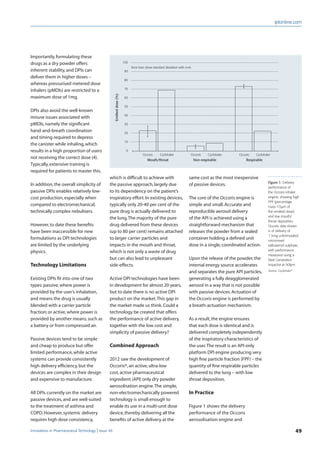
In Practice
Figure 1 shows the delivery
performance of the Occoris
aerosolisation engine and
100
90
80
70
60
50
40
30
20
10
0
Error bars show standard deviation with n=6
Emitteddose(%)
Occoris Occoris OccorisCyclohaler Cyclohaler Cyclohaler
Mouth/throat Non-respirable Respirable
Figure 1: Delivery
performance of
the Occoris inhaler
engine, showing high
FPF (percentage
mass <5μm of
the emitted dose)
and low mouth/
throat deposition.
Occoris data shown
is of delivery of
1.5mg unformulated
micronised
salbutamol sulphate,
with performance
measured using a
Next Generation
Impactor at 90lpm
Source: Cyclohaler®
50 Innovations in Pharmaceutical Technology Issue 48
iptonline.com
No lactose-blend formulation
time and expense
High aerosolisation efficiency
and FPF
Good delivery to the deep lung
User-independent,consistent
aerosolisation
High dose-to-dose consistency
Such a platform technology could
be used across a variety of device
designs,depending upon the
dosing regimen,user group and
therapy.Drugs of higher payloads,
requiring systemic delivery to the
deep lung,will be able to be
self-administered by untrained
users in a highly efficient,breath-
actuated,single-use disposable
device.Notably,high delivery
performance,combined with a very
low device cost,will result in an
economically viable solution.
New Therapy Areas
As a result of these benefits,dry
powder aerosolisation offers great
potential for pharma companies
looking to take inhalers beyond
the core asthma and COPD
markets,enabling a new range of
devices designed to capitalise on
current research.Systemic drugs
for pulmonary delivery could
be developed for several
new applications:
Oxytocin Delivery
Oxytocin is routinely prescribed
in the treatment of post-partum
haemorrhage; it is delivered by
needle and syringe,and hence
requires access to trained medical
staff.In developing nations,
especially in remote villages,there
is often no access to medical staff,
and sadly many women die during
childbirth due to lack of oxytocin.
Dry powder oxytocin,intended for
inhaled delivery,is currently being
developed.A breath-actuated,
single-use,disposable device would
enable the self-administration of
oxytocin without a needle and
syringe,and would be ideal for
contexts where a lack of trained
medical staff can prevent access
to this life-saving drug.
demonstrates the percentage
of FPF exceeding 70 per cent,
compared to the 20-40 per cent
achieved by typical DPIs.The
data also shows the benefit of
enabling API-only delivery, as
the new device achieves typical
mouth and throat deposition of
approximately 20 per cent, with
the lowest recorded being
14 per cent.
These inhaler performance results
demonstrate the core benefits that
an active aerosolisation engine can
deliver:
As a result of these benefits, dry powder aerosolisation offers
great potential for pharma companies looking to take inhalers
beyond the core asthma and COPD markets, enabling a new
range of devices designed to capitalise on current research.
Systemic drugs for pulmonary delivery could be developed
for several new applications
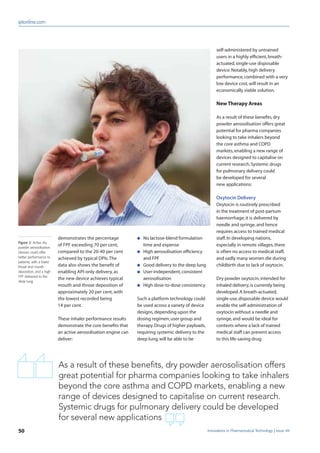
Figure 2: Active dry
powder aerosolisation
devices could offer
better performance to
patients, with a lower
throat and mouth
deposition, and a high
FPF delivered to the
deep lung
52 Innovations in Pharmaceutical Technology Issue 48
iptonline.com
Furthermore, as the devices
can deliver pure API, there
would be no need for the
drug to go through the
time-consuming and expensive
carrier/drug formulation process.
Yearly flu vaccines could follow
a similar model; with no need
for the patient to receive an
injection, they could instead
receive a single-use inhaler from
a pharmacist and self-administer
a precise dose.
Pain Relief
Oral analgesics, taken for the
relief of headaches or migraines,
typically take half an hour or so
to provide therapeutic effect;
systemic delivery of specially
formulated analgesics via
the pulmonary route could
provide relief within seconds.
The limitations of current DPI
technology, together with its
relatively high cost, mean that
this is not currently an option.
However, active aerosolised
technology opens up a potential
new market segment for inhalable
over-the-counter analgesics.
Clinical Trials
New chemical entities (NCEs),
intended for delivery using
DPIs, would typically have to
be blended with lactose before
being tested in vivo (following
successful in vitro trials).This
requires significant formulation
development time – and
expense – to ensure that the
ratio of the blend is correct,
the blend is homogeneous,
and the resulting particle size is
in the correct respirable range
following aerosolisation.
By aerosolising and delivering
pure drug powder, NCEs could
be tested without the need
to go through the process of
lactose blending and particle
size engineering, thus saving
development time and cost.
This should also remove
the variable of formulation-
device performance from drug
performance results.
And Beyond
The new technology could be
used to deliver drugs for a wide
variety of additional therapies.The
systemic delivery of antibiotics
and higher payload drugs is one
particularly interesting area which
could be explored, as well as the
delivery of analgesics, opioids for
pain relief, antidotes, and drugs
for bio-defence.
Significant Development
Respiratory drug delivery
has the potential to not only
improve the treatment of asthma
and COPD,but many other
conditions too.Until now,inhaler
technology has been a limiting
factor in new market growth,
but active aerosolised devices
have the potential to challenge
this by providing market-leading
performance at low cost for a
wide range of conditions that
require rapid onset,ease of use
and safety.There is further work to
be done,but as can be seen from
the initial data,it is an encouraging
platform on which to build.
References
1. Pulmonary drug delivery
systems: technologies
and global markets, BCC
Research, 2012
2. Hickey AJ, Back to the future:
inhaled drug products,
J Pharm Sci 1024: pp1,165-
1,172, 2013
3. Newman SP, Respiratory drug
delivery: essential theory and
practice, RDD Online, Virginia
Commonwealth University,
Richmond, 2009
4. Dolovich MB et al, Device
selection and outcomes of
aerosol therapy: evidence-
based guidelines, Chest 127:
pp335-371, 2005
Pandemic Response
During a pandemic, rapid drug
formulation and distribution is
vital. Aerosolised technology
could enable the mass distribution
of essential vaccines directly to
patients who could then self-
administer the correct dose
without the compliance issues or
risks associated with a needle and
syringe.This could significantly
reduce the workload for healthcare
professionals and allow them
to focus on those who cannot
self-administer.
David Harris joined Team Consulting as
Principal Consultant in 2011 to further
strengthen its technical and scientific
capabilities in drug delivery. He now
heads up the Respiratory Drug Delivery
division, and enjoys the challenge of
balancing commercial and technical activities. David has
worked in the field of medical device development since
1994, when he started his career in the Respiratory
Physics group at Fisons. He specialises in respiratory
drug delivery, and enjoys applying solid aerosol science
and fluid dynamics to improve the efficacy of inhaler
technology. David has numerous patents and publications
in this area and regularly presents at conferences.
Email: team@emlwildfire.com
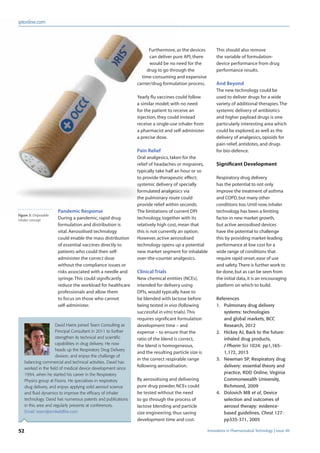
Figure 3: Disposable
inhaler concept

Technological Inspiration - Occoris

  • 1.
    Drug Delivery 48 Innovationsin Pharmaceutical Technology Issue 48 Respiratory drug delivery Chronic obstructive pulmonary disease Dry powder aerosolisation Fine particle fraction By David Harris at Team Consulting The benefits of dry powder inhalers as a drug delivery route are being explored for a range of new therapeutic areas, outside of traditional asthma and COPD treatments. Developments in active aerosolised devices could offer a solution to current performance and cost obstructions Technological Inspiration The global pulmonary drug delivery market is mature,large and growing – it reached $22.5 billion in 2011,and is expected to rise to $44.4 billion by 2016 (1).Much of this growth is attributed to the increase in asthma and chronic obstructive pulmonary disease (COPD) worldwide,especially in the BRICS countries (Brazil,Russia, India,China and South Africa),and it is these diseases that are typically managed through the use of inhaled pharmaceuticals. However,there is another projected area of growth within this market, as research is under way to develop therapeutic drugs for delivery via the pulmonary route for other applications,such as pain and migraine relief,insulin delivery and vaccinations (2).Although there is a wealth of opportunities to deliver novel therapies via the inhaled route, the market is severely limited by the lack of a suitable delivery technology – in particular,the lack of suitable dry powder inhaler (DPI) devices. Delivery Method Pulmonary drug delivery offers significant and unique benefits. Inhalers have been used for many years to deliver drugs to the lungs to treat airway diseases such as asthma,COPD and,more recently,cystic fibrosis.Inhalation allows direct delivery of just a few milligrams of drug to the site of action.It is non-invasive,with fewer systemic side-effects than oral therapy (3). The lungs may also be used as a portal of entry to the body, enabling delivery of a drug via the airways into the bloodstream. Inhaled formulations for systemic delivery,therefore,are an attractive proposition,taking advantage of the optimal permeability to macromolecules provided by the lungs – presenting opportunities in terms of conditions requiring rapid response,or as an alternative to orally delivered drugs. Device Analysis The inherent and potential benefits of dry powder inhalation have resulted in this delivery route being investigated for a wider range of potential therapies,including inhaled insulin,oxytocin,antibiotics, vaccines,opioids and drugs for neurological disorders. Keywords
  • 2.
    iptonline.com 49Innovations in PharmaceuticalTechnology Issue 48 Importantly,formulating these drugs as a dry powder offers inherent stability,and DPIs can deliver them in higher doses – whereas pressurised metered dose inhalers (pMDIs) are restricted to a maximum dose of 1mg. DPIs also avoid the well-known misuse issues associated with pMDIs,namely the significant hand-and-breath coordination and timing required to depress the canister while inhaling,which results in a high proportion of users not receiving the correct dose (4). Typically,extensive training is required for patients to master this. In addition,the overall simplicity of passive DPIs enables relatively low- cost production,especially when compared to electromechanical, technically complex nebulisers. However,to date these benefits have been inaccessible for new formulations as DPI technologies are limited by the underlying physics. Technology Limitations Existing DPIs fit into one of two types:passive,where power is provided by the user’s inhalation, and means the drug is usually blended with a carrier particle fraction; or active,where power is provided by another means,such as a battery or from compressed air. Passive devices tend to be simple and cheap to produce but offer limited performance,while active systems can provide consistently high delivery efficiency,but the devices are complex in their design and expensive to manufacture. All DPIs currently on the market are passive devices,and are well-suited to the treatment of asthma and COPD.However,systemic delivery requires high dose consistency, which is difficult to achieve with the passive approach,largely due to its dependency on the patient’s inspiratory effort.In existing devices, typically only 20-40 per cent of the pure drug is actually delivered to the lung.The majority of the pure drug delivered from these devices (up to 80 per cent) remains attached to larger carrier particles and impacts in the mouth and throat, which is not only a waste of drug but can also lead to unpleasant side-effects. Active DPI technologies have been in development for almost 20 years, but to date there is no active DPI product on the market.This gap in the market made us think.Could a technology be created that offers the performance of active delivery, together with the low cost and simplicity of passive delivery? Combined Approach 2012 saw the development of Occoris®,an active,ultra-low cost,active pharmaceutical ingredient (API) only dry powder aerosolisation engine.The simple, non-electromechanically powered technology is small enough to enable its use in a multi-unit dose device,thereby delivering all the benefits of active delivery at the same cost as the most inexpensive of passive devices. The core of the Occoris engine is simple and small.Accurate and reproducible aerosol delivery of the API is achieved using a straightforward mechanism that releases the powder from a sealed container holding a defined unit dose in a single,coordinated action. Upon the release of the powder,the internal energy source accelerates and separates the pure API particles, generating a fully deagglomerated aerosol in a way that is not possible with passive devices.Actuation of the Occoris engine is performed by a breath-actuation mechanism. As a result,the engine ensures that each dose is identical and is delivered completely independently of the inspiratory characteristics of the user.The result is an API-only platform DPI engine producing very high fine particle fraction (FPF) – the quantity of fine respirable particles delivered to the lung – with low throat deposition. In Practice Figure 1 shows the delivery performance of the Occoris aerosolisation engine and 100 90 80 70 60 50 40 30 20 10 0 Error bars show standard deviation with n=6 Emitteddose(%) Occoris Occoris OccorisCyclohaler Cyclohaler Cyclohaler Mouth/throat Non-respirable Respirable Figure 1: Delivery performance of the Occoris inhaler engine, showing high FPF (percentage mass <5μm of the emitted dose) and low mouth/ throat deposition. Occoris data shown is of delivery of 1.5mg unformulated micronised salbutamol sulphate, with performance measured using a Next Generation Impactor at 90lpm Source: Cyclohaler®
  • 3.
    50 Innovations inPharmaceutical Technology Issue 48 iptonline.com No lactose-blend formulation time and expense High aerosolisation efficiency and FPF Good delivery to the deep lung User-independent,consistent aerosolisation High dose-to-dose consistency Such a platform technology could be used across a variety of device designs,depending upon the dosing regimen,user group and therapy.Drugs of higher payloads, requiring systemic delivery to the deep lung,will be able to be self-administered by untrained users in a highly efficient,breath- actuated,single-use disposable device.Notably,high delivery performance,combined with a very low device cost,will result in an economically viable solution. New Therapy Areas As a result of these benefits,dry powder aerosolisation offers great potential for pharma companies looking to take inhalers beyond the core asthma and COPD markets,enabling a new range of devices designed to capitalise on current research.Systemic drugs for pulmonary delivery could be developed for several new applications: Oxytocin Delivery Oxytocin is routinely prescribed in the treatment of post-partum haemorrhage; it is delivered by needle and syringe,and hence requires access to trained medical staff.In developing nations, especially in remote villages,there is often no access to medical staff, and sadly many women die during childbirth due to lack of oxytocin. Dry powder oxytocin,intended for inhaled delivery,is currently being developed.A breath-actuated, single-use,disposable device would enable the self-administration of oxytocin without a needle and syringe,and would be ideal for contexts where a lack of trained medical staff can prevent access to this life-saving drug. demonstrates the percentage of FPF exceeding 70 per cent, compared to the 20-40 per cent achieved by typical DPIs.The data also shows the benefit of enabling API-only delivery, as the new device achieves typical mouth and throat deposition of approximately 20 per cent, with the lowest recorded being 14 per cent. These inhaler performance results demonstrate the core benefits that an active aerosolisation engine can deliver: As a result of these benefits, dry powder aerosolisation offers great potential for pharma companies looking to take inhalers beyond the core asthma and COPD markets, enabling a new range of devices designed to capitalise on current research. Systemic drugs for pulmonary delivery could be developed for several new applications Figure 2: Active dry powder aerosolisation devices could offer better performance to patients, with a lower throat and mouth deposition, and a high FPF delivered to the deep lung
  • 4.
    52 Innovations inPharmaceutical Technology Issue 48 iptonline.com Furthermore, as the devices can deliver pure API, there would be no need for the drug to go through the time-consuming and expensive carrier/drug formulation process. Yearly flu vaccines could follow a similar model; with no need for the patient to receive an injection, they could instead receive a single-use inhaler from a pharmacist and self-administer a precise dose. Pain Relief Oral analgesics, taken for the relief of headaches or migraines, typically take half an hour or so to provide therapeutic effect; systemic delivery of specially formulated analgesics via the pulmonary route could provide relief within seconds. The limitations of current DPI technology, together with its relatively high cost, mean that this is not currently an option. However, active aerosolised technology opens up a potential new market segment for inhalable over-the-counter analgesics. Clinical Trials New chemical entities (NCEs), intended for delivery using DPIs, would typically have to be blended with lactose before being tested in vivo (following successful in vitro trials).This requires significant formulation development time – and expense – to ensure that the ratio of the blend is correct, the blend is homogeneous, and the resulting particle size is in the correct respirable range following aerosolisation. By aerosolising and delivering pure drug powder, NCEs could be tested without the need to go through the process of lactose blending and particle size engineering, thus saving development time and cost. This should also remove the variable of formulation- device performance from drug performance results. And Beyond The new technology could be used to deliver drugs for a wide variety of additional therapies.The systemic delivery of antibiotics and higher payload drugs is one particularly interesting area which could be explored, as well as the delivery of analgesics, opioids for pain relief, antidotes, and drugs for bio-defence. Significant Development Respiratory drug delivery has the potential to not only improve the treatment of asthma and COPD,but many other conditions too.Until now,inhaler technology has been a limiting factor in new market growth, but active aerosolised devices have the potential to challenge this by providing market-leading performance at low cost for a wide range of conditions that require rapid onset,ease of use and safety.There is further work to be done,but as can be seen from the initial data,it is an encouraging platform on which to build. References 1. Pulmonary drug delivery systems: technologies and global markets, BCC Research, 2012 2. Hickey AJ, Back to the future: inhaled drug products, J Pharm Sci 1024: pp1,165- 1,172, 2013 3. Newman SP, Respiratory drug delivery: essential theory and practice, RDD Online, Virginia Commonwealth University, Richmond, 2009 4. Dolovich MB et al, Device selection and outcomes of aerosol therapy: evidence- based guidelines, Chest 127: pp335-371, 2005 Pandemic Response During a pandemic, rapid drug formulation and distribution is vital. Aerosolised technology could enable the mass distribution of essential vaccines directly to patients who could then self- administer the correct dose without the compliance issues or risks associated with a needle and syringe.This could significantly reduce the workload for healthcare professionals and allow them to focus on those who cannot self-administer. David Harris joined Team Consulting as Principal Consultant in 2011 to further strengthen its technical and scientific capabilities in drug delivery. He now heads up the Respiratory Drug Delivery division, and enjoys the challenge of balancing commercial and technical activities. David has worked in the field of medical device development since 1994, when he started his career in the Respiratory Physics group at Fisons. He specialises in respiratory drug delivery, and enjoys applying solid aerosol science and fluid dynamics to improve the efficacy of inhaler technology. David has numerous patents and publications in this area and regularly presents at conferences. Email: team@emlwildfire.com Figure 3: Disposable inhaler concept