Inhalation
Devices
&
Medications
Dr.A.Sundararajaperumal M.D (TB & RM) ;
D.C.H
Professor – Thoracic Medicine
Institute Of Thoracic Medicine
Madras Medical College & RGGGH
Chennai – 600 003
HISTORY OF
INHALATION
THERAPY
EARLIEST KNOWN
INHALATION
• Inhalation of vapor of black henbane
(1,554 B.C.)
• Egyptian physicians threw this weed onto
hot bricks
• Alkaloid contents of the plant got
vaporized which the breathless patients
would inhale
HISTORY - INHALATION
South American Tobacco Pipes 2000
Years Ago
EARLIEST KNOWN INHALATION THERAPY IN
INDIA
The practice of inhaling fumes of stramonium (Datura) and hemp
THE FIRST ‘INHALER’ (1778)
• The word inhaler was
first used by the English
physician John Mudge
in 1778, for a pewter
tankard for the use of
opium vapour to treat
cough.
History
• The Sales-Girons “pulverisateur,” which
won the 1858 silver prize of the Paris
Academy of Science.
• The pump handle draws liquid from the
reservoir and forces it through an atomize
FIRST PRESSURISED INHALER (1858)
FIRST pMDI
March 1956 – Launch of the first
pMDI
(Medihaler-Epi, Medihaler-Iso).
PRINCIPLES OF
INHALATIONAL
THERAPY
> 5
Particle size
(microns)
Regional
deposition
Efficacy Safety
Mouth /
oesophageal
region
No clinical
effect
Absorption
from GI
tract if
swallowed
Particle size of drugs in inhaler devices:
Hypothesis from available data
2 – 5 Upper / central
airways
Clinical
effect
Subsequent
absorption
from lung
< 2
Peripheral
airways / alveoli
Some local
clinical
effect
High
systemic
absorption
Three main mechanisms
1.Inertial impaction: For
larger particles
2.Sedimentation: For
the medium size
particles.
3.Diffusion: Brownian
motion for smaller
particles
Fate of Inhaled Drugs
Systemic
circulation
20% deposited
in lung
80% swallowed
URINE
DEVICES FOR TREATMENT
OF AIRWAY DISEASE
> 65 different inhaled products of more than 20
ingredients
……and many more to come
Devices - Types
• Types and function of devices available for delivery of
therapeutic aerosols are reviewed here
• pressurized metered dose inhalers (pMDIs),
• dry powder inhalers (DPIs),
• soft mist inhalers (SMIs), and
• nebulizers
PRESSURIZED METERED DOSE INHALERS (pMDI)
• A pMDI consists of a pressurized canister, a
metering valve and stem, and a mouthpiece
actuator.
• The canister contains the drug suspended in
a pressurized mixture of propellants,
surfactants, preservatives, flavoring agents,
and dispersal agents.
• The propellent is hydrofluoroalkane (HFA)
• Lung deposition ranges between 10 and 40
percent of the nominal dose in adults and is
very technique-dependent
PRESSURIZED METERED DOSE INHALERS (pMDI)
• New pMDI technology incorporates micronized drug crystals that are co-
suspended with porous phospholipid particles in the HFA propellant.
• The drug crystals form strong associations with the porous phospholipid particles,
and the drug-to-porous-particle ratios employed minimize drug-drug interactions
for multi-drug combinations within a single inhaler.
• Unlike conventional HFA pMDIs, no additional excipients, such as co-solvents or
suspension stabilizers, are needed.
• This co-suspension technology was used in the development of a LAMA/LABA
fixed-dose combination of glycopyrronium and formoterol in a pMDI
PRESSURIZED METERED DOSE INHALERS (pMDI)
• Difficulty is precisely coordinating device actuation with inhalation,
leads to poor drug delivery, suboptimal disease control, and
increased inhaler use
• Such problems might be overcome by employing a spacer/valved
holding chamber or breath-actuated pMDI.
MDI WITH SPACER
• Decreases oropharyngeal deposition due a reduction
in velocity. This reduces local as well as systemic side
effects
• Overcomes coordination problems
• Decreases cold freon effect
• Larger particles remain in the spacer while the
smaller particles are inhaled
• Increases drug deposition in lungs
• Recommended esp. :
• dose of inhaled steroids > 800 mcg/day
• administration of high dose bronchodilators
Assembled
Unit
Inhalation
chamber
Mouthpiece
Canister
Dust
cap
Lock
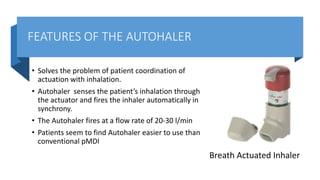
FEATURES OF THE AUTOHALER
• Solves the problem of patient coordination of
actuation with inhalation.
• Autohaler senses the patient’s inhalation through
the actuator and fires the inhaler automatically in
synchrony.
• The Autohaler fires at a flow rate of 20-30 l/min
• Patients seem to find Autohaler easier to use than
conventional pMDI
Breath Actuated Inhaler
Type Advantages Disadvantages
Pressurized metered
dose inhaler (pMDI)
•Convenient
•May be less expensive than nebulizer
•Portable
•More efficient than nebulizer
•No drug preparation required
•Difficult to contaminate
•Dose counter with some devices
•Patient coordination
essential
•Patient actuation required
•Large pharyngeal deposition
•Difficult to deliver high doses
•Not all medications available
pMDI with holding
chamber
•Less patient coordination required
•Less pharyngeal deposition
•More expensive than pMDI
alone
•Less portable than pMDI
alone
DRY POWDER INHALERS (DPI)
• Dry powder inhalers (DPIs)
create medication aerosols by
drawing air through a dose of
powdered medication.
• DPIs vary in the use of carrier
molecules, internal resistance
to airflow, threshold inspiratory
flow needed for deaggregation
of powder, particle size, and
susceptibility to clumping in
high ambient humidity.
SINGLE DOSE MULTI DOSE
Reservoir
Discrete
Novolizer
Revolizer Rotahaler
Lupihaler
Redihaler
Multihaler
Accuhaler Turbohaler
CLASSIFICATION OF DPIS
DRY POWDER INHALERS (DPI)
• Carrier molecules – The micronized particles are either in the form of loose aggregates or they are bound to
larger carrier particles (usually lactose or glucose). To facilitate deposition in the lungs, drug particles are
deagglomerated during inhalation.
• Internal resistance to airflow – The internal resistance to airflow varies among DPIs over a broad range. The
turbulent energy created during inhalation is the product of the patient’s inhalation flow multiplied by the
DPI’s resistance. Thus, a DPI with a high resistance will require a lower inhalation flow to achieve a similar
pressure difference, than a DPI with a lower resistance.
DRY POWDER INHALERS (DPI)
• Threshold inspiratory flow – For each DPI there is a minimum turbulent energy that
must be achieved for sufficient deaggregation of the powder during an inhalation.
• Particle size – DPIs produce aerosols in which most of the drug particles are in the
respirable range; however, the distribution of particle sizes differs significantly among
the various DPIs.
• Humidity – High ambient humidity produces clumping of the powder, creating larger
particles that are not as effectively aerosolized.
• Patients should be instructed to exhale before inhaling through their DPI device.
They should not exhale into the device, but rather exhale into the room.
HOW DPI’S WORK?
• Respir Care 2005;50(9):1209–1227
Type Advantages Disadvantages
Dry powder
inhaler (DPI)
•Less patient coordination
required
•Convenient
•Propellant not required
•Portable
•Breath-actuated
•Dose counter
•Requires moderate to high inspiratory flow
•Some units are single dose and need daily
loading
•Can result in high pharyngeal deposition
•Not all medications available
•Cannot be used effectively in mechanically
ventilated patients
SOFT MIST INHALERS
• Soft mist inhalers are aerosol delivery devices that have
been formulated to aerosolize solutions through
microelectronic dosimetric systems.
• When an SMI is manually primed a measured amount
of drug solution is drawn up into the dosing system.
Pressing a button releases the spring, and the buildup
of pressure forces the liquid through a nozzle structure
within a uniblock that has two narrow outlet channels
etched using microchip technology.
• The two jets of solution converge and the impact
generates a soft mist aerosol for approximately 1.2
seconds.
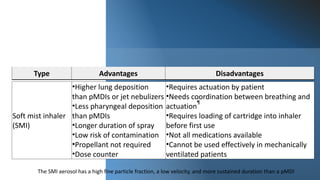
Type Advantages Disadvantages
Soft mist inhaler
(SMI)
•Higher lung deposition
than pMDIs or jet nebulizers
•Less pharyngeal deposition
than pMDIs
•Longer duration of spray
•Low risk of contamination
•Propellant not required
•Dose counter
•Requires actuation by patient
•Needs coordination between breathing and
actuation
¶
•Requires loading of cartridge into inhaler
before first use
•Not all medications available
•Cannot be used effectively in mechanically
ventilated patients
The SMI aerosol has a high fine particle fraction, a low velocity, and more sustained duration than a pMDI
NEBULISATION - INTRODUCTION
• Process of dispersing a liquid (medication) into microscopic particles and
delivering into lungs as patient inhales
• Nebulizers convert solutions or suspensions into aerosols with a particle
size that can be inhaled into the lower respiratory tract.
• An important component of treatment for many respiratory disorders
• Include delivery of medication directly to the site of action, potentially
faster onset of action, and reduced systemic availability to minimize
adverse effects of the medication.
USES
• Inhaled beta agonist and muscarinic antagonist (anticholinergic) bronchodilators
for chronic obstructive lung diseases (eg, asthma, COPD, bronchiectasis,
bronchiolitis)
• Inhaled corticosteroids or ICS for asthma, eosinophilic bronchitis, and COPD
• Inhaled antibiotics for prevention of Pneumocystis pneumonia and treatment of
respiratory syncytial virus, cystic fibrosis, and bronchiectasis
• Airway secretion modifying agents for cystic fibrosis
• Inhaled pulmonary vasodilators for pulmonary hypertension
• Aerosol delivery of drugs (eg, opiates, insulin, levodopa, loxapine) may be used to
treat some non respiratory diseases
NEBULIZERS
• The three basic types of nebulizer devices are jet (also known as
pneumatic), ultrasonic, and mesh.
• Nebulizer performance is affected by both technical and patient-related
factors
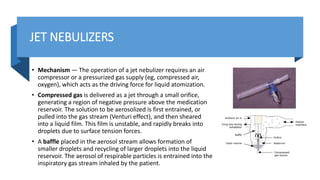
JET NEBULIZERS
• Mechanism — The operation of a jet nebulizer requires an air
compressor or a pressurized gas supply (eg, compressed air,
oxygen), which acts as the driving force for liquid atomization.
• Compressed gas is delivered as a jet through a small orifice,
generating a region of negative pressure above the medication
reservoir. The solution to be aerosolized is first entrained, or
pulled into the gas stream (Venturi effect), and then sheared
into a liquid film. This film is unstable, and rapidly breaks into
droplets due to surface tension forces.
• A baffle placed in the aerosol stream allows formation of
smaller droplets and recycling of larger droplets into the liquid
reservoir. The aerosol of respirable particles is entrained into the
inspiratory gas stream inhaled by the patient.
MESH NEBULIZERS
• The solution or suspension of medication is forced
through the mesh to produce an aerosol, without need
for an internal baffling system or compressed air
source.
• A common feature of these devices is their ability to
generate aerosols with a high fine-particle fraction,
which results in more efficient drug delivery compared
to conventional nebulizers
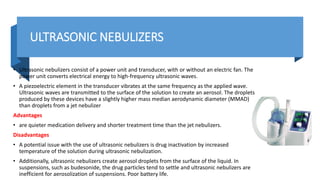
ULTRASONIC NEBULIZERS
• Ultrasonic nebulizers consist of a power unit and transducer, with or without an electric fan. The
power unit converts electrical energy to high-frequency ultrasonic waves.
• A piezoelectric element in the transducer vibrates at the same frequency as the applied wave.
Ultrasonic waves are transmitted to the surface of the solution to create an aerosol. The droplets
produced by these devices have a slightly higher mass median aerodynamic diameter (MMAD)
than droplets from a jet nebulizer
Advantages
• are quieter medication delivery and shorter treatment time than the jet nebulizers.
Disadvantages
• A potential issue with the use of ultrasonic nebulizers is drug inactivation by increased
temperature of the solution during ultrasonic nebulization.
• Additionally, ultrasonic nebulizers create aerosol droplets from the surface of the liquid. In
suspensions, such as budesonide, the drug particles tend to settle and ultrasonic nebulizers are
inefficient for aerosolization of suspensions. Poor battery life.
FACTORS AFFECTING DRUG DELIVERY
• Respirable dose – The most important characteristic of nebulizer performance is the respirable dose delivered to the
patient. Droplet size is usually reported as mass median aerodynamic diameter
• Droplet size should be 2 to 5 μm for airway deposition (eg, bronchodilator administration) and 1 to 2 μm or smaller
for parenchymal deposition (eg, drugs intended for absorption into the bloodstream such as pulmonary
vasodilators).
• Nebulization time – Nebulization time, the time required to deliver a dose of medication, is determined by the
volume of drug to be delivered and the flow of the driving gas into the nebulizer.
• Nebulization time is an important determinant of patient compliance with completing a full dose in the outpatient
setting.
• During nebulization, the solution within the nebulizer becomes increasingly concentrated as water evaporates from
the solution. Thus, on a per breath basis, more medication is delivered late in the course of a treatment.
• Patients should be encouraged to continue the treatment until there is no further pooling of medication in the
bottom of the reservoir; reservoir sputtering is a good sign that the treatment is complete.
Factors affecting drug delivery
• Dead volume – The volume of medication trapped inside the nebulizer, and
therefore not available for inhalation, is referred to as the dead volume of the
device. The dead volume is typically in the range of 1 to 3 mL. Increasing the
amount of solution within the nebulizer (the fill volume) reduces the
proportion of the dose lost as dead volume. Although nebulizer output
increases with a greater fill volume, this also results in an increase in
nebulization time
When combining drug solutions in the nebulizer to minimize the time required
for treatment, it is important to avoid a drug volume that exceeds the labelled
maximum volume of the nebulizer and to avoid any incompatibility issues of the
drugs.
FACTORS AFFECTING DRUG DELIVERY
• Driving gas – Increasing the flow of the driving gas results in an increase in nebulized output and a
reduction in particle size. A flow of 6 to 8 L/min is usually selected to optimize drug delivery.
• Gas density – The density of the gas powering the nebulizer affects nebulizer performance. For
example, the inhaled mass of salbutamol is significantly reduced when a nebulizer is powered with a
mixture of helium and oxygen (heliox). Accordingly, in the rare situation that the nebulizer is powered
with heliox, the flow to the nebulizer is increased by 50 percent to 9 to 12 L/min.
• Breathing pattern – The breathing pattern of the patient affects the amount of aerosol deposited in
the lower respiratory tract. Airflow obstruction increases the need for inhaled bronchodilator therapy,
but can decrease the effectiveness of that treatment. To improve aerosol penetration and deposition
in the lungs, the patient should be encouraged to use a slow breathing pattern with a normal tidal
volume and an occasional deep breath
• Nebulizer/compressor combination – Matching a nebulizer with a compressor is important for optimal
performance and to ensure that the aerosol produced is therapeutic.
ENHANCED NEBULIZER DESIGNS
• Newer technologies for nebulizer design address
issues of medication conservation, speed of
delivery of medication, portability, battery power,
and administration of specialized medications.
• With the traditional nebulizer design, an aerosol
is generated throughout the patient's respiratory
cycle.
• This results in considerable waste of aerosol
during exhalation. Newer designs reduce aerosol
waste during the exhalation phase
Type Advantages Disadvantages
Jet nebulizer
•Patient coordination not required
•High doses possible
•May be more expensive than pMDI
•More time required
•Contamination possible
•Device preparation required before treatment
•Not all medications available
•Less efficient than other devices (dead volume loss)
Mesh nebulizer
(eg, Aeroneb, eFlow,
Omron MicroAir, I-neb)
•Patient coordination not required
•High doses possible
•Quiet
•Faster delivery than jet nebulizer
•Portable, battery operated
•Expensive
•Contamination possible
•Device preparation required before treatment
•Cleaning required after dose
•Not all medications available
Ultrasonic nebulizer
(eg, OPTI-NEB, Beetle
Neb, Lumiscope,
MiniBreeze)
•Patient coordination not required
•High doses possible
•Small dead volume
•Quiet
•No drug loss during exhalation
•Faster delivery than jet nebulizer
•Expensive
•Contamination possible
•Prone to malfunction
•Device preparation required before treatment
•Cannot use with medications in suspension (eg,
budesonide)
AEROSOL THERAPY
• Administration of medication aerosols by pMDI or nebulizer to a spontaneously
breathing patient with a tracheostomy tube requires use of adaptive devices
• For mechanically-ventilated patients who require aerosol medication, we
suggest the use of pMDIs, combined with a specialized spacer that is placed in
the ventilator tubing, or a mesh nebulizer, rather than a jet nebulizer . The
pMDI method is technically easier than jet nebulizer treatments, involves less
personnel time, provides a reliable dose of the drug, and reduces the risk of
bacterial contamination that can occur with a nebulizer.
• Inhaled medications can also be delivered effectively to patients receiving non
invasive positive pressure ventilation (NIV).
SPECIAL SITUATIONS
• Patients with tracheostomy — Techniques have been developed for the delivery of
aerosol medication by nebulizer or pMDI to patients with a tracheostomy tube who are
not ventilator dependent
• Two systems are available for delivery of nebulized medication: either a mask can be
placed over the tracheostomy opening or the nebulizer chamber can be attached to
the tracheostomy tube using a T-piece made of ventilator tubing and a connector.
• The T-piece approach is preferred because more aerosol medication is directed into
the tracheostomy tube. For delivery of a pMDI aerosol, the canister is removed from its
usual plastic actuator and inserted into an actuator/spacer that is attached by T shaped
connector to the tracheostomy tube. This actuator/spacer is the same as that used for
patients on mechanical ventilation
• The caregiver actuates the pMDI into the spacer and the patient inhales the aerosol
through the tracheostomy tube. Adaptors have not been developed for effective
administration of medication from DPIs into tracheostomy tubes.
Inline metered dose
inhaler spacing device
SPECIAL SITUATIONS
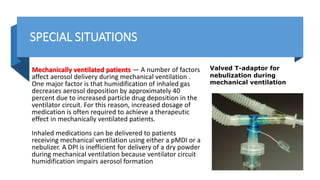
Mechanically ventilated patients — A number of factors
affect aerosol delivery during mechanical ventilation .
One major factor is that humidification of inhaled gas
decreases aerosol deposition by approximately 40
percent due to increased particle drug deposition in the
ventilator circuit. For this reason, increased dosage of
medication is often required to achieve a therapeutic
effect in mechanically ventilated patients.
Inhaled medications can be delivered to patients
receiving mechanical ventilation using either a pMDI or a
nebulizer. A DPI is inefficient for delivery of a dry powder
during mechanical ventilation because ventilator circuit
humidification impairs aerosol formation
Valved T-adaptor for
nebulization during
mechanical ventilation
SPECIAL SITUATIONS
• The heat and moisture exchange (HME)
selection device uses a rotating collar to allow
switching from HME mode for heat and moisture
exchange to AEROSOL mode without opening
the ventilator circuit. In HME mode, the unit
functions as a heat and moisture exchanger. In
AEROSOL mode, the heat and moisture function
is bypassed for administration of an aerosolized
or MDI medication.
SPECIAL SITUATIONS
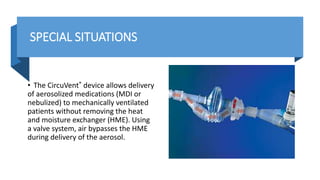
• The CircuVent® device allows delivery
of aerosolized medications (MDI or
nebulized) to mechanically ventilated
patients without removing the heat
and moisture exchanger (HME). Using
a valve system, air bypasses the HME
during delivery of the aerosol.
SPECIAL SITUATIONS
Patients receiving noninvasive ventilation — Aerosol therapy can
also be administered during noninvasive positive pressure
ventilation (NIV),using devices adapted for inline administration .
Effective delivery of salbutamol by MDI during NIV using a
specialized spacer has been reported in patients with
exacerbations of chronic obstructive pulmonary disease (COPD) .
When delivering aerosol therapy during NIV, the aerosol
generator should be placed between the leak port and the
interface.
• . Aerosolized medications, either by nebulizer
or MDI, can be administered during NPPV
CONCLUSION
Clinicians must be aware of inhaler devices
Choose a device that is suitable to the patient (which he likes)
Train him (takes a few minutes)
Check inhaler technique regularly (excellent investment)
THANK YOU
Aerosol Therapy
• For spontaneously breathing patients, pMDIs, DPIs, and nebulizers are all effective for
treatment of asthma and chronic obstructive pulmonary disease (COPD) when used
correctly. Thus, we advise selecting a delivery device based upon the desired beta
agonist or glucocorticoid, convenience, cost, clinician and patient preferences, and the
patient’s ability to use the device correctly
• For patients with a mild to moderate exacerbation of asthma, beta-2 agonists (eg,
salbutamol) may be administered either by nebulizer or by pMDI combined with a spacer
or chamber device. For patients with a severe exacerbation of asthma not requiring
mechanical ventilation, we suggest delivery of inhaled beta-2 agonists by nebulizer
rather than pMDI . Use of a nebulizer for a severe asthma exacerbation may be
intermittent (every 20 to 30 minutes) or continuous.
• Some drug preparations are only approved for delivery with specific nebulizers due to
factors such as preventing contamination of the ambient environment, achieving greater
precision in dosing, or preventing medication degradation by the aerosol technology.
Examples of medications requiring specific nebulizers include budesonide, iloprost,
pentamidine, ribavirin, DNase I, tobramycin, aztreonam, treprostinil, glycopyrrolate and
liposomal amikacin
Factors affecting drug delivery through
spacers
• Size: The optimum size of a spacer for a young child is
approximately 250-300 ml while the adults can use both
small as well as large volume spacers.
• Shape: The shape should be close to the shape of aerosol
plume discharged from the pMDI.
• Electrostatic charge: Electrostatic charge is a commonly
reported cause of inconsistent medication delivery from a
spacer. An non static spacer significant improves the lung
deposition.
• Multiple actuations: Preferable to fire one puff at at time in
the spacer
• Inhalation delay: Spacers with a longer aerosol half life may
be preferred
S A Respir J 1998; 4: 25 Swiss Med Wkly 2001; 131: 14-18 Eur Respir J 1999; 13: 673-678
Special Situations
iNeb nebulizer showing device and principle of operation
Adaptive Aerosol Delivery
Drug name(s) Age range approved Preparation(s)* Adult dose Pediatric dose
Short-acting, inhaled beta-2 agonists
Salbutamol
Salbutamol HFA
¶
≥4 years old MDI: 90 mcg/puff
2 puffs every 4 to 6 hours
as needed
2 puffs every 4 to 6 hours
as needed
Salbutamol DPI
¶
≥4 years old DPI: 90 mcg/actuation
2 inhalations every 4 to 6
hours, as needed
2 inhalations every 4 to 6
hours, as needed
Salbutamol solution for
nebulization
≥2 years old
Nebulizer solutions:
0.021% (0.63 mg/3 mL)
0.042% (1.25 mg/3 mL)
0.083% (2.5 mg/3 mL)
0.5% (2.5 mg/0.5 mL)
concentrate
2.5 mg every 4 to 6 hours
as needed
0.1 to 0.15 mg/kg every 4
to 6 hours as needed
Levosalbutamol
LevoSalbutamol HFA
¶
≥4 years old 45 mcg/puff
2 puffs every 4 to 6 hours
as needed
1 to 2 puffs every 4 to 6
hours as needed
LevoSalbutamol solution
for nebulization
≥6 years old
Nebulizer solution:
0.31/3 mL
0.63/3 mL
1.25 mg/3 mL
1.25 mg/0.5 mL
concentrate
0.63 to 1.25 mg, 2 to 4
times daily, as needed
0.31 mg, 2 to 4 times
daily, as needed
Usual doses of short-acting beta-2 agonists
Usual doses of - ICS
Drug Low dose Medium dose High dose
Beclomethasone HFA 80 to 160 mcg >160 to 320 mcg >320 mcg
40 mcg per puff 2 to 4 puffs
80 mcg per puff 1 to 2 puffs 3 to 4 puffs >4 puffs
Beclomethasone HFA
Δ
100 to 200 mcg >200 to 400 mcg >400 mcg
50 mcg per puff 2 to 4 puffs
100 mcg per puff 1 to 2 puffs 3 to 4 puffs >4 puffs
Budesonide DPI 180 to 360 mcg >360 to 720 mcg >720 mcg
90 mcg per inhalation 2 to 4 inhalations
180 mcg per inhalation 1 to 2 inhalations 3 to 4 inhalations >4 inhalations
Budesonide DPI
Δ
200 to 400 mcg >400 to 800 mcg >800 mcg
100 mcg per inhalation 2 to 4 inhalations
200 mcg per inhalation 1 to 2 inhalations 3 to 4 inhalations
400 mcg per inhalation 1 inhalation 2 inhalations >2 inhalations
Fluticasone propionate HFA 88 to 220 mcg >220 to 440 mcg >440 mcg
44 mcg per puff 2 to 5 puffs
110 mcg per puff 1 to 2 puffs 3 to 4 puffs
220 mcg per puff 2 puffs >2 puffs
Medication Low dose Medium dose High dose
Budesonide-formoterol HFA
80 mcg-4.5 mcg 2 puffs twice a day
160 mcg-4.5 mcg 2 puffs twice a day
Fluticasone propionate-salmeterol DPI
100 mcg-50 mcg 1 inhalation twice a day
250 mcg-50 mcg 1 inhalation twice a day
500 mcg-50 mcg 1 inhalation twice a day
Usual Doses Of LABA + ICS
Combination long-acting muscarinic antagonist/long-
acting beta agonist inhalers for COPD
Agents Dosing
Combination long-acting muscarinic antagonist/long-acting beta agonist inhalers
Glycopyrrolate 15.6 mcg/indacaterol 27.5 mcg 1 capsule (inhalation only) twice daily; DPI
Glycopyrrolate 50 mcg/indacaterol 110 mcg 1 capsule (inhalation only), once daily; DPI
Glycopyrrolate 9 mcg/formoterol 4.8 mcg 2 inhalations twice daily; pMDI
AEROSOL DELIVERY IN SPECIAL SITUATIONS
Medication Specialized nebulizer Comments
Amikacin Lamira mesh nebulizer
Aztreonam Mesh: Altera Nebulizer System
Budesonide Jet or mesh nebulizers, but NOT ultrasonic
Ultrasonic nebulizers cannot be used for
budesonide
Dornase alpha (DNase)
Jet: Pulmo-Aide, Pari-Proneb, Mobilaire, Porta-
Neb, Pari-Baby
Glycopyrrolate* Magnair mesh nebulizer
Iloprost
Jet: Prodose AAD (respironics)
Mesh: I-neb AAD (respironics)
Specialized nebulizer needed for accurate
dosing
Pentamidine Jet: Respirgard II
Small volume, one-way valve to prevent
contamination of ambient environment
Ribavirin
Jet: Viratek Small-Particle Aerosol Generator
(SPAG-2)
Small particle size; scavenging system to
minimize contamination of the ambient
environment
Tobramycin Jet: PARI-LC PLUS
Treprostinil Ultrasonic: Optineb
Specialized nebulizer needed for accurate
dosing
Special Situations
• Acute asthma exacerbation — Two issues that arise when choosing an aerosol delivery system for bronchodilator
medication during exacerbations of asthma are whether to use an MDI or a nebulizer and whether to use continuous or
intermittent nebulization for hospital based treatment. These choices are typically based on the severity of the
exacerbation and also clinician and patient preference (algorithm 1). For patients who have an asthma exacerbation that is
mild to moderate in severity (eg, mild to no dyspnea at rest and peak expiratory flow ≥40 percent of predicted),
administration of the beta 2-agonist albuterol via a pMDI (2 to 6 puffs for treatment at home, 4 to 8 puffs for emergency
room or hospital treatment) combined with a spacer or chamber device (eg, Aerochamber, Optichamber Diamond, Vortex)
results in comparable improvements in lung function compared to nebulizer delivery, although the actual dose delivered
by a pMDI is much lower (table 2). Similar results with pMDIs have been reported in patients with severe exacerbations,
but only a small number of such patients have been studied. Generally, nebulizer treatments (every 20 minutes or
continuous) are preferred for more severe asthma exacerbations. (See "Acute exacerbations of asthma in adults:
Emergency department and inpatient management", section on 'Nebulizer versus MDI'.) For patients with severe asthma
exacerbations (eg, dyspnea at rest, accessory muscle use, retractions, forced expiratory volume in one second or peak
expiratory flow <40 percent predicted), beta agonists are often administered continuously (eg, albuterol 5 to 15 mg/hour)
rather than intermittently [16,88,89]. This method of bronchodilator administration is equally effective compared to
frequent intermittent nebulization [8,90]. Several studies have established the safety of continuous nebulization, even
when high doses (eg, 20 mg/hour of albuterol) are used [42,88,91]. However, continuous nebulization of albuterol (10
mg/hour) in healthy adults has been associated with a decrease in serum potassium of 0.5 mEq/L (95% CI: -0.72 to -0.28
mEq/L), which could be clinically important in patients with a low potassium level prior to therapy [92]. Continuous
nebulization may be most beneficial in patients with the most severe pulmonary dysfunction [88]. The specialized delivery
systems adapted for continuous nebulization are described above. (See 'Continuous nebulization' above.)
• Metered dose inhaler — A special actuator is needed to adapt the pMDI
into the ventilator circuit (picture 7) [107,108]. The size, shape, and design
of these actuators have a major impact on drug delivery to the patient. A
pMDI with a chamber results in a four- to six-fold greater delivery of
aerosol than MDI actuation into a connector attached directly to the
endotracheal tube, or into an in-line device that lacks a chamber [98].
When using a pMDI during mechanical ventilation, it is important to
synchronize actuation with inspiratory airflow to optimize drug delivery.
Properly used, a pMDI may deliver a more consistent dose than a nebulizer
[109]. The following technique has been proposed for using pMDIs in
mechanically ventilated adult patients [110]: Revefenacin - (Yupelri)
inhalation solution is the only once-daily, nebulized bronchodilator for
maintenance treatment of COPD [85,86]. Revefenacin is a LAMA and is
nebulized with a standard jet nebulizer connected to a compressor. (See
"Role of anticholinergic therapy in COPD", section on 'Revefenacin'.)
• Amikacin – Amikacin (Arikayce) liposome inhalation suspension is delivered once daily with the Lamira mesh nebulizer system.
During nebulization, approximately 70 percent of the amikacin dose remains encapsulated within liposomes while approximately
30 percent of the dose is released as free amikacin. Nebulized amikacin is indicated only for patients with refractory disease
caused by Mycobacterium avium complex (MAC) who have limited or no alternative treatment options [87]. (See "Treatment of
Mycobacterium avium complex lung infection in adults", section on 'Efficacy of alternative agents'. ● Shake the pMDI vigorously
• ● Place canister in the actuator of a cylindrical spacer situated in the inspiratory limb of ventilator circuit (picture 7)
• ● Actuate the pMDI once only with the onset of inspiration by the ventilator
• ● Repeat actuations after 15 seconds until the total dose is delivered
• Helium-oxygen mixtures affect aerosol deposition, and in vitro modeling has reported a 50 percent increase in deposition of
albuterol from a pMDI during mechanical ventilation when heliox was used as the driving gas [111]. However, heliox can interfere
with the functioning of flow sensors and oxygen levels when delivered through some ventilators, and care must be taken if this
approach is employed with a ventilator that is not approved for heliox administration [112-114]. (See "Physiology and clinical use
of heliox", section on 'Instrument recalibration'.)
• The use of a heat and moisture exchanger (HME) in the ventilator circuit can filter out the aerosol when a pMDI (or nebulizer) is
used. Commercially available devices can be used to bypass the HME when a pMDI is used (picture 8 and picture 9). Alternatively,
the HME must be removed from the circuit when the aerosol is delivered [115].
• Nebulizer — The optimal methods for delivery of nebulized medication to mechanically ventilated patients are not well-
established. Delivery of a large tidal volume, use of an end-inspiratory pause, and use of a slow inspiratory flow affect aerosol
delivery by jet nebulizer but not by a pMDI [95].
• Nebulizer performance can be optimized by placing the nebulizer 30 cm from the endotracheal tube, rather than at the Y-piece,
because the inspiratory ventilator tubing acts as a spacer. In a simulation model, delivery of albuterol via mesh nebulizer was two
to four times greater than with a jet nebulizer, and placement of the mesh nebulizer in the ventilator tubing on the ventilator side
of the humidifier, rather than closer to the patient, increased drug delivery [100].
• Operating the nebulizer only during inspiration is more efficient for aerosol delivery compared with continuous aerosol generation
throughout the respiratory cycle. When a breath-actuated nebulizer is used, the delivered dose increases by more than five-fold.
In addition, when the humidifier is bypassed the delivered dose increases by a factor of nearly four [96].
• Disadvantages of jet nebulizer use during mechanical ventilation include circuit contamination due to interrupting the ventilator
tubing circuit, decreased ability of the patient to trigger the ventilator, and the associated increases in tidal volume and airway
pressure due to nebulizer flow. Valved T-piece devices are commercially available and commonly used to allow the nebulizer to be
inserted within the ventilator circuit without disconnecting the patient from the ventilator, thus avoiding interruption of
mechanical ventilation for nebulizer insertion and removal
• The mesh nebulizer can be used effectively during mechanical ventilation and is placed between the ventilator outlet and the
heated humidifier Unlike the jet nebulizer, the mesh nebulizer remains in the ventilator circuit and does not interfere with
ventilator function (eg, no additional gas flow, no effect on triggering). (See 'Mesh nebulizers' above.)
• Choice of device — Although the jet nebulizer is less efficient than the pMDI during
mechanical ventilation, the nebulizer can deliver a greater cumulative dose to the lower
respiratory tract [117]. Thus, nebulizers and pMDIs produce similar therapeutic effects in
mechanically ventilated patients [118]. The use of a pMDI for routine bronchodilator
therapy in ventilator-supported patients has been preferred because of the problems
associated with the use of nebulizers, including contamination and triggering difficulty, as
well as increased pressure and volume delivery. However, use of a mesh nebulizer avoids
several of the problems of the jet nebulizer and performs comparably to pMDIs.
Compared with the pMDI, the mesh nebulizer is a convenient and efficient delivery
method in mechanically ventilated patients [119].
• Aerosol delivery by pMDI is easy to administer, involves less personnel time than a
nebulizer, provides a reliable dose of the drug, and is free from the risk of bacterial
contamination. When a pMDI is used with an in-line spacer, the ventilator circuit does
not need to be disconnected with each treatment; this may reduce the risk of ventilator-
associated pneumonia. This also prevents the loss of positive end-expiratory pressure
(PEEP) in patients with acute lung injury (ALI) and acute respiratory distress syndrome
(ARDS).
• Patients using high flow nasal cannula — The high flow nasal cannula is
increasingly used for hypoxemic respiratory failure and can also be used for
aerosol delivery in the intensive care unit (ICU) [126,127]. The results of in
vitro studies suggest that aerosols can be delivered by HFNC, and there is
anecdotal experience suggesting benefit [65]. At high flows, the amount of
aerosol delivery is likely to be very low [65,66]. In one study, pulmonary
drug delivery through the high-flow nasal cannula was about 1 to 4 percent
of the amount placed in the nebulizer, with a higher efficiency for a mesh
nebulizer than a jet nebulizer [17]. However, in a separate study of 26
subjects with COPD, the physiologic response to inhaled bronchodilator
was similar for mouthpiece and nasal cannula at a flow of 35 L/minute
[128]. The lower deposition with high flow nasal cannula might also be
overcome by increasing the dose [65]. A pMDI, SMI, or DPI device cannot
be used with high flow nasal cannula
• Home use — Prescription of a nebulizer for home use is usually not necessary for patients with asthma or COPD due to the
efficacy of pMDIs and DPIs for delivery of bronchodilator medications. However, some patients (eg, those with difficulty mastering
the technique of pMDIs) may have a better response to a nebulizer. The decision to prescribe a nebulizer for home use is made on
a case-by-case basis. Careful instructions are provided regarding indications for coming to the emergency department if one or two
nebulizer treatments do not result in reduced symptoms. Typically, jet nebulizers are provided for patients with asthma or COPD
unless the patient is willing to pay extra for a smaller, more portable mesh nebulizer. For patients requiring specialized medications
such as budesonide suspension, iloprost, pentamidine, ribavirin, DNase I, tobramycin, aztreonam, and treprostinil the selection of
a nebulizer device depends on the requirements of the particular medication, as described above.
• With a jet nebulizer, the patient also needs an air compressor in addition to the nebulizer, tubing, and mouthpiece. Although the
nebulizer is disposable, many patients re-use it multiple times before replacing. Proper cleaning and air-drying of the nebulizer
chamber and mouthpiece are needed to prevent bacterial and fungal colonization and also contamination by allergens, such as
dust mites, cockroach, and dander. The plastic tubing and medication chamber should be stored in a plastic bag between uses.
Once or twice a week, the nebulizer (figure 1) should be disassembled, washed in soapy tap water, and disinfected with either a
1.25 percent acetic acid (white vinegar) mixture or a quaternary ammonium compound at a dilution of 1 ounce to 1 gallon of
sterile distilled water. The acetic acid soak should be at least 1 hour, but a quaternary ammonium compound soak needs only 10
minutes. However, patients with asthma should avoid breathing the fumes of these cleaning agents.
• Ultrasonic and mesh nebulizers should be cleaned and disinfected per the manufacturer’s specifications. Acetic acid should not be
reused, but the quaternary ammonium solution can be reused for up to one week.
MDI Amount of Drug Per Actuation
Albuterol sulfate (Ventolin, Proventil, Ventolin HFA, Proventil HFA,
ProAir HFA)**
90 mcg
Beclomethasone dipropionate (QVAR) 40 or 80 mcg
Ciclesonide (Alvesco) 80 or 160 mcg
Cromolyn sodium (Intal) 800 mcg
Flunisolide (AeroBid, AeroBid-M +) 250 mcg
Flunisolide hemihydrate (Aerospan HFA) 80 mcg (78 mcg delivered)
Fluticasone propionate (Flovent HFA) 44, 110, or 220 mcg
Fluticasone propionate/salmeterol xinafoate (Advair HFA) 45, 115, or 230 mcg/21 mcg
Ipratropium bromide (Atrovent HFA) 17 mcg
Ipratropium bromide/albuterol sulfate (Combivent) 18 mcg /90 mcg
Levalbuterol tartrate (Xopenex HFA) 45 mcg
Pirbuterol acetate (Maxair Autohaler) 200 mcg
Mometasone/formoterol (Dulera) 100 or 200 mcg/5 mcg
Triamcinolone acetonide (Azmacort)* 75 mcg
DPI Amount of Drug Delivered
Budesonide (Pulmicort Flexhaler) 90 or 180 mcg (delivers 80 or 160 mcg/inhalation)
Budesonide (Pulmicort Turbuhaler)* --
Budesonide/Formoterol HFA (Symbicort) Delivers 80 or 160 mcg/4.5 mcg per actuation
Fluticasone propionate (Flovent Diskus) 50 mcg/inhalation
Fluticasone propionate/salmeterol xinafoate
(Advair Diskus)
100, 250, or 500 mcg/50 mcg per blister
Formoterol fumarate (Foradil Aerolizer) 12 mcg/capsule
Mometasone furoate (Asmanex Twisthaler) 110 or 220 mcg (delivers 100 or 200 mcg/inhalation)
Salmeterol xinafoate (Serevent Diskus) 50 mcg/blister
Tiotropium bromide (Spiriva HandiHaler) 18 mcg/capsule
Note: DPIs contain dry medication inside; patient's breathing delivers medication to lungs, no propellant
inside; priming not required after activating and loading initial dose; no need to shake device; do not
use with spacer; keep device dry, do not place in water; clean mouthpiece and dry immediately; do not
swallow capsules for inhalation.
* Pulmicort Turbuhaler has been discontinued. Pulmicort Flexhaler has replaced the phased-out
product.
Drug Available concentrations
Albuterol sulfate (Proventil, AccuNeb) 5 mg/mL; 0.63 or 1.25 mg/3 mL
Arformoterol tartrate (Brovana) 15 mcg/2 mL
Budesonide (Pulmicort Respules) 0.25, 0.5, or 1 mg/2 mL
Cromolyn sodium (Intal) 20 mg/2 mL
Formoterol fumarate (Perforomist) 20 mcg/2 mL
Ipratropium bromide 500 mcg/2.5 mL
Ipratropium bromide/albuterol sulfate
(DuoNeb)
0.5 mg/2.5 mg/3 mL
Levalbuterol hydrochloride (Xopenex) 0.31, 0.63, or 1.25 mg/3 mL; 1.25 mg/0.5 mL
Type Advantages Disadvantages
Jet nebulizer*
•Patient coordination not required
•High doses possible
•May be more expensive than pMDI
•More time required
•Contamination possible
•Device preparation required before treatment
•Not all medications available
•Less efficient than other devices (dead volume loss)
Mesh nebulizer
(eg, Aeroneb, eFlow, Omron MicroAir, I-neb)
•Patient coordination not required
•High doses possible
•Quiet
•Faster delivery than jet nebulizer
•Portable, battery operated
•Expensive
•Contamination possible
•Device preparation required before treatment
•Cleaning required after dose
•Not all medications available
Ultrasonic nebulizer
(eg, OPTI-NEB, Beetle Neb, Lumiscope, MiniBreeze)
•Patient coordination not required
•High doses possible
•Small dead volume
•Quiet
•No drug loss during exhalation
•Faster delivery than jet nebulizer
•Expensive
•Contamination possible
•Prone to malfunction
•Device preparation required before treatment
•Cannot use with medications in suspension (eg,
budesonide)
Pressurized metered dose inhaler (pMDI)
•Convenient
•May be less expensive than nebulizer
•Portable
•More efficient than nebulizer
•No drug preparation required
•Difficult to contaminate
•Dose counter with some devices
•Patient coordination essential
•Patient actuation required
•Large pharyngeal deposition
•Difficult to deliver high doses
•Not all medications available
pMDI with holding chamber
•Less patient coordination required
•Less pharyngeal deposition
•More expensive than pMDI alone
•Less portable than pMDI alone
Dry powder inhaler (DPI)
•Less patient coordination required
•Convenient
•Propellant not required
•Portable
•Breath-actuated
•Dose counter
•Requires moderate to high inspiratory flow
•Some units are single dose and need daily loading
•Can result in high pharyngeal deposition
•Not all medications available
•Cannot be used effectively in mechanically ventilated patients
Soft mist inhaler (SMI)
•Higher lung deposition than pMDIs or jet nebulizers
•Less pharyngeal deposition than pMDIs
•Longer duration of spray
•Low risk of contamination
•Propellant not required
•Dose counter
•Requires actuation by patient
•Needs coordination between breathing and actuation
¶
•Requires loading of cartridge into inhaler before first use
•Not all medications available
•Cannot be used effectively in mechanically ventilated patients
Technique for use of medication
nebulizer
Place patient in a comfortable position (preferably sitting up or partially supine, since there is some risk of spillage if the
patient is lying flat).
Assemble apparatus.
Add medication to nebulizer.
Use a fill volume of 3 to 6 mL.
Attach a compressor or a pressurized gas supply (eg, compressed air or oxygen) with a flow of 6 to 8 L/min.
Instruct patient to breathe through the mouth whether using a mask or mouthpiece. If using a mouthpiece, the patient
can rest teeth on mouthpiece and close lips around it.
Encourage patient to breathe with a slow inspiratory flow and an occasional deep breath.
Periodically tap nebulizer to return impacted droplets to reservoir.
Stop treatment when the nebulizer sputters despite tapping.
Usual doses of - ICS
Budesonide DPI 180 to 360 mcg >360 to 720 mcg >720 mcg
90 mcg per inhalation 2 to 4 inhalations
180 mcg per inhalation 1 to 2 inhalations 3 to 4 inhalations >4 inhalations
Budesonide DPI
Δ
200 to 400 mcg >400 to 800 mcg >800 mcg
100 mcg per inhalation 2 to 4 inhalations
200 mcg per inhalation 1 to 2 inhalations 3 to 4 inhalations
400 mcg per inhalation 1 inhalation 2 inhalations >2 inhalations
Ciclesonide HFA 80 to 160 mcg >160 to 320 mcg >320 mcg
80 mcg per puff 1 to 2 puffs 3 to 4 puffs
160 mcg per puff 1 puff 2 puffs >2 puffs
Ciclesonide HFA
Δ
100 to 200 mcg >200 to 400 mcg >400 mcg
100 mcg per puff 1 to 2 puffs 3 to 4 puffs
200 mcg per puff 1 puff 2 puffs >2 puffs
Flunisolide MDI 320 mcg >320 to 640 mcg Insufficient data
80 mcg per puff 4 puffs 5 to 8 puffs Insufficient data
Fluticasone propionate HFA 88 to 220 mcg >220 to 440 mcg >440 mcg
44 mcg per puff 2 to 5 puffs
110 mcg per puff 1 to 2 puffs 3 to 4 puffs
220 mcg per puff 2 puffs >2 puffs
Drug Low dose Medium dose High dose
Beclomethasone HFA
(Qvar and Qvar RediHaler products availablein United States)*
80 to 160 mcg >160 to 320 mcg >320 mcg
40 mcg per puff 2 to 4 puffs ¶ ¶
80 mcg per puff 1 to 2 puffs 3 to 4 puffs >4 puffs
Beclomethasone HFA
Δ
(Qvar product availablein Canada, Europe, and elsewhere)
100 to 200 mcg >200 to 400 mcg >400 mcg
50 mcg per puff 2 to 4 puffs ¶ ¶
100 mcg per puff 1 to 2 puffs 3 to 4 puffs >4 puffs
Budesonide DPI
(Pulmicort Flexhaler product availablein United States)*
180 to 360 mcg >360 to 720 mcg >720 mcg
90 mcg per inhalation 2 to 4 inhalations ¶ ¶
180 mcg per inhalation 1 to 2 inhalations 3 to 4 inhalations >4 inhalations
Budesonide DPI
Δ
(Pulmicort Turbuhaler productavailablein Canada, Europe, and elsewhere)
200 to 400 mcg >400 to 800 mcg >800 mcg
100 mcg per inhalation 2 to 4 inhalations ¶ ¶
200 mcg per inhalation 1 to 2 inhalations 3 to 4 inhalations ¶
400 mcg per inhalation 1 inhalation 2 inhalations >2 inhalations
Ciclesonide HFA
(Alvesco product availablein United States, Europe, and elsewhere)*
80 to 160 mcg >160 to 320 mcg >320 mcg
80 mcg per puff 1 to 2 puffs 3 to 4 puffs ¶
160 mcg per puff 1 puff 2 puffs >2 puffs
Ciclesonide HFA
Δ
(Alvesco product availablein Canada)
100 to 200 mcg >200 to 400 mcg >400 mcg
100 mcg per puff 1 to 2 puffs 3 to 4 puffs ¶
200 mcg per puff 1 puff 2 puffs >2 puffs
Flunisolide MDI
(Aerospan product availablein United States)*
320 mcg >320 to 640 mcg Insufficient data
80 mcg per puff 4 puffs 5 to 8 puffs Insufficient data
Fluticasone propionate HFA
(Flovent HFA product availablein United States)*
88 to 220 mcg >220 to 440 mcg >440 mcg
44 mcg per puff 2 to 5 puffs ¶ ¶
110 mcg per puff 1 to 2 puffs 3 to 4 puffs ¶
220 mcg per puff ◊ 2 puffs >2 puffs
Fluticasone propionate HFA
Δ
(Flovent HFA product availablein Canada, Europe, and elsewhere)
100 to 250 mcg >250 to 500 mcg >500 mcg
50 mcg per puff 2 to 5 puffs ¶ ¶
125 mcg per puff 1 to 2 puffs 3 to 4 puffs ¶
250 mcg per puff ◊ 2 puffs >2 puffs
Fluticasone propionate DPI
(Flovent Diskusproductavailablein United Statesand Canada)*
100 to 250 mcg >250 to 500 mcg >500 mcg
50 mcg per inhalation 2 to 5 inhalations ¶ ¶
100 mcg per inhalation 1 to 2 inhalations 3 to 5 inhalations ¶
250 mcg per inhalation 1 inhalation 2 inhalations >2 inhalations
500 mcg per inhalation (strengthnotavailablein United States) ◊ 1 inhalation >1 inhalation
Fluticasone propionate DPI
(Armonair Respiclick product availablein United States)*
100 to 250 mcg >250 to 500 mcg >500 mcg
55 mcg per inhalation 2 to 4 inhalations ¶ ¶
113 mcg per inhalation 1 to 2 inhalations 3 to 4 inhalations >4 inhalations
232 mcg per inhalation 1 inhalation 2 inhalation >2 inhalations
Fluticasone furoate DPI
(Arnuity Ellipta productavailablein United States)*
NOTE: Inhaled fluticasonefuroatehas a greater anti-inflammatory potency per microgram than fluticasonepropionateinhalers. Thus, fluticasonefuroateis administered at a lower daily doseand used only oncedaily.
50 mcg (by useof pediatric DPI, which is off-label in adolescents and adults) 100 mcg 200 mcg
50 mcg per inhalation 1 inhalation ¶ ¶
100 mcg per inhalation ◊ 1 inhalation 2 inhalations
200 mcg per actuation ◊ ◊ 1 inhalation
Mometasone DPI
§
(Asmanex DPI product availablein United States)*
110 to 220 mcg >220 to 440 mcg >440 mcg
110 mcg per inhalation 1 to 2 inhalations ¶ ¶
220 mcg per inhalation 1 inhalation 2 inhalations >2 inhalations
Mometasone HFA
§
(Asmanex HFA productavailablein United States)*
100 to 200 mcg >200 to 400 mcg >400 mcg
100 mcg per actuation 1 to 2 inhalations ¶ ¶
200 mcg per actuation 1 inhalation 2 inhalations >2 inhalations
Mometasone DPI
Δ§
(Asmanex Twisthaler product availablein Canada, Europe, and elsewhere)
200 mcg >200 to 400 mcg >400 mcg
200 mcg per inhalation 1 inhalation 2 inhalations >2 inhalations
400 mcg per inhalation ◊ 1 inhalation >1 inhalation
Fluticasone propionate HFA
(Flovent HFA product available in United States)*
88 to 220 mcg >220 to 440 mcg >440 mcg
44 mcg per puff 2 to 5 puffs ¶ ¶
110 mcg per puff 1 to 2 puffs 3 to 4 puffs ¶
220 mcg per puff ◊ 2 puffs >2 puffs
Fluticasone propionate HFA
Δ
(Flovent HFA product available in Canada, Europe, and
elsewhere)
100 to 250 mcg >250 to 500 mcg >500 mcg
50 mcg per puff 2 to 5 puffs ¶ ¶
125 mcg per puff 1 to 2 puffs 3 to 4 puffs ¶
250 mcg per puff ◊ 2 puffs >2 puffs
Fluticasone propionate DPI
(Flovent Diskus product available in United States and
Canada)*
100 to 250 mcg >250 to 500 mcg >500 mcg
50 mcg per inhalation 2 to 5 inhalations ¶ ¶
100 mcg per inhalation 1 to 2 inhalations 3 to 5 inhalations ¶
250 mcg per inhalation 1 inhalation 2 inhalations >2 inhalations
500 mcg per inhalation (strength not available in United
States)
◊ 1 inhalation >1 inhalation
Fluticasone propionate DPI
(Armonair Respiclick product available in United
States)*
100 to 250 mcg >250 to 500 mcg >500 mcg
55 mcg per inhalation 2 to 4 inhalations ¶ ¶
113 mcg per inhalation 1 to 2 inhalations 3 to 4 inhalations >4 inhalations
232 mcg per inhalation 1 inhalation 2 inhalation >2 inhalations
Fluticasone furoate DPI
(Arnuity Ellipta product available in United States)*
50 mcg (by use of pediatric DPI, which is off-label in
adolescents and adults)
100 mcg 200 mcg
50 mcg per inhalation 1 inhalation ¶ ¶
100 mcg per inhalation ◊ 1 inhalation 2 inhalations
200 mcg per actuation ◊ ◊ 1 inhalation
Mometasone DPI
§
110 to 220 mcg >220 to 440 mcg >440 mcg
110 mcg per inhalation 1 to 2 inhalations ¶ ¶
220 mcg per inhalation 1 inhalation 2 inhalations >2 inhalations
Mometasone HFA
§
100 to 200 mcg >200 to 400 mcg >400 mcg
100 mcg per actuation 1 to 2 inhalations ¶ ¶
200 mcg per actuation 1 inhalation 2 inhalations >2 inhalations
Mometasone DPI
Δ§
200 mcg >200 to 400 mcg >400 mcg
200 mcg per inhalation 1 inhalation 2 inhalations >2 inhalations
400 mcg per inhalation ◊ 1 inhalation >1 inhalation
Factors affecting aerosol delivery by nebulizer
Technical factors
Mechanism and manufacturer
Flow rate
Fill volume
Solution characteristics
Characteristics of driving gas
Designs to enhance output
Continuous versus intermittent delivery
Patient factors
Breathing pattern
Nose versus mouth breathing
Artificial airway
Airway obstruction
Positive pressure level
Factors affecting aerosol delivery during
mechanical ventilation
Nebulizer
Position of nebulizer placement in the
circuit
Type of nebulizer and fill volume
Treatment time
Duty cycle (I:E ratio)
Ventilator brand
pMDI
Type of actuator
Timing of actuation
Nebulizer and pMDI
Endotracheal tube size
Humidification of the inspired gas
Nebulisation & Medications.pptx

Nebulisation & Medications.pptx

  • 1.
    Inhalation Devices & Medications Dr.A.Sundararajaperumal M.D (TB& RM) ; D.C.H Professor – Thoracic Medicine Institute Of Thoracic Medicine Madras Medical College & RGGGH Chennai – 600 003
  • 2.
  • 3.
    EARLIEST KNOWN INHALATION • Inhalationof vapor of black henbane (1,554 B.C.) • Egyptian physicians threw this weed onto hot bricks • Alkaloid contents of the plant got vaporized which the breathless patients would inhale
  • 4.
    HISTORY - INHALATION SouthAmerican Tobacco Pipes 2000 Years Ago
  • 5.
    EARLIEST KNOWN INHALATIONTHERAPY IN INDIA The practice of inhaling fumes of stramonium (Datura) and hemp
  • 6.
    THE FIRST ‘INHALER’(1778) • The word inhaler was first used by the English physician John Mudge in 1778, for a pewter tankard for the use of opium vapour to treat cough.
  • 7.
    History • The Sales-Girons“pulverisateur,” which won the 1858 silver prize of the Paris Academy of Science. • The pump handle draws liquid from the reservoir and forces it through an atomize FIRST PRESSURISED INHALER (1858)
  • 8.
    FIRST pMDI March 1956– Launch of the first pMDI (Medihaler-Epi, Medihaler-Iso).
  • 10.
  • 11.
    > 5 Particle size (microns) Regional deposition EfficacySafety Mouth / oesophageal region No clinical effect Absorption from GI tract if swallowed Particle size of drugs in inhaler devices: Hypothesis from available data 2 – 5 Upper / central airways Clinical effect Subsequent absorption from lung < 2 Peripheral airways / alveoli Some local clinical effect High systemic absorption
  • 12.
    Three main mechanisms 1.Inertialimpaction: For larger particles 2.Sedimentation: For the medium size particles. 3.Diffusion: Brownian motion for smaller particles
  • 13.
    Fate of InhaledDrugs Systemic circulation 20% deposited in lung 80% swallowed URINE
  • 14.
    DEVICES FOR TREATMENT OFAIRWAY DISEASE > 65 different inhaled products of more than 20 ingredients ……and many more to come
  • 15.
    Devices - Types •Types and function of devices available for delivery of therapeutic aerosols are reviewed here • pressurized metered dose inhalers (pMDIs), • dry powder inhalers (DPIs), • soft mist inhalers (SMIs), and • nebulizers
  • 16.
    PRESSURIZED METERED DOSEINHALERS (pMDI) • A pMDI consists of a pressurized canister, a metering valve and stem, and a mouthpiece actuator. • The canister contains the drug suspended in a pressurized mixture of propellants, surfactants, preservatives, flavoring agents, and dispersal agents. • The propellent is hydrofluoroalkane (HFA) • Lung deposition ranges between 10 and 40 percent of the nominal dose in adults and is very technique-dependent
  • 17.
    PRESSURIZED METERED DOSEINHALERS (pMDI) • New pMDI technology incorporates micronized drug crystals that are co- suspended with porous phospholipid particles in the HFA propellant. • The drug crystals form strong associations with the porous phospholipid particles, and the drug-to-porous-particle ratios employed minimize drug-drug interactions for multi-drug combinations within a single inhaler. • Unlike conventional HFA pMDIs, no additional excipients, such as co-solvents or suspension stabilizers, are needed. • This co-suspension technology was used in the development of a LAMA/LABA fixed-dose combination of glycopyrronium and formoterol in a pMDI
  • 18.
    PRESSURIZED METERED DOSEINHALERS (pMDI) • Difficulty is precisely coordinating device actuation with inhalation, leads to poor drug delivery, suboptimal disease control, and increased inhaler use • Such problems might be overcome by employing a spacer/valved holding chamber or breath-actuated pMDI.
  • 19.
    MDI WITH SPACER •Decreases oropharyngeal deposition due a reduction in velocity. This reduces local as well as systemic side effects • Overcomes coordination problems • Decreases cold freon effect • Larger particles remain in the spacer while the smaller particles are inhaled • Increases drug deposition in lungs • Recommended esp. : • dose of inhaled steroids > 800 mcg/day • administration of high dose bronchodilators Assembled Unit Inhalation chamber Mouthpiece Canister Dust cap Lock
  • 20.
    FEATURES OF THEAUTOHALER • Solves the problem of patient coordination of actuation with inhalation. • Autohaler senses the patient’s inhalation through the actuator and fires the inhaler automatically in synchrony. • The Autohaler fires at a flow rate of 20-30 l/min • Patients seem to find Autohaler easier to use than conventional pMDI Breath Actuated Inhaler
  • 21.
    Type Advantages Disadvantages Pressurizedmetered dose inhaler (pMDI) •Convenient •May be less expensive than nebulizer •Portable •More efficient than nebulizer •No drug preparation required •Difficult to contaminate •Dose counter with some devices •Patient coordination essential •Patient actuation required •Large pharyngeal deposition •Difficult to deliver high doses •Not all medications available pMDI with holding chamber •Less patient coordination required •Less pharyngeal deposition •More expensive than pMDI alone •Less portable than pMDI alone
  • 22.
    DRY POWDER INHALERS(DPI) • Dry powder inhalers (DPIs) create medication aerosols by drawing air through a dose of powdered medication. • DPIs vary in the use of carrier molecules, internal resistance to airflow, threshold inspiratory flow needed for deaggregation of powder, particle size, and susceptibility to clumping in high ambient humidity.
  • 23.
    SINGLE DOSE MULTIDOSE Reservoir Discrete Novolizer Revolizer Rotahaler Lupihaler Redihaler Multihaler Accuhaler Turbohaler CLASSIFICATION OF DPIS
  • 24.
    DRY POWDER INHALERS(DPI) • Carrier molecules – The micronized particles are either in the form of loose aggregates or they are bound to larger carrier particles (usually lactose or glucose). To facilitate deposition in the lungs, drug particles are deagglomerated during inhalation. • Internal resistance to airflow – The internal resistance to airflow varies among DPIs over a broad range. The turbulent energy created during inhalation is the product of the patient’s inhalation flow multiplied by the DPI’s resistance. Thus, a DPI with a high resistance will require a lower inhalation flow to achieve a similar pressure difference, than a DPI with a lower resistance.
  • 25.
    DRY POWDER INHALERS(DPI) • Threshold inspiratory flow – For each DPI there is a minimum turbulent energy that must be achieved for sufficient deaggregation of the powder during an inhalation. • Particle size – DPIs produce aerosols in which most of the drug particles are in the respirable range; however, the distribution of particle sizes differs significantly among the various DPIs. • Humidity – High ambient humidity produces clumping of the powder, creating larger particles that are not as effectively aerosolized. • Patients should be instructed to exhale before inhaling through their DPI device. They should not exhale into the device, but rather exhale into the room.
  • 26.
    HOW DPI’S WORK? •Respir Care 2005;50(9):1209–1227
  • 27.
    Type Advantages Disadvantages Drypowder inhaler (DPI) •Less patient coordination required •Convenient •Propellant not required •Portable •Breath-actuated •Dose counter •Requires moderate to high inspiratory flow •Some units are single dose and need daily loading •Can result in high pharyngeal deposition •Not all medications available •Cannot be used effectively in mechanically ventilated patients
  • 28.
    SOFT MIST INHALERS •Soft mist inhalers are aerosol delivery devices that have been formulated to aerosolize solutions through microelectronic dosimetric systems. • When an SMI is manually primed a measured amount of drug solution is drawn up into the dosing system. Pressing a button releases the spring, and the buildup of pressure forces the liquid through a nozzle structure within a uniblock that has two narrow outlet channels etched using microchip technology. • The two jets of solution converge and the impact generates a soft mist aerosol for approximately 1.2 seconds.
  • 29.
    Type Advantages Disadvantages Softmist inhaler (SMI) •Higher lung deposition than pMDIs or jet nebulizers •Less pharyngeal deposition than pMDIs •Longer duration of spray •Low risk of contamination •Propellant not required •Dose counter •Requires actuation by patient •Needs coordination between breathing and actuation ¶ •Requires loading of cartridge into inhaler before first use •Not all medications available •Cannot be used effectively in mechanically ventilated patients The SMI aerosol has a high fine particle fraction, a low velocity, and more sustained duration than a pMDI
  • 30.
    NEBULISATION - INTRODUCTION •Process of dispersing a liquid (medication) into microscopic particles and delivering into lungs as patient inhales • Nebulizers convert solutions or suspensions into aerosols with a particle size that can be inhaled into the lower respiratory tract. • An important component of treatment for many respiratory disorders • Include delivery of medication directly to the site of action, potentially faster onset of action, and reduced systemic availability to minimize adverse effects of the medication.
  • 31.
    USES • Inhaled betaagonist and muscarinic antagonist (anticholinergic) bronchodilators for chronic obstructive lung diseases (eg, asthma, COPD, bronchiectasis, bronchiolitis) • Inhaled corticosteroids or ICS for asthma, eosinophilic bronchitis, and COPD • Inhaled antibiotics for prevention of Pneumocystis pneumonia and treatment of respiratory syncytial virus, cystic fibrosis, and bronchiectasis • Airway secretion modifying agents for cystic fibrosis • Inhaled pulmonary vasodilators for pulmonary hypertension • Aerosol delivery of drugs (eg, opiates, insulin, levodopa, loxapine) may be used to treat some non respiratory diseases
  • 32.
    NEBULIZERS • The threebasic types of nebulizer devices are jet (also known as pneumatic), ultrasonic, and mesh. • Nebulizer performance is affected by both technical and patient-related factors
  • 33.
    JET NEBULIZERS • Mechanism— The operation of a jet nebulizer requires an air compressor or a pressurized gas supply (eg, compressed air, oxygen), which acts as the driving force for liquid atomization. • Compressed gas is delivered as a jet through a small orifice, generating a region of negative pressure above the medication reservoir. The solution to be aerosolized is first entrained, or pulled into the gas stream (Venturi effect), and then sheared into a liquid film. This film is unstable, and rapidly breaks into droplets due to surface tension forces. • A baffle placed in the aerosol stream allows formation of smaller droplets and recycling of larger droplets into the liquid reservoir. The aerosol of respirable particles is entrained into the inspiratory gas stream inhaled by the patient.
  • 34.
    MESH NEBULIZERS • Thesolution or suspension of medication is forced through the mesh to produce an aerosol, without need for an internal baffling system or compressed air source. • A common feature of these devices is their ability to generate aerosols with a high fine-particle fraction, which results in more efficient drug delivery compared to conventional nebulizers
  • 35.
    ULTRASONIC NEBULIZERS • Ultrasonicnebulizers consist of a power unit and transducer, with or without an electric fan. The power unit converts electrical energy to high-frequency ultrasonic waves. • A piezoelectric element in the transducer vibrates at the same frequency as the applied wave. Ultrasonic waves are transmitted to the surface of the solution to create an aerosol. The droplets produced by these devices have a slightly higher mass median aerodynamic diameter (MMAD) than droplets from a jet nebulizer Advantages • are quieter medication delivery and shorter treatment time than the jet nebulizers. Disadvantages • A potential issue with the use of ultrasonic nebulizers is drug inactivation by increased temperature of the solution during ultrasonic nebulization. • Additionally, ultrasonic nebulizers create aerosol droplets from the surface of the liquid. In suspensions, such as budesonide, the drug particles tend to settle and ultrasonic nebulizers are inefficient for aerosolization of suspensions. Poor battery life.
  • 36.
    FACTORS AFFECTING DRUGDELIVERY • Respirable dose – The most important characteristic of nebulizer performance is the respirable dose delivered to the patient. Droplet size is usually reported as mass median aerodynamic diameter • Droplet size should be 2 to 5 μm for airway deposition (eg, bronchodilator administration) and 1 to 2 μm or smaller for parenchymal deposition (eg, drugs intended for absorption into the bloodstream such as pulmonary vasodilators). • Nebulization time – Nebulization time, the time required to deliver a dose of medication, is determined by the volume of drug to be delivered and the flow of the driving gas into the nebulizer. • Nebulization time is an important determinant of patient compliance with completing a full dose in the outpatient setting. • During nebulization, the solution within the nebulizer becomes increasingly concentrated as water evaporates from the solution. Thus, on a per breath basis, more medication is delivered late in the course of a treatment. • Patients should be encouraged to continue the treatment until there is no further pooling of medication in the bottom of the reservoir; reservoir sputtering is a good sign that the treatment is complete.
  • 37.
    Factors affecting drugdelivery • Dead volume – The volume of medication trapped inside the nebulizer, and therefore not available for inhalation, is referred to as the dead volume of the device. The dead volume is typically in the range of 1 to 3 mL. Increasing the amount of solution within the nebulizer (the fill volume) reduces the proportion of the dose lost as dead volume. Although nebulizer output increases with a greater fill volume, this also results in an increase in nebulization time When combining drug solutions in the nebulizer to minimize the time required for treatment, it is important to avoid a drug volume that exceeds the labelled maximum volume of the nebulizer and to avoid any incompatibility issues of the drugs.
  • 38.
    FACTORS AFFECTING DRUGDELIVERY • Driving gas – Increasing the flow of the driving gas results in an increase in nebulized output and a reduction in particle size. A flow of 6 to 8 L/min is usually selected to optimize drug delivery. • Gas density – The density of the gas powering the nebulizer affects nebulizer performance. For example, the inhaled mass of salbutamol is significantly reduced when a nebulizer is powered with a mixture of helium and oxygen (heliox). Accordingly, in the rare situation that the nebulizer is powered with heliox, the flow to the nebulizer is increased by 50 percent to 9 to 12 L/min. • Breathing pattern – The breathing pattern of the patient affects the amount of aerosol deposited in the lower respiratory tract. Airflow obstruction increases the need for inhaled bronchodilator therapy, but can decrease the effectiveness of that treatment. To improve aerosol penetration and deposition in the lungs, the patient should be encouraged to use a slow breathing pattern with a normal tidal volume and an occasional deep breath • Nebulizer/compressor combination – Matching a nebulizer with a compressor is important for optimal performance and to ensure that the aerosol produced is therapeutic.
  • 39.
    ENHANCED NEBULIZER DESIGNS •Newer technologies for nebulizer design address issues of medication conservation, speed of delivery of medication, portability, battery power, and administration of specialized medications. • With the traditional nebulizer design, an aerosol is generated throughout the patient's respiratory cycle. • This results in considerable waste of aerosol during exhalation. Newer designs reduce aerosol waste during the exhalation phase
  • 40.
    Type Advantages Disadvantages Jetnebulizer •Patient coordination not required •High doses possible •May be more expensive than pMDI •More time required •Contamination possible •Device preparation required before treatment •Not all medications available •Less efficient than other devices (dead volume loss) Mesh nebulizer (eg, Aeroneb, eFlow, Omron MicroAir, I-neb) •Patient coordination not required •High doses possible •Quiet •Faster delivery than jet nebulizer •Portable, battery operated •Expensive •Contamination possible •Device preparation required before treatment •Cleaning required after dose •Not all medications available Ultrasonic nebulizer (eg, OPTI-NEB, Beetle Neb, Lumiscope, MiniBreeze) •Patient coordination not required •High doses possible •Small dead volume •Quiet •No drug loss during exhalation •Faster delivery than jet nebulizer •Expensive •Contamination possible •Prone to malfunction •Device preparation required before treatment •Cannot use with medications in suspension (eg, budesonide)
  • 41.
    AEROSOL THERAPY • Administrationof medication aerosols by pMDI or nebulizer to a spontaneously breathing patient with a tracheostomy tube requires use of adaptive devices • For mechanically-ventilated patients who require aerosol medication, we suggest the use of pMDIs, combined with a specialized spacer that is placed in the ventilator tubing, or a mesh nebulizer, rather than a jet nebulizer . The pMDI method is technically easier than jet nebulizer treatments, involves less personnel time, provides a reliable dose of the drug, and reduces the risk of bacterial contamination that can occur with a nebulizer. • Inhaled medications can also be delivered effectively to patients receiving non invasive positive pressure ventilation (NIV).
  • 42.
    SPECIAL SITUATIONS • Patientswith tracheostomy — Techniques have been developed for the delivery of aerosol medication by nebulizer or pMDI to patients with a tracheostomy tube who are not ventilator dependent • Two systems are available for delivery of nebulized medication: either a mask can be placed over the tracheostomy opening or the nebulizer chamber can be attached to the tracheostomy tube using a T-piece made of ventilator tubing and a connector. • The T-piece approach is preferred because more aerosol medication is directed into the tracheostomy tube. For delivery of a pMDI aerosol, the canister is removed from its usual plastic actuator and inserted into an actuator/spacer that is attached by T shaped connector to the tracheostomy tube. This actuator/spacer is the same as that used for patients on mechanical ventilation • The caregiver actuates the pMDI into the spacer and the patient inhales the aerosol through the tracheostomy tube. Adaptors have not been developed for effective administration of medication from DPIs into tracheostomy tubes. Inline metered dose inhaler spacing device
  • 43.
    SPECIAL SITUATIONS Mechanically ventilatedpatients — A number of factors affect aerosol delivery during mechanical ventilation . One major factor is that humidification of inhaled gas decreases aerosol deposition by approximately 40 percent due to increased particle drug deposition in the ventilator circuit. For this reason, increased dosage of medication is often required to achieve a therapeutic effect in mechanically ventilated patients. Inhaled medications can be delivered to patients receiving mechanical ventilation using either a pMDI or a nebulizer. A DPI is inefficient for delivery of a dry powder during mechanical ventilation because ventilator circuit humidification impairs aerosol formation Valved T-adaptor for nebulization during mechanical ventilation
  • 44.
    SPECIAL SITUATIONS • Theheat and moisture exchange (HME) selection device uses a rotating collar to allow switching from HME mode for heat and moisture exchange to AEROSOL mode without opening the ventilator circuit. In HME mode, the unit functions as a heat and moisture exchanger. In AEROSOL mode, the heat and moisture function is bypassed for administration of an aerosolized or MDI medication.
  • 45.
    SPECIAL SITUATIONS • TheCircuVent® device allows delivery of aerosolized medications (MDI or nebulized) to mechanically ventilated patients without removing the heat and moisture exchanger (HME). Using a valve system, air bypasses the HME during delivery of the aerosol.
  • 46.
    SPECIAL SITUATIONS Patients receivingnoninvasive ventilation — Aerosol therapy can also be administered during noninvasive positive pressure ventilation (NIV),using devices adapted for inline administration . Effective delivery of salbutamol by MDI during NIV using a specialized spacer has been reported in patients with exacerbations of chronic obstructive pulmonary disease (COPD) . When delivering aerosol therapy during NIV, the aerosol generator should be placed between the leak port and the interface. • . Aerosolized medications, either by nebulizer or MDI, can be administered during NPPV
  • 47.
    CONCLUSION Clinicians must beaware of inhaler devices Choose a device that is suitable to the patient (which he likes) Train him (takes a few minutes) Check inhaler technique regularly (excellent investment)
  • 48.
  • 49.
    Aerosol Therapy • Forspontaneously breathing patients, pMDIs, DPIs, and nebulizers are all effective for treatment of asthma and chronic obstructive pulmonary disease (COPD) when used correctly. Thus, we advise selecting a delivery device based upon the desired beta agonist or glucocorticoid, convenience, cost, clinician and patient preferences, and the patient’s ability to use the device correctly • For patients with a mild to moderate exacerbation of asthma, beta-2 agonists (eg, salbutamol) may be administered either by nebulizer or by pMDI combined with a spacer or chamber device. For patients with a severe exacerbation of asthma not requiring mechanical ventilation, we suggest delivery of inhaled beta-2 agonists by nebulizer rather than pMDI . Use of a nebulizer for a severe asthma exacerbation may be intermittent (every 20 to 30 minutes) or continuous. • Some drug preparations are only approved for delivery with specific nebulizers due to factors such as preventing contamination of the ambient environment, achieving greater precision in dosing, or preventing medication degradation by the aerosol technology. Examples of medications requiring specific nebulizers include budesonide, iloprost, pentamidine, ribavirin, DNase I, tobramycin, aztreonam, treprostinil, glycopyrrolate and liposomal amikacin
  • 50.
    Factors affecting drugdelivery through spacers • Size: The optimum size of a spacer for a young child is approximately 250-300 ml while the adults can use both small as well as large volume spacers. • Shape: The shape should be close to the shape of aerosol plume discharged from the pMDI. • Electrostatic charge: Electrostatic charge is a commonly reported cause of inconsistent medication delivery from a spacer. An non static spacer significant improves the lung deposition. • Multiple actuations: Preferable to fire one puff at at time in the spacer • Inhalation delay: Spacers with a longer aerosol half life may be preferred S A Respir J 1998; 4: 25 Swiss Med Wkly 2001; 131: 14-18 Eur Respir J 1999; 13: 673-678
  • 51.
    Special Situations iNeb nebulizershowing device and principle of operation Adaptive Aerosol Delivery
  • 52.
    Drug name(s) Agerange approved Preparation(s)* Adult dose Pediatric dose Short-acting, inhaled beta-2 agonists Salbutamol Salbutamol HFA ¶ ≥4 years old MDI: 90 mcg/puff 2 puffs every 4 to 6 hours as needed 2 puffs every 4 to 6 hours as needed Salbutamol DPI ¶ ≥4 years old DPI: 90 mcg/actuation 2 inhalations every 4 to 6 hours, as needed 2 inhalations every 4 to 6 hours, as needed Salbutamol solution for nebulization ≥2 years old Nebulizer solutions: 0.021% (0.63 mg/3 mL) 0.042% (1.25 mg/3 mL) 0.083% (2.5 mg/3 mL) 0.5% (2.5 mg/0.5 mL) concentrate 2.5 mg every 4 to 6 hours as needed 0.1 to 0.15 mg/kg every 4 to 6 hours as needed Levosalbutamol LevoSalbutamol HFA ¶ ≥4 years old 45 mcg/puff 2 puffs every 4 to 6 hours as needed 1 to 2 puffs every 4 to 6 hours as needed LevoSalbutamol solution for nebulization ≥6 years old Nebulizer solution: 0.31/3 mL 0.63/3 mL 1.25 mg/3 mL 1.25 mg/0.5 mL concentrate 0.63 to 1.25 mg, 2 to 4 times daily, as needed 0.31 mg, 2 to 4 times daily, as needed Usual doses of short-acting beta-2 agonists
  • 53.
    Usual doses of- ICS Drug Low dose Medium dose High dose Beclomethasone HFA 80 to 160 mcg >160 to 320 mcg >320 mcg 40 mcg per puff 2 to 4 puffs 80 mcg per puff 1 to 2 puffs 3 to 4 puffs >4 puffs Beclomethasone HFA Δ 100 to 200 mcg >200 to 400 mcg >400 mcg 50 mcg per puff 2 to 4 puffs 100 mcg per puff 1 to 2 puffs 3 to 4 puffs >4 puffs Budesonide DPI 180 to 360 mcg >360 to 720 mcg >720 mcg 90 mcg per inhalation 2 to 4 inhalations 180 mcg per inhalation 1 to 2 inhalations 3 to 4 inhalations >4 inhalations Budesonide DPI Δ 200 to 400 mcg >400 to 800 mcg >800 mcg 100 mcg per inhalation 2 to 4 inhalations 200 mcg per inhalation 1 to 2 inhalations 3 to 4 inhalations 400 mcg per inhalation 1 inhalation 2 inhalations >2 inhalations Fluticasone propionate HFA 88 to 220 mcg >220 to 440 mcg >440 mcg 44 mcg per puff 2 to 5 puffs 110 mcg per puff 1 to 2 puffs 3 to 4 puffs 220 mcg per puff 2 puffs >2 puffs
  • 54.
    Medication Low doseMedium dose High dose Budesonide-formoterol HFA 80 mcg-4.5 mcg 2 puffs twice a day 160 mcg-4.5 mcg 2 puffs twice a day Fluticasone propionate-salmeterol DPI 100 mcg-50 mcg 1 inhalation twice a day 250 mcg-50 mcg 1 inhalation twice a day 500 mcg-50 mcg 1 inhalation twice a day Usual Doses Of LABA + ICS
  • 55.
    Combination long-acting muscarinicantagonist/long- acting beta agonist inhalers for COPD Agents Dosing Combination long-acting muscarinic antagonist/long-acting beta agonist inhalers Glycopyrrolate 15.6 mcg/indacaterol 27.5 mcg 1 capsule (inhalation only) twice daily; DPI Glycopyrrolate 50 mcg/indacaterol 110 mcg 1 capsule (inhalation only), once daily; DPI Glycopyrrolate 9 mcg/formoterol 4.8 mcg 2 inhalations twice daily; pMDI
  • 56.
    AEROSOL DELIVERY INSPECIAL SITUATIONS Medication Specialized nebulizer Comments Amikacin Lamira mesh nebulizer Aztreonam Mesh: Altera Nebulizer System Budesonide Jet or mesh nebulizers, but NOT ultrasonic Ultrasonic nebulizers cannot be used for budesonide Dornase alpha (DNase) Jet: Pulmo-Aide, Pari-Proneb, Mobilaire, Porta- Neb, Pari-Baby Glycopyrrolate* Magnair mesh nebulizer Iloprost Jet: Prodose AAD (respironics) Mesh: I-neb AAD (respironics) Specialized nebulizer needed for accurate dosing Pentamidine Jet: Respirgard II Small volume, one-way valve to prevent contamination of ambient environment Ribavirin Jet: Viratek Small-Particle Aerosol Generator (SPAG-2) Small particle size; scavenging system to minimize contamination of the ambient environment Tobramycin Jet: PARI-LC PLUS Treprostinil Ultrasonic: Optineb Specialized nebulizer needed for accurate dosing
  • 57.
    Special Situations • Acuteasthma exacerbation — Two issues that arise when choosing an aerosol delivery system for bronchodilator medication during exacerbations of asthma are whether to use an MDI or a nebulizer and whether to use continuous or intermittent nebulization for hospital based treatment. These choices are typically based on the severity of the exacerbation and also clinician and patient preference (algorithm 1). For patients who have an asthma exacerbation that is mild to moderate in severity (eg, mild to no dyspnea at rest and peak expiratory flow ≥40 percent of predicted), administration of the beta 2-agonist albuterol via a pMDI (2 to 6 puffs for treatment at home, 4 to 8 puffs for emergency room or hospital treatment) combined with a spacer or chamber device (eg, Aerochamber, Optichamber Diamond, Vortex) results in comparable improvements in lung function compared to nebulizer delivery, although the actual dose delivered by a pMDI is much lower (table 2). Similar results with pMDIs have been reported in patients with severe exacerbations, but only a small number of such patients have been studied. Generally, nebulizer treatments (every 20 minutes or continuous) are preferred for more severe asthma exacerbations. (See "Acute exacerbations of asthma in adults: Emergency department and inpatient management", section on 'Nebulizer versus MDI'.) For patients with severe asthma exacerbations (eg, dyspnea at rest, accessory muscle use, retractions, forced expiratory volume in one second or peak expiratory flow <40 percent predicted), beta agonists are often administered continuously (eg, albuterol 5 to 15 mg/hour) rather than intermittently [16,88,89]. This method of bronchodilator administration is equally effective compared to frequent intermittent nebulization [8,90]. Several studies have established the safety of continuous nebulization, even when high doses (eg, 20 mg/hour of albuterol) are used [42,88,91]. However, continuous nebulization of albuterol (10 mg/hour) in healthy adults has been associated with a decrease in serum potassium of 0.5 mEq/L (95% CI: -0.72 to -0.28 mEq/L), which could be clinically important in patients with a low potassium level prior to therapy [92]. Continuous nebulization may be most beneficial in patients with the most severe pulmonary dysfunction [88]. The specialized delivery systems adapted for continuous nebulization are described above. (See 'Continuous nebulization' above.)
  • 58.
    • Metered doseinhaler — A special actuator is needed to adapt the pMDI into the ventilator circuit (picture 7) [107,108]. The size, shape, and design of these actuators have a major impact on drug delivery to the patient. A pMDI with a chamber results in a four- to six-fold greater delivery of aerosol than MDI actuation into a connector attached directly to the endotracheal tube, or into an in-line device that lacks a chamber [98]. When using a pMDI during mechanical ventilation, it is important to synchronize actuation with inspiratory airflow to optimize drug delivery. Properly used, a pMDI may deliver a more consistent dose than a nebulizer [109]. The following technique has been proposed for using pMDIs in mechanically ventilated adult patients [110]: Revefenacin - (Yupelri) inhalation solution is the only once-daily, nebulized bronchodilator for maintenance treatment of COPD [85,86]. Revefenacin is a LAMA and is nebulized with a standard jet nebulizer connected to a compressor. (See "Role of anticholinergic therapy in COPD", section on 'Revefenacin'.)
  • 59.
    • Amikacin –Amikacin (Arikayce) liposome inhalation suspension is delivered once daily with the Lamira mesh nebulizer system. During nebulization, approximately 70 percent of the amikacin dose remains encapsulated within liposomes while approximately 30 percent of the dose is released as free amikacin. Nebulized amikacin is indicated only for patients with refractory disease caused by Mycobacterium avium complex (MAC) who have limited or no alternative treatment options [87]. (See "Treatment of Mycobacterium avium complex lung infection in adults", section on 'Efficacy of alternative agents'. ● Shake the pMDI vigorously • ● Place canister in the actuator of a cylindrical spacer situated in the inspiratory limb of ventilator circuit (picture 7) • ● Actuate the pMDI once only with the onset of inspiration by the ventilator • ● Repeat actuations after 15 seconds until the total dose is delivered • Helium-oxygen mixtures affect aerosol deposition, and in vitro modeling has reported a 50 percent increase in deposition of albuterol from a pMDI during mechanical ventilation when heliox was used as the driving gas [111]. However, heliox can interfere with the functioning of flow sensors and oxygen levels when delivered through some ventilators, and care must be taken if this approach is employed with a ventilator that is not approved for heliox administration [112-114]. (See "Physiology and clinical use of heliox", section on 'Instrument recalibration'.) • The use of a heat and moisture exchanger (HME) in the ventilator circuit can filter out the aerosol when a pMDI (or nebulizer) is used. Commercially available devices can be used to bypass the HME when a pMDI is used (picture 8 and picture 9). Alternatively, the HME must be removed from the circuit when the aerosol is delivered [115].
  • 60.
    • Nebulizer —The optimal methods for delivery of nebulized medication to mechanically ventilated patients are not well- established. Delivery of a large tidal volume, use of an end-inspiratory pause, and use of a slow inspiratory flow affect aerosol delivery by jet nebulizer but not by a pMDI [95]. • Nebulizer performance can be optimized by placing the nebulizer 30 cm from the endotracheal tube, rather than at the Y-piece, because the inspiratory ventilator tubing acts as a spacer. In a simulation model, delivery of albuterol via mesh nebulizer was two to four times greater than with a jet nebulizer, and placement of the mesh nebulizer in the ventilator tubing on the ventilator side of the humidifier, rather than closer to the patient, increased drug delivery [100]. • Operating the nebulizer only during inspiration is more efficient for aerosol delivery compared with continuous aerosol generation throughout the respiratory cycle. When a breath-actuated nebulizer is used, the delivered dose increases by more than five-fold. In addition, when the humidifier is bypassed the delivered dose increases by a factor of nearly four [96]. • Disadvantages of jet nebulizer use during mechanical ventilation include circuit contamination due to interrupting the ventilator tubing circuit, decreased ability of the patient to trigger the ventilator, and the associated increases in tidal volume and airway pressure due to nebulizer flow. Valved T-piece devices are commercially available and commonly used to allow the nebulizer to be inserted within the ventilator circuit without disconnecting the patient from the ventilator, thus avoiding interruption of mechanical ventilation for nebulizer insertion and removal • The mesh nebulizer can be used effectively during mechanical ventilation and is placed between the ventilator outlet and the heated humidifier Unlike the jet nebulizer, the mesh nebulizer remains in the ventilator circuit and does not interfere with ventilator function (eg, no additional gas flow, no effect on triggering). (See 'Mesh nebulizers' above.)
  • 61.
    • Choice ofdevice — Although the jet nebulizer is less efficient than the pMDI during mechanical ventilation, the nebulizer can deliver a greater cumulative dose to the lower respiratory tract [117]. Thus, nebulizers and pMDIs produce similar therapeutic effects in mechanically ventilated patients [118]. The use of a pMDI for routine bronchodilator therapy in ventilator-supported patients has been preferred because of the problems associated with the use of nebulizers, including contamination and triggering difficulty, as well as increased pressure and volume delivery. However, use of a mesh nebulizer avoids several of the problems of the jet nebulizer and performs comparably to pMDIs. Compared with the pMDI, the mesh nebulizer is a convenient and efficient delivery method in mechanically ventilated patients [119]. • Aerosol delivery by pMDI is easy to administer, involves less personnel time than a nebulizer, provides a reliable dose of the drug, and is free from the risk of bacterial contamination. When a pMDI is used with an in-line spacer, the ventilator circuit does not need to be disconnected with each treatment; this may reduce the risk of ventilator- associated pneumonia. This also prevents the loss of positive end-expiratory pressure (PEEP) in patients with acute lung injury (ALI) and acute respiratory distress syndrome (ARDS).
  • 62.
    • Patients usinghigh flow nasal cannula — The high flow nasal cannula is increasingly used for hypoxemic respiratory failure and can also be used for aerosol delivery in the intensive care unit (ICU) [126,127]. The results of in vitro studies suggest that aerosols can be delivered by HFNC, and there is anecdotal experience suggesting benefit [65]. At high flows, the amount of aerosol delivery is likely to be very low [65,66]. In one study, pulmonary drug delivery through the high-flow nasal cannula was about 1 to 4 percent of the amount placed in the nebulizer, with a higher efficiency for a mesh nebulizer than a jet nebulizer [17]. However, in a separate study of 26 subjects with COPD, the physiologic response to inhaled bronchodilator was similar for mouthpiece and nasal cannula at a flow of 35 L/minute [128]. The lower deposition with high flow nasal cannula might also be overcome by increasing the dose [65]. A pMDI, SMI, or DPI device cannot be used with high flow nasal cannula
  • 63.
    • Home use— Prescription of a nebulizer for home use is usually not necessary for patients with asthma or COPD due to the efficacy of pMDIs and DPIs for delivery of bronchodilator medications. However, some patients (eg, those with difficulty mastering the technique of pMDIs) may have a better response to a nebulizer. The decision to prescribe a nebulizer for home use is made on a case-by-case basis. Careful instructions are provided regarding indications for coming to the emergency department if one or two nebulizer treatments do not result in reduced symptoms. Typically, jet nebulizers are provided for patients with asthma or COPD unless the patient is willing to pay extra for a smaller, more portable mesh nebulizer. For patients requiring specialized medications such as budesonide suspension, iloprost, pentamidine, ribavirin, DNase I, tobramycin, aztreonam, and treprostinil the selection of a nebulizer device depends on the requirements of the particular medication, as described above. • With a jet nebulizer, the patient also needs an air compressor in addition to the nebulizer, tubing, and mouthpiece. Although the nebulizer is disposable, many patients re-use it multiple times before replacing. Proper cleaning and air-drying of the nebulizer chamber and mouthpiece are needed to prevent bacterial and fungal colonization and also contamination by allergens, such as dust mites, cockroach, and dander. The plastic tubing and medication chamber should be stored in a plastic bag between uses. Once or twice a week, the nebulizer (figure 1) should be disassembled, washed in soapy tap water, and disinfected with either a 1.25 percent acetic acid (white vinegar) mixture or a quaternary ammonium compound at a dilution of 1 ounce to 1 gallon of sterile distilled water. The acetic acid soak should be at least 1 hour, but a quaternary ammonium compound soak needs only 10 minutes. However, patients with asthma should avoid breathing the fumes of these cleaning agents. • Ultrasonic and mesh nebulizers should be cleaned and disinfected per the manufacturer’s specifications. Acetic acid should not be reused, but the quaternary ammonium solution can be reused for up to one week.
  • 65.
    MDI Amount ofDrug Per Actuation Albuterol sulfate (Ventolin, Proventil, Ventolin HFA, Proventil HFA, ProAir HFA)** 90 mcg Beclomethasone dipropionate (QVAR) 40 or 80 mcg Ciclesonide (Alvesco) 80 or 160 mcg Cromolyn sodium (Intal) 800 mcg Flunisolide (AeroBid, AeroBid-M +) 250 mcg Flunisolide hemihydrate (Aerospan HFA) 80 mcg (78 mcg delivered) Fluticasone propionate (Flovent HFA) 44, 110, or 220 mcg Fluticasone propionate/salmeterol xinafoate (Advair HFA) 45, 115, or 230 mcg/21 mcg Ipratropium bromide (Atrovent HFA) 17 mcg Ipratropium bromide/albuterol sulfate (Combivent) 18 mcg /90 mcg Levalbuterol tartrate (Xopenex HFA) 45 mcg Pirbuterol acetate (Maxair Autohaler) 200 mcg Mometasone/formoterol (Dulera) 100 or 200 mcg/5 mcg Triamcinolone acetonide (Azmacort)* 75 mcg
  • 66.
    DPI Amount ofDrug Delivered Budesonide (Pulmicort Flexhaler) 90 or 180 mcg (delivers 80 or 160 mcg/inhalation) Budesonide (Pulmicort Turbuhaler)* -- Budesonide/Formoterol HFA (Symbicort) Delivers 80 or 160 mcg/4.5 mcg per actuation Fluticasone propionate (Flovent Diskus) 50 mcg/inhalation Fluticasone propionate/salmeterol xinafoate (Advair Diskus) 100, 250, or 500 mcg/50 mcg per blister Formoterol fumarate (Foradil Aerolizer) 12 mcg/capsule Mometasone furoate (Asmanex Twisthaler) 110 or 220 mcg (delivers 100 or 200 mcg/inhalation) Salmeterol xinafoate (Serevent Diskus) 50 mcg/blister Tiotropium bromide (Spiriva HandiHaler) 18 mcg/capsule Note: DPIs contain dry medication inside; patient's breathing delivers medication to lungs, no propellant inside; priming not required after activating and loading initial dose; no need to shake device; do not use with spacer; keep device dry, do not place in water; clean mouthpiece and dry immediately; do not swallow capsules for inhalation. * Pulmicort Turbuhaler has been discontinued. Pulmicort Flexhaler has replaced the phased-out product.
  • 67.
    Drug Available concentrations Albuterolsulfate (Proventil, AccuNeb) 5 mg/mL; 0.63 or 1.25 mg/3 mL Arformoterol tartrate (Brovana) 15 mcg/2 mL Budesonide (Pulmicort Respules) 0.25, 0.5, or 1 mg/2 mL Cromolyn sodium (Intal) 20 mg/2 mL Formoterol fumarate (Perforomist) 20 mcg/2 mL Ipratropium bromide 500 mcg/2.5 mL Ipratropium bromide/albuterol sulfate (DuoNeb) 0.5 mg/2.5 mg/3 mL Levalbuterol hydrochloride (Xopenex) 0.31, 0.63, or 1.25 mg/3 mL; 1.25 mg/0.5 mL
  • 69.
    Type Advantages Disadvantages Jetnebulizer* •Patient coordination not required •High doses possible •May be more expensive than pMDI •More time required •Contamination possible •Device preparation required before treatment •Not all medications available •Less efficient than other devices (dead volume loss) Mesh nebulizer (eg, Aeroneb, eFlow, Omron MicroAir, I-neb) •Patient coordination not required •High doses possible •Quiet •Faster delivery than jet nebulizer •Portable, battery operated •Expensive •Contamination possible •Device preparation required before treatment •Cleaning required after dose •Not all medications available Ultrasonic nebulizer (eg, OPTI-NEB, Beetle Neb, Lumiscope, MiniBreeze) •Patient coordination not required •High doses possible •Small dead volume •Quiet •No drug loss during exhalation •Faster delivery than jet nebulizer •Expensive •Contamination possible •Prone to malfunction •Device preparation required before treatment •Cannot use with medications in suspension (eg, budesonide)
  • 70.
    Pressurized metered doseinhaler (pMDI) •Convenient •May be less expensive than nebulizer •Portable •More efficient than nebulizer •No drug preparation required •Difficult to contaminate •Dose counter with some devices •Patient coordination essential •Patient actuation required •Large pharyngeal deposition •Difficult to deliver high doses •Not all medications available pMDI with holding chamber •Less patient coordination required •Less pharyngeal deposition •More expensive than pMDI alone •Less portable than pMDI alone Dry powder inhaler (DPI) •Less patient coordination required •Convenient •Propellant not required •Portable •Breath-actuated •Dose counter •Requires moderate to high inspiratory flow •Some units are single dose and need daily loading •Can result in high pharyngeal deposition •Not all medications available •Cannot be used effectively in mechanically ventilated patients Soft mist inhaler (SMI) •Higher lung deposition than pMDIs or jet nebulizers •Less pharyngeal deposition than pMDIs •Longer duration of spray •Low risk of contamination •Propellant not required •Dose counter •Requires actuation by patient •Needs coordination between breathing and actuation ¶ •Requires loading of cartridge into inhaler before first use •Not all medications available •Cannot be used effectively in mechanically ventilated patients
  • 71.
    Technique for useof medication nebulizer Place patient in a comfortable position (preferably sitting up or partially supine, since there is some risk of spillage if the patient is lying flat). Assemble apparatus. Add medication to nebulizer. Use a fill volume of 3 to 6 mL. Attach a compressor or a pressurized gas supply (eg, compressed air or oxygen) with a flow of 6 to 8 L/min. Instruct patient to breathe through the mouth whether using a mask or mouthpiece. If using a mouthpiece, the patient can rest teeth on mouthpiece and close lips around it. Encourage patient to breathe with a slow inspiratory flow and an occasional deep breath. Periodically tap nebulizer to return impacted droplets to reservoir. Stop treatment when the nebulizer sputters despite tapping.
  • 72.
    Usual doses of- ICS Budesonide DPI 180 to 360 mcg >360 to 720 mcg >720 mcg 90 mcg per inhalation 2 to 4 inhalations 180 mcg per inhalation 1 to 2 inhalations 3 to 4 inhalations >4 inhalations Budesonide DPI Δ 200 to 400 mcg >400 to 800 mcg >800 mcg 100 mcg per inhalation 2 to 4 inhalations 200 mcg per inhalation 1 to 2 inhalations 3 to 4 inhalations 400 mcg per inhalation 1 inhalation 2 inhalations >2 inhalations Ciclesonide HFA 80 to 160 mcg >160 to 320 mcg >320 mcg 80 mcg per puff 1 to 2 puffs 3 to 4 puffs 160 mcg per puff 1 puff 2 puffs >2 puffs Ciclesonide HFA Δ 100 to 200 mcg >200 to 400 mcg >400 mcg 100 mcg per puff 1 to 2 puffs 3 to 4 puffs 200 mcg per puff 1 puff 2 puffs >2 puffs
  • 73.
    Flunisolide MDI 320mcg >320 to 640 mcg Insufficient data 80 mcg per puff 4 puffs 5 to 8 puffs Insufficient data Fluticasone propionate HFA 88 to 220 mcg >220 to 440 mcg >440 mcg 44 mcg per puff 2 to 5 puffs 110 mcg per puff 1 to 2 puffs 3 to 4 puffs 220 mcg per puff 2 puffs >2 puffs
  • 74.
    Drug Low doseMedium dose High dose Beclomethasone HFA (Qvar and Qvar RediHaler products availablein United States)* 80 to 160 mcg >160 to 320 mcg >320 mcg 40 mcg per puff 2 to 4 puffs ¶ ¶ 80 mcg per puff 1 to 2 puffs 3 to 4 puffs >4 puffs Beclomethasone HFA Δ (Qvar product availablein Canada, Europe, and elsewhere) 100 to 200 mcg >200 to 400 mcg >400 mcg 50 mcg per puff 2 to 4 puffs ¶ ¶ 100 mcg per puff 1 to 2 puffs 3 to 4 puffs >4 puffs Budesonide DPI (Pulmicort Flexhaler product availablein United States)* 180 to 360 mcg >360 to 720 mcg >720 mcg 90 mcg per inhalation 2 to 4 inhalations ¶ ¶ 180 mcg per inhalation 1 to 2 inhalations 3 to 4 inhalations >4 inhalations Budesonide DPI Δ (Pulmicort Turbuhaler productavailablein Canada, Europe, and elsewhere) 200 to 400 mcg >400 to 800 mcg >800 mcg 100 mcg per inhalation 2 to 4 inhalations ¶ ¶ 200 mcg per inhalation 1 to 2 inhalations 3 to 4 inhalations ¶ 400 mcg per inhalation 1 inhalation 2 inhalations >2 inhalations Ciclesonide HFA (Alvesco product availablein United States, Europe, and elsewhere)* 80 to 160 mcg >160 to 320 mcg >320 mcg 80 mcg per puff 1 to 2 puffs 3 to 4 puffs ¶ 160 mcg per puff 1 puff 2 puffs >2 puffs Ciclesonide HFA Δ (Alvesco product availablein Canada) 100 to 200 mcg >200 to 400 mcg >400 mcg 100 mcg per puff 1 to 2 puffs 3 to 4 puffs ¶ 200 mcg per puff 1 puff 2 puffs >2 puffs Flunisolide MDI (Aerospan product availablein United States)* 320 mcg >320 to 640 mcg Insufficient data 80 mcg per puff 4 puffs 5 to 8 puffs Insufficient data Fluticasone propionate HFA (Flovent HFA product availablein United States)* 88 to 220 mcg >220 to 440 mcg >440 mcg 44 mcg per puff 2 to 5 puffs ¶ ¶ 110 mcg per puff 1 to 2 puffs 3 to 4 puffs ¶ 220 mcg per puff ◊ 2 puffs >2 puffs Fluticasone propionate HFA Δ (Flovent HFA product availablein Canada, Europe, and elsewhere) 100 to 250 mcg >250 to 500 mcg >500 mcg 50 mcg per puff 2 to 5 puffs ¶ ¶ 125 mcg per puff 1 to 2 puffs 3 to 4 puffs ¶ 250 mcg per puff ◊ 2 puffs >2 puffs Fluticasone propionate DPI (Flovent Diskusproductavailablein United Statesand Canada)* 100 to 250 mcg >250 to 500 mcg >500 mcg 50 mcg per inhalation 2 to 5 inhalations ¶ ¶ 100 mcg per inhalation 1 to 2 inhalations 3 to 5 inhalations ¶ 250 mcg per inhalation 1 inhalation 2 inhalations >2 inhalations 500 mcg per inhalation (strengthnotavailablein United States) ◊ 1 inhalation >1 inhalation Fluticasone propionate DPI (Armonair Respiclick product availablein United States)* 100 to 250 mcg >250 to 500 mcg >500 mcg 55 mcg per inhalation 2 to 4 inhalations ¶ ¶ 113 mcg per inhalation 1 to 2 inhalations 3 to 4 inhalations >4 inhalations 232 mcg per inhalation 1 inhalation 2 inhalation >2 inhalations Fluticasone furoate DPI (Arnuity Ellipta productavailablein United States)* NOTE: Inhaled fluticasonefuroatehas a greater anti-inflammatory potency per microgram than fluticasonepropionateinhalers. Thus, fluticasonefuroateis administered at a lower daily doseand used only oncedaily. 50 mcg (by useof pediatric DPI, which is off-label in adolescents and adults) 100 mcg 200 mcg 50 mcg per inhalation 1 inhalation ¶ ¶ 100 mcg per inhalation ◊ 1 inhalation 2 inhalations 200 mcg per actuation ◊ ◊ 1 inhalation Mometasone DPI § (Asmanex DPI product availablein United States)* 110 to 220 mcg >220 to 440 mcg >440 mcg 110 mcg per inhalation 1 to 2 inhalations ¶ ¶ 220 mcg per inhalation 1 inhalation 2 inhalations >2 inhalations Mometasone HFA § (Asmanex HFA productavailablein United States)* 100 to 200 mcg >200 to 400 mcg >400 mcg 100 mcg per actuation 1 to 2 inhalations ¶ ¶ 200 mcg per actuation 1 inhalation 2 inhalations >2 inhalations Mometasone DPI Δ§ (Asmanex Twisthaler product availablein Canada, Europe, and elsewhere) 200 mcg >200 to 400 mcg >400 mcg 200 mcg per inhalation 1 inhalation 2 inhalations >2 inhalations 400 mcg per inhalation ◊ 1 inhalation >1 inhalation
  • 75.
    Fluticasone propionate HFA (FloventHFA product available in United States)* 88 to 220 mcg >220 to 440 mcg >440 mcg 44 mcg per puff 2 to 5 puffs ¶ ¶ 110 mcg per puff 1 to 2 puffs 3 to 4 puffs ¶ 220 mcg per puff ◊ 2 puffs >2 puffs Fluticasone propionate HFA Δ (Flovent HFA product available in Canada, Europe, and elsewhere) 100 to 250 mcg >250 to 500 mcg >500 mcg 50 mcg per puff 2 to 5 puffs ¶ ¶ 125 mcg per puff 1 to 2 puffs 3 to 4 puffs ¶ 250 mcg per puff ◊ 2 puffs >2 puffs Fluticasone propionate DPI (Flovent Diskus product available in United States and Canada)* 100 to 250 mcg >250 to 500 mcg >500 mcg 50 mcg per inhalation 2 to 5 inhalations ¶ ¶ 100 mcg per inhalation 1 to 2 inhalations 3 to 5 inhalations ¶ 250 mcg per inhalation 1 inhalation 2 inhalations >2 inhalations 500 mcg per inhalation (strength not available in United States) ◊ 1 inhalation >1 inhalation Fluticasone propionate DPI (Armonair Respiclick product available in United States)* 100 to 250 mcg >250 to 500 mcg >500 mcg 55 mcg per inhalation 2 to 4 inhalations ¶ ¶ 113 mcg per inhalation 1 to 2 inhalations 3 to 4 inhalations >4 inhalations 232 mcg per inhalation 1 inhalation 2 inhalation >2 inhalations Fluticasone furoate DPI (Arnuity Ellipta product available in United States)* 50 mcg (by use of pediatric DPI, which is off-label in adolescents and adults) 100 mcg 200 mcg 50 mcg per inhalation 1 inhalation ¶ ¶ 100 mcg per inhalation ◊ 1 inhalation 2 inhalations 200 mcg per actuation ◊ ◊ 1 inhalation
  • 76.
    Mometasone DPI § 110 to220 mcg >220 to 440 mcg >440 mcg 110 mcg per inhalation 1 to 2 inhalations ¶ ¶ 220 mcg per inhalation 1 inhalation 2 inhalations >2 inhalations Mometasone HFA § 100 to 200 mcg >200 to 400 mcg >400 mcg 100 mcg per actuation 1 to 2 inhalations ¶ ¶ 200 mcg per actuation 1 inhalation 2 inhalations >2 inhalations Mometasone DPI Δ§ 200 mcg >200 to 400 mcg >400 mcg 200 mcg per inhalation 1 inhalation 2 inhalations >2 inhalations 400 mcg per inhalation ◊ 1 inhalation >1 inhalation
  • 77.
    Factors affecting aerosoldelivery by nebulizer Technical factors Mechanism and manufacturer Flow rate Fill volume Solution characteristics Characteristics of driving gas Designs to enhance output Continuous versus intermittent delivery Patient factors Breathing pattern Nose versus mouth breathing Artificial airway Airway obstruction Positive pressure level
  • 78.
    Factors affecting aerosoldelivery during mechanical ventilation Nebulizer Position of nebulizer placement in the circuit Type of nebulizer and fill volume Treatment time Duty cycle (I:E ratio) Ventilator brand pMDI Type of actuator Timing of actuation Nebulizer and pMDI Endotracheal tube size Humidification of the inspired gas