SUSTAINED AND CONTROLLED RELEASE
DRUG DELIVERY SYSTEM
Presented By-
Km Parul
M.Pharma, Sem-1st Year-1st
Department Of Pharmaceutics
R V Northland Institute GT Road, Dadri, Uttar Pradesh
1
 Definition of SR and CRDDS
 Advantages and disadvantages of SR CRDDS
 Factors Influencing the release rate from SR and CRDDS
 Physicochemical approaches for SR and CRDDS
 Application of SR and CRDDS
 Conclusion
 References
Contents
2
Sustained release drug delivery system
 sustained release are drug delivery system that achieve slow
release of drug over an extended period of time after
administration of single dose.
 In other words, the drug release is simply extended in time i.e.
the rate and duration are not designed to achieve a particular
profile.
3
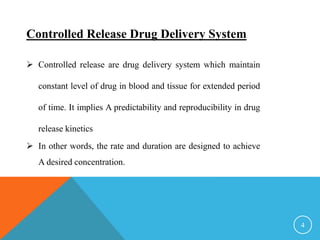
Controlled Release Drug Delivery System
 Controlled release are drug delivery system which maintain
constant level of drug in blood and tissue for extended period
of time. It implies A predictability and reproducibility in drug
release kinetics
 In other words, the rate and duration are designed to achieve
A desired concentration.
4
5
6
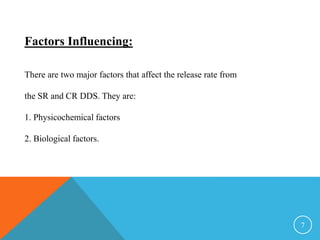
Factors Influencing:
There are two major factors that affect the release rate from
the SR and CR DDS. They are:
1. Physicochemical factors
2. Biological factors.
7
Physicochemical Factors
 Aqueous solubility
 Partition coefficient (K [O/W])
 Drug pKa and ionization at physiological Ph
 Drug stability
 Molecular weight and diffusivity
 Protein binding
 Dose size.
8
Biological Factors
 Absorption
 Distribution
 Metabolism
 Biological half-life/duration of action
 Margin of safety/therapeutic index
 Side effect
 Disease state.
9
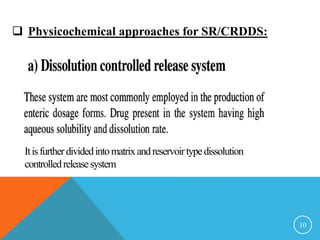
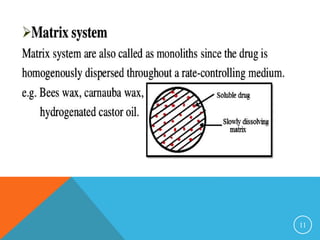
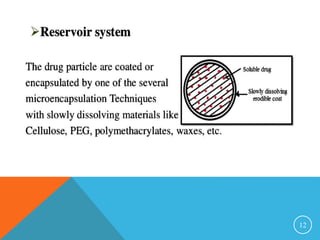
 Physicochemical approaches for SR/CRDDS:
Itisfurtherdividedintomatrixandreservoirtypedissolution
controlledreleasesystem
10
11
12
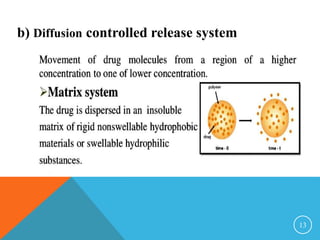
b) Diffusion controlled release system
13
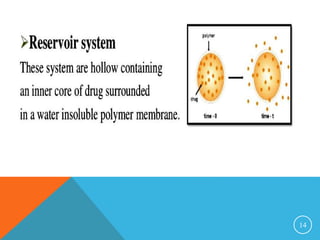
14
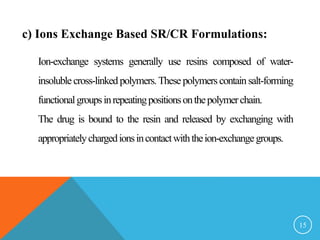
c) Ions Exchange Based SR/CR Formulations:
Ion-exchange systems generally use resins composed of water-
insolublecross-linkedpolymers.These polymerscontain salt-forming
functionalgroupsinrepeatingpositionsonthepolymerchain.
The drug is bound to the resin and released by exchanging with
appropriatelychargedionsincontactwiththeion-exchangegroups.
15
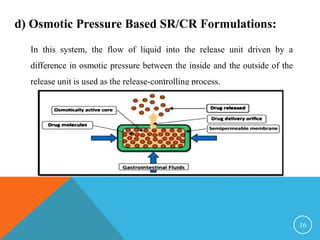
d) Osmotic Pressure Based SR/CR Formulations:
In this system, the flow of liquid into the release unit driven by a
difference in osmotic pressure between the inside and the outside of the
release unit is used as the release-controlling process.
16
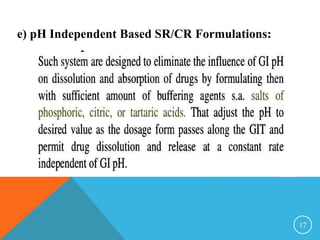
e) pH Independent Based SR/CR Formulations:
17
f) Altered Density Based SR/CR Formulations:
It is reasonable to expect that unless a delivery system remains
in the vicinity of the absorption site until most, if not all of its
drug contents is released, it would have limited utility.
To this end, several approaches have been developed to
prolong the residence time of DDS in the GI tract.
High-density approach
Low-density approach
18
Biological Approaches For SR/CR DDS:
a) Bio- Polymers Based SR/CR Formulations:
Nanoparticles in submicron size range (50-1000nm) made from
biological/physiological lipids which are biodegradable are used as colloidal
drug carriers for i.v. application.
At room temperature the particles are in the solid state. Therefore, the
mobility of incorporated drugs is reduced, which is a prerequisite for
controlled drug release.
19
b) Pulse Based (Pulsatile) SR/CR Formulations:
Those drug delivery system deliver the drug at specific time as per
biological or pathophysiological need of the diseases, resulting in
improved patient therapeutic efficacy and compliance.
The drug release is controlled by the stimuli like the biological pH or
enzyme present in body or drug delivery system.
20
c) Gastro retention based SR/CR Formulations:
Gastro Retentive dosage forms (GRDFs) are a drug delivery formulation
that are designed to be retained in the stomach for a prolonged time and
release there their active materials and thereby enable sustained and
prolonged input of the drug to the upper part of the gastrointestinal (GI)
tract.
21
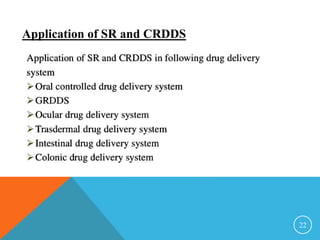
Application of SR and CRDDS
22
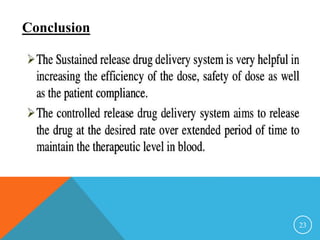
Conclusion
23
Reference
 http://www.slideshare.net/prashantbhamare5/sustained-and-
controlled-drug-delivery-system-72889886
 DIXIT, N.et.al. (2013). Sustained Release Drug Delivery
System, Indian Journal of Research in Pharmacy and
Biotechnology, 1(3), pp. 305-310
24
25
26

Sustained and controlled release drug delivery system

  • 1.
    SUSTAINED AND CONTROLLEDRELEASE DRUG DELIVERY SYSTEM Presented By- Km Parul M.Pharma, Sem-1st Year-1st Department Of Pharmaceutics R V Northland Institute GT Road, Dadri, Uttar Pradesh 1
  • 2.
     Definition ofSR and CRDDS  Advantages and disadvantages of SR CRDDS  Factors Influencing the release rate from SR and CRDDS  Physicochemical approaches for SR and CRDDS  Application of SR and CRDDS  Conclusion  References Contents 2
  • 3.
    Sustained release drugdelivery system  sustained release are drug delivery system that achieve slow release of drug over an extended period of time after administration of single dose.  In other words, the drug release is simply extended in time i.e. the rate and duration are not designed to achieve a particular profile. 3
  • 4.
    Controlled Release DrugDelivery System  Controlled release are drug delivery system which maintain constant level of drug in blood and tissue for extended period of time. It implies A predictability and reproducibility in drug release kinetics  In other words, the rate and duration are designed to achieve A desired concentration. 4
  • 5.
  • 6.
  • 7.
    Factors Influencing: There aretwo major factors that affect the release rate from the SR and CR DDS. They are: 1. Physicochemical factors 2. Biological factors. 7
  • 8.
    Physicochemical Factors  Aqueoussolubility  Partition coefficient (K [O/W])  Drug pKa and ionization at physiological Ph  Drug stability  Molecular weight and diffusivity  Protein binding  Dose size. 8
  • 9.
    Biological Factors  Absorption Distribution  Metabolism  Biological half-life/duration of action  Margin of safety/therapeutic index  Side effect  Disease state. 9
  • 10.
     Physicochemical approachesfor SR/CRDDS: Itisfurtherdividedintomatrixandreservoirtypedissolution controlledreleasesystem 10
  • 11.
  • 12.
  • 13.
    b) Diffusion controlledrelease system 13
  • 14.
  • 15.
    c) Ions ExchangeBased SR/CR Formulations: Ion-exchange systems generally use resins composed of water- insolublecross-linkedpolymers.These polymerscontain salt-forming functionalgroupsinrepeatingpositionsonthepolymerchain. The drug is bound to the resin and released by exchanging with appropriatelychargedionsincontactwiththeion-exchangegroups. 15
  • 16.
    d) Osmotic PressureBased SR/CR Formulations: In this system, the flow of liquid into the release unit driven by a difference in osmotic pressure between the inside and the outside of the release unit is used as the release-controlling process. 16
  • 17.
    e) pH IndependentBased SR/CR Formulations: 17
  • 18.
    f) Altered DensityBased SR/CR Formulations: It is reasonable to expect that unless a delivery system remains in the vicinity of the absorption site until most, if not all of its drug contents is released, it would have limited utility. To this end, several approaches have been developed to prolong the residence time of DDS in the GI tract. High-density approach Low-density approach 18
  • 19.
    Biological Approaches ForSR/CR DDS: a) Bio- Polymers Based SR/CR Formulations: Nanoparticles in submicron size range (50-1000nm) made from biological/physiological lipids which are biodegradable are used as colloidal drug carriers for i.v. application. At room temperature the particles are in the solid state. Therefore, the mobility of incorporated drugs is reduced, which is a prerequisite for controlled drug release. 19
  • 20.
    b) Pulse Based(Pulsatile) SR/CR Formulations: Those drug delivery system deliver the drug at specific time as per biological or pathophysiological need of the diseases, resulting in improved patient therapeutic efficacy and compliance. The drug release is controlled by the stimuli like the biological pH or enzyme present in body or drug delivery system. 20
  • 21.
    c) Gastro retentionbased SR/CR Formulations: Gastro Retentive dosage forms (GRDFs) are a drug delivery formulation that are designed to be retained in the stomach for a prolonged time and release there their active materials and thereby enable sustained and prolonged input of the drug to the upper part of the gastrointestinal (GI) tract. 21
  • 22.
    Application of SRand CRDDS 22
  • 23.
  • 24.
    Reference  http://www.slideshare.net/prashantbhamare5/sustained-and- controlled-drug-delivery-system-72889886  DIXIT,N.et.al. (2013). Sustained Release Drug Delivery System, Indian Journal of Research in Pharmacy and Biotechnology, 1(3), pp. 305-310 24
  • 25.
  • 26.