Pulmonary drug delivery system
PARUL INSTITUTE OF PHARMACY
DEPARTMENT OF
PHARMACEUTICS
LIMDA, WAGHODIA, VADODARA
 Anatomy
 Formulation
 Devices:
I. dry powder
II. pressurised meter dose inhaler
III. nebulizer
 Advantages
 Disadvantages
 The vestibular region:
It is located at the opening of nasal passages and is mainly
responsible for restricting entry of air borne particles.
 The respiratory region:
The respiratory region is the largest having the highest
degree of vascularity. The respiratory region contains three
nasal turbinate: superior, middle, and inferior which project
from the lateral wall of each of the nasal cavity.
 The olfactory region
The olfactory region is situated between the nasal septum
and the lateral walls of each of the two nasal cavities and
just below the cribriform plate of the ethmoid bone
separating the cranial cavity from nasal cavity.
 Types of dosage forms and delivery systems Nasal drops are the
simplest and the most convenient nasal pharmaceutical form, but
the exact amount of drug delivered is not easily quantified and often
result in overdose. Moreover, rapid nasal drainage can occur when
using this dosage form.
 Solution and suspension sprays are preferred over powders sprays
because the last one easily prompted the development of nasal
mucosa irritation.
 Recently, gel devices have been developed for a more accurate drug
delivery. They reduce postnasal drip and anterior leakage, fixing the
drug formulation in nasal mucosa. This enhances the drug residence
time and diminishes mucociliary clearance, thereby, potentially
increases nasal absorption. Over the last few years, specialized
systems such as lipid emulsions, microspheres, liposomes and films
have also been developed to improve nasal drug delivery.
 This enhances the drug residence time and diminishes
mucociliary clearance, thereby, potentially increases nasal
absorption. Over the last few years, specialized systems
such as lipid emulsions, microspheres, liposomes and films
have also been developed to improve nasal drug delivery
 Physical form of formulation:
Nasal drug absorption depends on the physical form of the
formulation. A powder form was found to be more effective
than liquid formulations because powder is not readily
washed out with the nasal secretions.
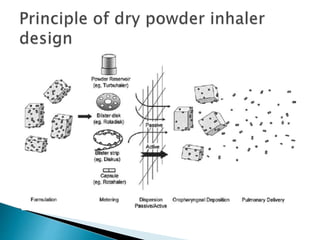
 Dry Powder Inhalation (DPI) Devices
 The Pressurized Metered-Dose Inhalation (pMDI)
Device
 Nebulizers
 DPIs are used to treat respiratory diseases such as
asthma and COPD, systemic disorders such as diabetes,
cancer, neurological diseases (including pain), and
other pulmonary diseases such as cystic fibrosis and
pulmonary infectious diseases
 Devices requiring the patient's inspiration effort to
aerosolize the powder aliquot are called passive devices
because as they do not provide an internal energy
source
 Active devices provide different kinds of energy for
aerosolization: kinetic energy by a loaded spring and
compressed air or electric energy by a battery
 Most DPIs contain micronized drug blended with larger
carrier particles, which prevents aggregation and
promotes flow
Dose type # 3 Capsule
Dose range From µg to 50 mg
Pressure Drop kPa at 35 L/min. Performance
substantially flow-independent 25
L/min.
Lifetime 30 to 60 capsules (one month’s
use)
Componants Three, Plastic
Performance Lactose-based, fine particle
fraction: 20 – 50% Particle
engineered, FPF: 50 – 80%
Patent Filed in 2010
Uses Chronic or acute uses
 The pressurized metered-dose inhalation (pMDI) device
was introduced to deliver asthma medications in a
convenient and reliable multi-dose presentation
 The key components of the pMDI device are: container,
propellants, formulation, metering valve, and actuator
 The pMDI container must withstand high pressure
generated by the propellant. Stainless steel has been used as
a pMDI container material. Aluminum is now preferred
because, compared to glass, it is lighter, more compact, less
fragile, and light-proof
Drug Brand Main Excipients Supplier Main
Indications
Olapatadine Patanase Benzalkoniu
m chloride,
dibasic
sodium
phosphate,
Alcon
Laboratories
Mometasone Nasonex Microcrystall
ine cellulose,
carboxymeth
ylcellulose
sodium,
benzalkoniu
m chloride
Schering-
Plough
Management
/treat ment
of symptoms
of seasonal
and
perennial
rhinosinusiti
s
 Coatings on the internal container surfaces
may be useful to prevent adhesion of drug
particles and chemical degradation of drug
 Propellants in pMDIs are liquefied,
compressed gases that are in the gaseous
phase at atmospheric pressure but form
liquids when compressed
 They are required to be nontoxic,
nonflammable, compatible with drugs
formulated either as suspensions or
solutions, and to have appropriate boiling
points and densities
 A nebulizer is a device used to administer medication to
patient in the form of a mist inhaled into the lungs
 It is commonly used in treating cystic fibrosis, asthma, and
other respiratory diseases
 There are two basic types of nebulizers:
◦ The jet nebulizer functions by the Bernoulli principle by which
compressed gas (air or oxygen) passes through a narrow orifice,
creating an area of low pressure at the outlet of the adjacent
liquid feed tube. This results in the drug solution being drawn up
from the fluid reservoir and shattering into droplets in the gas
stream
◦ The ultrasonic nebulizer uses a piezoelectric crystal, vibrating at a
high frequency (usually 1–3 MHz), to generate a fountain of liquid
in the nebulizer chamber; the higher the frequency, the smaller
the droplets produced
 rapid absorption, higher bioavailability, therefore, lower
doses;
• fast onset of therapeutic action;
• avoidance of liver first pass metabolism;
• avoidance of metabolism by the gastrointestinal tract;
• avoidance of irritation of the gastrointestinal membrane;
• reduced risk of overdose;
• non-invasive, therefore, reduced risk of infectious disease
transmission;
• ease of convenience and self-medication;
• improved patient compliance;
• can be a beneficial adjunct product to an existing product
 mucociliary clearance reduces the residence time
of drug;
• not applicable to all drugs;
• insufficient absorption due to lack of adequate
aqueous solubility;
• require high volume of dose (25-200 ml)
depending on aqueous solubility of drug; few
drugs can cause nasal irritation;
• few drugs may undergo metabolic degradation
in the nasal cavity;
• less suitable for chronically administered drugs;
 Physiological factors-
1.Mucocilliary Clearance
2.Enzymatic Degradation
 Low Bioavailability
 Physic-chemical factors
1.dissolution rate
2.particle size
3.solubility
4.molecular weight
5.partition coefficient
6.polymorphism,
 pH of the formulation
 Osmolarity
 Non-aqueous nasal sprays
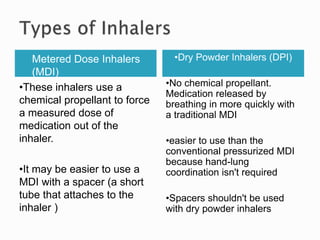
 Metered Dose Inhalers
(MDI)
•These inhalers use a
chemical propellant to force
a measured dose of
medication out of the
inhaler.
•It may be easier to use a
MDI with a spacer (a short
tube that attaches to the
inhaler )
•Dry Powder Inhalers (DPI)
•No chemical propellant.
Medication released by
breathing in more quickly with
a traditional MDI
•easier to use than the
conventional pressurized MDI
because hand-lung
coordination isn't required
•Spacers shouldn't be used
with dry powder inhalers
 Sanjay Dey1*, Beduin Mahanti1, Bhasakar
Mazumder2, Nasal drug delivery: An approach of
drug delivery through nasal route, Pelagia
Research Library, Der Pharmacia Sinica, 2011, 2
(3): 94-106.
 Cecilia Wadwll, In vitro studies on factors
influencing permeability and implications on
absorption, Thesis Uppsala University, 2002.
 S. B. Patil, R. S. R. Murthy, Preparation and in
vitro evaluation of mucoadhesive chitosan
microspheres of amlodipine besylate for nasal
administration, Indian journal of pharmaceutical
sciences January - February 2006:64-67.
mandalsirpresentation-160721093725.pdf

mandalsirpresentation-160721093725.pdf

  • 1.
    Pulmonary drug deliverysystem PARUL INSTITUTE OF PHARMACY DEPARTMENT OF PHARMACEUTICS LIMDA, WAGHODIA, VADODARA
  • 2.
     Anatomy  Formulation Devices: I. dry powder II. pressurised meter dose inhaler III. nebulizer  Advantages  Disadvantages
  • 3.
     The vestibularregion: It is located at the opening of nasal passages and is mainly responsible for restricting entry of air borne particles.  The respiratory region: The respiratory region is the largest having the highest degree of vascularity. The respiratory region contains three nasal turbinate: superior, middle, and inferior which project from the lateral wall of each of the nasal cavity.  The olfactory region The olfactory region is situated between the nasal septum and the lateral walls of each of the two nasal cavities and just below the cribriform plate of the ethmoid bone separating the cranial cavity from nasal cavity.
  • 4.
     Types ofdosage forms and delivery systems Nasal drops are the simplest and the most convenient nasal pharmaceutical form, but the exact amount of drug delivered is not easily quantified and often result in overdose. Moreover, rapid nasal drainage can occur when using this dosage form.  Solution and suspension sprays are preferred over powders sprays because the last one easily prompted the development of nasal mucosa irritation.  Recently, gel devices have been developed for a more accurate drug delivery. They reduce postnasal drip and anterior leakage, fixing the drug formulation in nasal mucosa. This enhances the drug residence time and diminishes mucociliary clearance, thereby, potentially increases nasal absorption. Over the last few years, specialized systems such as lipid emulsions, microspheres, liposomes and films have also been developed to improve nasal drug delivery.
  • 5.
     This enhancesthe drug residence time and diminishes mucociliary clearance, thereby, potentially increases nasal absorption. Over the last few years, specialized systems such as lipid emulsions, microspheres, liposomes and films have also been developed to improve nasal drug delivery  Physical form of formulation: Nasal drug absorption depends on the physical form of the formulation. A powder form was found to be more effective than liquid formulations because powder is not readily washed out with the nasal secretions.
  • 6.
     Dry PowderInhalation (DPI) Devices  The Pressurized Metered-Dose Inhalation (pMDI) Device  Nebulizers
  • 7.
     DPIs areused to treat respiratory diseases such as asthma and COPD, systemic disorders such as diabetes, cancer, neurological diseases (including pain), and other pulmonary diseases such as cystic fibrosis and pulmonary infectious diseases  Devices requiring the patient's inspiration effort to aerosolize the powder aliquot are called passive devices because as they do not provide an internal energy source  Active devices provide different kinds of energy for aerosolization: kinetic energy by a loaded spring and compressed air or electric energy by a battery
  • 8.
     Most DPIscontain micronized drug blended with larger carrier particles, which prevents aggregation and promotes flow
  • 10.
    Dose type #3 Capsule Dose range From µg to 50 mg Pressure Drop kPa at 35 L/min. Performance substantially flow-independent 25 L/min. Lifetime 30 to 60 capsules (one month’s use) Componants Three, Plastic Performance Lactose-based, fine particle fraction: 20 – 50% Particle engineered, FPF: 50 – 80% Patent Filed in 2010 Uses Chronic or acute uses
  • 11.
     The pressurizedmetered-dose inhalation (pMDI) device was introduced to deliver asthma medications in a convenient and reliable multi-dose presentation  The key components of the pMDI device are: container, propellants, formulation, metering valve, and actuator  The pMDI container must withstand high pressure generated by the propellant. Stainless steel has been used as a pMDI container material. Aluminum is now preferred because, compared to glass, it is lighter, more compact, less fragile, and light-proof
  • 12.
    Drug Brand MainExcipients Supplier Main Indications Olapatadine Patanase Benzalkoniu m chloride, dibasic sodium phosphate, Alcon Laboratories Mometasone Nasonex Microcrystall ine cellulose, carboxymeth ylcellulose sodium, benzalkoniu m chloride Schering- Plough Management /treat ment of symptoms of seasonal and perennial rhinosinusiti s
  • 13.
     Coatings onthe internal container surfaces may be useful to prevent adhesion of drug particles and chemical degradation of drug  Propellants in pMDIs are liquefied, compressed gases that are in the gaseous phase at atmospheric pressure but form liquids when compressed  They are required to be nontoxic, nonflammable, compatible with drugs formulated either as suspensions or solutions, and to have appropriate boiling points and densities
  • 16.
     A nebulizeris a device used to administer medication to patient in the form of a mist inhaled into the lungs  It is commonly used in treating cystic fibrosis, asthma, and other respiratory diseases  There are two basic types of nebulizers: ◦ The jet nebulizer functions by the Bernoulli principle by which compressed gas (air or oxygen) passes through a narrow orifice, creating an area of low pressure at the outlet of the adjacent liquid feed tube. This results in the drug solution being drawn up from the fluid reservoir and shattering into droplets in the gas stream ◦ The ultrasonic nebulizer uses a piezoelectric crystal, vibrating at a high frequency (usually 1–3 MHz), to generate a fountain of liquid in the nebulizer chamber; the higher the frequency, the smaller the droplets produced
  • 18.
     rapid absorption,higher bioavailability, therefore, lower doses; • fast onset of therapeutic action; • avoidance of liver first pass metabolism; • avoidance of metabolism by the gastrointestinal tract; • avoidance of irritation of the gastrointestinal membrane; • reduced risk of overdose; • non-invasive, therefore, reduced risk of infectious disease transmission; • ease of convenience and self-medication; • improved patient compliance; • can be a beneficial adjunct product to an existing product
  • 19.
     mucociliary clearancereduces the residence time of drug; • not applicable to all drugs; • insufficient absorption due to lack of adequate aqueous solubility; • require high volume of dose (25-200 ml) depending on aqueous solubility of drug; few drugs can cause nasal irritation; • few drugs may undergo metabolic degradation in the nasal cavity; • less suitable for chronically administered drugs;
  • 20.
     Physiological factors- 1.MucocilliaryClearance 2.Enzymatic Degradation  Low Bioavailability  Physic-chemical factors 1.dissolution rate 2.particle size 3.solubility 4.molecular weight 5.partition coefficient 6.polymorphism,
  • 21.
     pH ofthe formulation  Osmolarity  Non-aqueous nasal sprays
  • 22.
     Metered DoseInhalers (MDI) •These inhalers use a chemical propellant to force a measured dose of medication out of the inhaler. •It may be easier to use a MDI with a spacer (a short tube that attaches to the inhaler ) •Dry Powder Inhalers (DPI) •No chemical propellant. Medication released by breathing in more quickly with a traditional MDI •easier to use than the conventional pressurized MDI because hand-lung coordination isn't required •Spacers shouldn't be used with dry powder inhalers
  • 23.
     Sanjay Dey1*,Beduin Mahanti1, Bhasakar Mazumder2, Nasal drug delivery: An approach of drug delivery through nasal route, Pelagia Research Library, Der Pharmacia Sinica, 2011, 2 (3): 94-106.  Cecilia Wadwll, In vitro studies on factors influencing permeability and implications on absorption, Thesis Uppsala University, 2002.  S. B. Patil, R. S. R. Murthy, Preparation and in vitro evaluation of mucoadhesive chitosan microspheres of amlodipine besylate for nasal administration, Indian journal of pharmaceutical sciences January - February 2006:64-67.