Respiratory dosage form Technology
• Description of respiratory dosage form and rationale of their use.
• Advantages and disadvantages.
• Formulation strategies.
• Manufacturing technologies.
Introduction
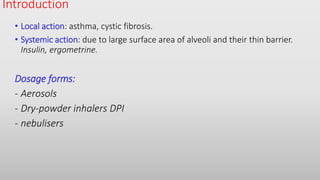
• Local action: asthma, cystic fibrosis.
• Systemic action: due to large surface area of alveoli and their thin barrier.
Insulin, ergometrine.
Dosage forms:
- Aerosols
- Dry-powder inhalers DPI
- nebulisers
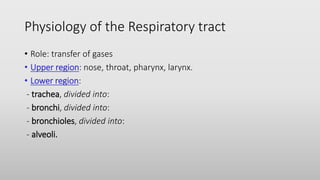
Physiology of the Respiratory tract
• Role: transfer of gases
• Upper region: nose, throat, pharynx, larynx.
• Lower region:
- trachea, divided into:
- bronchi, divided into:
- bronchioles, divided into:
- alveoli.
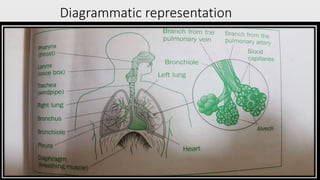
Diagrammatic representation
• The role of trachea, bronchi and bronchioles is in the conductance of
air to and from the alveoli.
• The role of alveoli is the transfer of gases.
• The diameters decreases towards the alveoli. This has a profound
effect on the deposition of particles or droplets.
• Combined surface area of alveoli sacs is large 70 – 80 m2.
• The goblet cells responsible for secretion of mucus which acts to trap
foreign particles.
• The epithelial cells responsible for the transport of foreign
particles upwards for subsequent elimination.
Advantages of respiratory drug delivery
• Required dose for local action hence minimize the side effects.
• Large surface area of alveoli, excellent blood supply, thin nature of the barrier
between the lung and the systemic circulation. Therefore it is a viable alternative for
parenteral route.
• Rapid onset of action. beneficial for the treatment of asthma and for lowering blood
glucose level.
• Portable and so convenient for patient use.
Disadvantages
• Coordination between activating the inhaler and inspiration.
• Deposition of drug in the lower airways may be imbedded in the
presence of high volume of mucus during infection.
• The physical stability may be problematic.
Factors affecting the deposition of particles / droplets within the
respiratory tract
The bronchioles are the site required for treatment of asthma. The alveoli
are the site required for systemic absorption.
1- the size of the inspired particles / droplets.
2- the effect of humidity on particles size.
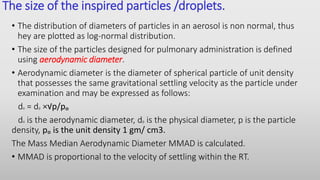
The size of the inspired particles /droplets.
• The distribution of diameters of particles in an aerosol is non normal, thus
hey are plotted as log-normal distribution.
• The size of the particles designed for pulmonary administration is defined
using aerodynamic diameter.
• Aerodynamic diameter is the diameter of spherical particle of unit density
that possesses the same gravitational settling velocity as the particle under
examination and may be expressed as follows:
da = dp ×√p/pₒ
da is the aerodynamic diameter, dp is the physical diameter, p is the particle
density, pₒ is the unit density 1 gm/ cm3.
The Mass Median Aerodynamic Diameter MMAD is calculated.
• MMAD is proportional to the velocity of settling within the RT.
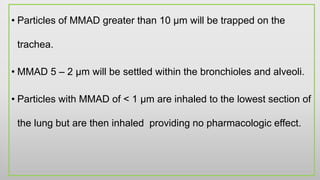
• Particles of MMAD greater than 10 µm will be trapped on the
trachea.
• MMAD 5 – 2 µm will be settled within the bronchioles and alveoli.
• Particles with MMAD of < 1 µm are inhaled to the lowest section of
the lung but are then inhaled providing no pharmacologic effect.
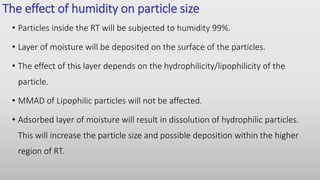
The effect of humidity on particle size
• Particles inside the RT will be subjected to humidity 99%.
• Layer of moisture will be deposited on the surface of the particles.
• The effect of this layer depends on the hydrophilicity/lipophilicity of the
particle.
• MMAD of Lipophilic particles will not be affected.
• Adsorbed layer of moisture will result in dissolution of hydrophilic particles.
This will increase the particle size and possible deposition within the higher
region of RT.
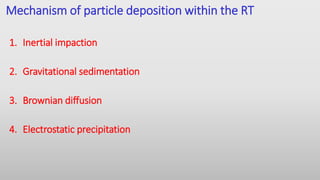
Mechanism of particle deposition within the RT
1. Inertial impaction
2. Gravitational sedimentation
3. Brownian diffusion
4. Electrostatic precipitation
Inertial impaction
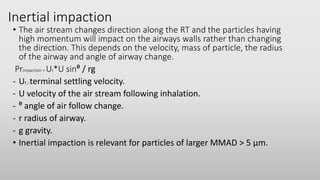
• The air stream changes direction along the RT and the particles having
high momentum will impact on the airways walls rather than changing
the direction. This depends on the velocity, mass of particle, the radius
of the airway and angle of airway change.
Primpaction = Ut*U sinᶿ / rg
- Ut ; terminal settling velocity.
- U velocity of the air stream following inhalation.
- ᶿ angle of air follow change.
- r radius of airway.
- g gravity.
• Inertial impaction is relevant for particles of larger MMAD > 5 µm.
Gravitational sedimentation
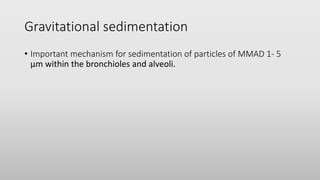
• Important mechanism for sedimentation of particles of MMAD 1- 5
µm within the bronchioles and alveoli.
Brownian diffusion
• For particles < 0.5 µm.
• No therapeutic significance.
Electrostatic precipitation
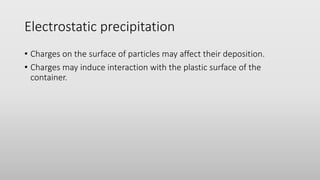
• Charges on the surface of particles may affect their deposition.
• Charges may induce interaction with the plastic surface of the
container.
Formulation of the respiratory dosage forms
• Metered-dose inhalers.
• Dry-powder inhalers.
• Nebulisers
MDI - Advantages
1. Portable.
2. Low-cost.
3. Hermetically sealed
4. Effective in respiratory disorder.
MDI- Disadvantages
• The physical stability of drug.
• Failure to reach the proposed site.
• Patient use.
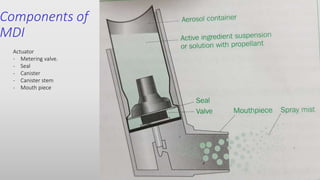
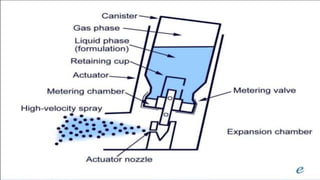
Components of
MDI
Actuator
- Metering valve.
- Seal
- Canister
- Canister stem
- Mouth piece
Formulation of MDI
• Propellant
• Therapeutic agent.
• Factors for successful actuation:
1. Required diameter and polydispersitity.
2. Shaking prior to use must provide resusupended particles.
3. Rapid evaporation of the propellant to ensure free solid drug
particles.
Propellant
• To provide driving pressure to force the therapeutic agent from
the canister to the upper respiratory tract.
• To exhibit the required evaporation rate to facilitate particle
delivery to the required site within the RT.
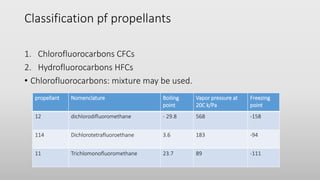
Classification pf propellants
1. Chlorofluorocarbons CFCs
2. Hydrofluorocarbons HFCs
• Chlorofluorocarbons: mixture may be used.
propellant Nomenclature Boiling
point
Vapor pressure at
20C k/Pa
Freezing
point
12 dichlorodifluoromethane - 29.8 568 -158
114 Dichlorotetrafluoroethane 3.6 183 -94
11 Trichlomonofluoromethane 23.7 89 -111
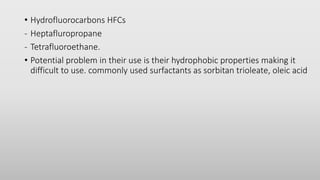
• Hydrofluorocarbons HFCs
- Heptafluropropane
- Tetrafluoroethane.
• Potential problem in their use is their hydrophobic properties making it
difficult to use. commonly used surfactants as sorbitan trioleate, oleic acid
Physiochemical properties of active agent
• Solubility in the propellant
• MMAD and polydispersity 1- 5 µm
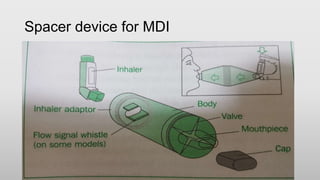
Spacer device for MDI
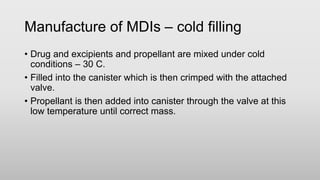
Manufacture of MDIs – cold filling
• Drug and excipients and propellant are mixed under cold
conditions – 30 C.
• Filled into the canister which is then crimped with the attached
valve.
• Propellant is then added into canister through the valve at this
low temperature until correct mass.
• Drug and excipients mixed with a portion of propellant of higher
boiling point and low vapour pressure at 20 C.
• Filled to canister and crimped with the valve.
• Second portion of propellant filled through the valve under
pressure.
Manufacture of MDIs – pressure filling
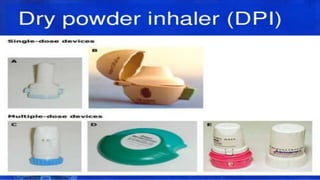
Dry Powder Inhalers DPI
• No propellant is required.
• Designs:
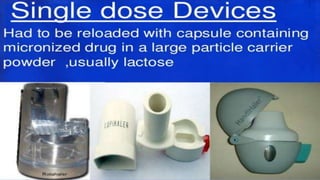
- Drug and excipients in hard gelatin capsule. The capsule is located inside the device, pierced into
two locations prior to use, as the patient inhales, a rotor is activated, resulting in turbulent airflow
which carries the powder to the patient.
- Drug and excipient in a blister pack. Located in a circular device containing a mouthpiece. On use,
the individual dose be pierced. Inhalation by the patient results in passage of air through the
device delivering the drug to the patient.
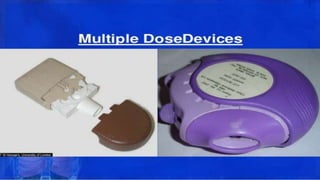
- Drug and excipients present within the inhaler. Inhaler is loaded with multidoses, each dose
broken allowing flow of powder during inhalation.
Formulation of DPI
• Particle size of drug MMAD should be less than 5 microns.
• Excipients are used for two main purposes:
1. To facilitate production.
2. To improve the flow properties of the therapeutic agent during inhalation.
• The excipient MMAD should be 30 – 60 micron? Why?
• Commonly lactose is used.
• Interaction between the drug and the carrier is dependent on:
1. Surface area of the particles.
2. Surface energies of the particles.
3. Morphology of the particles.
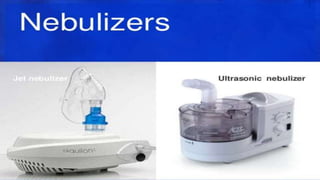
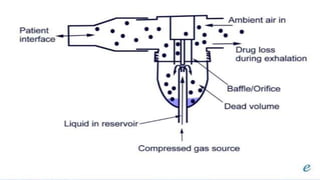
• Nebulization involves the application of energy either high-
velocity gas or by the use of ultrasonic system to drug solution
resulting in the formation of droplets which are then inspired by
the patient through facemask.
• Energy sources are jet or ultrasonic nebulizer.
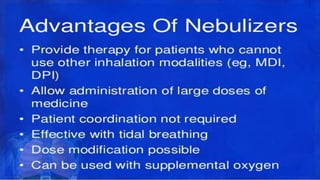
• Nebulizer is used for treatment of acute attacks or where
patients have difficulties to use MDI or DPI.
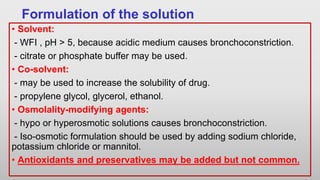
Formulation of the solution
• Solvent:
- WFI , pH > 5, because acidic medium causes bronchoconstriction.
- citrate or phosphate buffer may be used.
• Co-solvent:
- may be used to increase the solubility of drug.
- propylene glycol, glycerol, ethanol.
• Osmolality-modifying agents:
- hypo or hyperosmotic solutions causes bronchoconstriction.
- Iso-osmotic formulation should be used by adding sodium chloride,
potassium chloride or mannitol.
• Antioxidants and preservatives may be added but not common.
Respiratory dosage form technology

Respiratory dosage form technology

  • 1.
    Respiratory dosage formTechnology • Description of respiratory dosage form and rationale of their use. • Advantages and disadvantages. • Formulation strategies. • Manufacturing technologies.
  • 2.
    Introduction • Local action:asthma, cystic fibrosis. • Systemic action: due to large surface area of alveoli and their thin barrier. Insulin, ergometrine. Dosage forms: - Aerosols - Dry-powder inhalers DPI - nebulisers
  • 3.
    Physiology of theRespiratory tract • Role: transfer of gases • Upper region: nose, throat, pharynx, larynx. • Lower region: - trachea, divided into: - bronchi, divided into: - bronchioles, divided into: - alveoli.
  • 4.
  • 5.
    • The roleof trachea, bronchi and bronchioles is in the conductance of air to and from the alveoli. • The role of alveoli is the transfer of gases. • The diameters decreases towards the alveoli. This has a profound effect on the deposition of particles or droplets. • Combined surface area of alveoli sacs is large 70 – 80 m2. • The goblet cells responsible for secretion of mucus which acts to trap foreign particles. • The epithelial cells responsible for the transport of foreign particles upwards for subsequent elimination.
  • 6.
    Advantages of respiratorydrug delivery • Required dose for local action hence minimize the side effects. • Large surface area of alveoli, excellent blood supply, thin nature of the barrier between the lung and the systemic circulation. Therefore it is a viable alternative for parenteral route. • Rapid onset of action. beneficial for the treatment of asthma and for lowering blood glucose level. • Portable and so convenient for patient use.
  • 7.
    Disadvantages • Coordination betweenactivating the inhaler and inspiration. • Deposition of drug in the lower airways may be imbedded in the presence of high volume of mucus during infection. • The physical stability may be problematic.
  • 8.
    Factors affecting thedeposition of particles / droplets within the respiratory tract The bronchioles are the site required for treatment of asthma. The alveoli are the site required for systemic absorption. 1- the size of the inspired particles / droplets. 2- the effect of humidity on particles size.
  • 9.
    The size ofthe inspired particles /droplets. • The distribution of diameters of particles in an aerosol is non normal, thus hey are plotted as log-normal distribution. • The size of the particles designed for pulmonary administration is defined using aerodynamic diameter. • Aerodynamic diameter is the diameter of spherical particle of unit density that possesses the same gravitational settling velocity as the particle under examination and may be expressed as follows: da = dp ×√p/pₒ da is the aerodynamic diameter, dp is the physical diameter, p is the particle density, pₒ is the unit density 1 gm/ cm3. The Mass Median Aerodynamic Diameter MMAD is calculated. • MMAD is proportional to the velocity of settling within the RT.
  • 10.
    • Particles ofMMAD greater than 10 µm will be trapped on the trachea. • MMAD 5 – 2 µm will be settled within the bronchioles and alveoli. • Particles with MMAD of < 1 µm are inhaled to the lowest section of the lung but are then inhaled providing no pharmacologic effect.
  • 11.
    The effect ofhumidity on particle size • Particles inside the RT will be subjected to humidity 99%. • Layer of moisture will be deposited on the surface of the particles. • The effect of this layer depends on the hydrophilicity/lipophilicity of the particle. • MMAD of Lipophilic particles will not be affected. • Adsorbed layer of moisture will result in dissolution of hydrophilic particles. This will increase the particle size and possible deposition within the higher region of RT.
  • 12.
    Mechanism of particledeposition within the RT 1. Inertial impaction 2. Gravitational sedimentation 3. Brownian diffusion 4. Electrostatic precipitation
  • 13.
    Inertial impaction • Theair stream changes direction along the RT and the particles having high momentum will impact on the airways walls rather than changing the direction. This depends on the velocity, mass of particle, the radius of the airway and angle of airway change. Primpaction = Ut*U sinᶿ / rg - Ut ; terminal settling velocity. - U velocity of the air stream following inhalation. - ᶿ angle of air follow change. - r radius of airway. - g gravity. • Inertial impaction is relevant for particles of larger MMAD > 5 µm.
  • 14.
    Gravitational sedimentation • Importantmechanism for sedimentation of particles of MMAD 1- 5 µm within the bronchioles and alveoli.
  • 15.
    Brownian diffusion • Forparticles < 0.5 µm. • No therapeutic significance.
  • 16.
    Electrostatic precipitation • Chargeson the surface of particles may affect their deposition. • Charges may induce interaction with the plastic surface of the container.
  • 17.
    Formulation of therespiratory dosage forms • Metered-dose inhalers. • Dry-powder inhalers. • Nebulisers
  • 18.
    MDI - Advantages 1.Portable. 2. Low-cost. 3. Hermetically sealed 4. Effective in respiratory disorder.
  • 19.
    MDI- Disadvantages • Thephysical stability of drug. • Failure to reach the proposed site. • Patient use.
  • 20.
    Components of MDI Actuator - Meteringvalve. - Seal - Canister - Canister stem - Mouth piece
  • 21.
    Formulation of MDI •Propellant • Therapeutic agent. • Factors for successful actuation: 1. Required diameter and polydispersitity. 2. Shaking prior to use must provide resusupended particles. 3. Rapid evaporation of the propellant to ensure free solid drug particles.
  • 22.
    Propellant • To providedriving pressure to force the therapeutic agent from the canister to the upper respiratory tract. • To exhibit the required evaporation rate to facilitate particle delivery to the required site within the RT.
  • 23.
    Classification pf propellants 1.Chlorofluorocarbons CFCs 2. Hydrofluorocarbons HFCs • Chlorofluorocarbons: mixture may be used. propellant Nomenclature Boiling point Vapor pressure at 20C k/Pa Freezing point 12 dichlorodifluoromethane - 29.8 568 -158 114 Dichlorotetrafluoroethane 3.6 183 -94 11 Trichlomonofluoromethane 23.7 89 -111
  • 24.
    • Hydrofluorocarbons HFCs -Heptafluropropane - Tetrafluoroethane. • Potential problem in their use is their hydrophobic properties making it difficult to use. commonly used surfactants as sorbitan trioleate, oleic acid
  • 25.
    Physiochemical properties ofactive agent • Solubility in the propellant • MMAD and polydispersity 1- 5 µm
  • 26.
  • 27.
    Manufacture of MDIs– cold filling • Drug and excipients and propellant are mixed under cold conditions – 30 C. • Filled into the canister which is then crimped with the attached valve. • Propellant is then added into canister through the valve at this low temperature until correct mass.
  • 28.
    • Drug andexcipients mixed with a portion of propellant of higher boiling point and low vapour pressure at 20 C. • Filled to canister and crimped with the valve. • Second portion of propellant filled through the valve under pressure. Manufacture of MDIs – pressure filling
  • 32.
    Dry Powder InhalersDPI • No propellant is required. • Designs: - Drug and excipients in hard gelatin capsule. The capsule is located inside the device, pierced into two locations prior to use, as the patient inhales, a rotor is activated, resulting in turbulent airflow which carries the powder to the patient. - Drug and excipient in a blister pack. Located in a circular device containing a mouthpiece. On use, the individual dose be pierced. Inhalation by the patient results in passage of air through the device delivering the drug to the patient. - Drug and excipients present within the inhaler. Inhaler is loaded with multidoses, each dose broken allowing flow of powder during inhalation.
  • 38.
    Formulation of DPI •Particle size of drug MMAD should be less than 5 microns. • Excipients are used for two main purposes: 1. To facilitate production. 2. To improve the flow properties of the therapeutic agent during inhalation. • The excipient MMAD should be 30 – 60 micron? Why? • Commonly lactose is used. • Interaction between the drug and the carrier is dependent on: 1. Surface area of the particles. 2. Surface energies of the particles. 3. Morphology of the particles.
  • 40.
    • Nebulization involvesthe application of energy either high- velocity gas or by the use of ultrasonic system to drug solution resulting in the formation of droplets which are then inspired by the patient through facemask. • Energy sources are jet or ultrasonic nebulizer. • Nebulizer is used for treatment of acute attacks or where patients have difficulties to use MDI or DPI.
  • 46.
    Formulation of thesolution • Solvent: - WFI , pH > 5, because acidic medium causes bronchoconstriction. - citrate or phosphate buffer may be used. • Co-solvent: - may be used to increase the solubility of drug. - propylene glycol, glycerol, ethanol. • Osmolality-modifying agents: - hypo or hyperosmotic solutions causes bronchoconstriction. - Iso-osmotic formulation should be used by adding sodium chloride, potassium chloride or mannitol. • Antioxidants and preservatives may be added but not common.