MYCOLOGY FUNDAMENTALS, DIAGNOSIS AND TREATMENT Dr. Maria Ellery Mendez FPAMS,FPAAM,DPASMAP
General Characteristics: > heterotrophs > thallopytes > chemotrophic  organism > all are obligate aerobes, some are  facultative anaerobes  > all fungi are gram (+) > natural habitat is the environment  Introduction
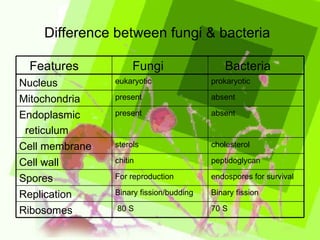
Difference between fungi & bacteria   Features Fungi Bacteria Nucleus eukaryotic prokaryotic Mitochondria present absent Endoplasmic reticulum present absent Cell membrane sterols cholesterol Cell wall chitin peptidoglycan Spores For reproduction endospores for survival Replication Binary fission/budding Binary fission Ribosomes 80 S 70 S
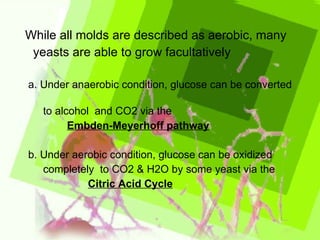
While all molds are described as aerobic, many  yeasts are able to grow facultatively a. Under anaerobic condition, glucose can be converted  to alcohol  and CO2 via the Embden-Meyerhoff pathway b. Under aerobic condition, glucose can be oxidized  completely  to CO2 & H2O by some yeast via the Citric Acid Cycle
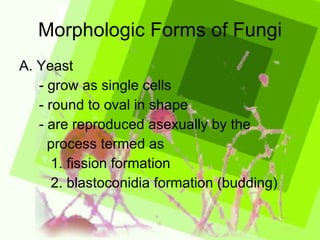
Morphologic Forms of Fungi A. Yeast - grow as single cells - round to oval in shape - are reproduced asexually by the  process termed as  1. fission formation 2. blastoconidia formation (budding)
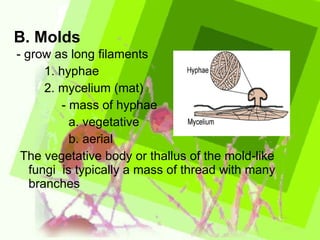
- grow as long filaments 1. hyphae 2. mycelium (mat) - mass of hyphae a. vegetative b. aerial The vegetative body or thallus of the mold-like fungi  is typically a mass of thread with many branches B. Molds
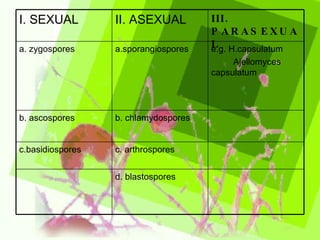
I. SEXUAL II. ASEXUAL III. PARASEXUAL a. zygospores a.sporangiospores e.g. H.capsulatum  Ajellomyces  capsulatum b. ascospores b. chlamydospores c.basidiospores c. arthrospores d. blastospores
Reproduction *   The sexual (perfect, meiotic ) state is referred to  as  teleomorph *   The asexual (imperfect, mitotic) state of a  fungus is  termed as  anamorph *   Many fungi can have both states, especially  Ascomycota > Most have either one or  the other
> can exist in 2 forms: a . tissue phase b.  mycelial or filamentous phase I.  Fungal allergies II.  Mycotoxicosis - potent toxins produced a. phalloidin  c. ergotism b. Amanitin  d. Aflatoxin  III.  Fungal Infections DIMORPHIC  FUNGI FUNGAL DISEASES
LABORATORY DIANOSIS
1.Direct Microscopic examination   a) Wet preparation - uses KOH or NaOH as clearing agent b) Calcofluor white stain - shows fungal elements in exudats & small skin scales  under fluorescent  microscope c) Nigrosin or India Ink  d) Wright stain or Giemsa stain 2. Culture - slow growers - Medium  Sabouraud Dextrose Agar, Potato Dextros Agar, Blood agar Corn Meal Agar -IDENTIFICATION OF FUNGUS a. Macroscopic examination - study the mycotic colony, mycelium & the pigment produced b. Microscopic examination - uses a drop of LPCB -observe the size,shape,septation & color of spores
• IDENTIFICATION OF  YEAST  CULTURES - is based on morphologic characteristics & biochemical tests • IDENTIFICATION OF  FILAMENTOUS  FUNGAL CULTURES - uses an immunologic method called  exoantigen test  * antigen extracted  are immunodiffused  against known antisera  3. Histologic stains a. Periodic Acid Shift b. Gomori Methenemine Silver Stain c. Calcofluor white d. Fluorescent Antibody Stain - for rapid diagnosis of fungal; cell wall
4. DNA probe test - identify colonies growing in culture at an earlier  stage of  growth - available for coccidioides, histoplasmas, blastomyces,  cryptococcus 5. Immunologic - for detection of antigen or antibody - complement-fixation ,Agglutination,Precipitin test - useful only for systemic & opportunistic mycoses * C-F is freq. used in suspected cases of  coccidiodomycoses, blastomycoses, histoplasmosis  6. Wood’s light -use in determining the prognosis of the patient -e.g. T.capitis-yellowish green in color P. versicolor-golden yellow
ANTIFUNGAL AGENTS - MOA: combines sterol in cell membrane causing disruption  &  leakage of the cytoplasmic contents - E.g.: a. Amphotericin  B  b. Nystatin -MOA:  blocks the microsomal P450 dependent demethylation  of lanosterol -E.g. a. Clotrimazole & Miconazole b. Ketoconazole c. Fluconazole - Terbinafine (Lamisil) - MOA: inhibits squalene epoxidation - higher cure rates for onychomycosis I. POLYENES II. IMIDAZOLE III. ALLYLAMINES
IV. POLYOXIN COMPOUNDS - inhibit nucleic acid synthesis -inhibitor of chitin synthetase a. Flucytosine - MOA: deaminate to 5-flurouracil,which inhibit DNA synthesis - active only on yeast - S/E: neutropenia & jaundice b. Griseofulvin - MOA: inhibit microtuble assembly  V. OTHER TOPICAL AGENTS - whitfield’s ointment, tolnaftate,ciclopirox,halprogin & naftifine •  Flucytosine + Amphotericin B  Synergistic •  Ketoconazole + Amphotericin B  Antagonistic
SUPERFICIAL  MYCOSES
- infection is limited to the dead cell layer of the skin & hair shaft - skin   outermost  layers of the stratum corneum hair   involves the cuticle - cellular immune response is not involved  I. SKIN - fungal infection of the stratum corneum epidermidis A. Pityriasis versicolor (lipophilic fungi) - Pityrosporum ovale & orbiculare are part of the  normal flora  - are found in areas of the body rich in sebaceous  gland - lesions  are described as scales giving a dry chalky  appearance - etiologic agent: Malassezia furfur - clinical diagnosis: spaghetti & meatball appearance
B. Tinea nigra - found on palmar & plantar areas of the stratum corneum - lesions are described as light to blackish macular areas - etiologic agent: Exiophiala werneckii - clinical diagnosis: septate hypahe & budding yeast cells - a dematiaceous fungi producing melanin II. HAIR A. Black Piedra - hard black nodules found along the hair shaft - affects scalp hair - etiologic agent: Piedraia hortae - clinical diagnosis: asci & ascospores B. White Piedra - development  of cream colored soft pasty growths along the  infected hair shaft - affects the hair of the axilla, beard, moustache,pubic & scalp - etiologic agent: Trichosporon beigli - clinical diagnosis: sleeve-like colarette around the hair shaft
CUTANEOUS  MYCOSES
These are fungal diseases that affects the skin, hair & nails.  They are  generally restricted to the keratinized layers of the  integuments & its  appendages. They are also referred to as: 1. Keratinophilic  fungi 2. Dermatophytes – tinea , ringworm May give rise  to hypersensitive state known as dermatophytid or “id” reaction There are 3 genera which are distributed accdg. to its geographical  distribution or by the area of the body involved A. TRICHOPHYTON (Arthroderma) - infects the skin, hair & nails - microconidia>macroconidia  a. T.mentagrophytes – grape-like clusters on terminal  branch b. T. rubrum – teardrop shaped microconidia c. T. tonsurans – clavate microconidia  d. T. schoenleinii ( favic chandelier) - leads to the formation of scutula (crusts) around  the follicle
B. MICROSPORUM (Nannizia) -infects skin & hair - macroconidia>microconidia a. M. canis – macroconidia have curved  or hooked spiny tips b. M. gypseum –thinner walled macroconidia c. M. audouinii – thick walled chlamydospores - fluoresce under Wood’s lamp C. EPIDERMOPHYTON - invades skin & nails -  Fuseaux in banana bunch - E. floccosum
Clinical  Features: 1. T. pedis – infected with Trichophyton or  Epidermophyton 2. T. corporis – infected with microsporum,  Trichophyton &  Epidermophyton - fungal infection of the globorous skin 3. T. cruris – infected with  Trichophyton &  Epidermophyton 4. T. barbae – infected with Trichophyton 5. T. capitis a. Endothrix infection – Trichophyton sp.  (T. tonsurans) b. Ectothrix infection – microsporum sp.
Types: a. Epidemic (Anthropophilic) -caused bu M.audouinii -occurs in children &  contagious b. Nonepidemic (zoophilic) - caused by T.mentagrophytes or M.canis - occurs primarily in children - transmitted by pets - may induce a severe combined inflammatory &  hypersensitivity reaction called kerion c. Black dot - caused by T. tonsurans - occurs in adults & is a chronic infection characterized  by hair breakage d. Favus
THE  END

Mycology

  • 1.
    MYCOLOGY FUNDAMENTALS, DIAGNOSISAND TREATMENT Dr. Maria Ellery Mendez FPAMS,FPAAM,DPASMAP
  • 2.
    General Characteristics: >heterotrophs > thallopytes > chemotrophic organism > all are obligate aerobes, some are facultative anaerobes > all fungi are gram (+) > natural habitat is the environment Introduction
  • 3.
    Difference between fungi& bacteria Features Fungi Bacteria Nucleus eukaryotic prokaryotic Mitochondria present absent Endoplasmic reticulum present absent Cell membrane sterols cholesterol Cell wall chitin peptidoglycan Spores For reproduction endospores for survival Replication Binary fission/budding Binary fission Ribosomes 80 S 70 S
  • 4.
    While all moldsare described as aerobic, many yeasts are able to grow facultatively a. Under anaerobic condition, glucose can be converted to alcohol and CO2 via the Embden-Meyerhoff pathway b. Under aerobic condition, glucose can be oxidized completely to CO2 & H2O by some yeast via the Citric Acid Cycle
  • 5.
    Morphologic Forms ofFungi A. Yeast - grow as single cells - round to oval in shape - are reproduced asexually by the process termed as 1. fission formation 2. blastoconidia formation (budding)
  • 6.
    - grow aslong filaments 1. hyphae 2. mycelium (mat) - mass of hyphae a. vegetative b. aerial The vegetative body or thallus of the mold-like fungi is typically a mass of thread with many branches B. Molds
  • 7.
    I. SEXUAL II.ASEXUAL III. PARASEXUAL a. zygospores a.sporangiospores e.g. H.capsulatum Ajellomyces capsulatum b. ascospores b. chlamydospores c.basidiospores c. arthrospores d. blastospores
  • 8.
    Reproduction * The sexual (perfect, meiotic ) state is referred to as teleomorph * The asexual (imperfect, mitotic) state of a fungus is termed as anamorph * Many fungi can have both states, especially Ascomycota > Most have either one or the other
  • 9.
    > can existin 2 forms: a . tissue phase b. mycelial or filamentous phase I. Fungal allergies II. Mycotoxicosis - potent toxins produced a. phalloidin c. ergotism b. Amanitin d. Aflatoxin III. Fungal Infections DIMORPHIC FUNGI FUNGAL DISEASES
  • 10.
  • 11.
    1.Direct Microscopic examination a) Wet preparation - uses KOH or NaOH as clearing agent b) Calcofluor white stain - shows fungal elements in exudats & small skin scales under fluorescent microscope c) Nigrosin or India Ink d) Wright stain or Giemsa stain 2. Culture - slow growers - Medium Sabouraud Dextrose Agar, Potato Dextros Agar, Blood agar Corn Meal Agar -IDENTIFICATION OF FUNGUS a. Macroscopic examination - study the mycotic colony, mycelium & the pigment produced b. Microscopic examination - uses a drop of LPCB -observe the size,shape,septation & color of spores
  • 12.
    • IDENTIFICATION OF YEAST CULTURES - is based on morphologic characteristics & biochemical tests • IDENTIFICATION OF FILAMENTOUS FUNGAL CULTURES - uses an immunologic method called exoantigen test * antigen extracted are immunodiffused against known antisera 3. Histologic stains a. Periodic Acid Shift b. Gomori Methenemine Silver Stain c. Calcofluor white d. Fluorescent Antibody Stain - for rapid diagnosis of fungal; cell wall
  • 13.
    4. DNA probetest - identify colonies growing in culture at an earlier stage of growth - available for coccidioides, histoplasmas, blastomyces, cryptococcus 5. Immunologic - for detection of antigen or antibody - complement-fixation ,Agglutination,Precipitin test - useful only for systemic & opportunistic mycoses * C-F is freq. used in suspected cases of coccidiodomycoses, blastomycoses, histoplasmosis 6. Wood’s light -use in determining the prognosis of the patient -e.g. T.capitis-yellowish green in color P. versicolor-golden yellow
  • 14.
    ANTIFUNGAL AGENTS -MOA: combines sterol in cell membrane causing disruption & leakage of the cytoplasmic contents - E.g.: a. Amphotericin B b. Nystatin -MOA: blocks the microsomal P450 dependent demethylation of lanosterol -E.g. a. Clotrimazole & Miconazole b. Ketoconazole c. Fluconazole - Terbinafine (Lamisil) - MOA: inhibits squalene epoxidation - higher cure rates for onychomycosis I. POLYENES II. IMIDAZOLE III. ALLYLAMINES
  • 15.
    IV. POLYOXIN COMPOUNDS- inhibit nucleic acid synthesis -inhibitor of chitin synthetase a. Flucytosine - MOA: deaminate to 5-flurouracil,which inhibit DNA synthesis - active only on yeast - S/E: neutropenia & jaundice b. Griseofulvin - MOA: inhibit microtuble assembly V. OTHER TOPICAL AGENTS - whitfield’s ointment, tolnaftate,ciclopirox,halprogin & naftifine • Flucytosine + Amphotericin B Synergistic • Ketoconazole + Amphotericin B Antagonistic
  • 16.
  • 17.
    - infection islimited to the dead cell layer of the skin & hair shaft - skin  outermost layers of the stratum corneum hair  involves the cuticle - cellular immune response is not involved I. SKIN - fungal infection of the stratum corneum epidermidis A. Pityriasis versicolor (lipophilic fungi) - Pityrosporum ovale & orbiculare are part of the normal flora - are found in areas of the body rich in sebaceous gland - lesions are described as scales giving a dry chalky appearance - etiologic agent: Malassezia furfur - clinical diagnosis: spaghetti & meatball appearance
  • 18.
    B. Tinea nigra- found on palmar & plantar areas of the stratum corneum - lesions are described as light to blackish macular areas - etiologic agent: Exiophiala werneckii - clinical diagnosis: septate hypahe & budding yeast cells - a dematiaceous fungi producing melanin II. HAIR A. Black Piedra - hard black nodules found along the hair shaft - affects scalp hair - etiologic agent: Piedraia hortae - clinical diagnosis: asci & ascospores B. White Piedra - development of cream colored soft pasty growths along the infected hair shaft - affects the hair of the axilla, beard, moustache,pubic & scalp - etiologic agent: Trichosporon beigli - clinical diagnosis: sleeve-like colarette around the hair shaft
  • 19.
  • 20.
    These are fungaldiseases that affects the skin, hair & nails. They are generally restricted to the keratinized layers of the integuments & its appendages. They are also referred to as: 1. Keratinophilic fungi 2. Dermatophytes – tinea , ringworm May give rise to hypersensitive state known as dermatophytid or “id” reaction There are 3 genera which are distributed accdg. to its geographical distribution or by the area of the body involved A. TRICHOPHYTON (Arthroderma) - infects the skin, hair & nails - microconidia>macroconidia a. T.mentagrophytes – grape-like clusters on terminal branch b. T. rubrum – teardrop shaped microconidia c. T. tonsurans – clavate microconidia d. T. schoenleinii ( favic chandelier) - leads to the formation of scutula (crusts) around the follicle
  • 21.
    B. MICROSPORUM (Nannizia)-infects skin & hair - macroconidia>microconidia a. M. canis – macroconidia have curved or hooked spiny tips b. M. gypseum –thinner walled macroconidia c. M. audouinii – thick walled chlamydospores - fluoresce under Wood’s lamp C. EPIDERMOPHYTON - invades skin & nails - Fuseaux in banana bunch - E. floccosum
  • 22.
    Clinical Features:1. T. pedis – infected with Trichophyton or Epidermophyton 2. T. corporis – infected with microsporum, Trichophyton & Epidermophyton - fungal infection of the globorous skin 3. T. cruris – infected with Trichophyton & Epidermophyton 4. T. barbae – infected with Trichophyton 5. T. capitis a. Endothrix infection – Trichophyton sp. (T. tonsurans) b. Ectothrix infection – microsporum sp.
  • 23.
    Types: a. Epidemic(Anthropophilic) -caused bu M.audouinii -occurs in children & contagious b. Nonepidemic (zoophilic) - caused by T.mentagrophytes or M.canis - occurs primarily in children - transmitted by pets - may induce a severe combined inflammatory & hypersensitivity reaction called kerion c. Black dot - caused by T. tonsurans - occurs in adults & is a chronic infection characterized by hair breakage d. Favus
  • 24.