Organic Pedagogical Electronic
Network
Zimmerman-Traxler Model
Created by Alexis Johnson
Edited by Margaret Hilton
Honors Organic Chemistry
CHEM 2321 (Sigman), 2013
The Zimmerman Traxler Model
Overview: The Zimmerman-Traxler model is invoked to rationalize the unexpected
stereochemical outcomes of certain aldol reactions, such as the Reformatsky and
Ivanov reactions. It models the stereochemistry of the products, based on the steric
hindrance in the possible six-membered transition states in the aldol condensation
reactions.
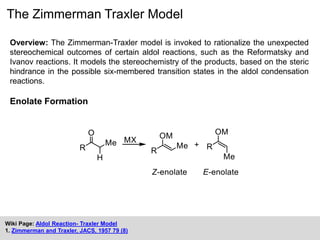
Enolate Formation
Wiki Page: Aldol Reaction- Traxler Model
1. Zimmerman and Traxler, JACS, 1957 79 (8)
The Zimmerman Traxler Model
Overview: The Zimmerman-Traxler model is invoked to rationalize the unexpected
stereochemical outcomes of certain aldol reactions, such as the Reformatsky and
Ivanov reactions. It models the stereochemistry of the products, based on the steric
hindrance in the possible six-membered transition states in the aldol condensation
reactions.
Wiki Page: Aldol Reaction- Traxler Model
1. Zimmerman and Traxler, JACS, 1957 79 (8)
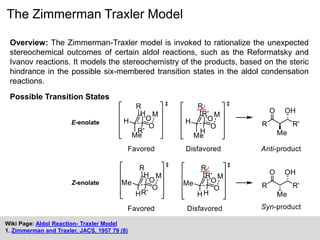
Possible Transition States
E-enolate
Z-enolate
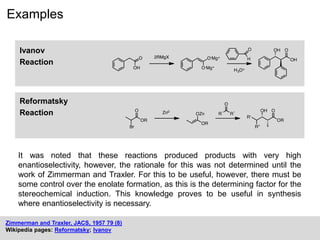
Examples
Ivanov
Reaction
Reformatsky
Reaction
It was noted that these reactions produced products with very high
enantioselectivity, however, the rationale for this was not determined until the
work of Zimmerman and Traxler. For this to be useful, however, there must be
some control over the enolate formation, as this is the determining factor for the
stereochemical induction. This knowledge proves to be useful in synthesis
where enantioselectivity is necessary.
Zimmerman and Traxler, JACS, 1957 79 (8)
Wikipedia pages: Reformatsky; Ivanov
Experimental Observation
Lui et. al. JACS 2005, 127 (16), pp 5770–5771
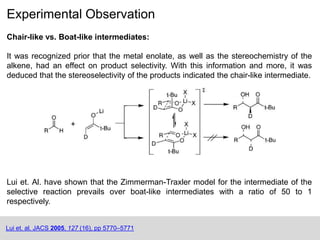
Chair-like vs. Boat-like intermediates:
Lui et. Al. have shown that the Zimmerman-Traxler model for the intermediate of the
selective reaction prevails over boat-like intermediates with a ratio of 50 to 1
respectively.
It was recognized prior that the metal enolate, as well as the stereochemistry of the
alkene, had an effect on product selectivity. With this information and more, it was
deduced that the stereoselectivity of the products indicated the chair-like intermediate.
Problems
1 & 2. Reiser, O. Chem. Rev. 1999, 1191
3. Choppin et. al. Chem. Soc. Rev., 2013,42, 937-949
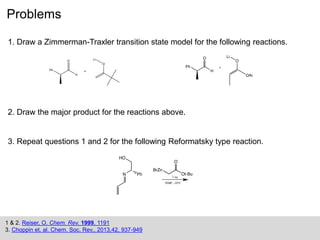
1. Draw a Zimmerman-Traxler transition state model for the following reactions.
2. Draw the major product for the reactions above.
3. Repeat questions 1 and 2 for the following Reformatsky type reaction.
This work is licensed under a
Creative Commons Attribution-
ShareAlike 4.0 International
License.
Contributed by:
Created by Alexis Johnson (Undergraduate)
Edited by Margaret Hilton
Honors Organic Chemistry
CHEM 2321 (Sigman), 2013
University of Utah

Zimmerman traxler model

  • 1.
    Organic Pedagogical Electronic Network Zimmerman-TraxlerModel Created by Alexis Johnson Edited by Margaret Hilton Honors Organic Chemistry CHEM 2321 (Sigman), 2013
  • 2.
    The Zimmerman TraxlerModel Overview: The Zimmerman-Traxler model is invoked to rationalize the unexpected stereochemical outcomes of certain aldol reactions, such as the Reformatsky and Ivanov reactions. It models the stereochemistry of the products, based on the steric hindrance in the possible six-membered transition states in the aldol condensation reactions. Enolate Formation Wiki Page: Aldol Reaction- Traxler Model 1. Zimmerman and Traxler, JACS, 1957 79 (8)
  • 3.
    The Zimmerman TraxlerModel Overview: The Zimmerman-Traxler model is invoked to rationalize the unexpected stereochemical outcomes of certain aldol reactions, such as the Reformatsky and Ivanov reactions. It models the stereochemistry of the products, based on the steric hindrance in the possible six-membered transition states in the aldol condensation reactions. Wiki Page: Aldol Reaction- Traxler Model 1. Zimmerman and Traxler, JACS, 1957 79 (8) Possible Transition States E-enolate Z-enolate
  • 4.
    Examples Ivanov Reaction Reformatsky Reaction It was notedthat these reactions produced products with very high enantioselectivity, however, the rationale for this was not determined until the work of Zimmerman and Traxler. For this to be useful, however, there must be some control over the enolate formation, as this is the determining factor for the stereochemical induction. This knowledge proves to be useful in synthesis where enantioselectivity is necessary. Zimmerman and Traxler, JACS, 1957 79 (8) Wikipedia pages: Reformatsky; Ivanov
  • 5.
    Experimental Observation Lui et.al. JACS 2005, 127 (16), pp 5770–5771 Chair-like vs. Boat-like intermediates: Lui et. Al. have shown that the Zimmerman-Traxler model for the intermediate of the selective reaction prevails over boat-like intermediates with a ratio of 50 to 1 respectively. It was recognized prior that the metal enolate, as well as the stereochemistry of the alkene, had an effect on product selectivity. With this information and more, it was deduced that the stereoselectivity of the products indicated the chair-like intermediate.
  • 6.
    Problems 1 & 2.Reiser, O. Chem. Rev. 1999, 1191 3. Choppin et. al. Chem. Soc. Rev., 2013,42, 937-949 1. Draw a Zimmerman-Traxler transition state model for the following reactions. 2. Draw the major product for the reactions above. 3. Repeat questions 1 and 2 for the following Reformatsky type reaction.
  • 7.
    This work islicensed under a Creative Commons Attribution- ShareAlike 4.0 International License. Contributed by: Created by Alexis Johnson (Undergraduate) Edited by Margaret Hilton Honors Organic Chemistry CHEM 2321 (Sigman), 2013 University of Utah