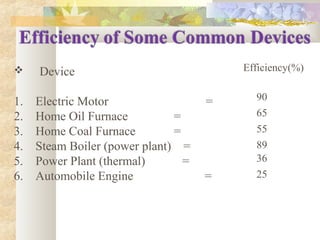
 Device
1. Electric Motor =
2. Home Oil Furnace =
3. Home Coal Furnace =
4. Steam Boiler (power plant) =
5. Power Plant (thermal) =
6. Automobile Engine =
Efficiency(%)
90
65
55
89
36
25
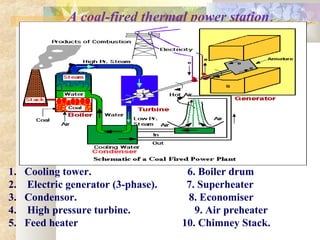
A coal-fired thermal power station.
1. Cooling tower. 6. Boiler drum
2. Electric generator (3-phase). 7. Superheater
3. Condensor. 8. Economiser
4. High pressure turbine. 9. Air preheater
5. Feed heater 10. Chimney Stack.
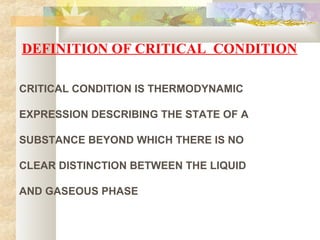
CRITICAL CONDITION IS THERMODYNAMIC
EXPRESSION DESCRIBING THE STATE OF A
SUBSTANCE BEYOND WHICH THERE IS NO
CLEAR DISTINCTION BETWEEN THE LIQUID
AND GASEOUS PHASE
DEFINITION OF CRITICAL CONDITION
WHAT IS SUPERCRITICAL PLANT
 The power plant which operates above the critical
condition is a ”SUPER CRITICAL POWER PLANT
 Water reaches to this state at a critical pressure
above 22.1 MPa and 374 o
C.
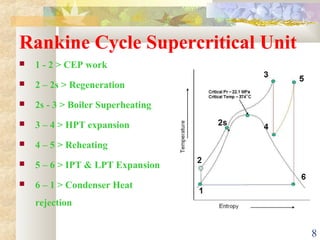
Rankine Cycle Supercritical Unit
8
 1 - 2 > CEP work
 2 – 2s > Regeneration
 2s - 3 > Boiler Superheating
 3 – 4 > HPT expansion
 4 – 5 > Reheating
 5 – 6 > IPT & LPT Expansion
 6 – 1 > Condenser Heat
rejection
This advanced technology for power
generation
Higher Efficiency,
Clean,
Safe Overall Environment
The development of coal fired supercritical
power plant technology can be described as an
evolutionary advancement towards greater
power output per unit and higher efficiency.
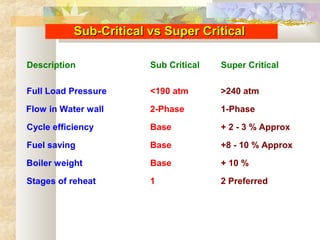
Sub-Critical vs Super CriticalSub-Critical vs Super Critical
Description Sub Critical Super Critical
Full Load Pressure <190 atm >240 atm
Flow in Water wall 2-Phase 1-Phase
Cycle efficiency Base + 2 - 3 % Approx
Fuel saving Base +8 - 10 % Approx
Boiler weight Base + 10 %
Stages of reheat 1 2 Preferred
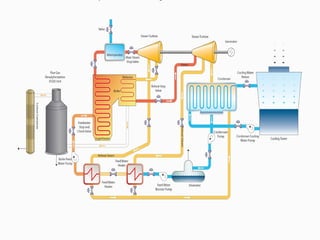
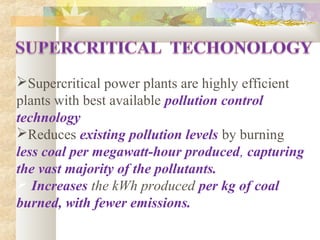
Supercritical power plants are highly efficient
plants with best available pollution control
technology,
Reduces existing pollution levels by burning
less coal per megawatt-hour produced, capturing
the vast majority of the pollutants.
 Increases the kWh produced per kg of coal
burned, with fewer emissions.
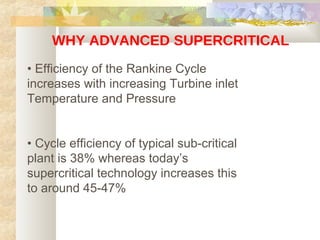
WHY ADVANCED SUPERCRITICAL
• Efficiency of the Rankine Cycle
increases with increasing Turbine inlet
Temperature and Pressure
• Cycle efficiency of typical sub-critical
plant is 38% whereas today’s
supercritical technology increases this
to around 45-47%
Coal-fired Supercritical Power plants operate at
very high temperature [580°C temp.] & with a
pressure of 23 MPa)
 Resulting much higher heat efficiencies (46%),
as compare to Sub-Critical coal-fired plants.
 Sub-Critical coal-fired plant operates at 455°C
temp., and efficiency of within 40%.
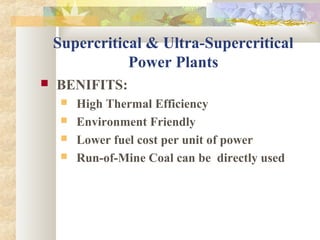
Supercritical & Ultra-Supercritical
Power Plants
 BENIFITS:
 High Thermal Efficiency
 Environment Friendly
 Lower fuel cost per unit of power
 Run-of-Mine Coal can be directly used
 Weaknesses:
 Materials Limitation
 High levels of corrosion
 Increased supervision and maintenance
costs
 Limited scope for retrofitting
opportunities
Supercritical & Ultra-Supercritical
Power Plants
CONCLUSION
 The current state-of-the-art for coal-fired
supercritical steam cycles is –600C/300 bar
maximum steam conditions, with a net thermal
efficiency of about 45% (LHV, based on UK
inland conditions). 620C plant are expected
within five years while, in the longer term (10-20
years). 650-700C is expected, with resulting cycle
efficiencies in the range 50-55%.
 Materials limitations are the major factors
limiting further development, with key
constraints at the furnace wall, superheater and
reheater outlets, and the first stages of the HP
and IP turbines. Considerable materials R&D is
under way in Europe, Japan and the USA.
Thank you for your Attention

ganesh ppts on supercritical thenology

  • 2.
     Device 1. ElectricMotor = 2. Home Oil Furnace = 3. Home Coal Furnace = 4. Steam Boiler (power plant) = 5. Power Plant (thermal) = 6. Automobile Engine = Efficiency(%) 90 65 55 89 36 25
  • 3.
    A coal-fired thermalpower station. 1. Cooling tower. 6. Boiler drum 2. Electric generator (3-phase). 7. Superheater 3. Condensor. 8. Economiser 4. High pressure turbine. 9. Air preheater 5. Feed heater 10. Chimney Stack.
  • 5.
    CRITICAL CONDITION ISTHERMODYNAMIC EXPRESSION DESCRIBING THE STATE OF A SUBSTANCE BEYOND WHICH THERE IS NO CLEAR DISTINCTION BETWEEN THE LIQUID AND GASEOUS PHASE DEFINITION OF CRITICAL CONDITION
  • 6.
    WHAT IS SUPERCRITICALPLANT  The power plant which operates above the critical condition is a ”SUPER CRITICAL POWER PLANT  Water reaches to this state at a critical pressure above 22.1 MPa and 374 o C.
  • 8.
    Rankine Cycle SupercriticalUnit 8  1 - 2 > CEP work  2 – 2s > Regeneration  2s - 3 > Boiler Superheating  3 – 4 > HPT expansion  4 – 5 > Reheating  5 – 6 > IPT & LPT Expansion  6 – 1 > Condenser Heat rejection
  • 9.
    This advanced technologyfor power generation Higher Efficiency, Clean, Safe Overall Environment The development of coal fired supercritical power plant technology can be described as an evolutionary advancement towards greater power output per unit and higher efficiency.
  • 10.
    Sub-Critical vs SuperCriticalSub-Critical vs Super Critical Description Sub Critical Super Critical Full Load Pressure <190 atm >240 atm Flow in Water wall 2-Phase 1-Phase Cycle efficiency Base + 2 - 3 % Approx Fuel saving Base +8 - 10 % Approx Boiler weight Base + 10 % Stages of reheat 1 2 Preferred
  • 11.
    Supercritical power plantsare highly efficient plants with best available pollution control technology, Reduces existing pollution levels by burning less coal per megawatt-hour produced, capturing the vast majority of the pollutants.  Increases the kWh produced per kg of coal burned, with fewer emissions.
  • 12.
    WHY ADVANCED SUPERCRITICAL •Efficiency of the Rankine Cycle increases with increasing Turbine inlet Temperature and Pressure • Cycle efficiency of typical sub-critical plant is 38% whereas today’s supercritical technology increases this to around 45-47%
  • 13.
    Coal-fired Supercritical Powerplants operate at very high temperature [580°C temp.] & with a pressure of 23 MPa)  Resulting much higher heat efficiencies (46%), as compare to Sub-Critical coal-fired plants.  Sub-Critical coal-fired plant operates at 455°C temp., and efficiency of within 40%.
  • 14.
    Supercritical & Ultra-Supercritical PowerPlants  BENIFITS:  High Thermal Efficiency  Environment Friendly  Lower fuel cost per unit of power  Run-of-Mine Coal can be directly used
  • 15.
     Weaknesses:  MaterialsLimitation  High levels of corrosion  Increased supervision and maintenance costs  Limited scope for retrofitting opportunities Supercritical & Ultra-Supercritical Power Plants
  • 16.
    CONCLUSION  The currentstate-of-the-art for coal-fired supercritical steam cycles is –600C/300 bar maximum steam conditions, with a net thermal efficiency of about 45% (LHV, based on UK inland conditions). 620C plant are expected within five years while, in the longer term (10-20 years). 650-700C is expected, with resulting cycle efficiencies in the range 50-55%.  Materials limitations are the major factors limiting further development, with key constraints at the furnace wall, superheater and reheater outlets, and the first stages of the HP and IP turbines. Considerable materials R&D is under way in Europe, Japan and the USA.
  • 17.
    Thank you foryour Attention