Apresentationon....
Contents
 Introduction
 New Technology WiMax
 Working
 Advantages & Disadvantages
 Future
 Relationship with other Wireless Technologies
 Comparision of WiMax & WIFI
 Conclusion
Think about how you access
the Internet today………
3 options !!
Broadband access
Wi-Fi access
Dial-up access
WiMax
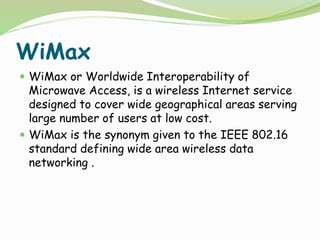
 WiMax or Worldwide Interoperability of
Microwave Access, is a wireless Internet service
designed to cover wide geographical areas serving
large number of users at low cost.
 WiMax is the synonym given to the IEEE 802.16
standard defining wide area wireless data
networking .
Working
 There are two parts:
 WiMax Tower
 WiMax Receiver
WiMax stations connect directly to the internet
with a wired connection.
How Does it work ?
• WiMax uses microwave radio technology to connect computers to the
internet in place of wired connections such as DSL or cable modems.
• It works very much like cell phone technology in that reasonable
proximity to a base station is required to establish a data link to the
Internet.
• Users within 3 to 5 miles of the base station will be able to establish a
link using NLOS technology with data rates as high as 75 Mbps.
• Users up to 30 miles away from the base staion with an antenna mounted
for LOS to the base station will be able to connect at data rates
approaching 280 Mbps.
ISP PoPWire line or Wireless
backhaul
WiMax Base Station
Homes with outdoor/indoor
WiMax receiver
ADVANTAGES
 Bandwidth Flexibility
 Pricing + Contract Flexibility
 Quick Installation
 Interpenetration
DISADVANTAGES
 WiMax can operate at higher bitrates or over longer
distances but not both.
 Omni directional antennas are used.
FUTURE
Anywhere, Anytime, Connectivity
Cost Effective
High speed of Broadband service
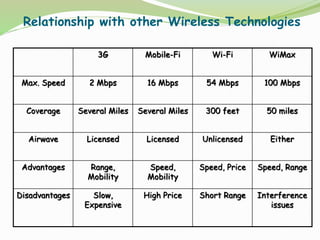
Relationship with other Wireless Technologies
3G Mobile-Fi Wi-Fi WiMax
Max. Speed 2 Mbps 16 Mbps 54 Mbps 100 Mbps
Coverage Several Miles Several Miles 300 feet 50 miles
Airwave Licensed Licensed Unlicensed Either
Advantages Range,
Mobility
Speed,
Mobility
Speed, Price Speed, Range
Disadvantages Slow,
Expensive
High Price Short Range Interference
issues
Comparison between WiMax & WiFi
WiMax
 WiMax is a long
range system.
 WiMax provides
services analogous to
cell phone.
 It uses a mechanism
based on setting up
connections between
the base station &
user device.
WiFi
 WiFi is shorter range
system.
 WiFi is more
analogous to a
cordless phone.
 WiFi has introduced
a quality of service
mechanism similar
to fixed Ethernet,
where packet can
receive different
priorities based on
their tags.
Conclusion
Within five years, we expect WiMax to be the
dominant technology for wireless networking. By that
time it will be fully mobile, as well as providing low-
cost, fixed broadband access that will open up regions
where internet access has no far not been practical.
Sources
 Wikipedia
 Slideshare
 MTNL training manual
MADE BY :
SUNAYANA PATI
14ECU095
ECE-V-B

Wimax

  • 1.
  • 2.
    Contents  Introduction  NewTechnology WiMax  Working  Advantages & Disadvantages  Future  Relationship with other Wireless Technologies  Comparision of WiMax & WIFI  Conclusion
  • 3.
    Think about howyou access the Internet today………
  • 4.
    3 options !! Broadbandaccess Wi-Fi access Dial-up access
  • 5.
    WiMax  WiMax orWorldwide Interoperability of Microwave Access, is a wireless Internet service designed to cover wide geographical areas serving large number of users at low cost.  WiMax is the synonym given to the IEEE 802.16 standard defining wide area wireless data networking .
  • 6.
    Working  There aretwo parts:  WiMax Tower  WiMax Receiver WiMax stations connect directly to the internet with a wired connection.
  • 7.
    How Does itwork ? • WiMax uses microwave radio technology to connect computers to the internet in place of wired connections such as DSL or cable modems. • It works very much like cell phone technology in that reasonable proximity to a base station is required to establish a data link to the Internet. • Users within 3 to 5 miles of the base station will be able to establish a link using NLOS technology with data rates as high as 75 Mbps. • Users up to 30 miles away from the base staion with an antenna mounted for LOS to the base station will be able to connect at data rates approaching 280 Mbps.
  • 8.
    ISP PoPWire lineor Wireless backhaul WiMax Base Station Homes with outdoor/indoor WiMax receiver
  • 9.
    ADVANTAGES  Bandwidth Flexibility Pricing + Contract Flexibility  Quick Installation  Interpenetration DISADVANTAGES  WiMax can operate at higher bitrates or over longer distances but not both.  Omni directional antennas are used.
  • 10.
    FUTURE Anywhere, Anytime, Connectivity CostEffective High speed of Broadband service
  • 11.
    Relationship with otherWireless Technologies 3G Mobile-Fi Wi-Fi WiMax Max. Speed 2 Mbps 16 Mbps 54 Mbps 100 Mbps Coverage Several Miles Several Miles 300 feet 50 miles Airwave Licensed Licensed Unlicensed Either Advantages Range, Mobility Speed, Mobility Speed, Price Speed, Range Disadvantages Slow, Expensive High Price Short Range Interference issues
  • 12.
    Comparison between WiMax& WiFi WiMax  WiMax is a long range system.  WiMax provides services analogous to cell phone.  It uses a mechanism based on setting up connections between the base station & user device. WiFi  WiFi is shorter range system.  WiFi is more analogous to a cordless phone.  WiFi has introduced a quality of service mechanism similar to fixed Ethernet, where packet can receive different priorities based on their tags.
  • 13.
    Conclusion Within five years,we expect WiMax to be the dominant technology for wireless networking. By that time it will be fully mobile, as well as providing low- cost, fixed broadband access that will open up regions where internet access has no far not been practical.
  • 14.
  • 15.
    MADE BY : SUNAYANAPATI 14ECU095 ECE-V-B