ZIGBEE TECHNOLOGY
Presented By:
“Devendra Singh​
”
A
Seminar Report on
CONTENTS
 Introduction
 Evolution
 Architecture
 Device
 Network Topologies
 Advantages
 Disadvantages
 Application
 Future Enhancement
 Conclusion ZIGBEE 2
INTRODUCTION
INTRODUCTION
OVERVIEW PURPOSE
Zigbee is a wireless
communication protocol
designed for low-power, low
data rate, and short-range
applications.
The main purpose of its design
is to interconnect devices, use
less energy, and provide
reliable data transmission.
IMPACT ADVANTAGES
This technology is
revolutionizing various sectors
such as smart homes, industrial
automation, healthcare, and
agriculture.
Its low cost, low power
consumption, and mesh
networking capabilities make it
an attractive option for many
IoT applications
ZIGBEE 4
EVOLUTION
E V O L U T I O N
2002 2003 2004
Zigbee Alliance founded to
develop and standardize the
Zigbee protocol for low
energy consumption and
reliability in battery-powered
devices.
IEEE published the
802.15.4 standard for
low-power wireless
networks, adopted by
Zigbee.
First Zigbee standard
released, introducing
star, tree, and mesh
topologies, and three
device types (coordinator,
router, end device).
2006 2012
Advanced Zigbee version
introduced with
improved networking,
security, and profiles for
home and industrial
automation.
Zigbee implemented in
smart energy, IoT, and
smart grids, with profiles
for smart homes,
metering, and
healthcare.
ZIGBEE 6
2016
Zigbee 3.0 launched,
unifying profiles for better
interoperability, improved
security, and enhanced
mesh networking with self-
healing capabilities.
ARCHITECTURE
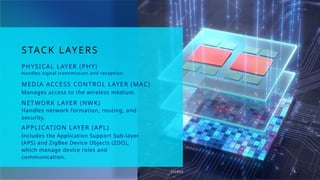
STACK LAYERS
PHYSICAL LAYER (PHY)
Handles signal transmission and reception.
MEDIA ACCESS CONTROL LAYER (MAC)
Manages access to the wireless medium.
NETWORK LAYER (NWK)​
Handles network formation, routing, and
security.
8
APPLICATION LAYER (APL)
Includes the Application Support Sub-layer
(APS) and ZigBee Device Objects (ZDO),
which manage device roles and
communication.
ZIGBEE
ZIGBEE 9
T H E S E L A Y E R S F A C I L I TAT E T H E
F E AT U R E S T H AT M A K E Z I G B E E V E R Y
AT T R A C T I V E
Low Cost
Easy Implementation
Reliable Data Transfer
Short-range Operations
Very Low Power Consumption
Adequate Security Features
DEVICE
ZIGBEE
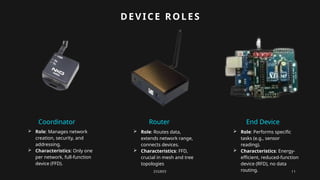
DEVICE ROLES
Coordinator Router End Device
11
 Role: Manages network
creation, security, and
addressing.
 Characteristics: Only one
per network, full-function
device (FFD).
 Role: Routes data,
extends network range,
connects devices.
 Characteristics: FFD,
crucial in mesh and tree
topologies
 Role: Performs specific
tasks (e.g., sensor
reading).
 Characteristics: Energy-
efficient, reduced-function
device (RFD), no data
routing.
ZIGBEE 12
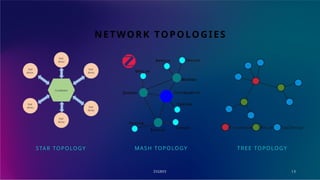
NETWORK TOPOLOGIES
ZIGBEE
NETWORK TOPOLOGIES
STAR TOPOLOGY MASH TOPOLOGY TREE TOPOLOGY
13
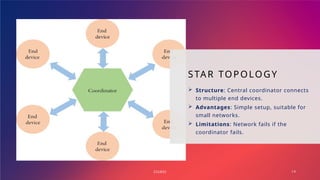
STAR TOPOLOGY
 Structure: Central coordinator connects
to multiple end devices.
 Advantages: Simple setup, suitable for
small networks.
 Limitations: Network fails if the
coordinator fails.
ZIGBEE 14
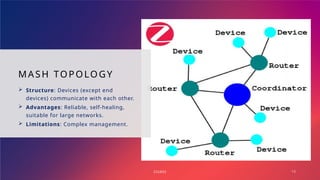
MASH TOPOLOGY
 Structure: Devices (except end
devices) communicate with each other.
 Advantages: Reliable, self-healing,
suitable for large networks.
 Limitations: Complex management.
ZIGBEE 15
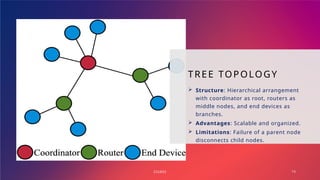
TREE TOPOLOGY
 Structure: Hierarchical arrangement
with coordinator as root, routers as
middle nodes, and end devices as
branches.
 Advantages: Scalable and organized.
 Limitations: Failure of a parent node
disconnects child nodes.
ZIGBEE 16
ZIGBEE 17
ADVANTAGES
ZIGBEE 18
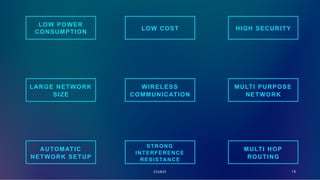
LOW COST HIGH SECURITY
LOW POWER
CONSUMPTION
WIRELESS
COMMUNICATION
MULTI PURPOSE
NETWORK
AUTOMATIC
NETWORK SETUP
STRONG
INTERFERENCE
RESISTANCE
MULTI HOP
ROUTING
LARGE NETWORK
SIZE
ZIGBEE 19
DISADVANTAGES
ZIGBEE 20
SHORT WORKING
RANGE
COMPLEXITY
LIMITED DATA
RATE
LATENCY
HIGH INITIAL
COST
LIMITED GLOBAL
ADOPTION
LOW SPEED
NETWORKING
UPGRADE AND
MAINTENANCE
LIMITED
BANDWIDTH
APPLICATIONS
ZIGBEE 22
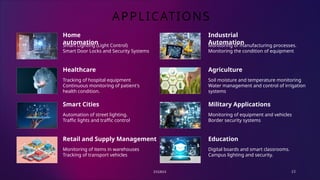
APPLICATIONS
Home
automation
Smart Lighting (Light Control)
Smart Door Locks and Security Systems
Industrial
Automation
Monitoring of manufacturing processes.
Monitoring the condition of equipment
Healthcare
Tracking of hospital equipment
Continuous monitoring of patient's
health condition.
Agriculture
Soil moisture and temperature monitoring
Water management and control of irrigation
systems
Smart Cities
Automation of street lighting.
Traffic lights and traffic control
Military Applications
Monitoring of equipment and vehicles
Border security systems
Retail and Supply Management
Monitoring of items in warehouses
Tracking of transport vehicles
Education
Digital boards and smart classrooms.
Campus lighting and security.
FUTURE
ENHANCEMENT
ZigBee 23
ZigBee 24
FUTURE
ENHANCEMENT
Increased Data Rates
Future enhancements could
focus on boosting Zigbee's data
transmission speeds beyond
the current 250 kbps, making it
more suitable for data intensive
IoT applications.
Extended Range
Improvements in signal
strength and range (beyond
100 meters) would enable
Zigbee to support larger scale
deployments, such as smart
cities and expansive industrial
setups.
Increased Data Rates
Upgrading encryption protocols
and introducing advanced
security features like quantum
resistant algorithms to address
evolving cybersecurity threats
AI and ML Integration
Incorporating artificial
intelligence and machine
learning to optimize network
performance, enable predictive
maintenance, and enhance
device interoperability in
complex IoT ecosystems.
CONCLUSION
CONCLUSION
ZIGBEE 26
Energy Efficiency and Low Power
Consumption
1 Zigbee is highly efficient, making it ideal for battery
powered devices and applications requiring long term,
low energy operation, such as smart homes and
industrial automation.
Scalability and Flexibility
2 With support for star, mesh, and tree network topologies,
Zigbee offers robust scalability and adaptability, enabling
reliable communication across large scale networks.
Security and Reliability
3 Zigbee employs AES-128 encryption, ensuring secure
data transmission, which is critical for industrial,
commercial, and smart city applications.
Future Potential
4 As IoT and smart devices expand, Zigbee is expected to
evolve with improved data rates, range, and integration
with emerging technologies like AI, further broadening
its applications and relevance.

THANK YOU
If you have any questions please
ZIGBEE 27

Zigbee Technology in college Seminar.pptx

  • 1.
    ZIGBEE TECHNOLOGY Presented By: “DevendraSingh​ ” A Seminar Report on
  • 2.
    CONTENTS  Introduction  Evolution Architecture  Device  Network Topologies  Advantages  Disadvantages  Application  Future Enhancement  Conclusion ZIGBEE 2
  • 3.
  • 4.
    INTRODUCTION OVERVIEW PURPOSE Zigbee isa wireless communication protocol designed for low-power, low data rate, and short-range applications. The main purpose of its design is to interconnect devices, use less energy, and provide reliable data transmission. IMPACT ADVANTAGES This technology is revolutionizing various sectors such as smart homes, industrial automation, healthcare, and agriculture. Its low cost, low power consumption, and mesh networking capabilities make it an attractive option for many IoT applications ZIGBEE 4
  • 5.
  • 6.
    E V OL U T I O N 2002 2003 2004 Zigbee Alliance founded to develop and standardize the Zigbee protocol for low energy consumption and reliability in battery-powered devices. IEEE published the 802.15.4 standard for low-power wireless networks, adopted by Zigbee. First Zigbee standard released, introducing star, tree, and mesh topologies, and three device types (coordinator, router, end device). 2006 2012 Advanced Zigbee version introduced with improved networking, security, and profiles for home and industrial automation. Zigbee implemented in smart energy, IoT, and smart grids, with profiles for smart homes, metering, and healthcare. ZIGBEE 6 2016 Zigbee 3.0 launched, unifying profiles for better interoperability, improved security, and enhanced mesh networking with self- healing capabilities.
  • 7.
  • 8.
    STACK LAYERS PHYSICAL LAYER(PHY) Handles signal transmission and reception. MEDIA ACCESS CONTROL LAYER (MAC) Manages access to the wireless medium. NETWORK LAYER (NWK)​ Handles network formation, routing, and security. 8 APPLICATION LAYER (APL) Includes the Application Support Sub-layer (APS) and ZigBee Device Objects (ZDO), which manage device roles and communication. ZIGBEE
  • 9.
    ZIGBEE 9 T HE S E L A Y E R S F A C I L I TAT E T H E F E AT U R E S T H AT M A K E Z I G B E E V E R Y AT T R A C T I V E Low Cost Easy Implementation Reliable Data Transfer Short-range Operations Very Low Power Consumption Adequate Security Features
  • 10.
  • 11.
    ZIGBEE DEVICE ROLES Coordinator RouterEnd Device 11  Role: Manages network creation, security, and addressing.  Characteristics: Only one per network, full-function device (FFD).  Role: Routes data, extends network range, connects devices.  Characteristics: FFD, crucial in mesh and tree topologies  Role: Performs specific tasks (e.g., sensor reading).  Characteristics: Energy- efficient, reduced-function device (RFD), no data routing.
  • 12.
  • 13.
    ZIGBEE NETWORK TOPOLOGIES STAR TOPOLOGYMASH TOPOLOGY TREE TOPOLOGY 13
  • 14.
    STAR TOPOLOGY  Structure:Central coordinator connects to multiple end devices.  Advantages: Simple setup, suitable for small networks.  Limitations: Network fails if the coordinator fails. ZIGBEE 14
  • 15.
    MASH TOPOLOGY  Structure:Devices (except end devices) communicate with each other.  Advantages: Reliable, self-healing, suitable for large networks.  Limitations: Complex management. ZIGBEE 15
  • 16.
    TREE TOPOLOGY  Structure:Hierarchical arrangement with coordinator as root, routers as middle nodes, and end devices as branches.  Advantages: Scalable and organized.  Limitations: Failure of a parent node disconnects child nodes. ZIGBEE 16
  • 17.
  • 18.
    ZIGBEE 18 LOW COSTHIGH SECURITY LOW POWER CONSUMPTION WIRELESS COMMUNICATION MULTI PURPOSE NETWORK AUTOMATIC NETWORK SETUP STRONG INTERFERENCE RESISTANCE MULTI HOP ROUTING LARGE NETWORK SIZE
  • 19.
  • 20.
    ZIGBEE 20 SHORT WORKING RANGE COMPLEXITY LIMITEDDATA RATE LATENCY HIGH INITIAL COST LIMITED GLOBAL ADOPTION LOW SPEED NETWORKING UPGRADE AND MAINTENANCE LIMITED BANDWIDTH
  • 21.
  • 22.
    ZIGBEE 22 APPLICATIONS Home automation Smart Lighting(Light Control) Smart Door Locks and Security Systems Industrial Automation Monitoring of manufacturing processes. Monitoring the condition of equipment Healthcare Tracking of hospital equipment Continuous monitoring of patient's health condition. Agriculture Soil moisture and temperature monitoring Water management and control of irrigation systems Smart Cities Automation of street lighting. Traffic lights and traffic control Military Applications Monitoring of equipment and vehicles Border security systems Retail and Supply Management Monitoring of items in warehouses Tracking of transport vehicles Education Digital boards and smart classrooms. Campus lighting and security.
  • 23.
  • 24.
    ZigBee 24 FUTURE ENHANCEMENT Increased DataRates Future enhancements could focus on boosting Zigbee's data transmission speeds beyond the current 250 kbps, making it more suitable for data intensive IoT applications. Extended Range Improvements in signal strength and range (beyond 100 meters) would enable Zigbee to support larger scale deployments, such as smart cities and expansive industrial setups. Increased Data Rates Upgrading encryption protocols and introducing advanced security features like quantum resistant algorithms to address evolving cybersecurity threats AI and ML Integration Incorporating artificial intelligence and machine learning to optimize network performance, enable predictive maintenance, and enhance device interoperability in complex IoT ecosystems.
  • 25.
  • 26.
    CONCLUSION ZIGBEE 26 Energy Efficiencyand Low Power Consumption 1 Zigbee is highly efficient, making it ideal for battery powered devices and applications requiring long term, low energy operation, such as smart homes and industrial automation. Scalability and Flexibility 2 With support for star, mesh, and tree network topologies, Zigbee offers robust scalability and adaptability, enabling reliable communication across large scale networks. Security and Reliability 3 Zigbee employs AES-128 encryption, ensuring secure data transmission, which is critical for industrial, commercial, and smart city applications. Future Potential 4 As IoT and smart devices expand, Zigbee is expected to evolve with improved data rates, range, and integration with emerging technologies like AI, further broadening its applications and relevance.

  • 27.
    THANK YOU If youhave any questions please ZIGBEE 27