Abhiroop Ghatak
           ghatak.20@gmail.com


04/17/12                         1
04/17/12   2
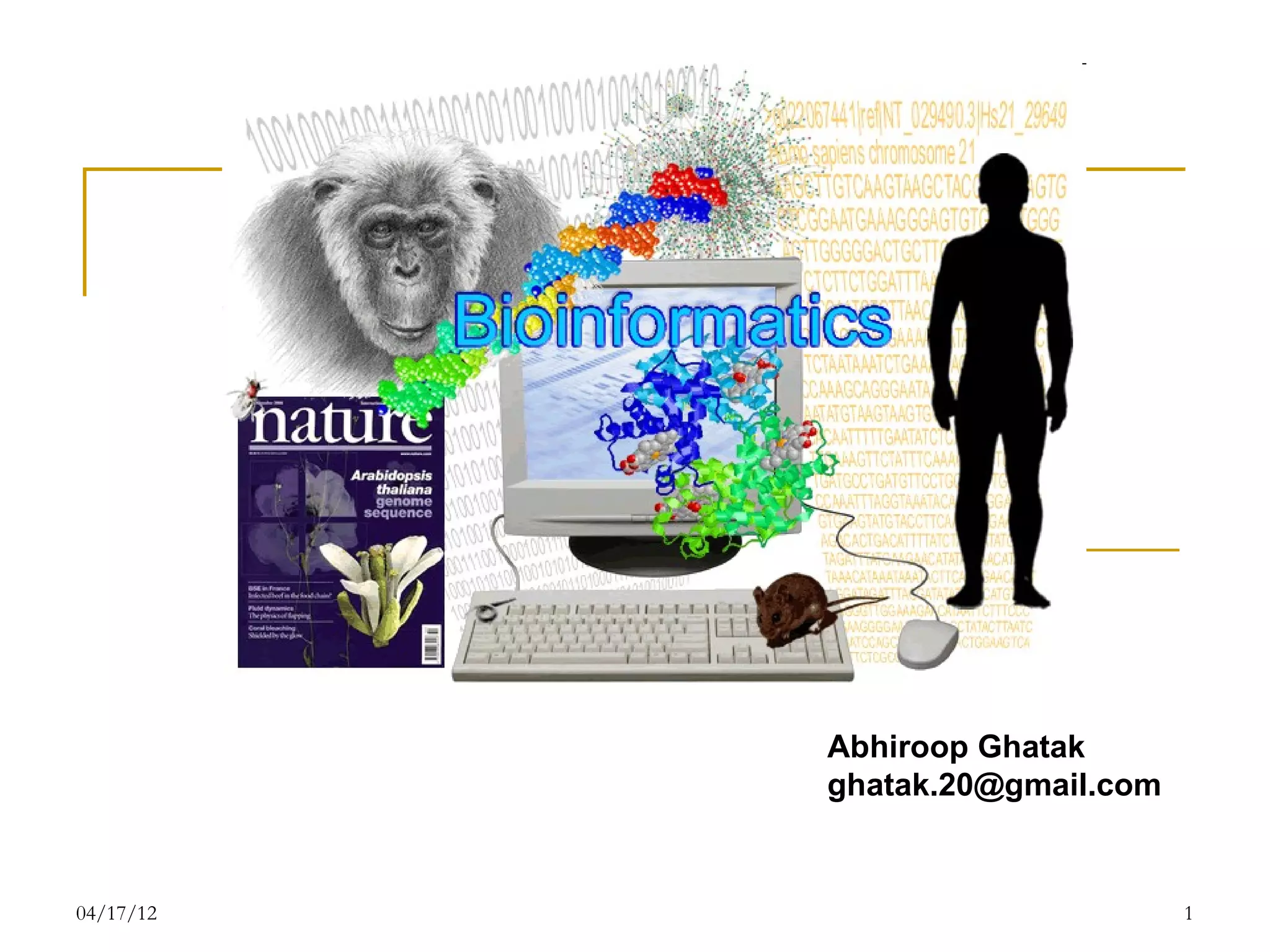
Bioinformatics
   (Molecular) bio – informatics: bioinformatics is
    conceptualizing biology in terms of molecules (in the
    sense of physical chemistry) and applying
    "informatics techniques" (derived from disciplines
    such as applied mathematics ,computer science and
    statistics) to understand and organize the
    information associated with these molecules, on a
    large scale. In short, bioinformatics is a
    management information system for molecular
    biology and has many practical applications.


04/17/12                                                3
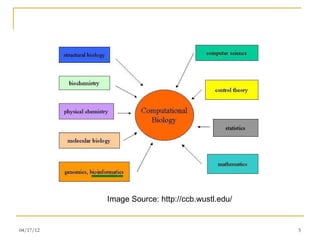
   Computational biology and bioinformatics are
    multidisciplinary fields, involving researchers from different areas
    of specialty, including (but in no means limited to) statistics,
    computer science, physics, biochemistry, genetics, molecular
    biology and mathematics. The goal of these two fields is as
    follows:

• Bioinformatics: Typically refers to the field concerned with the
   collection and storage of biological information. All matters
   concerned with biological databases are considered
   bioinformatics.

• Computational biology: Refers to the aspect of developing
   algorithms and statistical models necessary to analyze biological
   data through the aid of computers.


04/17/12                                                               4
Image Source: http://ccb.wustl.edu/


04/17/12                                         5
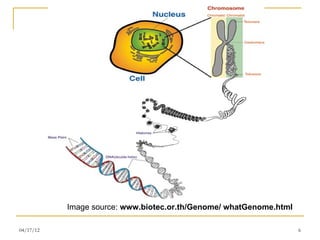
Image source: www.biotec.or.th/Genome/ whatGenome.html

04/17/12                                                            6
04/17/12   7
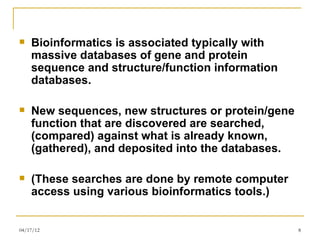
   Bioinformatics is associated typically with
    massive databases of gene and protein
    sequence and structure/function information
    databases.

   New sequences, new structures or protein/gene
    function that are discovered are searched,
    (compared) against what is already known,
    (gathered), and deposited into the databases.

   (These searches are done by remote computer
    access using various bioinformatics tools.)


04/17/12                                            8
Molecular Biology Information
Redundancy and Multiplicity
   Different sequences have the same
    structure.
   One organism has many similar genes
   A single gene may have multiple functions
   Genomic sequence redundancy due to the
    genetic code


04/17/12                                    9
General Types of informatics” techniques in
Bioinformatics
   Text String Comparison
          Text Search
          1D Alignment
          Significance Statistics
   Finding Patterns
          AI / Machine Learning
          Clustering
          Datamining
     Databases
          Building, Querying
          Object DB

04/17/12                                      10
Contd…
       Physical Simulation
          Electrostatics
          Numerical Algorithms
          Simulation
       Geometry
          Robotics
          Graphics (Surfaces, Volumes)
          Comparison and 3D Matching
          (Visision, recognition


04/17/12                                  11
What is done in Bioinformatics?
   Analysis and interpretation of various types of
    biological data including: nucleotide and amino
    acid sequences, protein domains, and protein
    structures.

   Development of new algorithms and statistics with
    which to assess biological information, such as
    relationships among members of large data sets.

   Development and implementation of tools that
    enable efficient access and management of
    different types of information, such as various
    databases, integrated mapping information.


04/17/12                                                12
Aims of bioinformatics
   Improve content and utility of databases.
   Develop better tools for data generation, capture,
    and annotation.
   Develop and improve tools and databases for
    comprehensive functional studies.
   Develop and improve tools for representing and
    analyzing sequence similarity and variation.
   Create mechanisms to support effective approaches
    for producing robust, exportable software that can
    be widely shared.

04/17/12                                             13
Why Is Bioinformatics So Important?
The rationale for applying computational approaches to
  facilitate the understanding of various biological
  processes includes:
   a more global perspective in experimental design
   the ability to capitalize on the emerging technology of
    database-mining - the process by which testable hypotheses
    are generated regarding the function or structure of a gene or
    protein of interest by identifying similar sequences in better
    characterized organisms

   Although a human disease may not be found in exactly
    the same form in animals, there may be sufficient data
    for an animal model that allow researchers to make
    inferences about the process in humans.


04/17/12                                                             14
Biological problems that computers
can help with:
   I cloned a gene - is it a known gene?
   Does the sequence match? Is the sequence any good?
   Does it look like anything else in the database?
   Which family does it belong to?
   How can I find more family members?
   I have an orphan receptor, how can I find its legend?
   How can I find out which other proteins my sequence interacts with?
   I have linkage to a specific region on chromosome x, how do I find
    genes in that region?
   I have an RNA or protein sequence with poor expression and I'd
    like to know its structure and/or function is?


04/17/12                                                              15
Major research areas
1.         Computational evolutionary biology
2.         Sequence analysis
3.         Genome annotation
               Genome annotation is the process of attaching biological information to
              sequences. It consists of two main steps:
             identifying elements on the genome, a process called Gene Finding, and
             attaching biological information to these elements.
4.         Analysis of regulation
              Regulation is the complex orchestration of events starting with an extra
              cellular signal such as a hormone and leading to an increase or decrease in
              the activity of one or more proteins.


n          In cancer Analysis of mutations
n          Comparative genomics


04/17/12                                                                                    16
Application of Bioinformatics

   Gene therapy
   Personalized medicine
   Improve nutritional quality
    Alternative energy sources
   The reality of bio weapon creation


04/17/12                                 17
Major ReSearch Labs
   The Bioinformatics Research Center (BRC) at North
    Carolina State University.

   The Bioinformatics Research Group (BiRG) at Wright
    State University

   Bioinformatics @ The University of Manchester,UK.

   Department of Molecular Biophysics and Biochemistry
    ,Yale University,New Haven, USA.


04/17/12                                                  18
     For additional information visit
           http://www.geocities.com/bioinformaticsweb/
           index.html
          http://www.bioinformatics.org/


    04/17/12                                             19

Bioinformatics-General_Intro

  • 1.
    Abhiroop Ghatak ghatak.20@gmail.com 04/17/12 1
  • 2.
  • 3.
    Bioinformatics  (Molecular) bio – informatics: bioinformatics is conceptualizing biology in terms of molecules (in the sense of physical chemistry) and applying "informatics techniques" (derived from disciplines such as applied mathematics ,computer science and statistics) to understand and organize the information associated with these molecules, on a large scale. In short, bioinformatics is a management information system for molecular biology and has many practical applications. 04/17/12 3
  • 4.
    Computational biology and bioinformatics are multidisciplinary fields, involving researchers from different areas of specialty, including (but in no means limited to) statistics, computer science, physics, biochemistry, genetics, molecular biology and mathematics. The goal of these two fields is as follows: • Bioinformatics: Typically refers to the field concerned with the collection and storage of biological information. All matters concerned with biological databases are considered bioinformatics. • Computational biology: Refers to the aspect of developing algorithms and statistical models necessary to analyze biological data through the aid of computers. 04/17/12 4
  • 5.
  • 6.
    Image source: www.biotec.or.th/Genome/whatGenome.html 04/17/12 6
  • 7.
  • 8.
    Bioinformatics is associated typically with massive databases of gene and protein sequence and structure/function information databases.  New sequences, new structures or protein/gene function that are discovered are searched, (compared) against what is already known, (gathered), and deposited into the databases.  (These searches are done by remote computer access using various bioinformatics tools.) 04/17/12 8
  • 9.
    Molecular Biology Information Redundancyand Multiplicity  Different sequences have the same structure.  One organism has many similar genes  A single gene may have multiple functions  Genomic sequence redundancy due to the genetic code 04/17/12 9
  • 10.
    General Types ofinformatics” techniques in Bioinformatics  Text String Comparison  Text Search  1D Alignment  Significance Statistics  Finding Patterns  AI / Machine Learning  Clustering  Datamining  Databases  Building, Querying  Object DB 04/17/12 10
  • 11.
    Contd…  Physical Simulation  Electrostatics  Numerical Algorithms  Simulation  Geometry  Robotics  Graphics (Surfaces, Volumes)  Comparison and 3D Matching  (Visision, recognition 04/17/12 11
  • 12.
    What is donein Bioinformatics?  Analysis and interpretation of various types of biological data including: nucleotide and amino acid sequences, protein domains, and protein structures.  Development of new algorithms and statistics with which to assess biological information, such as relationships among members of large data sets.  Development and implementation of tools that enable efficient access and management of different types of information, such as various databases, integrated mapping information. 04/17/12 12
  • 13.
    Aims of bioinformatics  Improve content and utility of databases.  Develop better tools for data generation, capture, and annotation.  Develop and improve tools and databases for comprehensive functional studies.  Develop and improve tools for representing and analyzing sequence similarity and variation.  Create mechanisms to support effective approaches for producing robust, exportable software that can be widely shared. 04/17/12 13
  • 14.
    Why Is BioinformaticsSo Important? The rationale for applying computational approaches to facilitate the understanding of various biological processes includes:  a more global perspective in experimental design  the ability to capitalize on the emerging technology of database-mining - the process by which testable hypotheses are generated regarding the function or structure of a gene or protein of interest by identifying similar sequences in better characterized organisms  Although a human disease may not be found in exactly the same form in animals, there may be sufficient data for an animal model that allow researchers to make inferences about the process in humans. 04/17/12 14
  • 15.
    Biological problems thatcomputers can help with:  I cloned a gene - is it a known gene?  Does the sequence match? Is the sequence any good?  Does it look like anything else in the database?  Which family does it belong to?  How can I find more family members?  I have an orphan receptor, how can I find its legend?  How can I find out which other proteins my sequence interacts with?  I have linkage to a specific region on chromosome x, how do I find genes in that region?  I have an RNA or protein sequence with poor expression and I'd like to know its structure and/or function is? 04/17/12 15
  • 16.
    Major research areas 1. Computational evolutionary biology 2. Sequence analysis 3. Genome annotation Genome annotation is the process of attaching biological information to sequences. It consists of two main steps:  identifying elements on the genome, a process called Gene Finding, and  attaching biological information to these elements. 4. Analysis of regulation Regulation is the complex orchestration of events starting with an extra cellular signal such as a hormone and leading to an increase or decrease in the activity of one or more proteins. n In cancer Analysis of mutations n Comparative genomics 04/17/12 16
  • 17.
    Application of Bioinformatics  Gene therapy  Personalized medicine  Improve nutritional quality  Alternative energy sources  The reality of bio weapon creation 04/17/12 17
  • 18.
    Major ReSearch Labs  The Bioinformatics Research Center (BRC) at North Carolina State University.  The Bioinformatics Research Group (BiRG) at Wright State University  Bioinformatics @ The University of Manchester,UK.  Department of Molecular Biophysics and Biochemistry ,Yale University,New Haven, USA. 04/17/12 18
  • 19.
    For additional information visit http://www.geocities.com/bioinformaticsweb/ index.html  http://www.bioinformatics.org/ 04/17/12 19

Editor's Notes

  • #2 0771184406 04/17/12 abhiroop ghatak@ CDAC NOIDA
  • #5 0771184406 04/17/12 abhiroop ghatak@ CDAC NOIDA
  • #9 0771184406 04/17/12 abhiroop ghatak@ CDAC NOIDA