Presented by :-
Shimaa Rashed
Objectives
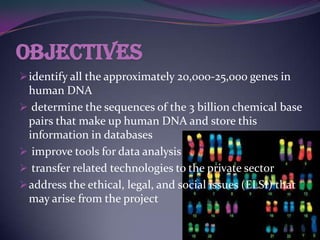
 identify all the approximately 20,000-25,000 genes in
  human DNA
 determine the sequences of the 3 billion chemical base
  pairs that make up human DNA and store this
  information in databases
 improve tools for data analysis
 transfer related technologies to the private sector
 address the ethical, legal, and social issues (ELSI) that
  may arise from the project
On January 1989 biologist and scientists
gathered and Zinder Norton declared “today
we are initiating an unending study of human
biology whatever else happen it will be an
adventure , priceless endeavor”
The main aim of human genome project is
to map the human genome.
About 3 billion nucleotide pairs encode all
human traits .
 It should be noted that through the first eight years of the
  project ,only three percent of the human genome had
been sequenced.
 James d Watson was one of the early supporters of the
  human genome initiative and the first director of the center
  of human genome research.
What is the Human
Genome Project?
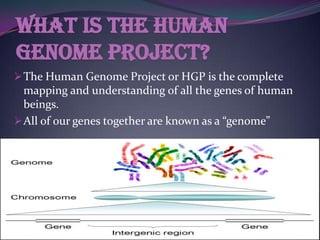
 The Human Genome Project or HGP is the complete
  mapping and understanding of all the genes of human
  beings.
 All of our genes together are known as a “genome”
Brief history of HGP
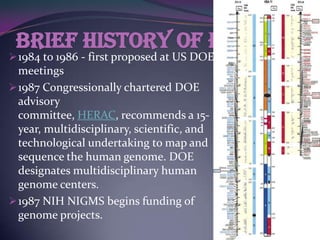
 1984 to 1986 - first proposed at US DOE
  meetings
 1987 Congressionally chartered DOE
  advisory
  committee, HERAC, recommends a 15-
  year, multidisciplinary, scientific, and
  technological undertaking to map and
  sequence the human genome. DOE
  designates multidisciplinary human
  genome centers.
 1987 NIH NIGMS begins funding of
  genome projects.
 1988 - endorsed by US National Research Council (Funded by
  NIH and US DOE $3 billion set aside)
 1988 First annual Cold Spring Harbor Laboratory meeting on
  human genome mapping and sequencing.
 1988 Telomere (chromosome end) sequence having implications
  for aging and cancer research is identified at LANL.
 1990 - Human Genome Project started formally.
 1991 Human chromosome mapping data
  repository, GDB, established.
 1992 Low-resolution genetic linkage map of entire human
  genome published.
 1995 LANL and LLNL announce high-resolution
  physical maps of chromosome 16 and chromosome
  19, respectively.
 1995 Moderate-resolution maps of chromosomes
  3, 11, 12, and 22 maps published.
 1995 Physical map with over 15,000 STS markers
  published.
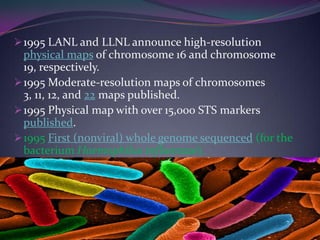
 1995 First (nonviral) whole genome sequenced (for the
  bacterium Haemophilus influenzae).
 1996 Sequence of the human T-cell receptor region completed.
 1997 NIH NCHGR becomes National Human Genome Research
  Institute (NHGRI).
 1997 High-resolution physical maps of chromosomes X and 7
  completed.
 1997 UNESCO adopts Universal Declaration on the Human
  Genome and Human Rights
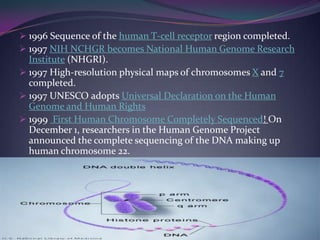
 1999 First Human Chromosome Completely Sequenced! On
  December 1, researchers in the Human Genome Project
  announced the complete sequencing of the DNA making up
  human chromosome 22.
 2000 International research
  consortium publishes chromosome 21
  genome, the smallest human
  chromosome and the fifth to be
  completed.
 2000 DOE researchers announce
  completion of chromosomes 5, 16, and
  19 draft sequence.
 2001 Human Chromosome 20
  Finished - Chromosome 20 is the third
  chromosome completely sequenced to
  the high quality specified by the
  Human Genome Project.
 Human Genome sequence published
  in Nature 2003.
 2003 Human Chromosome 6 Completed, October
 Human Chromosome 7 Completed, July 2003.
 Human Chromosome Y Completed, June 2003.
 2004 Human Chromosome 16 Completed, December
 Landmark Paper: Finishing the euchromatic
    sequence of the human genome, Nature, Oct.
    21, 2004
   Human Gene Count Estimates Changed to 20,000 to
    25,000, October 2004.
   Human Chromosome 5 Completed, September 2004.
   Human Chromosome 9 Completed, May 2004.
   Human Chromosome 10 Completed, May 2004.
   Human Chromosome 18 Completed, March 2004.
   Human Chromosome 19 Completed, March 2004.
   Human Chromosome 13 Completed, March 2004.
 2005 Human Chromosome 4 Completed, April 2005.
 Human Chromosome 2 Completed, April 2005.
 Human Chromosome X Completed, March 2005.
 2006 Human Chromosome 1 Completed, May 2006.
 Human Chromosome 3 Completed, April 2006.
 Human Chromosome 17 Completed, April 2006.
 Human Chromosome 11 Completed, March 2006.
 Human Chromosome 12 Completed, March 2006.
 Human Chromosome 15 Completed, March 2006.
 Human Chromosome 8 Completed, January 2006.
 2007 Human Microbiome Project begins. See
  Turnbaugh, P.J. et al. (2007) The human microbiome
  project.
 1000 Genomes Project Consortium publishes pilot paper
  in Nature, October 2010.
 2011 Ruling Upholds Myriad Gene Patent in Cancer
  Test, NYT, July 30
 Launched Genomic Revolution (May 2011)
 2012 Launches MyGenome App for iPad; "First Tool of Its
  Kind for Visualizing the Human Genome", June
 2013 The U.S. Is Building Massive DNA Databases
 Map Of 'Shortcuts' Created Between All Human
  Genes
Determining the
Sequence of DNA
 Methods:
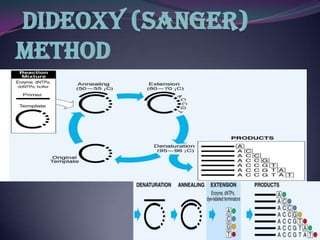
   1. Chain termination or dideoxy method
           F. Sanger
   2.   Shotgun sequence method
   3.   2nd generation sequence methods
           Pyrosequencing
Dideoxy (Sanger)
Method
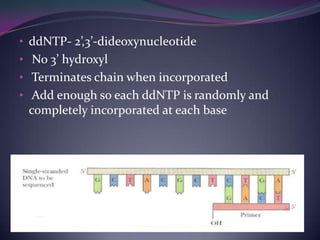
• ddNTP- 2’,3’-dideoxynucleotide
• No 3’ hydroxyl
• Terminates chain when incorporated
• Add enough so each ddNTP is randomly and
  completely incorporated at each base
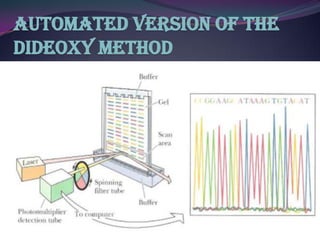
Automated Version of the
Dideoxy Method
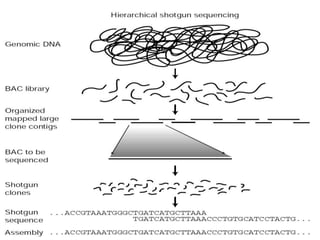
Shotgun sequence method
 The shotgun phase of the Human Genome Project
 itself consisted of three steps:

 1-Obtaining a DNA clone to sequence
 2-Sequencing the DNA clone
 3-Assembling sequence data from multiple clones to
 determine overlap and establish a contiguous
 sequence
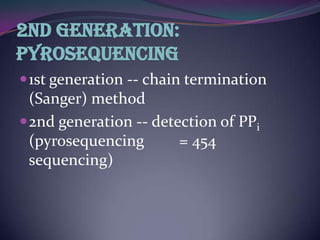
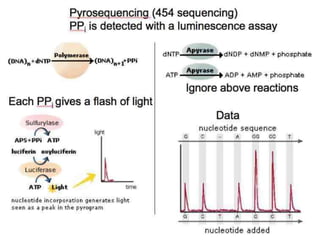
2nd Generation:
Pyrosequencing
 1st generation -- chain termination
  (Sanger) method
 2nd generation -- detection of PPi
  (pyrosequencing       = 454
  sequencing)
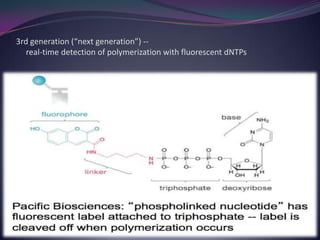
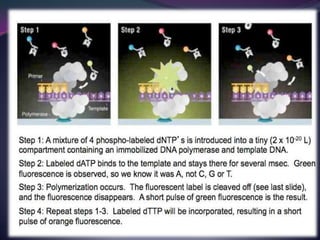
3rd generation (“next generation”) --
   real-time detection of polymerization with fluorescent dNTPs
What are the outcomes
of The human Genome
Project?
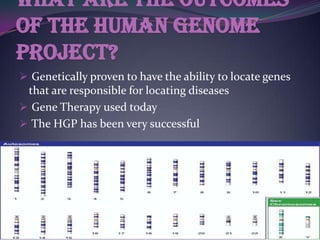
 Genetically proven to have the ability to locate genes
 that are responsible for locating diseases
 Gene Therapy used today
 The HGP has been very successful
Benefits/advantages
 The human genome project has
 been described as the most
 important experiment in the
 biological sciences, providing
 benefits in various fields.
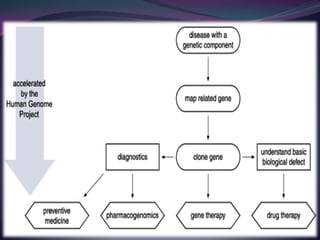
Medicine application
 Improved diagnosis of disease
 Earlier detection of genetic
  predispositions to disease
 Rational drug design
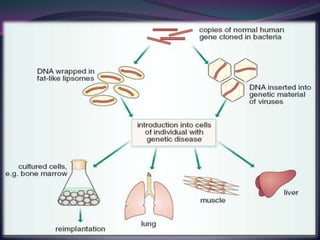
 Gene therapy and control systems
  for drugs
 Pharmacogenomics "custom
  drugs“
Energy and Environmental Applications:-
 Use microbial genomics research to create new energy
  sources (biofuels)
 Use microbial genomics research to develop
  environmental monitoring techniques to detect
  pollutants
 Use microbial genomics research for safe, efficient
  environmental remediation
 Use microbial genomics research for carbon
  sequestration
Risk Assessment: -
 Assess health damage and risks caused by radiation
  exposure, including low-dose exposures
 Assess health damage and risks caused by exposure to
  mutagenic chemicals and cancer-causing toxins
 Reduce the likelihood of heritable mutations
Thank you

Human genome

  • 1.
  • 2.
    Objectives  identify allthe approximately 20,000-25,000 genes in human DNA  determine the sequences of the 3 billion chemical base pairs that make up human DNA and store this information in databases  improve tools for data analysis  transfer related technologies to the private sector  address the ethical, legal, and social issues (ELSI) that may arise from the project
  • 3.
    On January 1989biologist and scientists gathered and Zinder Norton declared “today we are initiating an unending study of human biology whatever else happen it will be an adventure , priceless endeavor” The main aim of human genome project is to map the human genome. About 3 billion nucleotide pairs encode all human traits .
  • 4.
     It shouldbe noted that through the first eight years of the project ,only three percent of the human genome had been sequenced.  James d Watson was one of the early supporters of the human genome initiative and the first director of the center of human genome research.
  • 5.
    What is theHuman Genome Project?  The Human Genome Project or HGP is the complete mapping and understanding of all the genes of human beings.  All of our genes together are known as a “genome”
  • 7.
    Brief history ofHGP  1984 to 1986 - first proposed at US DOE meetings  1987 Congressionally chartered DOE advisory committee, HERAC, recommends a 15- year, multidisciplinary, scientific, and technological undertaking to map and sequence the human genome. DOE designates multidisciplinary human genome centers.  1987 NIH NIGMS begins funding of genome projects.
  • 8.
     1988 -endorsed by US National Research Council (Funded by NIH and US DOE $3 billion set aside)  1988 First annual Cold Spring Harbor Laboratory meeting on human genome mapping and sequencing.  1988 Telomere (chromosome end) sequence having implications for aging and cancer research is identified at LANL.  1990 - Human Genome Project started formally.  1991 Human chromosome mapping data repository, GDB, established.  1992 Low-resolution genetic linkage map of entire human genome published.
  • 9.
     1995 LANLand LLNL announce high-resolution physical maps of chromosome 16 and chromosome 19, respectively.  1995 Moderate-resolution maps of chromosomes 3, 11, 12, and 22 maps published.  1995 Physical map with over 15,000 STS markers published.  1995 First (nonviral) whole genome sequenced (for the bacterium Haemophilus influenzae).
  • 10.
     1996 Sequenceof the human T-cell receptor region completed.  1997 NIH NCHGR becomes National Human Genome Research Institute (NHGRI).  1997 High-resolution physical maps of chromosomes X and 7 completed.  1997 UNESCO adopts Universal Declaration on the Human Genome and Human Rights  1999 First Human Chromosome Completely Sequenced! On December 1, researchers in the Human Genome Project announced the complete sequencing of the DNA making up human chromosome 22.
  • 11.
     2000 Internationalresearch consortium publishes chromosome 21 genome, the smallest human chromosome and the fifth to be completed.  2000 DOE researchers announce completion of chromosomes 5, 16, and 19 draft sequence.  2001 Human Chromosome 20 Finished - Chromosome 20 is the third chromosome completely sequenced to the high quality specified by the Human Genome Project.  Human Genome sequence published in Nature 2003.
  • 12.
     2003 HumanChromosome 6 Completed, October  Human Chromosome 7 Completed, July 2003.  Human Chromosome Y Completed, June 2003.  2004 Human Chromosome 16 Completed, December  Landmark Paper: Finishing the euchromatic sequence of the human genome, Nature, Oct. 21, 2004  Human Gene Count Estimates Changed to 20,000 to 25,000, October 2004.  Human Chromosome 5 Completed, September 2004.  Human Chromosome 9 Completed, May 2004.  Human Chromosome 10 Completed, May 2004.  Human Chromosome 18 Completed, March 2004.  Human Chromosome 19 Completed, March 2004.  Human Chromosome 13 Completed, March 2004.
  • 13.
     2005 HumanChromosome 4 Completed, April 2005.  Human Chromosome 2 Completed, April 2005.  Human Chromosome X Completed, March 2005.  2006 Human Chromosome 1 Completed, May 2006.  Human Chromosome 3 Completed, April 2006.  Human Chromosome 17 Completed, April 2006.  Human Chromosome 11 Completed, March 2006.  Human Chromosome 12 Completed, March 2006.  Human Chromosome 15 Completed, March 2006.  Human Chromosome 8 Completed, January 2006.
  • 14.
     2007 HumanMicrobiome Project begins. See Turnbaugh, P.J. et al. (2007) The human microbiome project.  1000 Genomes Project Consortium publishes pilot paper in Nature, October 2010.  2011 Ruling Upholds Myriad Gene Patent in Cancer Test, NYT, July 30  Launched Genomic Revolution (May 2011)  2012 Launches MyGenome App for iPad; "First Tool of Its Kind for Visualizing the Human Genome", June  2013 The U.S. Is Building Massive DNA Databases  Map Of 'Shortcuts' Created Between All Human Genes
  • 16.
    Determining the Sequence ofDNA  Methods: 1. Chain termination or dideoxy method  F. Sanger 2. Shotgun sequence method 3. 2nd generation sequence methods  Pyrosequencing
  • 17.
  • 18.
    • ddNTP- 2’,3’-dideoxynucleotide •No 3’ hydroxyl • Terminates chain when incorporated • Add enough so each ddNTP is randomly and completely incorporated at each base
  • 19.
    Automated Version ofthe Dideoxy Method
  • 20.
    Shotgun sequence method The shotgun phase of the Human Genome Project itself consisted of three steps:  1-Obtaining a DNA clone to sequence  2-Sequencing the DNA clone  3-Assembling sequence data from multiple clones to determine overlap and establish a contiguous sequence
  • 22.
    2nd Generation: Pyrosequencing  1stgeneration -- chain termination (Sanger) method  2nd generation -- detection of PPi (pyrosequencing = 454 sequencing)
  • 24.
    3rd generation (“nextgeneration”) -- real-time detection of polymerization with fluorescent dNTPs
  • 26.
    What are theoutcomes of The human Genome Project?  Genetically proven to have the ability to locate genes that are responsible for locating diseases  Gene Therapy used today  The HGP has been very successful
  • 27.
    Benefits/advantages  The humangenome project has been described as the most important experiment in the biological sciences, providing benefits in various fields.
  • 28.
    Medicine application  Improveddiagnosis of disease  Earlier detection of genetic predispositions to disease  Rational drug design  Gene therapy and control systems for drugs  Pharmacogenomics "custom drugs“
  • 31.
    Energy and EnvironmentalApplications:-  Use microbial genomics research to create new energy sources (biofuels)  Use microbial genomics research to develop environmental monitoring techniques to detect pollutants  Use microbial genomics research for safe, efficient environmental remediation  Use microbial genomics research for carbon sequestration
  • 32.
    Risk Assessment: - Assess health damage and risks caused by radiation exposure, including low-dose exposures  Assess health damage and risks caused by exposure to mutagenic chemicals and cancer-causing toxins  Reduce the likelihood of heritable mutations
  • 33.