GENOMICS

The science of studying
   whole genomes.
Genomics
• (1980s) the nucleotide sequences of many
  important genes from human and other
  organisms had been determined.
• (1990s) a team of scientists determined
  the nucleotide sequence of the entire
  genome of Haemophilus influenzae.
• The first targets of genomics research
  were pathogenic bacteria.
The Human Genome Project
• (1990) an international consortium of
  government-funded researchers began
  the Human Genome Project.
• (April 14, 2003) the Human Genome
  Project was successfully completed more
  than 2 years head of schedule.
The Human Genome Project
• The 24 different kinds of chromosomes in
  the human genome (22 autosomes plus
  the X and Y chromosomes) contain
  approximately 3.2 billion nucleotide pairs
  of DNA and 30,000 to 40,000 genes.
• Most complex eukaryotes have huge
  amount of noncoding DNA – about 97% of
  human DNA is made up of gene control
  type.
The Human Genome Project
• The remaining DNA has been called “junk
  DNA”, a tongue-in-cheek way of saying
  that scientists don’t understand its
  functions.
• Much of the DNA between genes consists
  of repetitive DNA.
The Human Genome Project
Repetitive DNA
   Nucleotide sequences present in many copies
   in the genome.

Main Types:
5. A unit of just a few nucleotide pairs is repeated
   many times in a row.
6. Each repeated unit is hundreds of nucleotides
   long and the copies are scattered around the
   genome.
Tracking the Anthrax Killer
• (October 2001) Bob Stevens, a 63-year-old
  editor at a Florida media company, died from
  inhalation anthrax, a disease caused by
  breathing spores of the bacterium Bacillus
  anthracis.
• Examining the genomes of the spores could
  answer several crucial questions.
• Investigators compared the genomes – which
  were 3 million nucleotides long – of the mailed
  anthrax spores with several laboratory strains.
Tracking the Anthrax Killer
• They were able to match the deadly spores with
  a laboratory subtype called the Ames strain.
• The Ames strain was first isolated from a dead
  Texas cow in 1981.
• The samples were sent to U.S. Army Medical
  Research Institute in Fort Detrick, Maryland.
• From there, it was sent to at least 14 other labs
  for use in experiments.
Tracking the Anthrax Killer
• Unfortunately, the date were not detailed
  enough to tie the mailed samples to any
  particular laboratory.
• The anthrax investigation is a prominent
  example of the new field of comparative
  genomics, the comparison of whole
  genomes.
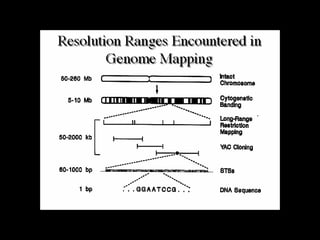
Genome-Mapping Techniques
             Genetic (Linkage) Mapping
• Scientists combined pedigree analysis of large
  families with DNA technology to map over 5,000
  genetic markers.
• These markers included both coding regions
  (genes) and noncoding regions (such as strands
  of repetitive DNA).
• The low-resolution genetic map provided anchor
  points that enabled researchers to map other
  markers by testing for genetic linkage to the
  known markers.
Genome-Mapping Techniques
                   Physical Mapping
•   Researchers used several different restriction
    enzymes to break the DNA of each chromosome
    into a number of identifiable fragments, which
    they cloned.
•   They then determined the original order of the
    fragments in the chromosome by overlapping
    the fragments and matching up their ends.
•   They used probes to relate the fragments to the
    markers mapped in stage 1.
•   The end result was a series of DNA segments
    that spanned the genome in a known order.
Genome-Mapping Techniques
              DNA Sequencing
• As the sequence of each cloned fragment
  from the physical map of stage 2 was
  determined, the fragments were
  reassembled in their proper order,
  producing large-scale sequences.
Genome-Mapping Techniques
       The Whole Genome Shotgun Method
• The procedure essentially skips the first two
  stages described and proceeds directly to the
  third.
• An entire genome is chopped by restriction
  enzymes into fragments that are cloned and
  sequenced.
• High-performance computers running
  specialized mapping software can reassemble
  the millions of partial sequences into a entire
  genome.
HUMAN GENE THERAPY

 A recombinant DNA procedure that
 seeks to treat disease by altering an
      afflicted person’s genes.
Human Gene Therapy
1. A gene from a normal individual is
   isolated and cloned by recombinant DNA
   techniques.
2. The gene is inserted into a vector, such
   as a nonharmful virus.
3. The virus is then injectedto the patient.
Treating Severe Combined
        Immunodeficiency
Severe Combined Immunodeficiency (SCID)
 A fatal inherited disease caused by a
 single defective gene.
Treating Severe Combined
          Immunodeficiency
• The first trial of began at the National Institutes
  of Health in 1990 on a 4-year-old girl with SCID.
• Immune system cells were periodically removed
  from her blood, infected with a virus engineered
  to carry the normal allele of the defective gene,
  then reinjected into her bloodstream.
• Her gene therapy lasted a limited time and was
  only one of the several treatments she received.
SAFETY
     AND
ETHICAL ISSUES
The Controversy Over
     Genetically Modified Foods
• Advocates of a cautious approach fear
  that crops from other species might be
  hazardous to human health or harm the
  environment.
Ethical Questions Raised by
         DNA Technology
• DNA technology raises many questions –
  moral, legal, and ethical – few of which
  have clear answers.
• Advances in genetic fingerprinting raise
  private issues.
• There is a danger that information about
  disease-associated genes could be
  abused.
Ethical Questions Raised by
          DNA Technology
• Should we try to eliminate genetic defects in our
  children and their descendants?
• Should we interfere with evolution this way?
• Are we willing to risk making genetic changes
  that could be detrimental to our species in the
  future?
• How do we really feel about wielding one of
  nature’s singular powers – the ability to make
  new microorganisms, plants, and even animals?

Genomics

  • 1.
    GENOMICS The science ofstudying whole genomes.
  • 2.
    Genomics • (1980s) thenucleotide sequences of many important genes from human and other organisms had been determined. • (1990s) a team of scientists determined the nucleotide sequence of the entire genome of Haemophilus influenzae. • The first targets of genomics research were pathogenic bacteria.
  • 3.
    The Human GenomeProject • (1990) an international consortium of government-funded researchers began the Human Genome Project. • (April 14, 2003) the Human Genome Project was successfully completed more than 2 years head of schedule.
  • 4.
    The Human GenomeProject • The 24 different kinds of chromosomes in the human genome (22 autosomes plus the X and Y chromosomes) contain approximately 3.2 billion nucleotide pairs of DNA and 30,000 to 40,000 genes. • Most complex eukaryotes have huge amount of noncoding DNA – about 97% of human DNA is made up of gene control type.
  • 5.
    The Human GenomeProject • The remaining DNA has been called “junk DNA”, a tongue-in-cheek way of saying that scientists don’t understand its functions. • Much of the DNA between genes consists of repetitive DNA.
  • 6.
    The Human GenomeProject Repetitive DNA Nucleotide sequences present in many copies in the genome. Main Types: 5. A unit of just a few nucleotide pairs is repeated many times in a row. 6. Each repeated unit is hundreds of nucleotides long and the copies are scattered around the genome.
  • 7.
    Tracking the AnthraxKiller • (October 2001) Bob Stevens, a 63-year-old editor at a Florida media company, died from inhalation anthrax, a disease caused by breathing spores of the bacterium Bacillus anthracis. • Examining the genomes of the spores could answer several crucial questions. • Investigators compared the genomes – which were 3 million nucleotides long – of the mailed anthrax spores with several laboratory strains.
  • 8.
    Tracking the AnthraxKiller • They were able to match the deadly spores with a laboratory subtype called the Ames strain. • The Ames strain was first isolated from a dead Texas cow in 1981. • The samples were sent to U.S. Army Medical Research Institute in Fort Detrick, Maryland. • From there, it was sent to at least 14 other labs for use in experiments.
  • 9.
    Tracking the AnthraxKiller • Unfortunately, the date were not detailed enough to tie the mailed samples to any particular laboratory. • The anthrax investigation is a prominent example of the new field of comparative genomics, the comparison of whole genomes.
  • 10.
    Genome-Mapping Techniques Genetic (Linkage) Mapping • Scientists combined pedigree analysis of large families with DNA technology to map over 5,000 genetic markers. • These markers included both coding regions (genes) and noncoding regions (such as strands of repetitive DNA). • The low-resolution genetic map provided anchor points that enabled researchers to map other markers by testing for genetic linkage to the known markers.
  • 11.
    Genome-Mapping Techniques Physical Mapping • Researchers used several different restriction enzymes to break the DNA of each chromosome into a number of identifiable fragments, which they cloned. • They then determined the original order of the fragments in the chromosome by overlapping the fragments and matching up their ends. • They used probes to relate the fragments to the markers mapped in stage 1. • The end result was a series of DNA segments that spanned the genome in a known order.
  • 12.
    Genome-Mapping Techniques DNA Sequencing • As the sequence of each cloned fragment from the physical map of stage 2 was determined, the fragments were reassembled in their proper order, producing large-scale sequences.
  • 13.
    Genome-Mapping Techniques The Whole Genome Shotgun Method • The procedure essentially skips the first two stages described and proceeds directly to the third. • An entire genome is chopped by restriction enzymes into fragments that are cloned and sequenced. • High-performance computers running specialized mapping software can reassemble the millions of partial sequences into a entire genome.
  • 15.
    HUMAN GENE THERAPY A recombinant DNA procedure that seeks to treat disease by altering an afflicted person’s genes.
  • 16.
    Human Gene Therapy 1.A gene from a normal individual is isolated and cloned by recombinant DNA techniques. 2. The gene is inserted into a vector, such as a nonharmful virus. 3. The virus is then injectedto the patient.
  • 17.
    Treating Severe Combined Immunodeficiency Severe Combined Immunodeficiency (SCID) A fatal inherited disease caused by a single defective gene.
  • 18.
    Treating Severe Combined Immunodeficiency • The first trial of began at the National Institutes of Health in 1990 on a 4-year-old girl with SCID. • Immune system cells were periodically removed from her blood, infected with a virus engineered to carry the normal allele of the defective gene, then reinjected into her bloodstream. • Her gene therapy lasted a limited time and was only one of the several treatments she received.
  • 19.
    SAFETY AND ETHICAL ISSUES
  • 20.
    The Controversy Over Genetically Modified Foods • Advocates of a cautious approach fear that crops from other species might be hazardous to human health or harm the environment.
  • 21.
    Ethical Questions Raisedby DNA Technology • DNA technology raises many questions – moral, legal, and ethical – few of which have clear answers. • Advances in genetic fingerprinting raise private issues. • There is a danger that information about disease-associated genes could be abused.
  • 22.
    Ethical Questions Raisedby DNA Technology • Should we try to eliminate genetic defects in our children and their descendants? • Should we interfere with evolution this way? • Are we willing to risk making genetic changes that could be detrimental to our species in the future? • How do we really feel about wielding one of nature’s singular powers – the ability to make new microorganisms, plants, and even animals?