Surya Saha, Ph.D.
Cornell University & Boyce Thompson Institute
suryasaha@cornell.edu @SahaSurya
Centre for Agricultural Bioinformatics
Pusa, New Delhi
June 13,2014
Slides: http://bit.ly/CABin_Pusa_2014
http://www.acgt.me/blog/2014/3/7/next-generation-sequencing-must-die
Genome Assembly
Jason Chin http://www.bit.ly/SZPKIG
6/15/2014 Centre for Agricultural Bioinformatics, Pusa 2
You are free to:
Copy, share, adapt, or re-mix;
Photograph, film, or broadcast;
Blog, live-blog, or post video of;
This presentation. Provided that:
You attribute the work to its author and respect the rights
and licenses associated with its components.
Slide Concept by Cameron Neylon, who has waived all copyright and related or neighbouring rights. This slide only ccZero. Social Media Icons adapted with
permission from originals by Christopher Ross. Original images are available under GPL at
http://www.thisismyurl.com/free-downloads/15-free-speech-bubble-icons-for-popular-websites
6/15/2014 Centre for Agricultural Bioinformatics, Pusa 3
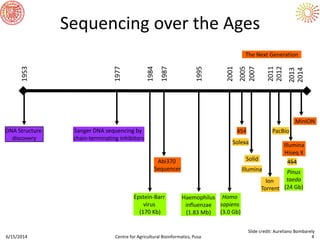
Sequencing
1953
DNA Structure
discovery
1977
2012
Sanger DNA sequencing by
chain-terminating inhibitors
1984
Epstein-Barr
virus
(170 Kb)
1987Abi370
Sequencer
1995
2001
Homo
sapiens
(3.0 Gb)
2005
454
Solexa
Solid
2007
2011
Ion
Torrent
PacBio
Haemophilus
influenzae
(1.83 Mb)
2013
Slide credit: Aureliano Bombarely
Sequencing over the Ages
Illumina
Illumina
Hiseq X
454
6/15/2014 Centre for Agricultural Bioinformatics, Pusa 4
Pinus
taeda
(24 Gb)
2014
MinION
The Next Generation
6/15/2014 Centre for Agricultural Bioinformatics, Pusa 5
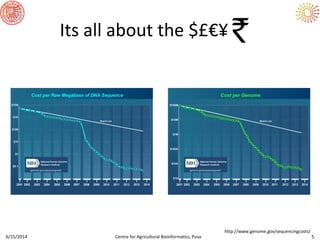
Its all about the $£€¥
http://www.genome.gov/sequencingcosts/
6/15/2014 Centre for Agricultural Bioinformatics, Pusa 6
First generation sequencing
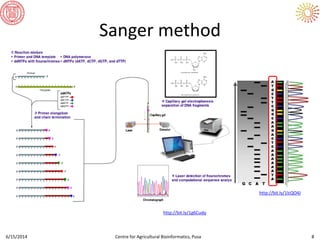
Sanger method
6/15/2014 Centre for Agricultural Bioinformatics, Pusa 7
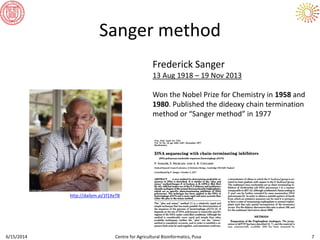
Frederick Sanger
13 Aug 1918 – 19 Nov 2013
Won the Nobel Prize for Chemistry in 1958 and
1980. Published the dideoxy chain termination
method or “Sanger method” in 1977
http://dailym.ai/1f1XeTB
Sanger method
6/15/2014 Centre for Agricultural Bioinformatics, Pusa 8
http://bit.ly/1g6Cudq
http://bit.ly/1lcQO4J
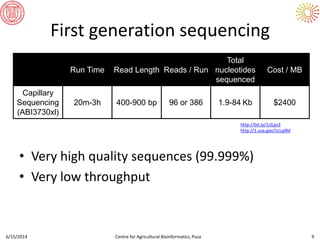
First generation sequencing
• Very high quality sequences (99.999%)
• Very low throughput
6/15/2014 Centre for Agricultural Bioinformatics, Pusa 9
Run Time Read Length Reads / Run
Total
nucleotides
sequenced
Cost / MB
Capillary
Sequencing
(ABI3730xl)
20m-3h 400-900 bp 96 or 386 1.9-84 Kb $2400
http://bit.ly/1clLps3
http://1.usa.gov/1cLqIRd
Use the specific technology used
to generate the data
– Illumina Hiseq/Miseq/NextSeq
– Pacific Biosciences RS I/RS II
– Ion Torrent Proton/PGM
– SOLiD
– 454
6/15/2014 Centre for Agricultural Bioinformatics, Pusa 10
http://www.acgt.me/blog/2014/3/10/next-generation-
sequencing-must-diepart-2
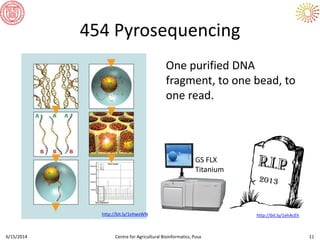
454 Pyrosequencing
One purified DNA
fragment, to one bead, to
one read.
6/15/2014 Centre for Agricultural Bioinformatics, Pusa 11
http://bit.ly/1ehwxWN
GS FLX
Titanium
http://bit.ly/1ehAcEh
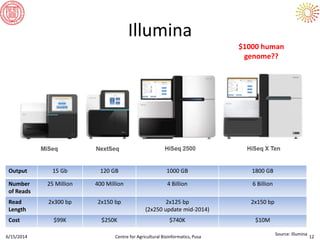
Illumina
6/15/2014 Centre for Agricultural Bioinformatics, Pusa 12
Output 15 Gb 120 GB 1000 GB 1800 GB
Number
of Reads
25 Million 400 Million 4 Billion 6 Billion
Read
Length
2x300 bp 2x150 bp 2x125 bp
(2x250 update mid-2014)
2x150 bp
Cost $99K $250K $740K $10M
Source: Illumina
$1000 human
genome??
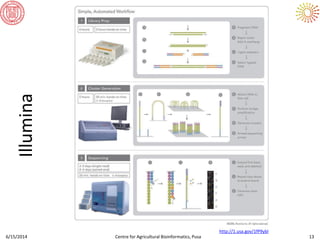
Illumina
6/15/2014 Centre for Agricultural Bioinformatics, Pusa 13
http://1.usa.gov/1fP9ybl
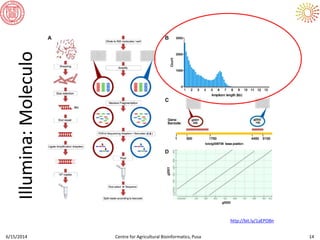
Illumina:Moleculo
6/15/2014 Centre for Agricultural Bioinformatics, Pusa 14
http://bit.ly/1aEPOBn
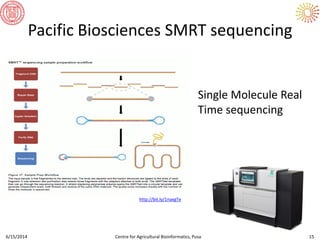
Pacific Biosciences SMRT sequencing
Single Molecule Real
Time sequencing
6/15/2014 Centre for Agricultural Bioinformatics, Pusa 15
http://bit.ly/1naxgTe
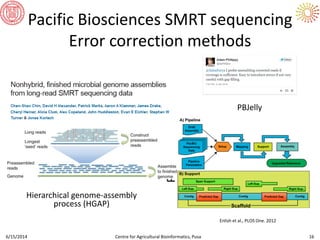
Pacific Biosciences SMRT sequencing
Error correction methods
6/15/2014 Centre for Agricultural Bioinformatics, Pusa 16
Hierarchical genome-assembly
process (HGAP)
PBJelly
Enlish et al., PLOS One. 2012
PBJelly
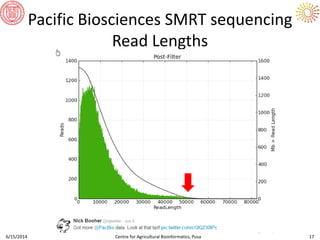
6/15/2014 Centre for Agricultural Bioinformatics, Pusa 17
Pacific Biosciences SMRT sequencing
Read Lengths
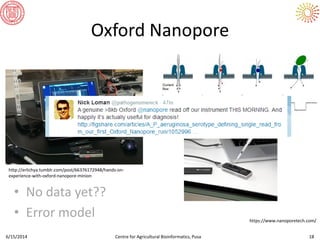
Oxford Nanopore
6/15/2014 Centre for Agricultural Bioinformatics, Pusa 18
https://www.nanoporetech.com/
• No data yet??
• Error model
http://erlichya.tumblr.com/post/66376172948/hands-on-
experience-with-oxford-nanopore-minion
Others
• Ion Torrent Proton/PGM
• Nabsys
• SOLiD
6/15/2014 Centre for Agricultural Bioinformatics, Pusa 19
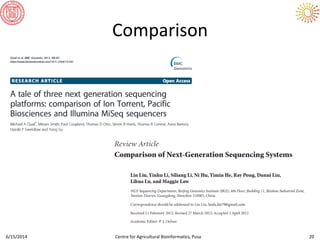
Comparison
6/15/2014 Centre for Agricultural Bioinformatics, Pusa 20
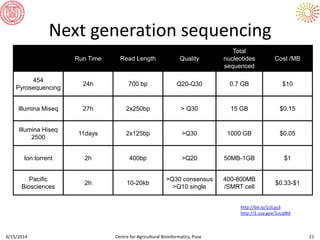
Next generation sequencing
6/15/2014 Centre for Agricultural Bioinformatics, Pusa 21
Run Time Read Length Quality
Total
nucleotides
sequenced
Cost /MB
454
Pyrosequencing
24h 700 bp Q20-Q30 0.7 GB $10
Illumina Miseq 27h 2x250bp > Q30 15 GB $0.15
Illumina Hiseq
2500
11days 2x125bp >Q30 1000 GB $0.05
Ion torrent 2h 400bp >Q20 50MB-1GB $1
Pacific
Biosciences
2h 10-20kb
>Q30 consensus
>Q10 single
400-800MB
/SMRT cell
$0.33-$1
http://bit.ly/1clLps3
http://1.usa.gov/1cLqIRd
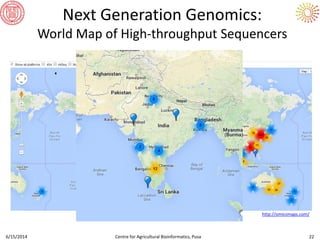
http://omicsmaps.com/
Next Generation Genomics:
World Map of High-throughput Sequencers
Centre for Agricultural Bioinformatics, Pusa6/15/2014 22
6/15/2014 Centre for Agricultural Bioinformatics, Pusa 23
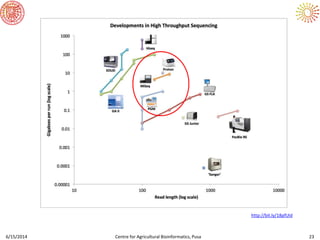
http://bit.ly/18pfUId
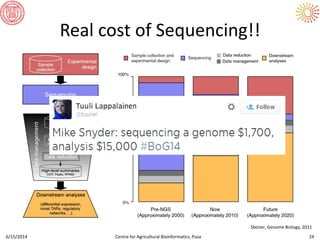
Real cost of Sequencing!!
Sboner, Genome Biology, 2011
6/15/2014 24Centre for Agricultural Bioinformatics, Pusa
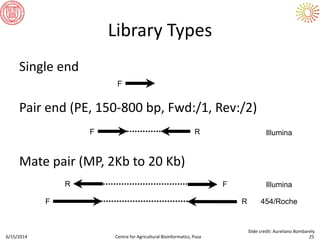
Library Types
Single end
Pair end (PE, 150-800 bp, Fwd:/1, Rev:/2)
Mate pair (MP, 2Kb to 20 Kb)
6/15/2014 Centre for Agricultural Bioinformatics, Pusa 25
F
F R
F R 454/Roche
FR Illumina
Illumina
Slide credit: Aureliano Bombarely
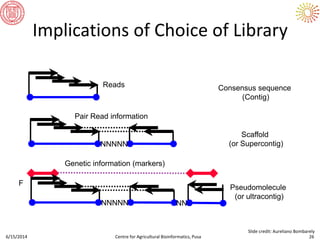
Implications of Choice of Library
6/15/2014 Centre for Agricultural Bioinformatics, Pusa 26
Slide credit: Aureliano Bombarely
Consensus sequence
(Contig)
Reads
Scaffold
(or Supercontig)
Pair Read information
NNNNN
Pseudomolecule
(or ultracontig)
F
Genetic information (markers)
NNNNN NN
6/15/2014 Centre for Agricultural Bioinformatics, Pusa 27
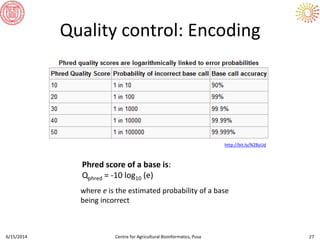
Quality control: Encoding
http://bit.ly/N28yUd
Phred score of a base is:
Qphred = -10 log10 (e)
where e is the estimated probability of a base
being incorrect
6/15/2014 Centre for Agricultural Bioinformatics, Pusa 28
Genome Assembly
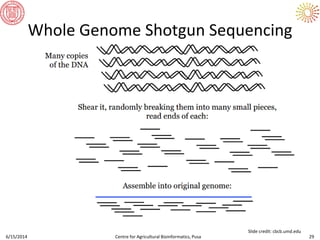
Whole Genome Shotgun Sequencing
6/15/2014 Centre for Agricultural Bioinformatics, Pusa 29
Slide credit: cbcb.umd.edu
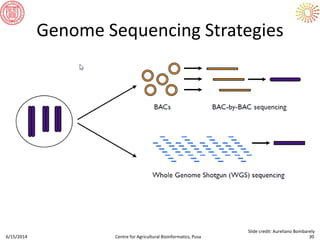
Genome Sequencing Strategies
6/15/2014 Centre for Agricultural Bioinformatics, Pusa 30
Slide credit: Aureliano Bombarely
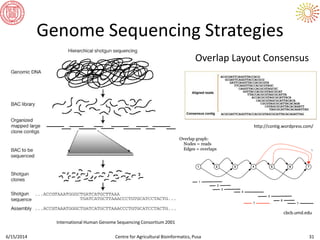
Genome Sequencing Strategies
6/15/2014 Centre for Agricultural Bioinformatics, Pusa 31
International Human Genome Sequencing Consortium 2001
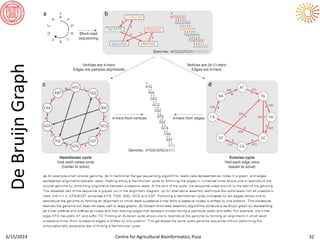
Overlap Layout Consensus
http://contig.wordpress.com/
cbcb.umd.edu
DeBruijnGraph
6/15/2014 Centre for Agricultural Bioinformatics, Pusa 32
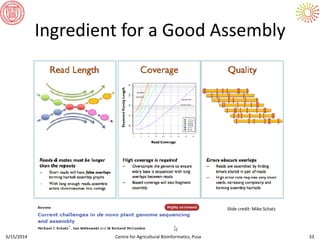
Ingredient for a Good Assembly
6/15/2014 Centre for Agricultural Bioinformatics, Pusa 33
Slide credit: Mike Schatz
6/15/2014 Centre for Agricultural Bioinformatics, Pusa 34
6/15/2014 Centre for Agricultural Bioinformatics, Pusa 35
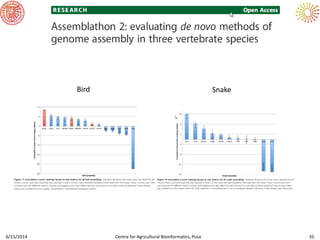
Bird Snake
6/15/2014 Centre for Agricultural Bioinformatics, Pusa 36
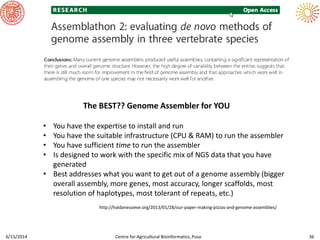
• You have the expertise to install and run
• You have the suitable infrastructure (CPU & RAM) to run the assembler
• You have sufficient time to run the assembler
• Is designed to work with the specific mix of NGS data that you have
generated
• Best addresses what you want to get out of a genome assembly (bigger
overall assembly, more genes, most accuracy, longer scaffolds, most
resolution of haplotypes, most tolerant of repeats, etc.)
The BEST?? Genome Assembler for YOU
http://haldanessieve.org/2013/01/28/our-paper-making-pizzas-and-genome-assemblies/
6/15/2014 Centre for Agricultural Bioinformatics, Pusa 37
Which technology to use??
• Microbial genomes
• Eukaryotic genomes
• Resequencing genomes
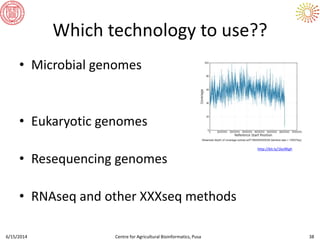
• RNAseq and other XXXseq methods
6/15/2014 Centre for Agricultural Bioinformatics, Pusa 38
http://bit.ly/1ko9Kgh
6/15/2014 Centre for Agricultural Bioinformatics, Pusa 39
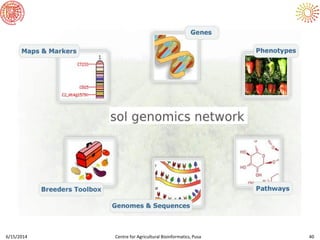
SOL Genomics Network
6/15/2014 Centre for Agricultural Bioinformatics, Pusa 40
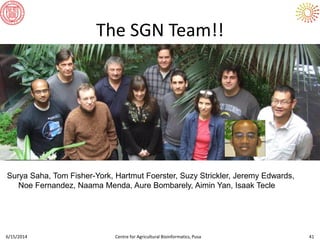
The SGN Team!!
6/15/2014 Centre for Agricultural Bioinformatics, Pusa 41
Surya Saha, Tom Fisher-York, Hartmut Foerster, Suzy Strickler, Jeremy Edwards,
Noe Fernandez, Naama Menda, Aure Bombarely, Aimin Yan, Isaak Tecle
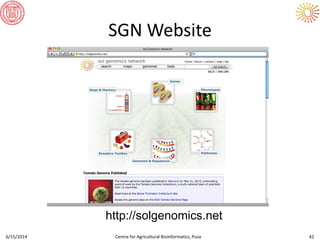
SGN Website
6/15/2014 Centre for Agricultural Bioinformatics, Pusa 42
http://solgenomics.net
6/15/2014 Centre for Agricultural Bioinformatics, Pusa 43
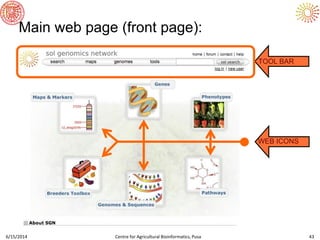
Main web page (front page):
WEB ICONS
TOOL BAR
6/15/2014 Centre for Agricultural Bioinformatics, Pusa 44
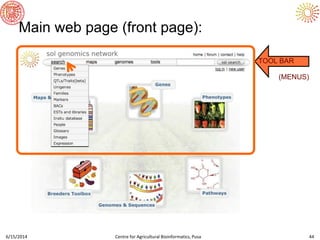
Main web page (front page):
TOOL BAR
(MENUS)
6/15/2014 Centre for Agricultural Bioinformatics, Pusa 45
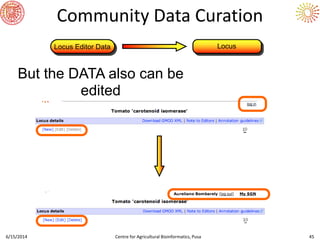
But the DATA also can be
edited
LocusLocus Editor Data
Community Data Curation
6/15/2014 Centre for Agricultural Bioinformatics, Pusa 46
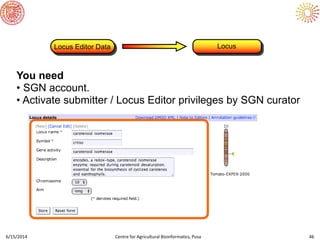
You need
• SGN account.
• Activate submitter / Locus Editor privileges by SGN curator
LocusLocus Editor Data
6/15/2014 Centre for Agricultural Bioinformatics, Pusa 47
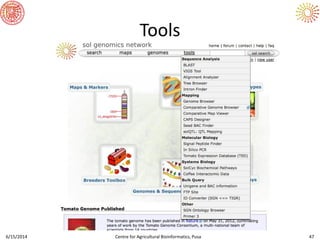
Tools
6/15/2014 Centre for Agricultural Bioinformatics, Pusa 48
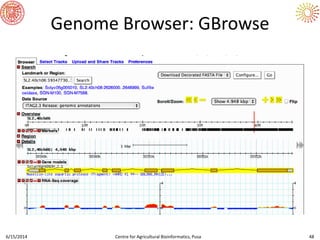
Genome Browser: GBrowse
6/15/2014 Centre for Agricultural Bioinformatics, Pusa 49
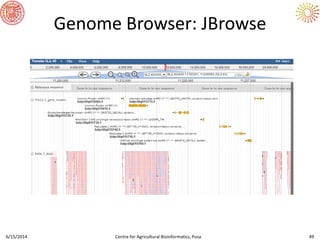
Genome Browser: JBrowse
6/15/2014 Centre for Agricultural Bioinformatics, Pusa 50
6/15/2014 Centre for Agricultural Bioinformatics, Pusa 51
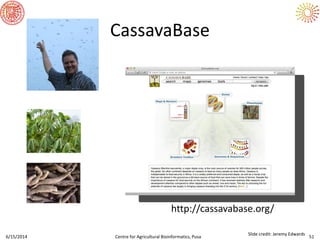
CassavaBase
http://cassavabase.org/
Slide credit: Jeremy Edwards
6/15/2014 Centre for Agricultural Bioinformatics, Pusa 52
NextGen Cassava Project
● Project: Adapt SGN database for Cassava Breeding
● Goal: Apply Genomic Selection to cassava breeding
● Predict breeding values from genotype information
● Shorten the breeding cycle
● Massive amounts of genotypic data (GBS)
● Phenotypic data
● Data management challenge
● Improve flowering
● http://nextgencassava.org
Slide credit: Jeremy Edwards
SGN/Cassavabase behind the scenes
6/15/2014 Centre for Agricultural Bioinformatics, Pusa 53
● Perl/Catalyst MVC Framework
● PostgreSQL Database
● Generic Model Organism Database (GMOD)
– Chado relational database schema
– GBrowse
– JBrowse
● R
– Experimental design
– QTL mapping
– Genomic selection
Slide credit: Jeremy Edwards
Objectives
Provide cassava breeders and researchers access
to data and tools in a centralized, user-friendly
and reliable database.
– Improve partner breeding program information
tracking
– Streamline management of genotypic and
phenotypic data
– Pipeline genotypic and phenotypic data through
Genomic Selection prediction analyses
6/15/2014 Centre for Agricultural Bioinformatics, Pusa 54
Slide credit: Jeremy Edwards
6/15/2014 Centre for Agricultural Bioinformatics, Pusa 55
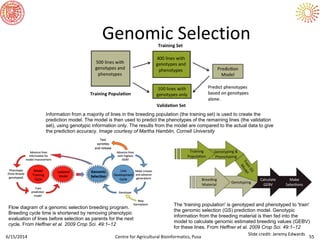
Genomic Selection
The 'training population' is genotyped and phenotyped to 'train'
the genomic selection (GS) prediction model. Genotypic
information from the breeding material is then fed into the
model to calculate genomic estimated breeding values (GEBV)
for these lines. From Heffner et al. 2009 Crop Sci. 49:1–12
Information from a majority of lines in the breeding population (the training set) is used to create the
prediction model. The model is then used to predict the phenotypes of the remaining lines (the validation
set), using genotypic information only. The results from the model are compared to the actual data to give
the prediction accuracy. Image courtesy of Martha Hamblin, Cornell University
Flow diagram of a genomic selection breeding program.
Breeding cycle time is shortened by removing phenotypic
evaluation of lines before selection as parents for the next
cycle. From Heffner et al. 2009 Crop Sci. 49:1–12
Slide credit: Jeremy Edwards
6/15/2014 Centre for Agricultural Bioinformatics, Pusa 56
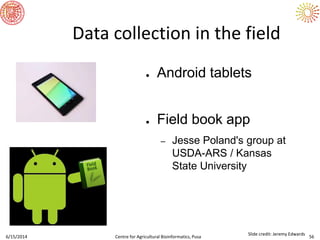
Data collection in the field
● Android tablets
● Field book app
– Jesse Poland's group at
USDA-ARS / Kansas
State University
Slide credit: Jeremy Edwards
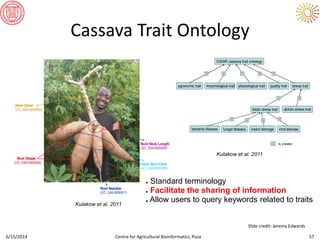
Cassava Trait Ontology
6/15/2014 Centre for Agricultural Bioinformatics, Pusa 57
Kulakow et al. 2011
Kulakow et al. 2011
● Standard terminology
● Facilitate the sharing of information
● Allow users to query keywords related to traits
Slide credit: Jeremy Edwards
6/15/2014 Centre for Agricultural Bioinformatics, Pusa 58
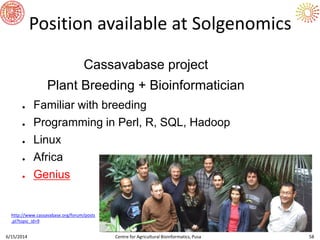
Position available at Solgenomics
Cassavabase project
Plant Breeding + Bioinformatician
● Familiar with breeding
● Programming in Perl, R, SQL, Hadoop
● Linux
● Africa
● Genius
http://www.cassavabase.org/forum/posts
.pl?topic_id=9
Thank you!!
Questions??
6/15/2014 Centre for Agricultural Bioinformatics, Pusa 59

Sequencing, Genome Assembly and the SGN Platform

  • 1.
    Surya Saha, Ph.D. CornellUniversity & Boyce Thompson Institute suryasaha@cornell.edu @SahaSurya Centre for Agricultural Bioinformatics Pusa, New Delhi June 13,2014 Slides: http://bit.ly/CABin_Pusa_2014 http://www.acgt.me/blog/2014/3/7/next-generation-sequencing-must-die Genome Assembly Jason Chin http://www.bit.ly/SZPKIG
  • 2.
    6/15/2014 Centre forAgricultural Bioinformatics, Pusa 2 You are free to: Copy, share, adapt, or re-mix; Photograph, film, or broadcast; Blog, live-blog, or post video of; This presentation. Provided that: You attribute the work to its author and respect the rights and licenses associated with its components. Slide Concept by Cameron Neylon, who has waived all copyright and related or neighbouring rights. This slide only ccZero. Social Media Icons adapted with permission from originals by Christopher Ross. Original images are available under GPL at http://www.thisismyurl.com/free-downloads/15-free-speech-bubble-icons-for-popular-websites
  • 3.
    6/15/2014 Centre forAgricultural Bioinformatics, Pusa 3 Sequencing
  • 4.
    1953 DNA Structure discovery 1977 2012 Sanger DNAsequencing by chain-terminating inhibitors 1984 Epstein-Barr virus (170 Kb) 1987Abi370 Sequencer 1995 2001 Homo sapiens (3.0 Gb) 2005 454 Solexa Solid 2007 2011 Ion Torrent PacBio Haemophilus influenzae (1.83 Mb) 2013 Slide credit: Aureliano Bombarely Sequencing over the Ages Illumina Illumina Hiseq X 454 6/15/2014 Centre for Agricultural Bioinformatics, Pusa 4 Pinus taeda (24 Gb) 2014 MinION The Next Generation
  • 5.
    6/15/2014 Centre forAgricultural Bioinformatics, Pusa 5 Its all about the $£€¥ http://www.genome.gov/sequencingcosts/
  • 6.
    6/15/2014 Centre forAgricultural Bioinformatics, Pusa 6 First generation sequencing
  • 7.
    Sanger method 6/15/2014 Centrefor Agricultural Bioinformatics, Pusa 7 Frederick Sanger 13 Aug 1918 – 19 Nov 2013 Won the Nobel Prize for Chemistry in 1958 and 1980. Published the dideoxy chain termination method or “Sanger method” in 1977 http://dailym.ai/1f1XeTB
  • 8.
    Sanger method 6/15/2014 Centrefor Agricultural Bioinformatics, Pusa 8 http://bit.ly/1g6Cudq http://bit.ly/1lcQO4J
  • 9.
    First generation sequencing •Very high quality sequences (99.999%) • Very low throughput 6/15/2014 Centre for Agricultural Bioinformatics, Pusa 9 Run Time Read Length Reads / Run Total nucleotides sequenced Cost / MB Capillary Sequencing (ABI3730xl) 20m-3h 400-900 bp 96 or 386 1.9-84 Kb $2400 http://bit.ly/1clLps3 http://1.usa.gov/1cLqIRd
  • 10.
    Use the specifictechnology used to generate the data – Illumina Hiseq/Miseq/NextSeq – Pacific Biosciences RS I/RS II – Ion Torrent Proton/PGM – SOLiD – 454 6/15/2014 Centre for Agricultural Bioinformatics, Pusa 10 http://www.acgt.me/blog/2014/3/10/next-generation- sequencing-must-diepart-2
  • 11.
    454 Pyrosequencing One purifiedDNA fragment, to one bead, to one read. 6/15/2014 Centre for Agricultural Bioinformatics, Pusa 11 http://bit.ly/1ehwxWN GS FLX Titanium http://bit.ly/1ehAcEh
  • 12.
    Illumina 6/15/2014 Centre forAgricultural Bioinformatics, Pusa 12 Output 15 Gb 120 GB 1000 GB 1800 GB Number of Reads 25 Million 400 Million 4 Billion 6 Billion Read Length 2x300 bp 2x150 bp 2x125 bp (2x250 update mid-2014) 2x150 bp Cost $99K $250K $740K $10M Source: Illumina $1000 human genome??
  • 13.
    Illumina 6/15/2014 Centre forAgricultural Bioinformatics, Pusa 13 http://1.usa.gov/1fP9ybl
  • 14.
    Illumina:Moleculo 6/15/2014 Centre forAgricultural Bioinformatics, Pusa 14 http://bit.ly/1aEPOBn
  • 15.
    Pacific Biosciences SMRTsequencing Single Molecule Real Time sequencing 6/15/2014 Centre for Agricultural Bioinformatics, Pusa 15 http://bit.ly/1naxgTe
  • 16.
    Pacific Biosciences SMRTsequencing Error correction methods 6/15/2014 Centre for Agricultural Bioinformatics, Pusa 16 Hierarchical genome-assembly process (HGAP) PBJelly Enlish et al., PLOS One. 2012 PBJelly
  • 17.
    6/15/2014 Centre forAgricultural Bioinformatics, Pusa 17 Pacific Biosciences SMRT sequencing Read Lengths
  • 18.
    Oxford Nanopore 6/15/2014 Centrefor Agricultural Bioinformatics, Pusa 18 https://www.nanoporetech.com/ • No data yet?? • Error model http://erlichya.tumblr.com/post/66376172948/hands-on- experience-with-oxford-nanopore-minion
  • 19.
    Others • Ion TorrentProton/PGM • Nabsys • SOLiD 6/15/2014 Centre for Agricultural Bioinformatics, Pusa 19
  • 20.
    Comparison 6/15/2014 Centre forAgricultural Bioinformatics, Pusa 20
  • 21.
    Next generation sequencing 6/15/2014Centre for Agricultural Bioinformatics, Pusa 21 Run Time Read Length Quality Total nucleotides sequenced Cost /MB 454 Pyrosequencing 24h 700 bp Q20-Q30 0.7 GB $10 Illumina Miseq 27h 2x250bp > Q30 15 GB $0.15 Illumina Hiseq 2500 11days 2x125bp >Q30 1000 GB $0.05 Ion torrent 2h 400bp >Q20 50MB-1GB $1 Pacific Biosciences 2h 10-20kb >Q30 consensus >Q10 single 400-800MB /SMRT cell $0.33-$1 http://bit.ly/1clLps3 http://1.usa.gov/1cLqIRd
  • 22.
    http://omicsmaps.com/ Next Generation Genomics: WorldMap of High-throughput Sequencers Centre for Agricultural Bioinformatics, Pusa6/15/2014 22
  • 23.
    6/15/2014 Centre forAgricultural Bioinformatics, Pusa 23 http://bit.ly/18pfUId
  • 24.
    Real cost ofSequencing!! Sboner, Genome Biology, 2011 6/15/2014 24Centre for Agricultural Bioinformatics, Pusa
  • 25.
    Library Types Single end Pairend (PE, 150-800 bp, Fwd:/1, Rev:/2) Mate pair (MP, 2Kb to 20 Kb) 6/15/2014 Centre for Agricultural Bioinformatics, Pusa 25 F F R F R 454/Roche FR Illumina Illumina Slide credit: Aureliano Bombarely
  • 26.
    Implications of Choiceof Library 6/15/2014 Centre for Agricultural Bioinformatics, Pusa 26 Slide credit: Aureliano Bombarely Consensus sequence (Contig) Reads Scaffold (or Supercontig) Pair Read information NNNNN Pseudomolecule (or ultracontig) F Genetic information (markers) NNNNN NN
  • 27.
    6/15/2014 Centre forAgricultural Bioinformatics, Pusa 27 Quality control: Encoding http://bit.ly/N28yUd Phred score of a base is: Qphred = -10 log10 (e) where e is the estimated probability of a base being incorrect
  • 28.
    6/15/2014 Centre forAgricultural Bioinformatics, Pusa 28 Genome Assembly
  • 29.
    Whole Genome ShotgunSequencing 6/15/2014 Centre for Agricultural Bioinformatics, Pusa 29 Slide credit: cbcb.umd.edu
  • 30.
    Genome Sequencing Strategies 6/15/2014Centre for Agricultural Bioinformatics, Pusa 30 Slide credit: Aureliano Bombarely
  • 31.
    Genome Sequencing Strategies 6/15/2014Centre for Agricultural Bioinformatics, Pusa 31 International Human Genome Sequencing Consortium 2001 Overlap Layout Consensus http://contig.wordpress.com/ cbcb.umd.edu
  • 32.
    DeBruijnGraph 6/15/2014 Centre forAgricultural Bioinformatics, Pusa 32
  • 33.
    Ingredient for aGood Assembly 6/15/2014 Centre for Agricultural Bioinformatics, Pusa 33 Slide credit: Mike Schatz
  • 34.
    6/15/2014 Centre forAgricultural Bioinformatics, Pusa 34
  • 35.
    6/15/2014 Centre forAgricultural Bioinformatics, Pusa 35 Bird Snake
  • 36.
    6/15/2014 Centre forAgricultural Bioinformatics, Pusa 36 • You have the expertise to install and run • You have the suitable infrastructure (CPU & RAM) to run the assembler • You have sufficient time to run the assembler • Is designed to work with the specific mix of NGS data that you have generated • Best addresses what you want to get out of a genome assembly (bigger overall assembly, more genes, most accuracy, longer scaffolds, most resolution of haplotypes, most tolerant of repeats, etc.) The BEST?? Genome Assembler for YOU http://haldanessieve.org/2013/01/28/our-paper-making-pizzas-and-genome-assemblies/
  • 37.
    6/15/2014 Centre forAgricultural Bioinformatics, Pusa 37
  • 38.
    Which technology touse?? • Microbial genomes • Eukaryotic genomes • Resequencing genomes • RNAseq and other XXXseq methods 6/15/2014 Centre for Agricultural Bioinformatics, Pusa 38 http://bit.ly/1ko9Kgh
  • 39.
    6/15/2014 Centre forAgricultural Bioinformatics, Pusa 39 SOL Genomics Network
  • 40.
    6/15/2014 Centre forAgricultural Bioinformatics, Pusa 40
  • 41.
    The SGN Team!! 6/15/2014Centre for Agricultural Bioinformatics, Pusa 41 Surya Saha, Tom Fisher-York, Hartmut Foerster, Suzy Strickler, Jeremy Edwards, Noe Fernandez, Naama Menda, Aure Bombarely, Aimin Yan, Isaak Tecle
  • 42.
    SGN Website 6/15/2014 Centrefor Agricultural Bioinformatics, Pusa 42 http://solgenomics.net
  • 43.
    6/15/2014 Centre forAgricultural Bioinformatics, Pusa 43 Main web page (front page): WEB ICONS TOOL BAR
  • 44.
    6/15/2014 Centre forAgricultural Bioinformatics, Pusa 44 Main web page (front page): TOOL BAR (MENUS)
  • 45.
    6/15/2014 Centre forAgricultural Bioinformatics, Pusa 45 But the DATA also can be edited LocusLocus Editor Data Community Data Curation
  • 46.
    6/15/2014 Centre forAgricultural Bioinformatics, Pusa 46 You need • SGN account. • Activate submitter / Locus Editor privileges by SGN curator LocusLocus Editor Data
  • 47.
    6/15/2014 Centre forAgricultural Bioinformatics, Pusa 47 Tools
  • 48.
    6/15/2014 Centre forAgricultural Bioinformatics, Pusa 48 Genome Browser: GBrowse
  • 49.
    6/15/2014 Centre forAgricultural Bioinformatics, Pusa 49 Genome Browser: JBrowse
  • 50.
    6/15/2014 Centre forAgricultural Bioinformatics, Pusa 50
  • 51.
    6/15/2014 Centre forAgricultural Bioinformatics, Pusa 51 CassavaBase http://cassavabase.org/ Slide credit: Jeremy Edwards
  • 52.
    6/15/2014 Centre forAgricultural Bioinformatics, Pusa 52 NextGen Cassava Project ● Project: Adapt SGN database for Cassava Breeding ● Goal: Apply Genomic Selection to cassava breeding ● Predict breeding values from genotype information ● Shorten the breeding cycle ● Massive amounts of genotypic data (GBS) ● Phenotypic data ● Data management challenge ● Improve flowering ● http://nextgencassava.org Slide credit: Jeremy Edwards
  • 53.
    SGN/Cassavabase behind thescenes 6/15/2014 Centre for Agricultural Bioinformatics, Pusa 53 ● Perl/Catalyst MVC Framework ● PostgreSQL Database ● Generic Model Organism Database (GMOD) – Chado relational database schema – GBrowse – JBrowse ● R – Experimental design – QTL mapping – Genomic selection Slide credit: Jeremy Edwards
  • 54.
    Objectives Provide cassava breedersand researchers access to data and tools in a centralized, user-friendly and reliable database. – Improve partner breeding program information tracking – Streamline management of genotypic and phenotypic data – Pipeline genotypic and phenotypic data through Genomic Selection prediction analyses 6/15/2014 Centre for Agricultural Bioinformatics, Pusa 54 Slide credit: Jeremy Edwards
  • 55.
    6/15/2014 Centre forAgricultural Bioinformatics, Pusa 55 Genomic Selection The 'training population' is genotyped and phenotyped to 'train' the genomic selection (GS) prediction model. Genotypic information from the breeding material is then fed into the model to calculate genomic estimated breeding values (GEBV) for these lines. From Heffner et al. 2009 Crop Sci. 49:1–12 Information from a majority of lines in the breeding population (the training set) is used to create the prediction model. The model is then used to predict the phenotypes of the remaining lines (the validation set), using genotypic information only. The results from the model are compared to the actual data to give the prediction accuracy. Image courtesy of Martha Hamblin, Cornell University Flow diagram of a genomic selection breeding program. Breeding cycle time is shortened by removing phenotypic evaluation of lines before selection as parents for the next cycle. From Heffner et al. 2009 Crop Sci. 49:1–12 Slide credit: Jeremy Edwards
  • 56.
    6/15/2014 Centre forAgricultural Bioinformatics, Pusa 56 Data collection in the field ● Android tablets ● Field book app – Jesse Poland's group at USDA-ARS / Kansas State University Slide credit: Jeremy Edwards
  • 57.
    Cassava Trait Ontology 6/15/2014Centre for Agricultural Bioinformatics, Pusa 57 Kulakow et al. 2011 Kulakow et al. 2011 ● Standard terminology ● Facilitate the sharing of information ● Allow users to query keywords related to traits Slide credit: Jeremy Edwards
  • 58.
    6/15/2014 Centre forAgricultural Bioinformatics, Pusa 58 Position available at Solgenomics Cassavabase project Plant Breeding + Bioinformatician ● Familiar with breeding ● Programming in Perl, R, SQL, Hadoop ● Linux ● Africa ● Genius http://www.cassavabase.org/forum/posts .pl?topic_id=9
  • 59.
    Thank you!! Questions?? 6/15/2014 Centrefor Agricultural Bioinformatics, Pusa 59