Preparing For The Future: Helping Libraries Respond to
Changing Technological, Economic and Political Change
Making Sense of the Future
Presentation by Brian Kelly, UKOLN at the ILI 2012
conference
1
Brian Kelly,
UKOLN
A centre of expertise in digital information management www.ukoln.ac.uk
http://www.ukoln.ac.uk/web-focus/events/workshops/york-library-2013/Twitter:
#???
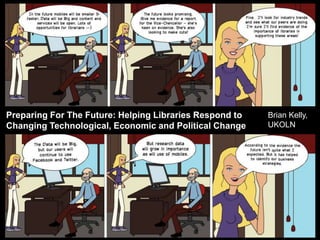
Preparing For The Future: Helping Libraries
Respond to Changing Technological,
Economic and Political Change
Brian Kelly
UKOLN
University of Bath
Bath, UK
UKOLN is supported by:
This work is licensed under a Creative
Commons Attribution 2.0 licence
(but note caveat)
Email:
b.kelly@ukoln.ac.uk
Blog:
http://ukwebfocus.wordpress.com/
Twitter: @briankelly
Acceptable Use Policy
Recording this talk, taking photos,
discussing the content using Twitter,
blogs, etc. is welcomed providing
distractions to others is minimised.
A centre of expertise in digital information management www.ukoln.ac.uk
About Me
Brian Kelly:
• UK Web Focus: national advisory post to UK HEIs
• Long-standing Web evangelist (since 1993)
• Based at UKOLN at the University of Bath
• Prolific blogger (1,100+ posts since Nov 2006)
• User of various devices to support professional (and
social) activities
• Prolific speaker (~400 talks from 1996-2012)
• Author of peer-reviewed papers on various Web
topics
• About to start life as a free-lance consultant
3
Introduction
Abstract
Abstract
What technological (and social) developments might
we expect to arrive which will affect the working
environment of the academic library?
We can expect … But there are dangers of making
plans based on technological determinism.
This workshop provides an opportunity for
participants to make use of a methodology for
identifying 'weak signals' of technological
developments and an open sense-making process
for discussing the implications of such developments.
4
In the Future
Data will be Big
5
In the Future
Content and services will be open
6
In the Future
We will own our services and content
7
In the Future
We will see a growth in use of online services
8
In the Future
We will see the importance of librarians and
information professionals acknowledged
9
In the Future
We will see greater investment in libraries
10
In the Future
We will travel to work by monorail
11
Monorails
12
What I expected in the future
In the Future
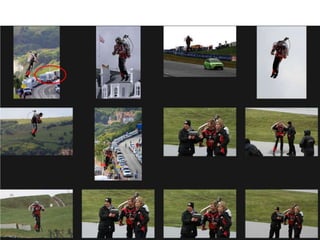
We will use jetpacks at weekends
13
Has the Future Arrived?
Hoverpacks do exist
14
Shush!
15
Librarians will appropriate technological
developments to support their activities!
Acknowledgements to Patrick
Hochstenbach (@hochstenbach)
What Can We Conclude?
Assumptions of:
• Inevitability of technological developments
• Economic growth (we can afford them)
• Political and social environment (no legal or
environmental barriers)
There is a need to:
• Be wary of predictions which:
 Simply justify our organisation‟s current
approaches (cf. music industry)
 Reflect personal beliefs / discipline norms
• Base predictions on evidence
• Acknowledge that evidence may challenge
organisational or personal beliefs / prejudices
16
The Context
In the future mobiles will be smaller & faster;
Data will be Big and content and services will be
open. Lots of opportunities for librarians 
17
Ideas initially described
in paper presented at
EMTACL (Emerging
Technologies in
Academic Libraries)
conference
See bit.ly/emtacl12-
kelly
18
Accompanying Paper
Time of Growth 
1990s & early 2000s saw:
• Increased funding across
education sector
• Significant developments in
IT sector
• Willingness by senior
managers & funding bodies
to invest in innovative IT
developments (e.g. JISC
development programmes)
19
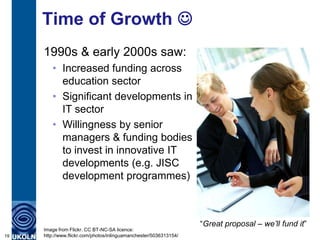
“Great proposal – we’ll fund it”
Image from Flickr. CC BT-NC-SA licence:
http://www.flickr.com/photos/inlinguamanchester/5036313154/
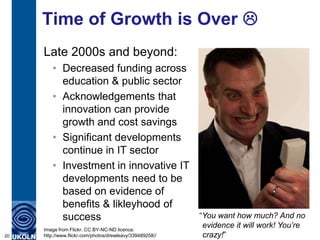
Time of Growth is Over 
Late 2000s and beyond:
• Decreased funding across
education & public sector
• Acknowledgements that
innovation can provide
growth and cost savings
• Significant developments
continue in IT sector
• Investment in innovative IT
developments need to be
based on evidence of
benefits & likleyhood of
success
20
Image from Flickr. CC BY-NC-ND licence:
http://www.flickr.com/photos/drewleavy/339489258//
“You want how much? And no
evidence it will work! You’re
crazy!”
Lessons From The Past
Importance of open standards:
• Open standards are essential for interoperability;
preservation; …
• Therefore use SMIL and SVG (open standards from
W3C) and not Flash (proprietary)
The need to be realistic
• What happened to SMIL and SVG?
• The marketplace didn‟t embrace the open standards
• Adoption of open standards would have been costly
• Flash is now being superceded by HTML5
• Flash‟s demise due to lack of support by Apple on
mobile devices
21
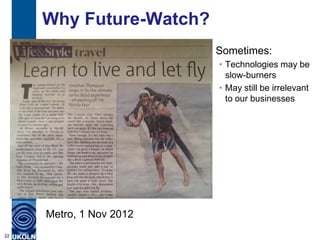
Why Future-Watch?
Sometimes:
• Technologies may be
slow-burners
• May still be irrelevant
to our businesses
22
Metro, 1 Nov 2012
Why Future-Watch?
Need for future-watching to help identify tomorrow‟s key
technologies:
• Changes to existing business processes
• Decisions on assigning resources to find out more
(e.g. commissioning reports)
• Investing in training & development in new areas
• Exploring ways of deprecating existing services (cf
WH Smith‟s decision to stop selling CD singles in
2004)
• …
23
Group Exercise
In about 5 groups:
• Identify 4 technology / technology-related trends
which you feel will have a significant impact on
your work in 2-5 years time
24
Group Exercise
In about 5 groups:
• Identify 4 technology / technology-related trends
which you feel will have a significant impact on
your work in 2-5 years time
• Share your 4 technologies with the other groups
(only 4!)
25
Group Exercise
In about 5 groups:
• Identify 4 technology / technology-related trends
which you feel will have a significant impact on
your work in 2-5 years time
• Share your 4 technologies with the other groups
(only 4!)
• Agreed on a vote on the other groups‟ list:
 3 = Yes, this is important
 2 = Could be important
 1 = Doubtful; sceptical
 0 = No way!
(no half marks; no single transferable votes!)
26
Previous Examples
From previous workshops the following technological
/ societal developments were used:
• Mainstream areas
• Niche areas
27
HTML5 EPUB “Openness”“BYOD”
JISC Observatory
JISC Observatory:
• JISC-funded initiative
• Systematises processes for anticipating and
responding to projected future trends & scenarios
• Provided by JISC Innovation Support Centres at
UKOLN and CETIS
• See <http://blog.observatory.jisc.ac.uk/>
28
Note:
• JISC Observatory work about to close due to
cessation of JISC core funding for UKOLN & CETIS
• Therefore need for institutional understanding of
processes
JIS Observatory process
29
Scanning Activities
• Blog posts:
Posts published on JISC Observatory
blog and on existing blogs.
• Monitoring trends:
Monitoring trends in order to:
 Benchmark current usage patterns
 Identify trends
 Identify emerging patterns of usage
30
Google searches for “learning analytics”
took off in 2010.
Possible indicator of relevance across
sector & need for further investigation.
Sense-making
Need to:
• Understand limitations of evidence-gathering
techniques (including documenting „paradata‟ so
survey findings are reproducible & can be critiqued)
• Provide suggestions of implications of developments
for the sector
In addition need to encourage feedback on:
• Evidence-gathering techniques
• Interpretation of findings
• Implications of developments
In order to inform:
• Further investigation
• Policy-making, planning and funding31
Significant Trends: Mobile
32
We now know of the
importance of Mobile
Tecmark Digital Marketing Agency
Significant Trends: Mobile
33
We now know of the
importance of Mobile
Cisco
Significant Trends: Mobile
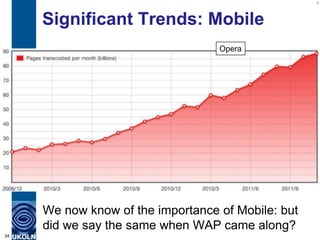
34
We now know of the importance of Mobile: but
did we say the same when WAP came along?
Opera
Significant Trends: Social Media
There were “more than 150 million Tweets about the
Olympics over the past 16 days”. [Twitter blog]
35
Significant Trends: Social Media
Survey in Aug 2012 of institutional use of Facebook across the
24 Russell Group universities found >1M „Likes‟ followers
36
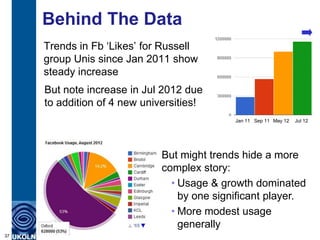
Behind The Data
Trends in Fb „Likes‟ for Russell
group Unis since Jan 2011 show
steady increase
37
Jan 11 Sep 11 May 12 Jul 12
But note increase in Jul 2012 due
to addition of 4 new universities!
But might trends hide a more
complex story:
• Usage & growth dominated
by one significant player.
• More modest usage
generally
Need for Paradata and Discussion
Surveys carried out to monitor usage & trends for:
• Institutional use of social media
• Use of researcher profiling services (e.g. Google
Scholar, Academia.edu, …) across institutions
Observations (and feedback):
• Differing results found if quotes used
• Possible inclusion of wrong Unis (e.g. Newcastle
University, Australia)
• Personalised results depending on client environment
38
Need to provide paradata and encourage feedback
on processes and intrepretation of findings
Lies, Damned Lies and Graphs
“#Blekko traffic goes through the
roof – for good reason. Try it out!”
Based on blog post entitled
“Blekko’s Traffic Is Up Almost 400
Percent; Here Are The CEO’s
Five Reasons Why” (includes
dissatisfaction with Goole)
39
Is Blekko’s Traffic Really Going Through The Roof? Will It Challenge Google?,
UK Web Focus blog, 18 April 2012
Open Sense-making
Importance of open approaches to interpretation
of signals:
• Evidence-gathering methodologies may have flaws
• Incorrect or inappropriate implications may be
made
• This may lead to wrong decisions being made
40
Open sense-making approaches may be difficult –
your marketing department may wish a consistent,
positive message to be made.
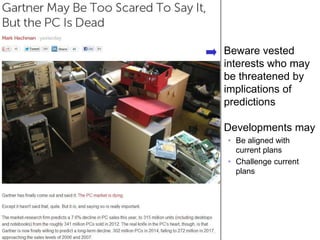
Beware vested
interests who may
be threatened by
implications of
predictions
Developments may
• Be aligned with
current plans
• Challenge current
plans
41
Group Exercise 2
Agree on a hot topic and describe how you would:
• Gather evidence of its importance
• Interpret the evidence
• Address personal / departmental / institutional
biases
• Identify reasons to engage (e.g. actions needed
now; actions needed in the future; risks if actions
not taken; …)
Examples:
• What should we be doing with mobile?
• Should we have a Library Facebook page?
• Should we provide cover pages for printouts from
the IR?
42
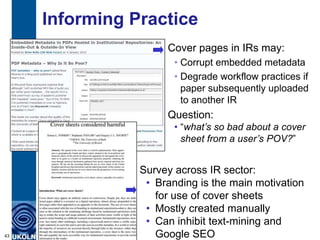
Informing Practice
Cover pages in IRs may:
• Corrupt embedded metadata
• Degrade workflow practices if
paper subsequently uploaded
to another IR
43
Question:
• “what’s so bad about a cover
sheet from a user’s POV?”
Survey across IR sector:
• Branding is the main motivation
for use of cover sheets
• Mostly created manually
• Can inhibit text-mining and
Google SEO
Sense-Making: Use of Fb
Session at IWMW 2013:
• Librarian 1 (research-intensive Uni):
Students keep telling us to “keep out of our social
space”
• Librarian 2 (teaching Uni):
We set up a Library Facebook page. It works
because “we need a presence where students
hangout”
44
Personal perspectives. How do we:
• Gather evidence which informs policies and
practices?
• Make the evidence-based decisions?
University of Bedford Library Facebook page
45
University of
Bedford
Library
Facebook
page
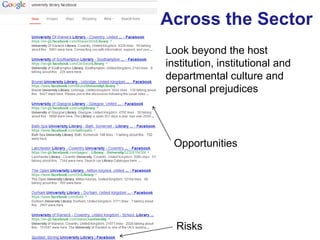
Across the Sector
Look beyond the host
institution, institutional and
departmental culture and
personal prejudices
46
Opportunities
Risks
Opportunities and Risks
Risks averse:
• Public sector
• Libraries
Risks of being risk-averse
• Missed opportunities
• Criticisms from users
• Advantages to competitors
Need for a managed approach to:
• Assessing risks
• Risk mitigation
• Acceptance of risks
47
Kelly, B. and Oppenheim, C., 2009.
Empowering users and their
institutions: A risks and opportunities
framework for exploiting the potential
of the social web.
“It‟s About Nodes and Connections”
Cameron Neylon keynote at OR 2012:
“Networks qualitatively change our capacity”
• With only 20% of a community connected
only limited interaction can take place
• This increases drastically as numbers of
connected nodes grows
Examples:
• Phone networks (no use with only 1 user!)
• Tweeting at events
• Galaxy Zoo
Implications:
• Importance of best practices for popular & well-used channels
e.g. Twitter/Facebook and not Identi.ca/Diaspora
48
“Filters block. Filters cause
friction”
Need for client-side, not
supply-side filters.
Theory
49
Open Data
“Is London 2012 a
haven for open
data?”
Conclusions:
• “Not this time”
• “But it is the first
data Olympics”
• “It's hard to see that
by [Rio] 2016 this
won't emerge as
data we can all
use”
Open Data
“Manchester City to
open the archive on
player data and
statistics”
Example of:
• Public interest in
open data
• Interest from
commercial sector
50
51
Use of Open Data in Libraries
Trends in reusing Library usage data,
e.g. JISC‟s Library Impact Data Project
Average number of books borrowed and e-resource
logins for ~33,000 students in final year of studies
Image & data provided by
Dave Pattern under a CC
BY-NC-SA licence
52
Early Signals?
News stories (Aug
2012) about plans for
privatisation at
London Metropolitan
University
Follow-up comment
(20 Aug 2012):
“VC should be
applauded for the
classic business
move of getting the
university to
concentrate on its
core activity”
53
Early Signals?
Carl Lygo is chief executive
of the 'for profit' BPP
Professional Education group
and principal of BPP
University College
Recap
Within your organisation / sector there is a need to have
mechanisms for identifying technological developments
which may have an impact on the business:
• Observing trends and signals
• Observing signals from diversity of sources
• Interpreting the implications
• Identifying changes which may be needed within the
organisation
• Inviting feedback and critiques of the evidence-gathering
processes and the interpretations of the findings
54
Challenge For Librarians
In time of uncertain
futures:
• Use evidence-based
approaches to
understanding the future
• Understand the changing
environment
• Engage with opportunities
in areas of growth and
institutional importance
• Be open and encourage
discussion on analysis &
interpretation of findings
55
Serenity prayer
Serenity prayer:
God, grant me the
serenity to accept
the things I cannot
change,
Courage to change
the things I can,
And wisdom to know
the difference.
56
Tim Berners-Lee
didn‟t accept the
evidence of the
popularity of Gopher!
Beyond The Uncertainties
What are the “only three certainties in life”?
• Death
• Taxes
• The government is out to get you /
other jokey remark
57
Benjamin Franklin once said “There are only two
certainties in life - death and taxes”.
What‟s the relevance to today‟s session?
The three certainties:
• Death
• Taxes
• At some point we will all leave our host institution

Preparing For The Future: Helping Libraries Respond to Changing Technological, Economic and Political Change

  • 1.
    Preparing For TheFuture: Helping Libraries Respond to Changing Technological, Economic and Political Change Making Sense of the Future Presentation by Brian Kelly, UKOLN at the ILI 2012 conference 1 Brian Kelly, UKOLN
  • 2.
    A centre ofexpertise in digital information management www.ukoln.ac.uk http://www.ukoln.ac.uk/web-focus/events/workshops/york-library-2013/Twitter: #??? Preparing For The Future: Helping Libraries Respond to Changing Technological, Economic and Political Change Brian Kelly UKOLN University of Bath Bath, UK UKOLN is supported by: This work is licensed under a Creative Commons Attribution 2.0 licence (but note caveat) Email: b.kelly@ukoln.ac.uk Blog: http://ukwebfocus.wordpress.com/ Twitter: @briankelly Acceptable Use Policy Recording this talk, taking photos, discussing the content using Twitter, blogs, etc. is welcomed providing distractions to others is minimised.
  • 3.
    A centre ofexpertise in digital information management www.ukoln.ac.uk About Me Brian Kelly: • UK Web Focus: national advisory post to UK HEIs • Long-standing Web evangelist (since 1993) • Based at UKOLN at the University of Bath • Prolific blogger (1,100+ posts since Nov 2006) • User of various devices to support professional (and social) activities • Prolific speaker (~400 talks from 1996-2012) • Author of peer-reviewed papers on various Web topics • About to start life as a free-lance consultant 3 Introduction
  • 4.
    Abstract Abstract What technological (andsocial) developments might we expect to arrive which will affect the working environment of the academic library? We can expect … But there are dangers of making plans based on technological determinism. This workshop provides an opportunity for participants to make use of a methodology for identifying 'weak signals' of technological developments and an open sense-making process for discussing the implications of such developments. 4
  • 5.
    In the Future Datawill be Big 5
  • 6.
    In the Future Contentand services will be open 6
  • 7.
    In the Future Wewill own our services and content 7
  • 8.
    In the Future Wewill see a growth in use of online services 8
  • 9.
    In the Future Wewill see the importance of librarians and information professionals acknowledged 9
  • 10.
    In the Future Wewill see greater investment in libraries 10
  • 11.
    In the Future Wewill travel to work by monorail 11
  • 12.
  • 13.
    In the Future Wewill use jetpacks at weekends 13
  • 14.
    Has the FutureArrived? Hoverpacks do exist 14
  • 15.
    Shush! 15 Librarians will appropriatetechnological developments to support their activities! Acknowledgements to Patrick Hochstenbach (@hochstenbach)
  • 16.
    What Can WeConclude? Assumptions of: • Inevitability of technological developments • Economic growth (we can afford them) • Political and social environment (no legal or environmental barriers) There is a need to: • Be wary of predictions which:  Simply justify our organisation‟s current approaches (cf. music industry)  Reflect personal beliefs / discipline norms • Base predictions on evidence • Acknowledge that evidence may challenge organisational or personal beliefs / prejudices 16
  • 17.
    The Context In thefuture mobiles will be smaller & faster; Data will be Big and content and services will be open. Lots of opportunities for librarians  17
  • 18.
    Ideas initially described inpaper presented at EMTACL (Emerging Technologies in Academic Libraries) conference See bit.ly/emtacl12- kelly 18 Accompanying Paper
  • 19.
    Time of Growth 1990s & early 2000s saw: • Increased funding across education sector • Significant developments in IT sector • Willingness by senior managers & funding bodies to invest in innovative IT developments (e.g. JISC development programmes) 19 “Great proposal – we’ll fund it” Image from Flickr. CC BT-NC-SA licence: http://www.flickr.com/photos/inlinguamanchester/5036313154/
  • 20.
    Time of Growthis Over  Late 2000s and beyond: • Decreased funding across education & public sector • Acknowledgements that innovation can provide growth and cost savings • Significant developments continue in IT sector • Investment in innovative IT developments need to be based on evidence of benefits & likleyhood of success 20 Image from Flickr. CC BY-NC-ND licence: http://www.flickr.com/photos/drewleavy/339489258// “You want how much? And no evidence it will work! You’re crazy!”
  • 21.
    Lessons From ThePast Importance of open standards: • Open standards are essential for interoperability; preservation; … • Therefore use SMIL and SVG (open standards from W3C) and not Flash (proprietary) The need to be realistic • What happened to SMIL and SVG? • The marketplace didn‟t embrace the open standards • Adoption of open standards would have been costly • Flash is now being superceded by HTML5 • Flash‟s demise due to lack of support by Apple on mobile devices 21
  • 22.
    Why Future-Watch? Sometimes: • Technologiesmay be slow-burners • May still be irrelevant to our businesses 22 Metro, 1 Nov 2012
  • 23.
    Why Future-Watch? Need forfuture-watching to help identify tomorrow‟s key technologies: • Changes to existing business processes • Decisions on assigning resources to find out more (e.g. commissioning reports) • Investing in training & development in new areas • Exploring ways of deprecating existing services (cf WH Smith‟s decision to stop selling CD singles in 2004) • … 23
  • 24.
    Group Exercise In about5 groups: • Identify 4 technology / technology-related trends which you feel will have a significant impact on your work in 2-5 years time 24
  • 25.
    Group Exercise In about5 groups: • Identify 4 technology / technology-related trends which you feel will have a significant impact on your work in 2-5 years time • Share your 4 technologies with the other groups (only 4!) 25
  • 26.
    Group Exercise In about5 groups: • Identify 4 technology / technology-related trends which you feel will have a significant impact on your work in 2-5 years time • Share your 4 technologies with the other groups (only 4!) • Agreed on a vote on the other groups‟ list:  3 = Yes, this is important  2 = Could be important  1 = Doubtful; sceptical  0 = No way! (no half marks; no single transferable votes!) 26
  • 27.
    Previous Examples From previousworkshops the following technological / societal developments were used: • Mainstream areas • Niche areas 27 HTML5 EPUB “Openness”“BYOD”
  • 28.
    JISC Observatory JISC Observatory: •JISC-funded initiative • Systematises processes for anticipating and responding to projected future trends & scenarios • Provided by JISC Innovation Support Centres at UKOLN and CETIS • See <http://blog.observatory.jisc.ac.uk/> 28 Note: • JISC Observatory work about to close due to cessation of JISC core funding for UKOLN & CETIS • Therefore need for institutional understanding of processes
  • 29.
    JIS Observatory process JISObservatory process 29
  • 30.
    Scanning Activities • Blogposts: Posts published on JISC Observatory blog and on existing blogs. • Monitoring trends: Monitoring trends in order to:  Benchmark current usage patterns  Identify trends  Identify emerging patterns of usage 30 Google searches for “learning analytics” took off in 2010. Possible indicator of relevance across sector & need for further investigation.
  • 31.
    Sense-making Need to: • Understandlimitations of evidence-gathering techniques (including documenting „paradata‟ so survey findings are reproducible & can be critiqued) • Provide suggestions of implications of developments for the sector In addition need to encourage feedback on: • Evidence-gathering techniques • Interpretation of findings • Implications of developments In order to inform: • Further investigation • Policy-making, planning and funding31
  • 32.
    Significant Trends: Mobile 32 Wenow know of the importance of Mobile Tecmark Digital Marketing Agency
  • 33.
    Significant Trends: Mobile 33 Wenow know of the importance of Mobile Cisco
  • 34.
    Significant Trends: Mobile 34 Wenow know of the importance of Mobile: but did we say the same when WAP came along? Opera
  • 35.
    Significant Trends: SocialMedia There were “more than 150 million Tweets about the Olympics over the past 16 days”. [Twitter blog] 35
  • 36.
    Significant Trends: SocialMedia Survey in Aug 2012 of institutional use of Facebook across the 24 Russell Group universities found >1M „Likes‟ followers 36
  • 37.
    Behind The Data Trendsin Fb „Likes‟ for Russell group Unis since Jan 2011 show steady increase 37 Jan 11 Sep 11 May 12 Jul 12 But note increase in Jul 2012 due to addition of 4 new universities! But might trends hide a more complex story: • Usage & growth dominated by one significant player. • More modest usage generally
  • 38.
    Need for Paradataand Discussion Surveys carried out to monitor usage & trends for: • Institutional use of social media • Use of researcher profiling services (e.g. Google Scholar, Academia.edu, …) across institutions Observations (and feedback): • Differing results found if quotes used • Possible inclusion of wrong Unis (e.g. Newcastle University, Australia) • Personalised results depending on client environment 38 Need to provide paradata and encourage feedback on processes and intrepretation of findings
  • 39.
    Lies, Damned Liesand Graphs “#Blekko traffic goes through the roof – for good reason. Try it out!” Based on blog post entitled “Blekko’s Traffic Is Up Almost 400 Percent; Here Are The CEO’s Five Reasons Why” (includes dissatisfaction with Goole) 39 Is Blekko’s Traffic Really Going Through The Roof? Will It Challenge Google?, UK Web Focus blog, 18 April 2012
  • 40.
    Open Sense-making Importance ofopen approaches to interpretation of signals: • Evidence-gathering methodologies may have flaws • Incorrect or inappropriate implications may be made • This may lead to wrong decisions being made 40 Open sense-making approaches may be difficult – your marketing department may wish a consistent, positive message to be made.
  • 41.
    Beware vested interests whomay be threatened by implications of predictions Developments may • Be aligned with current plans • Challenge current plans 41
  • 42.
    Group Exercise 2 Agreeon a hot topic and describe how you would: • Gather evidence of its importance • Interpret the evidence • Address personal / departmental / institutional biases • Identify reasons to engage (e.g. actions needed now; actions needed in the future; risks if actions not taken; …) Examples: • What should we be doing with mobile? • Should we have a Library Facebook page? • Should we provide cover pages for printouts from the IR? 42
  • 43.
    Informing Practice Cover pagesin IRs may: • Corrupt embedded metadata • Degrade workflow practices if paper subsequently uploaded to another IR 43 Question: • “what’s so bad about a cover sheet from a user’s POV?” Survey across IR sector: • Branding is the main motivation for use of cover sheets • Mostly created manually • Can inhibit text-mining and Google SEO
  • 44.
    Sense-Making: Use ofFb Session at IWMW 2013: • Librarian 1 (research-intensive Uni): Students keep telling us to “keep out of our social space” • Librarian 2 (teaching Uni): We set up a Library Facebook page. It works because “we need a presence where students hangout” 44 Personal perspectives. How do we: • Gather evidence which informs policies and practices? • Make the evidence-based decisions?
  • 45.
    University of BedfordLibrary Facebook page 45 University of Bedford Library Facebook page
  • 46.
    Across the Sector Lookbeyond the host institution, institutional and departmental culture and personal prejudices 46 Opportunities Risks
  • 47.
    Opportunities and Risks Risksaverse: • Public sector • Libraries Risks of being risk-averse • Missed opportunities • Criticisms from users • Advantages to competitors Need for a managed approach to: • Assessing risks • Risk mitigation • Acceptance of risks 47 Kelly, B. and Oppenheim, C., 2009. Empowering users and their institutions: A risks and opportunities framework for exploiting the potential of the social web.
  • 48.
    “It‟s About Nodesand Connections” Cameron Neylon keynote at OR 2012: “Networks qualitatively change our capacity” • With only 20% of a community connected only limited interaction can take place • This increases drastically as numbers of connected nodes grows Examples: • Phone networks (no use with only 1 user!) • Tweeting at events • Galaxy Zoo Implications: • Importance of best practices for popular & well-used channels e.g. Twitter/Facebook and not Identi.ca/Diaspora 48 “Filters block. Filters cause friction” Need for client-side, not supply-side filters. Theory
  • 49.
    49 Open Data “Is London2012 a haven for open data?” Conclusions: • “Not this time” • “But it is the first data Olympics” • “It's hard to see that by [Rio] 2016 this won't emerge as data we can all use”
  • 50.
    Open Data “Manchester Cityto open the archive on player data and statistics” Example of: • Public interest in open data • Interest from commercial sector 50
  • 51.
    51 Use of OpenData in Libraries Trends in reusing Library usage data, e.g. JISC‟s Library Impact Data Project Average number of books borrowed and e-resource logins for ~33,000 students in final year of studies Image & data provided by Dave Pattern under a CC BY-NC-SA licence
  • 52.
    52 Early Signals? News stories(Aug 2012) about plans for privatisation at London Metropolitan University
  • 53.
    Follow-up comment (20 Aug2012): “VC should be applauded for the classic business move of getting the university to concentrate on its core activity” 53 Early Signals? Carl Lygo is chief executive of the 'for profit' BPP Professional Education group and principal of BPP University College
  • 54.
    Recap Within your organisation/ sector there is a need to have mechanisms for identifying technological developments which may have an impact on the business: • Observing trends and signals • Observing signals from diversity of sources • Interpreting the implications • Identifying changes which may be needed within the organisation • Inviting feedback and critiques of the evidence-gathering processes and the interpretations of the findings 54
  • 55.
    Challenge For Librarians Intime of uncertain futures: • Use evidence-based approaches to understanding the future • Understand the changing environment • Engage with opportunities in areas of growth and institutional importance • Be open and encourage discussion on analysis & interpretation of findings 55
  • 56.
    Serenity prayer Serenity prayer: God,grant me the serenity to accept the things I cannot change, Courage to change the things I can, And wisdom to know the difference. 56 Tim Berners-Lee didn‟t accept the evidence of the popularity of Gopher!
  • 57.
    Beyond The Uncertainties Whatare the “only three certainties in life”? • Death • Taxes • The government is out to get you / other jokey remark 57 Benjamin Franklin once said “There are only two certainties in life - death and taxes”. What‟s the relevance to today‟s session? The three certainties: • Death • Taxes • At some point we will all leave our host institution