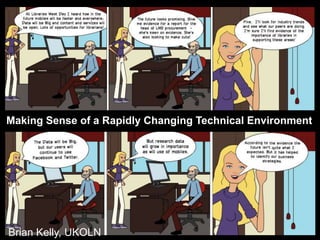
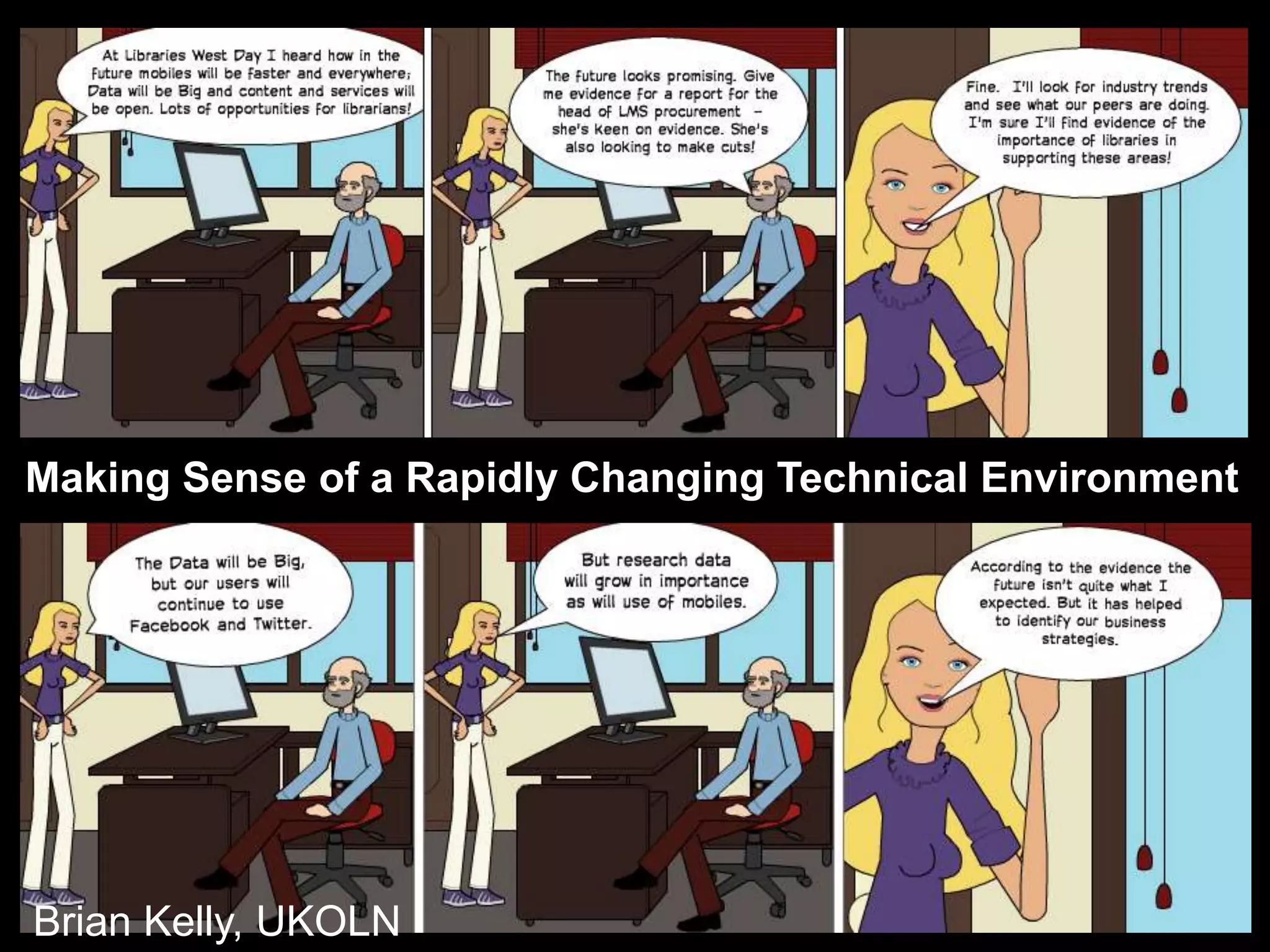
Making Sense of a Rapidly Changing Technical Environment


Making Sense of a Rapidly Changing Technical Environment


           Presentation by Brian Kelly, UKOLN at the ILI 2012
           conference

Brian Kelly, UKOLN
1
Twitter:      http://www.ukoln.ac.uk/web-focus/events/meetings/libraries-west-staff-development-2012/
#libwest12


                  Making Sense of a Rapidly
               Changing Technical Environment
             Brian Kelly                                 Acceptable Use Policy
             UKOLN                                       Recording this talk, taking photos,
             University of Bath                          discussing the content using Twitter,
             Bath, UK                                    blogs, etc. is welcomed providing
                                                         distractions to others is minimised.
             Email:
             b.kelly@ukoln.ac.uk
             Blog:
             http://ukwebfocus.wordpress.com/
             Twitter: @briankelly

             UKOLN is supported by:
                                                             This work is licensed under a Creative
             A centre of expertise in digital information managementAttribution 2.0 licence www.ukoln.ac.uk
                                                             Commons
                                                             (but note caveat)
Idea from Cameron Neylon

You are free to:
                                                 copy, share, adapt or re-mix;


                                                 photograph, film or broadcast;


                                                 blog, live-blog or post video of


this presentation provided that:
              You attribute the work to its author and respect the rights
              and licences associated with its components.
    Slide Concept by Cameron Neylon, who has waived all copyright and related or neighbouring rights. This slide only CCZero.
    Social Media Icons adapted with permission from originals bymanagement
               A centre of expertise in digital information Christopher Ross. Original images are available under GPL at:
                                                                                                       www.ukoln.ac.uk
3   http://www.thisismyurl.com/free-downloads/15-free-speech-bubble-icons-for-popular-websites
About Me
    Brian Kelly
        • Based at UKOLN, University of Bath
        • Involved in Web development since 1993
        • Excited about the potential of the Web to support
          University activities
        • Realistic about the challenges!

    The Innovation Support Centre (ISC) at UKOLN
       • Funded by the JISC
       • Supports innovation in higher & further education
       • Provides the JISC Observatory in conjunction with
         JISC CETIS

4
About This Talk
    This talk:
       • Reviews the future by looking at the past
       • Distinguishes between invention, innovation and
         improvement
       • Highlights importance of evidence-gathering
       • Describes work funded by JISC in UK
       • Outlines a methodology which others can adopt
       • Discussions about the talk
         welcomed using Twitter
         hashtag #libwest12


5
The Context
    What do we want technology to do for us?
    LMS procurement: 2016 and beyond
    We will soon have to tender for a new Library
    Management System (LMS) for LibrariesWest. Before
    we get to this point however, we must have a clear
    understanding of our requirements for a system over the
    lifespan of the new contract.
    Issues:
       • What will we need technology to do for us over the
         next 10-15 years?
       • What will our library services look like in the future?
       • How will society in general be using technology, and
         how will we respond to that?
6
E

    You’re Not A Couch Potato!
    Later on I‟ll ask you to:
       • State what you feel will be the significant
         technological changes which will affect the library
         service in 2016
       • Will the changes be beneficial or not for libraries?
       • What evidence will you need to gather to validate
         your predictions?
       • What processes will you need to support the
         interpretation of the evidence?
       • What actions should you be taking in order to
         respond to the changes?
     You can start now (especially if you‟re online).
     Yes, you can use Google & Wikipedia!
7
In the Future


    Data will be Big


8
In the Future


    Content and services will be open


9
In the Future


     We will own our services and content


10
In the Future


     We will see a growth in use of online services



11
In the Future


     We will see the importance of librarians
     acknowledged


12
In the Future


     We will see greater investment in libraries


13
In the Future


     We will travel to work by monorail


14
What I expected in the future
     Monorails


15
In the Future


     We will use jetpacks at weekends


16
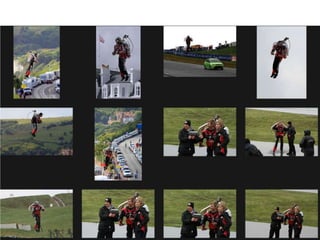
Has the Future Arrived?
     Hoverpacks do exist


17
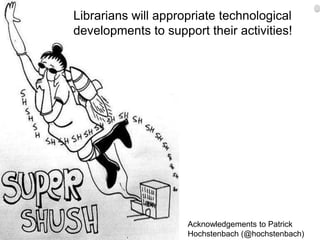
Librarians will appropriate technological
     Shush!
          developments to support their activities!


                               Acknowledgements to Patrick
18                             Hochstenbach (@hochstenbach)
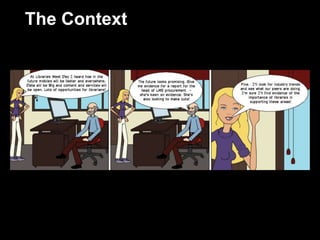
The Context


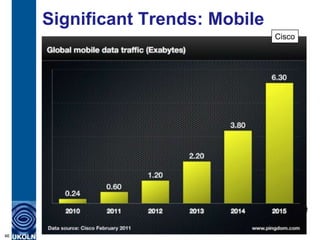
     In the future mobiles will be smaller & faster;
     Data will be Big and content and services will be
     open. Lots of opportunities for librarians 


19
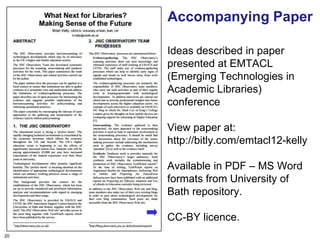
Accompanying Paper

     Ideas described in paper
     presented at EMTACL
     (Emerging Technologies in
     Academic Libraries)
     conference

     View paper at:
     http://bitly.com/emtacl12-kelly

     Available in PDF – MS Word
     formats from University of
     Bath repository.

     CC-BY licence.
20
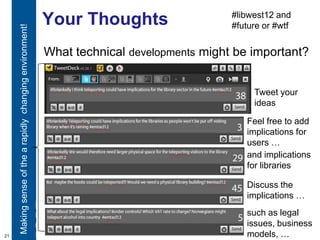
#libwest12 and
     Making sense of the a rapidly changing environment!   Your Thoughts                    #future or #wtf


                                                           What technical developments might be important?


                                                                                                 Tweet your
                                                                                                 ideas

                                                                                               Feel free to add
                                                                                               implications for
                                                                                               users …
                                                                                               and implications
                                                                                               for libraries

                                                                                               Discuss the
                                                                                               implications …
                                                                                               such as legal
                                                                                               issues, business
21                                                                                             models, …
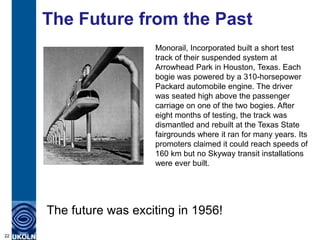
The Future from the Past
                        Monorail, Incorporated built a short test
                        track of their suspended system at
                        Arrowhead Park in Houston, Texas. Each
                        bogie was powered by a 310-horsepower
                        Packard automobile engine. The driver
                        was seated high above the passenger
                        carriage on one of the two bogies. After
                        eight months of testing, the track was
                        dismantled and rebuilt at the Texas State
                        fairgrounds where it ran for many years. Its
                        promoters claimed it could reach speeds of
                        160 km but no Skyway transit installations
                        were ever built.


     The future was exciting in 1956!
22
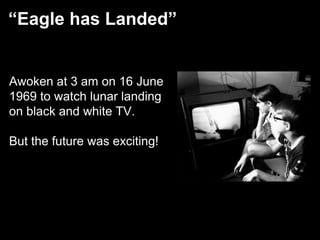
“Eagle has Landed”


 Awoken at 3 am on 16 June
 1969 to watch lunar landing
 on black and white TV.

 But the future was exciting!


23
The Future from the Past
     1969 was exciting!


24
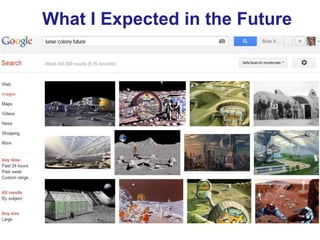
What I Expected in the Future
     The future is exciting!


25
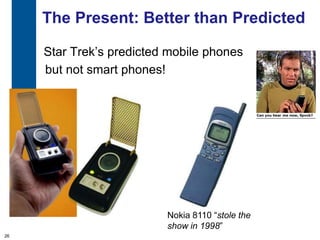
The Present: Better than Predicted

     Star Trek‟s predicted mobile phones
     but not smart phones!


                          Nokia 8110 “stole the
                          show in 1998”
26
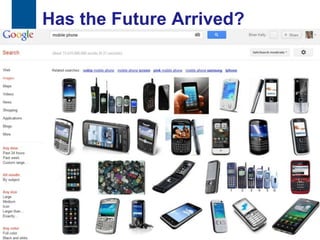
Has the Future Arrived?
     Mobile phones


27
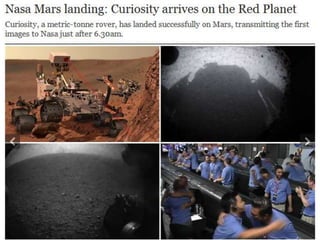
Has the Future Arrived?
     Landing on Mars


28
Has the Future Arrived?
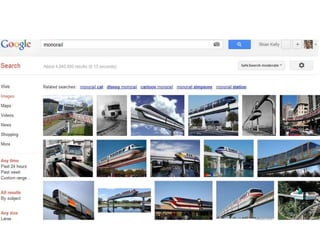
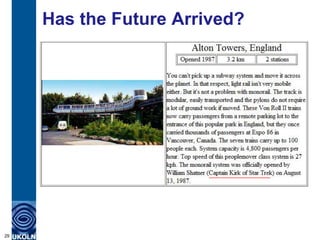
     Monorails


29
Has the Future Arrived?
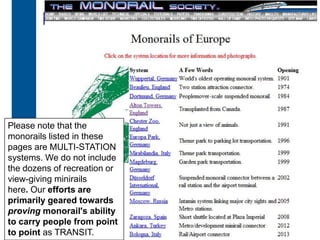
         Monorail


 Please note that the
 monorails listed in these
 pages are MULTI-STATION
 systems. We do not include
 the dozens of recreation or
 view-giving minirails
 here. Our efforts are
 primarily geared towards
 proving monorail's ability
 to carry people from point
 to point as TRANSIT.
30
Has the Future Arrived?
     Predictions & expectations from the past:
        • Have arrived
        • Sometimes have exceed expectations
        • Often fail to become widely embedded

     Can we learn from past expectations of the future?

     Note importance of evidence:
       “Our efforts are primarily geared towards proving
       monorail's ability to carry people from point to
       point as TRANSIT”


31
Rich Opportunities
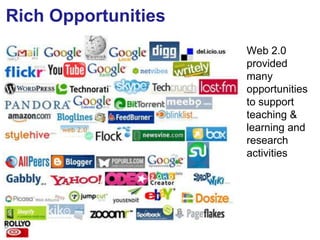
                     Web 2.0
                     provided
                     many
                     opportunities
                     to support
                     teaching &
                     learning and
                     research
                     activities


32
Optimism


33
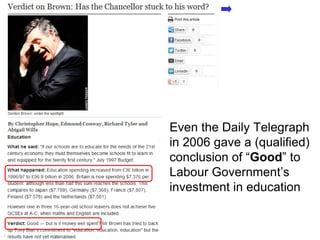
The Mid 2000s


                     Even the Daily Telegraph
                     in 2006 gave a (qualified)
                     conclusion of “Good” to
                     Labour Government‟s
                     investment in education


34
From the Sea of Tranquility to
     the Perfect Storm
        Stormy times


35
Time of Growth 
     1990s & early 2000s saw:
        • Increased funding across
          education sector
        • Significant developments
          in IT sector
        • Willingness by senior
          managers & funding
          bodies to invest in
          innovative IT
          developments


                                                                   “Great proposal – we’ll fund it”
     Image from Flickr. CC BT-NC-SA licence:
36   http://www.flickr.com/photos/inlinguamanchester/5036313154/
Time of Growth is Over 
     Late 2000s and beyond:
        • Decreased funding across
          education & public sector
        • Acknowledgements that
          innovation can provide
          growth and cost savings
        • Significant developments
          continue in IT sector
        • Investment in innovative IT
          developments need to be
          based on evidence of
          benefits & likleyhood of
          success                                         “You want how much? And no
     Image from Flickr. CC BY-NC-ND licence:
                                                           evidence it will work! You’re
37   http://www.flickr.com/photos/drewleavy/339489258//    crazy!”
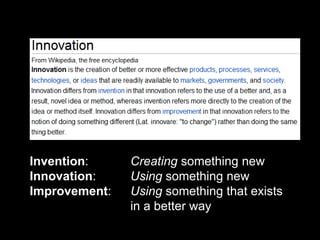
Innovation


     Invention:     Creating something new
     Innovation:    Using something new
     Improvement:   Using something that exists
                    in a better way

38
JISC Observatory


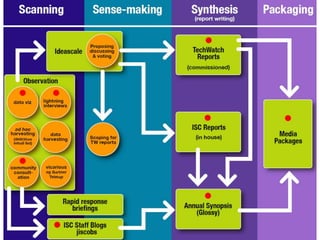
     JISC Observatory:
       • JISC-funded initiative
       • Systematises processes for anticipating and
         responding to projected future trends & scenarios
       • Provided by JISC Innovation Support Centres at
         UKOLN and CETIS
       • See <http://blog.observatory.jisc.ac.uk/>


39
JIS Observatory process
     JIS Observatory process


40
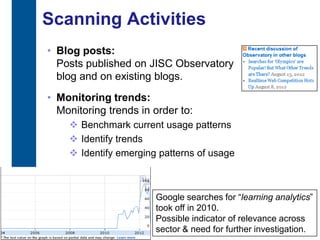
Scanning Activities
     • Blog posts:
       Posts published on JISC Observatory
       blog and on existing blogs.
     • Monitoring trends:
       Monitoring trends in order to:
          Benchmark current usage patterns
          Identify trends
          Identify emerging patterns of usage


                            Google searches for “learning analytics”
                            took off in 2010.
                            Possible indicator of relevance across
                            sector & need for further investigation.
41
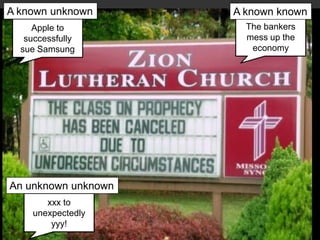
A known unknown          A known known
         Apple to           The bankers
       successfully         mess up the
      sue Samsung            economy
           Scepticism


     An unknown unknown
            xxx to
         unexpectedly
             yyy!
42
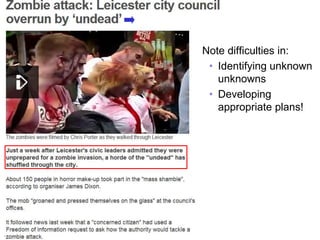
Zombie Attack
                     Note difficulties in:
                      • Identifying unknown
                        unknowns
                      • Developing
                        appropriate plans!


43
Sense-making
     Need to:
      • Understand limitations of evidence-gathering
        techniques (including documenting „paradata‟ so
        survey findings are reproducible & can be critiqued)
      • Provide suggestions of implications of developments
        for the sector
     In addition need to encourage feedback on:
       • Evidence-gathering techniques
       • Interpretation of findings
                                        Make sense of my
       • Implications of developments   talk in realtime: tweet if
                                        you agree, but
     In order to inform:
                                        especially if you don‟t!
       • Further investigation
44     • Policy-making, planning and funding
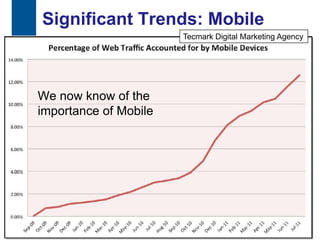
Significant Trends: Mobile
                            Tecmark Digital Marketing Agency


     We now know of the
     importance of Mobile


45
Significant Trends: Mobile
                                    Cisco


                      We now know of the
                      importance of Mobile

46
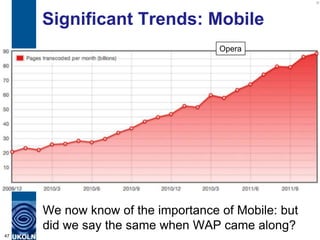
Significant Trends: Mobile
                                   Opera


     We now know of the importance of Mobile: but
     did we say the same when WAP came along?
47
Significant Trends: Social Media


     There were “more than 150 million Tweets about the
     Olympics over the past 16 days”. [Twitter blog]
48
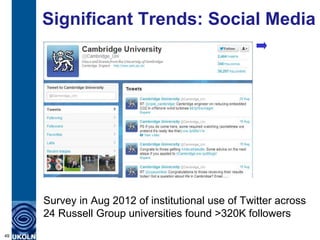
Significant Trends: Social Media


     Survey in Aug 2012 of institutional use of Twitter across
     24 Russell Group universities found >320K followers
49
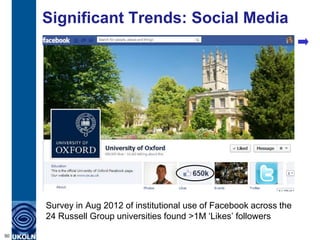
Significant Trends: Social Media


     Survey in Aug 2012 of institutional use of Facebook across the
     24 Russell Group universities found >1M „Likes‟ followers

50
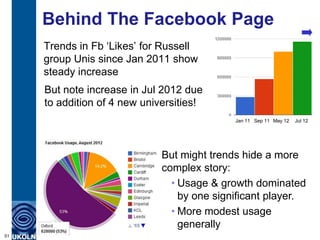
Behind The Facebook Page
     Trends in Fb „Likes‟ for Russell
     group Unis since Jan 2011 show
     steady increase
     But note increase in Jul 2012 due
     to addition of 4 new universities!
                                             Jan 11 Sep 11 May 12   Jul 12


                              But might trends hide a more
                              complex story:
                                • Usage & growth dominated
                                  by one significant player.
                                • More modest usage
                                  generally
51
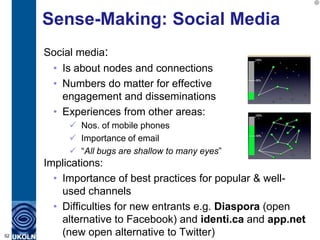
Sense-Making: Social Media
     Social media:
      • Is about nodes and connections
      • Numbers do matter for effective
        engagement and disseminations
      • Experiences from other areas:
           Nos. of mobile phones
           Importance of email
           “All bugs are shallow to many eyes”
     Implications:
       • Importance of best practices for popular & well-
         used channels
       • Difficulties for new entrants e.g. Diaspora (open
         alternative to Facebook) and identi.ca and app.net
52       (new open alternative to Twitter)
Open Data
     “Is London 2012 a
     haven for open
     data?”
     Conclusions:
      • “Not this time”
      • “But it is the first
        data Olympics”
      • “It's hard to see that
        by [Rio] 2016 this
        won't emerge as
        data we can all
        use”


53
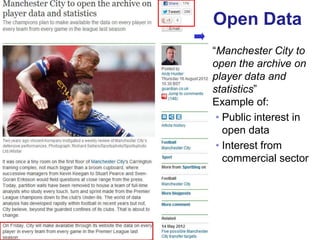
Open Data
     “Manchester City to
     open the archive on
     player data and
     statistics”
     Example of:
      • Public interest in
        open data
      • Interest from
        commercial sector


54
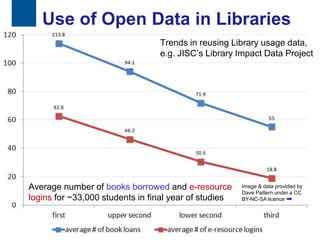
Use of Open Data in Libraries
                                      Trends in reusing Library usage data,
                                      e.g. JISC‟s Library Impact Data Project


     Average number of books borrowed and e-resource        Image & data provided by
                                                            Dave Pattern under a CC
     logins for ~33,000 students in final year of studies   BY-NC-SA licence


55
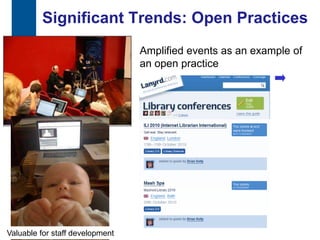
Significant Trends: Open Practices
                                 Amplified events as an example of
                                 an open practice


Valuable for staff development
56
Sharing Is Caring?
                                                   Epilogger archive showed
                                                   evidence of sharing of
                                                   resources & exchange of
                                                   ideas at ILI 2012


     Sharing with one‟s peers (&
     socialising later in the pub) or
     being unsocial?
      • Someone suggest that social interaction in the
        conference was inhibited by mobile devices. I
        don’t agree- the networking was great.
      • “mainly because I’m shy… my professional life
57
        is much better now I have this option [Twitter]”
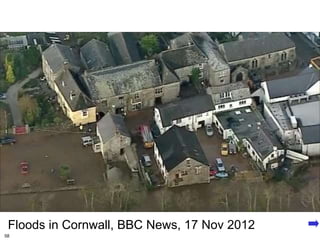
Floods in Cornwall, BBC News, 17 Nov 2012
58
Innovating or Improving?
     How should we enhance the visibility of
     research papers?
          • Search tools “better than Google”
          • Richer metadata?
          • Exploit potential of Linked Data?
     Or
          • Make more effective use of existing
            infrastructure?


59
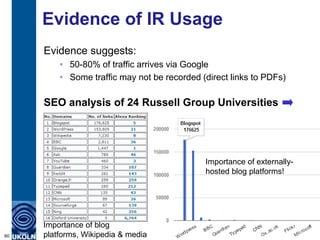
Evidence of IR Usage
     Evidence suggests:
         • 50-80% of traffic arrives via Google
         • Some traffic may not be recorded (direct links to PDFs)

     SEO analysis of 24 Russell Group Universities


                                             Importance of externally-
                                             hosted blog platforms!


     Importance of blog
60   platforms, Wikipedia & media
Implications
                Implications of findings:
                 • Innovation is important
                But:
                 • We shouldn‟t ignore potential
                   of implementing best practices
                   on existing systems
                Remember:
                 • Today‟s mainstream service
                   was yesterday‟s innovation
                 • No guarantee that best
                   practices for innovative
                   systems will be implemented

61
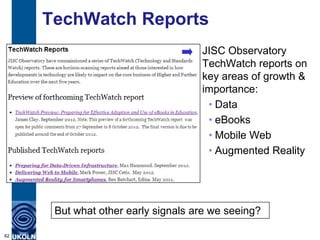
TechWatch Reports
                                    JISC Observatory
                                    TechWatch reports on
                                    key areas of growth &
                                    importance:
                                     • Data
                                     • eBooks
                                     • Mobile Web
                                     • Augmented Reality


      But what other early signals are we seeing?

62
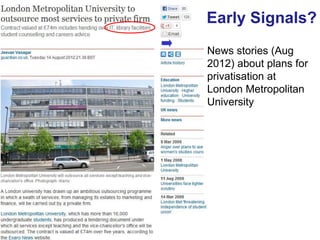
Early Signals?
     News stories (Aug
     2012) about plans for
     privatisation at
     London Metropolitan
     University


63
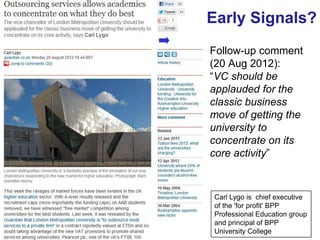
Early Signals?
     Follow-up comment
     (20 Aug 2012):
     “VC should be
     applauded for the
     classic business
     move of getting the
     university to
     concentrate on its
     core activity”


     Carl Lygo is chief executive
     of the 'for profit' BPP
     Professional Education group
     and principal of BPP
     University College
64
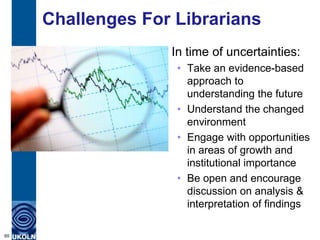
Challenges For Librarians
                   In time of uncertainties:
                    • Take an evidence-based
                      approach to
                      understanding the future
                    • Understand the changed
                      environment
                    • Engage with opportunities
                      in areas of growth and
                      institutional importance
                    • Be open and encourage
                      discussion on analysis &
                      interpretation of findings

65
E

     Responding to Challenges
     Working in groups:
       • State what you feel will be the significant
         technological changes which will affect the library
         service in 2016
       • Will the changes be beneficial or not for libraries?
       • What evidence will you need to gather to validate
         your predictions?
       • What processes will you need to support the
         interpretation of the evidence?
       • What actions should you be taking in order to
         respond to the changes?


66
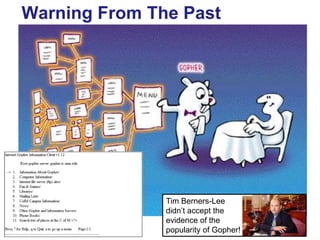
Warning From The Past

       Gopher


                    Tim Berners-Lee
                    didn‟t accept the
                    evidence of the
                    popularity of Gopher!
67
Serenity prayer

         Serenity prayer:
         God, grant me the
         serenity to accept
         the things I cannot
         change,
         Courage to change
         the things I can,
         And wisdom to know
         the difference.


68
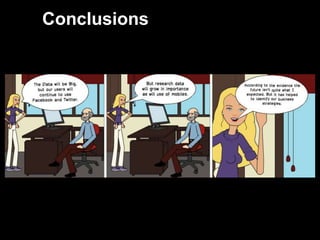
Conclusions


     The Data will be Big, but our users will continue to use
     Facebook and Twitter
     But research data will grow in importance as will use of
     mobiles.
     According to the evidence the future isn‟t quite what I
     expected. But it has helped to identify our business
     strategies.


69
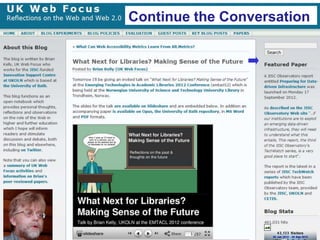
Continue the Conversation

     See http://ukwebfocus.wordpress.com/


70

Making Sense of a Rapidly Changing Technical Environment

  • 1.
    Making Sense ofa Rapidly Changing Technical Environment Making Sense of a Rapidly Changing Technical Environment Presentation by Brian Kelly, UKOLN at the ILI 2012 conference Brian Kelly, UKOLN 1
  • 2.
    Twitter: http://www.ukoln.ac.uk/web-focus/events/meetings/libraries-west-staff-development-2012/ #libwest12 Making Sense of a Rapidly Changing Technical Environment Brian Kelly Acceptable Use Policy UKOLN Recording this talk, taking photos, University of Bath discussing the content using Twitter, Bath, UK blogs, etc. is welcomed providing distractions to others is minimised. Email: b.kelly@ukoln.ac.uk Blog: http://ukwebfocus.wordpress.com/ Twitter: @briankelly UKOLN is supported by: This work is licensed under a Creative A centre of expertise in digital information managementAttribution 2.0 licence www.ukoln.ac.uk Commons (but note caveat)
  • 3.
    Idea from CameronNeylon You are free to: copy, share, adapt or re-mix; photograph, film or broadcast; blog, live-blog or post video of this presentation provided that: You attribute the work to its author and respect the rights and licences associated with its components. Slide Concept by Cameron Neylon, who has waived all copyright and related or neighbouring rights. This slide only CCZero. Social Media Icons adapted with permission from originals bymanagement A centre of expertise in digital information Christopher Ross. Original images are available under GPL at: www.ukoln.ac.uk 3 http://www.thisismyurl.com/free-downloads/15-free-speech-bubble-icons-for-popular-websites
  • 4.
    About Me Brian Kelly • Based at UKOLN, University of Bath • Involved in Web development since 1993 • Excited about the potential of the Web to support University activities • Realistic about the challenges! The Innovation Support Centre (ISC) at UKOLN • Funded by the JISC • Supports innovation in higher & further education • Provides the JISC Observatory in conjunction with JISC CETIS 4
  • 5.
    About This Talk This talk: • Reviews the future by looking at the past • Distinguishes between invention, innovation and improvement • Highlights importance of evidence-gathering • Describes work funded by JISC in UK • Outlines a methodology which others can adopt • Discussions about the talk welcomed using Twitter hashtag #libwest12 5
  • 6.
    The Context What do we want technology to do for us? LMS procurement: 2016 and beyond We will soon have to tender for a new Library Management System (LMS) for LibrariesWest. Before we get to this point however, we must have a clear understanding of our requirements for a system over the lifespan of the new contract. Issues: • What will we need technology to do for us over the next 10-15 years? • What will our library services look like in the future? • How will society in general be using technology, and how will we respond to that? 6
  • 7.
    E You’re Not A Couch Potato! Later on I‟ll ask you to: • State what you feel will be the significant technological changes which will affect the library service in 2016 • Will the changes be beneficial or not for libraries? • What evidence will you need to gather to validate your predictions? • What processes will you need to support the interpretation of the evidence? • What actions should you be taking in order to respond to the changes? You can start now (especially if you‟re online). Yes, you can use Google & Wikipedia! 7
  • 8.
    In the Future Data will be Big 8
  • 9.
    In the Future Content and services will be open 9
  • 10.
    In the Future We will own our services and content 10
  • 11.
    In the Future We will see a growth in use of online services 11
  • 12.
    In the Future We will see the importance of librarians acknowledged 12
  • 13.
    In the Future We will see greater investment in libraries 13
  • 14.
    In the Future We will travel to work by monorail 14
  • 15.
    What I expectedin the future Monorails 15
  • 16.
    In the Future We will use jetpacks at weekends 16
  • 17.
    Has the FutureArrived? Hoverpacks do exist 17
  • 18.
    Librarians will appropriatetechnological Shush! developments to support their activities! Acknowledgements to Patrick 18 Hochstenbach (@hochstenbach)
  • 19.
    The Context In the future mobiles will be smaller & faster; Data will be Big and content and services will be open. Lots of opportunities for librarians  19
  • 20.
    Accompanying Paper Ideas described in paper presented at EMTACL (Emerging Technologies in Academic Libraries) conference View paper at: http://bitly.com/emtacl12-kelly Available in PDF – MS Word formats from University of Bath repository. CC-BY licence. 20
  • 21.
    #libwest12 and Making sense of the a rapidly changing environment! Your Thoughts #future or #wtf What technical developments might be important? Tweet your ideas Feel free to add implications for users … and implications for libraries Discuss the implications … such as legal issues, business 21 models, …
  • 22.
    The Future fromthe Past Monorail, Incorporated built a short test track of their suspended system at Arrowhead Park in Houston, Texas. Each bogie was powered by a 310-horsepower Packard automobile engine. The driver was seated high above the passenger carriage on one of the two bogies. After eight months of testing, the track was dismantled and rebuilt at the Texas State fairgrounds where it ran for many years. Its promoters claimed it could reach speeds of 160 km but no Skyway transit installations were ever built. The future was exciting in 1956! 22
  • 23.
    “Eagle has Landed” Awoken at 3 am on 16 June 1969 to watch lunar landing on black and white TV. But the future was exciting! 23
  • 24.
    The Future fromthe Past 1969 was exciting! 24
  • 25.
    What I Expectedin the Future The future is exciting! 25
  • 26.
    The Present: Betterthan Predicted Star Trek‟s predicted mobile phones but not smart phones! Nokia 8110 “stole the show in 1998” 26
  • 27.
    Has the FutureArrived? Mobile phones 27
  • 28.
    Has the FutureArrived? Landing on Mars 28
  • 29.
    Has the FutureArrived? Monorails 29
  • 30.
    Has the FutureArrived? Monorail Please note that the monorails listed in these pages are MULTI-STATION systems. We do not include the dozens of recreation or view-giving minirails here. Our efforts are primarily geared towards proving monorail's ability to carry people from point to point as TRANSIT. 30
  • 31.
    Has the FutureArrived? Predictions & expectations from the past: • Have arrived • Sometimes have exceed expectations • Often fail to become widely embedded Can we learn from past expectations of the future? Note importance of evidence: “Our efforts are primarily geared towards proving monorail's ability to carry people from point to point as TRANSIT” 31
  • 32.
    Rich Opportunities Web 2.0 provided many opportunities to support teaching & learning and research activities 32
  • 33.
  • 34.
    The Mid 2000s Even the Daily Telegraph in 2006 gave a (qualified) conclusion of “Good” to Labour Government‟s investment in education 34
  • 35.
    From the Seaof Tranquility to the Perfect Storm Stormy times 35
  • 36.
    Time of Growth 1990s & early 2000s saw: • Increased funding across education sector • Significant developments in IT sector • Willingness by senior managers & funding bodies to invest in innovative IT developments “Great proposal – we’ll fund it” Image from Flickr. CC BT-NC-SA licence: 36 http://www.flickr.com/photos/inlinguamanchester/5036313154/
  • 37.
    Time of Growthis Over  Late 2000s and beyond: • Decreased funding across education & public sector • Acknowledgements that innovation can provide growth and cost savings • Significant developments continue in IT sector • Investment in innovative IT developments need to be based on evidence of benefits & likleyhood of success “You want how much? And no Image from Flickr. CC BY-NC-ND licence: evidence it will work! You’re 37 http://www.flickr.com/photos/drewleavy/339489258// crazy!”
  • 38.
    Innovation Invention: Creating something new Innovation: Using something new Improvement: Using something that exists in a better way 38
  • 39.
    JISC Observatory JISC Observatory: • JISC-funded initiative • Systematises processes for anticipating and responding to projected future trends & scenarios • Provided by JISC Innovation Support Centres at UKOLN and CETIS • See <http://blog.observatory.jisc.ac.uk/> 39
  • 40.
    JIS Observatory process JIS Observatory process 40
  • 41.
    Scanning Activities • Blog posts: Posts published on JISC Observatory blog and on existing blogs. • Monitoring trends: Monitoring trends in order to:  Benchmark current usage patterns  Identify trends  Identify emerging patterns of usage Google searches for “learning analytics” took off in 2010. Possible indicator of relevance across sector & need for further investigation. 41
  • 42.
    A known unknown A known known Apple to The bankers successfully mess up the sue Samsung economy Scepticism An unknown unknown xxx to unexpectedly yyy! 42
  • 43.
    Zombie Attack Note difficulties in: • Identifying unknown unknowns • Developing appropriate plans! 43
  • 44.
    Sense-making Need to: • Understand limitations of evidence-gathering techniques (including documenting „paradata‟ so survey findings are reproducible & can be critiqued) • Provide suggestions of implications of developments for the sector In addition need to encourage feedback on: • Evidence-gathering techniques • Interpretation of findings Make sense of my • Implications of developments talk in realtime: tweet if you agree, but In order to inform: especially if you don‟t! • Further investigation 44 • Policy-making, planning and funding
  • 45.
    Significant Trends: Mobile Tecmark Digital Marketing Agency We now know of the importance of Mobile 45
  • 46.
    Significant Trends: Mobile Cisco We now know of the importance of Mobile 46
  • 47.
    Significant Trends: Mobile Opera We now know of the importance of Mobile: but did we say the same when WAP came along? 47
  • 48.
    Significant Trends: SocialMedia There were “more than 150 million Tweets about the Olympics over the past 16 days”. [Twitter blog] 48
  • 49.
    Significant Trends: SocialMedia Survey in Aug 2012 of institutional use of Twitter across 24 Russell Group universities found >320K followers 49
  • 50.
    Significant Trends: SocialMedia Survey in Aug 2012 of institutional use of Facebook across the 24 Russell Group universities found >1M „Likes‟ followers 50
  • 51.
    Behind The FacebookPage Trends in Fb „Likes‟ for Russell group Unis since Jan 2011 show steady increase But note increase in Jul 2012 due to addition of 4 new universities! Jan 11 Sep 11 May 12 Jul 12 But might trends hide a more complex story: • Usage & growth dominated by one significant player. • More modest usage generally 51
  • 52.
    Sense-Making: Social Media Social media: • Is about nodes and connections • Numbers do matter for effective engagement and disseminations • Experiences from other areas:  Nos. of mobile phones  Importance of email  “All bugs are shallow to many eyes” Implications: • Importance of best practices for popular & well- used channels • Difficulties for new entrants e.g. Diaspora (open alternative to Facebook) and identi.ca and app.net 52 (new open alternative to Twitter)
  • 53.
    Open Data “Is London 2012 a haven for open data?” Conclusions: • “Not this time” • “But it is the first data Olympics” • “It's hard to see that by [Rio] 2016 this won't emerge as data we can all use” 53
  • 54.
    Open Data “Manchester City to open the archive on player data and statistics” Example of: • Public interest in open data • Interest from commercial sector 54
  • 55.
    Use of OpenData in Libraries Trends in reusing Library usage data, e.g. JISC‟s Library Impact Data Project Average number of books borrowed and e-resource Image & data provided by Dave Pattern under a CC logins for ~33,000 students in final year of studies BY-NC-SA licence 55
  • 56.
    Significant Trends: OpenPractices Amplified events as an example of an open practice Valuable for staff development 56
  • 57.
    Sharing Is Caring? Epilogger archive showed evidence of sharing of resources & exchange of ideas at ILI 2012 Sharing with one‟s peers (& socialising later in the pub) or being unsocial? • Someone suggest that social interaction in the conference was inhibited by mobile devices. I don’t agree- the networking was great. • “mainly because I’m shy… my professional life 57 is much better now I have this option [Twitter]”
  • 58.
    Floods in Cornwall,BBC News, 17 Nov 2012 58
  • 59.
    Innovating or Improving? How should we enhance the visibility of research papers? • Search tools “better than Google” • Richer metadata? • Exploit potential of Linked Data? Or • Make more effective use of existing infrastructure? 59
  • 60.
    Evidence of IRUsage Evidence suggests: • 50-80% of traffic arrives via Google • Some traffic may not be recorded (direct links to PDFs) SEO analysis of 24 Russell Group Universities Importance of externally- hosted blog platforms! Importance of blog 60 platforms, Wikipedia & media
  • 61.
    Implications Implications of findings: • Innovation is important But: • We shouldn‟t ignore potential of implementing best practices on existing systems Remember: • Today‟s mainstream service was yesterday‟s innovation • No guarantee that best practices for innovative systems will be implemented 61
  • 62.
    TechWatch Reports JISC Observatory TechWatch reports on key areas of growth & importance: • Data • eBooks • Mobile Web • Augmented Reality But what other early signals are we seeing? 62
  • 63.
    Early Signals? News stories (Aug 2012) about plans for privatisation at London Metropolitan University 63
  • 64.
    Early Signals? Follow-up comment (20 Aug 2012): “VC should be applauded for the classic business move of getting the university to concentrate on its core activity” Carl Lygo is chief executive of the 'for profit' BPP Professional Education group and principal of BPP University College 64
  • 65.
    Challenges For Librarians In time of uncertainties: • Take an evidence-based approach to understanding the future • Understand the changed environment • Engage with opportunities in areas of growth and institutional importance • Be open and encourage discussion on analysis & interpretation of findings 65
  • 66.
    E Responding to Challenges Working in groups: • State what you feel will be the significant technological changes which will affect the library service in 2016 • Will the changes be beneficial or not for libraries? • What evidence will you need to gather to validate your predictions? • What processes will you need to support the interpretation of the evidence? • What actions should you be taking in order to respond to the changes? 66
  • 67.
    Warning From ThePast Gopher Tim Berners-Lee didn‟t accept the evidence of the popularity of Gopher! 67
  • 68.
    Serenity prayer Serenity prayer: God, grant me the serenity to accept the things I cannot change, Courage to change the things I can, And wisdom to know the difference. 68
  • 69.
    Conclusions The Data will be Big, but our users will continue to use Facebook and Twitter But research data will grow in importance as will use of mobiles. According to the evidence the future isn‟t quite what I expected. But it has helped to identify our business strategies. 69
  • 70.
    Continue the Conversation See http://ukwebfocus.wordpress.com/ 70

Editor's Notes

  • #34 We should be happy. The future has arrived.And we were happy – until a few years ago!