

Future Technologies and
Their Applications
A one-day workshop
at ILI 2013 facilitated
by Brian Kelly and
Tony Hirst
Twitter hashtag:
#ili2013fut
Available under a
Creative Commons
(CC-BY licence)
1
B1: Predicting Technology
Trends:
a Methodology
The Future: A Quick Summary
What technological developments might
have an impact in the future?
For the impatient, here‟s a summary!
2
In the Future
Data will be Big
3
In the Future
Content and services will be open
4
In the Future
We will own our services and content
5
In the Future
We will see a growth in use of online services
6
In the Future
We will see the importance of librarians and
information professionals acknowledged
7
In the Future
We will see greater investment in libraries
8
In the Future
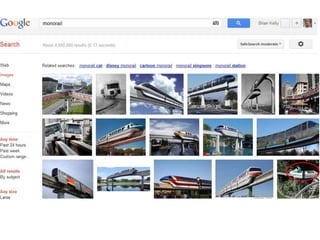
We will travel to work by monorail
9
What I expected in the future
Monorails
10
In the Future
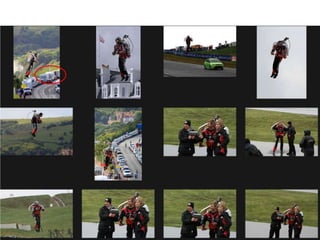
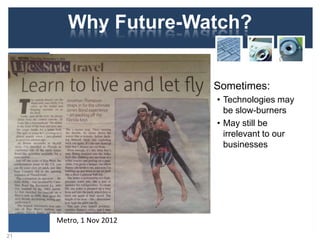
We will use jetpacks at weekends
11
Has the Future Arrived?
Hoverpacks do exist
12
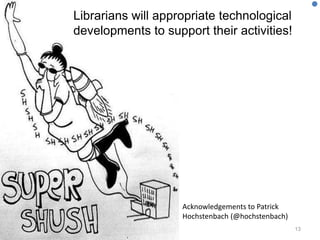
Shush!
13
Librarians will appropriate technological
developments to support their activities!
Acknowledgements to Patrick
Hochstenbach (@hochstenbach)
What Can We Conclude?
Assumptions of:
• Inevitability of technological developments
• Economic growth (we can afford them)
• Political and social environment (no legal or
environmental barriers)
There is a need to:
• Be wary of predictions which:
 Simply justify our organisation‟s current
approaches (cf. music industry)
 Reflect personal beliefs
• Base predictions on evidence
• Acknowledge that evidence may challenge
organisational or personal beliefs / prejudices
14
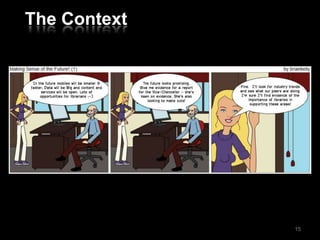
The Context
In the future mobiles will be smaller & faster; Data
will be Big and content and services will be open.
Lots of opportunities for librarians 
15
Accompanying Paper
Papers on “What Next for
Libraries? Making Sense
of the Future” and
“Reflecting on Yesterday,
Understanding Today,
Planning for Tomorrow”
presented at EMTACL 2012
and Umbrella 2013
conferences
See:
• bit.ly/emtacl12-kelly
• bit.ly/umbrella-13-kelly
16
Inventions, Innovations,
Improvements
From Wikipedia:
• Invention: the creation of the idea or
method itself.
• Innovation: the use of a better and, as
a result, novel idea or method.
• Improvement: doing current activities
better.
17
Today‟s focus: innovations within the organisation.
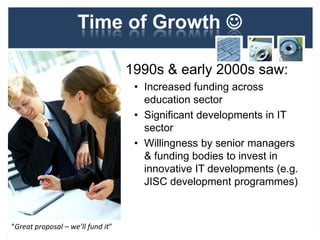
Time of Growth 
1990s & early 2000s saw:
• Increased funding across
education sector
• Significant developments in IT
sector
• Willingness by senior managers
& funding bodies to invest in
innovative IT developments (e.g.
JISC development programmes)
18
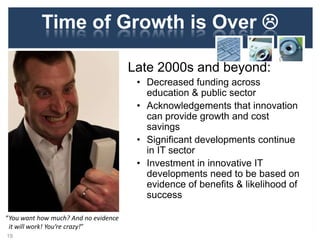
“Great proposal – we’ll fund it”
Time of Growth is Over 
Late 2000s and beyond:
• Decreased funding across
education & public sector
• Acknowledgements that innovation
can provide growth and cost
savings
• Significant developments continue
in IT sector
• Investment in innovative IT
developments need to be based on
evidence of benefits & likelihood of
success
19
“You want how much? And no evidence
it will work! You’re crazy!”
Lessons From The Past
Importance of open standards:
• Open standards are essential for interoperability;
preservation; …
• Therefore use SMIL and SVG (open standards from
W3C) and not Flash (proprietary)
The need to be realistic
• What happened to SMIL (and SVG)?
• The marketplace didn‟t embrace the open standards
• Adoption of open standards would have been costly
• Flash is now being superceded by HTML5
• Flash‟s demise due to lack of support by Apple on
mobile devices
20
NOTE: SVG is becoming important due to its use on mobile devices
(~10 years after launch)
Why Future-Watch?
Sometimes:
• Technologies may
be slow-burners
• May not be
relevant to our
businesses
21
Metro, 1 Nov 2012
Why Future-Watch?
Need for future-watching to help identify tomorrow‟s
key technologies:
• Change existing business processes
• Decide to invest resources in finding out more
(e.g. commissioning reports)
• Invest in training and development in new
areas
• Explore ways of deprecating existing services
(cf WH Smith‟s decision to stop selling CD
singles in 2004)
• …
22
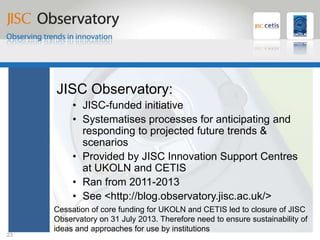
JISC Observatory
JISC Observatory:
• JISC-funded initiative
• Systematises processes for anticipating and
responding to projected future trends &
scenarios
• Provided by JISC Innovation Support Centres
at UKOLN and CETIS
• Ran from 2011-2013
• See <http://blog.observatory.jisc.ac.uk/>
23
Cessation of core funding for UKOLN and CETIS led to closure of JISC
Observatory on 31 July 2013. Therefore need to ensure sustainability of
ideas and approaches for use by institutions
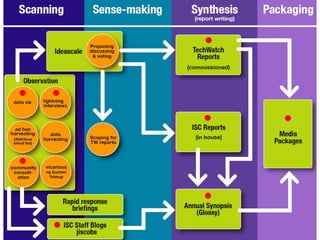
JIS Observatory process
24
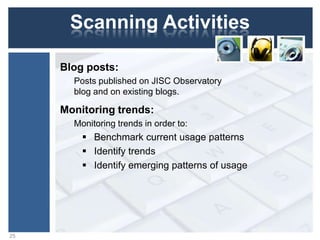
Scanning Activities
Blog posts:
Posts published on JISC Observatory
blog and on existing blogs.
Monitoring trends:
Monitoring trends in order to:
 Benchmark current usage patterns
 Identify trends
 Identify emerging patterns of usage
25
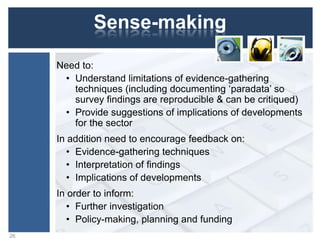
Sense-making
Need to:
• Understand limitations of evidence-gathering
techniques (including documenting „paradata‟ so
survey findings are reproducible & can be critiqued)
• Provide suggestions of implications of developments
for the sector
In addition need to encourage feedback on:
• Evidence-gathering techniques
• Interpretation of findings
• Implications of developments
In order to inform:
• Further investigation
• Policy-making, planning and funding
26
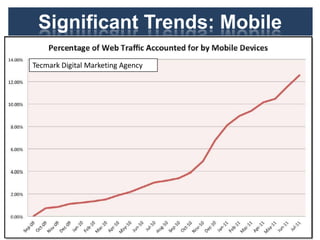
Significant Trends: Mobile
We now know
of the
importance of
Mobile
27
Tecmark Digital Marketing Agency
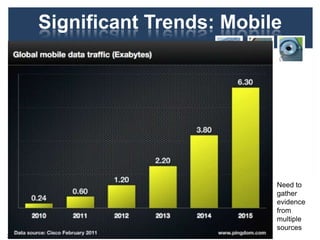
Significant Trends: Mobile
Need to
gather
evidence
from
multiple
sources
28
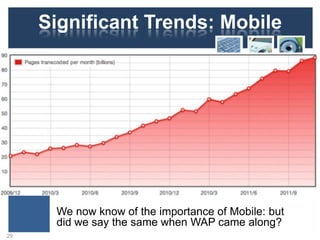
Significant Trends: Mobile
We now know of the importance of Mobile: but
did we say the same when WAP came along?
29
Significant Trends: Social Media
There were “more than 150 million Tweets about the
Olympics over the past 16 days”. [Twitter blog]
30
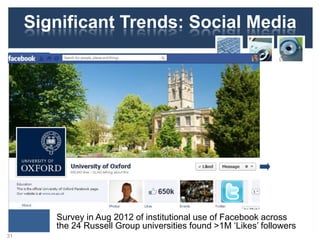
Significant Trends: Social Media
Survey in Aug 2012 of institutional use of Facebook across
the 24 Russell Group universities found >1M „Likes‟ followers
31
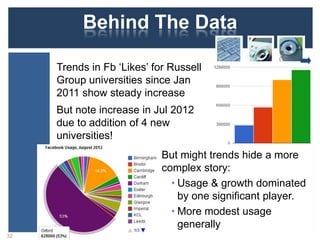
Behind The Data
Trends in Fb „Likes‟ for Russell
Group universities since Jan
2011 show steady increase
32
But note increase in Jul 2012
due to addition of 4 new
universities!
But might trends hide a more
complex story:
• Usage & growth dominated
by one significant player.
• More modest usage
generally
Need for Paradata
Surveys carried out to monitor usage & trends for:
• Institutional use of social media
• Use of researcher profiling services (e.g. Google
Scholar, Academia.edu, …) across institutions
Observations (and feedback):
• Differing results found if quotes used
• Possible inclusion of wrong Unis (e.g. Newcastle
University, Australia)
• Personalised results depending on client
environment
33
Need to provide paradata and encourage feedback on processes and
interpretation of findings
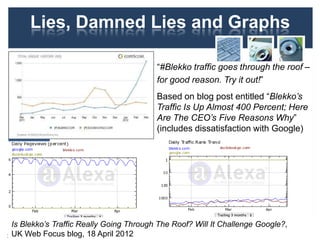
Lies, Damned Lies and Graphs
“#Blekko traffic goes through the roof –
for good reason. Try it out!”
Based on blog post entitled “Blekko’s
Traffic Is Up Almost 400 Percent; Here
Are The CEO’s Five Reasons Why”
(includes dissatisfaction with Google)
34
Is Blekko’s Traffic Really Going Through The Roof? Will It Challenge Google?,
UK Web Focus blog, 18 April 2012
Open Sense-making
Importance of open approaches to
interpretation of signals:
• Evidence-gathering methodologies may have
flaws
• Incorrect or inappropriate implications may be
made
• This may lead to wrong decisions being
made
35
Open sense-making approaches may be difficult – your marketing
department may wish a consistent, positive message to be made.
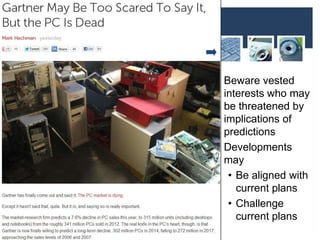
Beware vested
interests who may
be threatened by
implications of
predictions
Developments
may
• Be aligned with
current plans
• Challenge
current plans
36
5 April 2013
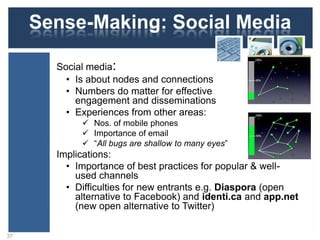
Sense-Making: Social Media
Social media:
• Is about nodes and connections
• Numbers do matter for effective
engagement and disseminations
• Experiences from other areas:
 Nos. of mobile phones
 Importance of email
 “All bugs are shallow to many eyes”
Implications:
• Importance of best practices for popular & well-
used channels
• Difficulties for new entrants e.g. Diaspora (open
alternative to Facebook) and identi.ca and app.net
(new open alternative to Twitter)
37
Open Data
“Is London 2012 a
haven for open
data?”
Conclusions:
• “Not this time”
• “But it is the first
data Olympics”
• “It's hard to see
that by [Rio]
2016 this won't
emerge as data
we can all use”
38
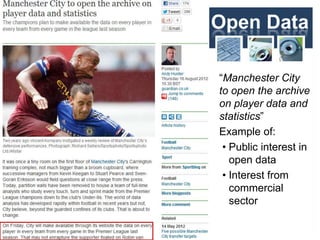
Open Data
“Manchester City
to open the archive
on player data and
statistics”
Example of:
• Public interest in
open data
• Interest from
commercial
sector
39
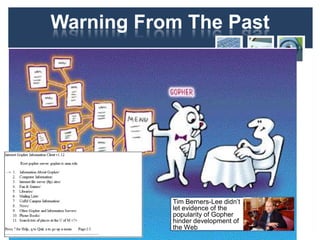
Warning From The Past
Tim Berners-Lee didn‟t
let evidence of the
popularity of Gopher
hinder development of
the Web
40
The Serenity Prayer
The Serenity Prayer
41
Conclusions
• We tend to believe in prediction which
interest is or justifies our existence
• Economic realities necessitates more
objective approaches to future-watching
• Social media and big data can provide
access to evidence that was previously
difficult to use
• Evidence-gathering processes and
interpretation can also be flawed, so need
for open debate
42
Questions
Any questions?
43

B1 Predicting developments: Future Technologies and Their Applications

  • 1.
    Future Technologies and TheirApplications A one-day workshop at ILI 2013 facilitated by Brian Kelly and Tony Hirst Twitter hashtag: #ili2013fut Available under a Creative Commons (CC-BY licence) 1 B1: Predicting Technology Trends: a Methodology
  • 2.
    The Future: AQuick Summary What technological developments might have an impact in the future? For the impatient, here‟s a summary! 2
  • 3.
    In the Future Datawill be Big 3
  • 4.
    In the Future Contentand services will be open 4
  • 5.
    In the Future Wewill own our services and content 5
  • 6.
    In the Future Wewill see a growth in use of online services 6
  • 7.
    In the Future Wewill see the importance of librarians and information professionals acknowledged 7
  • 8.
    In the Future Wewill see greater investment in libraries 8
  • 9.
    In the Future Wewill travel to work by monorail 9
  • 10.
    What I expectedin the future Monorails 10
  • 11.
    In the Future Wewill use jetpacks at weekends 11
  • 12.
    Has the FutureArrived? Hoverpacks do exist 12
  • 13.
    Shush! 13 Librarians will appropriatetechnological developments to support their activities! Acknowledgements to Patrick Hochstenbach (@hochstenbach)
  • 14.
    What Can WeConclude? Assumptions of: • Inevitability of technological developments • Economic growth (we can afford them) • Political and social environment (no legal or environmental barriers) There is a need to: • Be wary of predictions which:  Simply justify our organisation‟s current approaches (cf. music industry)  Reflect personal beliefs • Base predictions on evidence • Acknowledge that evidence may challenge organisational or personal beliefs / prejudices 14
  • 15.
    The Context In thefuture mobiles will be smaller & faster; Data will be Big and content and services will be open. Lots of opportunities for librarians  15
  • 16.
    Accompanying Paper Papers on“What Next for Libraries? Making Sense of the Future” and “Reflecting on Yesterday, Understanding Today, Planning for Tomorrow” presented at EMTACL 2012 and Umbrella 2013 conferences See: • bit.ly/emtacl12-kelly • bit.ly/umbrella-13-kelly 16
  • 17.
    Inventions, Innovations, Improvements From Wikipedia: •Invention: the creation of the idea or method itself. • Innovation: the use of a better and, as a result, novel idea or method. • Improvement: doing current activities better. 17 Today‟s focus: innovations within the organisation.
  • 18.
    Time of Growth 1990s & early 2000s saw: • Increased funding across education sector • Significant developments in IT sector • Willingness by senior managers & funding bodies to invest in innovative IT developments (e.g. JISC development programmes) 18 “Great proposal – we’ll fund it”
  • 19.
    Time of Growthis Over  Late 2000s and beyond: • Decreased funding across education & public sector • Acknowledgements that innovation can provide growth and cost savings • Significant developments continue in IT sector • Investment in innovative IT developments need to be based on evidence of benefits & likelihood of success 19 “You want how much? And no evidence it will work! You’re crazy!”
  • 20.
    Lessons From ThePast Importance of open standards: • Open standards are essential for interoperability; preservation; … • Therefore use SMIL and SVG (open standards from W3C) and not Flash (proprietary) The need to be realistic • What happened to SMIL (and SVG)? • The marketplace didn‟t embrace the open standards • Adoption of open standards would have been costly • Flash is now being superceded by HTML5 • Flash‟s demise due to lack of support by Apple on mobile devices 20 NOTE: SVG is becoming important due to its use on mobile devices (~10 years after launch)
  • 21.
    Why Future-Watch? Sometimes: • Technologiesmay be slow-burners • May not be relevant to our businesses 21 Metro, 1 Nov 2012
  • 22.
    Why Future-Watch? Need forfuture-watching to help identify tomorrow‟s key technologies: • Change existing business processes • Decide to invest resources in finding out more (e.g. commissioning reports) • Invest in training and development in new areas • Explore ways of deprecating existing services (cf WH Smith‟s decision to stop selling CD singles in 2004) • … 22
  • 23.
    JISC Observatory JISC Observatory: •JISC-funded initiative • Systematises processes for anticipating and responding to projected future trends & scenarios • Provided by JISC Innovation Support Centres at UKOLN and CETIS • Ran from 2011-2013 • See <http://blog.observatory.jisc.ac.uk/> 23 Cessation of core funding for UKOLN and CETIS led to closure of JISC Observatory on 31 July 2013. Therefore need to ensure sustainability of ideas and approaches for use by institutions
  • 24.
    JIS Observatory process JISObservatory process 24
  • 25.
    Scanning Activities Blog posts: Postspublished on JISC Observatory blog and on existing blogs. Monitoring trends: Monitoring trends in order to:  Benchmark current usage patterns  Identify trends  Identify emerging patterns of usage 25
  • 26.
    Sense-making Need to: • Understandlimitations of evidence-gathering techniques (including documenting „paradata‟ so survey findings are reproducible & can be critiqued) • Provide suggestions of implications of developments for the sector In addition need to encourage feedback on: • Evidence-gathering techniques • Interpretation of findings • Implications of developments In order to inform: • Further investigation • Policy-making, planning and funding 26
  • 27.
    Significant Trends: Mobile Wenow know of the importance of Mobile 27 Tecmark Digital Marketing Agency
  • 28.
    Significant Trends: Mobile Needto gather evidence from multiple sources 28
  • 29.
    Significant Trends: Mobile Wenow know of the importance of Mobile: but did we say the same when WAP came along? 29
  • 30.
    Significant Trends: SocialMedia There were “more than 150 million Tweets about the Olympics over the past 16 days”. [Twitter blog] 30
  • 31.
    Significant Trends: SocialMedia Survey in Aug 2012 of institutional use of Facebook across the 24 Russell Group universities found >1M „Likes‟ followers 31
  • 32.
    Behind The Data Trendsin Fb „Likes‟ for Russell Group universities since Jan 2011 show steady increase 32 But note increase in Jul 2012 due to addition of 4 new universities! But might trends hide a more complex story: • Usage & growth dominated by one significant player. • More modest usage generally
  • 33.
    Need for Paradata Surveyscarried out to monitor usage & trends for: • Institutional use of social media • Use of researcher profiling services (e.g. Google Scholar, Academia.edu, …) across institutions Observations (and feedback): • Differing results found if quotes used • Possible inclusion of wrong Unis (e.g. Newcastle University, Australia) • Personalised results depending on client environment 33 Need to provide paradata and encourage feedback on processes and interpretation of findings
  • 34.
    Lies, Damned Liesand Graphs “#Blekko traffic goes through the roof – for good reason. Try it out!” Based on blog post entitled “Blekko’s Traffic Is Up Almost 400 Percent; Here Are The CEO’s Five Reasons Why” (includes dissatisfaction with Google) 34 Is Blekko’s Traffic Really Going Through The Roof? Will It Challenge Google?, UK Web Focus blog, 18 April 2012
  • 35.
    Open Sense-making Importance ofopen approaches to interpretation of signals: • Evidence-gathering methodologies may have flaws • Incorrect or inappropriate implications may be made • This may lead to wrong decisions being made 35 Open sense-making approaches may be difficult – your marketing department may wish a consistent, positive message to be made.
  • 36.
    Beware vested interests whomay be threatened by implications of predictions Developments may • Be aligned with current plans • Challenge current plans 36 5 April 2013
  • 37.
    Sense-Making: Social Media Socialmedia: • Is about nodes and connections • Numbers do matter for effective engagement and disseminations • Experiences from other areas:  Nos. of mobile phones  Importance of email  “All bugs are shallow to many eyes” Implications: • Importance of best practices for popular & well- used channels • Difficulties for new entrants e.g. Diaspora (open alternative to Facebook) and identi.ca and app.net (new open alternative to Twitter) 37
  • 38.
    Open Data “Is London2012 a haven for open data?” Conclusions: • “Not this time” • “But it is the first data Olympics” • “It's hard to see that by [Rio] 2016 this won't emerge as data we can all use” 38
  • 39.
    Open Data “Manchester City toopen the archive on player data and statistics” Example of: • Public interest in open data • Interest from commercial sector 39
  • 40.
    Warning From ThePast Tim Berners-Lee didn‟t let evidence of the popularity of Gopher hinder development of the Web 40
  • 41.
    The Serenity Prayer TheSerenity Prayer 41
  • 42.
    Conclusions • We tendto believe in prediction which interest is or justifies our existence • Economic realities necessitates more objective approaches to future-watching • Social media and big data can provide access to evidence that was previously difficult to use • Evidence-gathering processes and interpretation can also be flawed, so need for open debate 42
  • 43.