Web Accessibility is Not (Primarily) About 
Conformance with Web Accessibility Standards 
Brian Kelly 
Innovation Advocate 
Cetis 
University of Bolton 
Bolton, UK 
Contact Details 
Email: ukwebfocus@gmail.com 
Twitter: @briankelly 
Cetis Web site: http://www.cetis.ac.uk/ 
Blog: http://ukwebfocus.wordpress.com/ 
1 
A presentation for the IDRAC (International Disability Rights Affirmation Conference) 2014 
conference to be held in Second Life on 3-4 October 2014 
Slides and further information available at 
http://ukwebfocus.wordpress.com/events/web-accessibility-is-not-primarily-about- 
conformance-with-web-accessibility-standards/
Contents 
• About Me 
• Early Involvement with Web Accessibility 
• About WAI and WCAG 
• Realisation of the Limitations 
• “Blended Accessibility for Blended Learning” 
• Beyond Accessibility for Learning 
• Accessibility 2.0: People, Policies and Processes 
(and Politics) 
• A Standard – BS 8878 
• Conclusions 
2
About Me 
Brian Kelly 
• Early adopter of Web technologies (Jan 1993) 
• UK Web Focus at UKOLN: a national post, 
advising UK universities on best practices for use 
of the Web from 1996-2013 
• Now Innovation Advocate at Cetis, encouraging 
take-up of innovation technologies and practices 
by UK universities 
3
Involvement with Web Accessibility 
Long-standing involvement with Web accessibility: 
• Attended W3C WAI launch, Santa Clara, April 1997 
• Many peer-reviewed papers published since 2004, 
co-authored with accessibility researchers & 
practitioners from UK and Australia 
• Awards: 
 “Implementing A Holistic Approach To E-Learning 
Accessibility”: Best research paper at ALT-C 2005 
 “Developing countries; developing experiences: 
approaches to accessibility for the Real World”: 
John M Slatin Award for best communications 
paper at W4A 2010 
• Co-organiser of Accessibility Summit in 2004 and 
Accessibility Summit II in 2006 
4
WAI Recap 
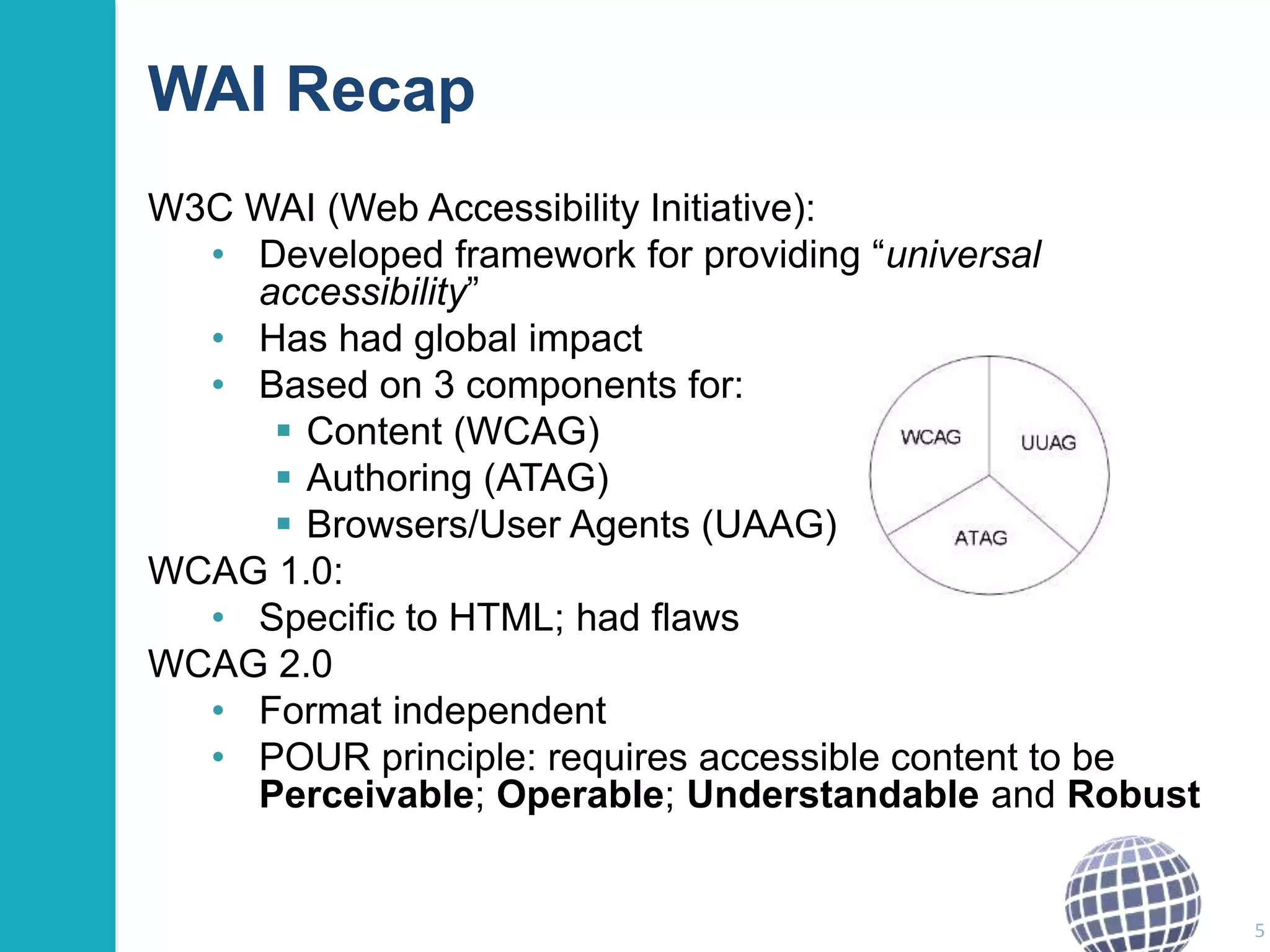
W3C WAI (Web Accessibility Initiative): 
• Developed framework for providing “universal 
accessibility” 
• Has had global impact 
• Based on 3 components for: 
 Content (WCAG) 
 Authoring (ATAG) 
 Browsers/User Agents (UAAG) 
WCAG 1.0: 
• Specific to HTML; had flaws 
WCAG 2.0 
• Format independent 
• POUR principle: requires accessible content to be 
Perceivable; Operable; Understandable and Robust 
5
Realisation of the Limitations 
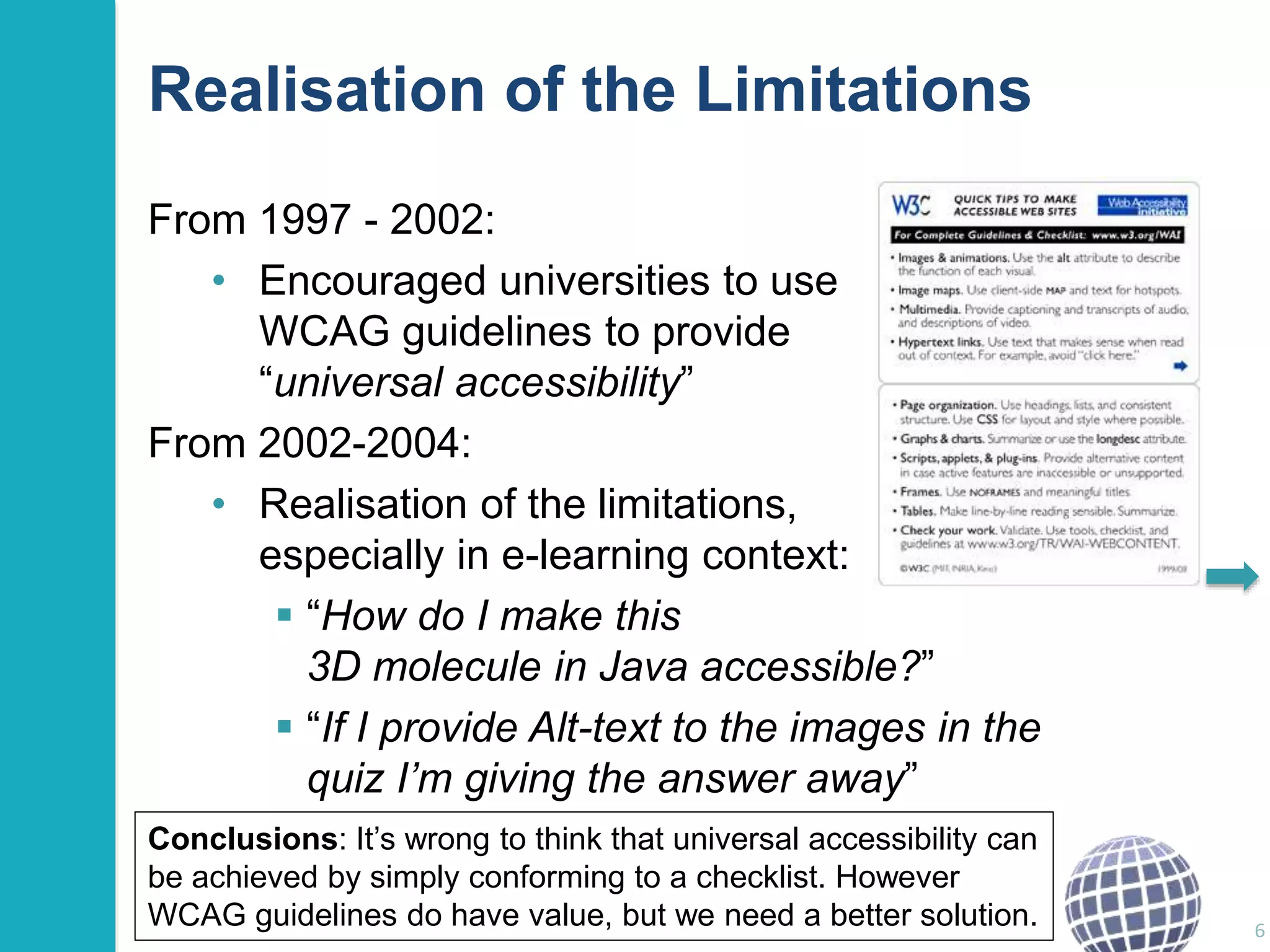
From 1997 - 2002: 
• Encouraged universities to use 
WCAG guidelines to provide 
“universal accessibility” 
From 2002-2004: 
• Realisation of the limitations, 
especially in e-learning context: 
 “How do I make this 
3D molecule in Java accessible?” 
 “If I provide Alt-text to the images in the 
quiz I’m giving the answer away” 
6 
Conclusions: It’s wrong to think that universal accessibility can 
be achieved by simply conforming to a checklist. However 
WCAG guidelines do have value, but we need a better solution.
“Blended Accessibility for Blended Learning” 
7 
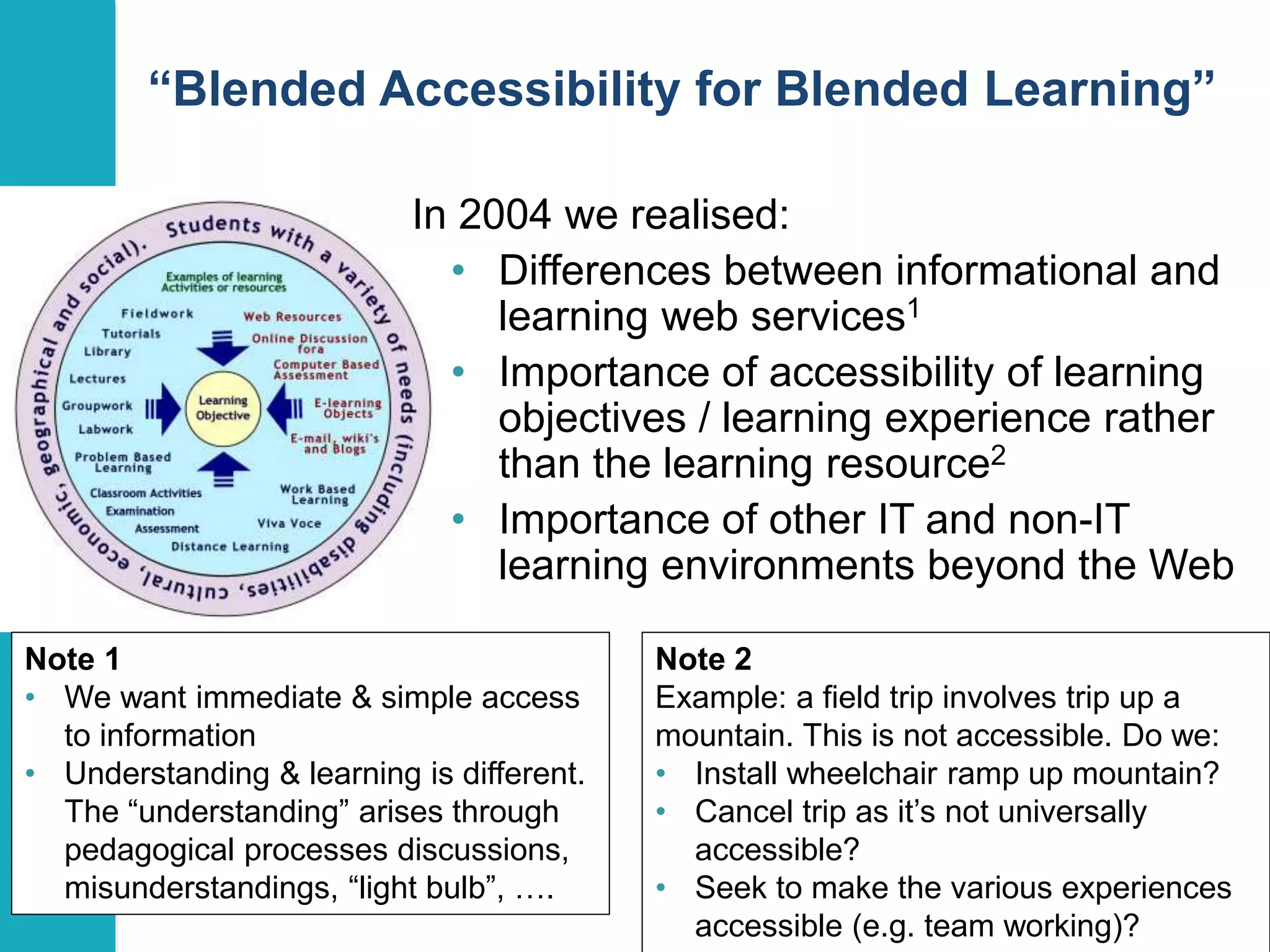
In 2004 we realised: 
• Differences between informational and 
learning web services1 
• Importance of accessibility of learning 
objectives / learning experience rather 
than the learning resource2 
• Importance of other IT and non-IT 
learning environments beyond the Web 
Note 1 
• We want immediate & simple access 
to information 
• Understanding & learning is different. 
The “understanding” arises through 
pedagogical processes discussions, 
misunderstandings, “light bulb”, …. 
Note 2 
Example: a field trip involves trip up a 
mountain. This is not accessible. Do we: 
• Install wheelchair ramp up mountain? 
• Cancel trip as it’s not universally 
accessible? 
• Seek to make the various experiences 
accessible (e.g. team working)?
Beyond Accessibility for Learning 
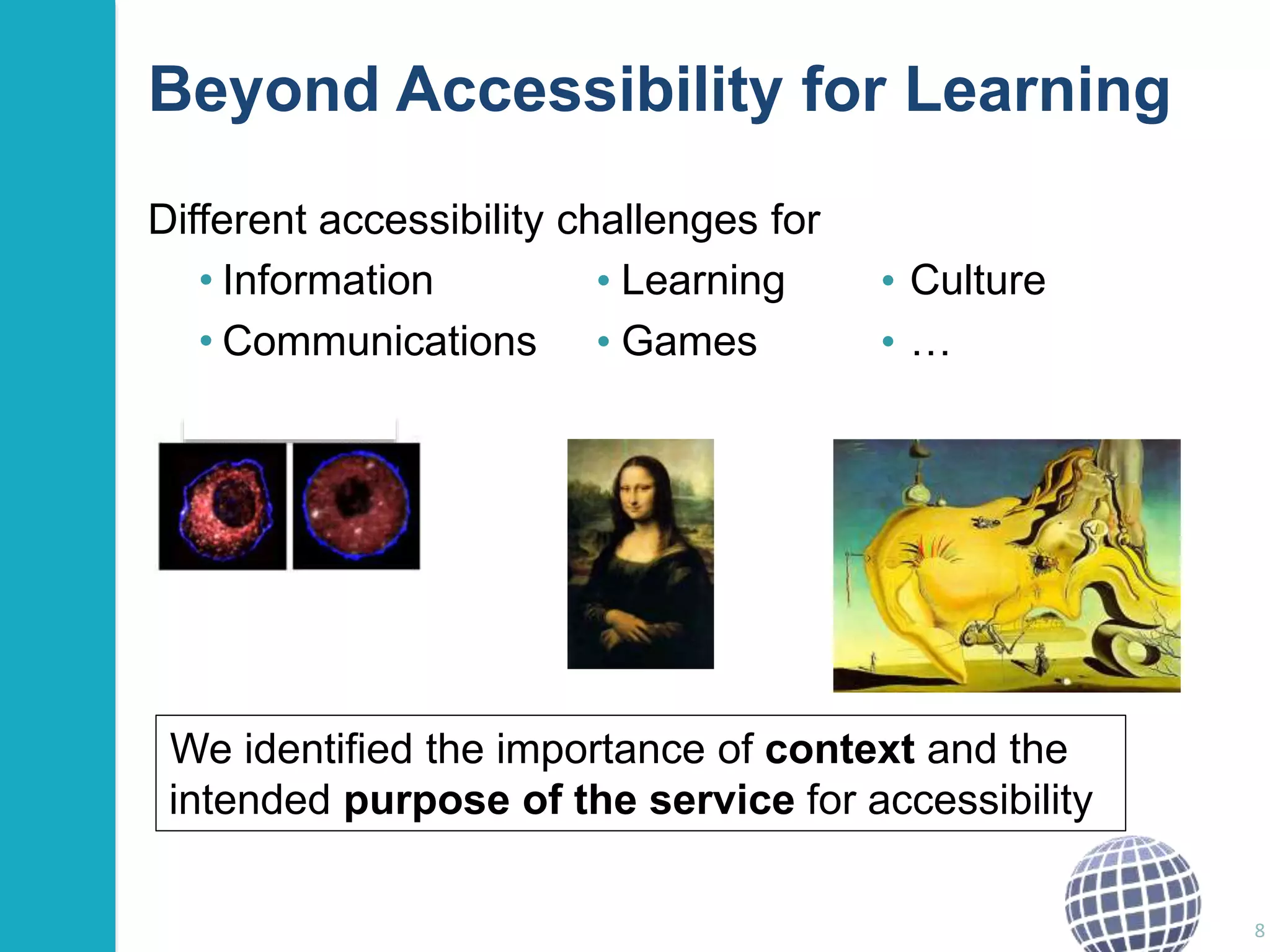
Different accessibility challenges for 
• Information • Learning • Culture 
• Communications • Games • … 
8 
We identified the importance of context and the 
intended purpose of the service for accessibility
Relevance of Second Life 
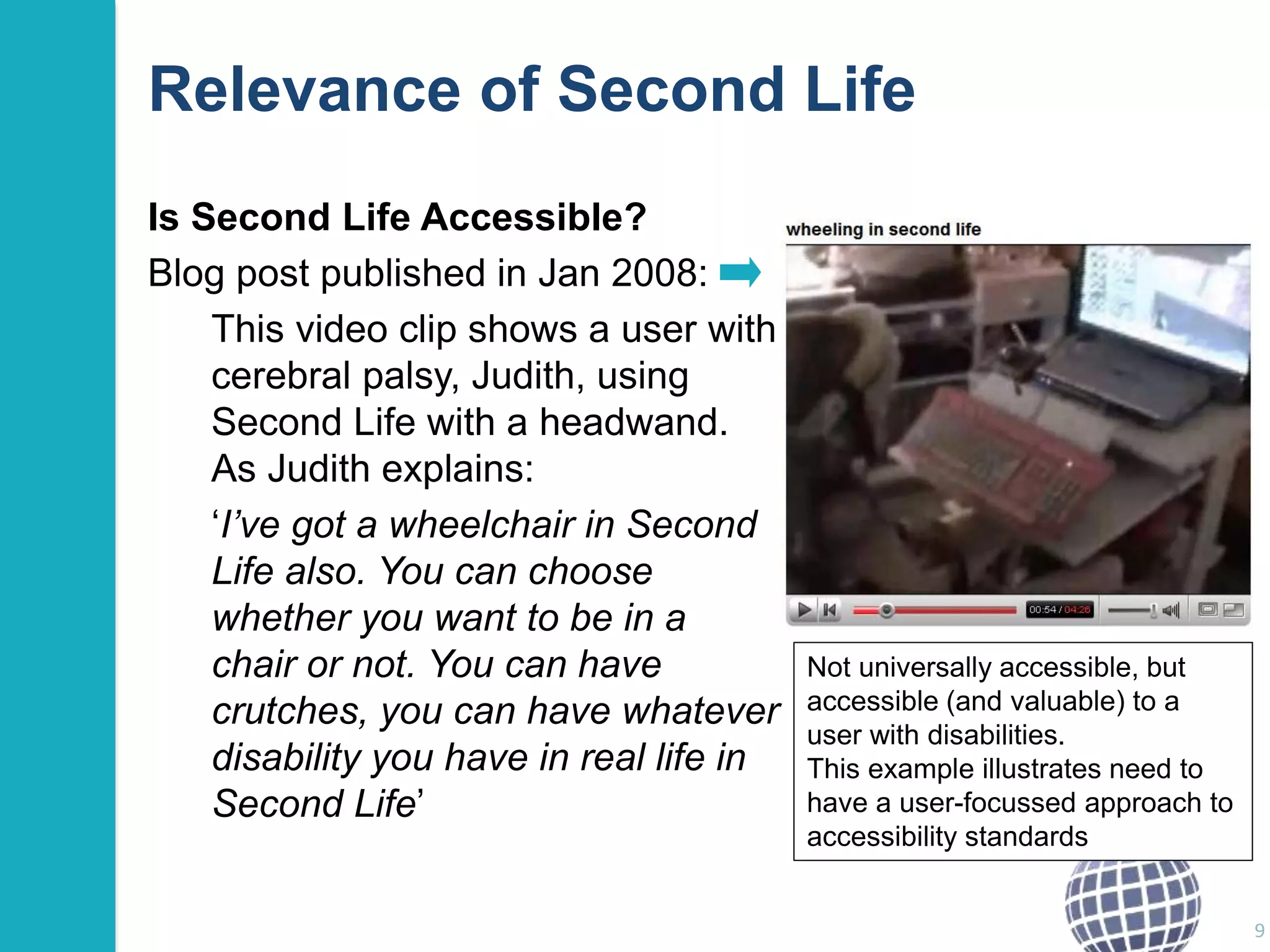
Is Second Life Accessible? 
Blog post published in Jan 2008: 
This video clip shows a user with 
cerebral palsy, Judith, using 
Second Life with a headwand. 
As Judith explains: 
‘I’ve got a wheelchair in Second 
Life also. You can choose 
whether you want to be in a 
chair or not. You can have 
crutches, you can have whatever 
disability you have in real life in 
Second Life’ 
9 
Not universally accessible, but 
accessible (and valuable) to a 
user with disabilities. 
This example illustrates need to 
have a user-focussed approach to 
accessibility standards
Revisiting Limitations of WAI 
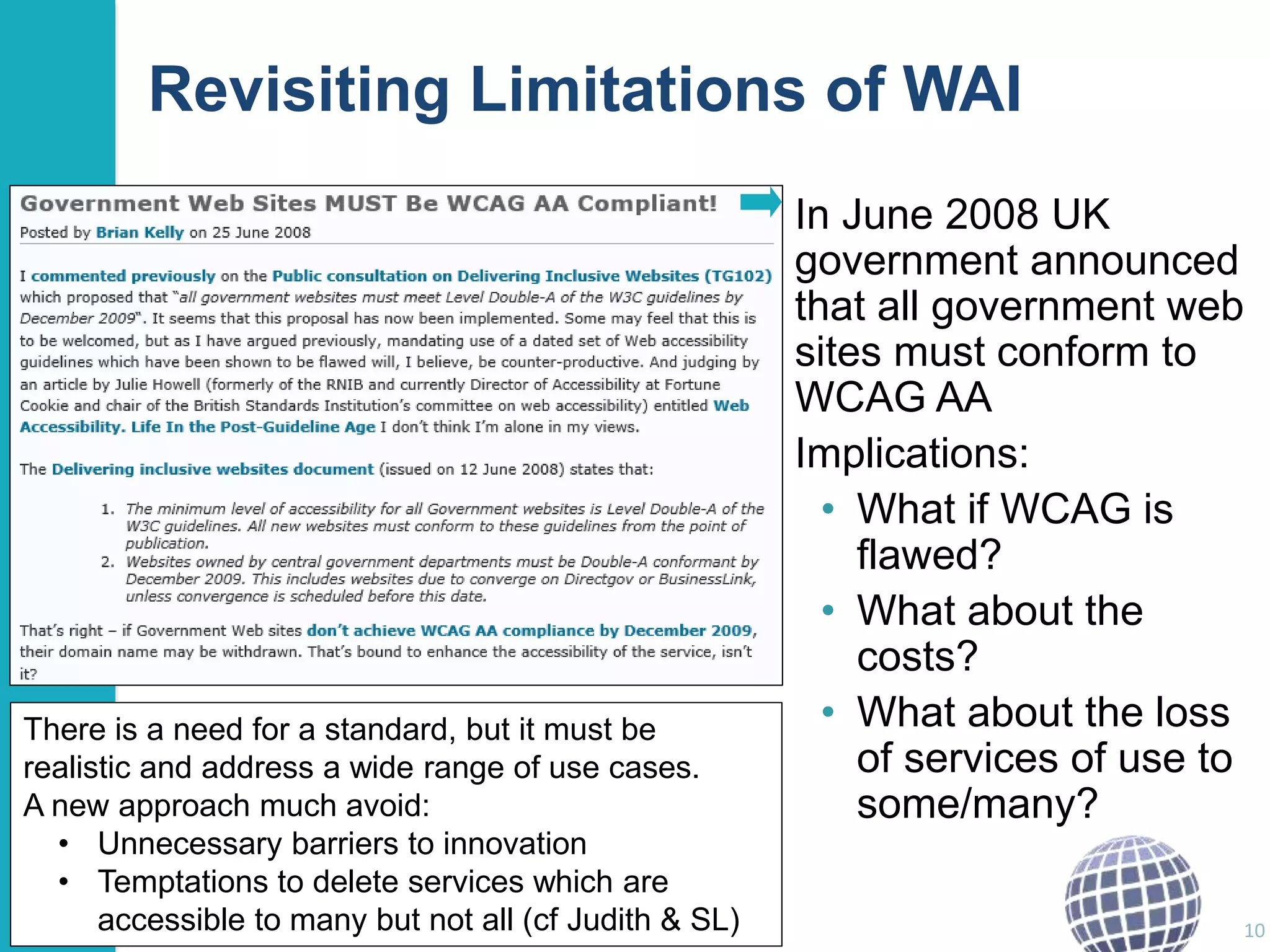
In June 2008 UK 
government announced 
that all government web 
sites must conform to 
WCAG AA 
Implications: 
• What if WCAG is 
flawed? 
• What about the 
costs? 
• What about the loss 
of services of use to 
some/many? 
10 
There is a need for a standard, but it must be 
realistic and address a wide range of use cases. 
A new approach much avoid: 
• Unnecessary barriers to innovation 
• Temptations to delete services which are 
accessible to many but not all (cf Judith & SL)
People, Policies 
and Processes 
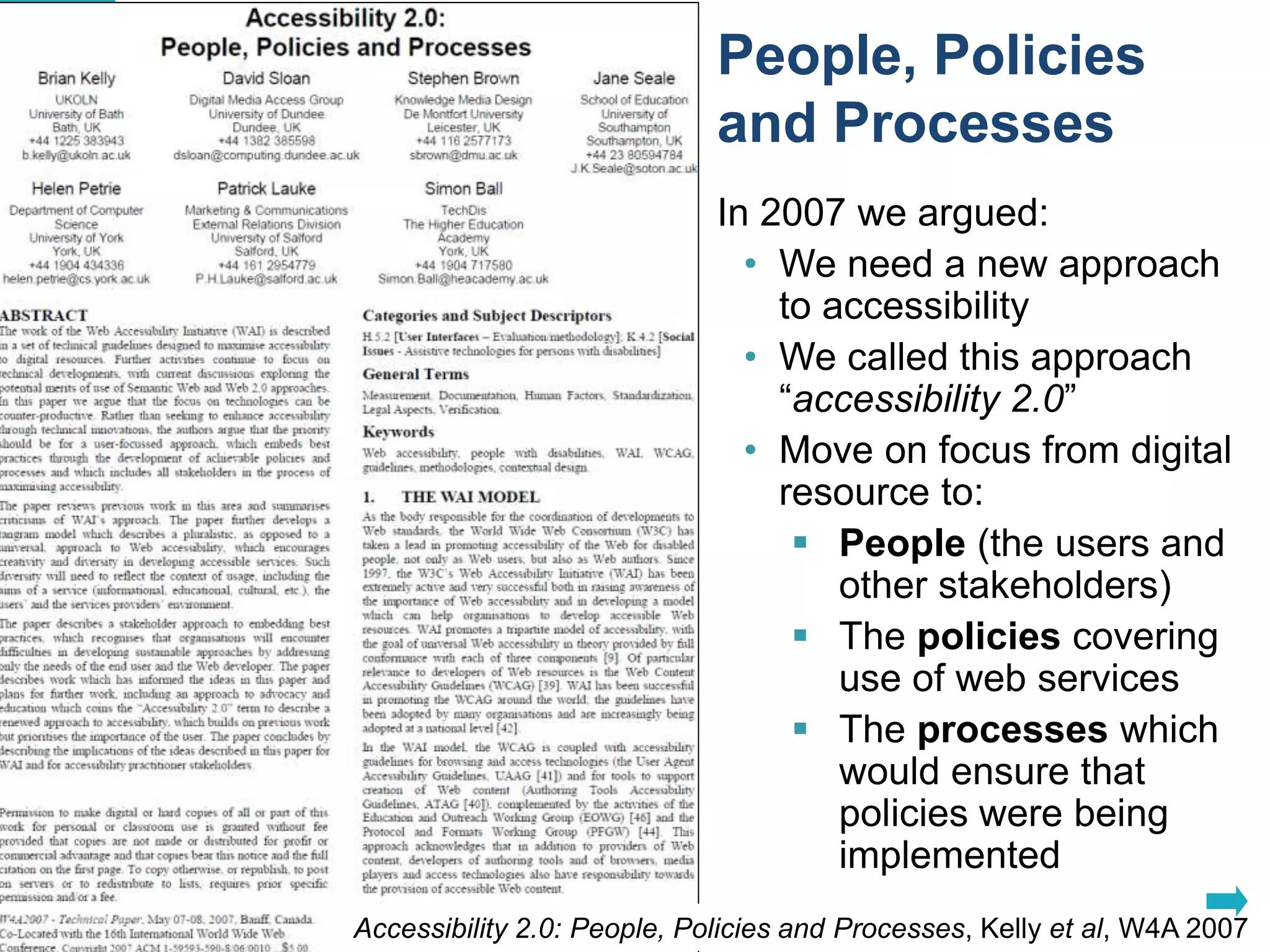
In 2007 we argued: 
• We need a new approach 
to accessibility 
• We called this approach 
“accessibility 2.0” 
• Move on focus from digital 
resource to: 
 People (the users and 
other stakeholders) 
 The policies covering 
use of web services 
 The processes which 
would ensure that 
policies were being 
implemented 
Accessibility 2.0: People, Policies and Processes, Kelly et al, W4A 200711
• xx 
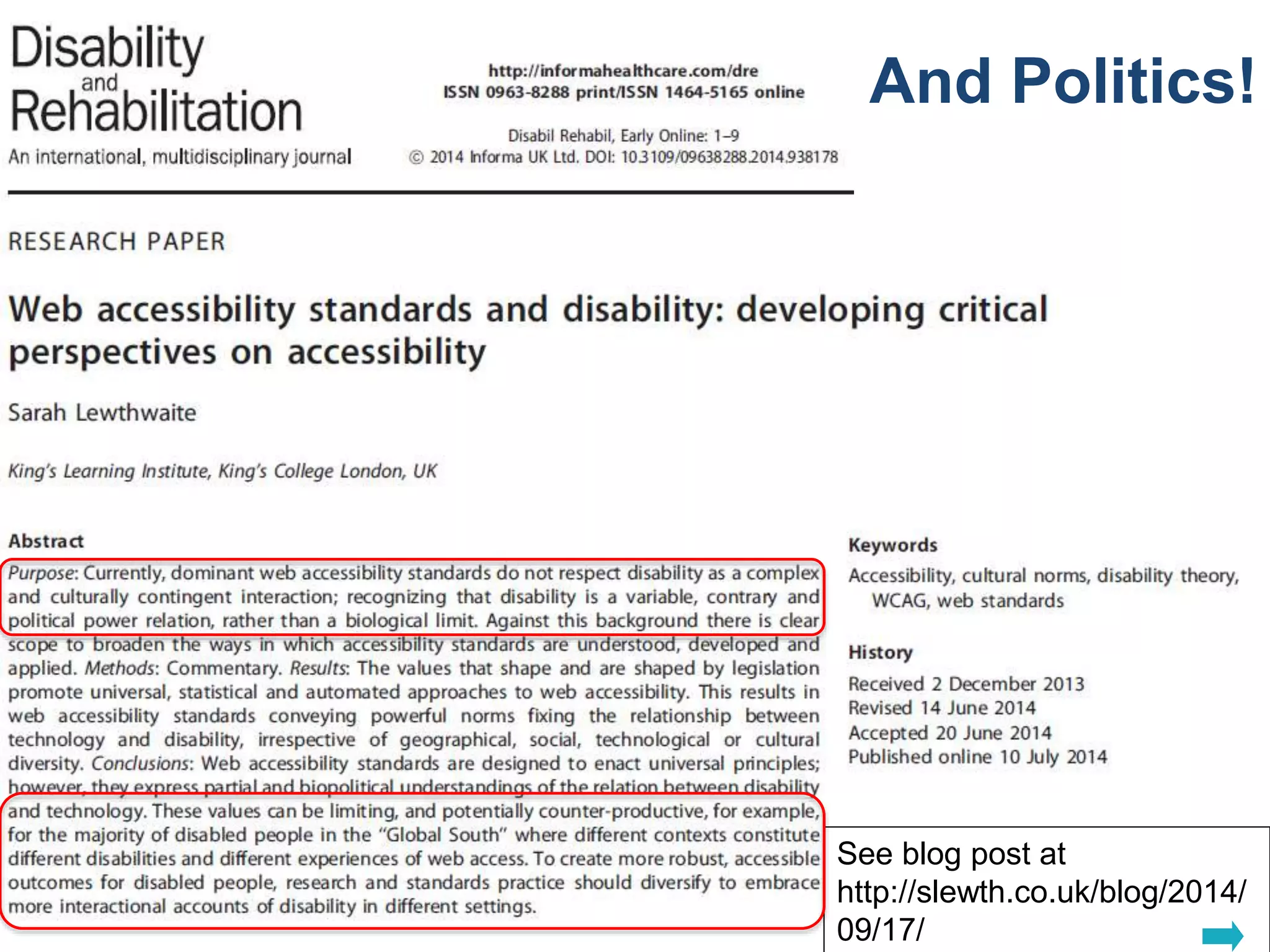
And Politics! 
See blog post at 
http://slewth.co.uk/blog/2014/ 
09/17/ 
12
A Standard – BS 8878 
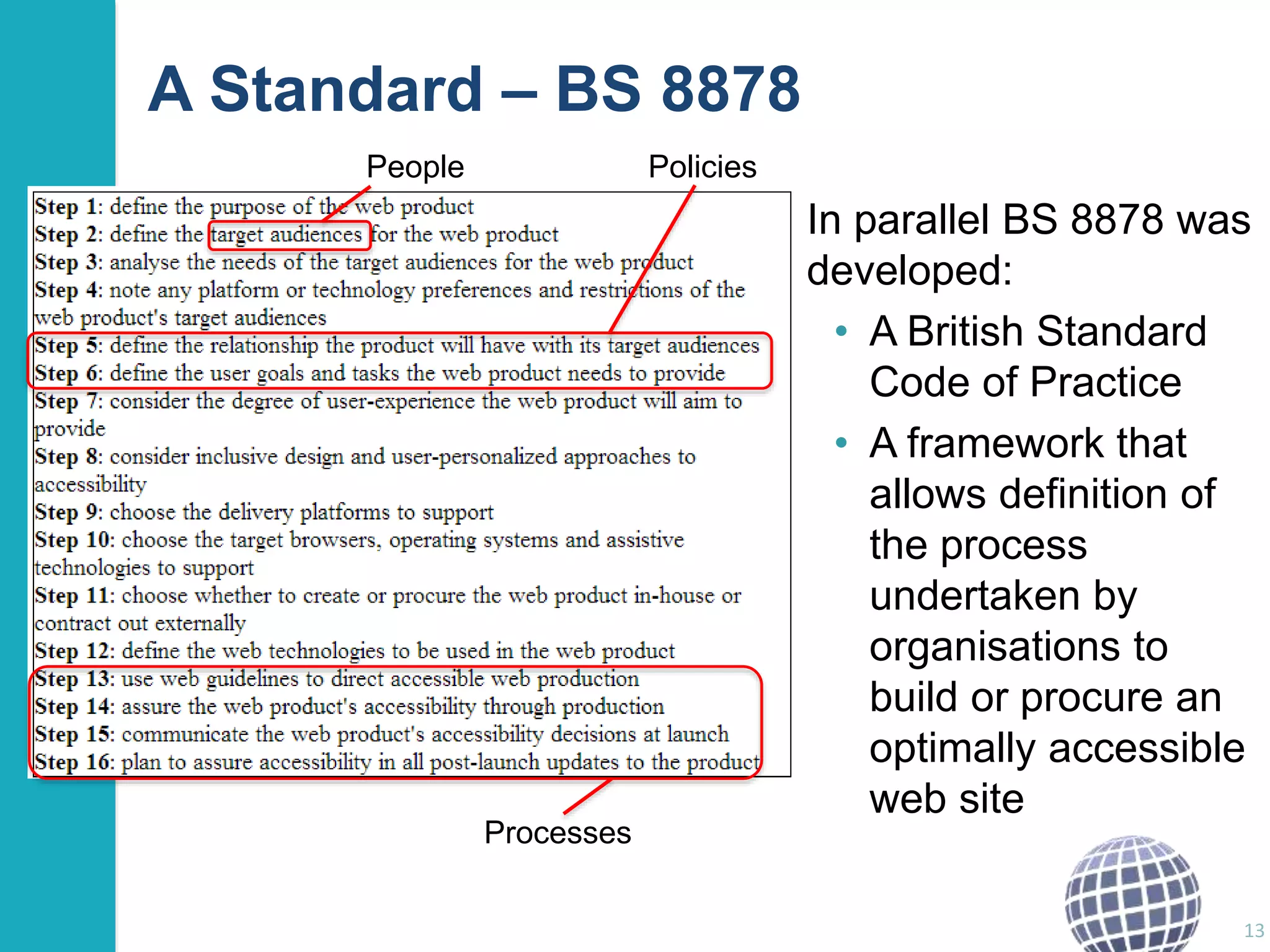
In parallel BS 8878 was 
developed: 
• A British Standard 
Code of Practice 
• A framework that 
allows definition of 
the process 
undertaken by 
organisations to 
build or procure an 
optimally accessible 
web site 
13 
People Policies 
Processes
BS 878 In 88 Seconds 
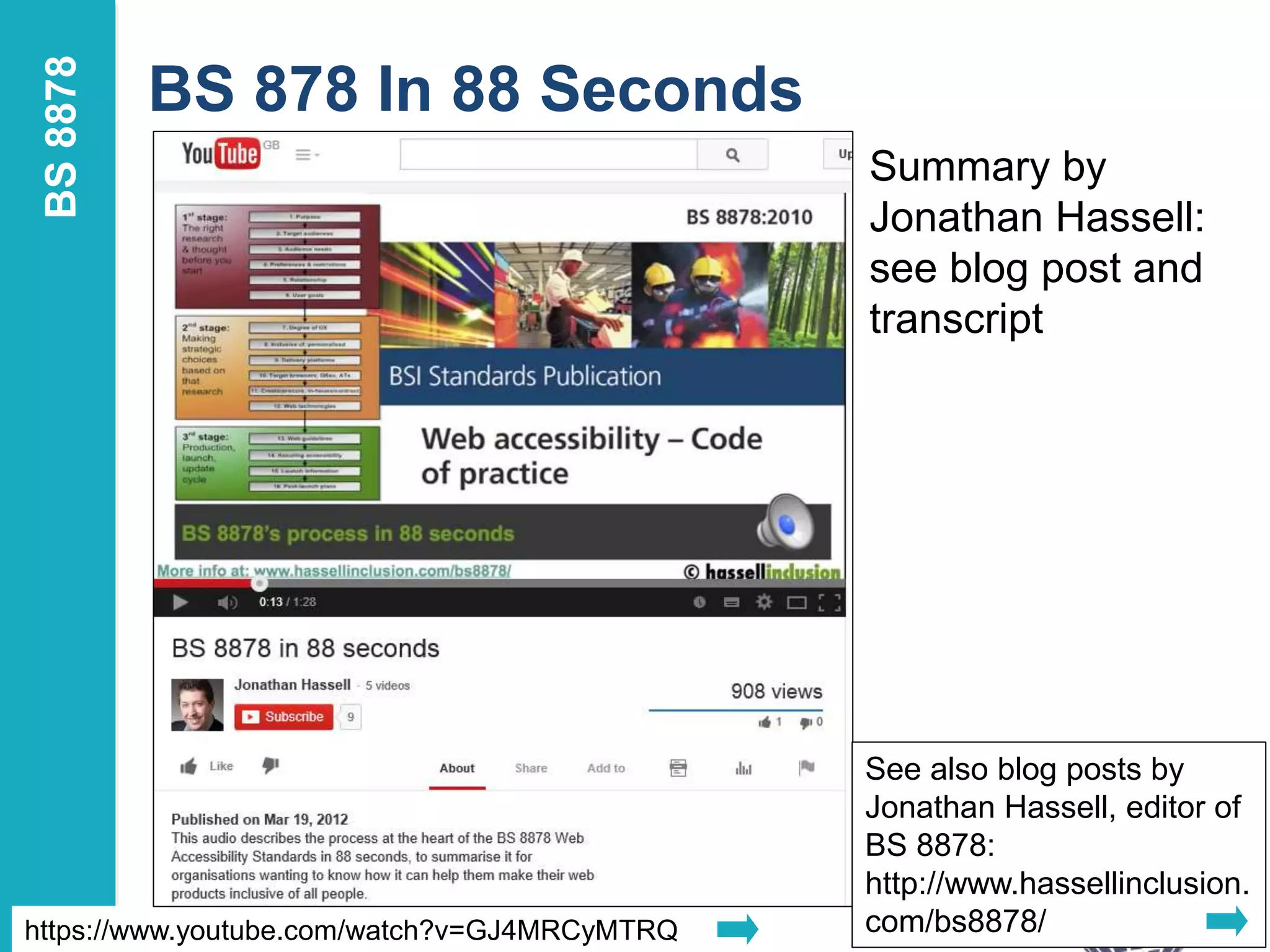
Summary by 
Jonathan Hassell: 
see blog post and 
transcript 
BS 8878 
See also blog posts by 
Jonathan Hassell, editor of 
BS 8878: 
http://www.hassellinclusion. 
com/bs8878/ 
https://www.youtube.com/watch?v=GJ4MRCyMTRQ 14
Conclusions 
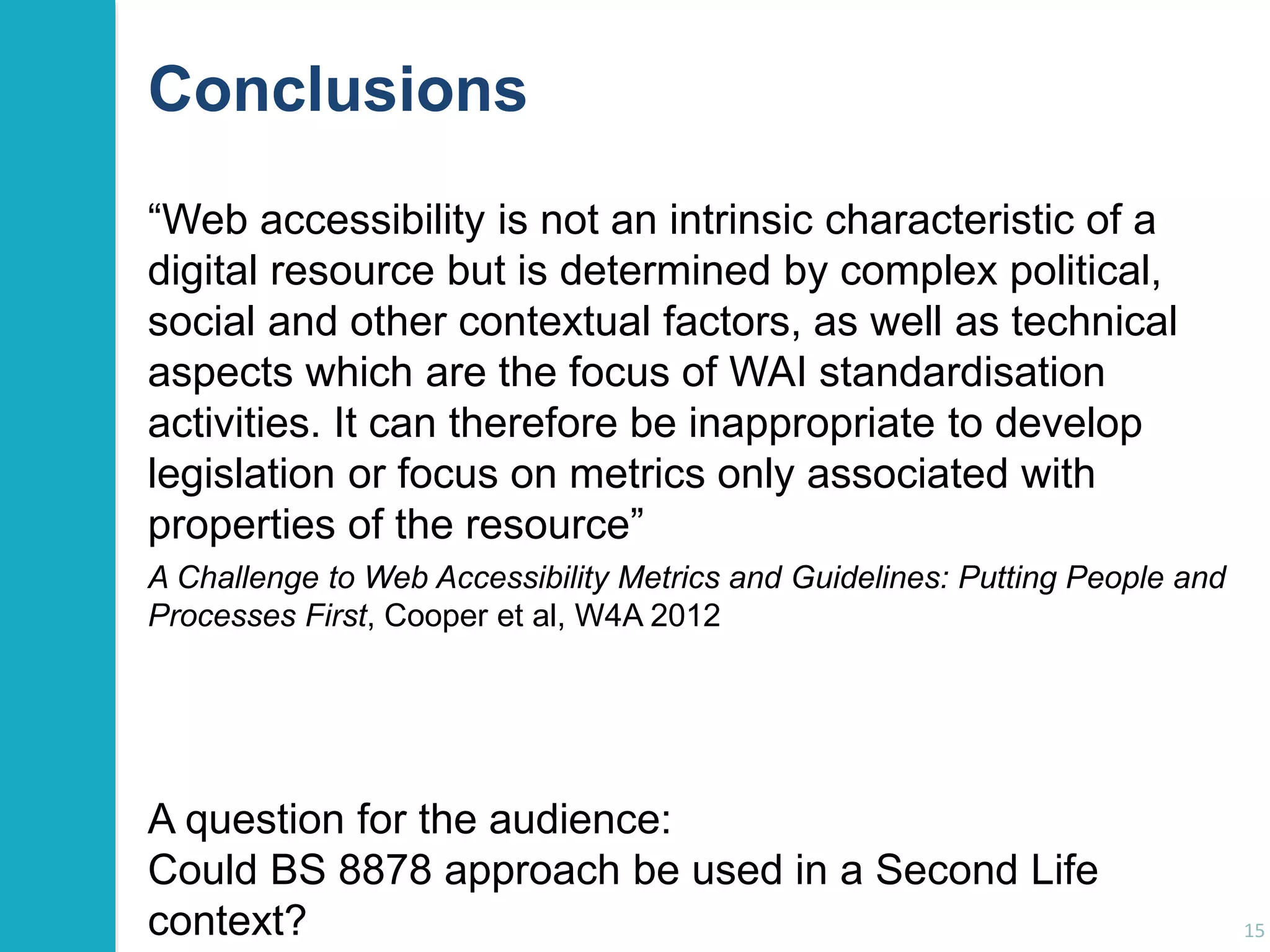
“Web accessibility is not an intrinsic characteristic of a 
digital resource but is determined by complex political, 
social and other contextual factors, as well as technical 
aspects which are the focus of WAI standardisation 
activities. It can therefore be inappropriate to develop 
legislation or focus on metrics only associated with 
properties of the resource” 
15 
A Challenge to Web Accessibility Metrics and Guidelines: Putting People and 
Processes First, Cooper et al, W4A 2012 
A question for the audience: 
Could BS 8878 approach be used in a Second Life 
context?
Questions? 
Any questions, comments, …? 
16
Licence and Additional Resources 
This presentation, “Web accessibility is not (primarily) about 
conformance with web accessibility standards”, by Brian Kelly, Cetis is 
licensed under the Creative Commons Attribution 3.0 Unported Licence 
Note the licence covers most of the text in this presentation. Quotations 
may have other licence conditions. 
Images may have other licence conditions. Where possible links are 
provided to the source of images so that licence conditions can be found. 
17 
Slides and further information available at 
http://ukwebfocus.wordpress.com/events/web-accessibility-is-not-primarily-about- 
conformance-with-web-accessibility-standards/

Web accessibility is not primarily about conformance with standards

  • 1.
    Web Accessibility isNot (Primarily) About Conformance with Web Accessibility Standards Brian Kelly Innovation Advocate Cetis University of Bolton Bolton, UK Contact Details Email: ukwebfocus@gmail.com Twitter: @briankelly Cetis Web site: http://www.cetis.ac.uk/ Blog: http://ukwebfocus.wordpress.com/ 1 A presentation for the IDRAC (International Disability Rights Affirmation Conference) 2014 conference to be held in Second Life on 3-4 October 2014 Slides and further information available at http://ukwebfocus.wordpress.com/events/web-accessibility-is-not-primarily-about- conformance-with-web-accessibility-standards/
  • 2.
    Contents • AboutMe • Early Involvement with Web Accessibility • About WAI and WCAG • Realisation of the Limitations • “Blended Accessibility for Blended Learning” • Beyond Accessibility for Learning • Accessibility 2.0: People, Policies and Processes (and Politics) • A Standard – BS 8878 • Conclusions 2
  • 3.
    About Me BrianKelly • Early adopter of Web technologies (Jan 1993) • UK Web Focus at UKOLN: a national post, advising UK universities on best practices for use of the Web from 1996-2013 • Now Innovation Advocate at Cetis, encouraging take-up of innovation technologies and practices by UK universities 3
  • 4.
    Involvement with WebAccessibility Long-standing involvement with Web accessibility: • Attended W3C WAI launch, Santa Clara, April 1997 • Many peer-reviewed papers published since 2004, co-authored with accessibility researchers & practitioners from UK and Australia • Awards:  “Implementing A Holistic Approach To E-Learning Accessibility”: Best research paper at ALT-C 2005  “Developing countries; developing experiences: approaches to accessibility for the Real World”: John M Slatin Award for best communications paper at W4A 2010 • Co-organiser of Accessibility Summit in 2004 and Accessibility Summit II in 2006 4
  • 5.
    WAI Recap W3CWAI (Web Accessibility Initiative): • Developed framework for providing “universal accessibility” • Has had global impact • Based on 3 components for:  Content (WCAG)  Authoring (ATAG)  Browsers/User Agents (UAAG) WCAG 1.0: • Specific to HTML; had flaws WCAG 2.0 • Format independent • POUR principle: requires accessible content to be Perceivable; Operable; Understandable and Robust 5
  • 6.
    Realisation of theLimitations From 1997 - 2002: • Encouraged universities to use WCAG guidelines to provide “universal accessibility” From 2002-2004: • Realisation of the limitations, especially in e-learning context:  “How do I make this 3D molecule in Java accessible?”  “If I provide Alt-text to the images in the quiz I’m giving the answer away” 6 Conclusions: It’s wrong to think that universal accessibility can be achieved by simply conforming to a checklist. However WCAG guidelines do have value, but we need a better solution.
  • 7.
    “Blended Accessibility forBlended Learning” 7 In 2004 we realised: • Differences between informational and learning web services1 • Importance of accessibility of learning objectives / learning experience rather than the learning resource2 • Importance of other IT and non-IT learning environments beyond the Web Note 1 • We want immediate & simple access to information • Understanding & learning is different. The “understanding” arises through pedagogical processes discussions, misunderstandings, “light bulb”, …. Note 2 Example: a field trip involves trip up a mountain. This is not accessible. Do we: • Install wheelchair ramp up mountain? • Cancel trip as it’s not universally accessible? • Seek to make the various experiences accessible (e.g. team working)?
  • 8.
    Beyond Accessibility forLearning Different accessibility challenges for • Information • Learning • Culture • Communications • Games • … 8 We identified the importance of context and the intended purpose of the service for accessibility
  • 9.
    Relevance of SecondLife Is Second Life Accessible? Blog post published in Jan 2008: This video clip shows a user with cerebral palsy, Judith, using Second Life with a headwand. As Judith explains: ‘I’ve got a wheelchair in Second Life also. You can choose whether you want to be in a chair or not. You can have crutches, you can have whatever disability you have in real life in Second Life’ 9 Not universally accessible, but accessible (and valuable) to a user with disabilities. This example illustrates need to have a user-focussed approach to accessibility standards
  • 10.
    Revisiting Limitations ofWAI In June 2008 UK government announced that all government web sites must conform to WCAG AA Implications: • What if WCAG is flawed? • What about the costs? • What about the loss of services of use to some/many? 10 There is a need for a standard, but it must be realistic and address a wide range of use cases. A new approach much avoid: • Unnecessary barriers to innovation • Temptations to delete services which are accessible to many but not all (cf Judith & SL)
  • 11.
    People, Policies andProcesses In 2007 we argued: • We need a new approach to accessibility • We called this approach “accessibility 2.0” • Move on focus from digital resource to:  People (the users and other stakeholders)  The policies covering use of web services  The processes which would ensure that policies were being implemented Accessibility 2.0: People, Policies and Processes, Kelly et al, W4A 200711
  • 12.
    • xx AndPolitics! See blog post at http://slewth.co.uk/blog/2014/ 09/17/ 12
  • 13.
    A Standard –BS 8878 In parallel BS 8878 was developed: • A British Standard Code of Practice • A framework that allows definition of the process undertaken by organisations to build or procure an optimally accessible web site 13 People Policies Processes
  • 14.
    BS 878 In88 Seconds Summary by Jonathan Hassell: see blog post and transcript BS 8878 See also blog posts by Jonathan Hassell, editor of BS 8878: http://www.hassellinclusion. com/bs8878/ https://www.youtube.com/watch?v=GJ4MRCyMTRQ 14
  • 15.
    Conclusions “Web accessibilityis not an intrinsic characteristic of a digital resource but is determined by complex political, social and other contextual factors, as well as technical aspects which are the focus of WAI standardisation activities. It can therefore be inappropriate to develop legislation or focus on metrics only associated with properties of the resource” 15 A Challenge to Web Accessibility Metrics and Guidelines: Putting People and Processes First, Cooper et al, W4A 2012 A question for the audience: Could BS 8878 approach be used in a Second Life context?
  • 16.
    Questions? Any questions,comments, …? 16
  • 17.
    Licence and AdditionalResources This presentation, “Web accessibility is not (primarily) about conformance with web accessibility standards”, by Brian Kelly, Cetis is licensed under the Creative Commons Attribution 3.0 Unported Licence Note the licence covers most of the text in this presentation. Quotations may have other licence conditions. Images may have other licence conditions. Where possible links are provided to the source of images so that licence conditions can be found. 17 Slides and further information available at http://ukwebfocus.wordpress.com/events/web-accessibility-is-not-primarily-about- conformance-with-web-accessibility-standards/

Editor's Notes

  • #2 Hello, my name is Brian Kelly. The title of my talk is Web Accessibility is Not (Primarily) About Conformance with Web Accessibility Standards. Please note that the slides are also available on my UK Web Focus blog. Also feel free to get in touch with me about this presentation.
  • #3 In my talk I will introduce myself and summarise my early involvement with Web accessibility. I will summary WAI’s approaches to Web accessibility and describe the limitations of this approach. I will describe work myself and colleagues were involved in in providing more appropriate approaches for addressing accessibility challenges in a learning context. I will then describe how these approaches were applied to other context. I will describe how our approach, which we called “Accessibility 2.0” focusses on people, policies and processes, rather than the web resource. I will conclude by described how the BS 8878, developed in parallel to our work, provides an appropriate framework for developing or building accessible web sites.