Joining it all up: developing research-practice
linkages in the UK
Presentation to the School of Business and Economics, Åbo
Akademi University, Finland
Thursday 13th March 2014
Professor Hazel Hall
www.napier.ac.uk/iidi
Welcome to today‟s presentation
Page 2
Professor Hazel Hall
@hazelh
http://hazelhall.org
http://about.me/hazelh
h.hall@napier.ac.uk
0131 455 2760
www.napier.ac.uk/iidi
Work of the Centre for Social Informatics
Page 3
CPD
Knowledge management
Library and Information Science, e.g.
research resources for LIS
Social media strategies with focus on knowledge
management, risk management and engagement
strategies
…
Research – research councils, Europe
E-participation
E-governance
Information Society
Library and Information Science, e.g. AHRC
Smart cities
…
Research: contract, consultancy, “other”
Knowledge management
Library and Information Science e.g. CILIP
Market research
Online communities
Project management
Social computing
Sociotechnical project evaluation
…
One of five research centre within IIDI
Distributed Computing, Networking & Security
Emergent Computing
Information & Software Systems
Interaction Design
Social Informatics: exploring human-
technology relationships in context, and their
impact, e.g. on organisations, communities
www.napier.ac.uk/iidi
Two eras
Page 4
National projects: 2009-2012
Library and Information Science Research
Coalition
Developing Research Excellence and Methods
(DREaM)
Research in Librarianship Impact Evaluation
Study (RiLIES)
“Impact”: 2012 onwards
Professional bodies
Practitioner groups
Researcher groups
www.napier.ac.uk/iidi Page 5
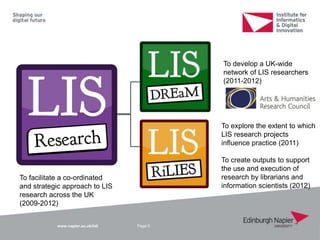
To facilitate a co-ordinated
and strategic approach to LIS
research across the UK
(2009-2012)
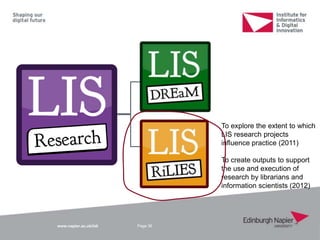
To explore the extent to which
LIS research projects
influence practice (2011)
To create outputs to support
the use and execution of
research by librarians and
information scientists (2012)
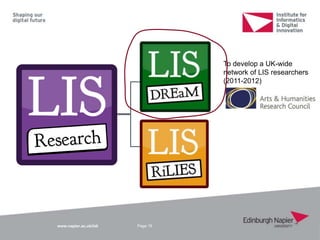
To develop a UK-wide
network of LIS researchers
(2011-2012)
www.napier.ac.uk/iidi Page 6
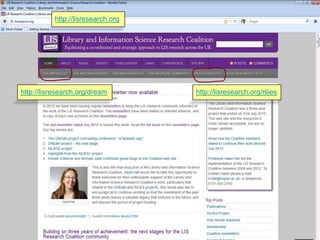
http://lisresearch.org
http://lisresearch.org/dream http://lisresearch.org/rilies
www.napier.ac.uk/iidi Page 7
Resources still useful and
well-used
www.napier.ac.uk/iidi Page 8
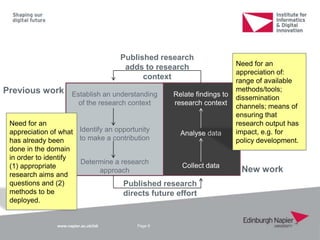
Previous work
New workCollect data
Establish an understanding
of the research context
Identify an opportunity
to make a contribution
Determine a research
approach
Analyse data
Relate findings to
research context
Published research
adds to research
context
Need for an
appreciation of:
range of available
methods/tools;
dissemination
channels; means of
ensuring that
research output has
impact, e.g. for
policy development.
Need for an
appreciation of what
has already been
done in the domain
in order to identify
(1) appropriate
research aims and
questions and (2)
methods to be
deployed.
Published research
directs future effort
www.napier.ac.uk/iidi Page 9
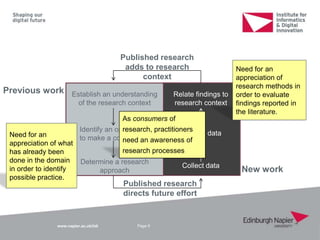
Previous work
New workCollect data
Establish an understanding
of the research context
Identify an opportunity
to make a contribution
Determine a research
approach
Analyse data
Relate findings to
research context
Published research
adds to research
context
Need for an
appreciation of
research methods in
order to evaluate
findings reported in
the literature.
Need for an
appreciation of what
has already been
done in the domain
in order to identify
possible practice.
Published research
directs future effort
As consumers of
research, practitioners
need an awareness of
research processes
www.napier.ac.uk/iidi
Importance of research-led practice
To exploit existing knowledge base for services (outcomes)
improvement  improve decision making for services delivery
To enhance the value of prior work
• to capitalise on significant investment in previous studies
• to raise the value of previous studies through reuse
To demonstrate the value and impact of service delivery
Page 10
www.napier.ac.uk/iidi Page 11
… reduced anti-social behaviour
…contributed to improvements in
pupils‟ exam results
…attracted international student fee
income
… raised research assessment ratings
… increased literacy levels
www.napier.ac.uk/iidi
Barriers to research-led practice: “evaluation by-pass”
(Booth, 2006)
Valuable research work is often not published at all
Multidisciplinary nature of the LIS literature, across publications of various domains,
makes it difficult to access
Much valuable research is held in grey sources: straightforward access not always
obvious, e.g. unpublished internal studies, summaries on listservs
There is a preference amongst practitioners for face-to-face dissemination channels
- tailored, lowered incidence of information overload, addresses issues of
fragmented infrastructures – but opportunities to attend professional events are few
Some practitioners suffer restricted access to social media channels – valued for
immediacy, updates on on-going projects
Page 12
Booth, A. (2006). Clear and present questions: formulating questions for evidence based practice. Library Hi Tech, 24(3), 355-368.
www.napier.ac.uk/iidi
And lack of practitioner-led research (as opposed to
research-led practice)?
Irony of librarians helping others identify evidence to support their
practice, but less likely to do for themselves
Few LIS practitioners publish research in international peer-reviewed
journals – except North American librarians seeking tenure
Page 13
www.napier.ac.uk/iidi Page 14
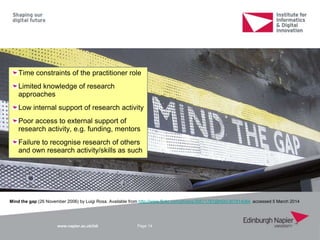
Time constraints of the practitioner role
Limited knowledge of research
approaches
Low internal support of research activity
Poor access to external support of
research activity, e.g. funding, mentors
Failure to recognise research of others
and own research activity/skills as such
Mind the gap (26 November 2006) by Luigi Rosa. Available from http://www.flickr.com/photos/30571787@N00/307814064, accessed 5 March 2014
www.napier.ac.uk/iidi Page 15
To facilitate a co-ordinated and strategic
approach to LIS research across the UK
Bring together information about LIS research
opportunities and results
Encourage dialogue between research funders
Promote LIS practitioner research and the
translation of research outcomes into practice
Articulate a strategic approach to LIS research
Promote the development of research capacity in
LIS
www.napier.ac.uk/iidi Page 16
To develop a UK-wide
network of LIS researchers
(2011-2012)
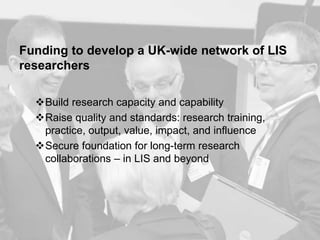
Funding to develop a UK-wide network of LIS
researchers
Build research capacity and capability
Raise quality and standards: research training,
practice, output, value, impact, and influence
Secure foundation for long-term research
collaborations – in LIS and beyond
www.napier.ac.uk/iidi Page 18
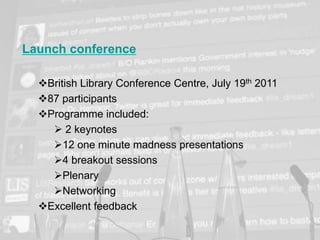
Launch conference
British Library Conference Centre, July 19th 2011
87 participants
Programme included:
 2 keynotes
12 one minute madness presentations
4 breakout sessions
Plenary
Networking
Excellent feedback
www.napier.ac.uk/iidi Page 19
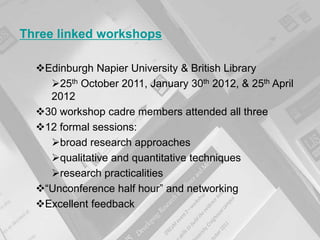
Three linked workshops
Edinburgh Napier University & British Library
25th October 2011, January 30th 2012, & 25th April
2012
30 workshop cadre members attended all three
12 formal sessions:
broad research approaches
qualitative and quantitative techniques
research practicalities
“Unconference half hour” and networking
Excellent feedback
www.napier.ac.uk/iidi Page 20
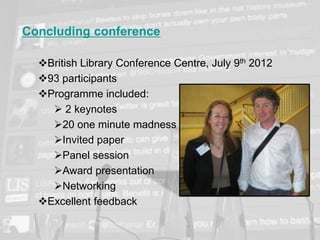
Concluding conference
British Library Conference Centre, July 9th 2012
93 participants
Programme included:
 2 keynotes
20 one minute madness presentations
Invited paper
Panel session
Award presentation
Networking
Excellent feedback
www.napier.ac.uk/iidi Page 21
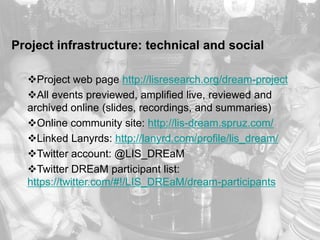
Project infrastructure: technical and social
Project web page http://lisresearch.org/dream-project
All events previewed, amplified live, reviewed and
archived online (slides, recordings, and summaries)
Online community site: http://lis-dream.spruz.com/
Linked Lanyrds: http://lanyrd.com/profile/lis_dream/
Twitter account: @LIS_DREaM
Twitter DREaM participant list:
https://twitter.com/#!/LIS_DREaM/dream-participants
www.napier.ac.uk/iidi Page 22
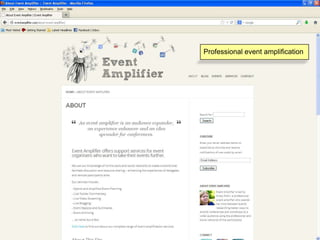
Professional event amplification
www.napier.ac.uk/iidi Page 23
Event reviews by delegates
www.napier.ac.uk/iidi Page 24
The DREaM online community
www.napier.ac.uk/iidi Page 25
The Twitter feed
www.napier.ac.uk/iidi Page 26
The Twitter list
www.napier.ac.uk/iidi Page 27
Participation and reach in numbers
5 events
led by 33 „official‟ contributors
for 213 on-site delegate participants
from 12 countries (and 4 continents)
not counting „remote‟ audience of ~80 blog posts,
~1000+ tweets, multiple web pages, SlideShares,
Vimeos, SoundClouds etc.
www.napier.ac.uk/iidi Page 28
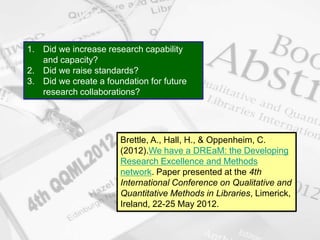
Brettle, A., Hall, H., & Oppenheim, C.
(2012).We have a DREaM: the Developing
Research Excellence and Methods
network. Paper presented at the 4th
International Conference on Qualitative and
Quantitative Methods in Libraries, Limerick,
Ireland, 22-25 May 2012.
1. Did we increase research capability
and capacity?
2. Did we raise standards?
3. Did we create a foundation for future
research collaborations?
www.napier.ac.uk/iidi Page 29
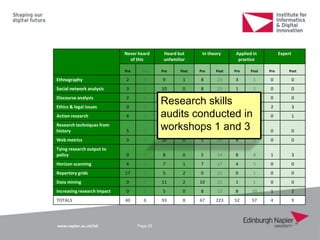
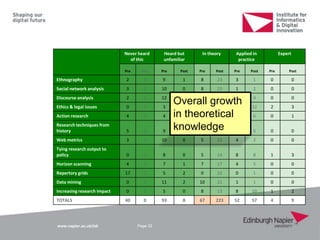
Never heard
of this
Heard but
unfamiliar
In theory Applied in
practice
Expert
Pre Post Pre Post Pre Post Pre Post Pre Post
Ethnography 2 0 9 1 8 23 3 1 0 0
Social network analysis 3 0 10 0 8 23 1 2 0 0
Discourse analysis 2 0 12 1 6 19 2 4 0 0
Ethics & legal issues 0 0 3 0 6 10 12 12 2 3
Action research 4 0 4 1 8 18 6 6 0 1
Research techniques from
history 5 0 9 0 4 20 3 5 0 0
Web metrics 3 0 10 0 5 23 4 2 0 0
Tying research output to
policy 0 0 8 0 5 14 8 8 1 3
Horizon scanning 4 0 7 1 7 17 4 5 0 0
Repertory grids 17 0 5 2 0 22 0 1 0 0
Data mining 0 0 11 2 10 21 1 1 0 0
Increasing research impact 0 0 5 0 8 13 8 10 1 2
TOTALS 40 0 93 8 67 223 52 57 4 9
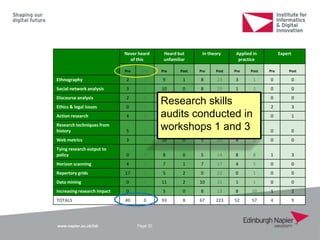
Research skills
audits conducted in
workshops 1 and 3
www.napier.ac.uk/iidi Page 30
Never heard
of this
Heard but
unfamiliar
In theory Applied in
practice
Expert
Pre Post Pre Post Pre Post Pre Post Pre Post
Ethnography 2 0 9 1 8 23 3 1 0 0
Social network analysis 3 0 10 0 8 23 1 2 0 0
Discourse analysis 2 0 12 1 6 19 2 4 0 0
Ethics & legal issues 0 0 3 0 6 10 12 12 2 3
Action research 4 0 4 1 8 18 6 6 0 1
Research techniques from
history 5 0 9 0 4 20 3 5 0 0
Web metrics 3 0 10 0 5 23 4 2 0 0
Tying research output to
policy 0 0 8 0 5 14 8 8 1 3
Horizon scanning 4 0 7 1 7 17 4 5 0 0
Repertory grids 17 0 5 2 0 22 0 1 0 0
Data mining 0 0 11 2 10 21 1 1 0 0
Increasing research impact 0 0 5 0 8 13 8 10 1 2
TOTALS 40 0 93 8 67 223 52 57 4 9
Research skills
audits conducted in
workshops 1 and 3
www.napier.ac.uk/iidi Page 31
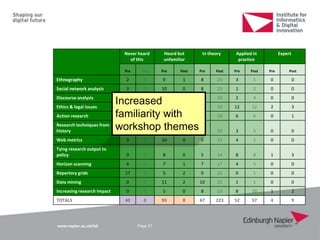
Never heard
of this
Heard but
unfamiliar
In theory Applied in
practice
Expert
Pre Post Pre Post Pre Post Pre Post Pre Post
Ethnography 2 0 9 1 8 23 3 1 0 0
Social network analysis 3 0 10 0 8 23 1 2 0 0
Discourse analysis 2 0 12 1 6 19 2 4 0 0
Ethics & legal issues 0 0 3 0 6 10 12 12 2 3
Action research 4 0 4 1 8 18 6 6 0 1
Research techniques from
history 5 0 9 0 4 20 3 5 0 0
Web metrics 3 0 10 0 5 23 4 2 0 0
Tying research output to
policy 0 0 8 0 5 14 8 8 1 3
Horizon scanning 4 0 7 1 7 17 4 5 0 0
Repertory grids 17 0 5 2 0 22 0 1 0 0
Data mining 0 0 11 2 10 21 1 1 0 0
Increasing research impact 0 0 5 0 8 13 8 10 1 2
TOTALS 40 0 93 8 67 223 52 57 4 9
Increased
familiarity with
workshop themes
www.napier.ac.uk/iidi Page 32
Never heard
of this
Heard but
unfamiliar
In theory Applied in
practice
Expert
Pre Post Pre Post Pre Post Pre Post Pre Post
Ethnography 2 0 9 1 8 23 3 1 0 0
Social network analysis 3 0 10 0 8 23 1 2 0 0
Discourse analysis 2 0 12 1 6 19 2 4 0 0
Ethics & legal issues 0 0 3 0 6 10 12 12 2 3
Action research 4 0 4 1 8 18 6 6 0 1
Research techniques from
history 5 0 9 0 4 20 3 5 0 0
Web metrics 3 0 10 0 5 23 4 2 0 0
Tying research output to
policy 0 0 8 0 5 14 8 8 1 3
Horizon scanning 4 0 7 1 7 17 4 5 0 0
Repertory grids 17 0 5 2 0 22 0 1 0 0
Data mining 0 0 11 2 10 21 1 1 0 0
Increasing research impact 0 0 5 0 8 13 8 10 1 2
TOTALS 40 0 93 8 67 223 52 57 4 9
Overall growth
in theoretical
knowledge
www.napier.ac.uk/iidi Page 33
Never heard
of this
Heard but
unfamiliar
In theory Applied in
practice
Expert
Pre Post Pre Post Pre Post Pre Post Pre Post
Ethnography 2 0 9 1 8 23 3 1 0 0
Social network analysis 3 0 10 0 8 23 1 2 0 0
Discourse analysis 2 0 12 1 6 19 2 4 0 0
Ethics & legal issues 0 0 3 0 6 10 12 12 2 3
Action research 4 0 4 1 8 18 6 6 0 1
Research techniques from
history 5 0 9 0 4 20 3 5 0 0
Web metrics 3 0 10 0 5 23 4 2 0 0
Tying research output to
policy 0 0 8 0 5 14 8 8 1 3
Horizon scanning 4 0 7 1 7 17 4 5 0 0
Repertory grids 17 0 5 2 0 22 0 1 0 0
Data mining 0 0 11 2 10 21 1 1 0 0
Increasing research impact 0 0 5 0 8 13 8 10 1 2
TOTALS 40 0 93 8 67 223 52 57 4 9
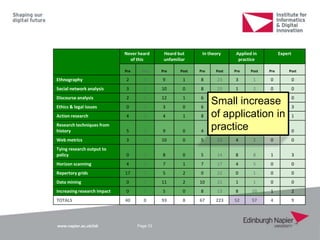
Small increase
of application in
practice
www.napier.ac.uk/iidi Page 34
Never heard
of this
Heard but
unfamiliar
In theory Applied in
practice
Expert
Pre Post Pre Post Pre Post Pre Post Pre Post
Ethnography 2 0 9 1 8 23 3 1 0 0
Social network analysis 3 0 10 0 8 23 1 2 0 0
Discourse analysis 2 0 12 1 6 19 2 4 0 0
Ethics & legal issues 0 0 3 0 6 10 12 12 2 3
Action research 4 0 4 1 8 18 6 6 0 1
Research techniques from
history 5 0 9 0 4 20 3 5 0 0
Web metrics 3 0 10 0 5 23 4 2 0 0
Tying research output to
policy 0 0 8 0 5 14 8 8 1 3
Horizon scanning 4 0 7 1 7 17 4 5 0 0
Repertory grids 17 0 5 2 0 22 0 1 0 0
Data mining 0 0 11 2 10 21 1 1 0 0
Increasing research impact 0 0 5 0 8 13 8 10 1 2
TOTALS 40 0 93 8 67 223 52 57 4 9
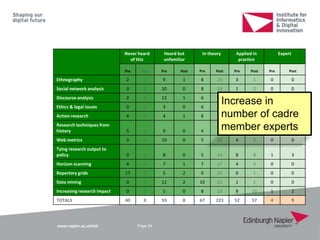
Increase in
number of cadre
member experts
www.napier.ac.uk/iidi Page 35
Critical incident technique - cadre reported
Increased research capacity and capability
Growth in knowledge and research confidence
Raised standards
Impact and influence – demonstrating research knowledge in the
workplace
Quality of training – new resources to share
Research practice – methodological choice
Foundations for future collaborations
Widened networks and research relationships
www.napier.ac.uk/iidi Page 36
To explore the extent to which
LIS research projects
influence practice (2011)
To create outputs to support
the use and execution of
research by librarians and
information scientists (2012)
www.napier.ac.uk/iidi
Addressing the issues: project conception
Researchers should involve practitioners in research design
Funders should support research that is relevant to the needs of the
practitioner community and – allied to this – an explicit goal of research
should be to influence practice
Research undertaken should have high level support: steering
committees, influential stakeholders
Page 37
www.napier.ac.uk/iidi
Addressing the issues: project execution
Practitioners should be invited to participate in the research from the
outset, e.g. capacity building workshops as hook
Information about the project should be disseminated throughout its
duration (and not just at the end)
Page 38
www.napier.ac.uk/iidi
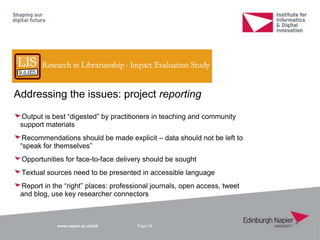
Addressing the issues: project reporting
Output is best “digested” by practitioners in teaching and community
support materials
Recommendations should be made explicit – data should not be left to
“speak for themselves”
Opportunities for face-to-face delivery should be sought
Textual sources need to be presented in accessible language
Report in the “right” places: professional journals, open access, tweet
and blog, use key researcher connectors
Page 39
www.napier.ac.uk/iidi Page 40
www.napier.ac.uk/iidi
“Impact” 2012 onwards?
Professional bodies
Practitioner groups
Researcher groups
Page 41
www.napier.ac.uk/iidi Page 42
Higher profile for
research skills
www.napier.ac.uk/iidi Page 43
LIRG invigorated
www.napier.ac.uk/iidi
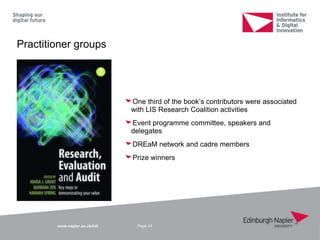
Practitioner groups
One third of the book‟s contributors were associated
with LIS Research Coalition activities
Event programme committee, speakers and
delegates
DREaM network and cadre members
Prize winners
Page 44
www.napier.ac.uk/iidi Page 45
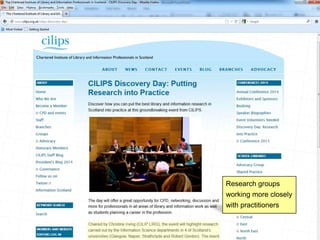
Research groups
working more closely
with practitioners
www.napier.ac.uk/iidi Page 46
www.napier.ac.uk/iidi Page 47
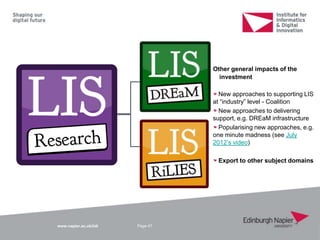
Other general impacts of the
investment
New approaches to supporting LIS
at “industry” level - Coalition
New approaches to delivering
support, e.g. DREaM infrastructure
Popularising new approaches, e.g.
one minute madness (see July
2012‟s video)
Export to other subject domains
Joining it all up: developing research-practice
linkages in the UK
Presentation to the School of Business and Economics, Åbo
Akademi University, Finland
Thursday 13th March 2014
Professor Hazel Hall

Joining it all up: developing research-practice linkages in the UK

  • 1.
    Joining it allup: developing research-practice linkages in the UK Presentation to the School of Business and Economics, Åbo Akademi University, Finland Thursday 13th March 2014 Professor Hazel Hall
  • 2.
    www.napier.ac.uk/iidi Welcome to today‟spresentation Page 2 Professor Hazel Hall @hazelh http://hazelhall.org http://about.me/hazelh h.hall@napier.ac.uk 0131 455 2760
  • 3.
    www.napier.ac.uk/iidi Work of theCentre for Social Informatics Page 3 CPD Knowledge management Library and Information Science, e.g. research resources for LIS Social media strategies with focus on knowledge management, risk management and engagement strategies … Research – research councils, Europe E-participation E-governance Information Society Library and Information Science, e.g. AHRC Smart cities … Research: contract, consultancy, “other” Knowledge management Library and Information Science e.g. CILIP Market research Online communities Project management Social computing Sociotechnical project evaluation … One of five research centre within IIDI Distributed Computing, Networking & Security Emergent Computing Information & Software Systems Interaction Design Social Informatics: exploring human- technology relationships in context, and their impact, e.g. on organisations, communities
  • 4.
    www.napier.ac.uk/iidi Two eras Page 4 Nationalprojects: 2009-2012 Library and Information Science Research Coalition Developing Research Excellence and Methods (DREaM) Research in Librarianship Impact Evaluation Study (RiLIES) “Impact”: 2012 onwards Professional bodies Practitioner groups Researcher groups
  • 5.
    www.napier.ac.uk/iidi Page 5 Tofacilitate a co-ordinated and strategic approach to LIS research across the UK (2009-2012) To explore the extent to which LIS research projects influence practice (2011) To create outputs to support the use and execution of research by librarians and information scientists (2012) To develop a UK-wide network of LIS researchers (2011-2012)
  • 6.
  • 7.
    www.napier.ac.uk/iidi Page 7 Resourcesstill useful and well-used
  • 8.
    www.napier.ac.uk/iidi Page 8 Previouswork New workCollect data Establish an understanding of the research context Identify an opportunity to make a contribution Determine a research approach Analyse data Relate findings to research context Published research adds to research context Need for an appreciation of: range of available methods/tools; dissemination channels; means of ensuring that research output has impact, e.g. for policy development. Need for an appreciation of what has already been done in the domain in order to identify (1) appropriate research aims and questions and (2) methods to be deployed. Published research directs future effort
  • 9.
    www.napier.ac.uk/iidi Page 9 Previouswork New workCollect data Establish an understanding of the research context Identify an opportunity to make a contribution Determine a research approach Analyse data Relate findings to research context Published research adds to research context Need for an appreciation of research methods in order to evaluate findings reported in the literature. Need for an appreciation of what has already been done in the domain in order to identify possible practice. Published research directs future effort As consumers of research, practitioners need an awareness of research processes
  • 10.
    www.napier.ac.uk/iidi Importance of research-ledpractice To exploit existing knowledge base for services (outcomes) improvement  improve decision making for services delivery To enhance the value of prior work • to capitalise on significant investment in previous studies • to raise the value of previous studies through reuse To demonstrate the value and impact of service delivery Page 10
  • 11.
    www.napier.ac.uk/iidi Page 11 …reduced anti-social behaviour …contributed to improvements in pupils‟ exam results …attracted international student fee income … raised research assessment ratings … increased literacy levels
  • 12.
    www.napier.ac.uk/iidi Barriers to research-ledpractice: “evaluation by-pass” (Booth, 2006) Valuable research work is often not published at all Multidisciplinary nature of the LIS literature, across publications of various domains, makes it difficult to access Much valuable research is held in grey sources: straightforward access not always obvious, e.g. unpublished internal studies, summaries on listservs There is a preference amongst practitioners for face-to-face dissemination channels - tailored, lowered incidence of information overload, addresses issues of fragmented infrastructures – but opportunities to attend professional events are few Some practitioners suffer restricted access to social media channels – valued for immediacy, updates on on-going projects Page 12 Booth, A. (2006). Clear and present questions: formulating questions for evidence based practice. Library Hi Tech, 24(3), 355-368.
  • 13.
    www.napier.ac.uk/iidi And lack ofpractitioner-led research (as opposed to research-led practice)? Irony of librarians helping others identify evidence to support their practice, but less likely to do for themselves Few LIS practitioners publish research in international peer-reviewed journals – except North American librarians seeking tenure Page 13
  • 14.
    www.napier.ac.uk/iidi Page 14 Timeconstraints of the practitioner role Limited knowledge of research approaches Low internal support of research activity Poor access to external support of research activity, e.g. funding, mentors Failure to recognise research of others and own research activity/skills as such Mind the gap (26 November 2006) by Luigi Rosa. Available from http://www.flickr.com/photos/30571787@N00/307814064, accessed 5 March 2014
  • 15.
    www.napier.ac.uk/iidi Page 15 Tofacilitate a co-ordinated and strategic approach to LIS research across the UK Bring together information about LIS research opportunities and results Encourage dialogue between research funders Promote LIS practitioner research and the translation of research outcomes into practice Articulate a strategic approach to LIS research Promote the development of research capacity in LIS
  • 16.
    www.napier.ac.uk/iidi Page 16 Todevelop a UK-wide network of LIS researchers (2011-2012)
  • 17.
    Funding to developa UK-wide network of LIS researchers Build research capacity and capability Raise quality and standards: research training, practice, output, value, impact, and influence Secure foundation for long-term research collaborations – in LIS and beyond
  • 18.
    www.napier.ac.uk/iidi Page 18 Launchconference British Library Conference Centre, July 19th 2011 87 participants Programme included:  2 keynotes 12 one minute madness presentations 4 breakout sessions Plenary Networking Excellent feedback
  • 19.
    www.napier.ac.uk/iidi Page 19 Threelinked workshops Edinburgh Napier University & British Library 25th October 2011, January 30th 2012, & 25th April 2012 30 workshop cadre members attended all three 12 formal sessions: broad research approaches qualitative and quantitative techniques research practicalities “Unconference half hour” and networking Excellent feedback
  • 20.
    www.napier.ac.uk/iidi Page 20 Concludingconference British Library Conference Centre, July 9th 2012 93 participants Programme included:  2 keynotes 20 one minute madness presentations Invited paper Panel session Award presentation Networking Excellent feedback
  • 21.
    www.napier.ac.uk/iidi Page 21 Projectinfrastructure: technical and social Project web page http://lisresearch.org/dream-project All events previewed, amplified live, reviewed and archived online (slides, recordings, and summaries) Online community site: http://lis-dream.spruz.com/ Linked Lanyrds: http://lanyrd.com/profile/lis_dream/ Twitter account: @LIS_DREaM Twitter DREaM participant list: https://twitter.com/#!/LIS_DREaM/dream-participants
  • 22.
  • 23.
  • 24.
    www.napier.ac.uk/iidi Page 24 TheDREaM online community
  • 25.
  • 26.
  • 27.
    www.napier.ac.uk/iidi Page 27 Participationand reach in numbers 5 events led by 33 „official‟ contributors for 213 on-site delegate participants from 12 countries (and 4 continents) not counting „remote‟ audience of ~80 blog posts, ~1000+ tweets, multiple web pages, SlideShares, Vimeos, SoundClouds etc.
  • 28.
    www.napier.ac.uk/iidi Page 28 Brettle,A., Hall, H., & Oppenheim, C. (2012).We have a DREaM: the Developing Research Excellence and Methods network. Paper presented at the 4th International Conference on Qualitative and Quantitative Methods in Libraries, Limerick, Ireland, 22-25 May 2012. 1. Did we increase research capability and capacity? 2. Did we raise standards? 3. Did we create a foundation for future research collaborations?
  • 29.
    www.napier.ac.uk/iidi Page 29 Neverheard of this Heard but unfamiliar In theory Applied in practice Expert Pre Post Pre Post Pre Post Pre Post Pre Post Ethnography 2 0 9 1 8 23 3 1 0 0 Social network analysis 3 0 10 0 8 23 1 2 0 0 Discourse analysis 2 0 12 1 6 19 2 4 0 0 Ethics & legal issues 0 0 3 0 6 10 12 12 2 3 Action research 4 0 4 1 8 18 6 6 0 1 Research techniques from history 5 0 9 0 4 20 3 5 0 0 Web metrics 3 0 10 0 5 23 4 2 0 0 Tying research output to policy 0 0 8 0 5 14 8 8 1 3 Horizon scanning 4 0 7 1 7 17 4 5 0 0 Repertory grids 17 0 5 2 0 22 0 1 0 0 Data mining 0 0 11 2 10 21 1 1 0 0 Increasing research impact 0 0 5 0 8 13 8 10 1 2 TOTALS 40 0 93 8 67 223 52 57 4 9 Research skills audits conducted in workshops 1 and 3
  • 30.
    www.napier.ac.uk/iidi Page 30 Neverheard of this Heard but unfamiliar In theory Applied in practice Expert Pre Post Pre Post Pre Post Pre Post Pre Post Ethnography 2 0 9 1 8 23 3 1 0 0 Social network analysis 3 0 10 0 8 23 1 2 0 0 Discourse analysis 2 0 12 1 6 19 2 4 0 0 Ethics & legal issues 0 0 3 0 6 10 12 12 2 3 Action research 4 0 4 1 8 18 6 6 0 1 Research techniques from history 5 0 9 0 4 20 3 5 0 0 Web metrics 3 0 10 0 5 23 4 2 0 0 Tying research output to policy 0 0 8 0 5 14 8 8 1 3 Horizon scanning 4 0 7 1 7 17 4 5 0 0 Repertory grids 17 0 5 2 0 22 0 1 0 0 Data mining 0 0 11 2 10 21 1 1 0 0 Increasing research impact 0 0 5 0 8 13 8 10 1 2 TOTALS 40 0 93 8 67 223 52 57 4 9 Research skills audits conducted in workshops 1 and 3
  • 31.
    www.napier.ac.uk/iidi Page 31 Neverheard of this Heard but unfamiliar In theory Applied in practice Expert Pre Post Pre Post Pre Post Pre Post Pre Post Ethnography 2 0 9 1 8 23 3 1 0 0 Social network analysis 3 0 10 0 8 23 1 2 0 0 Discourse analysis 2 0 12 1 6 19 2 4 0 0 Ethics & legal issues 0 0 3 0 6 10 12 12 2 3 Action research 4 0 4 1 8 18 6 6 0 1 Research techniques from history 5 0 9 0 4 20 3 5 0 0 Web metrics 3 0 10 0 5 23 4 2 0 0 Tying research output to policy 0 0 8 0 5 14 8 8 1 3 Horizon scanning 4 0 7 1 7 17 4 5 0 0 Repertory grids 17 0 5 2 0 22 0 1 0 0 Data mining 0 0 11 2 10 21 1 1 0 0 Increasing research impact 0 0 5 0 8 13 8 10 1 2 TOTALS 40 0 93 8 67 223 52 57 4 9 Increased familiarity with workshop themes
  • 32.
    www.napier.ac.uk/iidi Page 32 Neverheard of this Heard but unfamiliar In theory Applied in practice Expert Pre Post Pre Post Pre Post Pre Post Pre Post Ethnography 2 0 9 1 8 23 3 1 0 0 Social network analysis 3 0 10 0 8 23 1 2 0 0 Discourse analysis 2 0 12 1 6 19 2 4 0 0 Ethics & legal issues 0 0 3 0 6 10 12 12 2 3 Action research 4 0 4 1 8 18 6 6 0 1 Research techniques from history 5 0 9 0 4 20 3 5 0 0 Web metrics 3 0 10 0 5 23 4 2 0 0 Tying research output to policy 0 0 8 0 5 14 8 8 1 3 Horizon scanning 4 0 7 1 7 17 4 5 0 0 Repertory grids 17 0 5 2 0 22 0 1 0 0 Data mining 0 0 11 2 10 21 1 1 0 0 Increasing research impact 0 0 5 0 8 13 8 10 1 2 TOTALS 40 0 93 8 67 223 52 57 4 9 Overall growth in theoretical knowledge
  • 33.
    www.napier.ac.uk/iidi Page 33 Neverheard of this Heard but unfamiliar In theory Applied in practice Expert Pre Post Pre Post Pre Post Pre Post Pre Post Ethnography 2 0 9 1 8 23 3 1 0 0 Social network analysis 3 0 10 0 8 23 1 2 0 0 Discourse analysis 2 0 12 1 6 19 2 4 0 0 Ethics & legal issues 0 0 3 0 6 10 12 12 2 3 Action research 4 0 4 1 8 18 6 6 0 1 Research techniques from history 5 0 9 0 4 20 3 5 0 0 Web metrics 3 0 10 0 5 23 4 2 0 0 Tying research output to policy 0 0 8 0 5 14 8 8 1 3 Horizon scanning 4 0 7 1 7 17 4 5 0 0 Repertory grids 17 0 5 2 0 22 0 1 0 0 Data mining 0 0 11 2 10 21 1 1 0 0 Increasing research impact 0 0 5 0 8 13 8 10 1 2 TOTALS 40 0 93 8 67 223 52 57 4 9 Small increase of application in practice
  • 34.
    www.napier.ac.uk/iidi Page 34 Neverheard of this Heard but unfamiliar In theory Applied in practice Expert Pre Post Pre Post Pre Post Pre Post Pre Post Ethnography 2 0 9 1 8 23 3 1 0 0 Social network analysis 3 0 10 0 8 23 1 2 0 0 Discourse analysis 2 0 12 1 6 19 2 4 0 0 Ethics & legal issues 0 0 3 0 6 10 12 12 2 3 Action research 4 0 4 1 8 18 6 6 0 1 Research techniques from history 5 0 9 0 4 20 3 5 0 0 Web metrics 3 0 10 0 5 23 4 2 0 0 Tying research output to policy 0 0 8 0 5 14 8 8 1 3 Horizon scanning 4 0 7 1 7 17 4 5 0 0 Repertory grids 17 0 5 2 0 22 0 1 0 0 Data mining 0 0 11 2 10 21 1 1 0 0 Increasing research impact 0 0 5 0 8 13 8 10 1 2 TOTALS 40 0 93 8 67 223 52 57 4 9 Increase in number of cadre member experts
  • 35.
    www.napier.ac.uk/iidi Page 35 Criticalincident technique - cadre reported Increased research capacity and capability Growth in knowledge and research confidence Raised standards Impact and influence – demonstrating research knowledge in the workplace Quality of training – new resources to share Research practice – methodological choice Foundations for future collaborations Widened networks and research relationships
  • 36.
    www.napier.ac.uk/iidi Page 36 Toexplore the extent to which LIS research projects influence practice (2011) To create outputs to support the use and execution of research by librarians and information scientists (2012)
  • 37.
    www.napier.ac.uk/iidi Addressing the issues:project conception Researchers should involve practitioners in research design Funders should support research that is relevant to the needs of the practitioner community and – allied to this – an explicit goal of research should be to influence practice Research undertaken should have high level support: steering committees, influential stakeholders Page 37
  • 38.
    www.napier.ac.uk/iidi Addressing the issues:project execution Practitioners should be invited to participate in the research from the outset, e.g. capacity building workshops as hook Information about the project should be disseminated throughout its duration (and not just at the end) Page 38
  • 39.
    www.napier.ac.uk/iidi Addressing the issues:project reporting Output is best “digested” by practitioners in teaching and community support materials Recommendations should be made explicit – data should not be left to “speak for themselves” Opportunities for face-to-face delivery should be sought Textual sources need to be presented in accessible language Report in the “right” places: professional journals, open access, tweet and blog, use key researcher connectors Page 39
  • 40.
  • 41.
    www.napier.ac.uk/iidi “Impact” 2012 onwards? Professionalbodies Practitioner groups Researcher groups Page 41
  • 42.
    www.napier.ac.uk/iidi Page 42 Higherprofile for research skills
  • 43.
  • 44.
    www.napier.ac.uk/iidi Practitioner groups One thirdof the book‟s contributors were associated with LIS Research Coalition activities Event programme committee, speakers and delegates DREaM network and cadre members Prize winners Page 44
  • 45.
    www.napier.ac.uk/iidi Page 45 Researchgroups working more closely with practitioners
  • 46.
  • 47.
    www.napier.ac.uk/iidi Page 47 Othergeneral impacts of the investment New approaches to supporting LIS at “industry” level - Coalition New approaches to delivering support, e.g. DREaM infrastructure Popularising new approaches, e.g. one minute madness (see July 2012‟s video) Export to other subject domains
  • 48.
    Joining it allup: developing research-practice linkages in the UK Presentation to the School of Business and Economics, Åbo Akademi University, Finland Thursday 13th March 2014 Professor Hazel Hall