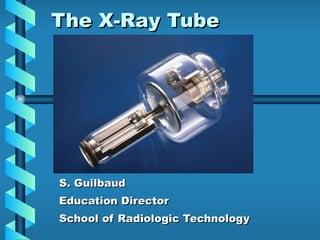
The X-Ray Tube S. Guilbaud Education Director School of Radiologic Technology
X-Ray Tube Electrical device used for the generation of x-rays. This is accomplished by the acceleration of electrons and then suddenly decelerating them. The energy of the x-rays is dependent on the kinetic energy of the electrons.
X-Ray tube components Glass envelope Cathode  Anode  Protective housing
Glass envelope Made of Pyrex glass Able to withstand tremendous heat Tube maintains a vacuum. Tube window A segment of glass that is thinner than the rest of the glass envelope. Contributes to inherent filtration. 0.5mm Al equivalency.
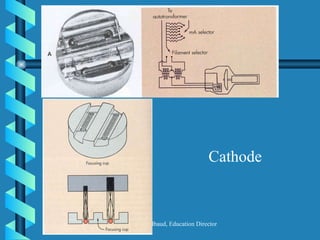
Cathode  Negatively charged electrode. Two primary parts: Filament  Focusing cup
Cathode
Focusing cup Metallic shroud containing the two filaments. Usually made from nickel. Contains a negative charge. Designed to repel electrons. Designed to condense electron beam to small area on on focal track.
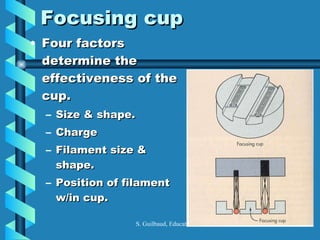
Focusing cup Four factors determine the effectiveness of the cup. Size & shape. Charge  Filament size & shape. Position of filament w/in cup.
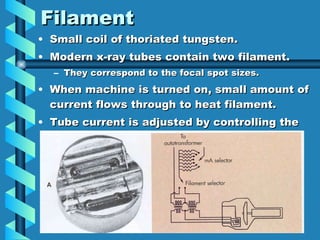
Filament  Small coil of thoriated tungsten. Modern x-ray tubes contain two filament. They correspond to the focal spot sizes. When machine is turned on, small amount of current flows through to heat filament. Tube current is adjusted by controlling the filament current.
Anode  Positively charged electrode. Two types. Stationary anode. Rotating anode.
Stationary Anode  Made of tungsten target embedded in a large copper bar. Usually used in dental x-ray machine.
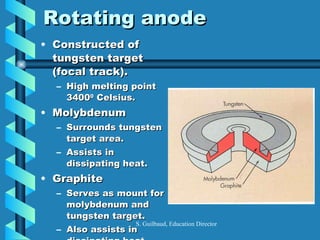
Rotating anode Constructed of tungsten target (focal track). High melting point 3400 0  Celsius. Molybdenum Surrounds tungsten target area. Assists in dissipating heat. Graphite  Serves as mount for molybdenum and tungsten target. Also assists in dissipating heat.
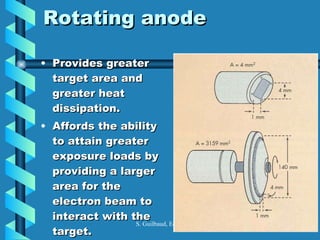
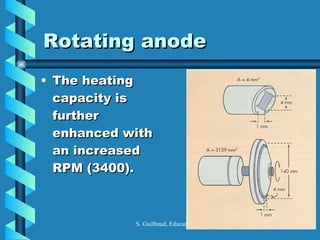
Rotating anode Provides greater target area and greater heat dissipation. Affords the ability to attain greater exposure loads by providing a larger area for the electron beam to interact with the target.
Rotating anode The heating capacity is further enhanced with an increased RPM (3400).
Induction motor Responsible for driving the rotating anode. Consists of two parts separated by the glass envelope.
Induction motor Works on the principle similar to the transformer. Electromagnetic induction. Current flowing in the stator develops a magnetic field. Stator windings are sequentially energized so that the induced magnetic field rotates on the axis of the stator. This causes the rotor to rotate.
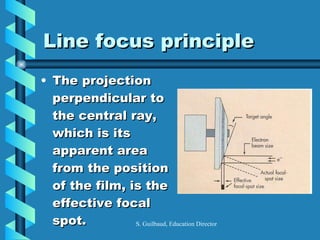
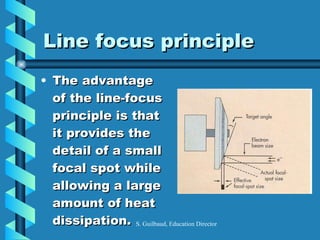
Line focus principle The area of the x-ray tube anode from which the x-ray photons are emitted. This is called the actual focal spot
Line focus principle The projection perpendicular to the central ray, which is its apparent area from the position of the film, is the effective focal spot.
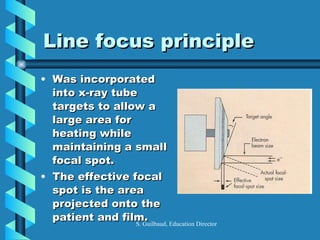
Line focus principle Was incorporated into x-ray tube targets to allow a large area for heating while maintaining a small focal spot. The effective focal spot is the area projected onto the patient and film.
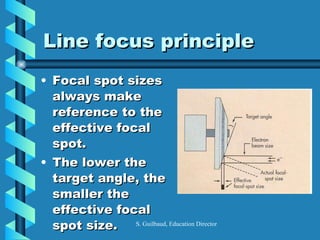
Line focus principle Focal spot sizes always make reference to the effective focal spot. The lower the target angle, the smaller the effective focal spot size.
Line focus principle The advantage of the line-focus principle is that it provides the detail of a small focal spot while allowing a large amount of heat dissipation.
Line focus principle The unfortunate bi-product of the line-focus principle is the “anode heel effect”
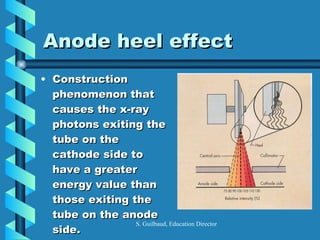
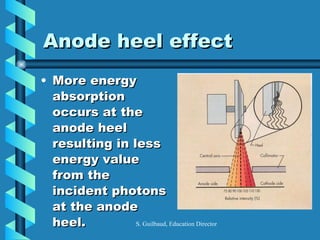
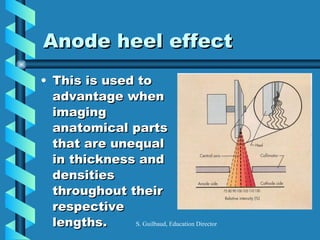
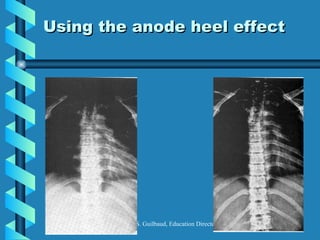
Anode heel effect Construction phenomenon that causes the x-ray photons exiting the tube on the cathode side to have a greater energy value than those exiting the tube on the anode side.
Anode heel effect More energy absorption occurs at the anode heel resulting in less energy value from the incident photons at the anode heel.
Anode heel effect This is used to advantage when imaging anatomical parts that are unequal in thickness and densities throughout their respective lengths.
Using the anode heel effect   The following anatomical parts may be imaged using the anode heel effect: Thoracic vertebrae Humerus  Femur  Tibia & fibula  Forearm
Using the anode heel effect
Anode heel effect The thicker portion of the anatomical part is placed beneath the cathode end of the x-ray tube.
Protective housing
Protective housing X-ray tube is always mounted inside a lead-lined protective housing that is designed to: Prevent excessive radiation exposure. Prevent electric shock to the patient and operator (technologist).
Protective housing Incorporates specially designed high-voltage receptacles. Provides mechanical support for the x-ray tube and protects it from damage. Some tube housings contain oil in which the tube is bathed. Some tube housings contain a cooling fan to air-cool the tube.
Protective housing When properly designed, they reduce the level of leakage radiation to  less than 100 mR/hr at 1 meter  when operated at maximum conditions.
Tube rating charts
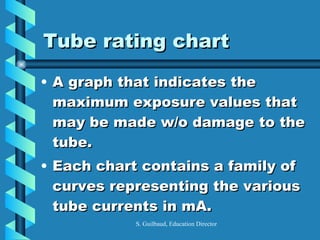
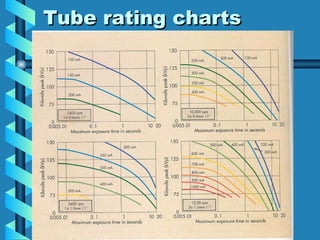
Tube rating chart A graph that indicates the maximum exposure values that may be made w/o damage to the tube. Each chart contains a family of curves representing the various tube currents in mA.
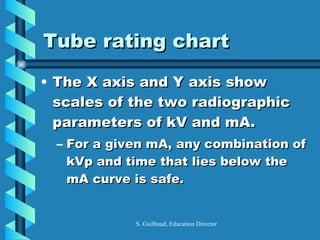
Tube rating chart The X axis and Y axis show scales of the two radiographic parameters of kV and mA. For a given mA, any combination of kVp and time that lies below the mA curve is safe.
Tube rating charts
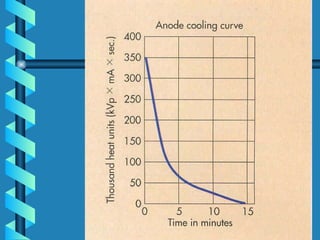
Anode cooling chart Provides the thermal capacity of the anode and its heat dissipation characteristics.
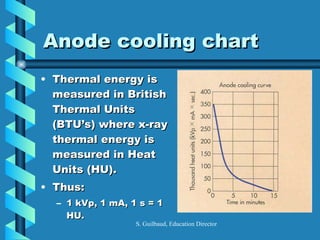
Anode cooling chart Thermal energy is measured in British Thermal Units (BTU’s) where x-ray thermal energy is measured in Heat Units (HU). Thus: 1 kVp, 1 mA, 1 s = 1 HU.
Calculating Heat Units For a single phase unit, HU = kVp x mA x s For a 3 phase 6 pulse unit, HU = 1.35 x kVp x mA x s  For a 3 phase 12 pulse unit, HU = 1.41 x kVp x mA x s  For a high frequency unit, HU = 1.44 x kVp x mA x s
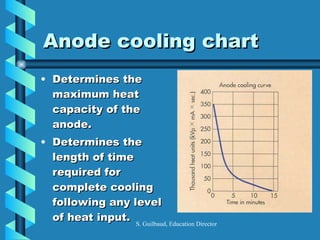
Anode cooling chart Determines the maximum heat capacity of the anode. Determines the length of time required for complete cooling following any level of heat input.
 
References Bushberg, et al.  The Essential Physics of Medical Imaging , Williams & Wilkins, 1994. Bushong, S.  Radiologic Science for Technologists, Physics, Biology, and Protection , 7 th  Edition, Mosby, 2000. Carlton et al.  Principles of Radiographic Imaging an Art and a Science , 3 rd  Edition, Delmar, 2001. Selman, J.  The Fundamentals of X-Ray and Radium Physics , 8 th  Edition, Charles Thomas, 1994.

X ray tube

  • 1.
    The X-Ray TubeS. Guilbaud Education Director School of Radiologic Technology
  • 2.
    X-Ray Tube Electricaldevice used for the generation of x-rays. This is accomplished by the acceleration of electrons and then suddenly decelerating them. The energy of the x-rays is dependent on the kinetic energy of the electrons.
  • 3.
    X-Ray tube componentsGlass envelope Cathode Anode Protective housing
  • 4.
    Glass envelope Madeof Pyrex glass Able to withstand tremendous heat Tube maintains a vacuum. Tube window A segment of glass that is thinner than the rest of the glass envelope. Contributes to inherent filtration. 0.5mm Al equivalency.
  • 5.
    Cathode Negativelycharged electrode. Two primary parts: Filament Focusing cup
  • 6.
  • 7.
    Focusing cup Metallicshroud containing the two filaments. Usually made from nickel. Contains a negative charge. Designed to repel electrons. Designed to condense electron beam to small area on on focal track.
  • 8.
    Focusing cup Fourfactors determine the effectiveness of the cup. Size & shape. Charge Filament size & shape. Position of filament w/in cup.
  • 9.
    Filament Smallcoil of thoriated tungsten. Modern x-ray tubes contain two filament. They correspond to the focal spot sizes. When machine is turned on, small amount of current flows through to heat filament. Tube current is adjusted by controlling the filament current.
  • 10.
    Anode Positivelycharged electrode. Two types. Stationary anode. Rotating anode.
  • 11.
    Stationary Anode Made of tungsten target embedded in a large copper bar. Usually used in dental x-ray machine.
  • 12.
    Rotating anode Constructedof tungsten target (focal track). High melting point 3400 0 Celsius. Molybdenum Surrounds tungsten target area. Assists in dissipating heat. Graphite Serves as mount for molybdenum and tungsten target. Also assists in dissipating heat.
  • 13.
    Rotating anode Providesgreater target area and greater heat dissipation. Affords the ability to attain greater exposure loads by providing a larger area for the electron beam to interact with the target.
  • 14.
    Rotating anode Theheating capacity is further enhanced with an increased RPM (3400).
  • 15.
    Induction motor Responsiblefor driving the rotating anode. Consists of two parts separated by the glass envelope.
  • 16.
    Induction motor Workson the principle similar to the transformer. Electromagnetic induction. Current flowing in the stator develops a magnetic field. Stator windings are sequentially energized so that the induced magnetic field rotates on the axis of the stator. This causes the rotor to rotate.
  • 17.
    Line focus principleThe area of the x-ray tube anode from which the x-ray photons are emitted. This is called the actual focal spot
  • 18.
    Line focus principleThe projection perpendicular to the central ray, which is its apparent area from the position of the film, is the effective focal spot.
  • 19.
    Line focus principleWas incorporated into x-ray tube targets to allow a large area for heating while maintaining a small focal spot. The effective focal spot is the area projected onto the patient and film.
  • 20.
    Line focus principleFocal spot sizes always make reference to the effective focal spot. The lower the target angle, the smaller the effective focal spot size.
  • 21.
    Line focus principleThe advantage of the line-focus principle is that it provides the detail of a small focal spot while allowing a large amount of heat dissipation.
  • 22.
    Line focus principleThe unfortunate bi-product of the line-focus principle is the “anode heel effect”
  • 23.
    Anode heel effectConstruction phenomenon that causes the x-ray photons exiting the tube on the cathode side to have a greater energy value than those exiting the tube on the anode side.
  • 24.
    Anode heel effectMore energy absorption occurs at the anode heel resulting in less energy value from the incident photons at the anode heel.
  • 25.
    Anode heel effectThis is used to advantage when imaging anatomical parts that are unequal in thickness and densities throughout their respective lengths.
  • 26.
    Using the anodeheel effect The following anatomical parts may be imaged using the anode heel effect: Thoracic vertebrae Humerus Femur Tibia & fibula Forearm
  • 27.
    Using the anodeheel effect
  • 28.
    Anode heel effectThe thicker portion of the anatomical part is placed beneath the cathode end of the x-ray tube.
  • 29.
  • 30.
    Protective housing X-raytube is always mounted inside a lead-lined protective housing that is designed to: Prevent excessive radiation exposure. Prevent electric shock to the patient and operator (technologist).
  • 31.
    Protective housing Incorporatesspecially designed high-voltage receptacles. Provides mechanical support for the x-ray tube and protects it from damage. Some tube housings contain oil in which the tube is bathed. Some tube housings contain a cooling fan to air-cool the tube.
  • 32.
    Protective housing Whenproperly designed, they reduce the level of leakage radiation to less than 100 mR/hr at 1 meter when operated at maximum conditions.
  • 33.
  • 34.
    Tube rating chartA graph that indicates the maximum exposure values that may be made w/o damage to the tube. Each chart contains a family of curves representing the various tube currents in mA.
  • 35.
    Tube rating chartThe X axis and Y axis show scales of the two radiographic parameters of kV and mA. For a given mA, any combination of kVp and time that lies below the mA curve is safe.
  • 36.
  • 37.
    Anode cooling chartProvides the thermal capacity of the anode and its heat dissipation characteristics.
  • 38.
    Anode cooling chartThermal energy is measured in British Thermal Units (BTU’s) where x-ray thermal energy is measured in Heat Units (HU). Thus: 1 kVp, 1 mA, 1 s = 1 HU.
  • 39.
    Calculating Heat UnitsFor a single phase unit, HU = kVp x mA x s For a 3 phase 6 pulse unit, HU = 1.35 x kVp x mA x s For a 3 phase 12 pulse unit, HU = 1.41 x kVp x mA x s For a high frequency unit, HU = 1.44 x kVp x mA x s
  • 40.
    Anode cooling chartDetermines the maximum heat capacity of the anode. Determines the length of time required for complete cooling following any level of heat input.
  • 41.
  • 42.
    References Bushberg, etal. The Essential Physics of Medical Imaging , Williams & Wilkins, 1994. Bushong, S. Radiologic Science for Technologists, Physics, Biology, and Protection , 7 th Edition, Mosby, 2000. Carlton et al. Principles of Radiographic Imaging an Art and a Science , 3 rd Edition, Delmar, 2001. Selman, J. The Fundamentals of X-Ray and Radium Physics , 8 th Edition, Charles Thomas, 1994.