ANTIGEN AND ANTIBODY
MAN BAHADUR RANA
BPH
ACAS,NEPAL
Types of Antigen – Antibody Reaction:
• Precipitation Reaction.
• Agglutination Reaction.
• Complement Fixation.
•Neutralisation Reaction
• ELISA – Enzyme Linked ImmunoSorbent Assay.
• Immunofluorescence.
•Radioimmunoassay
The types of antigen – antibody reactions are:
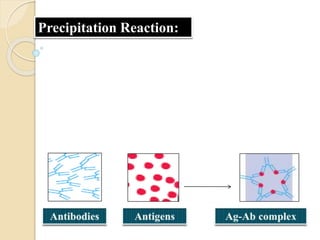
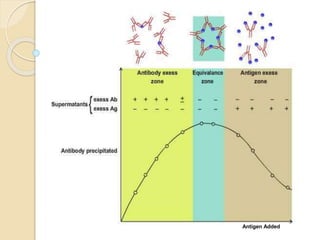
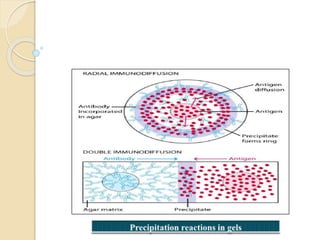
Precipitation Reaction:
Antigen Added
Agglutination Reaction:
• When a particular Ag is mixed with its Ab’s in the
presence of electrolytes at a suitable temperature and
pH, the particles are clumped or agglutinated.
• The Ab of the serum causes the cellular Ag’s to form
clumps and these are called Agglutinins.
• The particulate antigens that are aggregated are
termed Agglutinogens.
 Slide agglutination: This is a rapid method to
determine the presence of agglutinating antibodies.
This test is used for blood grouping
(Haemagglutination) and cross matching.
Tube agglutination:
Tube agglutination is employed for the serological
diagnosis of typhoid, brucellosis and typhus fever.
Widal test is used for the estimation of typhoid fever.
•antitoxin + toxin  neutralization
•toxigenecity test
•Shick test
•Nagler reaction
Neutralisation Reaction
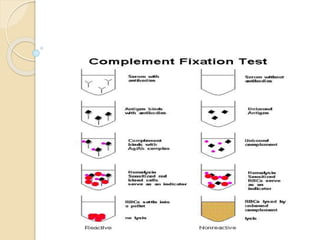
Complement Fixation:
•This complement system 11 proteins
•Fc component of Ag-Ab complex.
•E.g wasserman reaction
•Immobilisation test for T. pallidium
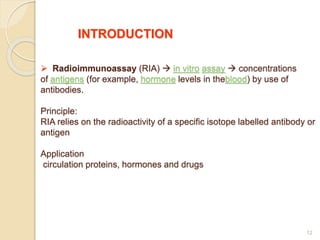
 Radioimmunoassay (RIA)  in vitro assay  concentrations
of antigens (for example, hormone levels in theblood) by use of
antibodies.
Principle:
RIA relies on the radioactivity of a specific isotope labelled antibody or
antigen
Application
circulation proteins, hormones and drugs
INTRODUCTION
12
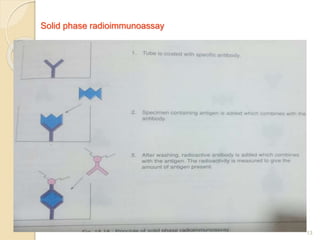
Solid phase radioimmunoassay
13
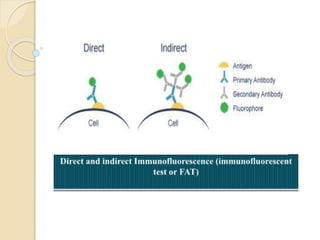
Immunofluorescence utilizes fluorescent-
labeled antibodies to detect specific target
antigens. It is used widely in both scientific
research and clinical laboratories.
Coons et al (1942) labeled dyes can be conjugated
to Ab’s and these labeled antibodies can be used to
detect Ag’s.
•Fluorescein, Phycoerythrin.
Immunofluorescence:
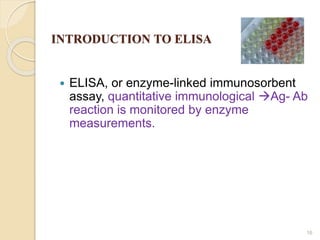
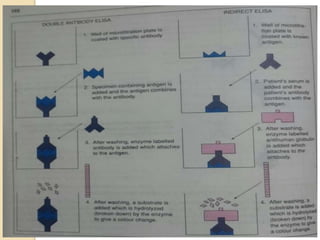
INTRODUCTION TO ELISA
 ELISA, or enzyme-linked immunosorbent
assay, quantitative immunological Ag- Ab
reaction is monitored by enzyme
measurements.
16
Antigen  antibody for bph class

Antigen antibody for bph class

  • 1.
    ANTIGEN AND ANTIBODY MANBAHADUR RANA BPH ACAS,NEPAL
  • 3.
    Types of Antigen– Antibody Reaction: • Precipitation Reaction. • Agglutination Reaction. • Complement Fixation. •Neutralisation Reaction • ELISA – Enzyme Linked ImmunoSorbent Assay. • Immunofluorescence. •Radioimmunoassay The types of antigen – antibody reactions are:
  • 4.
  • 5.
  • 7.
    Agglutination Reaction: • Whena particular Ag is mixed with its Ab’s in the presence of electrolytes at a suitable temperature and pH, the particles are clumped or agglutinated. • The Ab of the serum causes the cellular Ag’s to form clumps and these are called Agglutinins. • The particulate antigens that are aggregated are termed Agglutinogens.  Slide agglutination: This is a rapid method to determine the presence of agglutinating antibodies. This test is used for blood grouping (Haemagglutination) and cross matching.
  • 8.
    Tube agglutination: Tube agglutinationis employed for the serological diagnosis of typhoid, brucellosis and typhus fever. Widal test is used for the estimation of typhoid fever.
  • 9.
    •antitoxin + toxin neutralization •toxigenecity test •Shick test •Nagler reaction Neutralisation Reaction
  • 10.
    Complement Fixation: •This complementsystem 11 proteins •Fc component of Ag-Ab complex. •E.g wasserman reaction •Immobilisation test for T. pallidium
  • 12.
     Radioimmunoassay (RIA) in vitro assay  concentrations of antigens (for example, hormone levels in theblood) by use of antibodies. Principle: RIA relies on the radioactivity of a specific isotope labelled antibody or antigen Application circulation proteins, hormones and drugs INTRODUCTION 12
  • 13.
  • 14.
    Immunofluorescence utilizes fluorescent- labeledantibodies to detect specific target antigens. It is used widely in both scientific research and clinical laboratories. Coons et al (1942) labeled dyes can be conjugated to Ab’s and these labeled antibodies can be used to detect Ag’s. •Fluorescein, Phycoerythrin. Immunofluorescence:
  • 16.
    INTRODUCTION TO ELISA ELISA, or enzyme-linked immunosorbent assay, quantitative immunological Ag- Ab reaction is monitored by enzyme measurements. 16