Power System Evolution
From the Bottom Up
Lorenzo Kristov, PhD
Electric System Policy, Structure, Market Design
October 25, 2018
Preface
“The best way to get nothing done is to convince people
they’re on one side or the other of a duality.”
(attrib. to J. M. Greer)
• Decentralization and the Bulk Power System are
complementary, not alternatives or adversaries
• This talk emphasizes Decentralization because it is too
often under-valued, dismissed or poorly explained
The bulk power system is NOT going away
— but it will no longer be where all the action is.
10/25/18
Eletric System Policy, Structure, Market
Design LKristov@cal.net
Page 2
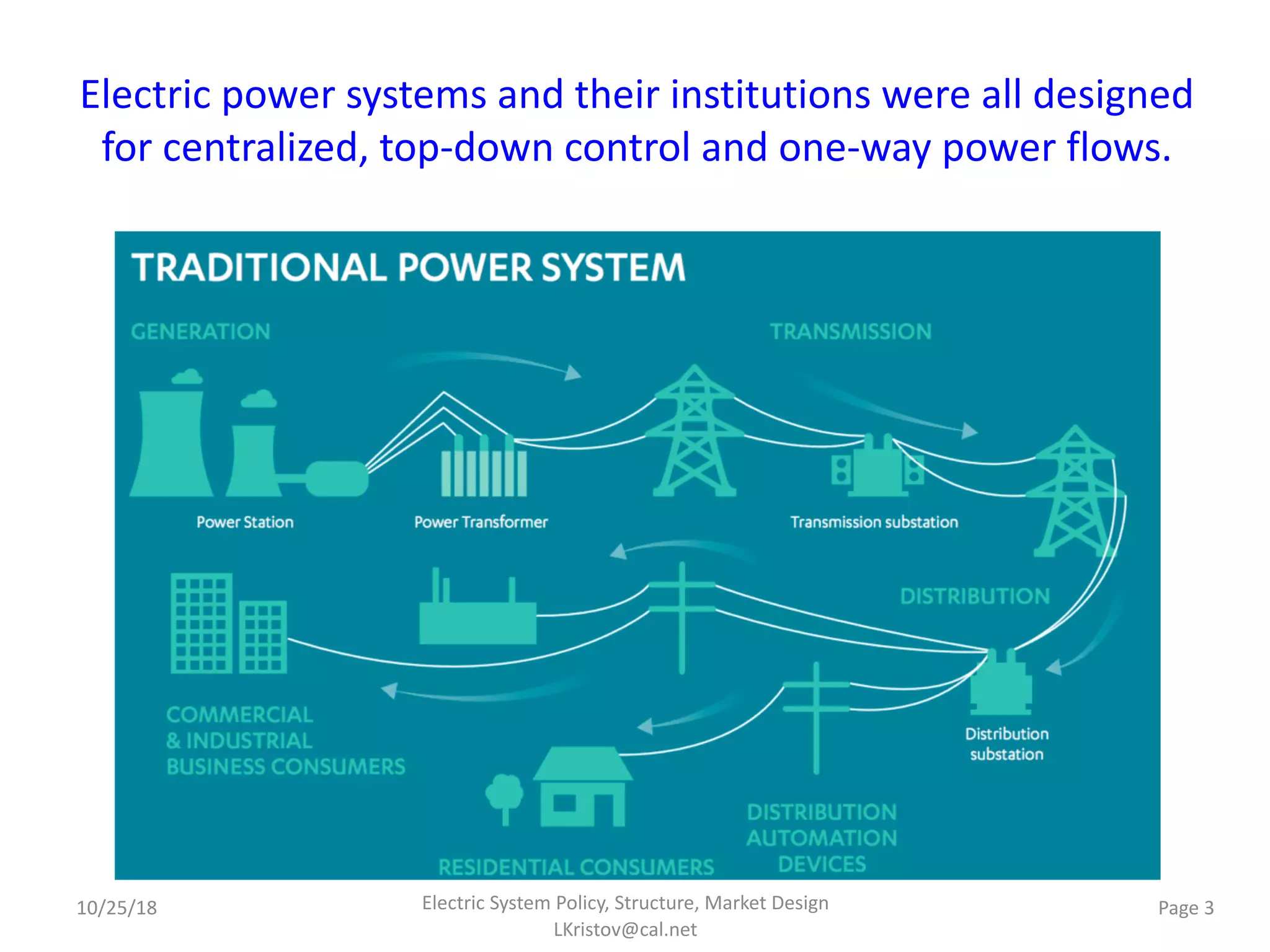
Electric power systems and their institutions were all designed
for centralized, top-down control and one-way power flows.
Electric System Policy, Structure, Market Design
LKristov@cal.net
Page 310/25/18
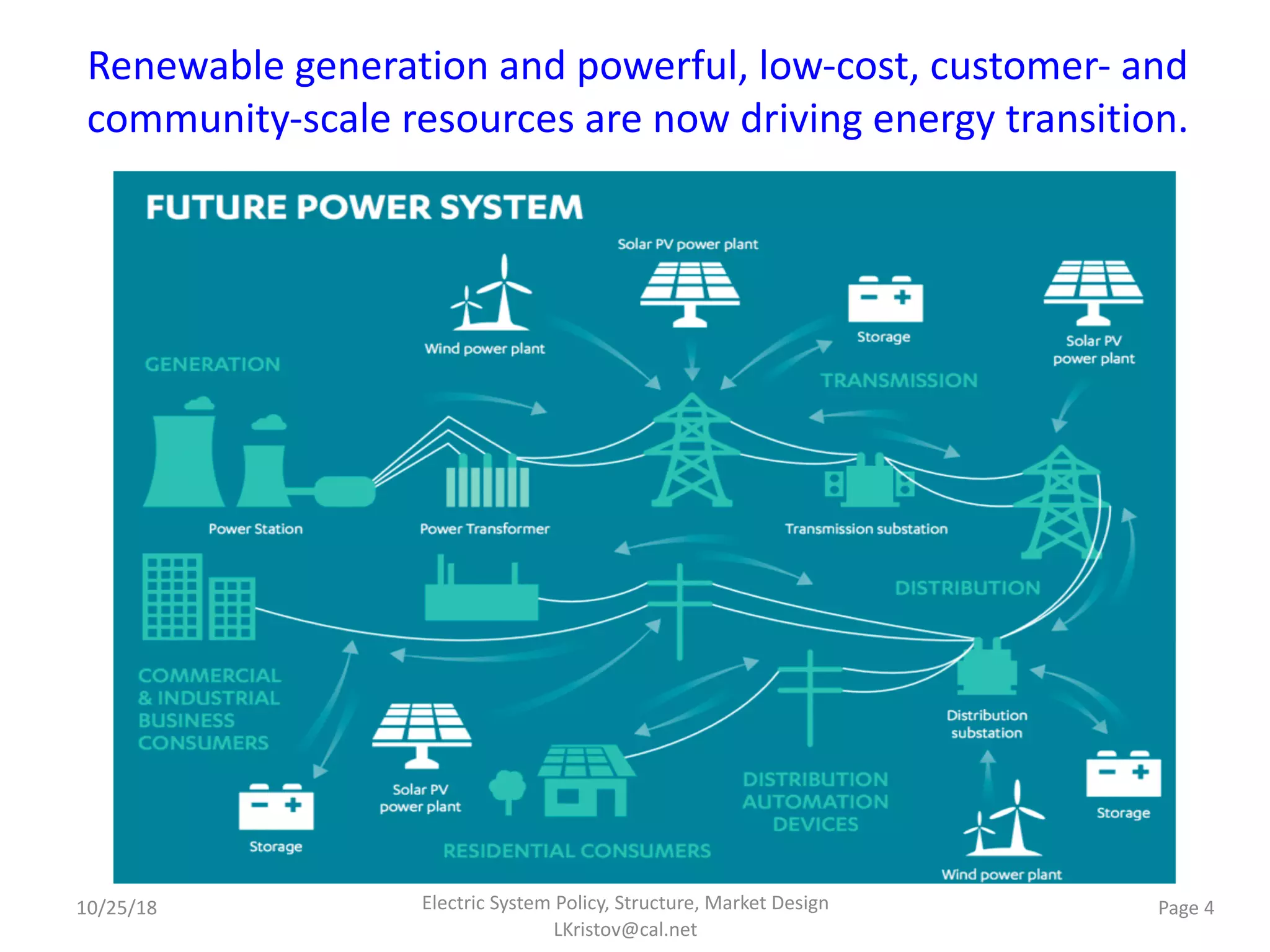
Renewable generation and powerful, low-cost, customer- and
community-scale resources are now driving energy transition.
Electric System Policy, Structure, Market Design
LKristov@cal.net
Page 410/25/18
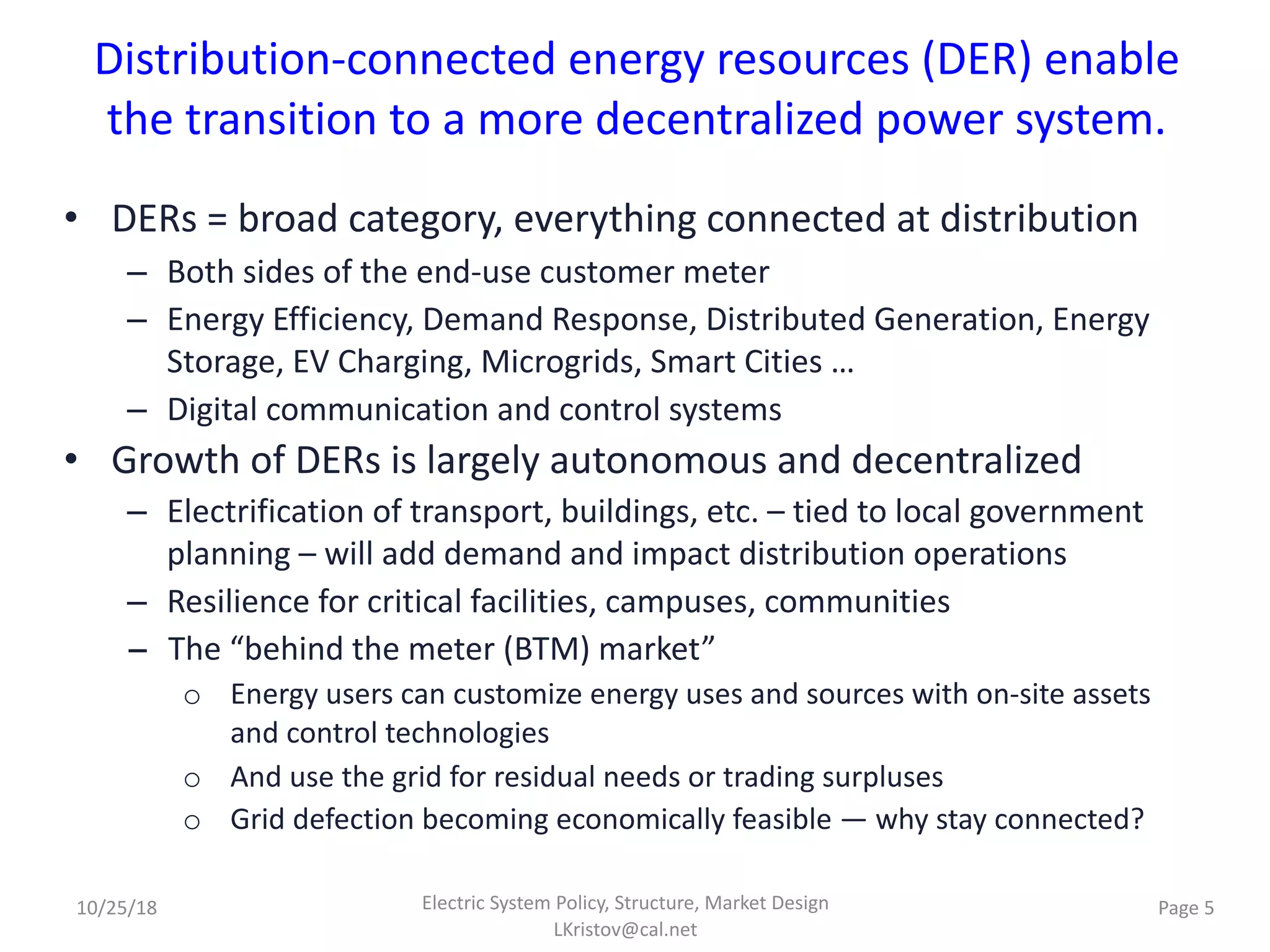
Distribution-connected energy resources (DER) enable
the transition to a more decentralized power system.
• DERs = broad category, everything connected at distribution
– Both sides of the end-use customer meter
– Energy Efficiency, Demand Response, Distributed Generation, Energy
Storage, EV Charging, Microgrids, Smart Cities …
– Digital communication and control systems
• Growth of DERs is largely autonomous and decentralized
– Electrification of transport, buildings, etc. – tied to local government
planning – will add demand and impact distribution operations
– Resilience for critical facilities, campuses, communities
− The “behind the meter (BTM) market”
o Energy users can customize energy uses and sources with on-site assets
and control technologies
o And use the grid for residual needs or trading surpluses
o Grid defection becoming economically feasible — why stay connected?
Electric System Policy, Structure, Market Design
LKristov@cal.net
Page 510/25/18
Choosing a preferred path for system evolution
starts with stating clear objectives.
1. Specify high-level policy objectives
• Safety, Robustness (Reliability & Resilience), Security, Affordability, Minimum
environmental footprint, Flexibility (extensibility & optionality), Financeability
(utility & non-utility assets)
[From DOE/PNNL 2015 “Grid Architecture” report]
2. Identify system qualities needed to achieve objectives
• Should be discrete, specific, quantifiable, translatable into specific functional
capabilities the system must have
Source: Paul De Martini 2014, “More Than Smart”
Electric System Policy, Structure, Market Design
LKristov@cal.net
Page 610/25/18
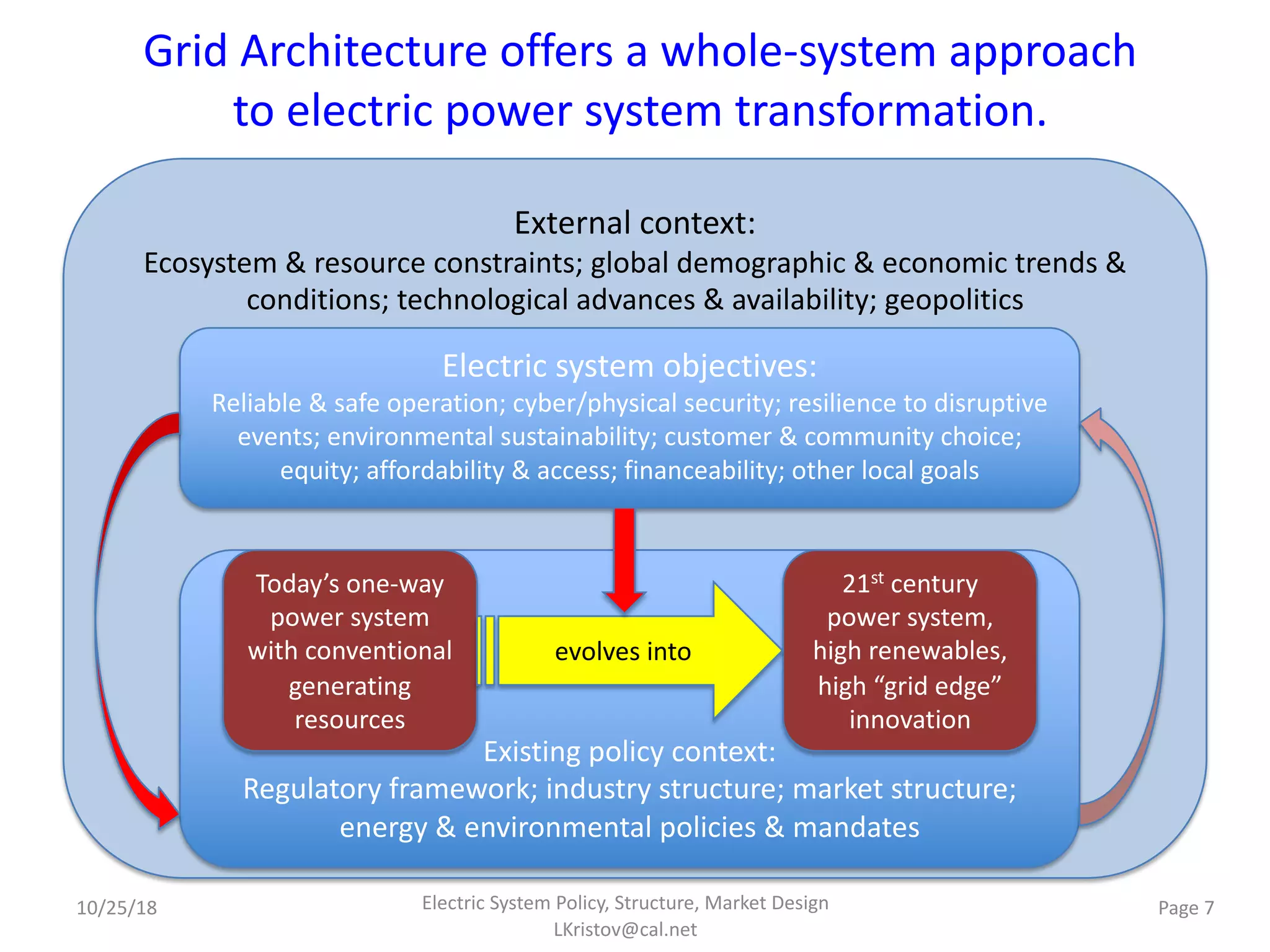
External context:
Ecosystem & resource constraints; global demographic & economic trends &
conditions; technological advances & availability; geopolitics
Existing policy context:
Regulatory framework; industry structure; market structure;
energy & environmental policies & mandates
Grid Architecture offers a whole-system approach
to electric power system transformation.
Electric system objectives:
Reliable & safe operation; cyber/physical security; resilience to disruptive
events; environmental sustainability; customer & community choice;
equity; affordability & access; financeability; other local goals
Today’s one-way
power system
with conventional
generating
resources
21st century
power system,
high renewables,
high “grid edge”
innovation
evolves into
Electric System Policy, Structure, Market Design
LKristov@cal.net
Page 710/25/18
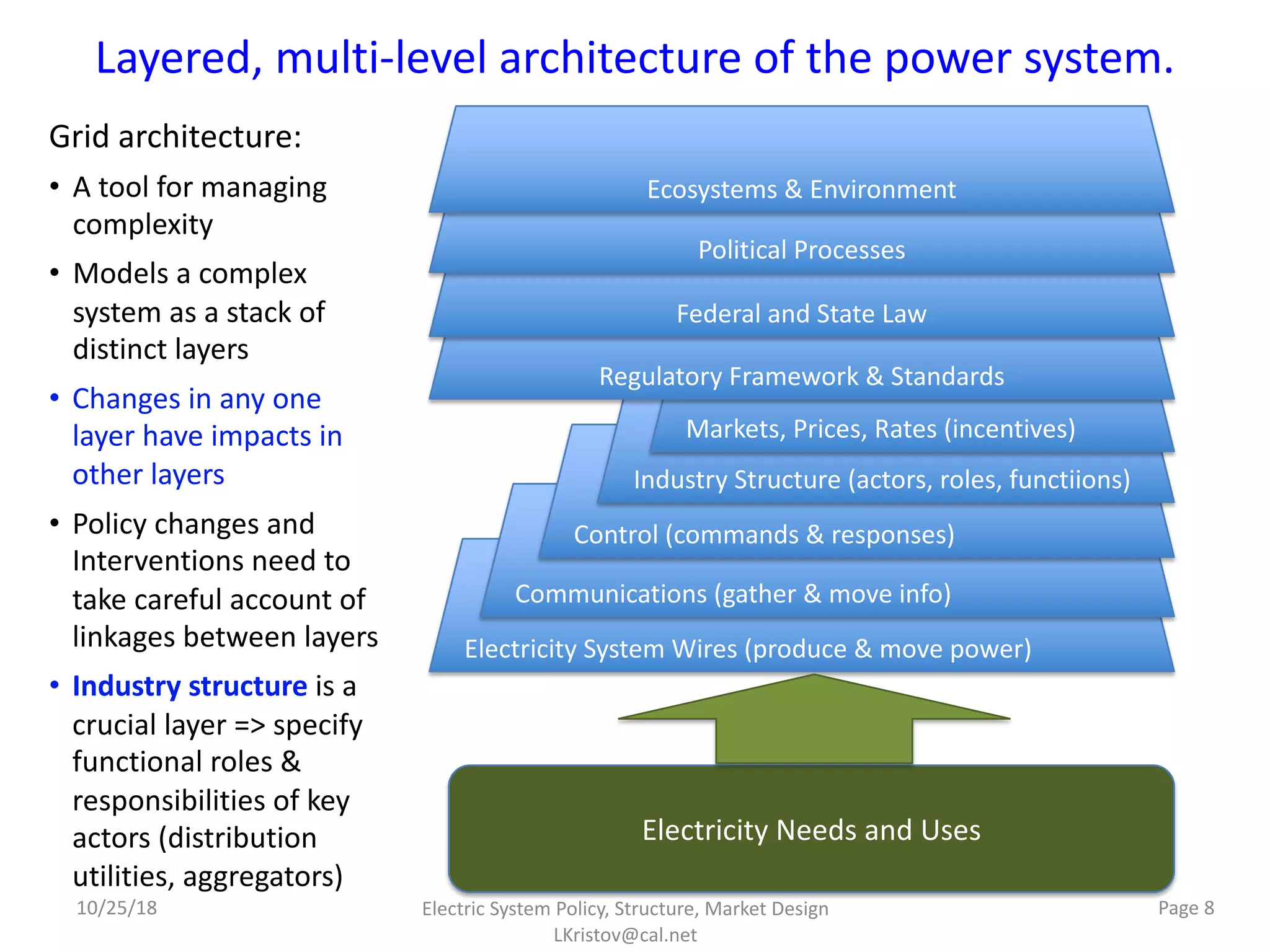
Layered, multi-level architecture of the power system.
Electricity Needs and Uses
Electricity System Wires (produce & move power)
Communications (gather & move info)
Control (commands & responses)
Industry Structure (actors, roles, functiions)
Markets, Prices, Rates (incentives)
Regulatory Framework & Standards
Federal and State Law
Political Processes
Grid architecture:
• A tool for managing
complexity
• Models a complex
system as a stack of
distinct layers
• Changes in any one
layer have impacts in
other layers
• Policy changes and
Interventions need to
take careful account of
linkages between layers
• Industry structure is a
crucial layer => specify
functional roles &
responsibilities of key
actors (distribution
utilities, aggregators)
Ecosystems & Environment
Page 8Electric System Policy, Structure, Market Design
LKristov@cal.net
10/25/18
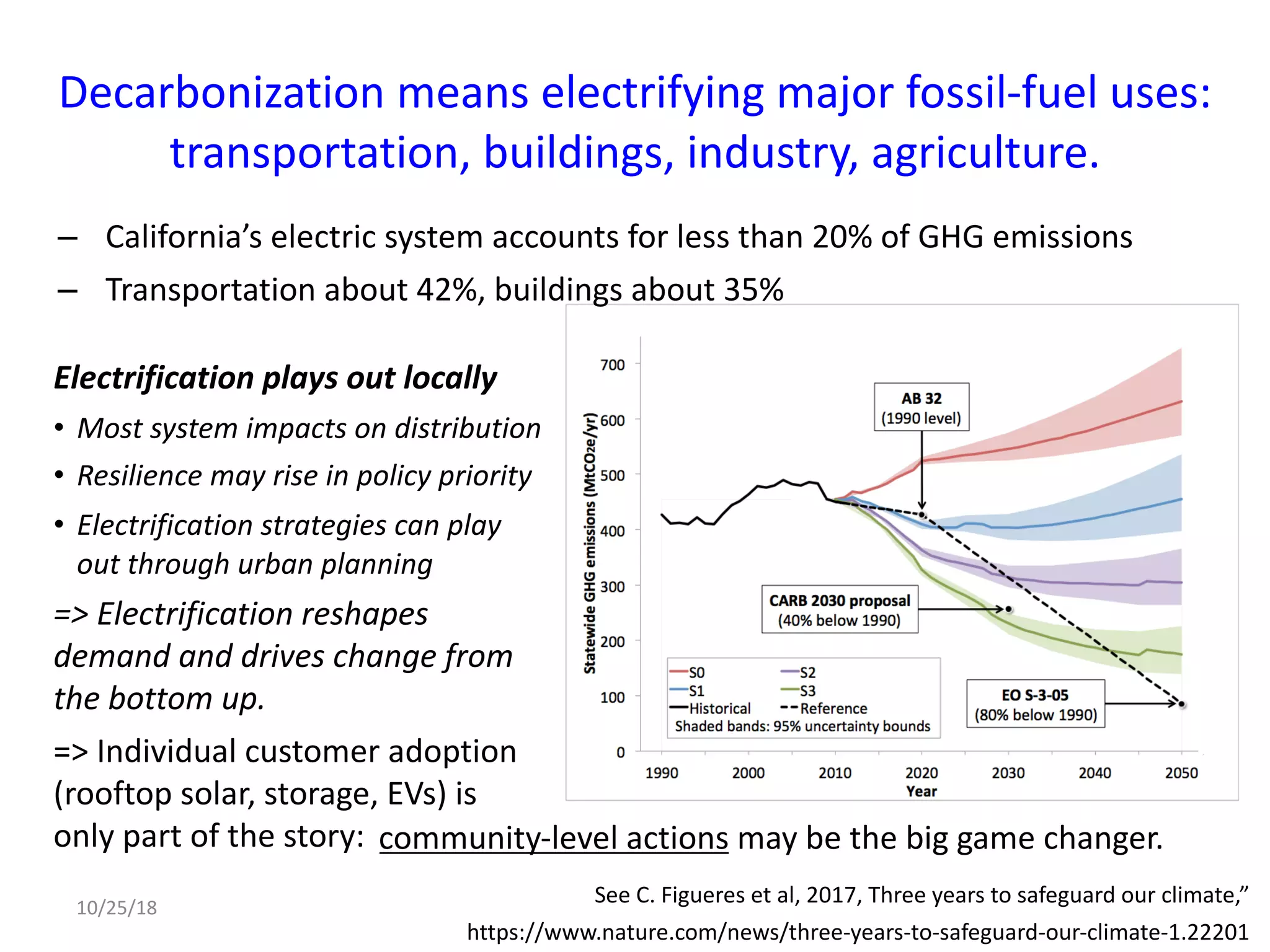
Decarbonization means electrifying major fossil-fuel uses:
transportation, buildings, industry, agriculture.
Electrification plays out locally
• Most system impacts on distribution
• Resilience may rise in policy priority
• Electrification strategies can play
out through urban planning
=> Electrification reshapes
demand and drives change from
the bottom up.
=> Individual customer adoption
(rooftop solar, storage, EVs) is
only part of the story: community-level actions may be the big game changer.
See C. Figueres et al, 2017, Three years to safeguard our climate,”
https://www.nature.com/news/three-years-to-safeguard-our-climate-1.22201
– California’s electric system accounts for less than 20% of GHG emissions
– Transportation about 42%, buildings about 35%
10/25/18
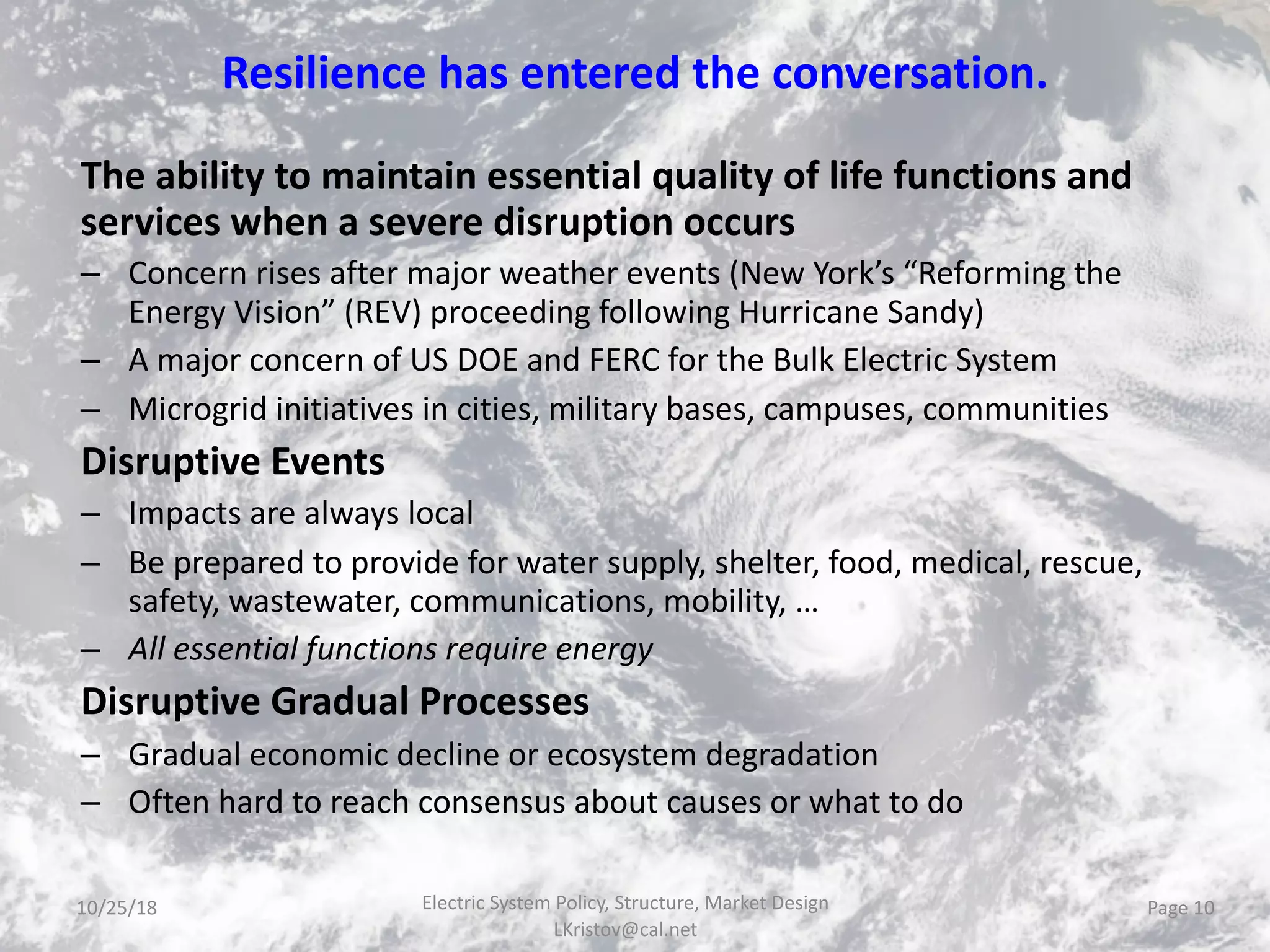
Resilience has entered the conversation.
The ability to maintain essential quality of life functions and
services when a severe disruption occurs
– Concern rises after major weather events (New York’s “Reforming the
Energy Vision” (REV) proceeding following Hurricane Sandy)
– A major concern of US DOE and FERC for the Bulk Electric System
– Microgrid initiatives in cities, military bases, campuses, communities
Disruptive Events
– Impacts are always local
– Be prepared to provide for water supply, shelter, food, medical, rescue,
safety, wastewater, communications, mobility, …
– All essential functions require energy
Disruptive Gradual Processes
– Gradual economic decline or ecosystem degradation
– Often hard to reach consensus about causes or what to do
Electric System Policy, Structure, Market Design
LKristov@cal.net
Page 1010/25/18
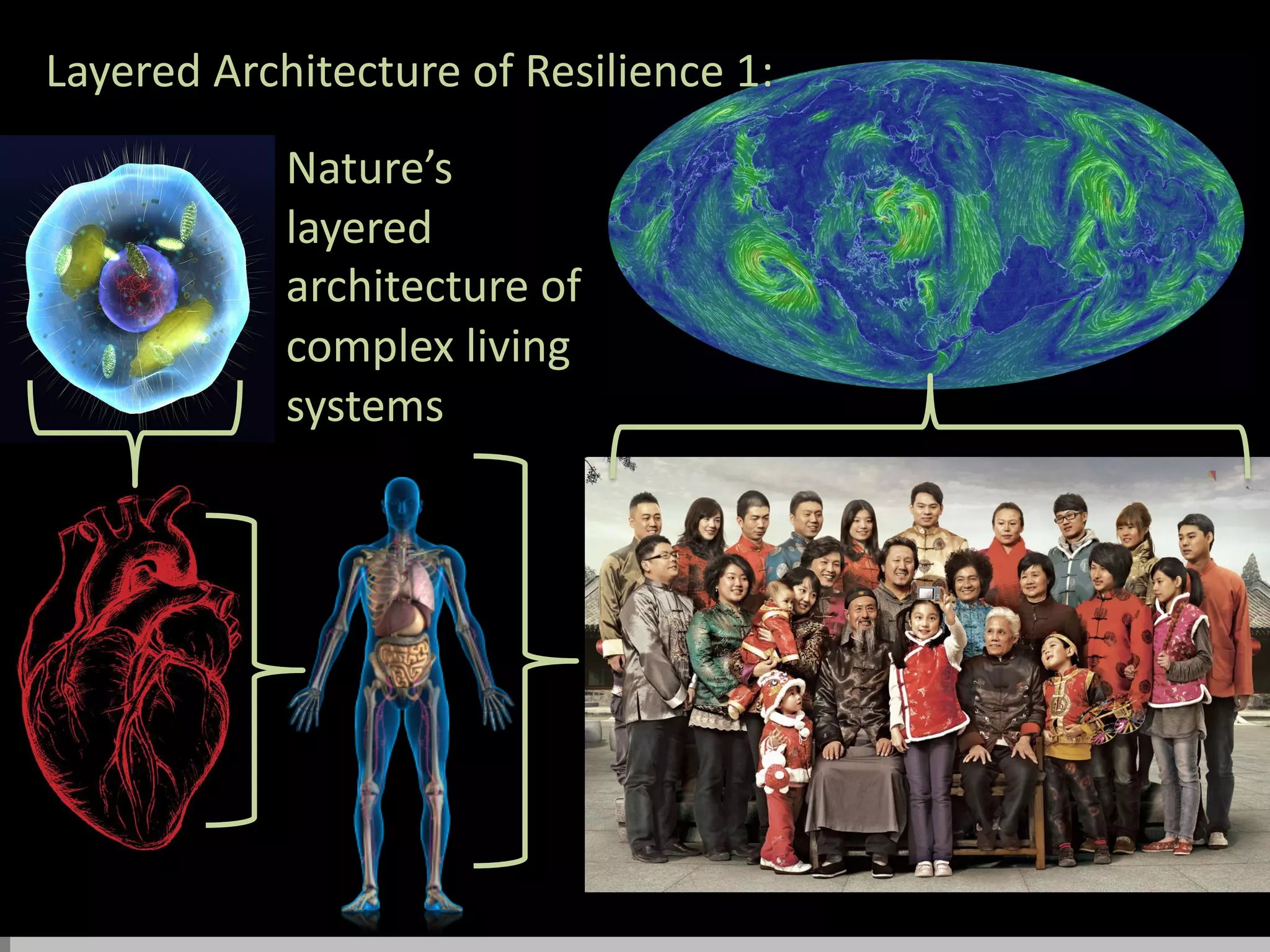
Layered Architecture of Resilience 1:
Nature’s
layered
architecture of
complex living
systems
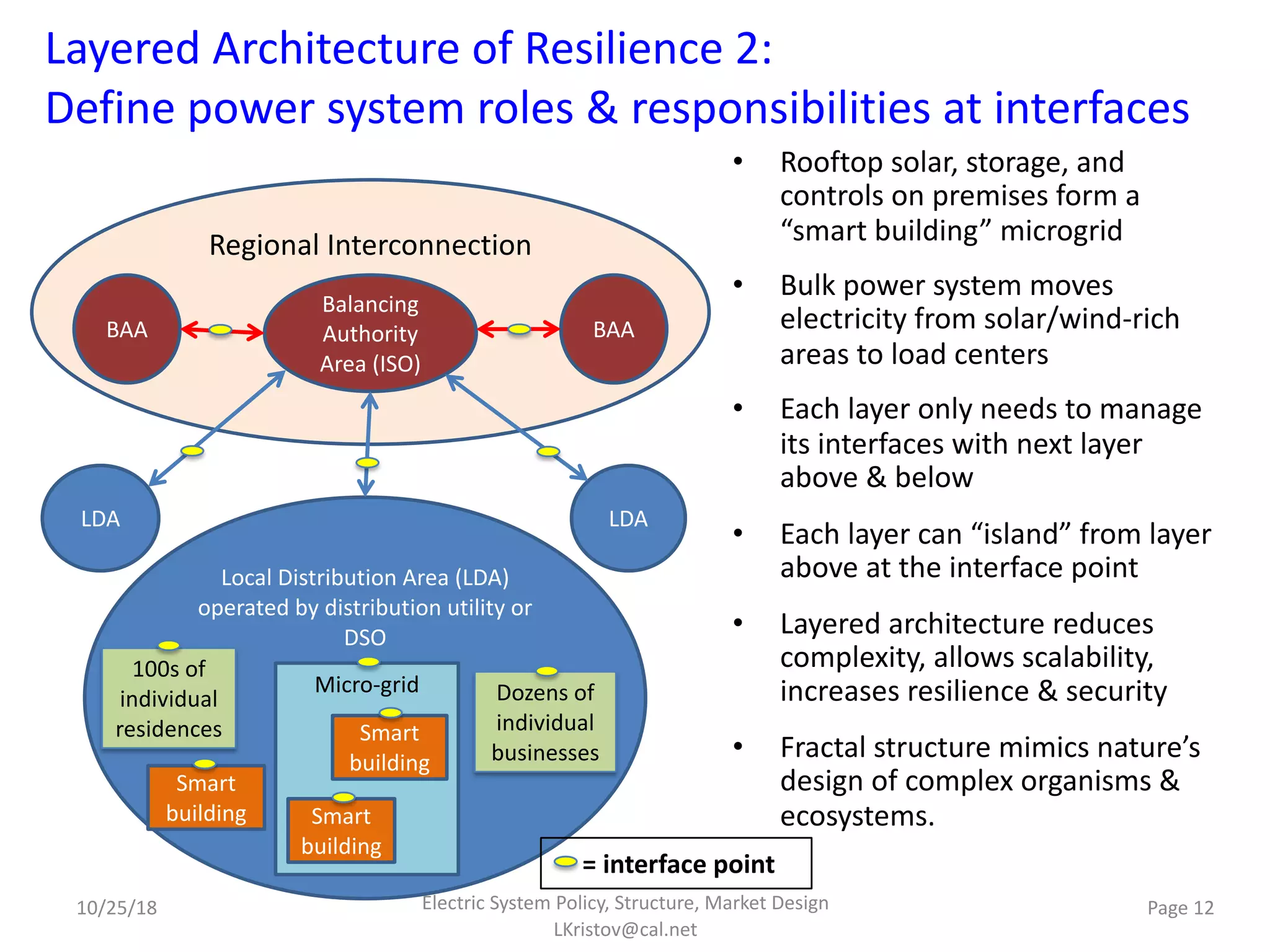
Local Distribution Area (LDA)
operated by distribution utility or
DSO
Regional Interconnection
Layered Architecture of Resilience 2:
Define power system roles & responsibilities at interfaces
Smart
building
Micro-grid
LDA LDA
Balancing
Authority
Area (ISO)
BAABAA
Smart
building
Smart
building
• Rooftop solar, storage, and
controls on premises form a
“smart building” microgrid
• Bulk power system moves
electricity from solar/wind-rich
areas to load centers
• Each layer only needs to manage
its interfaces with next layer
above & below
• Each layer can “island” from layer
above at the interface point
• Layered architecture reduces
complexity, allows scalability,
increases resilience & security
• Fractal structure mimics nature’s
design of complex organisms &
ecosystems.
= interface point
Dozens of
individual
businesses
100s of
individual
residences
Page 12Electric System Policy, Structure, Market Design
LKristov@cal.net
10/25/18
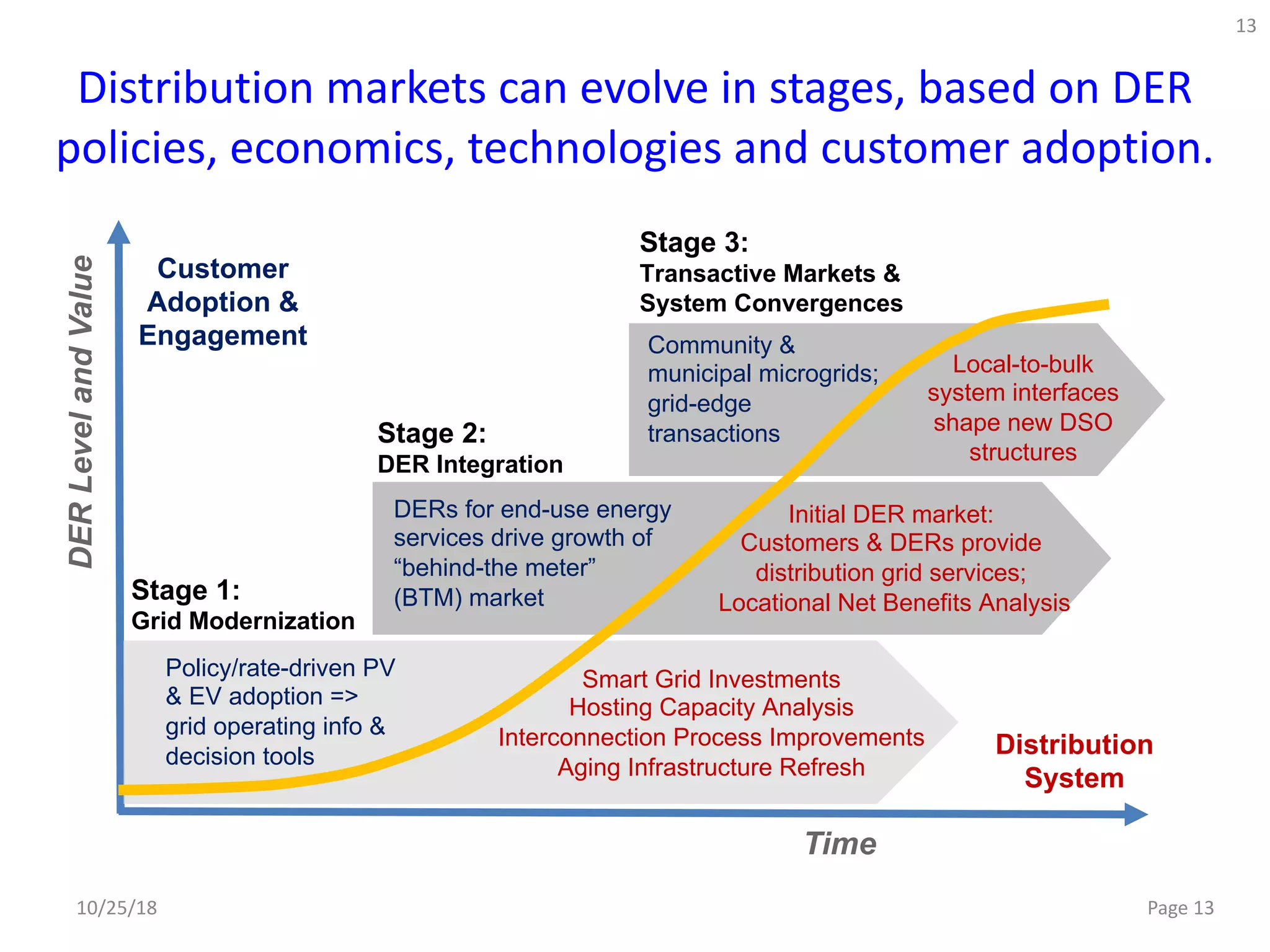
Stage 3:
Transactive Markets &
System Convergences
Community &
municipal microgrids;
grid-edge
transactions
Local-to-bulk
system interfaces
shape new DSO
structures
Initial DER market:
Customers & DERs provide
distribution grid services;
Locational Net Benefits Analysis
DERs for end-use energy
services drive growth of
“behind-the meter”
(BTM) market
Stage 2:
DER Integration
Smart Grid Investments
Hosting Capacity Analysis
Interconnection Process Improvements
Aging Infrastructure Refresh
Policy/rate-driven PV
& EV adoption =>
grid operating info &
decision tools
Stage 1:
Grid Modernization
DERLevelandValue
Time
Distribution
System
Customer
Adoption &
Engagement
Distribution markets can evolve in stages, based on DER
policies, economics, technologies and customer adoption.
13
10/25/18 Page 13
Current thinking about DER value
does not yet quantify important benefits.
1. Value of shaping and integrating new electrification demand
– Manage variability close to the source to reduce operational issues and need to
build peak D & T infrastructure
– Manage circuit-level “ducklings” and short-term volatility locally to reduce need to
run gas generators
– Requires imaginative new retail rate designs and pricing of D & T services
2. Value of resilience to severe disruptions
– Community, campus, building-level microgrids can operate in island mode
– Islanding can support bulk system reliability by removing load
3. Value to end-use customers and demand response
– The “behind the meter” market for energy services
Because DER values 1-2 are not well quantified,
we lack mechanisms for getting the full value of DERs
Electric System Policy, Structure, Market Design
LKristov@cal.net
Page 1410/25/18
Needed: a 21st century policy framework
for the electric power system
• Consider the future distribution utility as a “DSO”
– Specify DSO roles and responsibilities to deliver desired qualities and
support policy goals
– Collaborate among states and utilities to assess alternative DSO
models (see UK Open Networks Project)
• Different DSO models may arise in different places or stages, but all need
to address certain key issues:
– ‘Open access’ to enable technically qualified DERs regardless of
ownership to provide grid services
– If DSO is not independent of owner of physical D assets, then:
• Distribution planning, have independent assessment of need not
accountable to shareholders (if DSO compensation is on assets);
• Non-discriminatory energy scheduling and real-time operations.
– Incentive structure for DSO to partner with local governments on
electrification and resilience projects
Electric System Policy, Structure, Market Design
LKristov@cal.net
Page 1510/25/18
The needed policy framework – 2
• Structures for DERs to provide grid services
– Service definitions, performance specs, eligibility, measurement, compensation
– Markets and open procurement mechanisms
– Could states regulate distribution-level grid services markets?
• Update “distribution provider” NERC definition and define T-D coordination
practices to align DSO role with bulk system needs
• Base financial incentives to DSO on performance, not just value of assets
– Need to define DSO performance metrics
– Tie grid modernization investments to performance
• Rethink reliability and adequacy for high-DER, high-renewables system
– Traditional system adequacy measure – stacking capacity MW to meet peak
system load + reserve margin – needs updating
– Who is responsible for supply if BTM DERs fail?
– Enable customized reliability levels based on customer choice
– A microgrid that can island offers a “load drop” service to DSO => Could a
microgrid opt out of resource adequacy requirements?
Electric System Policy, Structure, Market Design
LKristov@cal.net
Page 1610/25/18
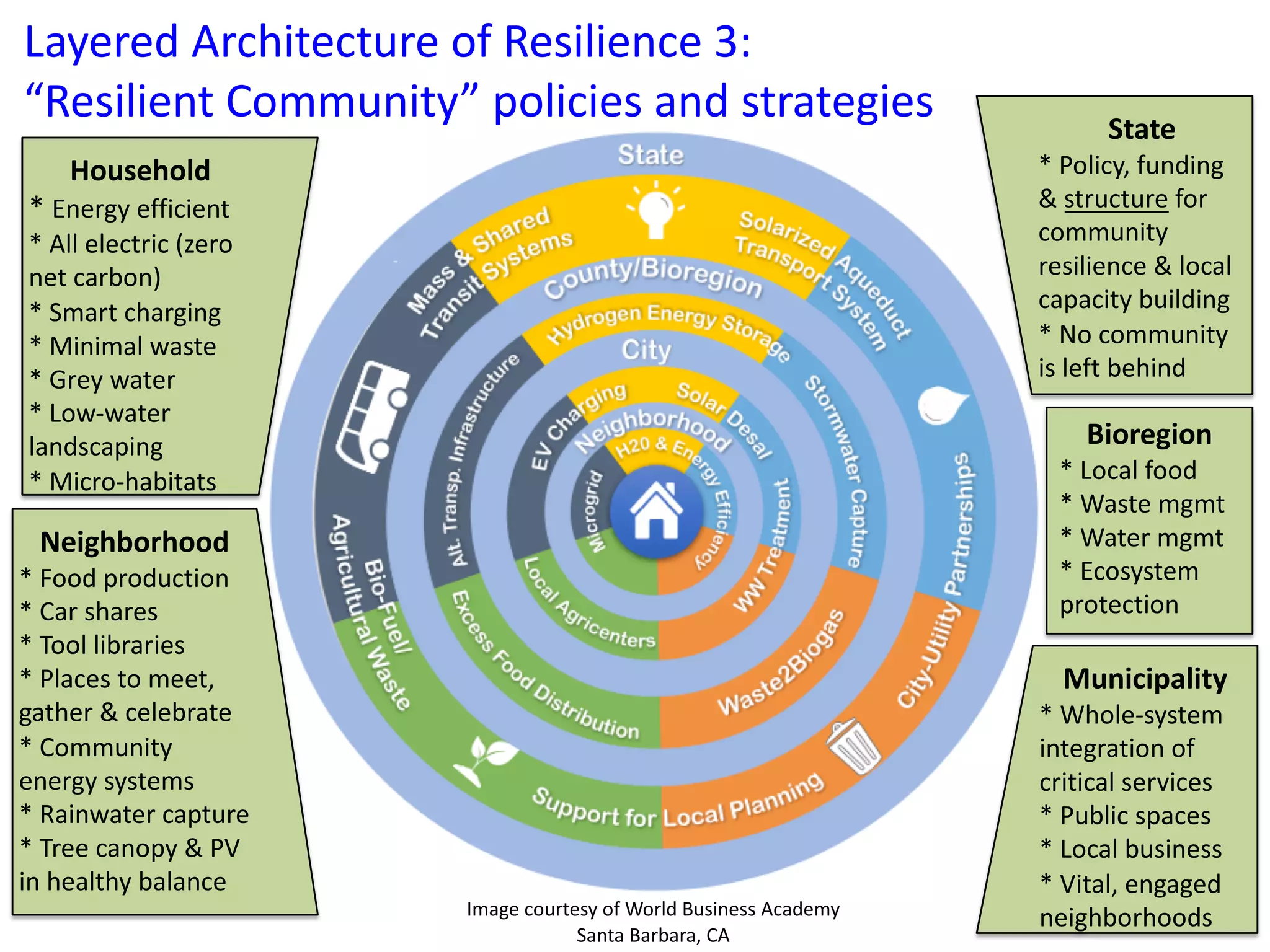
Layered Architecture of Resilience 3:
“Resilient Community” policies and strategies
Image courtesy of World Business Academy
Santa Barbara, CA
Neighborhood
* Food production
* Car shares
* Tool libraries
* Places to meet,
gather & celebrate
* Community
energy systems
* Rainwater capture
* Tree canopy & PV
in healthy balance
Household
* Energy efficient
* All electric (zero
net carbon)
* Smart charging
* Minimal waste
* Grey water
* Low-water
landscaping
* Micro-habitats
Municipality
* Whole-system
integration of
critical services
* Public spaces
* Local business
* Vital, engaged
neighborhoods
State
* Policy, funding
& structure for
community
resilience & local
capacity building
* No community
is left behind
Bioregion
* Local food
* Waste mgmt
* Water mgmt
* Ecosystem
protection
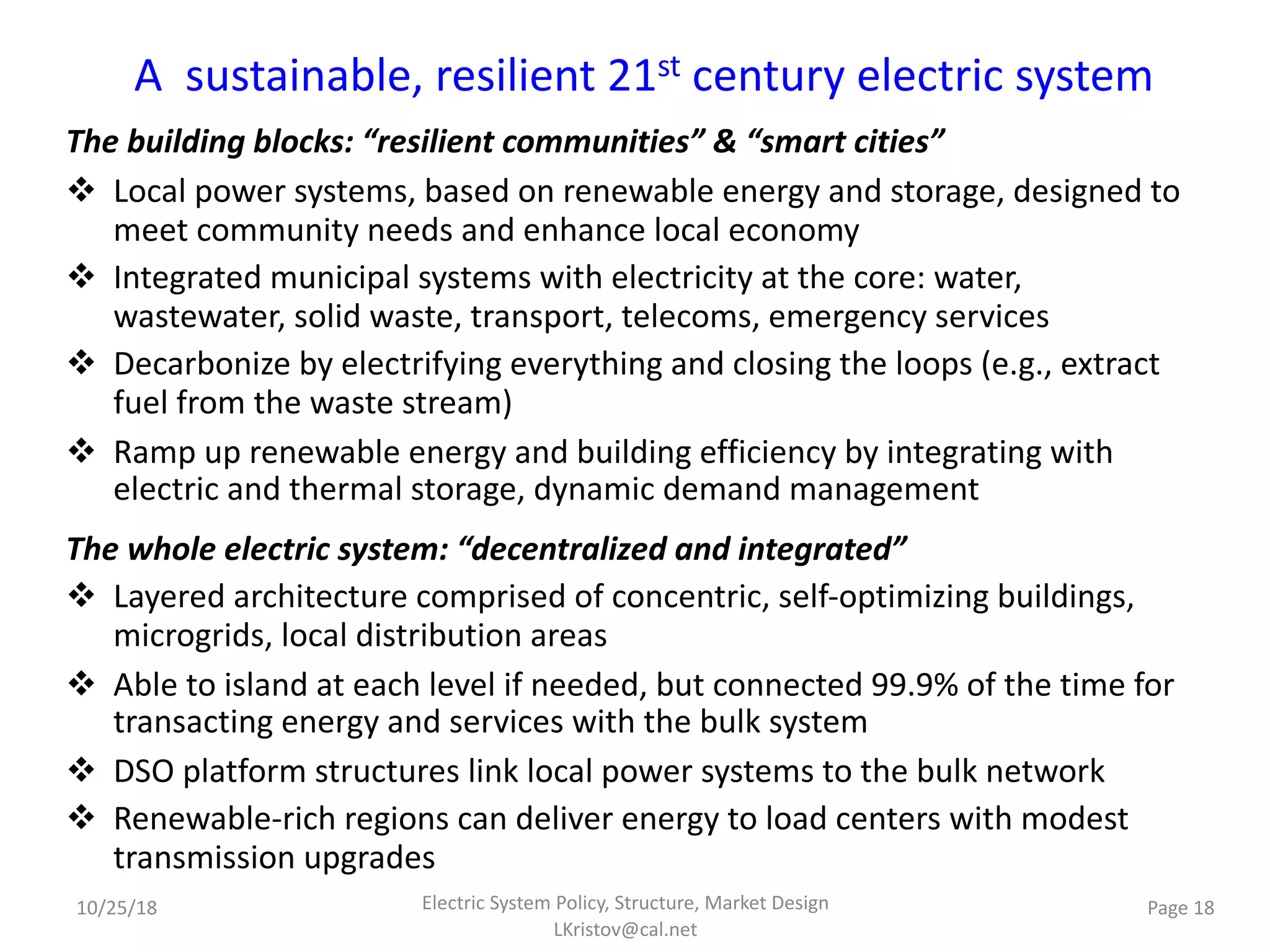
A sustainable, resilient 21st century electric system
The building blocks: “resilient communities” & “smart cities”
v Local power systems, based on renewable energy and storage, designed to
meet community needs and enhance local economy
v Integrated municipal systems with electricity at the core: water,
wastewater, solid waste, transport, telecoms, emergency services
v Decarbonize by electrifying everything and closing the loops (e.g., extract
fuel from the waste stream)
v Ramp up renewable energy and building efficiency by integrating with
electric and thermal storage, dynamic demand management
The whole electric system: “decentralized and integrated”
v Layered architecture comprised of concentric, self-optimizing buildings,
microgrids, local distribution areas
v Able to island at each level if needed, but connected 99.9% of the time for
transacting energy and services with the bulk system
v DSO platform structures link local power systems to the bulk network
v Renewable-rich regions can deliver energy to load centers with modest
transmission upgrades
10/25/18 Page 18Electric System Policy, Structure, Market Design
LKristov@cal.net
Thank you.
Lorenzo Kristov
LKristov@cal.net
Electric System Policy, Structure, Market Design
Additional resources
Decentralization and Layered Optimization
• http://resnick.caltech.edu/docs/Two_Visions.pdf
• https://gridarchitecture.pnnl.gov/media/advanced/Distribution%20Control%20Ref%20Model
_v1.1_final.pdf
• http://gridarchitecture.pnnl.gov/media/advanced/Sensor%20Networks%20for%20Electric%2
0Power%20Systems.pdf
• http://gridworks.org/wp-
content/uploads/2017/06/MTS_CoordinationTransmissionReport.pdf
Future Distribution Systems, Platforms and DSOs
• https://emp.lbl.gov/sites/all/files/FEUR_2%20distribution%20systems%2020151023.pdf
• http://doe-dspx.org
• http://futuresmart.ukpowernetworks.co.uk/wp-
content/themes/ukpnfuturesmart/assets/pdf/futuresmart-flexibility-roadmap.pdf
• http://www.energynetworks.org/assets/files/14969_ENA_FutureWorlds_AW06_INT.pdf
The Bottom-up Energy Transition
• http://www.cpuc.ca.gov/uploadedFiles/CPUC_Public_Website/Content/Utilities_and_Industr
ies/Energy_-_Electricity_and_Natural_Gas/Lorenzo%20Kristov%20Comments.pdf

Power System Evolution From the Bottom Up

  • 1.
    Power System Evolution Fromthe Bottom Up Lorenzo Kristov, PhD Electric System Policy, Structure, Market Design October 25, 2018
  • 2.
    Preface “The best wayto get nothing done is to convince people they’re on one side or the other of a duality.” (attrib. to J. M. Greer) • Decentralization and the Bulk Power System are complementary, not alternatives or adversaries • This talk emphasizes Decentralization because it is too often under-valued, dismissed or poorly explained The bulk power system is NOT going away — but it will no longer be where all the action is. 10/25/18 Eletric System Policy, Structure, Market Design LKristov@cal.net Page 2
  • 3.
    Electric power systemsand their institutions were all designed for centralized, top-down control and one-way power flows. Electric System Policy, Structure, Market Design LKristov@cal.net Page 310/25/18
  • 4.
    Renewable generation andpowerful, low-cost, customer- and community-scale resources are now driving energy transition. Electric System Policy, Structure, Market Design LKristov@cal.net Page 410/25/18
  • 5.
    Distribution-connected energy resources(DER) enable the transition to a more decentralized power system. • DERs = broad category, everything connected at distribution – Both sides of the end-use customer meter – Energy Efficiency, Demand Response, Distributed Generation, Energy Storage, EV Charging, Microgrids, Smart Cities … – Digital communication and control systems • Growth of DERs is largely autonomous and decentralized – Electrification of transport, buildings, etc. – tied to local government planning – will add demand and impact distribution operations – Resilience for critical facilities, campuses, communities − The “behind the meter (BTM) market” o Energy users can customize energy uses and sources with on-site assets and control technologies o And use the grid for residual needs or trading surpluses o Grid defection becoming economically feasible — why stay connected? Electric System Policy, Structure, Market Design LKristov@cal.net Page 510/25/18
  • 6.
    Choosing a preferredpath for system evolution starts with stating clear objectives. 1. Specify high-level policy objectives • Safety, Robustness (Reliability & Resilience), Security, Affordability, Minimum environmental footprint, Flexibility (extensibility & optionality), Financeability (utility & non-utility assets) [From DOE/PNNL 2015 “Grid Architecture” report] 2. Identify system qualities needed to achieve objectives • Should be discrete, specific, quantifiable, translatable into specific functional capabilities the system must have Source: Paul De Martini 2014, “More Than Smart” Electric System Policy, Structure, Market Design LKristov@cal.net Page 610/25/18
  • 7.
    External context: Ecosystem &resource constraints; global demographic & economic trends & conditions; technological advances & availability; geopolitics Existing policy context: Regulatory framework; industry structure; market structure; energy & environmental policies & mandates Grid Architecture offers a whole-system approach to electric power system transformation. Electric system objectives: Reliable & safe operation; cyber/physical security; resilience to disruptive events; environmental sustainability; customer & community choice; equity; affordability & access; financeability; other local goals Today’s one-way power system with conventional generating resources 21st century power system, high renewables, high “grid edge” innovation evolves into Electric System Policy, Structure, Market Design LKristov@cal.net Page 710/25/18
  • 8.
    Layered, multi-level architectureof the power system. Electricity Needs and Uses Electricity System Wires (produce & move power) Communications (gather & move info) Control (commands & responses) Industry Structure (actors, roles, functiions) Markets, Prices, Rates (incentives) Regulatory Framework & Standards Federal and State Law Political Processes Grid architecture: • A tool for managing complexity • Models a complex system as a stack of distinct layers • Changes in any one layer have impacts in other layers • Policy changes and Interventions need to take careful account of linkages between layers • Industry structure is a crucial layer => specify functional roles & responsibilities of key actors (distribution utilities, aggregators) Ecosystems & Environment Page 8Electric System Policy, Structure, Market Design LKristov@cal.net 10/25/18
  • 9.
    Decarbonization means electrifyingmajor fossil-fuel uses: transportation, buildings, industry, agriculture. Electrification plays out locally • Most system impacts on distribution • Resilience may rise in policy priority • Electrification strategies can play out through urban planning => Electrification reshapes demand and drives change from the bottom up. => Individual customer adoption (rooftop solar, storage, EVs) is only part of the story: community-level actions may be the big game changer. See C. Figueres et al, 2017, Three years to safeguard our climate,” https://www.nature.com/news/three-years-to-safeguard-our-climate-1.22201 – California’s electric system accounts for less than 20% of GHG emissions – Transportation about 42%, buildings about 35% 10/25/18
  • 10.
    Resilience has enteredthe conversation. The ability to maintain essential quality of life functions and services when a severe disruption occurs – Concern rises after major weather events (New York’s “Reforming the Energy Vision” (REV) proceeding following Hurricane Sandy) – A major concern of US DOE and FERC for the Bulk Electric System – Microgrid initiatives in cities, military bases, campuses, communities Disruptive Events – Impacts are always local – Be prepared to provide for water supply, shelter, food, medical, rescue, safety, wastewater, communications, mobility, … – All essential functions require energy Disruptive Gradual Processes – Gradual economic decline or ecosystem degradation – Often hard to reach consensus about causes or what to do Electric System Policy, Structure, Market Design LKristov@cal.net Page 1010/25/18
  • 11.
    Layered Architecture ofResilience 1: Nature’s layered architecture of complex living systems
  • 12.
    Local Distribution Area(LDA) operated by distribution utility or DSO Regional Interconnection Layered Architecture of Resilience 2: Define power system roles & responsibilities at interfaces Smart building Micro-grid LDA LDA Balancing Authority Area (ISO) BAABAA Smart building Smart building • Rooftop solar, storage, and controls on premises form a “smart building” microgrid • Bulk power system moves electricity from solar/wind-rich areas to load centers • Each layer only needs to manage its interfaces with next layer above & below • Each layer can “island” from layer above at the interface point • Layered architecture reduces complexity, allows scalability, increases resilience & security • Fractal structure mimics nature’s design of complex organisms & ecosystems. = interface point Dozens of individual businesses 100s of individual residences Page 12Electric System Policy, Structure, Market Design LKristov@cal.net 10/25/18
  • 13.
    Stage 3: Transactive Markets& System Convergences Community & municipal microgrids; grid-edge transactions Local-to-bulk system interfaces shape new DSO structures Initial DER market: Customers & DERs provide distribution grid services; Locational Net Benefits Analysis DERs for end-use energy services drive growth of “behind-the meter” (BTM) market Stage 2: DER Integration Smart Grid Investments Hosting Capacity Analysis Interconnection Process Improvements Aging Infrastructure Refresh Policy/rate-driven PV & EV adoption => grid operating info & decision tools Stage 1: Grid Modernization DERLevelandValue Time Distribution System Customer Adoption & Engagement Distribution markets can evolve in stages, based on DER policies, economics, technologies and customer adoption. 13 10/25/18 Page 13
  • 14.
    Current thinking aboutDER value does not yet quantify important benefits. 1. Value of shaping and integrating new electrification demand – Manage variability close to the source to reduce operational issues and need to build peak D & T infrastructure – Manage circuit-level “ducklings” and short-term volatility locally to reduce need to run gas generators – Requires imaginative new retail rate designs and pricing of D & T services 2. Value of resilience to severe disruptions – Community, campus, building-level microgrids can operate in island mode – Islanding can support bulk system reliability by removing load 3. Value to end-use customers and demand response – The “behind the meter” market for energy services Because DER values 1-2 are not well quantified, we lack mechanisms for getting the full value of DERs Electric System Policy, Structure, Market Design LKristov@cal.net Page 1410/25/18
  • 15.
    Needed: a 21stcentury policy framework for the electric power system • Consider the future distribution utility as a “DSO” – Specify DSO roles and responsibilities to deliver desired qualities and support policy goals – Collaborate among states and utilities to assess alternative DSO models (see UK Open Networks Project) • Different DSO models may arise in different places or stages, but all need to address certain key issues: – ‘Open access’ to enable technically qualified DERs regardless of ownership to provide grid services – If DSO is not independent of owner of physical D assets, then: • Distribution planning, have independent assessment of need not accountable to shareholders (if DSO compensation is on assets); • Non-discriminatory energy scheduling and real-time operations. – Incentive structure for DSO to partner with local governments on electrification and resilience projects Electric System Policy, Structure, Market Design LKristov@cal.net Page 1510/25/18
  • 16.
    The needed policyframework – 2 • Structures for DERs to provide grid services – Service definitions, performance specs, eligibility, measurement, compensation – Markets and open procurement mechanisms – Could states regulate distribution-level grid services markets? • Update “distribution provider” NERC definition and define T-D coordination practices to align DSO role with bulk system needs • Base financial incentives to DSO on performance, not just value of assets – Need to define DSO performance metrics – Tie grid modernization investments to performance • Rethink reliability and adequacy for high-DER, high-renewables system – Traditional system adequacy measure – stacking capacity MW to meet peak system load + reserve margin – needs updating – Who is responsible for supply if BTM DERs fail? – Enable customized reliability levels based on customer choice – A microgrid that can island offers a “load drop” service to DSO => Could a microgrid opt out of resource adequacy requirements? Electric System Policy, Structure, Market Design LKristov@cal.net Page 1610/25/18
  • 17.
    Layered Architecture ofResilience 3: “Resilient Community” policies and strategies Image courtesy of World Business Academy Santa Barbara, CA Neighborhood * Food production * Car shares * Tool libraries * Places to meet, gather & celebrate * Community energy systems * Rainwater capture * Tree canopy & PV in healthy balance Household * Energy efficient * All electric (zero net carbon) * Smart charging * Minimal waste * Grey water * Low-water landscaping * Micro-habitats Municipality * Whole-system integration of critical services * Public spaces * Local business * Vital, engaged neighborhoods State * Policy, funding & structure for community resilience & local capacity building * No community is left behind Bioregion * Local food * Waste mgmt * Water mgmt * Ecosystem protection
  • 18.
    A sustainable, resilient21st century electric system The building blocks: “resilient communities” & “smart cities” v Local power systems, based on renewable energy and storage, designed to meet community needs and enhance local economy v Integrated municipal systems with electricity at the core: water, wastewater, solid waste, transport, telecoms, emergency services v Decarbonize by electrifying everything and closing the loops (e.g., extract fuel from the waste stream) v Ramp up renewable energy and building efficiency by integrating with electric and thermal storage, dynamic demand management The whole electric system: “decentralized and integrated” v Layered architecture comprised of concentric, self-optimizing buildings, microgrids, local distribution areas v Able to island at each level if needed, but connected 99.9% of the time for transacting energy and services with the bulk system v DSO platform structures link local power systems to the bulk network v Renewable-rich regions can deliver energy to load centers with modest transmission upgrades 10/25/18 Page 18Electric System Policy, Structure, Market Design LKristov@cal.net
  • 19.
    Thank you. Lorenzo Kristov LKristov@cal.net ElectricSystem Policy, Structure, Market Design
  • 20.
    Additional resources Decentralization andLayered Optimization • http://resnick.caltech.edu/docs/Two_Visions.pdf • https://gridarchitecture.pnnl.gov/media/advanced/Distribution%20Control%20Ref%20Model _v1.1_final.pdf • http://gridarchitecture.pnnl.gov/media/advanced/Sensor%20Networks%20for%20Electric%2 0Power%20Systems.pdf • http://gridworks.org/wp- content/uploads/2017/06/MTS_CoordinationTransmissionReport.pdf Future Distribution Systems, Platforms and DSOs • https://emp.lbl.gov/sites/all/files/FEUR_2%20distribution%20systems%2020151023.pdf • http://doe-dspx.org • http://futuresmart.ukpowernetworks.co.uk/wp- content/themes/ukpnfuturesmart/assets/pdf/futuresmart-flexibility-roadmap.pdf • http://www.energynetworks.org/assets/files/14969_ENA_FutureWorlds_AW06_INT.pdf The Bottom-up Energy Transition • http://www.cpuc.ca.gov/uploadedFiles/CPUC_Public_Website/Content/Utilities_and_Industr ies/Energy_-_Electricity_and_Natural_Gas/Lorenzo%20Kristov%20Comments.pdf