Writing Continuous
Applications with Structured
Streaming in PySpark
Jules S. Damji, Databricks
AnacondaConf,Austin,TX 4/10/2018
I have used Apache Spark 2.x Before…
Apache Spark Community & DeveloperAdvocate
@ Databricks
DeveloperAdvocate@ Hortonworks
Software engineering @: Sun Microsystems,
Netscape, @Home, VeriSign, Scalix, Centrify,
LoudCloud/Opsware, ProQuest
Program Chair Spark + AI Summit
https://www.linkedin.com/in/dmatrix
@2twitme
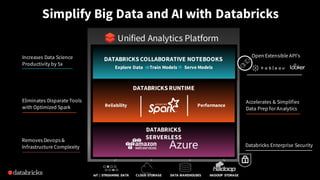
Simplify Big Data and AI with Databricks
Unified Analytics Platform
DATA WAREHOUSESCLOUD STORAGE HADOOP STORAGEIoT / STREAMING DATA
DATABRICKS
SERVERLESSRemoves Devops &
Infrastructure Complexity
DATABRICKS RUNTIME
Reliability
Eliminates Disparate Tools
with Optimized Spark
Explore Data Train Models Serve Models
DATABRICKS COLLABORATIVE NOTEBOOKSIncreases Data Science
Productivity by 5x
Databricks Enterprise Security
Open Extensible API’s
Accelerates & Simplifies
Data Prep for Analytics
Performance
Agenda for Today’s Talk
• What’s Big Data Done To Us
• What and Why Apache Spark
• Why Streaming Applications are Difficult
• What’s Structured Streaming
• Anatomy of a Continunous Application
• Demo
• Q & A
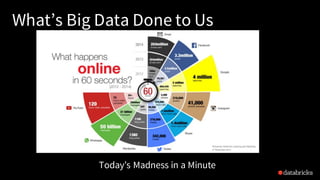
What’s Big Data Done to Us
Today’s Madness in a Minute
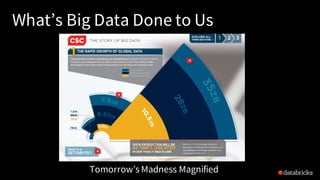
What’s Big Data Done to Us
Tomorrow’s Madness Magnified
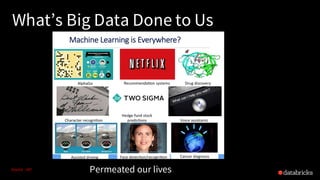
What’s Big Data Done to Us
Permeated our livesSource : MIT
What’s Apache Spark
& Why
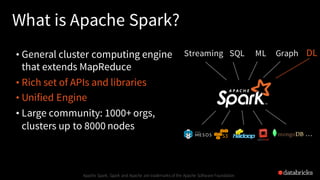
What is Apache Spark?
• General cluster computing engine
that extends MapReduce
• Rich set of APIs and libraries
• Unified Engine
• Large community: 1000+ orgs,
clusters up to 8000 nodes
Apache Spark, Spark and Apache are trademarks of the Apache Software Foundation
SQLStreaming ML Graph
…
DL
Unique Thing about Spark
• Unification: same engine and same API for diverse use cases
• Streaming, batch, or interactive
• ETL, SQL, machine learning, or graph
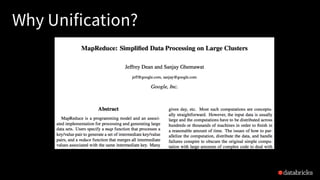
Why Unification?
Why Unification?
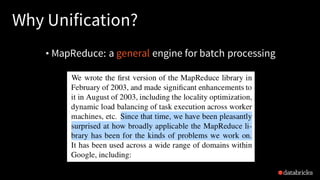
• MapReduce: a general engine for batch processing
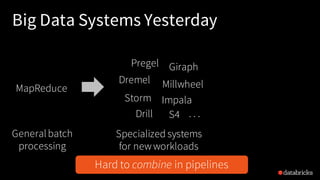
MapReduce
Generalbatch
processing
Pregel
Dremel Millwheel
Drill
Giraph
ImpalaStorm
S4 . . .
Specialized systems
for newworkloads
Big Data Systems Yesterday
Hard to manage, tune, deployHard to combine in pipelines
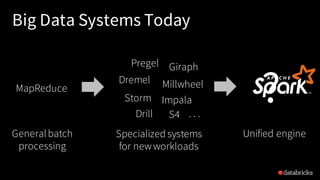
MapReduce
Generalbatch
processing
Unified engine
Big Data Systems Today
?
Pregel
Dremel Millwheel
Drill
Giraph
ImpalaStorm
S4 . . .
Specialized systems
for newworkloads
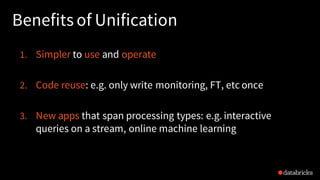
Benefits of Unification
1. Simpler to use and operate
2. Code reuse: e.g. only write monitoring, FT, etc once
3. New apps that span processing types: e.g. interactive
queries on a stream, online machine learning
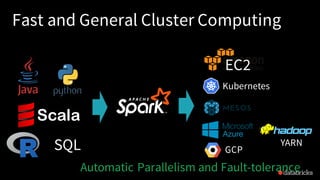
Fast and General Cluster Computing
Scala
SQL
EC2
Kubernetes
Automatic Parallelism and Fault-tolerance
GCP
YARN
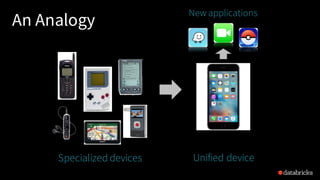
An Analogy
Specialized devices Unified device
New applications
Why Streaming Applications
are Inherently Difficult?
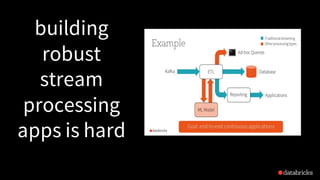
building
robust
stream
processing
apps is hard
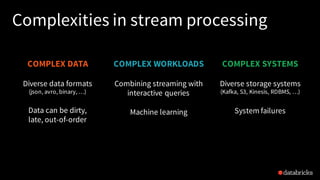
Complexities in stream processing
COMPLEX DATA
Diverse data formats
(json, avro, binary, …)
Data can be dirty,
late, out-of-order
COMPLEX SYSTEMS
Diverse storage systems
(Kafka, S3, Kinesis, RDBMS, …)
System failures
COMPLEX WORKLOADS
Combining streaming with
interactive queries
Machine learning
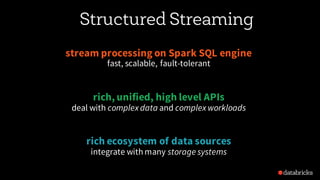
Structured Streaming
stream processing on Spark SQL engine
fast, scalable, fault-tolerant
rich, unified, high level APIs
deal with complex data and complex workloads
rich ecosystem of data sources
integrate with many storage systems
you
should not have to
reason about streaming
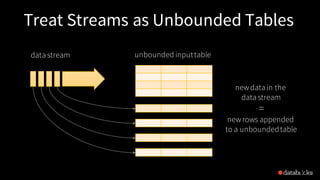
Treat Streams as Unbounded Tables
24
data stream unbounded inputtable
newdata in the
data stream
=
newrows appended
to a unboundedtable
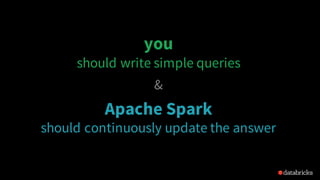
you
should write simple queries
&
Apache Spark
should continuously update the answer
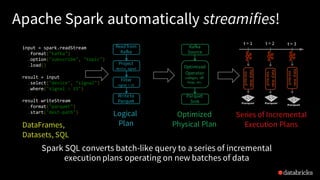
DataFrames,
Datasets, SQL
input = spark.readStream
.format("kafka")
.option("subscribe", "topic")
.load()
result = input
.select("device", "signal")
.where("signal > 15")
result.writeStream
.format("parquet")
.start("dest-path") Logical
Plan
Read from
Kafka
Project
device, signal
Filter
signal > 15
Writeto
Parquet
Apache Spark automatically streamifies!
Spark SQL converts batch-like query to a series of incremental
execution plans operating on new batches of data
Series of Incremental
Execution Plans
Kafka
Source
Optimized
Operator
codegen, off-
heap, etc.
Parquet
Sink
Optimized
Physical Plan
process
newdata
t = 1 t = 2 t = 3
process
newdata
process
newdata
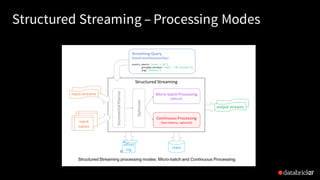
Structured Streaming – Processing Modes
27
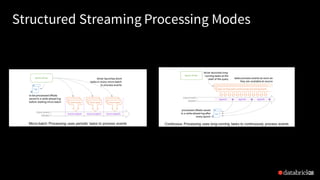
Structured Streaming Processing Modes
28
Simple Streaming ETL
Streaming word count
Anatomy of a Streaming Query
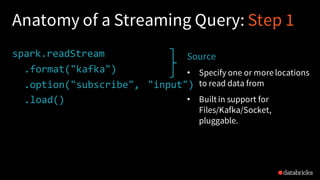
Anatomy of a Streaming Query: Step 1
spark.readStream
.format("kafka")
.option("subscribe", "input")
.load()
.
Source
• Specify one or more locations
to read data from
• Built in support for
Files/Kafka/Socket,
pluggable.
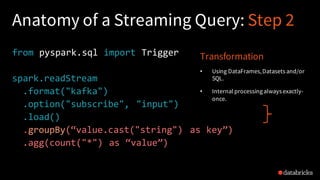
Anatomy of a Streaming Query: Step 2
from pyspark.sql import Trigger
spark.readStream
.format("kafka")
.option("subscribe", "input")
.load()
.groupBy(“value.cast("string") as key”)
.agg(count("*") as “value”)
Transformation
• Using DataFrames,Datasets and/or
SQL.
• Internal processingalways exactly-
once.
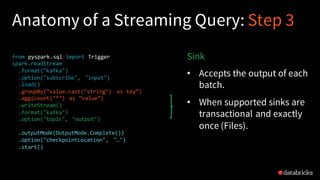
Anatomy of a Streaming Query: Step 3
from pyspark.sql import Trigger
spark.readStream
.format("kafka")
.option("subscribe", "input")
.load()
.groupBy(“value.cast("string") as key”)
.agg(count("*") as “value”)
.writeStream()
.format("kafka")
.option("topic", "output")
.trigger("1 minute")
.outputMode(OutputMode.Complete())
.option("checkpointLocation", "…")
.start()
Sink
• Accepts the output of each
batch.
• When supported sinks are
transactional and exactly
once (Files).
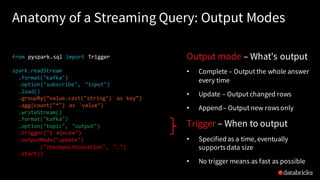
Anatomy of a Streaming Query: Output Modes
from pyspark.sql import Trigger
spark.readStream
.format("kafka")
.option("subscribe", "input")
.load()
.groupBy(“value.cast("string") as key”)
.agg(count("*") as 'value’)
.writeStream()
.format("kafka")
.option("topic", "output")
.trigger("1 minute")
.outputMode("update")
.option("checkpointLocation", "…")
.start()
Output mode – What's output
• Complete – Output the whole answer
every time
• Update – Output changed rows
• Append– Output new rowsonly
Trigger – When to output
• Specifiedas a time, eventually
supportsdata size
• No trigger means as fast as possible
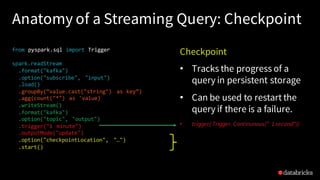
Anatomy of a Streaming Query: Checkpoint
from pyspark.sql import Trigger
spark.readStream
.format("kafka")
.option("subscribe", "input")
.load()
.groupBy(“value.cast("string") as key”)
.agg(count("*") as 'value)
.writeStream()
.format("kafka")
.option("topic", "output")
.trigger("1 minute")
.outputMode("update")
.option("checkpointLocation", "…")
.start()
Checkpoint
• Tracks the progress of a
query in persistent storage
• Can be used to restart the
query if there is a failure.
• trigger( Trigger. Continunous(“ 1 second”))
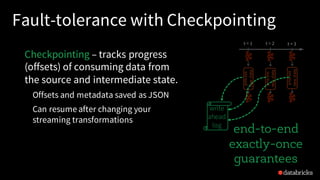
Fault-tolerance with Checkpointing
Checkpointing – tracks progress
(offsets) of consuming data from
the source and intermediate state.
Offsets and metadata saved as JSON
Can resume after changing your
streaming transformations
end-to-end
exactly-once
guarantees
process
newdata
t = 1 t = 2 t = 3
process
newdata
process
newdata
write
ahead
log
Complex Streaming ETL
Traditional ETL
• Raw, dirty, un/semi-structured is data dumped as files
• Periodic jobs run every few hours to convert raw data to structured
data ready for further analytics
• Hours of delay before taking decisions on latest data
• Problem: Unacceptable when time is of essence
• [intrusion detection, anomaly detection,etc.]
38
file
dump
seconds hours
table
10101010
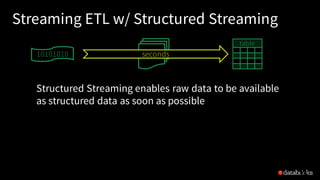
Streaming ETL w/ Structured Streaming
Structured Streaming enables raw data to be available
as structured data as soon as possible
39
seconds
table
10101010
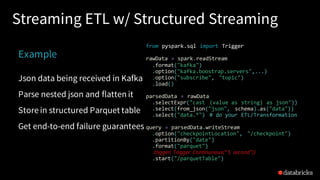
Streaming ETL w/ Structured Streaming
Example
Json data being received in Kafka
Parse nested json and flatten it
Store in structured Parquet table
Get end-to-end failure guarantees
from pyspark.sql import Trigger
rawData = spark.readStream
.format("kafka")
.option("kafka.boostrap.servers",...)
.option("subscribe", "topic")
.load()
parsedData = rawData
.selectExpr("cast (value as string) as json"))
.select(from_json("json", schema).as("data"))
.select("data.*") # do your ETL/Transformation
query = parsedData.writeStream
.option("checkpointLocation", "/checkpoint")
.partitionBy("date")
.format("parquet")
.trigger( Trigger. Continunous(“5 second”))
.start("/parquetTable")
Reading from Kafka
raw_data_df = spark.readStream
.format("kafka")
.option("kafka.boostrap.servers",...)
.option("subscribe", "topic")
.load()
rawData dataframe has
the following columns
key value topic partition offset timestamp
[binary] [binary] "topicA" 0 345 1486087873
[binary] [binary] "topicB" 3 2890 1486086721
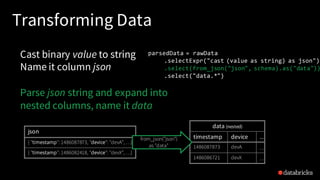
Transforming Data
Cast binary value to string
Name it column json
Parse json string and expand into
nested columns, name it data
parsedData = rawData
.selectExpr("cast (value as string) as json")
.select(from_json("json", schema).as("data"))
.select("data.*")
json
{ "timestamp": 1486087873, "device": "devA", …}
{ "timestamp": 1486082418, "device": "devX", …}
data (nested)
timestamp device …
1486087873 devA …
1486086721 devX …
from_json("json")
as "data"
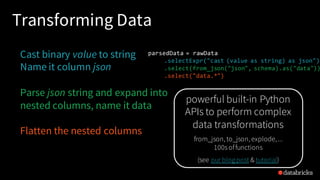
Transforming Data
Cast binary value to string
Name it column json
Parse json string and expand into
nested columns, name it data
Flatten the nested columns
parsedData = rawData
.selectExpr("cast (value as string) as json")
.select(from_json("json", schema).as("data"))
.select("data.*")
powerful built-in Python
APIs to perform complex
data transformations
from_json, to_json, explode,...
100s offunctions
(see our blogpost & tutorial)
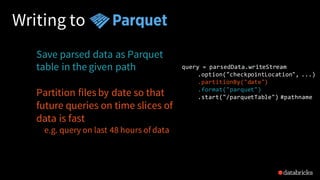
Writing to
Save parsed data as Parquet
table in the given path
Partition files by date so that
future queries on time slices of
data is fast
e.g. query on last 48 hours of data
query = parsedData.writeStream
.option("checkpointLocation", ...)
.partitionBy("date")
.format("parquet")
.start("/parquetTable") #pathname
Demo
https://dbricks.co/ss_mllib_py
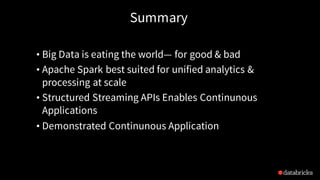
Summary
• Big Data is eating the world— for good & bad
• Apache Spark best suited for unified analytics &
processing at scale
• Structured Streaming APIs Enables Continunous
Applications
• Demonstrated Continunous Application
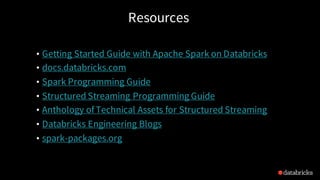
Resources
• Getting Started Guide with Apache Spark on Databricks
• docs.databricks.com
• Spark Programming Guide
• Structured Streaming Programming Guide
• Anthology of Technical Assets for Structured Streaming
• Databricks Engineering Blogs
• spark-packages.org
Thank You J
@2twitme
jules@databricks.com
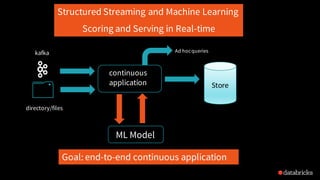
ML Model
Store	
continuous
application
Goal: end-to-end continuous application
Structured Streaming and Machine Learning
Scoring and Serving in Real-time
Ad hocquerieskafka
directory/files
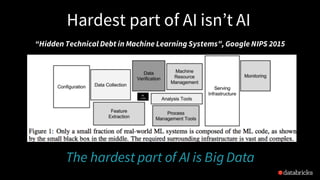
Hardest part of AI isn’t AI
“Hidden Technical Debt in Machine Learning Systems", Google NIPS 2015
The hardest part of AI is Big Data
ML	
Code
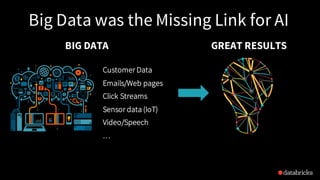
Big Data was the Missing Link for AI
BIG DATA
Customer Data
Emails/Web pages
Click Streams
Sensor data (IoT)
Video/Speech
…
GREAT RESULTS
Here is a basic slide
Suspendisseullamcorpervel odio a varius
• Pellentesque habitant morbi tristiqu
• enectus et netuset malesuada fames ac turpis egestas
• ut erat dapibus lobortis purus sed gravida augu
• efficitur a risus placerat porta nullam molestie malesuada velit et auctor
Here are some logos
HEADER CAN BE BOLD ALL CAPS LIKE THIS
Here is a comparison slide
• Quisque tortor quam, posuere sed
sagittis et, iaculis a urna. In
malesuada in orci ut lacinia
• Sed bibendum sed mauris egestas
pellentesque
• Vestibulum bibendum sagittis odio
quis tincidunt augue consequat e
• Aliquam purus leo, interdum eu
urna vitae
• Etiam in arcu gravida, tincidunt
magna ve faucibus
• Donec laoreet vel quam eu
condimentum
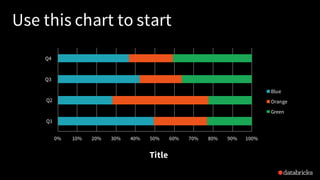
0% 10% 20% 30% 40% 50% 60% 70% 80% 90% 100%
Q1
Q2
Q3
Q4
Title
Blue
Orange
Green
Use this chart to start
Here are some icons to use - scalable
DB Benefits
DB Features
General /Data Science
Icons can be recoloredwithinPowerpoint — see: format picture/ picture color / recolor
Orange, Green, and Black versions (no recolorationnecessary) can be found in go/icons
More icons
Industries
Security
Spark Benefits Spark Features
Misc
Even more
Misc
Slide for Large Question
or Section Headers
Thank You
Parting words or contact information go here.

Writing Continuous Applications with Structured Streaming in PySpark

  • 1.
    Writing Continuous Applications withStructured Streaming in PySpark Jules S. Damji, Databricks AnacondaConf,Austin,TX 4/10/2018
  • 2.
    I have usedApache Spark 2.x Before…
  • 3.
    Apache Spark Community& DeveloperAdvocate @ Databricks DeveloperAdvocate@ Hortonworks Software engineering @: Sun Microsystems, Netscape, @Home, VeriSign, Scalix, Centrify, LoudCloud/Opsware, ProQuest Program Chair Spark + AI Summit https://www.linkedin.com/in/dmatrix @2twitme
  • 4.
    Simplify Big Dataand AI with Databricks Unified Analytics Platform DATA WAREHOUSESCLOUD STORAGE HADOOP STORAGEIoT / STREAMING DATA DATABRICKS SERVERLESSRemoves Devops & Infrastructure Complexity DATABRICKS RUNTIME Reliability Eliminates Disparate Tools with Optimized Spark Explore Data Train Models Serve Models DATABRICKS COLLABORATIVE NOTEBOOKSIncreases Data Science Productivity by 5x Databricks Enterprise Security Open Extensible API’s Accelerates & Simplifies Data Prep for Analytics Performance
  • 5.
    Agenda for Today’sTalk • What’s Big Data Done To Us • What and Why Apache Spark • Why Streaming Applications are Difficult • What’s Structured Streaming • Anatomy of a Continunous Application • Demo • Q & A
  • 6.
    What’s Big DataDone to Us Today’s Madness in a Minute
  • 7.
    What’s Big DataDone to Us Tomorrow’s Madness Magnified
  • 8.
    What’s Big DataDone to Us Permeated our livesSource : MIT
  • 9.
  • 10.
    What is ApacheSpark? • General cluster computing engine that extends MapReduce • Rich set of APIs and libraries • Unified Engine • Large community: 1000+ orgs, clusters up to 8000 nodes Apache Spark, Spark and Apache are trademarks of the Apache Software Foundation SQLStreaming ML Graph … DL
  • 11.
    Unique Thing aboutSpark • Unification: same engine and same API for diverse use cases • Streaming, batch, or interactive • ETL, SQL, machine learning, or graph
  • 12.
  • 13.
    Why Unification? • MapReduce:a general engine for batch processing
  • 14.
    MapReduce Generalbatch processing Pregel Dremel Millwheel Drill Giraph ImpalaStorm S4 .. . Specialized systems for newworkloads Big Data Systems Yesterday Hard to manage, tune, deployHard to combine in pipelines
  • 15.
    MapReduce Generalbatch processing Unified engine Big DataSystems Today ? Pregel Dremel Millwheel Drill Giraph ImpalaStorm S4 . . . Specialized systems for newworkloads
  • 16.
    Benefits of Unification 1.Simpler to use and operate 2. Code reuse: e.g. only write monitoring, FT, etc once 3. New apps that span processing types: e.g. interactive queries on a stream, online machine learning
  • 17.
    Fast and GeneralCluster Computing Scala SQL EC2 Kubernetes Automatic Parallelism and Fault-tolerance GCP YARN
  • 18.
    An Analogy Specialized devicesUnified device New applications
  • 19.
    Why Streaming Applications areInherently Difficult?
  • 20.
  • 21.
    Complexities in streamprocessing COMPLEX DATA Diverse data formats (json, avro, binary, …) Data can be dirty, late, out-of-order COMPLEX SYSTEMS Diverse storage systems (Kafka, S3, Kinesis, RDBMS, …) System failures COMPLEX WORKLOADS Combining streaming with interactive queries Machine learning
  • 22.
    Structured Streaming stream processingon Spark SQL engine fast, scalable, fault-tolerant rich, unified, high level APIs deal with complex data and complex workloads rich ecosystem of data sources integrate with many storage systems
  • 23.
    you should not haveto reason about streaming
  • 24.
    Treat Streams asUnbounded Tables 24 data stream unbounded inputtable newdata in the data stream = newrows appended to a unboundedtable
  • 25.
    you should write simplequeries & Apache Spark should continuously update the answer
  • 26.
    DataFrames, Datasets, SQL input =spark.readStream .format("kafka") .option("subscribe", "topic") .load() result = input .select("device", "signal") .where("signal > 15") result.writeStream .format("parquet") .start("dest-path") Logical Plan Read from Kafka Project device, signal Filter signal > 15 Writeto Parquet Apache Spark automatically streamifies! Spark SQL converts batch-like query to a series of incremental execution plans operating on new batches of data Series of Incremental Execution Plans Kafka Source Optimized Operator codegen, off- heap, etc. Parquet Sink Optimized Physical Plan process newdata t = 1 t = 2 t = 3 process newdata process newdata
  • 27.
    Structured Streaming –Processing Modes 27
  • 28.
  • 29.
  • 30.
    Streaming word count Anatomyof a Streaming Query
  • 31.
    Anatomy of aStreaming Query: Step 1 spark.readStream .format("kafka") .option("subscribe", "input") .load() . Source • Specify one or more locations to read data from • Built in support for Files/Kafka/Socket, pluggable.
  • 32.
    Anatomy of aStreaming Query: Step 2 from pyspark.sql import Trigger spark.readStream .format("kafka") .option("subscribe", "input") .load() .groupBy(“value.cast("string") as key”) .agg(count("*") as “value”) Transformation • Using DataFrames,Datasets and/or SQL. • Internal processingalways exactly- once.
  • 33.
    Anatomy of aStreaming Query: Step 3 from pyspark.sql import Trigger spark.readStream .format("kafka") .option("subscribe", "input") .load() .groupBy(“value.cast("string") as key”) .agg(count("*") as “value”) .writeStream() .format("kafka") .option("topic", "output") .trigger("1 minute") .outputMode(OutputMode.Complete()) .option("checkpointLocation", "…") .start() Sink • Accepts the output of each batch. • When supported sinks are transactional and exactly once (Files).
  • 34.
    Anatomy of aStreaming Query: Output Modes from pyspark.sql import Trigger spark.readStream .format("kafka") .option("subscribe", "input") .load() .groupBy(“value.cast("string") as key”) .agg(count("*") as 'value’) .writeStream() .format("kafka") .option("topic", "output") .trigger("1 minute") .outputMode("update") .option("checkpointLocation", "…") .start() Output mode – What's output • Complete – Output the whole answer every time • Update – Output changed rows • Append– Output new rowsonly Trigger – When to output • Specifiedas a time, eventually supportsdata size • No trigger means as fast as possible
  • 35.
    Anatomy of aStreaming Query: Checkpoint from pyspark.sql import Trigger spark.readStream .format("kafka") .option("subscribe", "input") .load() .groupBy(“value.cast("string") as key”) .agg(count("*") as 'value) .writeStream() .format("kafka") .option("topic", "output") .trigger("1 minute") .outputMode("update") .option("checkpointLocation", "…") .start() Checkpoint • Tracks the progress of a query in persistent storage • Can be used to restart the query if there is a failure. • trigger( Trigger. Continunous(“ 1 second”))
  • 36.
    Fault-tolerance with Checkpointing Checkpointing– tracks progress (offsets) of consuming data from the source and intermediate state. Offsets and metadata saved as JSON Can resume after changing your streaming transformations end-to-end exactly-once guarantees process newdata t = 1 t = 2 t = 3 process newdata process newdata write ahead log
  • 37.
  • 38.
    Traditional ETL • Raw,dirty, un/semi-structured is data dumped as files • Periodic jobs run every few hours to convert raw data to structured data ready for further analytics • Hours of delay before taking decisions on latest data • Problem: Unacceptable when time is of essence • [intrusion detection, anomaly detection,etc.] 38 file dump seconds hours table 10101010
  • 39.
    Streaming ETL w/Structured Streaming Structured Streaming enables raw data to be available as structured data as soon as possible 39 seconds table 10101010
  • 40.
    Streaming ETL w/Structured Streaming Example Json data being received in Kafka Parse nested json and flatten it Store in structured Parquet table Get end-to-end failure guarantees from pyspark.sql import Trigger rawData = spark.readStream .format("kafka") .option("kafka.boostrap.servers",...) .option("subscribe", "topic") .load() parsedData = rawData .selectExpr("cast (value as string) as json")) .select(from_json("json", schema).as("data")) .select("data.*") # do your ETL/Transformation query = parsedData.writeStream .option("checkpointLocation", "/checkpoint") .partitionBy("date") .format("parquet") .trigger( Trigger. Continunous(“5 second”)) .start("/parquetTable")
  • 41.
    Reading from Kafka raw_data_df= spark.readStream .format("kafka") .option("kafka.boostrap.servers",...) .option("subscribe", "topic") .load() rawData dataframe has the following columns key value topic partition offset timestamp [binary] [binary] "topicA" 0 345 1486087873 [binary] [binary] "topicB" 3 2890 1486086721
  • 42.
    Transforming Data Cast binaryvalue to string Name it column json Parse json string and expand into nested columns, name it data parsedData = rawData .selectExpr("cast (value as string) as json") .select(from_json("json", schema).as("data")) .select("data.*") json { "timestamp": 1486087873, "device": "devA", …} { "timestamp": 1486082418, "device": "devX", …} data (nested) timestamp device … 1486087873 devA … 1486086721 devX … from_json("json") as "data"
  • 43.
    Transforming Data Cast binaryvalue to string Name it column json Parse json string and expand into nested columns, name it data Flatten the nested columns parsedData = rawData .selectExpr("cast (value as string) as json") .select(from_json("json", schema).as("data")) .select("data.*") powerful built-in Python APIs to perform complex data transformations from_json, to_json, explode,... 100s offunctions (see our blogpost & tutorial)
  • 44.
    Writing to Save parseddata as Parquet table in the given path Partition files by date so that future queries on time slices of data is fast e.g. query on last 48 hours of data query = parsedData.writeStream .option("checkpointLocation", ...) .partitionBy("date") .format("parquet") .start("/parquetTable") #pathname
  • 45.
  • 46.
    Summary • Big Datais eating the world— for good & bad • Apache Spark best suited for unified analytics & processing at scale • Structured Streaming APIs Enables Continunous Applications • Demonstrated Continunous Application
  • 47.
    Resources • Getting StartedGuide with Apache Spark on Databricks • docs.databricks.com • Spark Programming Guide • Structured Streaming Programming Guide • Anthology of Technical Assets for Structured Streaming • Databricks Engineering Blogs • spark-packages.org
  • 48.
  • 49.
    ML Model Store continuous application Goal: end-to-endcontinuous application Structured Streaming and Machine Learning Scoring and Serving in Real-time Ad hocquerieskafka directory/files
  • 50.
    Hardest part ofAI isn’t AI “Hidden Technical Debt in Machine Learning Systems", Google NIPS 2015 The hardest part of AI is Big Data ML Code
  • 51.
    Big Data wasthe Missing Link for AI BIG DATA Customer Data Emails/Web pages Click Streams Sensor data (IoT) Video/Speech … GREAT RESULTS
  • 52.
    Here is abasic slide Suspendisseullamcorpervel odio a varius • Pellentesque habitant morbi tristiqu • enectus et netuset malesuada fames ac turpis egestas • ut erat dapibus lobortis purus sed gravida augu • efficitur a risus placerat porta nullam molestie malesuada velit et auctor
  • 53.
  • 54.
    HEADER CAN BEBOLD ALL CAPS LIKE THIS Here is a comparison slide • Quisque tortor quam, posuere sed sagittis et, iaculis a urna. In malesuada in orci ut lacinia • Sed bibendum sed mauris egestas pellentesque • Vestibulum bibendum sagittis odio quis tincidunt augue consequat e • Aliquam purus leo, interdum eu urna vitae • Etiam in arcu gravida, tincidunt magna ve faucibus • Donec laoreet vel quam eu condimentum
  • 55.
    0% 10% 20%30% 40% 50% 60% 70% 80% 90% 100% Q1 Q2 Q3 Q4 Title Blue Orange Green Use this chart to start
  • 56.
    Here are someicons to use - scalable DB Benefits DB Features General /Data Science Icons can be recoloredwithinPowerpoint — see: format picture/ picture color / recolor Orange, Green, and Black versions (no recolorationnecessary) can be found in go/icons
  • 57.
  • 58.
  • 59.
    Slide for LargeQuestion or Section Headers
  • 60.
    Thank You Parting wordsor contact information go here.