PARQUET & AVRO
http://airisdata.com/
Presenter Introduction
•Tim	Spann,	Senior	Solutions	Architect,	airis.DATA
• ex-Pivotal	Senior	Field	Engineer
• DZONE	MVB	and	Zone	Leader
• ex-Startup	Senior	Engineer	/	Team	Lead
• http://www.slideshare.net/bunkertor
• http://sparkdeveloper.com/
• http://www.twitter.com/PaasDev
•Srinivas	Daruna	
Data	Engineer,	airis.DATA
Spark	Certified	Developer
Presenter Introduction
airis.DATA
airis.DATA is	a	next	generation	system	integrator	that	specializes	in	rapidly	deployable	
machine	learning	and	graph	solutions.	
Our	core	competencies	involve	providing	modular,	scalable	Big	Data	products	that	can	be	
tailored	to	fit	use	cases	across	industry	verticals.	
We	offer	predictive	modeling	and	machine	learning	solutions	at	Petabyte	scale	utilizing	
the	most	advanced,	best-in-class	technologies	and	frameworks	including	Spark,	H20,	
Mahout,	and	Flink.	
Our	data	pipelining	solutions	can	be	deployed	in	batch,	real-time	or	near-real-time	
settings	to	fit	your	specific	business	use-case.	
airis.DATA
qAvro	and	Parquet	- When	and	Why	to	use	which	format?
qUse	cases	for	Schema	Evolution	&	practical	examples
qData	modeling	- Avro	and	Parquet	schema
qWorkshop
- Read	Avro	input	from	Kafka
- Transform	data	in	Spark
- Write	data	frame	to	Parquet
- Read	back	from	Parquet
qOur	experiences	with	Avro	and	Parquet
qSome	helpful	insights	for	projects	design
Agenda
AVRO - Introduction
Ø Doug	Cutting	created	Avro,	a	data	serialization	and	RPC		library,	to	help	improve	data	
interchange,	interoperability,	and	versioning	in	Hadoop	Eco	System.	
ØSerialization	&	RPC	Library	and	also	storage	format.
ØWhat	led	to	a	new	serialization	mechanism.?
ØThrift	and	PB	are	not	splittable and	codegen required	for	both	of	them.	Dynamic	reading	is	
not	possible
ØSequence	files	does	not	have	schema	evolution
ØEvolved	as	in-house	serialization	and	RPC	library	for	hadoop.	Good	overall	performance	that	
can	match	up	to	Protocol	Buffers	in	some	aspects.
Ø Dynamic	Access – No	need	of	Code	generation	for	accessing	the	data.
Ø UnTagged Data – Which	allows	better	compression
Ø Platform	in-dependent – Has	libraries	in	Java,	Scala,	Python,	Ruby,	C	and	C#.
Compressible	and	Splittable – Complements	the	parllel processing	systems	such	as	MR	and	
Spark.
Ø Schema	Evolution: “Data	models	evolve	over	time”,	and	it’s	important	that	your
data	formats	support	 your	need	to	modify	your	data	models.	Schema	evolution
allows	you	to	add,	modify,	and	in	some	cases	delete	attributes,	while	at	the	same
time	providing	 backward	and	forward	compatibility	for	readers	and	writers
Some Important features of AVRO
• Row	Based
• Direct	mapping	from/to	JSON
• Interoperability:	can	serialize	into	Avro/Binary	or	Avro/Json
• Provides	rich	data	structures
• Map	keys	can	only	be	strings	(could	be	seen	as	a	limitation)
• Compact	binary	form
• Extensible	schema	language
• Untagged	data
• Bindings	for	a	wide	variety	of	programming	languages
• Dynamic	typing
• Provides	a	remote	procedure	call
• Supports	block	compression
• Avro	files	are	splittable
• Best	compatibility	for	evolving	data	schemas
Summary of AVRO Properties
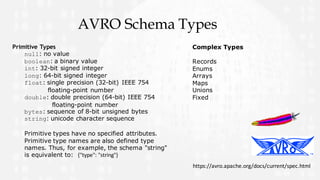
AVRO Schema Types
Primitive Types
null: no value
boolean: a binary value
int: 32-bit signed integer
long: 64-bit signed integer
float: single precision (32-bit) IEEE 754
floating-point number
double: double precision (64-bit) IEEE 754
floating-point number
bytes: sequence of 8-bit unsigned bytes
string: unicode character sequence
Primitive types have no specified attributes.
Primitive type names are also defined type
names. Thus, for example, the schema "string"
is equivalent to: {"type":	"string"}
Complex Types
Records
Enums
Arrays
Maps
Unions
Fixed
https://avro.apache.org/docs/current/spec.html
Avro Schema
Understanding	Avro	schema	is	very	important	for	Avro	
Data.	
Ø JSON	Format	is	used	to	define	schema
Ø Simpler	than	IDL(Interface	Definition	Language)	of	
Protocol	Buffers	and	thrift
Ø very	useful	in	RPC.	Schemas	will	be	exchanged	to	
ensure	the	data	correctness
Ø You	can	specify	order	(Ascending	or	Descending)	for	
fields.			
Sample	Schema:
{
"type":	"record",
"name":	"Meetup",
"fields":	[	{
"name":	"name",
"type":	"string”,
"order"	:	"descending"
}, {
"name":	"value",
"type":	["null",	"string”]
}
…..
]
}
Union
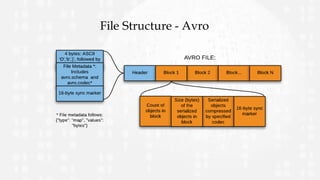
File Structure - Avro
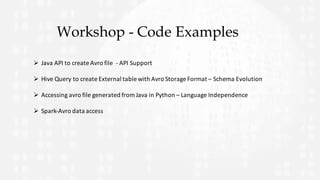
Workshop - Code Examples
Ø Java	API	to	create	Avro	file		- API	Support
Ø Hive	Query	to	create	External	table	with	Avro	Storage	Format	– Schema	Evolution
Ø Accessing	avro file	generated	from	Java	in	Python	– Language	Independence
Ø Spark-Avro	data	access
Few interesting things…
• Avro	Cli – Avro	Tools	jar	that	can	provide	some	command	line	help
• Thrift	and	Protocol	Buffers
• Kryo
• Jackson-avro-databind java	API
• Project	Kiji (	Schema	management	in	Hbase)
Please	drop	mail	for	support	if	you	have	any	issues	or	if	you	have	suggestions	on	Avro
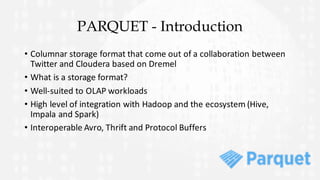
PARQUET - Introduction
• Columnar	storage	format	that	come	out	of	a	collaboration	between	
Twitter	and	Cloudera	based	on	Dremel
• What	is	a	storage	format?
• Well-suited	to	OLAP	workloads
• High	level	of	integration	with	Hadoop	and	the	ecosystem	(Hive,	
Impala	and	Spark)
• Interoperable	Avro,	Thrift	and	Protocol	Buffers
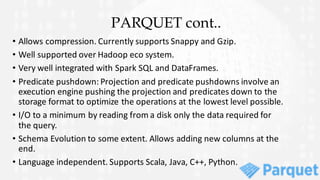
PARQUET cont..
• Allows	compression.	Currently	supports	Snappy	and	Gzip.
• Well	supported	over	Hadoop eco	system.	
• Very	well	integrated	with	Spark	SQL	and	DataFrames.
• Predicate	pushdown:	Projection	and	predicate	pushdowns	involve	an	
execution	engine	pushing	the	projection	and	predicates	down	to	the	
storage	format	to	optimize	the	operations	at	the	lowest	level	possible.
• I/O	to	a	minimum	by	reading	from	a	disk	only	the	data	required	for	
the	query.
• Schema	Evolution	to	some	extent.	Allows	adding	new	columns	at	the	
end.
• Language	independent.	Supports	Scala,	Java,	C++,	Python.
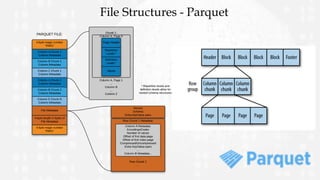
File Structures - Parquet
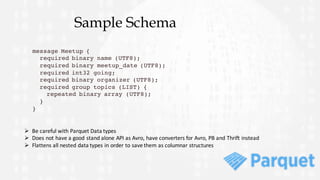
message Meetup {
required binary name (UTF8);
required binary meetup_date (UTF8);
required int32 going;
required binary organizer (UTF8);
required group topics (LIST) {
repeated binary array (UTF8);
}
}
Sample Schema
Ø Be	careful	with	Parquet	Data	types	
Ø Does	not	have	a	good	stand	alone	API	as	Avro,	have	converters	for	Avro,	PB	and	Thrift	instead
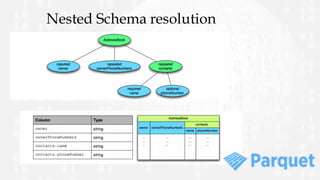
Ø Flattens	all	nested	data	types	in	order	to	save	them	as	columnar	structures
Nested Schema resolution
Parquet few important notes..
• Parquet	requires	a	lot	of	memory	when	writing	files	because	it	
buffers	writes	in	memory	to	optimize	the	encoding	and	
compressing	of	the	data
• Using	a	heavily	nested	data	structure	with	Parquet	will	likely	limit	
some	of	the	optimizations	that	Parquet	makes	for	pushdowns.	If	
possible,	try	to	flatten	your	schema
Code examples
• Java	API
• Spark	Example
• Kafka	Exmple
How to decide on storage format
• What	kind	of	data	you	have?
• What	is	the	processing	framework?	Future	and	Current
• Data	processing	and	querying
• Do	you	have	RPC/IPC
• How	much	schema	evolution	do	you	have?
Our experiences with Parquet and Avro
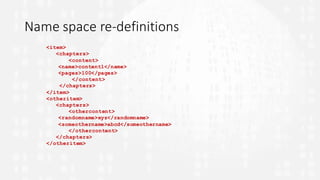
Name	space	re-definitions
<item>
<chapters>
<content>
<name>content1</name>
<pages>100</pages>
</content>
</chapters>
</item>
<otheritem>
<chapters>
<othercontent>
<randomname>xyz</randomname>
<someothername>abcd</someothername>
</othercontent>
</chapters>
</otheritem>
Is Agenda Accomplished..??
üAvro	and	Parquet	- When	and	Why	to	use	which	format?
üUse	cases	for	Schema	Evolution	&	practical	examples
üData	modeling	- Avro	and	Parquet	schema
üWorkshop
- Read	Avro	input	from	Kafka
- Transform	data	in	Spark
- Write	data	frame	to	Parquet
- Read	back	from	Parquet
üOur	experiences	with	Avro	and	Parquet
üSome	helpful	insights	for	projects	design
Questions… ????????
Notes
• https://dzone.com/articles/where-should-i-store-hadoop-data
• https://developer.ibm.com/hadoop/blog/2016/01/14/5-reasons-to-choose-parquet-for-spark-sql/
• http://www.slideshare.net/StampedeCon/choosing-an-hdfs-data-storage-format-avro-vs-parquet-and-more-stampedecon-2015
• http://parquet.apache.org/
• https://github.com/cloudera/parquet-examples
• http://avro.apache.org/docs/current/spec.html#schema_primitive
• http://www.michael-noll.com/blog/2013/03/17/reading-and-writing-avro-files-from-the-command-line/
• https://cwiki.apache.org/confluence/display/AVRO/FAQ
• http://avro.apache.org/
• https://github.com/miguno/avro-cli-examples
• http://avro.apache.org/docs/current/spec.html#schema_primitive
• https://dzone.com/articles/getting-started-apache-avro
• https://github.com/databricks/spark-avro
Notes
• https://github.com/twitter/bijection
• https://github.com/mkuthan/example-spark
• http://blog.cloudera.com/blog/2015/09/making-apache-spark-testing-easy-with-spark-testing-base/
• https://github.com/databricks/spark-avro/blob/master/README.md
• http://www.bigdatatidbits.cc/2015/01/how-to-load-some-avro-data-into-spark.html
• http://engineering.intenthq.com/2015/08/pucket/
• https://dzone.com/articles/understanding-how-parquet
• http://blog.cloudera.com/blog/2015/03/converting-apache-avro-data-to-parquet-format-in-apache-hadoop/
Our	Solutions	Team
o Prasad	Sripathi,	CEO,	Experienced	Big	Data	Architect,	Head	of	NJ	Data	Science	and	Hadoop	Meetups
o Sergey	Fogelson,	PhD,	Director,	Data	Science
o Eric	Marshall, Senior	Systems	Architect,	Hortonworks	Hadoop	Certified	Administrator
o Kristina	Rogale Plazonic,	Spark	Certified	Data	Engineer
o Ravi	Kora,	Spark	Certified	Senior	Data	Scientist
o Srinivasarao Daruna, Spark	Certified	Data	Engineer
o Srujana Kuntumalla,Spark	Certified	Data	Engineer
o Tim	Spann,Senior	Solutions	Architect,	ex-Pivotal
o Rajiv	Singla,	Data	Engineer
o Suresh	Kempula,	Data	Engineer
Technology Stack

Parquet and AVRO