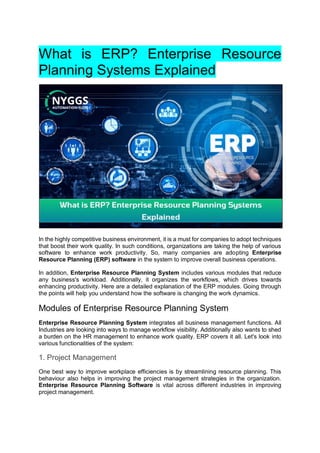
What is ERP? Enterprise Resource
Planning Systems Explained
In the highly competitive business environment, it is a must for companies to adopt techniques
that boost their work quality. In such conditions, organizations are taking the help of various
software to enhance work productivity. So, many companies are adopting Enterprise
Resource Planning (ERP) software in the system to improve overall business operations.
In addition, Enterprise Resource Planning System includes various modules that reduce
any business's workload. Additionally, it organizes the workflows, which drives towards
enhancing productivity. Here are a detailed explanation of the ERP modules. Going through
the points will help you understand how the software is changing the work dynamics.
Modules of Enterprise Resource Planning System
Enterprise Resource Planning System integrates all business management functions. All
Industries are looking into ways to manage workflow visibility. Additionally also wants to shed
a burden on the HR management to enhance work quality. ERP covers it all. Let's look into
various functionalities of the system:
1. Project Management
One best way to improve workplace efficiencies is by streamlining resource planning. This
behaviour also helps in improving the project management strategies in the organization.
Enterprise Resource Planning Software is vital across different industries in improving
project management.
ERP merges all aspects of a project into one centralized platform. The elements include
budget details, invoicing & billing, contracts, deadlines, and proposals. Moreover, this feature
also helps the entire team to stay updated.
Furthermore, it has been observed by the users that the software can assist in all stages of
project management. Project analysis, design, development, and ongoing maintenance are
all covered under ERP.
2. Supply Chain Management
In industries like e-commerce, construction supply chain management plays an integral role.
For instance, in e-commerce, retailers must source, store and deliver products managed under
the supply chain. Enterprise Resource Planning Software helps retailers optimize the supply
chain.
Also, the software helps keep track of warehouse management and logistics to ensure
delivery on customer expectations. Additionally, the software also keeps costs in check. ERP
solutions bring clear visibility to supply chain management.
Enterprise Resource Planning System gives access to real-time data across the supply
chain. This feature lets stakeholders make better decisions on how to take the process further.
It enables you to manage a clear path from procurement to inventory management.
Automation reduces human error and accelerates supply chain operations. Additionally, it
leads to both time and cost savings.
3. Inventory Management
From MSMEs to large-scale businesses having the right ERP solutions for your inventory
management is crucial. Work productivity is boosted by a system that tracks orders,
warehouses, and inventory. Consequently, this module in enterprise resource planning
software makes it all possible.
The ERP lets you manage all your sales and purchase actions. Optimizing the details allows
you easily track bills, invoices, and payments. Whereas you can even control and monitor
your stocks in different warehouses. With the help of the software, anyone can quickly track
item movements and generates detailed reports.
Moreover, optimizing the product details makes tracking saleable items, spare parts, and
expiry dates easy. Get accurate inventory ageing reports, vendor payments, sales details, and
inventory valuations with ERP.
4. Management Information System (MIS)
Every business needs a solution that enhances workflow visibility. Building better coordination
between multiple work sites is necessary to reduce confusion. Management Information
System in ERP offers that.
For instance, when we talk about the construction industry, they work on multiple sites. Here
the managers need to track sub-contractors and check on their plants and assets or building
materials. To manage all that, you require clear communication, which MIS enhances.
Certainly, updating the information manually can invite the chance of human errors. Enterprise
resource planning system lets you optimize databases and spreadsheets to reduce risks.
Under this feature, you can keep track of all available data and make a detailed report.
5. Customer Relationship Management
This feature in enterprise resource management is designed to foster customer interactions.
It includes features like lead management, customer service, and marketing automation.
Additionally, it also helps in developing customer analytics.
This module of ERP helps businesses enhance customer satisfaction. Which ultimately drives
sales growth at your organization. This feature allows companies to capture and track leads.
Besides, it also lets us view communication history and track opportunities. This feature helps
managers make informed decisions and close deals effectively.
Furthermore, with the help of the ERP, this feature teams can segment customers. It helps in
creating targeted campaigns and measuring campaign effectiveness. Ultimately resulting in
improved lead generation and conversion rates.
6. HR & Payroll Management
It is the most significant module of enterprise resource planning software. This feature is
becoming a shared vocabulary for HR personnel. Further, it simplifies all the processes and
enables handling HR functions using artificial intelligence.
The most significant feature of this module is payroll calculations. It has made tricky and
tedious calculations simplified for HRs. Payroll calculations can be challenging in industries
with high employee strength. Additionally, manual counts of such high strength can lead to
human mistakes. So, adopting this software in such places can be a thoughtful task.
Moreover, it reduces the extra administrative tasks the HR needs to perform. That indicates
they can focus more on building productivity in the organization. Some of the payroll modules
also contain the Aadhaar verification feature. It helps in blacklisting unworthy candidates.
7. Workforce Management
It is another vital feature of Enterprise Resource Planning System as it promotes efficient
workforce management and optimizes productivity. This solution helps organizations
automate the staff's time and efficiently deploy the labor force.
Additionally, automating all the data encourages employee and management self-service. It
promotes transparency in the working environment. This feature also ensures proper resource
allocation, which supports workforce efficiency.
In short, businesses can maximize employee productivity by streamlining the workforce
management process within ERP. It helps maintain labour regulations, ultimately increasing
organizational effectiveness and success.
Conclusion
By witnessing the features, we can conclude that Enterprise Resource Planning System is
revolutionizing the working of every industry. While different industries have different needs,
every company strives to stay ahead of the competition. And implementing ERP software
makes it possible to sustain a fiercely competitive environment.
Most of the administrative works are optimized, which helps businesses in focusing on
productivity. Additionally, streamlining the workforce and working environment helps make
informed decisions for the company. Ultimately it leads to making businesses stay ahead in
the game by overcoming all the shortcomings.

Enterprise Resource Planning System in Telangana

  • 1.
    What is ERP?Enterprise Resource Planning Systems Explained In the highly competitive business environment, it is a must for companies to adopt techniques that boost their work quality. In such conditions, organizations are taking the help of various software to enhance work productivity. So, many companies are adopting Enterprise Resource Planning (ERP) software in the system to improve overall business operations. In addition, Enterprise Resource Planning System includes various modules that reduce any business's workload. Additionally, it organizes the workflows, which drives towards enhancing productivity. Here are a detailed explanation of the ERP modules. Going through the points will help you understand how the software is changing the work dynamics. Modules of Enterprise Resource Planning System Enterprise Resource Planning System integrates all business management functions. All Industries are looking into ways to manage workflow visibility. Additionally also wants to shed a burden on the HR management to enhance work quality. ERP covers it all. Let's look into various functionalities of the system: 1. Project Management One best way to improve workplace efficiencies is by streamlining resource planning. This behaviour also helps in improving the project management strategies in the organization. Enterprise Resource Planning Software is vital across different industries in improving project management.
  • 2.
    ERP merges allaspects of a project into one centralized platform. The elements include budget details, invoicing & billing, contracts, deadlines, and proposals. Moreover, this feature also helps the entire team to stay updated. Furthermore, it has been observed by the users that the software can assist in all stages of project management. Project analysis, design, development, and ongoing maintenance are all covered under ERP. 2. Supply Chain Management In industries like e-commerce, construction supply chain management plays an integral role. For instance, in e-commerce, retailers must source, store and deliver products managed under the supply chain. Enterprise Resource Planning Software helps retailers optimize the supply chain. Also, the software helps keep track of warehouse management and logistics to ensure delivery on customer expectations. Additionally, the software also keeps costs in check. ERP solutions bring clear visibility to supply chain management. Enterprise Resource Planning System gives access to real-time data across the supply chain. This feature lets stakeholders make better decisions on how to take the process further. It enables you to manage a clear path from procurement to inventory management. Automation reduces human error and accelerates supply chain operations. Additionally, it leads to both time and cost savings. 3. Inventory Management From MSMEs to large-scale businesses having the right ERP solutions for your inventory management is crucial. Work productivity is boosted by a system that tracks orders, warehouses, and inventory. Consequently, this module in enterprise resource planning software makes it all possible. The ERP lets you manage all your sales and purchase actions. Optimizing the details allows you easily track bills, invoices, and payments. Whereas you can even control and monitor your stocks in different warehouses. With the help of the software, anyone can quickly track item movements and generates detailed reports. Moreover, optimizing the product details makes tracking saleable items, spare parts, and expiry dates easy. Get accurate inventory ageing reports, vendor payments, sales details, and inventory valuations with ERP. 4. Management Information System (MIS) Every business needs a solution that enhances workflow visibility. Building better coordination between multiple work sites is necessary to reduce confusion. Management Information System in ERP offers that. For instance, when we talk about the construction industry, they work on multiple sites. Here the managers need to track sub-contractors and check on their plants and assets or building materials. To manage all that, you require clear communication, which MIS enhances. Certainly, updating the information manually can invite the chance of human errors. Enterprise resource planning system lets you optimize databases and spreadsheets to reduce risks. Under this feature, you can keep track of all available data and make a detailed report.
  • 3.
    5. Customer RelationshipManagement This feature in enterprise resource management is designed to foster customer interactions. It includes features like lead management, customer service, and marketing automation. Additionally, it also helps in developing customer analytics. This module of ERP helps businesses enhance customer satisfaction. Which ultimately drives sales growth at your organization. This feature allows companies to capture and track leads. Besides, it also lets us view communication history and track opportunities. This feature helps managers make informed decisions and close deals effectively. Furthermore, with the help of the ERP, this feature teams can segment customers. It helps in creating targeted campaigns and measuring campaign effectiveness. Ultimately resulting in improved lead generation and conversion rates. 6. HR & Payroll Management It is the most significant module of enterprise resource planning software. This feature is becoming a shared vocabulary for HR personnel. Further, it simplifies all the processes and enables handling HR functions using artificial intelligence. The most significant feature of this module is payroll calculations. It has made tricky and tedious calculations simplified for HRs. Payroll calculations can be challenging in industries with high employee strength. Additionally, manual counts of such high strength can lead to human mistakes. So, adopting this software in such places can be a thoughtful task. Moreover, it reduces the extra administrative tasks the HR needs to perform. That indicates they can focus more on building productivity in the organization. Some of the payroll modules also contain the Aadhaar verification feature. It helps in blacklisting unworthy candidates. 7. Workforce Management It is another vital feature of Enterprise Resource Planning System as it promotes efficient workforce management and optimizes productivity. This solution helps organizations automate the staff's time and efficiently deploy the labor force. Additionally, automating all the data encourages employee and management self-service. It promotes transparency in the working environment. This feature also ensures proper resource allocation, which supports workforce efficiency. In short, businesses can maximize employee productivity by streamlining the workforce management process within ERP. It helps maintain labour regulations, ultimately increasing organizational effectiveness and success. Conclusion By witnessing the features, we can conclude that Enterprise Resource Planning System is revolutionizing the working of every industry. While different industries have different needs, every company strives to stay ahead of the competition. And implementing ERP software makes it possible to sustain a fiercely competitive environment. Most of the administrative works are optimized, which helps businesses in focusing on productivity. Additionally, streamlining the workforce and working environment helps make
  • 4.
    informed decisions forthe company. Ultimately it leads to making businesses stay ahead in the game by overcoming all the shortcomings.