Big Data Processing
January 2017
• Data Architect at unbelievable machine Company
• Software Engineering Background
• Jack of all Trades who also dives into Business topics,
Systems Engineering and Data Science.
• Big Data since 2011
• Cross-Industry: From Automotive to Transportation
• Other Activities
• Trainer: Hortonworks Apache Hadoop Certified Trainer
• Author: Articles and book projects
• Lector: Big Data at FH Technikum and FH Wiener Neustadt
Stefan Papp
Agenda
• Big Data Processing
• Evolution in Processing Big Data
• Data Processing Patterns
• Components of a Data Processing Engine
• Apache Spark
• Concept
• Ecosystem
• Apache Flink
• Concept
• Ecosystem
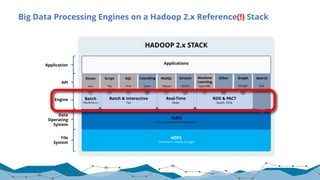
Big Data Processing Engines on a Hadoop 2.x Reference(!) Stack
HADOOP 2.x STACK
HDFS
(redundant, reliable storage)
YARN
(cluster resource management)
Batch
MapReduce
Direct
Java
Search
Solr
API
Engine
Data
Operating
System
File
System
Batch & Interactive
Tez
Script
Pig
SQL
Hive
Cascading
Java
Real-Time
Slider
NoSQL
HBase
Stream
Storm
RDD & PACT
Spark, Flink
Machine
Learning
SparkML
Other
Application
Graph
Giraph
Applications
Evolution
in Processing
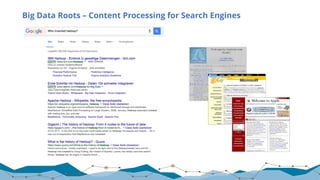
Big Data Roots – Content Processing for Search Engines
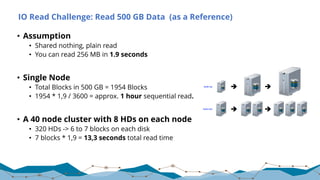
IO Read Challenge: Read 500 GB Data (as a Reference)
• Assumption
• Shared nothing, plain read
• You can read 256 MB in 1.9 seconds
• Single Node
• Total Blocks in 500 GB = 1954 Blocks
• 1954 * 1,9 / 3600 = approx. 1 hour sequential read.
• A 40 node cluster with 8 HDs on each node
• 320 HDs -> 6 to 7 blocks on each disk
• 7 blocks * 1,9 = 13,3 seconds total read time
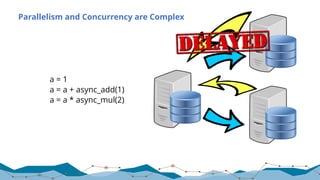
Parallelism and Concurrency are Complex
a = 1
a = a + async_add(1)
a = a * async_mul(2)
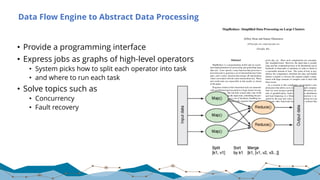
Data Flow Engine to Abstract Data Processing
• Provide a programming interface
• Express jobs as graphs of high-level operators
• System picks how to split each operator into task
• and where to run each task
• Solve topics such as
• Concurrency
• Fault recovery
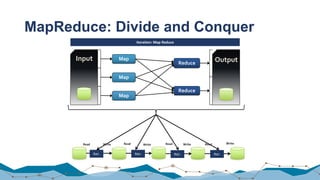
MapReduce: Divide and Conquer
Map
Map
Map
Reduce
Reduce
Input Output
Read Read Read ReadWrite Write Write Write
Iter. Iter. Iter. Iter.
Iteration:	Map	Reduce
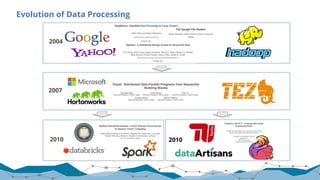
Evolution of Data Processing
2004
2007
2010 2010
Data Processing
Patterns
Classification and Processing Patterns
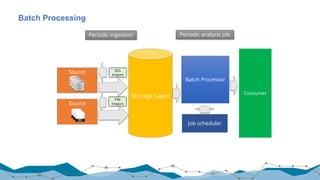
Batch Processing
14
Source
Source
Storage Layer
Periodic ingestion
Batch Processor
Periodic analysis job
Consumer
Job scheduler
SQL
Import
File
Import
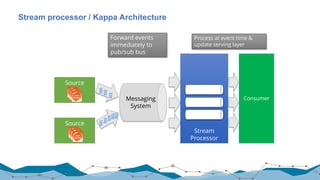
Stream processor / Kappa Architecture
15
Source
Source
Consumer
Forward events
immediately to
pub/sub bus
Stream
Processor
Process at event time &
update serving layer
Messaging
System
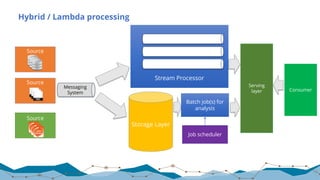
Hybrid / Lambda processing
16
Storage Layer
Batch job(s) for
analysis
Serving
layer
Job scheduler
Stream Processor
Messaging
System
Consumer
Source
Source
Source
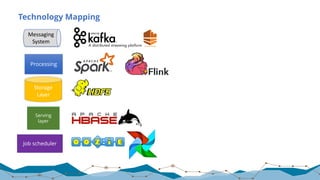
Technology Mapping
Messaging	
System
Storage	
Layer
Processing
Serving
layer
Job scheduler
Data Processing
Engines
Essential Components
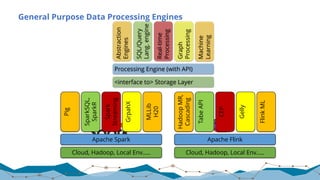
General Purpose Data Processing Engines
Processing Engine (with API)
Abstraction
Engines
SQL/Query
Lang.engine
Real-time
Processing
Machine
Learning
Graph
Processing
<interface to> Storage Layer
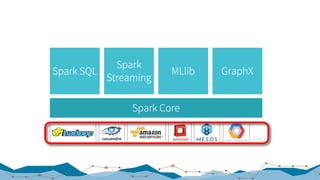
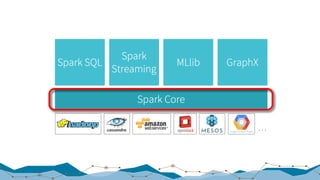
Apache Spark
Pig
SparkSQL,
SparkR
Spark
Streaming
MLLib
H20
GrpahX
Cloud, Hadoop, Local Env…..
Apache Flink
HadoopMR,
Cascading
TabeAPI
CEP
FlinkML
Gelly
Cloud, Hadoop, Local Env…..
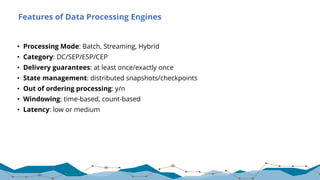
Features of Data Processing Engines
• Processing Mode: Batch, Streaming, Hybrid
• Category: DC/SEP/ESP/CEP
• Delivery guarantees: at least once/exactly once
• State management: distributed snapshots/checkpoints
• Out of ordering processing: y/n
• Windowing: time-based, count-based
• Latency: low or medium
Apache Spark
January 2017
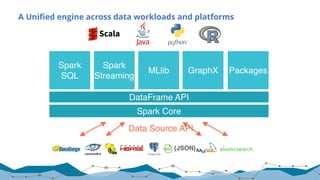
A Unified engine across data workloads and platforms
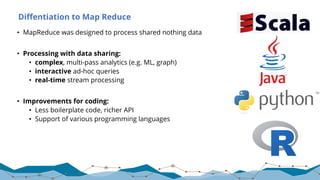
Diffentiation to Map Reduce
• MapReduce was designed to process shared nothing data
• Processing with data sharing:
• complex, multi-pass analytics (e.g. ML, graph)
• interactive ad-hoc queries
• real-time stream processing
• Improvements for coding:
• Less boilerplate code, richer API
• Support of various programming languages
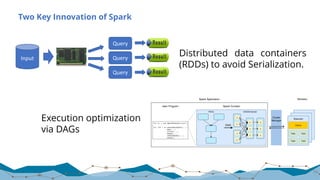
Two Key Innovation of Spark
24
Execution optimization
via DAGs
Distributed data containers
(RDDs) to avoid Serialization.
Query
Input
Query
Query
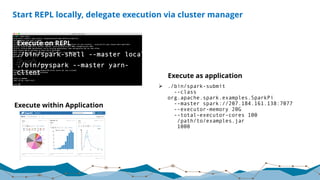
Start REPL locally, delegate execution via cluster manager
Execute on REPL
Ø ./bin/spark-shell --master local
Ø ./bin/pyspark --master yarn-
client
Execute as application
Ø ./bin/spark-submit
--class
org.apache.spark.examples.SparkPi
--master spark://207.184.161.138:7077
--executor-memory 20G
--total-executor-cores 100
/path/to/examples.jar
1000
Execute within Application
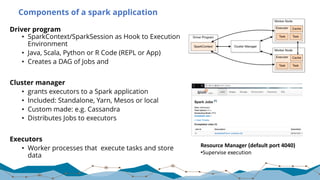
Components of a spark application
Driver program
• SparkContext/SparkSession as Hook to Execution
Environment
• Java, Scala, Python or R Code (REPL or App)
• Creates a DAG of Jobs and
Cluster manager
• grants executors to a Spark application
• Included: Standalone, Yarn, Mesos or local
• Custom made: e.g. Cassandra
• Distributes Jobs to executors
Executors
• Worker processes that execute tasks and store
data
Resource	Manager	(default	port	4040)
•Supervise	execution
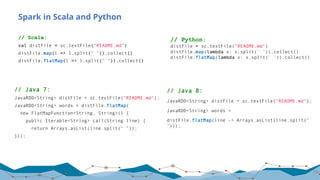
Spark in Scala and Python
// Scala:
val distFile = sc.textFile("README.md")
distFile.map(l => l.split(" ")).collect()
distFile.flatMap(l => l.split(" ")).collect()
29
// Python:
distFile = sc.textFile("README.md")
distFile.map(lambda x: x.split(' ')).collect()
distFile.flatMap(lambda x: x.split(' ')).collect()
// Java 7:
JavaRDD<String> distFile = sc.textFile("README.md");
JavaRDD<String> words = distFile.flatMap(
new FlatMapFunction<String, String>() {
public Iterable<String> call(String line) {
return Arrays.asList(line.split(" "));
}});
// Java 8:
JavaRDD<String> distFile = sc.textFile("README.md");
JavaRDD<String> words =
distFile.flatMap(line -> Arrays.asList(line.split("
")));
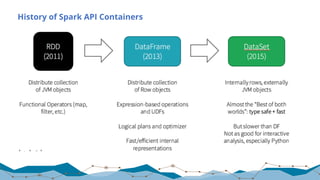
History of Spark API Containers
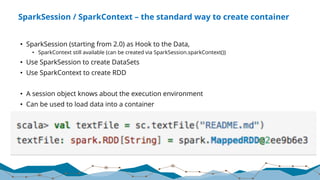
SparkSession / SparkContext – the standard way to create container
• SparkSession (starting from 2.0) as Hook to the Data,
• SparkContext still available (can be created via SparkSession.sparkContext())
• Use SparkSession to create DataSets
• Use SparkContext to create RDD
• A session object knows about the execution environment
• Can be used to load data into a container
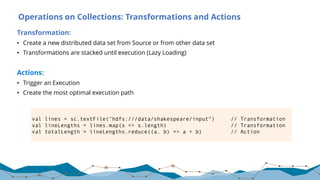
Operations on Collections: Transformations and Actions
val lines = sc.textFile("hdfs:///data/shakespeare/input") // Transformation
val lineLengths = lines.map(s => s.length) // Transformation
val totalLength = lineLengths.reduce((a, b) => a + b) // Action
Transformation:
• Create a new distributed data set from Source or from other data set
• Transformations are stacked until execution (Lazy Loading)
Actions:
• Trigger an Execution
• Create the most optimal execution path
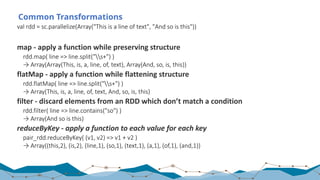
Common Transformations
val	rdd	=	sc.parallelize(Array("This	is	a	line	of	text",	"And	so	is	this"))
map	- apply	a	function	while	preserving	structure
rdd.map(	line	=>	line.split("s+")	)	
→	Array(Array(This,	is,	a,	line,	of,	text),	Array(And,	so,	is,	this))
flatMap	- apply	a	function	while	flattening	structure
rdd.flatMap(	line	=>	line.split("s+")	)	
→	Array(This,	is,	a,	line,	of,	text,	And,	so,	is,	this)	
filter	- discard	elements	from	an	RDD	which	don’t	match	a	condition
rdd.filter(	line	=>	line.contains("so")	)	
→	Array(And	so	is	this)
reduceByKey - apply a	function to each value for each key
pair_rdd.reduceByKey(	(v1,	v2)	=>	v1	+	v2	)	
→	Array((this,2),	(is,2),	(line,1),	(so,1),	(text,1),	(a,1),	(of,1),	(and,1))
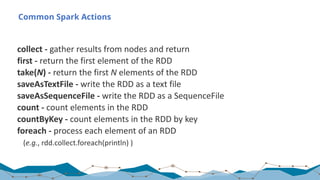
Common Spark Actions
collect	- gather	results	from	nodes	and	return
first	- return	the	first	element	of	the	RDD
take(N)	- return	the	first	N elements	of	the	RDD
saveAsTextFile	- write	the	RDD	as	a	text	file
saveAsSequenceFile	- write	the	RDD	as	a	SequenceFile
count	- count	elements	in	the	RDD
countByKey	- count	elements	in	the	RDD	by	key
foreach	- process	each	element	of	an	RDD	
(e.g.,	rdd.collect.foreach(println)	)
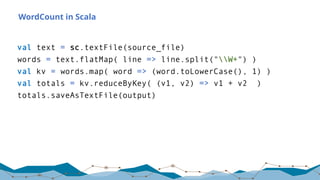
WordCount in Scala
val text = sc.textFile(source_file)
words = text.flatMap( line => line.split("W+") )
val kv = words.map( word => (word.toLowerCase(), 1) )
val totals = kv.reduceByKey( (v1, v2) => v1 + v2 )
totals.saveAsTextFile(output)
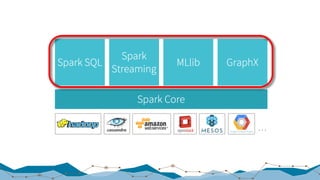
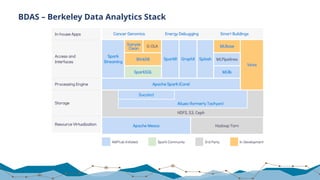
BDAS – Berkeley Data Analytics Stack
How to use SQL on Spark
• Spark SQL: Component direct on the Berkeley ecosystem
• Hive on Spark: Use Spark as execution engine for hive
• BlinkDB: Approximate SQL Engine
Spark SQL
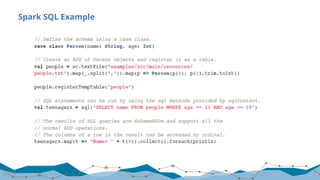
Spark SQL uses DataFrames (Typed Data Containers) for SQL
Hive:
c = HiveContext(sc)
rows = c.sql(“select * from titanic”)
rows.filter(rows[‘age’] > 25).show()
JSON:
c.read.format(‘json’).load(’file:///root/tweets.json”).registerTe
mpTable(“tweets”)
c.sql(“select text, user.name from tweets”)
39
28.01.17
Spark SQL Example
40
28.01.17
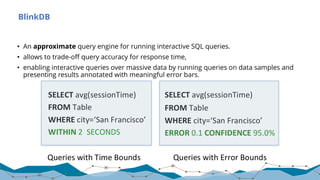
BlinkDB
• An approximate query engine for running interactive SQL queries.
• allows to trade-off query accuracy for response time,
• enabling interactive queries over massive data by running queries on data samples and
presenting results annotated with meaningful error bars.
Streaming
Spark Streaming and Structured Streaming
Spark Streaming
Streaming on RDDs
Structured Streaming
Streaming on DataFrames
Machine Learning and Graph
Analytics
SparkML, Spark MLLib, GraphX, GraphFrames,
Typical Use Cases
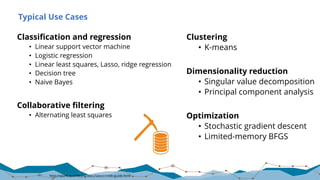
Classification and regression
• Linear support vector machine
• Logistic regression
• Linear least squares, Lasso, ridge regression
• Decision tree
• Naive Bayes
Collaborative filtering
• Alternating least squares
Clustering
• K-means
Dimensionality reduction
• Singular value decomposition
• Principal component analysis
Optimization
• Stochastic gradient descent
• Limited-memory BFGS
http://spark.apache.org/docs/latest/mllib-guide.html
MLLIb and H2O
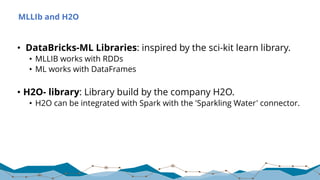
• DataBricks-ML Libraries: inspired by the sci-kit learn library.
• MLLIB works with RDDs
• ML works with DataFrames
• H2O- library: Library build by the company H2O.
• H2O can be integrated with Spark with the 'Sparkling Water' connector.
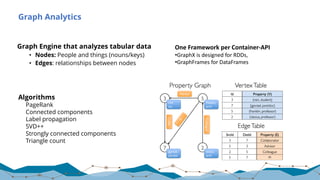
Graph Analytics
Graph Engine that analyzes tabular data
• Nodes: People and things (nouns/keys)
• Edges: relationships between nodes
Algorithms
PageRank
Connected components
Label propagation
SVD++
Strongly connected components
Triangle count
One	Framework	per	Container-API
•GraphX is	designed	for	RDDs,	
•GraphFrames for	DataFrames
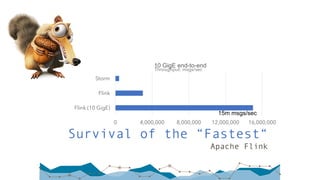
Survival of the “Fastest“
Apache Flink
0 4,000,000 8,000,000 12,000,000 16,000,000
Storm
Flink
Flink (10 GigE)
Throughput: msgs/sec
10 GigE end-to-end
15m msgs/sec
49
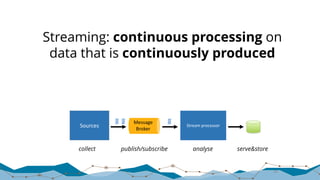
Streaming: continuous processing on
data that is continuously produced
Sources
Message	
Broker
Stream	processor
collect publish/subscribe analyse serve&store
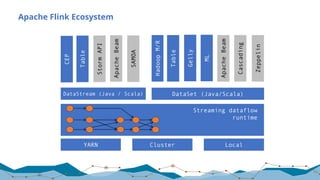
Apache Flink Ecosystem
50
Gelly
Table
ML
SAMOA
DataSet (Java/Scala)DataStream (Java / Scala)
HadoopM/R
LocalClusterYARN
ApacheBeam
ApacheBeam
Table
Cascading
Streaming dataflow
runtime
StormAPI
Zeppelin
CEP
Expressive APIs
51
case class Word (word: String, frequency: Int)
val lines: DataStream[String] = env.fromSocketStream(...)
lines.flatMap {line => line.split(" ")
.map(word => Word(word,1))}
.window(Time.of(5,SECONDS)).every(Time.of(1,SECONDS))
.groupBy("word").sum("frequency")
.print()
val lines: DataSet[String] = env.readTextFile(...)
lines.flatMap {line => line.split(" ")
.map(word => Word(word,1))}
.groupBy("word").sum("frequency")
.print()
DataSet API (batch):
DataStream API (streaming):
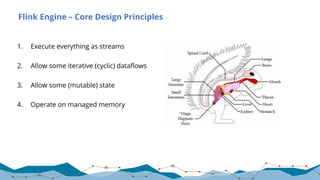
Flink Engine – Core Design Principles
1. Execute everything as streams
2. Allow some iterative (cyclic) dataflows
3. Allow some (mutable) state
4. Operate on managed memory
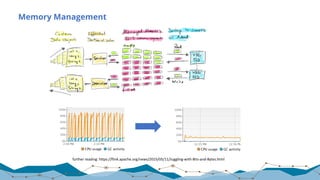
Memory Management
further	reading:	https://flink.apache.org/news/2015/05/11/Juggling-with-Bits-and-Bytes.html
54
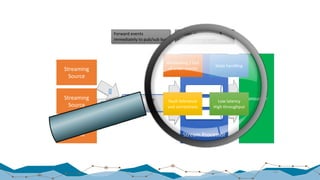
Streaming	
Source
Streaming	
Source
Streaming	
Source
Consumer
Forward	events	
immediately	to	pub/sub	bus
Stream	Processor
Process	at	event	time	&	
update	serving	layer
Message	
Broker
Low	latency
High	throughput
Windowing	/	Out	
of	order	events
State	handling
Fault	tolerance	
and	correctness
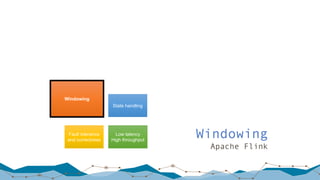
Windowing
Apache Flink
Low latency
High throughput
State handling
Windowing
Fault tolerance
and correctness
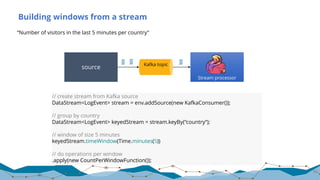
Building windows from a stream
“Number of visitors in the last 5 minutes per country”
56
source
Kafka topic
Stream processor
// create stream from Kafka source
DataStream<LogEvent> stream = env.addSource(new KafkaConsumer());
// group by country
DataStream<LogEvent> keyedStream = stream.keyBy(“country“);
// window of size 5 minutes
keyedStream.timeWindow(Time.minutes(5))
// do operations per window
.apply(new CountPerWindowFunction());
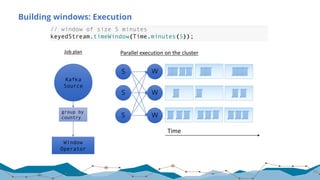
Building windows: Execution
57
Kafka
Source
Window
Operator
S
S
S
W
W
W
group by
country
// window of size 5 minutes
keyedStream.timeWindow(Time.minutes(5));
Job	plan Parallel	execution	on	the	cluster
Time
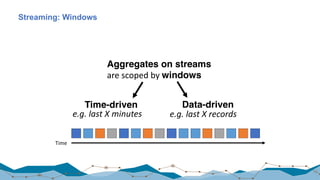
Streaming: Windows
58
Time
Aggregates on streams
are	scoped	by	windows
Time-driven Data-driven
e.g.	last	X	minutes e.g.	last	X	records
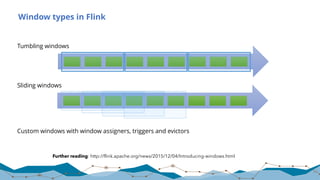
Window types in Flink
Tumbling windows
Sliding windows
Custom windows with window assigners, triggers and evictors
59
Further reading: http://flink.apache.org/news/2015/12/04/Introducing-windows.html
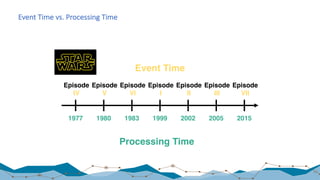
1977 1980 1983 1999 2002 2005 2015
Processing Time
Episode
IV
Episode
V
Episode
VI
Episode
I
Episode
II
Episode
III
Episode
VII
Event Time
Event Time	vs.	Processing	Time
60
State Handling
Apache Flink
Low	latency
High	throughput
State	handling
Windowing
Fault	tolerance	
and	correctness
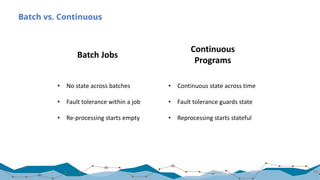
Batch vs. Continuous
62
• No	state	across	batches
• Fault	tolerance	within	a	job
• Re-processing	starts	empty
Batch	Jobs
Continuous	
Programs
• Continuous	state	across	time
• Fault	tolerance	guards	state
• Reprocessing	starts	stateful
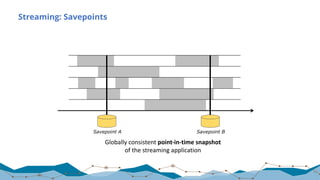
Streaming: Savepoints
63
Savepoint A Savepoint B
Globally	consistent	point-in-time	snapshot
of	the	streaming	application
Re-processing data (continuous)
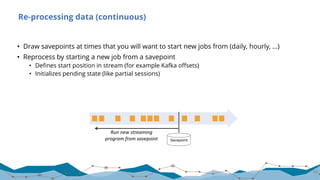
• Draw savepoints at times that you will want to start new jobs from (daily, hourly, …)
• Reprocess by starting a new job from a savepoint
• Defines start position in stream (for example Kafka offsets)
• Initializes pending state (like partial sessions)
64
Savepoint
Run	new	streaming
program	from	savepoint
Stream	processor:	Flink
Managed state in Flink
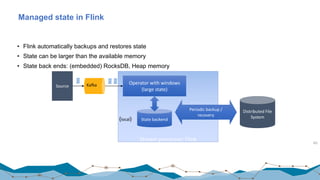
• Flink automatically backups and restores state
• State can be larger than the available memory
• State back ends: (embedded) RocksDB, Heap memory
65
Operator	with	windows	
(large	state)
State	backend(local)
Distributed	File	
System
Periodic	backup	/
recovery
Source Kafka
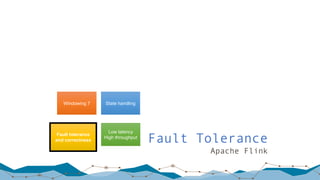
Fault Tolerance
Apache Flink
Low latency
High throughput
State handlingWindowing 7
Fault tolerance
and correctness
Fault tolerance in streaming
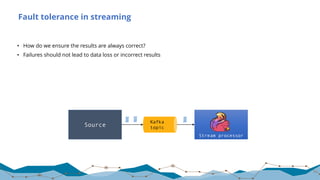
• How do we ensure the results are always correct?
• Failures should not lead to data loss or incorrect results
67
Source
Kafka
topic
Stream processor
Fault tolerance in streaming
• At least once: ensure all events are transmitted
• May lead to duplicates
• At most once: ensure that a known state of data is transmitted
• May lead to data loss
• Exactly once: ensure that operators do not perform duplicate updates to their state
• Flink achieves exactly once with Distributed Snapshots
Low Latency
Apache Flink
Low latency
High throughput
State handlingWindowing
Fault tolerance
and correctness
Yahoo! Benchmark
• Count ad impressions grouped by campaign
• Compute aggregates over a 10 second window
• Emit window aggregates to Redis every second for query
70
Full Yahoo! article: https://yahooeng.tumblr.com/post/135321837876/benchmarking-
streaming-computation-engines-at
“Storm […] and Flink […] show sub-second latencies at relatively high
throughputs with Storm having the lowest 99th percentile latency.
Spark streaming 1.5.1 supports high throughputs, but at a relatively higher
latency.”
(Quote from the blog post’s executive summary)
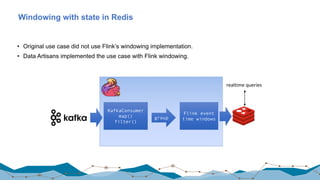
Windowing with state in Redis
• Original use case did not use Flink’s windowing implementation.
• Data Artisans implemented the use case with Flink windowing.
71
KafkaConsumer
map()
filter()
group
Flink event
time windows
realtime queries
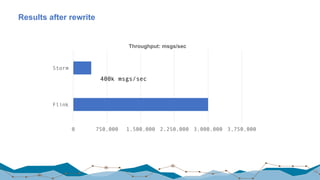
Results after rewrite
72
0 750,000 1,500,000 2,250,000 3,000,000 3,750,000
Storm
Flink
Throughput: msgs/sec
400k msgs/sec
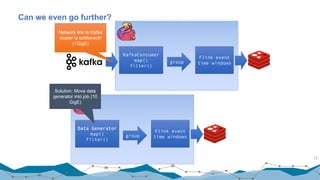
Can we even go further?
73
KafkaConsumer
map()
filter()
group
Flink event
time windows
Network link to Kafka
cluster is bottleneck!
(1GigE)
Data Generator
map()
filter()
group
Flink event
time windows
Solution: Move data
generator into job (10
GigE)
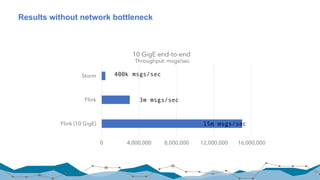
Results without network bottleneck
74
0 4,000,000 8,000,000 12,000,000 16,000,000
Storm
Flink
Flink (10 GigE)
Throughput: msgs/sec
10 GigE end-to-end
15m msgs/sec
400k msgs/sec
3m msgs/sec
Survival of the Fastest – Flink Performance
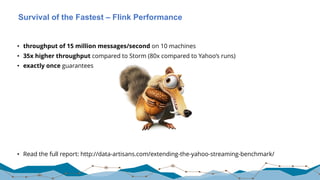
• throughput of 15 million messages/second on 10 machines
• 35x higher throughput compared to Storm (80x compared to Yahoo’s runs)
• exactly once guarantees
• Read the full report: http://data-artisans.com/extending-the-yahoo-streaming-benchmark/
The	unbelievable Machine Company	GmbH
Museumsplatz 1/10/13	
1070	Wien
Contact:
Stefan	Papp,	Data	Architect
stefan.papp@unbelievable-machine.com
Tel.	+43	- 1	- 361	99	77	- 215	
Mobile:	+43	664	2614367

20170126 big data processing

  • 1.
  • 2.
    • Data Architectat unbelievable machine Company • Software Engineering Background • Jack of all Trades who also dives into Business topics, Systems Engineering and Data Science. • Big Data since 2011 • Cross-Industry: From Automotive to Transportation • Other Activities • Trainer: Hortonworks Apache Hadoop Certified Trainer • Author: Articles and book projects • Lector: Big Data at FH Technikum and FH Wiener Neustadt Stefan Papp
  • 3.
    Agenda • Big DataProcessing • Evolution in Processing Big Data • Data Processing Patterns • Components of a Data Processing Engine • Apache Spark • Concept • Ecosystem • Apache Flink • Concept • Ecosystem
  • 4.
    Big Data ProcessingEngines on a Hadoop 2.x Reference(!) Stack HADOOP 2.x STACK HDFS (redundant, reliable storage) YARN (cluster resource management) Batch MapReduce Direct Java Search Solr API Engine Data Operating System File System Batch & Interactive Tez Script Pig SQL Hive Cascading Java Real-Time Slider NoSQL HBase Stream Storm RDD & PACT Spark, Flink Machine Learning SparkML Other Application Graph Giraph Applications
  • 5.
  • 6.
    Big Data Roots– Content Processing for Search Engines
  • 7.
    IO Read Challenge:Read 500 GB Data (as a Reference) • Assumption • Shared nothing, plain read • You can read 256 MB in 1.9 seconds • Single Node • Total Blocks in 500 GB = 1954 Blocks • 1954 * 1,9 / 3600 = approx. 1 hour sequential read. • A 40 node cluster with 8 HDs on each node • 320 HDs -> 6 to 7 blocks on each disk • 7 blocks * 1,9 = 13,3 seconds total read time
  • 8.
    Parallelism and Concurrencyare Complex a = 1 a = a + async_add(1) a = a * async_mul(2)
  • 9.
    Data Flow Engineto Abstract Data Processing • Provide a programming interface • Express jobs as graphs of high-level operators • System picks how to split each operator into task • and where to run each task • Solve topics such as • Concurrency • Fault recovery
  • 10.
    MapReduce: Divide andConquer Map Map Map Reduce Reduce Input Output Read Read Read ReadWrite Write Write Write Iter. Iter. Iter. Iter. Iteration: Map Reduce
  • 12.
    Evolution of DataProcessing 2004 2007 2010 2010
  • 13.
  • 14.
    Batch Processing 14 Source Source Storage Layer Periodicingestion Batch Processor Periodic analysis job Consumer Job scheduler SQL Import File Import
  • 15.
    Stream processor /Kappa Architecture 15 Source Source Consumer Forward events immediately to pub/sub bus Stream Processor Process at event time & update serving layer Messaging System
  • 16.
    Hybrid / Lambdaprocessing 16 Storage Layer Batch job(s) for analysis Serving layer Job scheduler Stream Processor Messaging System Consumer Source Source Source
  • 17.
  • 18.
  • 19.
    General Purpose DataProcessing Engines Processing Engine (with API) Abstraction Engines SQL/Query Lang.engine Real-time Processing Machine Learning Graph Processing <interface to> Storage Layer Apache Spark Pig SparkSQL, SparkR Spark Streaming MLLib H20 GrpahX Cloud, Hadoop, Local Env….. Apache Flink HadoopMR, Cascading TabeAPI CEP FlinkML Gelly Cloud, Hadoop, Local Env…..
  • 20.
    Features of DataProcessing Engines • Processing Mode: Batch, Streaming, Hybrid • Category: DC/SEP/ESP/CEP • Delivery guarantees: at least once/exactly once • State management: distributed snapshots/checkpoints • Out of ordering processing: y/n • Windowing: time-based, count-based • Latency: low or medium
  • 21.
  • 22.
    A Unified engineacross data workloads and platforms
  • 23.
    Diffentiation to MapReduce • MapReduce was designed to process shared nothing data • Processing with data sharing: • complex, multi-pass analytics (e.g. ML, graph) • interactive ad-hoc queries • real-time stream processing • Improvements for coding: • Less boilerplate code, richer API • Support of various programming languages
  • 24.
    Two Key Innovationof Spark 24 Execution optimization via DAGs Distributed data containers (RDDs) to avoid Serialization. Query Input Query Query
  • 26.
    Start REPL locally,delegate execution via cluster manager Execute on REPL Ø ./bin/spark-shell --master local Ø ./bin/pyspark --master yarn- client Execute as application Ø ./bin/spark-submit --class org.apache.spark.examples.SparkPi --master spark://207.184.161.138:7077 --executor-memory 20G --total-executor-cores 100 /path/to/examples.jar 1000 Execute within Application
  • 27.
    Components of aspark application Driver program • SparkContext/SparkSession as Hook to Execution Environment • Java, Scala, Python or R Code (REPL or App) • Creates a DAG of Jobs and Cluster manager • grants executors to a Spark application • Included: Standalone, Yarn, Mesos or local • Custom made: e.g. Cassandra • Distributes Jobs to executors Executors • Worker processes that execute tasks and store data Resource Manager (default port 4040) •Supervise execution
  • 29.
    Spark in Scalaand Python // Scala: val distFile = sc.textFile("README.md") distFile.map(l => l.split(" ")).collect() distFile.flatMap(l => l.split(" ")).collect() 29 // Python: distFile = sc.textFile("README.md") distFile.map(lambda x: x.split(' ')).collect() distFile.flatMap(lambda x: x.split(' ')).collect() // Java 7: JavaRDD<String> distFile = sc.textFile("README.md"); JavaRDD<String> words = distFile.flatMap( new FlatMapFunction<String, String>() { public Iterable<String> call(String line) { return Arrays.asList(line.split(" ")); }}); // Java 8: JavaRDD<String> distFile = sc.textFile("README.md"); JavaRDD<String> words = distFile.flatMap(line -> Arrays.asList(line.split(" ")));
  • 30.
    History of SparkAPI Containers
  • 31.
    SparkSession / SparkContext– the standard way to create container • SparkSession (starting from 2.0) as Hook to the Data, • SparkContext still available (can be created via SparkSession.sparkContext()) • Use SparkSession to create DataSets • Use SparkContext to create RDD • A session object knows about the execution environment • Can be used to load data into a container
  • 32.
    Operations on Collections:Transformations and Actions val lines = sc.textFile("hdfs:///data/shakespeare/input") // Transformation val lineLengths = lines.map(s => s.length) // Transformation val totalLength = lineLengths.reduce((a, b) => a + b) // Action Transformation: • Create a new distributed data set from Source or from other data set • Transformations are stacked until execution (Lazy Loading) Actions: • Trigger an Execution • Create the most optimal execution path
  • 33.
    Common Transformations val rdd = sc.parallelize(Array("This is a line of text", "And so is this")) map - apply a function while preserving structure rdd.map( line => line.split("s+") ) → Array(Array(This, is, a, line, of, text), Array(And, so, is, this)) flatMap -apply a function while flattening structure rdd.flatMap( line => line.split("s+") ) → Array(This, is, a, line, of, text, And, so, is, this) filter - discard elements from an RDD which don’t match a condition rdd.filter( line => line.contains("so") ) → Array(And so is this) reduceByKey - apply a function to each value for each key pair_rdd.reduceByKey( (v1, v2) => v1 + v2 ) → Array((this,2), (is,2), (line,1), (so,1), (text,1), (a,1), (of,1), (and,1))
  • 34.
    Common Spark Actions collect -gather results from nodes and return first - return the first element of the RDD take(N) - return the first N elements of the RDD saveAsTextFile - write the RDD as a text file saveAsSequenceFile - write the RDD as a SequenceFile count - count elements in the RDD countByKey - count elements in the RDD by key foreach - process each element of an RDD (e.g., rdd.collect.foreach(println) )
  • 35.
    WordCount in Scala valtext = sc.textFile(source_file) words = text.flatMap( line => line.split("W+") ) val kv = words.map( word => (word.toLowerCase(), 1) ) val totals = kv.reduceByKey( (v1, v2) => v1 + v2 ) totals.saveAsTextFile(output)
  • 37.
    BDAS – BerkeleyData Analytics Stack
  • 38.
    How to useSQL on Spark • Spark SQL: Component direct on the Berkeley ecosystem • Hive on Spark: Use Spark as execution engine for hive • BlinkDB: Approximate SQL Engine
  • 39.
    Spark SQL Spark SQLuses DataFrames (Typed Data Containers) for SQL Hive: c = HiveContext(sc) rows = c.sql(“select * from titanic”) rows.filter(rows[‘age’] > 25).show() JSON: c.read.format(‘json’).load(’file:///root/tweets.json”).registerTe mpTable(“tweets”) c.sql(“select text, user.name from tweets”) 39 28.01.17
  • 40.
  • 41.
    BlinkDB • An approximatequery engine for running interactive SQL queries. • allows to trade-off query accuracy for response time, • enabling interactive queries over massive data by running queries on data samples and presenting results annotated with meaningful error bars.
  • 42.
    Streaming Spark Streaming andStructured Streaming
  • 43.
    Spark Streaming Streaming onRDDs Structured Streaming Streaming on DataFrames
  • 44.
    Machine Learning andGraph Analytics SparkML, Spark MLLib, GraphX, GraphFrames,
  • 45.
    Typical Use Cases Classificationand regression • Linear support vector machine • Logistic regression • Linear least squares, Lasso, ridge regression • Decision tree • Naive Bayes Collaborative filtering • Alternating least squares Clustering • K-means Dimensionality reduction • Singular value decomposition • Principal component analysis Optimization • Stochastic gradient descent • Limited-memory BFGS http://spark.apache.org/docs/latest/mllib-guide.html
  • 46.
    MLLIb and H2O •DataBricks-ML Libraries: inspired by the sci-kit learn library. • MLLIB works with RDDs • ML works with DataFrames • H2O- library: Library build by the company H2O. • H2O can be integrated with Spark with the 'Sparkling Water' connector.
  • 47.
    Graph Analytics Graph Enginethat analyzes tabular data • Nodes: People and things (nouns/keys) • Edges: relationships between nodes Algorithms PageRank Connected components Label propagation SVD++ Strongly connected components Triangle count One Framework per Container-API •GraphX is designed for RDDs, •GraphFrames for DataFrames
  • 48.
    Survival of the“Fastest“ Apache Flink 0 4,000,000 8,000,000 12,000,000 16,000,000 Storm Flink Flink (10 GigE) Throughput: msgs/sec 10 GigE end-to-end 15m msgs/sec
  • 49.
    49 Streaming: continuous processingon data that is continuously produced Sources Message Broker Stream processor collect publish/subscribe analyse serve&store
  • 50.
    Apache Flink Ecosystem 50 Gelly Table ML SAMOA DataSet(Java/Scala)DataStream (Java / Scala) HadoopM/R LocalClusterYARN ApacheBeam ApacheBeam Table Cascading Streaming dataflow runtime StormAPI Zeppelin CEP
  • 51.
    Expressive APIs 51 case classWord (word: String, frequency: Int) val lines: DataStream[String] = env.fromSocketStream(...) lines.flatMap {line => line.split(" ") .map(word => Word(word,1))} .window(Time.of(5,SECONDS)).every(Time.of(1,SECONDS)) .groupBy("word").sum("frequency") .print() val lines: DataSet[String] = env.readTextFile(...) lines.flatMap {line => line.split(" ") .map(word => Word(word,1))} .groupBy("word").sum("frequency") .print() DataSet API (batch): DataStream API (streaming):
  • 52.
    Flink Engine –Core Design Principles 1. Execute everything as streams 2. Allow some iterative (cyclic) dataflows 3. Allow some (mutable) state 4. Operate on managed memory
  • 53.
  • 54.
  • 55.
    Windowing Apache Flink Low latency Highthroughput State handling Windowing Fault tolerance and correctness
  • 56.
    Building windows froma stream “Number of visitors in the last 5 minutes per country” 56 source Kafka topic Stream processor // create stream from Kafka source DataStream<LogEvent> stream = env.addSource(new KafkaConsumer()); // group by country DataStream<LogEvent> keyedStream = stream.keyBy(“country“); // window of size 5 minutes keyedStream.timeWindow(Time.minutes(5)) // do operations per window .apply(new CountPerWindowFunction());
  • 57.
    Building windows: Execution 57 Kafka Source Window Operator S S S W W W groupby country // window of size 5 minutes keyedStream.timeWindow(Time.minutes(5)); Job plan Parallel execution on the cluster Time
  • 58.
    Streaming: Windows 58 Time Aggregates onstreams are scoped by windows Time-driven Data-driven e.g. last X minutes e.g. last X records
  • 59.
    Window types inFlink Tumbling windows Sliding windows Custom windows with window assigners, triggers and evictors 59 Further reading: http://flink.apache.org/news/2015/12/04/Introducing-windows.html
  • 60.
    1977 1980 19831999 2002 2005 2015 Processing Time Episode IV Episode V Episode VI Episode I Episode II Episode III Episode VII Event Time Event Time vs. Processing Time 60
  • 61.
  • 62.
    Batch vs. Continuous 62 •No state across batches • Fault tolerance within a job • Re-processing starts empty Batch Jobs Continuous Programs • Continuous state across time • Fault tolerance guards state • Reprocessing starts stateful
  • 63.
    Streaming: Savepoints 63 Savepoint ASavepoint B Globally consistent point-in-time snapshot of the streaming application
  • 64.
    Re-processing data (continuous) •Draw savepoints at times that you will want to start new jobs from (daily, hourly, …) • Reprocess by starting a new job from a savepoint • Defines start position in stream (for example Kafka offsets) • Initializes pending state (like partial sessions) 64 Savepoint Run new streaming program from savepoint
  • 65.
    Stream processor: Flink Managed state inFlink • Flink automatically backups and restores state • State can be larger than the available memory • State back ends: (embedded) RocksDB, Heap memory 65 Operator with windows (large state) State backend(local) Distributed File System Periodic backup / recovery Source Kafka
  • 66.
    Fault Tolerance Apache Flink Lowlatency High throughput State handlingWindowing 7 Fault tolerance and correctness
  • 67.
    Fault tolerance instreaming • How do we ensure the results are always correct? • Failures should not lead to data loss or incorrect results 67 Source Kafka topic Stream processor
  • 68.
    Fault tolerance instreaming • At least once: ensure all events are transmitted • May lead to duplicates • At most once: ensure that a known state of data is transmitted • May lead to data loss • Exactly once: ensure that operators do not perform duplicate updates to their state • Flink achieves exactly once with Distributed Snapshots
  • 69.
    Low Latency Apache Flink Lowlatency High throughput State handlingWindowing Fault tolerance and correctness
  • 70.
    Yahoo! Benchmark • Countad impressions grouped by campaign • Compute aggregates over a 10 second window • Emit window aggregates to Redis every second for query 70 Full Yahoo! article: https://yahooeng.tumblr.com/post/135321837876/benchmarking- streaming-computation-engines-at “Storm […] and Flink […] show sub-second latencies at relatively high throughputs with Storm having the lowest 99th percentile latency. Spark streaming 1.5.1 supports high throughputs, but at a relatively higher latency.” (Quote from the blog post’s executive summary)
  • 71.
    Windowing with statein Redis • Original use case did not use Flink’s windowing implementation. • Data Artisans implemented the use case with Flink windowing. 71 KafkaConsumer map() filter() group Flink event time windows realtime queries
  • 72.
    Results after rewrite 72 0750,000 1,500,000 2,250,000 3,000,000 3,750,000 Storm Flink Throughput: msgs/sec 400k msgs/sec
  • 73.
    Can we evengo further? 73 KafkaConsumer map() filter() group Flink event time windows Network link to Kafka cluster is bottleneck! (1GigE) Data Generator map() filter() group Flink event time windows Solution: Move data generator into job (10 GigE)
  • 74.
    Results without networkbottleneck 74 0 4,000,000 8,000,000 12,000,000 16,000,000 Storm Flink Flink (10 GigE) Throughput: msgs/sec 10 GigE end-to-end 15m msgs/sec 400k msgs/sec 3m msgs/sec
  • 75.
    Survival of theFastest – Flink Performance • throughput of 15 million messages/second on 10 machines • 35x higher throughput compared to Storm (80x compared to Yahoo’s runs) • exactly once guarantees • Read the full report: http://data-artisans.com/extending-the-yahoo-streaming-benchmark/
  • 76.
    The unbelievable Machine Company GmbH Museumsplatz1/10/13 1070 Wien Contact: Stefan Papp, Data Architect stefan.papp@unbelievable-machine.com Tel. +43 - 1 - 361 99 77 - 215 Mobile: +43 664 2614367