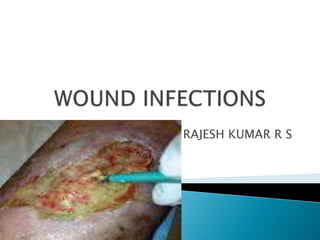
RAJESH KUMAR R S
 The accumulation of pus, either within an
abscess or exuding from a sinus tract or from
a mucocutaneous surface, is one of the
cardinal indicators of local sepsis.
 Redness, pain and swelling
 Liable to contamination from body surface &
environment
 Contaminants relatively low numbers
 Infection occurs if contaminants evades the
host’s defence
 Multiplication of commensal may be
colonization
 Virulence and resistance determines infection
 Exogenous Wound Infections
 Endogenous Wound Infections
 Source of infection is outside the body of the
patient.
 Traumatic injury
Decubitus pressure ulcers
Animal or Human bites
Burns
Foreign bodies
 Caused by organisms that have been leading
a commensal existence elsewhere in the
patient’s body.
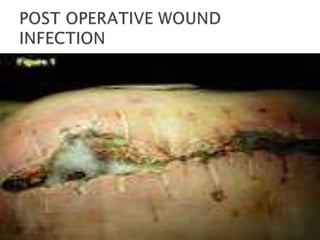
 Surgical or post operative sepsis.
 Nosocomial
 Staphylococcus aureus,Streptococcus
pyogenes, pneumococcus and coliform
bacilli.
 Anaerobic organisms involved in soiled deep
or lacerated wounds and devitalized tissues
present.
 Gas gangrene and tetanus
 Mixed infections
 Pathogenic synergy
 Ill, bed ridden patient
 Anaerobic conditions because of tissue
necrosis
 Most of these lesions are located near the
anus or on the lower extremities
 Infection with bowel flora
 Chronic infection
 Bacteremia
 B. fragilis, Clostridia sp, Enteric bacteria,
S. aureus and P. aeruginosa.
 CDC group EF-4
 Weeksella zoohelcum
 Pasteurella spp
 Staphylococcus intermedius
 Staphylococcus aureus
 Simonsiella
 Capnocytophaga canimorsus
 Pseudomonas sp
 Klebsiella sp
 Proteus sp
 E. coli
 Clostridia sp
 Aeromonas hydrophila
 Streptobacillus moniliformis
 Spirillum minus
AEROBES:
 α haemolytic streptococci
 S. aureus
 Streptococcus pyogenes
 Eikenella corrodens
ANAEROBES:
 Peptostreptococcus
 Prevotella oris
 Prevotella buccae
 Porphyromonas sp
 Fusobacterium nucleatum
 Bacteremia
 Significant mortality
 Interfere with the acceptance of skin grafts.
 4 types – Impetigo, Surgical infections, Cellulitis,
Systemic infections
 Factors that contribute to infection include loss
of skin barrier, coagulated proteins, loss of
vascularity, dehydration & immune response
 S. aureus, P.aeruginosa, Enterococci,
Enterobacter sp & E. coli.
 Candida, Aspergillus niger, Fusarium, Mucor
 Herpes simplex
 Chronic osteomyelitis
 S. aureus, Enterobacteriaceae, P. aeruginosa
 Anaerobic GNB & GPC
 Actinomycosis
 Actinomyces spp., Aggregatibacter
actinomycetemcomitans, P. propionicum,
Prevotella & Porphyromonas
 Tuberculosis, atypical mycobacteria, Nocardia
 Implanted foreign bodies
 Curettings or biopsy
 Problems in terms of collection
 Perirectal fistula in Crohn’s disease
 Bowel involvement only culture of specific key
organisms like mycobacteria or Actinomyces
are meaningful.
 Biopsy
AEROBES:
 S. aureus
 CONS
 Streptococcus pyogenes
 Streptococcus anginosus
 E. coli, klebsiella sp
 Enterococcus sp
 Proteus, Morganella & Providencia sp
 Pseudomonas sp
ANAEROBES :
 Clostridium spp
 Peptostreptococcus spp
 Bacteroides spp
 Prevotella
 Porphyromonas
 Fusobacterium
FUNGI :
 Candida spp
SPECIMENS :
 Wound swab
 Pus or exudate
 Fragments of excided tissue removed at
wound toilet or Curettings
 Biopsy
 Blood
Physician should be urged that when a
special investigation is required, they should
state this clearly on the request form.Thus
the routine investigation is usually confined
to a search for the common pyogenic
bacteria and anaerobic pathogens and does
not include an examination for
mycobacteria, actinomyces, nocardia,
diphtheria, anthrax or fungi
 Naked Eye Examination
 Microscopy
 Culture
 Gas Chromatography
 Staphylococci - thick creamy pus
 Strep. Pyogenes – straw colored & watery
 Proteus – fishy smell
 Pseudomonas – sweet,musty odour & a blue
pigment
 Anaerobes – offensive, putrid smell
 Actinomycosis – sulphur granules
 Mycetoma – black or brown granules
 Amoebic abscess – anchovy sauce
 Presence of relative numbers of polymorphs and
bacteria
 Morphology and arrangement
 Wet film – fungi or motile bacteria
- fluid aspirated from inflamed joint
resembling septic arthritis may show
uric acid crystals
- Dark ground microscopy
 Ziehl Neelsen or Fluorescent staining – AFB
 Immunofluorescent staining – Clostridia species
 Hematoxylin & Eosin – viral inclusions
 Blood agar – aerobic
- anaerobic
 MacConkey agar or CLED Agar
 Cooked Meat Broth
 PNPG Blood Agar
 Firm agar
 Special media
 Culture plates are examined after overnight
incubation at 37º C
 Relative number and type of colonies noted
 If there is no growth, the plates should be
reincubated for another 24 h.
 If A. Israeli or Bacteroides suspected, plates
incubated for 7 days
 If turbid, the broth should be subcultured
 Difficulty in culture of slow growing
anaerobes that are highly sensitive to oxygen.
 Their still invisible growth may be killed by
exposure to air during examination.
 Anaerobic cabinet
 Inoculated on two anaerobic plates
 Difficult in mixed cultures
 Scanty growth of CONS, diptheroids are not reported
 E.Coli from perineal wound etc are not reported.
 Physician informed in case of Clostidium perfringens.
 In chronic superficial lesions, the presence of mixed
commensal bacteria can be disregarded as
insignificant
 Pure growth of commensal type organism grown from
deep sites(eg.pleural fluid) should be reported with
sensitivities, unless the number of the organism is so
small as to indicate they are contaminants.
 Numerous or predominant organism is
pathogenic.
 Relative number of colonies may not reflect the
number of organism in lesion.
 Variations such as relative speed of growth of
different species under the cultural conditions
used, the presence of traces of antibacterial
drugs , and the greater tendency of delicate
pathogens to die during transport
 Colonies in subculture from broth bears no
relation to the number of organism in lesion.
 Discussion with the physician.
 Significance of isolates
 Predict the likelihood of burn wound sepsis
 Probability of wound healing
 Tissue weighed, homogenized, diluted serially,
and inoculated into multiple agar plates.
 S.pyogenes are clinically significant, no matter
what the quantity of bacteria present.
 >105 CFU/g is considered significant in burns
 Single biopsy of a wound will not give an
accurate picture of the microbial flora of chronic
wound
 Buchanan et al
 0.1(10-1) & 0.01(10-2 ) ml of sample in blood
agar in duplicate
 The number of CFUs per gram of tissue is
calculated using the formula:
Number of CFUs counted * Reciprocal of
volume of homogenate inoculated(10-1or 10-2 )
* volume of diluent used for tissue
homogenization /weight of tissue
Wound infections

Wound infections

  • 1.
  • 2.
     The accumulationof pus, either within an abscess or exuding from a sinus tract or from a mucocutaneous surface, is one of the cardinal indicators of local sepsis.  Redness, pain and swelling
  • 3.
     Liable tocontamination from body surface & environment  Contaminants relatively low numbers  Infection occurs if contaminants evades the host’s defence  Multiplication of commensal may be colonization  Virulence and resistance determines infection
  • 4.
     Exogenous WoundInfections  Endogenous Wound Infections
  • 5.
     Source ofinfection is outside the body of the patient.  Traumatic injury Decubitus pressure ulcers Animal or Human bites Burns Foreign bodies
  • 6.
     Caused byorganisms that have been leading a commensal existence elsewhere in the patient’s body.  Surgical or post operative sepsis.  Nosocomial
  • 8.
     Staphylococcus aureus,Streptococcus pyogenes,pneumococcus and coliform bacilli.  Anaerobic organisms involved in soiled deep or lacerated wounds and devitalized tissues present.  Gas gangrene and tetanus  Mixed infections  Pathogenic synergy
  • 10.
     Ill, bedridden patient  Anaerobic conditions because of tissue necrosis  Most of these lesions are located near the anus or on the lower extremities  Infection with bowel flora  Chronic infection  Bacteremia  B. fragilis, Clostridia sp, Enteric bacteria, S. aureus and P. aeruginosa.
  • 12.
     CDC groupEF-4  Weeksella zoohelcum  Pasteurella spp  Staphylococcus intermedius  Staphylococcus aureus  Simonsiella  Capnocytophaga canimorsus
  • 14.
     Pseudomonas sp Klebsiella sp  Proteus sp  E. coli  Clostridia sp  Aeromonas hydrophila
  • 15.
  • 17.
    AEROBES:  α haemolyticstreptococci  S. aureus  Streptococcus pyogenes  Eikenella corrodens
  • 18.
    ANAEROBES:  Peptostreptococcus  Prevotellaoris  Prevotella buccae  Porphyromonas sp  Fusobacterium nucleatum
  • 20.
     Bacteremia  Significantmortality  Interfere with the acceptance of skin grafts.  4 types – Impetigo, Surgical infections, Cellulitis, Systemic infections  Factors that contribute to infection include loss of skin barrier, coagulated proteins, loss of vascularity, dehydration & immune response  S. aureus, P.aeruginosa, Enterococci, Enterobacter sp & E. coli.  Candida, Aspergillus niger, Fusarium, Mucor  Herpes simplex
  • 22.
     Chronic osteomyelitis S. aureus, Enterobacteriaceae, P. aeruginosa  Anaerobic GNB & GPC  Actinomycosis  Actinomyces spp., Aggregatibacter actinomycetemcomitans, P. propionicum, Prevotella & Porphyromonas  Tuberculosis, atypical mycobacteria, Nocardia  Implanted foreign bodies  Curettings or biopsy
  • 24.
     Problems interms of collection  Perirectal fistula in Crohn’s disease  Bowel involvement only culture of specific key organisms like mycobacteria or Actinomyces are meaningful.  Biopsy
  • 26.
    AEROBES:  S. aureus CONS  Streptococcus pyogenes  Streptococcus anginosus  E. coli, klebsiella sp  Enterococcus sp  Proteus, Morganella & Providencia sp  Pseudomonas sp
  • 27.
    ANAEROBES :  Clostridiumspp  Peptostreptococcus spp  Bacteroides spp  Prevotella  Porphyromonas  Fusobacterium FUNGI :  Candida spp
  • 28.
    SPECIMENS :  Woundswab  Pus or exudate  Fragments of excided tissue removed at wound toilet or Curettings  Biopsy  Blood
  • 29.
    Physician should beurged that when a special investigation is required, they should state this clearly on the request form.Thus the routine investigation is usually confined to a search for the common pyogenic bacteria and anaerobic pathogens and does not include an examination for mycobacteria, actinomyces, nocardia, diphtheria, anthrax or fungi
  • 30.
     Naked EyeExamination  Microscopy  Culture  Gas Chromatography
  • 31.
     Staphylococci -thick creamy pus  Strep. Pyogenes – straw colored & watery  Proteus – fishy smell  Pseudomonas – sweet,musty odour & a blue pigment  Anaerobes – offensive, putrid smell  Actinomycosis – sulphur granules  Mycetoma – black or brown granules  Amoebic abscess – anchovy sauce
  • 32.
     Presence ofrelative numbers of polymorphs and bacteria  Morphology and arrangement  Wet film – fungi or motile bacteria - fluid aspirated from inflamed joint resembling septic arthritis may show uric acid crystals - Dark ground microscopy  Ziehl Neelsen or Fluorescent staining – AFB  Immunofluorescent staining – Clostridia species  Hematoxylin & Eosin – viral inclusions
  • 33.
     Blood agar– aerobic - anaerobic  MacConkey agar or CLED Agar  Cooked Meat Broth  PNPG Blood Agar  Firm agar  Special media
  • 34.
     Culture platesare examined after overnight incubation at 37º C  Relative number and type of colonies noted  If there is no growth, the plates should be reincubated for another 24 h.  If A. Israeli or Bacteroides suspected, plates incubated for 7 days  If turbid, the broth should be subcultured
  • 35.
     Difficulty inculture of slow growing anaerobes that are highly sensitive to oxygen.  Their still invisible growth may be killed by exposure to air during examination.  Anaerobic cabinet  Inoculated on two anaerobic plates
  • 36.
     Difficult inmixed cultures  Scanty growth of CONS, diptheroids are not reported  E.Coli from perineal wound etc are not reported.  Physician informed in case of Clostidium perfringens.  In chronic superficial lesions, the presence of mixed commensal bacteria can be disregarded as insignificant  Pure growth of commensal type organism grown from deep sites(eg.pleural fluid) should be reported with sensitivities, unless the number of the organism is so small as to indicate they are contaminants.
  • 37.
     Numerous orpredominant organism is pathogenic.  Relative number of colonies may not reflect the number of organism in lesion.  Variations such as relative speed of growth of different species under the cultural conditions used, the presence of traces of antibacterial drugs , and the greater tendency of delicate pathogens to die during transport  Colonies in subculture from broth bears no relation to the number of organism in lesion.  Discussion with the physician.
  • 38.
     Significance ofisolates  Predict the likelihood of burn wound sepsis  Probability of wound healing  Tissue weighed, homogenized, diluted serially, and inoculated into multiple agar plates.  S.pyogenes are clinically significant, no matter what the quantity of bacteria present.  >105 CFU/g is considered significant in burns  Single biopsy of a wound will not give an accurate picture of the microbial flora of chronic wound
  • 39.
     Buchanan etal  0.1(10-1) & 0.01(10-2 ) ml of sample in blood agar in duplicate  The number of CFUs per gram of tissue is calculated using the formula: Number of CFUs counted * Reciprocal of volume of homogenate inoculated(10-1or 10-2 ) * volume of diluent used for tissue homogenization /weight of tissue